One of the foundational principles of variationist sociolinguistics is that language change proceeds systematically (Weinreich, Labov, & Herzog, Reference Weinreich, Labov, Herzog, Lehmann and Malkiel1968). The combination of this systematicity with an understanding of the abstract structure of language is what allows us to infer processes of change from the examination of synchronic patterns of variation and to predict the path we would expect that change to follow. In this article, I apply this methodological precept to an investigation of a type of gender morphology variation in spoken Israeli Hebrew – variation that both scholarly and popular accounts have treated as a change-in-progress. I argue that while it is undeniable that there exists widespread gender neutralization across the language, the sociolinguistic conditioning of the neutralization that I consider is inconsistent with language change. Rather, I propose that a close examination of the linguistic and, to a certain extent, social factors that constrain the appearance of gender morphology in the relevant paradigm leads us to conclude that Hebrew no longer maintains gender distinctions in certain morphological contexts, and that the appearance there of gender-specific forms is instead the product of extralinguistic (and primarily political) pressures. My goal in making this claim is to demonstrate the importance of variationist perspectives for determining whether language change is taking place and, consequently, for developing a robust account of speakers' native grammars more generally.
I begin in the next section with an exposition of the phenomenon in question, including a brief discussion of its treatment in both the popular and scholarly literature on Hebrew. I then turn to the methods employed in the current study and provide details of the corpus investigated and the potential conditioning factors tested. The next two sections present the results of multivariate analyses of gender marking in the corpus, where findings are discussed in relation to predictions drawn from both sociolinguistic and typological theories of morphological change. The last section offers a brief summary and conclusion.
GENDER NEUTRALIZATION IN HEBREW
Morphological gender marking is a robust characteristic of Modern Hebrew (e.g., Glinert, Reference Glinert1994; Tobin, Reference Tobin, Hellinger and Bussman2001). Nearly every constituent type in the language, including nouns, adjectives, verbs, demonstratives, numerals, pronouns, clitics, prepositions, and quantifiers, is either always or very often explicitly marked as either masculine (zaxar) or feminine (nekeva). Gender is canonically understood to be an inherent and context-independent property of Hebrew nouns (both animate and inanimate), with all other word classes showing agreement with the gender of the relevant noun. Gender assignment is normally semantic for those nouns that designate animate beings (e.g., keves/kivsa ‘sheep/ewe’) and formal for nouns that designate inanimate entities (e.g., gad/gada ‘luck/riverbank’; see Ravid, Reference Ravid1995; Schwarzwald, Reference Schwarzwald1982, for further details).
In this article, I restrict my attention to gender marking in the context of human animate reference. I do so based on claims in the popular literature on Hebrew that for certain animate word classes distinct gender morphology is in the process of disappearing, resulting in leveling to syncretic forms (e.g., Gadish, Reference Gadish1998; Glinert, Reference Glinert1994; Shapira, Reference Shapira1991). This phenomenon is illustrated in the contrast between (1a) and (1b) (relevant morphology is underlined):

The sentence in (1a) is the prescriptively correct Hebrew version of the utterance “Ora and Liat want to eat and both of them are waiting downstairs.” In (1a), we see that the matrix verb of the first conjoined clause rotsot (‘want.fem.pl’) agrees in gender with the subject noun phrase Ora veLiat (‘Ora.fem and Liat.fem’); both elements of the complex quantifier šteihen (‘two.fem-them.fem’) in the subject position of the second conjoined clause also agree in gender with the first subject, as does the verb mexakot (‘waiting’) of this second clause. The sentence in (1b), on the other hand, represents what is anecdotally the more common realization of this utterance. There, we find that all three of these constituents (i.e., the verbs in both conjoined clauses and the subject of the second clause) appear with masculine morphology, though number agreement is preserved throughout.
Popular discussions of this phenomenon tend to see it as a product of language change, whereby the sentence in (1b) reflects the loss of a grammatical gender distinction that existed in the language's not-so-distant past (e.g., Gadish, Reference Gadish1998; Shapira, Reference Shapira1991). This position is succinctly summarized by the official Academy of the Hebrew Language, who states:
Since the end of the biblical period, masculine forms have been used to refer to women in the future and imperative tenses (in the Hebrew of today there is hardly any use of specifically feminine forms like toxalna [‘will eat.2nd.fem.pl’] or exolna [‘eat.imp.2nd.fem.pl’]). In current spoken usage, many speakers also do not insist on saying hen [‘they.fem’], aten [‘you.fem.pl’], katavten [‘wrote.2nd.fem.pl’], etc. … This seems to be the direction our language is going, and the Academy does not see its role as one of trying to force this change to stop (Academy of the Hebrew Language, n.d.; my translation).
In its statement, the academy establishes a parallel between a synchronic pattern of variation (the neutralization of gender distinctions in plural pronouns and second-person plural verb forms) and a well-documented change that took place in Biblical Hebrew 2000 years ago (see, e.g., Sáenz-Badillos, Reference Sáenz-Badillos1993). It goes on to describe the current pattern as the “direction [the] language is going,” thus explicitly categorizing the pattern as reflecting an ongoing process of change. Similarly, descriptive accounts of Modern Hebrew normally label the use of certain feminine morphological forms as either traditional or markedly formal (Glinert, Reference Glinert1989, Reference Glinert1994; Tobin, Reference Tobin, Hellinger and Bussman2001). Both of these descriptions imply that the current status of many feminine forms reflects the outcome of a recent change, based on an understanding of change as a process through which formerly widespread variants become stylistically restricted (Preston, Reference Preston1991). In other words, by labeling the forms in this way descriptive accounts contribute to the perception of gender neutralization as a product of language change.
Scholarly work on Hebrew has tended to adopt an analogous perspective, though it has focused for the most part on gender morphology in cases of inanimate reference (so-called grammatical gender). Ravid (Reference Ravid1995) and Meir (Reference Meir2008), for example, both attempted to experimentally assess whether gender distinctions exist in the grammars of native Hebrew speakers for the free (i.e., indefinite) and bound (i.e., definite) forms of Hebrew cardinal numerals. Ravid focused exclusively on native-speaking children, and investigated the effects on their production of age (comparing an older group of 12- to 13-year-olds to a younger group of 9- 10-year-olds) and attention (comparing an “unmonitored” task, in which speaker attention is not drawn to the production of prescriptively correct gendered numeral forms, with a “monitored” task, in which it is). What Ravid found was that while none of her subjects were particularly good at producing the prescriptively correct gendered forms of Hebrew free numerals, the older children were significantly better at doing so than the younger children were, but only in the monitored task. In other words, the only situation in which Ravid's subjects' production was significantly better than chance was when the older children were instructed to speak “correct Hebrew.” Ravid took this finding to indicate that prescriptive gender distinctions do not exist in the grammars of younger Hebrew speakers and are instead only learned beginning in pre-adolescence via a combination of rote instruction and increased levels of literacy. Building on Ravid's work, Meir (Reference Meir2008) examined gender marking on Hebrew bound numerals across children and adults of varying ages (ranging from 14 to 65 years). Using an unmonitored production task, Meir, like Ravid, found that her subjects were not consistent producers of prescriptively correct gendered forms. Moreover, Meir found no evidence for an effect of rote instruction on a speaker's ability to produce the prescriptively correct form. In fact, the only significant effect that Meir identified is an increased level of prescriptive accuracy in speakers over the age of 35. Meir ascribed this effect to the fact that these speakers were raised at a time when literary varieties of Hebrew more rigorously enforced normative grammar than they do today.
Together, Meir (Reference Meir2008) and Ravid (Reference Ravid1995) clearly demonstrated that, at least for inanimate numerals, the gender marking systems of native Hebrew speakers differ sharply from the one prescribed by the language's normative grammar. In their discussions of this, both scholars argued that this difference can be taken as evidence of ongoing language change. In both of these cases, however, I suggest that an alternative interpretation is possible. It is equally plausible to suggest that the grammar of Modern Hebrew lacks gender distinctions in the relevant morphological contexts altogether, and that the occasional appearance there of gender-specific forms is due entirely to extralinguistic pressure. This interpretation would still allow us to account for the patterns identified: For Ravid's data, we would simply maintain her proposal that prescriptive rules are learned beginning in pre adolescence, while for Meir's data we would claim (as Meir herself does) that these rules were much more stringently enforced 30 years ago than they are today. What this means is that the characterization of the situation that Ravid and Meir provided does not appear to be grounded in empirical necessity. Rather, I would argue that it seems to reflect an a priori presumption that language change is taking place—the same presumption that we first saw evidenced in the popular and descriptive literature mentioned above.
This presumption is, to my mind, due to the fact that all of the accounts of gender neutralization described here equate change with deviation from a normative standard. Yet we know that normative grammars are not necessarily accurate reflections of a language as it is known and used by speakers, be it now or in the recent past. Deviation from the prescribed norm can therefore not be taken as sufficient evidence for a change-in-progress (see Poplack & Dion, Reference Poplack and Dion2009). The only way to get compelling evidence of change is to engage in a close examination either of real-time data of language use at different periods or of apparent-time data such as is typically gathered in sociolinguistic studies. Next, I set out to do the latter for synchronic patterns of variation in gender morphology in Hebrew animate reference.
EMPIRICAL DESIGN
My analysis of gender neutralization in spoken Hebrew aims to resolve two research questions:
1. What are the social and linguistic factors that constrain variation in gender marking of animate referents in spoken Hebrew?
2. Is the patterning of these constraints consistent with a process of leveling to gender neutralized forms across speakers and/or constituent types?
Because of the particular focus of the current discussion, I adopt a methodological framework that is different in several important ways from those used in previous studies of gender in Hebrew. First, I restrict my attention to a consideration of human animate reference (or “natural gender”) and disregard cases of grammatical gender. I do so both because popular discussions of gender loss tend to focus on natural gender and because of the relative lack of prior research on the topic. I nevertheless concede that the exclusion of grammatical gender from the analysis necessarily limits the generalizability of my findings to instances of natural gender only. Second, while much previous research on gender in Hebrew has examined alternations within a single paradigm or word class (e.g., numerals), I adopt a language-wide perspective and investigate gender morphology variation across a range of grammatical categories. I do this because I am motivated by a desire to apply theories of morphological change derived from the literature on language typology (e.g., Corbett, Reference Corbett1991; Greenberg, Reference Greenberg1963) to the task at hand. These theories, which consider gender marking within a language system as a whole, are useful because they make specific predictions about the behavior of certain system-internal constraints, such as word class and number. By evaluating these predictions against observed patterns of variation, I hope to provide a more robust analysis of potential morphological change than would be possible by considering traditional sociolinguistic factors alone. Finally, and related to this, my arguments regarding the behavior of Hebrew gender morphology are grounded in a distributional analysis of naturally occurring forms. What this means is that there is at times insufficient data to allow for the consideration of all word classes separately. While I discuss independent constituent types wherever possible, overall I prioritize a systemic approach to the topic by combining individual paradigms where necessary.
The Corpus
Data for the analyses are taken from 50 hours of naturally occurring spoken Hebrew. Speech was obtained via recorded individual interviews conducted with 36 native Hebrew-speaking Israelis who were all participants in a larger sociolinguistic investigation of language, gender, and politics in Israel (Levon, Reference Levon2010). While many of the informants also speak other languages, all acquired Hebrew as their first language and use it as their dominant language of communication. Recordings took place about halfway through a period of 12 months of participant observation; I was therefore well acquainted with all informants at the time of interview. Standard procedures for sociolinguistic interviews were followed (e.g., Labov, Reference Labov, Baugh and Sherzer1984), and all interviews included talk on topics such as childhood and other life stages, education, military service, work, recreation, politics, and language. Interviews lasted 75–100 minutes each and were conducted entirely in Hebrew.
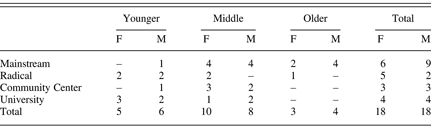
The interview sample (see Table 1) was balanced for speaker sex (18 women; 18 men). In addition, all informants had either already completed or were completing a post secondary degree, and all could be classified as in the middle-/upper-middle class. As Meir (Reference Meir2008:53) noted, the consideration of educated, middle-class speakers helps to ensure that any patterns of gender neutralization observed are not attributable to lack of exposure to prescriptive norms or to literary varieties of the language. In terms of age, informants ranged from 21–60 years old. In the analyses, I consider age alternatively as a continuous and a categorical variable. In the latter case, I divide the informant population into three categories: younger, which includes speakers between 21–29 years (5 women and 6 men; mean age: 23.5); middle, which includes speakers between 30–39 years (10 women and 8 men; mean age: 32.5); and older, which includes speakers between 40–60 years (3 women and 4 men; mean age: 49.4). Finally, each of the informants belonged to one of four Israeli political activist groups: Mainstream (6 women, 8 men); Community Center (3 women, 3 men); University (4 women, 4 men); and Radical (5 women, 2 men). While not the focus of the current discussion, these groups represent the informants' respective social networks, and, as I have argued elsewhere (e.g., Levon, Reference Levon2009), serve as reliable predictors of variation in linguistic practice.Footnote 1
Distribution of speakers in the sample by external factors groups and levels
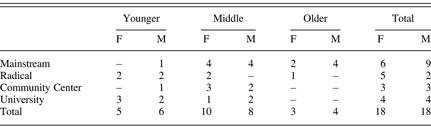
You will notice in Table 1 that the distribution of subjects is somewhat skewed across the age and activist group factors, such that younger speakers are concentrated primarily in the Radical and University groups while the Mainstream group is composed primarily of middle and older speakers. Diagnostic tests indicate that this distributional skew does not surpass the threshold of high multicollinearity (Variance Inflation Factor scores are all ≤3), and so in principle should not have a detrimental effect on the validity of quantitative results (see, e.g., Gahl, Reference Gahl2008; Gorman, Reference Gorman2009). I nevertheless return to the issue of this apparent interaction between external factors groups.
Coding
From the corpus of informants' speech, I extracted 4636 tokens of specific human female reference (i.e., reference to particular women or groups of women).Footnote 2 I excluded so-called generic you tokens even when the reference was necessarily female (e.g., One day you realize you're a mother; Sa'ar, Reference Sa'ar2007). My reason for excluding cases such as these is twofold. First, from a prescriptive point of view, generics are invariably masculine in Hebrew. It is therefore theoretically unclear whether the appearance of masculine morphology in generic sentences is an instance of gender marking per se or is instead related to the morphological encoding of some notion of abstract indefiniteness (cf. Gastil, Reference Gastil1990; Merritt & Kok, Reference Merritt and Kok1995). Second, and more importantly, this prescriptive norm is largely replicated in vernacular language use. Only a very small minority of spoken generic you sentences appear with feminine morphology, and those normally only when a speaker is taking an explicitly anti sexist stance. The use of feminine forms in these instances is thus clearly a case of the introduction of a novel form into the system for avowedly political reasons. While an interesting phenomenon in itself (see, e.g., Livnat, Reference Livnat, Thüne, Leonardi and Bazzanella2006; Sa'ar, Reference Sa'ar2007), it is qualitatively distinct from the patterns of gender neutralization that are my focus here.
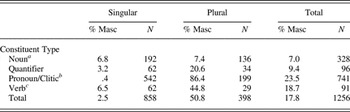
From the total figure of 4636 tokens, I went on to exclude a further 2127 tokens. These excluded tokens were all instances of self-reference (i.e., when women spoke about themselves), and their inclusion would have been problematic for two reasons. The first is a common-sense intuition that there is a qualitative difference between referring to one's self and referring to someone else (see also Kaplan, Reference Kaplan, Almog, Perry and Wettstein1989; Lewis, Reference Lewis1979), a difference that may have an impact on the gender marking observed. The second reason that the inclusion of self-referential tokens is a problem has to do with the fact that all such tokens in the corpus occurred in contexts where they “agreed” with the Hebrew first-person pronouns ani ‘I’ or anaxnu ‘we’. I use the term agree here tentatively since these pronouns are epicene forms in Hebrew, i.e., the same pronoun is used whether the speaker is a woman or a man. What this means is that determining what gender (if any) these pronouns bring to the syntax is to a large extent a function of an analyst's theoretical preferences and not something that can be read directly off of surface forms (Corbett, Reference Corbett1991:128–129). From a variationist perspective, this is problematic since it precludes an objective classification of “agreeing” tokens according to the syntactic contexts in which they occur–a central component of my analysis. For both of these reasons, then, I exclude self-referential tokens from my discussion and instead concentrate on instances in which both women and men spoke about other women (i.e., third-person reference only). The overall distribution of the corpus to be analyzed is presented in Table 2.
Overall distribution of gender marking in cases of specific human female reference, (self-referential tokens excluded)

For the purposes of analysis, I split these remaining 2509 tokens into two types: what I call independent tokens and dependent tokens. This division of tokens by type reflects the fact that while all tokens represent situations in which variation in gender morphology is possible, the factors that could potentially constrain that variation are not consistent throughout. To illustrate what I mean, consider the sentences in (2):
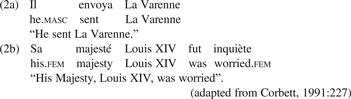
Sentences (2a) and (2b) both refer to the same individual: King Louis XIV of France. In (2a), reference to Louis XIV is accomplished via the use of the deictic subject pronoun il (‘he’), whereas in (2b) we find instead the honorific phrase sa majesté (‘his majesty’). That the deictic pronoun used in (2a) is masculine is an example of what Corbett, (Reference Corbett1991:225) labeled semantic agreement, or the appearance of gender morphology on a constituent that is consistent with the gender of its semantic referent – in this case, a masculine pronoun used to refer to a masculine referent. In (2b), on the other hand, we find that the predicate adjective meaning worried appears in the feminine form (inquiète), even though the “worrier” (Louis XIV) is himself masculine. Here, gender agreement is syntactic in nature, where the appearance of feminine morphology on the adjective meaning worried is a product of the fact that this adjective is syntactically “controlled” by (i.e., stands in a potential agreement relation with) the grammatically feminine noun phrase sa majesté.Footnote 3
Crucially for our purposes, variation is possible in both (2a) and (2b). The difference between the two lies in the availability of syntactic agreement as a mechanism for gender assignment. In (2a), there is no syntactic controller for the subject pronoun. Gender marking is thus either a product of semantic agreement with the referent or reflects default gender morphology in the language, where the choice between these options is grounded in certain pragmatic and/or functional considerations (Corbett, Reference Corbett1991:241–244; Cornish, Reference Cornish1986, Reference Cornish2008). Tokens like these are what I call independent tokens. For the adjective in (2b), in contrast, default, semantic, and syntactic agreement are all viable options since a syntactic controller is present. Analyses of these types of tokens, which I call dependent, therefore require examining additional potential conditioning factors, including the gender of the syntactic controller, the grammatical function of the target token, and the structural relationship between controller and target (Corbett, Reference Corbett1991:236–241).Footnote 4
Because of these differences in the sets of potential predictors to be considered, I treat independent and dependent tokens separately in the analyses. For each type, tokens were coded for whether they displayed feminine or masculine gender morphology, as well as for a range of social and linguistic factors. Quantitative analyses of the tokens were then conducted using mixed-effects logistic regressions in Rbrul (see Johnson, Reference Johnson2008). Details of these analyses and their results are presented in the following section.
FINDINGS
Independent Tokens
Multivariate analyses of the independent tokens examine the effect, if any, of two internal and three external factor groups on the appearance of masculine gender morphology in instances of specific human female reference.Footnote 5 The internal factors considered are: constituent type (pronoun/clitic, quantifier, noun, verb) and number (singular, plural).Footnote 6 These are the factors that the typological literature on morphological change (e.g., Corbett, Reference Corbett1991) shows to be the most likely to constrain variation in gender morphology. I therefore choose to investigate them here, while acknowledging that they are not necessarily exhaustive. The different constituent types are exemplified in (3–6), while the baseline distribution of tokens across the two internal factors groups is presented in Table 3.

Observed variability of “independent” tokens of specific female human reference

aNouns only include those words that have distinct masculine and feminine forms (e.g., occupation names, nationality nouns, the lemma friend(s)) and exclude nonvariable forms (e.g., ima ‘mother’, iša ‘woman’).
bPronouns/clitics include singular and plural third-person personal pronouns, singular demonstrative pronouns, and singular and plural third-person clitics (both prepositional and possessive). Plural first-person pronouns and plural demonstratives are excluded since they do not vary for gender.
cVerbs include singular and plural present tense forms; third-person singular past tense forms; and third-person singular future tense forms. Plural first- and third-person past and future tense forms are excluded since they do not vary for gender.
In addition to internal factors, I consider three external factors: sex, age, and group membership. Sex is included because of its predicted interaction with language change (e.g., Labov, Reference Labov2001:266–293) and because of the possibility that the women and the men differ in their broader political commitments in a way that could impact their use of gender-neutralized forms. My consideration of age reflects standard assumptions regarding the identification of patterns of language change in apparent time (Bailey, Reference Bailey, Chambers, Trudgill and Schilling-Estes2002; Labov, Reference Labov1994:43–72). Separate analyses were run with age as a continuous and a categorical predictor, respectively, so as to ensure that any age-related findings were not an artifact of the coding scheme. When considered categorically, age was divided into three factors (younger, middle, and older) as described. Finally, I examine group membership based on my arguments elsewhere (Levon, Reference Levon2009, Reference Levon2010) that in the population from which the current sample is drawn group affiliation serves as a significant correlate of sociolinguistic practice.
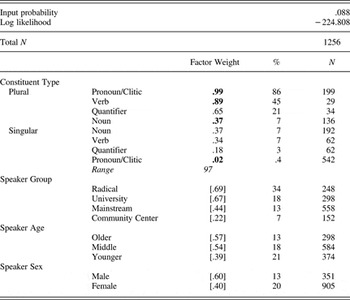
The results of the analysis of the independent tokens are presented in Table 4. There, we find that the only significant predictor to result from the analysis is an interaction between the two internal factor groups, number and constituent type.Footnote 7 We see that, for the most part, plural tokens favor masculine forms and singular tokens disfavor them. When we look within the factor groups, however, we find further significant subdivisions. For the plurals, pronouns/clitics very strongly favor masculine forms, with an almost categorical factor weight of .99. While plural verbs and quantifiers are also shown to favor masculine forms, they do so to a significantly lesser extent than the pronouns/clitics (with factor weights of .88 and .65, respectively, though note that the difference between these factors is not statistically significant). The only plural constituents shown to significantly disfavor masculine forms are nouns, with a factor weight of .37. Interestingly, among the singular tokens we find a mirror image pattern. In this case, pronouns and clitics very strongly disfavor masculine forms (with a factor weight of .02) while nouns, verbs and quantifiers more weakly disfavor them (with factor weights of .37, .34 and .18, respectively). What emerges then from the analysis in Table 4 is that the effect of constituent type is almost entirely restricted to pronouns/clitics. With the possible exception of nouns, the other constituent types pattern in a way that is wholly accounted for by the number effect, with plural tokens favoring masculine forms and singular tokens disfavoring them. The only reason constituent type as a factor group plays a role at all is because of the widely divergent behavior of plural versus singular pronouns/clitics.Footnote 8
Multivariate analysis of masculine morphology – “Independent” tokens of specific human female reference

Figures in bold type represent a significant contrast within factor groups. Square brackets enclose factor weights for groups not selected as significant. Factor weights above .5 favor masculine forms whereas factor weights below .5 disfavor them. Best model: Speaker (random) + Constituent Type × Number (<.001).
That plural tokens favor so-called leveled masculine forms while singular tokens instead favor the maintenance of a gender distinction is not surprising. This is a typologically very common pattern that itself reflects what Greenberg (Reference Greenberg1963) argued is a universal of language: “a language never has more gender categories in nonsingular numbers than in the singular” (Universal 37). For our purposes, this universal means that if a language is going to lose a gender distinction, we would expect that loss to begin in the nonsingular numbers before spreading to other paradigms. What is surprising about the results, however, is that among the plural tokens it is the pronouns/clitics that lead the purported change. Eighty-six percent of plural pronouns/clitics are realized with masculine morphology, while only 45 percent of verbs, 21 percent of quantifiers, and 7 percent of nouns are. This finding is unexpected from a typological perspective since much previous research has shown that changes in gender paradigms normally begin in “content” words (e.g., nouns) before proceeding to quantifiers and then pronouns (see, for example, Marchese, Reference Marchese, Barlow and Ferguson1988; Priestly, Reference Priestly1983). Corbett (Reference Corbett1991) provided a functional account for this pattern, arguing that pronouns are the least referentially specified constituent type; they are essentially just bundles of person, number, and gender features. Neutralization of gender marking could thus seriously compromise pronouns' referential potential, making it more difficult for them to fulfill their deictic function. Both typologically and functionally then the extensive use in the sample of gender neutralized plural pronouns/clitics runs counter to theoretical predictions for morphological change.
In contrast, when we examine the behavior of the singular tokens we find that they pattern as we would expect. Singular nouns, verbs, and quantifiers are not often realized with masculine morphology (7 percent for both nouns and verbs, 3 percent for quantifiers). Singular pronouns/clitics, however, lag far behind even these relatively low frequencies, with only 2 out of 542 tokens (.4 percent) showing masculine morphology. This is precisely the pattern we would predict, with neutralization more common for “content” words while pronominal elements maintain maximal referential information for the purposes of deixis. Based on these results, we seem to have evidence for what is essentially a split system for independent tokens in Hebrew: Singular tokens behave as predicted whereas plural tokens behave unexpectedly.
It should also be noted that the lack of any significant external effects in the analysis is likewise unexpected. If a change-in-progress with respect to gender marking were indeed taking place, we might have expected to find a significant age effect. Yet, while there is an increase in the frequency with which speakers use masculine forms for female reference across age groups (from 13 percent in the older group to 21 percent in the younger), this difference does not achieve statistical significance.Footnote 9 Similarly, we might also anticipate evidence of a sex effect in light of the substantial body of prior research that has found that women and men often differ in the extent to which they participate in ongoing processes of change. However, once again we find no significant difference as a function of speaker sex, even if the women's use of masculine forms is more frequent than the men's (19 percent versus 13 percent). We must bear in mind, however, that subjects are not evenly distributed across all of the external factor groups (see above). What this means is that it is difficult to determine whether the lack of any significant age or sex effects represents a more general finding for Hebrew or is instead a product of the constitution of this particular speaker sample. Thus while the nonsignificance of external factors in the analysis is suggestive, it cannot be taken as strong evidence on its own.
Before moving on, it is important to note that I tested the quantitative validity of the findings in Table 4 in multiple ways. To ensure, for example, that the presence in the model of pronouns/clitics was not obscuring other meaningful variable patterns, I ran analyses with those tokens removed. When I did so, number was the only internal factor group shown to have an effect (with plurals favoring masculine forms and singulars disfavoring them), and no external factors groups were selected as significant. In addition, I also ran separate analyses on plural pronouns/clitics alone, singular and plural quantifiers alone, and singular and plural verbs alone. In none of those cases were any fixed effects other than number (where it was examined) selected as having a significant effect on the appearance of masculine morphology. Finally, to test whether the non-significance of external factors was simply a result of including both internal and external factors in the same quantitative model, I ran analyses that included only external predictors. Here too, no fixed effects were selected as having a significant impact on the realization of the dependent variable.
To summarize the findings thus far, we have seen that among what I term independent tokens of specific human female reference there is variation in gender marking between feminine-specific forms and (default) masculine ones. The only significant factor shown to have an impact on this variation is the interaction of number and constituent type. The details of this interaction indicate that while singular tokens pattern as we would expect based on both typological and functional accounts of morphological change, plural tokens do not. In addition, variation is not affected by any of the external factors considered (sex, age, or group membership), even when only external factors are included in the quantitative model or when various constituent types are considered on their own. While I am unable to make any definitive claims based on the nonsignificance of the external factors alone, I argue that the observed behavior of the internal and external factors together serves to cast initial doubt on an understanding of this variation as a change-in-progress.
Dependent Tokens
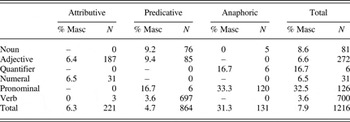
Unlike their independent counterparts (where only default or semantic agreement are possible), dependent tokens are able to receive gender marking via syntactic agreement. Analyzing these tokens therefore requires a more complex multivariate model in which characteristics of the target/controller relationship are considered. To that end, analyses of the dependent tokens examine five internal factor groups. Number (singular, plural) is considered as before. The remaining four internal factor groups all represent different aspects of the target/controller relationship (see Corbett, Reference Corbett1991:236–241). The first is token function, i.e., whether the target token is predicated on the controller (predicative), describes an attribute of the controller (attributive), or is a coreferent of the controller (anaphoric).Footnote 10 While in many ways similar to constituent type, research has argued that token function plays a greater role in determining agreement morphology in dependent contexts (Corbett, Reference Corbett1983, Reference Corbett1991; see Table 5 for the distribution of dependent tokens across both the token function and constituent type categories). Second, I examine the grammatical gender of the controller itself (feminine, masculine) in order to assess whether this has a distributional effect on the agreement morphology observed. A consideration of the grammatical gender of the controller is a central component of investigating the extent to which the observed frequencies of syntactic versus semantic agreement conform to typological predictions, as will become clear. Third, the relative distribution of targets is investigated by coding each token for whether it is the only target controlled in a particular clause (single target), or, if there are multiple targets, whether it is adjacent to the controller (adjacent) or not (non-adjacent). I include this factor group based on prior work that has claimed that the number and distribution of targets in a clause has an impact on the types of agreement morphology observed (see Corbett, Reference Corbett2006, for a review).Footnote 11 Finally, the linear position of the target is also considered (precontroller, postcontroller) based on robust typological evidence that semantic agreement is much more likely on targets that appear after their controllers (for a specific discussion of this pattern in Hebrew, see Borer, Reference Borer2005). The internal factor groups are illustrated in (7–10), where target morphology is underlined and controllers are capitalized. External factors remain the same (sex, age, group), and speaker is again included as a random effect.

Observed variability of “dependent” token by function and constituent type

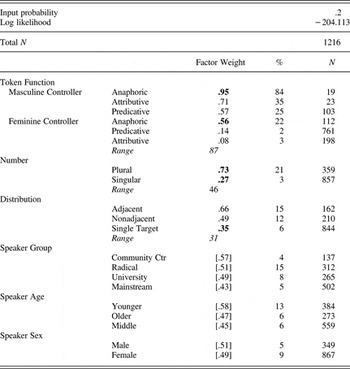
The results of the analysis of the dependent tokens are presented in Table 6. I begin by noting that, like for independent tokens, none of the external factor groups considered are selected as having a significant effect on the appearance of masculine morphology for dependent tokens. Also as before, these non-significant findings are replicated when only external factors are included in the model and when tokens from each of the function categories (i.e., attributive, predicative, and anaphoric) are analyzed on their own. This result notwithstanding, recall that it is difficult to extrapolate a more general claim regarding external factors due to the particular distribution of speakers in the sample. I therefore take this finding as suggestive, but one that would require further verification.
Multivariate analysis of masculine morphology – “Dependent” tokens of specific human female reference

As before, figures in bold type represent a significant contrast within factor groups. Square brackets enclose factor weights for groups not selected as significant. Factor weights above .5 favor masculine forms whereas factor weights below .5 disfavor them. Best model: Speaker (random) + Controller Gender*Function (<.001) + Number (<.001) + Distribution (.003).
In terms of internal factors, four of the five constraints considered are selected as significant. Two of these (number and distribution) are relatively straightforward and pattern according to predictions. For number, we find the same pattern as for the independent tokens, with plurals favoring masculine morphology overall and singulars disfavoring it. This pattern is in keeping with typological universals of morphological variation and change. As far as token distribution is concerned, we see that single targets disfavor masculine morphology (factor weight: .35) whereas tokens that are one of multiple targets in a clause are either relatively neutral or slightly favor masculine forms (for adjacent tokens, factor weight: .66; for nonadjacent tokens, factor weight: .49; note however that Bonferroni-corrected pairwise comparisons show there to be no significant difference between these).Footnote 12
The two remaining internal factor groups (token function and controller gender) together interact to significantly influence the appearance of masculine morphology.Footnote 13 For masculine-controlled targets (i.e., tokens whose syntactic controller is grammatically masculine), all tokens favor masculine forms. This overall pattern becomes more complex, however, when we look within the sub-category. There, we find that masculine-controlled anaphors very strongly favor masculine morphology (factor weight: .95) while masculine-controlled attributives and predicatives do so to a significantly lesser extent (with factor weights of .71 and .57, respectively, though this difference is not statistically significant). The feminine-controlled tokens, on the other hand, present an even wider distributional range. While feminine-controlled anaphors are neutral/weakly favor masculine forms (with a factor weight of .56), feminine-controlled predicatives and attributives very strongly disfavor them (factor weights of .14 and .08, respectively).
An interaction between controller gender and token function is a common predictor of gender morphology variation cross-linguistically. Typologically very robust, this interaction represents what Corbett (Reference Corbett1991:226) argued is a morphological universal of sorts, which he formalized in terms of an Agreement Hierarchy as in (11):
(11) The Agreement Hierarchy
attributive < predicate < relative pronoun < personal pronoun
As we move rightward along the hierarchy, the likelihood of semantic agreement will increase monotonically.
What this hierarchy means is that in situations of gender mismatch – that is, situations in which the gender of the syntactic controller is not the same as the gender of the semantic referent – the frequency of gender agreement with the referent should be highest for personal pronouns, lowest for attributive constituents, and somewhere in between for predicates and relative pronouns. In other words, the function of a target token in a clause conditions the extent to which that token will agree in gender with its syntactic controller.
When we re-examine the results in Table 6 in light of Corbett's Agreement Hierarchy, we find that they do not conform to the predicted pattern. For masculine-controlled tokens, the appearance of masculine morphology is an indication of what Corbett calls syntactic agreement (i.e., agreement with the controller rather than with the feminine referent). The Agreement Hierarchy would predict that attributives would be the most likely to show agreement in formal grammatical features as opposed to semantic content, followed by predicatives and then anaphors.Footnote 14 Instead, we find the opposite pattern: anaphors very strongly favor syntactic agreement while attributives and predicatives do so to a significantly lesser extent. This observed pattern can be represented schematically as in (12):
(12) Observed pattern of semantic agreement for masculine-controlled tokens
anaphoric < attributive, predicative
For feminine-controlled tokens, it is unclear to what extent the Agreement Hierarchy applies. According to Corbett, the hierarchy pertains to situations of gender mismatch. Yet when the syntactic controller is feminine, gender mismatch is not an issue: Both syntactic and semantic agreement would result in feminine morphology on the target token. It may be possible, however, to reinterpret the Agreement Hierarchy to refer to instances of “nondefault” agreement—that is, the likelihood that gender-specific agreement will appear on a constituent. If we accept for a moment this proposed reinterpretation, we see that, once again, the data considered here do not conform to the predicted pattern. Rather than finding that anaphors are the least likely to show default morphology, the results indicate that feminine-controlled anaphors favor masculine forms to a much greater extent than either attributives or predicatives, which both strongly disfavor them. In other words, the behavior of the feminine-controlled tokens contradicts the expectations of the adapted hierarchy.
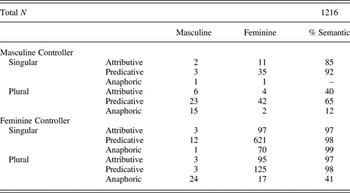
For both masculine- and feminine-controlled tokens then, the findings in Table 6 are inconsistent with the Agreement Hierarchy (or, in the latter case, with my adaptation of it). In both instances, anaphors are behaving unexpectedly by favoring the appearance of masculine morphology. You will recall from the discussion of the independent tokens that there we also found anaphoric tokens (i.e., pronouns/clitics) behaving in ways not predicted by theory, and in that case we were able to locate the origin of that unexpected behavior in the plurals. It would therefore be instructive to examine the current effect (function by controller gender) across numbers in an effort to determine whether here too number plays a significant role. Unfortunately, there are too few tokens to run a full analysis of the three-way interaction of function, controller gender, and number. A consideration of the raw frequencies (see Table 7) is nevertheless suggestive of a meaningful pattern.
Frequencies of masculine and feminine morphology – “Dependent” tokens of specific human female reference by controller gender, token function and number

In Table 7, there is preliminary evidence to suggest that the dependent tokens, like the independent tokens, are also part of a “split system” with respect to gender morphology. Beginning with the masculine-controlled tokens, we see that singular attributives show semantic agreement 85 percent of the time, while singular predicatives show semantic agreement 92 percent of the time. This is the monotonic increase in frequency of semantic agreement between attributives and predicatives that the Agreement Hierarchy predicts. Unfortunately, there are only two singular anaphoric tokens, making it impossible to come to any conclusions about how anaphors are patterning. When we turn to masculine-controlled plurals, we once again find the expected rise in frequency between attributives (40 percent semantic agreement) and predicatives (65 percent semantic agreement). Here, however, plural anaphors show only 12 percent semantic agreement, less than either attributives or predicatives. The behavior of the plural anaphors thus clearly contradicts the predictions of the Agreement Hierarchy.
For feminine-controlled tokens we find a similar pattern, though again this finding is in relation to an adapted version of the hierarchy. In Table 7, we see that singular attributives show nondefault (i.e., feminine) agreement 97 percent of the time, singular predicatives 98 percent of the time, and singular anaphors 99 percent of the time. If we accept that Corbett's hierarchy can be interpreted as applying to instances of default versus nondefault agreement, then we have perfect compliance with predictions among the singular feminine-controlled tokens. For the plurals, though, anaphors once again disrupt the pattern. Plural attributives and predicatives show nondefault agreement 97 and 98 percent of the time, respectively. Plural anaphors, however, show nondefault agreement only 41 percent of the time.
To summarize, the constraint shown to have the strongest impact on the realization of gender marking in dependent contexts is the interaction of controller gender and token function. While the interaction of these two factors groups is theoretically predicted, the details of how that interaction is borne out in the current data set are not. For both masculine- and feminine-controlled tokens, we would expect anaphors to show the highest frequency of feminine morphology. In both cases, however, anaphors favor masculine forms. When we further break down the sample by number, we find preliminary support for the idea that the unexpected behavior is restricted to anaphoric plurals. While singulars pattern as we would expect, plural anaphors show a much higher rate of masculine morphology than anticipated.
Taking the results of the analyses of the dependent and independent tokens together, the principal finding that emerges is the consistently unexpected behavior of plural pronouns/clitics. In independent contexts, singular tokens and plural quantifiers, nouns and verbs pattern as predicted by previous research on morphological variation and change. Similarly, in dependent contexts, singular tokens and plural attributives and predicatives act in accordance with the predictions of the Agreement Hierarchy (or, for feminine-controlled tokens, my reinterpretation of it). In both instances, however, plural pronominal elements stand out for the higher-than-expected rate at which they appear with masculine morphology.
MORPHOLOGICAL VARIATION AND PRESCRIPTIVE GRAMMAR
I argue that this finding, coupled with the consistent nonsignificance of any external effects, seriously compromises our ability to treat gender neutralization in Hebrew animate reference as reflecting a process of language change, especially as far as plural pronominals are concerned. Rather, I propose a two-pronged account for the patterns observed. First, I suggest that there exists a regular pattern of gender morphology variation in the relevant Hebrew contexts that is disrupted by plural pronominals. By a “regular” pattern of variation, I mean a stable and systematic alternation between masculine and feminine forms in cases of animate reference that is governed primarily by functional and/or syntactic considerations and is not necessarily indicative of a process of change. That this regular alternation is being “disrupted” by plural pronominals is, to my mind, a function of the second part of my argument: that plural pronominal elements in Modern Hebrew are already neutralized with respect to gender, and that the occasional appearance of feminine plural pronouns/clitics is the product of external prescriptive pressure to use these forms. In other words, I contend that the Modern Hebrew pronominal system is already convergent with respect to gender in plurals and that it is the imposition of a prescriptive norm that gives rise to a superficial appearance of a change-in-progress.
To the extent that we take the corpus examined here to be a representative sample of spoken Hebrew, understanding the patterns of gender neutralization observed as indicative of stable variation as opposed to change would make the lack of external effects uncontroversial. Under this analysis, age is not selected as a significant factor because there is no apparent time phenomenon to be captured. Likewise, sex and group membership are not selected as significant since they do not constrain the pattern of variation examined. Instead, the primary predictors of this variation are internal constraints. For independent tokens, these include number and constituent type while for dependent tokens they include number, distribution, token function, and controller gender. Crucially, when we remove plural pronouns/clitics from the quantitative model, all remaining tokens pattern as would be predicted by cross-linguistic analyses of these language-internal factors. Put another way, the patterns of gender morphology variation observed replicate the findings of previous research for all constituent types save plural pronominals.
This first part of my proposal would allow us to account for the lack of external effects in the data. It does not, however, provide a principled explanation for the unexpected behavior of plural pronouns/clitics. In order to account for this finding, I propose that Hebrew plural pronominals have already undergone morphological change and are thus already fully neutralized with respect to gender. What this means is that regular allomorphic variation is impossible for plural pronouns/clitics since only one gender-neutralized allomorph exists in the grammar. By historical accident or otherwise, this allomorph is the historically masculine form. The upshot of this argument is that the higher-than-expected rate of masculine plural pronominals observed falls straightforwardly out of Hebrew's lexico-grammatical inventory. Under this scenario, what requires explanation instead is the approximately 18 percent of plural pronominals that appear in the feminine form (47 out of the 257 plural pronouns/clitics in the corpus). For these cases, I argue that their appearance represents an imposition of a grammatical norm that is distinct from the actual and systematic rules of the language. In other words, I suggest that feminine plural pronouns/clitics are not derived via the regular morphosyntax of Hebrew but are instead frozen forms that are inserted for extragrammatical reasons (for a similar argument in a different context, see Parrott, Reference Parrott2006; see also Sobin, Reference Sobin1997).
My proposal regarding gender neutralization in Hebrew plural pronominals is supported by diachronic evidence. In the Rabbinic Hebrew period (from c. 200 BCE), a phonological change led to the neutralization of bilabial and alveolar nasals in word-final position. This change meant that words like hen (‘they.fem’) and hem (‘they.masc’) converged phonetically, resulting in the loss of a gender morphology distinction in the second- and third-person plural forms of pronouns/clitics (Sáenz-Badillos, Reference Sáenz-Badillos1993). The reason that this change in Rabbinic Hebrew is important here is because there is strong evidence to suggest that it was largely this variety that was transmitted over the centuries and eventually came to form the foundation of Modern Hebrew (see Kuzar, Reference Kuzar2001). Contrary to the popular belief that the language was “revived” in the late-19th century on a Biblical Hebrew model, the development of Modern Hebrew is more accurately described as a process of revernacularization through which an extant variety of written Rabbinic Hebrew familiar to much of the world's Jewish population was transposed to spoken form. Glinert (Reference Glinert1991:107–108, cited in Kuzar, Reference Kuzar2001:125) summarizes this position succinctly:
I would like to claim that the reemergent speech [i.e., Modern Hebrew], and primarily its syntax, was not an artificial blend of various hand-picked états de langue, the likes of dry bones put together (I doubt that such an attempt would have worked out), but a direct continuation of some internalized written langue, a complete language system, which despite the many changes it would undergo on its way to becoming a native system, was nevertheless a system already quite stable on its own.
Crucially for our purposes, the internalized written langue that Glinert referred to (i.e., a later variety of Rabbinic Hebrew) did not distinguish between feminine and masculine forms for plural pronominals. It is therefore possible to argue that the grammar of Modern Hebrew does not make this distinction either, and instead only contains a single syncretic form.
The linguistic facts notwithstanding, the development of Modern Hebrew was above all a political act designed to serve as the ultimate symbol of Jewish national rebirth. As has been argued extensively elsewhere (Spolsky & Shohamy, Reference Spolsky and Shohamy1999), a principal component of this nationalist project was the symbolic minimization of 2000 years of Jewish dispersion and a renewed focus on the historic roots of Jews in what was then Ottoman-controlled Palestine. Part of the way in which this was done was through the selection of Biblical Hebrew as the prescriptive model for the nascent Israeli vernacular. Generations of children, from the early 20th century to today, have been taught that Biblical Hebrew was the correct, “perfect” form of the language and that spoken Israeli Hebrew was “deficient in many areas” (Ornan, Reference Ornan1948, cited in Kuzar, Reference Kuzar2001: 261; see also Kasher, Reference Kasher1979).What this means in terms of the current investigation is that the standard variety of the language – the one taught in schools, heard in the national broadcast media and enforced by the Hebrew Language Academy – is morphosyntactically distinct from the variety of Rabbinic Hebrew from which contemporary speakers' native grammars emerged. Gender marking on plural pronominals is a case in point: while Biblical Hebrew maintains distinct masculine and feminine forms for second- and third-person plural pronominals, Rabbinic Hebrew and later varieties do not. I therefore argue that the use of gender-distinct forms for these constituents represents the imposition of a Biblical Hebrew model on speakers' largely Rabbinic Hebrew grammars.
It is instructive in this regard to compare gender neutralization in plural pronominals, a change that took place during the Rabbinic Hebrew period, with gender neutralization in the future and imperative tenses, a change that took place in Late Biblical Hebrew (c. 500 BCE–200 BCE). While earlier Biblical Hebrew maintained gender distinct forms of the second- and third-person plurals in these tenses (e.g., tišm orna ‘will guard.2nd.fem.pl’ versus tišm eru ‘will guard.2nd.masc.pl’; šim orna ‘guard.imp.2nd.fem.pl’ versus šim eru ‘guard.imp.2nd.masc.pl’), the later biblical record shows that this distinction was lost such that by the Rabbinic Hebrew period the masculine forms are used for both women and men (Rendsburg, Reference Rendsburg and Kaye2007). In Israel today, these archaic feminine forms are widely recognized as not part of the language's regular grammar and are instead only used, if at all, to indicate an extremely high level of formality or for a specific political purpose (Tobin, Reference Tobin, Hellinger and Bussman2001). My point in making this comparison is to claim that the neutralization of gender distinctions in future and imperative morphology is linguistically identical to the neutralization among plural pronouns/clitics. The difference between the two is a political one. Since the future and imperative tenses developed a convergent gender system during the Biblical Hebrew period, the prescriptive grammar of Modern Hebrew does not require gender distinct forms in these paradigms. Plural pronominals, on the other hand, became gender neutral in the postbiblical period, “too late” for that neutralization to be reflected in current prescriptive grammar.
CONCLUSION
I set out in this article to ascertain the extent to which sociolinguistic evidence supports the belief that gender neutralization in Hebrew animate reference reflects a process of change. To do so, I examine the multivariate distribution of gendered forms across independent contexts, where gender is assigned on primarily semantic grounds, and dependent contexts, where syntactic considerations also play a role. For both, I argue that the findings are inconsistent with a change-in-progress. My primary argument in this respect is based on an examination of the internal factors that constrain variation, which do not pattern as previous research leads us to expect from a system undergoing change. Specifically, the context found to be most favorable to gender syncretism (plural pronouns/clitics) is the one that multiple theories all consider most likely to retain gender differentiation the longest. This interpretation of the internal factors is further supported by an examination of external constraints, none of which is shown to have a significant effect on the realization of gender morphology.
To account for the variation observed, I propose that there exists an apparently stable pattern of morphological alternation that applies to all constituents save plural pronominals. For those constituents to which it applies, this variation involves a choice among default, semantic, and, in certain cases, syntactic agreement, and is governed by language-internal predictors. For plural pronouns/clitics, on the other hand, I argue that there are no variable forms in the grammar for speakers to choose between. This, I believe, is due to a process of gender neutralization in the plural pronominal paradigm that took place in Rabbinic Hebrew and was transmitted to the Hebrew of today. While feminine plural pronominals occasionally do appear, I suggest that these forms are the result of prescriptive pressure to adhere to a Biblical Hebrew model of the language, and are otherwise unrelated to a stable process of variation in which other constituent types participate.
From a descriptive perspective, my analysis demonstrates that Hebrew speakers' native grammars differ from the prescriptive standard, at least insofar as gender marking on animate referents is concerned. In this way, my arguments for animate reference parallel claims made for certain inanimate constituent types (e.g., Meir, Reference Meir2008; Ravid, Reference Ravid1995). Yet unlike previous studies, I do not take an observed difference between language use and the prescriptive standard as indicative of language change. Instead, I bring the theories and methods of variationist sociolinguistics to bear on the topic of gender neutralization in Hebrew animates. It is this examination of language in use that allows me to identify the unexpected behavior of plural pronominals and to model the role played by prescriptive pressure in informing speakers' linguistic practice. In short then, through this article I hope to have contributed not only to developing a more complete descriptive account of one aspect of Modern Hebrew, but also to illustrating the crucial importance of variationist perspectives in linguistic theorizing more broadly.