Introduction
Informal family carers carry the major burden of sustaining persons with dementia in the community. Globally, annual societal costs of dementia were estimated to be worth US$604 billion (Prince et al., Reference Prince, Prina and Guerehet2013). 80% of total worldwide costs are incurred in high income countries, reflecting the dominance of informal care in less developed countries (Prince, et al., Reference Prince, Prina and Guerehet2013). Costs will increase at least in line with increases in numbers of people with dementia. On this basis, Alzheimer's Disease International (ADI) in its 2010 World Alzheimer Report (Wimo and Prince, Reference Wimo and Prince2010) predicted a near doubling in worldwide societal costs from US$604 billion in 2010–US$1,117 billion by 2030 (Wimo and Prince, Reference Wimo and Prince2010). In Canada, informal carers play an integral and essential role in the health care infrastructure, providing care estimated at $26 billion per year (Hollander et al., Reference Hollander, Liu and Chappell2009).
While informal carers may readily accept the role of carer and express satisfaction in their work (Kramer, Reference Kramer1997; Cohen et al., Reference Cohen, Colantonio and Vernich2002; Hollander et al., Reference Hollander, Liu and Chappell2009), they are generally unprepared, emotionally vulnerable, with little knowledge of and few skills to deal with the responsibilities of providing care to a loved one with dementia. As a result, they are susceptible to the development of caregiver burden, an umbrella term for the physical, psychological, social, and financial impact of caregiving. Caregiver burden is significant as it can reduce carers’ caregiving capacity and impair their ability to effectively manage the challenges they encounter. Given this susceptibility, and the value of the dementia care provided by informal carers, a strong argument can be made that informal carers should be a legitimate target for services designed specifically to meet their needs. Presently, however, the needs of informal carers in the community are often overlooked due to the lack of training for health care providers and the paucity of evidence to guide practice.
Problem solving therapy (PST) is a structured, research-based intervention developed by Mynors-Wallis et al. (Reference Mynors-Wallis, Davies, Gray, Barbour and Gath1997). It is based on cognitive behavioral therapy principles that follow a logical sequence to identify, prioritize, explicitly define, and develop solutions for key problems. In PST, problems are examined systematically and solutions found without directly focusing on the emotion inherent in challenging situations. PST has been used successfully in reducing negative emotions and moderating distress in individuals with a range of mental and physical health conditions. A meta-analysis of 31 studies showed that PST is significantly more effective than no treatment in depression, obesity, cancer related distress, low back pain, and other emotional disorders (Malouff et al., Reference Malouff, Thorsteinsson and Schutte2007). In another systematic review of 22 studies of people with depression, in the age range 18–90 years, PST was superior to other forms of therapy including supportive therapy, reminiscence group therapy, psycho-education, and telephone support (Gellis and Kenaley, Reference Gellis and Kenaley2008). One study included in this review (Alexopoulos et al., Reference Alexopoulos2010) adapted PST for older patients with major depression and executive dysfunction and found that PST is more effective than supportive therapy in reducing disability. PST was suggested to be an alternative treatment in an older patient population resistant to pharmacotherapy.
When used with carers as a therapy tool, PST has the potential to shift the focus from emotion-focused coping (i.e. characterized by the individual being overwhelmed by negative emotions such as frustration, helplessness, fear, hopelessness, and depression) to task-oriented coping, thereby improving emotional regulation, mood and caregiving effectiveness, and relieving caregiver burden. PST can also enhance the carer's sense of mastery and self-efficacy over caregiving tasks. To date, only a few studies have examined PST specifically in carers. Rivera and her team (2008) conducted a randomized control study to test the hypothesis that a PST program provided to family carers of persons with traumatic brain injuries (TBI) would lower depression, health complaints, and burden, and increase well-being reported by this group. Results showed that PST training is indeed effective in alleviating distress and in decreasing dysfunctional problem solving (PS) styles among family carers of persons with TBI. Another study (Berry et al., Reference Berry, Elliott, Grant, Edwards and Fine2012) examined whether an individualized PS intervention provided to family carers of persons with severe disabilities is beneficial to the carer/care recipient dyads. Again, PST training was shown to significantly improve the PS skills of community-residing carers and also lessened their depressive symptoms. Care recipients in the PST group also had reductions in depression over time.
While in-home care provided by community healthcare providers often focuses on completing an instrumental task, it is recognized that these professionals have a unique opportunity to leverage their visits to deliver structured interventions based on the principles of PST in order to foster self-care and PS skills among carers in their home environment. At Mount Sinai Hospital's Cyril & Dorothy, Joel & Jill Reitman Centre for Alzheimer's Support and Training (Reitman Centre), PST methods have been adapted to help carers improve their psychosocial and emotional capacity to provide care for relatives or close friends with dementia (Chiu et al., Reference Chiu, Wesson and Sadavoy2013). Community healthcare providers trained in these adapted PST methods, called “Problem-Solving Techniques” (or PS techniques hereafter), may be particularly well-equipped with the knowledge and skills required to competently engage with carers in their own homes using effective PS and solution-finding skills. CCs from the Community Care Access Centre (CCAC) represent an important cohort of community healthcare providers who are in a good position to be trained and provide this kind of support to informal carers.
CCs play an integral role in the care management of individuals living in the community with complex health needs. They assess clients’ needs and potential risks, identify priorities, and design service plans for their clients. By balancing client needs with available resources, and by monitoring clients for continuing eligibility of services, CCs ensure that their clients are well supported in the community. In 2013, a subgroup of CCs who provide care management for informal carers (relatives or close friends of persons with dementia living in the community), received advanced PS techniques training from The Reitman Centre. The PS techniques approach, as used by CCs was designed to enhance the carers’ understanding of the specifics of their complex problems, to identify top priorities, and to work systematically to resolve them. Unlike using PST therapeutically, CCs using PS techniques do not attempt to train carers to use PS techniques themselves as a primary goal. Rather, CCs use PS techniques as a tool to quickly and accurately identify key problems of the carers, amidst the complexity of issues commonly presented to them, focus in on key priorities and concerns of the carers, and create a carer-driven agenda of problems (as opposed to a CC-driven agenda). PS techniques then help CCs engage collaboratively with carers to find solutions to their problems and make appropriate changes that are specific to them. The ultimate goal is to enhance carers’ sense of self efficacy and coping through PS techniques-guided coaching by CCs.
The purpose of the current study was to evaluate the effectiveness of a PS techniques-based intervention when delivered to informal carers in the community (e.g. family, friends, and neighbors) by CCs from the Toronto Central CCAC. To this end, the following hypotheses were tested:
-
1. Carers who receive the PS techniques-based intervention will demonstrate a reduction in emotion-focused coping and an increase in task-oriented coping;
-
2. Carers who receive the PS techniques-based intervention will demonstrate improved self-perceived competence and sense of mastery;
-
3. Neither group will demonstrate a change in burden since burden is highly associated with care recipient's physical condition and disease stage, neither of which are addressed by the intervention; and
-
4. Carers assigned to receive the PS techniques-based intervention will demonstrate reduced self-perceived stress
Methods
Participants
Problem-solving (ps) champions
Eighty one community-based CCs from the Toronto Central CCAC received advanced PS techniques training at the Reitman Centre through an intensive two-day workshop accredited by the Office of Continuing Education and Professional Development (CEPD), Faculty of Medicine, University of Toronto. The Reitman Centre CARERS Training Program for Professionals is derived from the evidence based and empirically demonstrated methods of the clinical Reitman Centre CARERS Program (Sadavoy et al., Reference Sadavoy, Wesson and Nelles2012; Chiu et al., Reference Chiu, Wesson and Sadavoy2013). Didactic elements include evidence-based theories and clinical knowledge. Following the introduction of the key grounding elements of PS techniques, consolidation of learning to practice is achieved through hands-on simulation exercises to practice the application of core methods.
For the purpose of this study, a protocol to deliver a structured intervention was developed, and is known as PS techniques-based intervention. Details of this intervention are provided in the “Procedures” section below. To evaluate the effectiveness of this intervention, it is imperative that the intervention be delivered as designed. Therefore, 6 of the 81 trained CCs were recruited to participate in the study and designated as PS Champions. They were selected based on the results of a post-training knowledge test completed after their two-day training workshop and their performance during experiential learning sessions in the training program, as observed by the trainers. Based on these two criteria, the PS Champions were considered competent in the theories and principles of PS techniques. To further prepare them for their role, PS Champions received additional specific instructions on how to deliver the PS techniques-based intervention in three, 1-h, structured visits to informal carers.
Informal carers of individuals with dementia
Intervention group carers from the existing caseloads of PS Champions who matched the study inclusion criteria (determined by method of assigning priority levels (MAPLe) scores and guideline for identifying vulnerable carers described below in “Procedures”) were recruited into the experimental cohort (known as the PS techniques-based intervention group). Based on the resident assessment instrument (RAI) profiles and MAPLe scores of this group, a matched cohort of clients concurrently receiving in-home care by the Toronto Central CCAC were recruited to serve as the control cohort. Standard in-home care was provided to control group carers by CCs who were not PS Champions.
Procedures
This study utilized a concurrent, matched cohort design.
Method of Assigning Priority Levels Scores
The MAPLe algorithm is a decision-support tool that may be used to inform choices related to allocation of home care resources and prioritization of clients needing community or facility-based services (Hirdes et al., Reference Hirdes, Poss and Curtin-Telegdi2008). In the current study, MAPLe scores derived by algorithms embedded in the RAI were used to identify carers of “high risk” or “very high risk” care recipients. “High risk” care recipients were defined as those with either (1) cognitive performance scale score of 1 or less AND compromised decision-making or (2) cognitive performance scale score of 1 or less AND behavioral problems. “Very high risk” care recipients were defined as those with either (1) cognitive performance scale score of 2 or greater AND behavioral problems, OR (2) Activities of Daily Living (ADL) score of 1 or greater AND behavioral problems. Potential study subjects were further vetted by PS Champions using the “Guideline for identifying vulnerable carers” (Box 1) developed at the Reitman Centre by the clinical team based on their extensive clinical practice and experience with carers. The Guideline was used by PS Champions to identify vulnerable carers based on their comprehensive knowledge and clinical observation of the carer and care recipient.
The “Guideline for identifying vulnerable carers” is a secondary tool used by PS Champions to identify vulnerable carers for the study.
**This is not a screening tool. Rather, it is meant to guide health professionals to identify who may be a vulnerable carer, based on their knowledge and clinical observations of a carer
Demographic characteristics and social economical status (May be at risk if matched 3 or more)
Older (>70 years)
Spouse (rather than Adult Child)
Limited (or inadequate) income
Isolated in the community
Lives with the care recipient
Caregiving characteristics (May be at risk if matched 3 or more)
Lack of knowledge regarding care recipient's illness or dementia (especially those who believe behavioral and psychological symptoms of dementia or BPSD are volitional or who have unrealistic expectations of care recipient)
Lack of skills for the management of dementia and BPSD
Self-perceived lack of mastery and caregiving competence
High caregiver burden
Self-perceived overload
Emotion focused or avoidance oriented coping
Provides many hours of care per week
Lack of respite
Lack of support (informal and formal/professional, especially those without a primary care physician)
Physical and mental health of carer (May be at risk if matched 1 or more)
Suffering from chronic medical illness (particularly those who make frequent use of emergency medical services)
Suffering from or history of psychological distress or diagnosed psychiatric illness (anxiety, depression, substance abuse or dependence, guilt, and shame)
Suffering from cognitive impairment
Relationship with care recipient (May be at risk if matched 1 or more)
Poor pre-morbid relationship with care recipient
Caring for highly dependent care recipient (basic and instrumental ADLs)
*Developed by clinical team at the Reitman Center for Alzheimer Support and Training
Informed consent and study visits to informal carers
Carers apparently fitting the inclusion criteria were contacted by the CC immediately responsible for the in-home care of the client with dementia. CCs briefly explained the nature of the study and requested consent for the study research assistant (RA) to contact the carers and provide additional details of the study objectives and procedures. Where the carer indicated interest in participating in the study, verbal and written consent was obtained by the RA. Two callers were recruited and trained specifically to collect outcome-measure data from both the intervention and control subjects by telephone, strictly following a phone script. The callers were blind to the research questions, objectives and design, and to the content of the PS techniques-based intervention. PS Champions began delivery of the intervention within one week of baseline data collection. Upon completion of the third visit, the callers were alerted by the RA to contact carers to arrange a post-intervention data collection telephone call.
Problem-solving (ps) techniques-based intervention
PS techniques-based intervention is a direct, face-to-face psychological intervention that focuses on the identification and definition of problems, and generation and implementation of adaptive solutions to them. The emphasis is placed on helping informal carers to identify their current problems, develop new PS skills and develop potential solutions to the problems that may be compromising their capacity to provide care. The structured approach adapted for use in this study involves eight step-by-step sequential processes including: (1) explanation of the treatment and its rationale, (2) clarification and definition of the problems, (3) choice of achievable goals, (4) generation of alternative solutions, (5) examining the pros and cons of each potential solution, (6) selection of a preferred solution, (7) developing and carrying out a plan to implement the solution, and (8) evaluation of progress. PS Champions used this approach to guide carers in re-examining their role in providing care and in collaboratively developing individualized care plans. The PS techniques-based intervention was delivered in the clients’ homes during three 1-h sessions over the course of three–four weeks.
Ethics Approval
This study was approved by the Joint Bridgepoint Health-West Park Healthcare Centre-Toronto Central CCAC-Toronto Grace Health Centre Research Ethics Board, which operates in compliance with the Tri-Council Policy Statement, TCH/GCP Guidelines and The Ontario PHIPA.
Measures
Carers’ outcome measures
The main carers-based outcome measures selected for evaluating the effectiveness of the PS techniques-based intervention included the coping inventory for stressful situations (Endler and Parker et al., Reference Endler, Parker and Butcher1993), self-mastery scale (Pearlin et al., Reference Pearlin, Mullan, Semple and Skaff1990), caregiving competency scale (Pearlin et al., Reference Pearlin, Mullan, Semple and Skaff1990), perceived stress scale (Cohen et al., Reference Cohen, Colantonio and Vernich2002), and Zarit Burden interview (Bédard et al., Reference Bédard, Molloy, Squire, Dubois, Lever and O’Donnell2001). CISS-short form is a 21-item measure that describes the manner in which an individual responds to stressful situations. It measures three forms of coping style: emotion-focused, task-oriented, and avoidance-oriented. For each coping strategy, carers rate the usage frequency on a 5-point Likert scale ranging from 1 (not at all) to 5 (very much). Self-mastery is a seven-item scale that evaluates one's personal mastery or control over life outcomes. The items are scored on a 4-point (agree-disagree format) scale with two items recoded in the opposite direction to produce scores ranging from 7 to 28. Caregiving competence scale is a four-item scale that measures carers’ self-perception of his/her ability to carry out carer role properly. A 4-point Likert scale reports the level of competence. The perceived stress scale measures the degree to which situations in one's life are appraised as stressful. The 10 items, 5-point Likert scale ranging from 0 (never) to 5 (very often) was designed to investigate how unpredictable, uncontrollable, and overloaded carers find their lives. The 12-item Zarit Burden interview covers multiple domains: financial difficulties, social life, physical and psychological health, and the relationship between the carer and the person with dementia. A 5-point Likert scale assesses level of burden experienced by carers.
PS techniques visits worksheets (documentation notes)
The ability of the PS Champions to maintain fidelity to the PS techniques-based intervention was assessed independently by two raters who were not involved in the delivery of the intervention. The two raters are mental health clinicians with masters of social work background who were trained and experienced in delivering the CARERS program in the hospital setting. Each rater reviewed the PS techniques visits worksheets (documentation notes) that PS Champions completed in collaboration with each carer throughout the intervention phase. Detailed documentation notes from all three visits completed by the PS Champions for each of their corresponding clients were coded by the raters following the headings seen in Box 2.
Rating template used by two experienced raters to individually rate documentation notes completed by the PS Champions for each of their corresponding clients.
CONTEXT
Carer background information
-
• Specific information to code:
-
• Conflicts in relationship between Carer and care recipients
-
• Severity of Care recipients’ conditions
-
• Carers’ physical and mental well being
-
PROBLEM LISTS
-
• Total number of problems identified by the carers
-
• # of carer-related problems
-
• # of care recipient-related problems
-
• Themes of problems
-
IDENTIFICATION OF PROBLEM
-
• Was a “meaningful” and “workable” problem selected to be worked on?
IDENTIFICATION OF GOALS
-
• Was a “meaningful” and “workable” goal selected to be worked towards?
SOLUTIONS
-
• Number of solutions (This number may be an indication of how interactive and in-depth the discussion was)
-
• Pros and cons of each solution carefully considered (yes/no)
-
• Carer had the chance to practice “operationalization” of the solution(s)
OVERALL RATING
Was intervention structured and based onProblem-Solving Techniques delivered asintended for each carer? YES/NO
EXTRA NOTES PROVIDED BY THERATERS
Statistical analysis
As mentioned above, to ensure PS Champions’ fidelity to the PS techniques-based intervention, two trained raters individually reviewed the PS techniques visits worksheets completed by each PS Champion. Each PS Champion completed three sets of worksheets (one set for each visit) for each of their six clients. Based on the coding content (Box 2), raters determined whether the intervention was delivered as intended (i.e. PS techniques were applied correctly during visits to carers). Each PS Champion was given an overall “Pass/Fail” evaluation by the rater, and Kappa statistic was used to determine agreement between the two raters in reaching this decision.
Independent-samples t-tests and χ 2 analyses were used to test for between-groups differences at baseline for continuous and categorical variables, respectively. Given the loss to follow-up of a small number of study subjects (intervention group, n = 5; control group, n = 2) intention-to-treat analysis using the last observation carried forward was used to account for the subjects who participated in baseline data collection but were not available for post-intervention data collection. Repeated measures ANOVA (RM ANOVA) were conducted to test each of the studies’ hypotheses for two levels of the between-groups factor “group” (intervention vs. usual care) and two levels of the within-groups factor “time” (baseline vs. post-intervention). Where significant interactions were detected, paired-samples t-tests were used for follow-up. The Bonferroni correction was used to reduce the likelihood of committing a type I error in interpreting the pair-wise comparisons.
Results
Twenty four (24) carers completed all three PS techniques-based visits. Sets of PS techniques visits worksheets (documentation notes) for these carers completed by PS Champions were reviewed. Two clinicians expert in the content and methods of PS techniques-based intervention individually reviewed the PS techniques visits worksheets. Based on the coding notes, raters determined whether the intervention was delivered as intended. All PS Champions received a “Pass” evaluation from both raters and raters were in 100% agreement in all aspects of this fidelity check. Box 3 contains a concrete example of how PS Champions and carers worked collaboratively through the PS process.
A case example of PS techniques-based intervention delivered by PS Champions to informal carers at home.
Candice (pseudonym for carer) and her husband Joe (pseudonym for care recipient) have been married for over 50 years. Joe was recently diagnosed with Alzheimer's disease, and has moderate cognitive impairment with few behavioral symptoms. Candice is overwhelmed with the diagnosis. She has no time for herself and feels tied to the house as Joe has no desire to go out or participate in any of his prior usual activities. She has nobody to talk to or share her feelings with, and feels that nobody understands her situation. She feels unsupported but does not want to bother her children as they have their own problems and busy family lives.
At the first visit, Peony (pseudonym for the PS Champion) spent time determining relevant life history and background of the couple e.g. family structure and common interests. Peony then discussed with Candice her strengths as a carer and the caregiving challenges that she was facing. She worked on creating a list of problems that Candice was encountering. Peony had to help Candice to separate her emotions from her feelings and to guide her to peel away the layers of her problems to choose one that was most concerning. Candice's initial problem statement was broad and non-specific: “I’m so tired that I can't manage anything”.
Peony used PS techniques to clarify the problem and, by employing probing questions, help Candice arrive at a more concrete and potentially solvable problem statement: “I feel fatigued during the day due to poor sleep at night as a result of my husband waking several times throughout the night and calling me.”
During the second visit, Peony and Candice reviewed the problem list and revisited the problem statement. Candice confirmed the problem statement, after which they began to discuss an achievable goal for Candice in the coming weeks. Candice's priority was re-stated as a goal statement: “My goal is to find solutions to help Joe sleep through the night.”
With this goal in mind, Peony assisted Candice in brainstorming possible solutions. The pair then examined each solution, with Candice stating the pros and cons for each:
-
• Speaking to Joe's physician about trying a sedative to assist with his sleep
-
• Altering Joe's bedtime: keeping him up later and putting him to bed at a later hour
-
• Feeding Joe a snack before bed to keep him full longer, as he sometimes wakes hungry
After brainstorming, Candice chose a solution that was practical and acceptable to her: “Speak to my husband's physician about trying a sedative to assist with his sleep”
At the end of the second visit, Peony and Candice crafted a concrete plan to implement the solution: “Candice will book an appointment with Joe's family doctor, and speak with him about the possibility of a trial of a sedative to assist with Joe's sleep. Peony will follow-up 2–3 weeks after the trial has begun to allow time for medication effect(s) to be observed”.
During the third visit, Peony and Candice evaluated the outcome of Candice's attempt at implementing the solution. Candice reported that the action plan was implemented smoothly. At the time of the visit, Candice's husband was still adjusting to the medication, although some improvements had already been noted by Candice, and Candice had had several nights of good quality sleep without being awakened by Joe.
Candice's success boosted her confidence in systematically identifying a solvable problem, setting a specific goal, and implementing solutions. She was encouraged to continue monitoring her current goal, and to work through other problems in a similar fashion.
A total of 56 carers were referred for possible participation in the study. Of the 28 carers referred to the intervention group, 28 completed all baseline measures, while 23 (82% response rate) were available to complete the post-intervention data collection. One carer who completed all three visits did not complete the post-intervention measures call as the care recipient died. Of the 28 carers referred to the control cohort, two could not be contacted after the initial referral and did not proceed to formal recruitment into the study; 26 completed all baseline measures while 24 (92% response rate) were available to complete the post-intervention data collection. Attempts were made to contact subjects ten times before it was determined that they were indeed lost to follow-up.
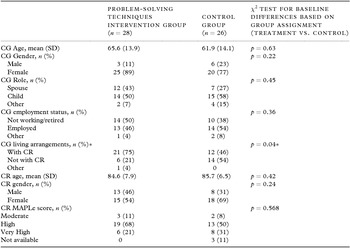
Descriptive statistics were used to summarize the participants’ demographic characteristics (Table 1). Carers in the intervention and control groups shared similar characteristics with mean age of 65.6 ± 13.9 and 61.9 ± 14.1 years, respectively. The majority of carers were female. Carers may be spouses, adult children, or individuals with close relationship to the care recipients. Most carers in the study were employed in the workforce. Greater than 80% of carers in both study groups were caring for high or very high risk care recipients (CRs) as determined by CRs’ MAPLe scores. As aforementioned, significant between-groups (intervention vs. control) difference was detected in the proportion of carers living with care recipients CRs at baseline, with more carers in the intervention group living with their CRs.
This table presents the descriptive statistics that summarized the participant's demographic characteristics. CG denotes Carer; CR, Care recipient; SD, standard deviation. Chi-Square statistics was conducted to test for baseline differences between treatment and control groups (significance is achieved when p value is < .05 and is denoted by an asterisk *).

χ 2 analysis showed significant between-groups difference in the proportion of carers living with CRs at baseline (χ 2 (2, n = 54) = 6.59, p < 0.05; Table 1), the binary variable “carer living arrangement” (i.e. Carers and CR living together vs. living in separate dwellings) was included as a covariate in the RM ANOVAs to control for the possibility that the study results may be influenced by the cohabitation factor.
Outcome measure data were screened to determine the best strategy to manage outliers. On average, 2.1% of responses to the individual outcome measures at baseline and post-intervention exceeded ±2 standard deviations from the mean. Where this was observed, data collection session notes were reviewed to determine whether anything occurred during the session that might explain the apparent outliers. Upon completion of a case-by-case review, it was determined that there were no legitimate outliers, thus all data were included in the analysis.
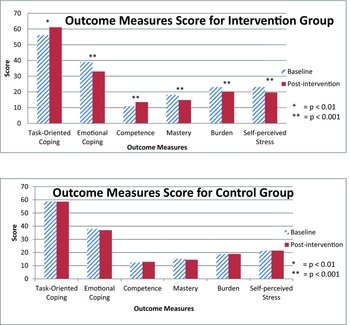
The hypothesis that carers assigned to receive PS techniques-based intervention will demonstrate a reduction in negative emotion-oriented coping and an increase in task-oriented coping was supported by the data. Specifically, the RM ANOVA detected a “time” main effect for emotional coping (38.5 (SD 9.7) vs. 34.9 (SD 10.8), p < 0.05), indicating a significant change from baseline to post-intervention, but not for task coping (57.4 (SD 8.5) vs. 59.9 (SD 8.6), p = 0.12). Significant “group” by “time” interactions were also detected for task (p < 0.01) and emotional coping (p < 0.05). As seen in Figure 1, while those subjects assigned to receive the PS techniques-based intervention demonstrated a significant increase in task-oriented coping score from baseline to post-intervention (56.1 (SD 6.9) vs. 61.1 (SD 8.9) ms, p < 0.01), there was no such change detected for those assigned to the control group (58.7 (SD 10.0) vs. 58.6 (SD 8.3) ms, p > 0.05). Intervention group subjects demonstrated a significant decrease in emotion-focused coping score from baseline to post-intervention (39.1 (SD 11.1) vs. 33.0 (SD 10.8) ms, p < 0.001); there was no such change detected for those assigned to the control group (37.9 (SD 7.9) vs. 36.9 (SD 10.5) ms, p > 0.05) (Figure 1). A significant “group” main effect was not detected for either task (p > 0.05) or emotional coping (p > 0.05).
Repeated measures ANOVA statistics showed that carers in the PS techniques intervention group (N = 28) more readily applied task-focused coping and have improved caregiving competence and mastery post intervention. They also use less emotion-focused coping, and experienced reduced burden and self-perceived stress. Carers in the control arm did not have any significant changes in any of the outcomes.

With regards to self-perceived competence and sense of mastery, “time” main effects for both competence (11.6 (SD 2.4) vs. 13.2 (SD 2.4), p < 0.001) and mastery (16.7 (SD 3.3) vs. 14.7 (SD 3.7), p < 0.05) indicated significant changes from baseline to post-intervention. Significant “group” by “time” interactions were also detected for competence (p < 0.01) and mastery (p < 0.01). While those subjects assigned to receive the PS techniques-based intervention demonstrated a significant increase in competence score from baseline to post-intervention (10.9 (SD 2.0) vs. 13.5 (SD 2.1) ms, p < 0.001), there was no such change detected for those assigned to the control group (12.4 (SD 2.5) vs. 12.9 (SD 2.6) ms, p > 0.05) (Figure 1). Intervention group subjects demonstrated a significant improvement in mastery score from baseline to post-intervention (reverse scoring was applied so that lower scores represent greater mastery; 18.1 (SD 2.4) vs. 14.8 (SD 4.1) ms, p < 0.001), there was no such change detected for those assigned to the control group (15.2 (SD 3.5) vs. 14.5 (SD 3.3) ms, p > 0.05) (Figure 1). Though there was no “group” main effect detected for competence (p > 0.05), there was a trend toward greater overall mastery for the intervention group as compared to the control group (p = 0.07).
Our hypothesis that there would be no between-groups difference in burden was partially rejected. While there was no main effect for “group” (p > 0.05), there was a significant “group” by “time” interaction (p < 0.01). Subjects assigned to the intervention group demonstrated a significant decrease in burden from the beginning to the end of the intervention phase (23.1 (SD 7.3) vs. 20.2 (SD 7.5), p < 0.001), while the control group demonstrated no change (18.9 (SD 9.6) vs. 18.9 (SD 10.4), p > 0.05) (Figure 1).
Lastly, data supported the hypothesis that carers assigned to receive PS techniques-based intervention will have lower level of self-perceived stress. While there was no main effect for “group” (p > 0.05), there was a significant “group” by “time” interaction (p < 0.01). Subjects assigned to the intervention group demonstrated a significant reduction in stress from the beginning to the end of the intervention phase (23.2 (SD 4.9) vs. 19.6 (SD 6.4), p < 0.001), while the control group demonstrated no change (21.4 (SD 6.7) vs. 21.4 (SD 7.0), p > 0.05) (Figure 1).
Discussion
The results of this pre/post-test control group study demonstrated that PS techniques-based intervention may be learned and applied effectively by PS Champions providing in-home support to informal carers of relatives or close friends with dementia. The focus of the intervention is on the individual carer and tailored to address each carer's specific problems and challenges rather than offering generic caregiving information or tips. With the support of the PS Champions, carers became active participants in identifying and defining their specific, current caregiving problems, and generating solutions customized to their specific situations.
PS techniques-grounded visits by PS Champions appeared to be more effective than usual home visits when informal carers were coached in adopting a more proactive, task-oriented approach to address problems and alleviate stress. The visits were guided by the PS Champions but driven and directed by the carers themselves, allowing carers to actively engage in the whole process. As a result, carers developed an improved sense of caregiving competence and sense of mastery, and experienced reduced self-perceived stress.
Unexpectedly, carers who received PS techniques-based visits from their PS Champions also showed a decrease in burden scores. The observed significant reduction in caregiver burden may reflect the synergistic effect of PS techniques-based coaching and care coordination in alleviating caregiver burden. Caregiver burden is a combination of objective and subjective burden (Brodaty and Donkin, Reference Brodaty and Donkin2009). Objective burden reflects the care recipient's physical condition and disease stage (Brodaty and Donkin, Reference Brodaty and Donkin2009), their dependency on the carers as well as the frequency and intensity of behavioral and psychological symptoms of dementia (BPSD). BPSD include psychological disturbances: apathy, depression, anxiety, irritability, agitation, personality changes, and psychotic symptoms as well as difficult behaviors including wandering, pacing, exit seeking, repetitive activities, sleep changes, and aggression (George and Gwyther, Reference George and Gwyther1986; Schulz et al., Reference Schulz, O’Brien, Bookwala and Fleissner1995; Mega et al., Reference Mega, Cummings, Fiorello and Gornbein1996; Donaldson and Burns, Reference Donaldson and Burns1999). Carers often know very little about BPSD or how they might best be managed (Sadavoy and Wesson, Reference Sadavoy and Wesson2012). This lack of knowledge and skills is significant as BPSD may pose the greatest challenge to carers and may contribute most to caregiver burden (Schulz et al. Reference Schulz, O’Brien, Bookwala and Fleissner1995; Mega et al., Reference Mega, Cummings, Fiorello and Gornbein1996; Donaldson & Burns, Reference Donaldson and Burns1999; Canadian Institute for Health Information, 2010). While objective burden may not be easily modifiable and is not the focus of the present PS techniques-based intervention, PS techniques may have been used to generate more effective approaches to the management of BPSD resulting in the observed reduction in caregiver burden. Objective burden also may have been relieved when alternative methods of care were explored or offered to carers by the PS Champions as one of the solutions to a specific problem defined using the PS techniques-based intervention. For example, for a carer who identified his problem as lack of time for himself, burden may have been reduced by the provision of more practical hands-on help at home. Subjective burden, on the other hand, refers to the appraisal of burden by the carer (Aneshensel et al., Reference Aneshensel, Pearlin, Mullan, Zarit and Whitlatch1995). Subjective burden appears to have been reduced in the study by the proper application of PS techniques, as carers learned to reframe how they evaluated the physical and emotional impact of caregiving, their psychological state and resources.
It should be pointed out that, both intervention and control subjects received standard, community-based care as directed by their individualized care plans. However, given resource and operational limitations, it was not possible to provide three placebo visits for the control group to control for the possibility that the improvements demonstrated by the intervention group were secondary to the intervention and not simply due to the additional three visits over and above their standard care regimen. However, given that all outcome measures trended in the direction suggesting improvement for the intervention group, with no pre-post differences detected on any measures for the control group, it is unlikely that the positive effects demonstrated in the intervention group could be ascribed to additional visits alone. While it is possible that the additional visits might influence an improvement in outcomes related to stress, it is unlikely that visits alone would achieve improvements in more specific measures such as mastery or caregiving competence.
Anecdotal reports from participating carers and PS Champions suggest further positive impact of the PS techniques-grounded visits. PS Champions were particularly enthusiastic about applying the PS techniques approach in practice as it provided a concrete way for them to establish a stronger therapeutic alliance with carers and bring focus and structure to caregiving situations that are emotionally charged and complicated by medical and psychosocial comorbidities. It was also noted that PS techniques-based intervention fosters carers’ strengths and abilities thereby building self-esteem and mastery. PS Champions’ commitment and professionalism undoubtedly contributed to the success of the pilot study. Participating carers embraced the PS techniques approach with enthusiasm as well and were pleased to learn that there is an intervention which focuses on them and helps them move from feeling unprepared and incompetent to feeling skillful and in control.
Limitations
There are several limitations to the study. In terms of the research design, care recipients were not evaluated so it is not possible to state whether the development of carers’ PS techniques and other caregiving capacities such as competence and mastery were successfully translated into improved care recipients’ outcomes. Secondly, as carers’ outcomes were only evaluated before and after the PS techniques-based intervention, long term effect of these visits on carers is unknown. Once learned, PS techniques-based intervention has the potential to equip carers with an approach that can be applied to problems they may face in the future but this has yet to be tested. Thirdly, it was not possible to include an attention control group in the research design because of operational limitations. While improvement shown in specific outcomes may be reasonably attributed to the PS techniques-based intervention, future study is necessary to confirm this finding. Fourthly, the study lacked formal direct evaluation of the CCs to ensure they were delivering PS techniques-based intervention with the necessary degree of fidelity to the method taught. This kind of evaluation would strengthen the conclusion that it was the intervention that led to the demonstrated improvement in carers’ outcomes and that successful scaling up of the PS techniques-based intervention is possible using this training model. Finally, the study intervention was delivered by a specialized group of trained CCs which might limit replication with less skilled CCs. Future studies may include an evaluation of the effect on care recipients’ outcomes including indicators such as the frequency and severity of BPSD exhibited by care recipients as evaluated by their carers. While the study processes were generally well tolerated by participants, some carers found the number of outcome measures administered to be burdensome. This may be especially true for carers in the usual care control group where four people were lost to follow-up. Development of a simplified package of outcome measures may encourage participants to remain in the study.
This proof of concept study appears to have demonstrated that effective partnerships between inter-professional clinicians in academic clinical health science centers and community agencies can extend the reach of the expertise of specialized academic, healthcare programs.
Conflict of interest
None.
Description of authors’ roles
Chiu M., Pauley T., Wesson V., and Sadavoy J. collectively designed the adaptation of PS techniques-based intervention for community carers and its evaluation framework. Chiu M. coordinated data collection from participating CCs and carers, wrote the introduction, methods, and discussion sections of the manuscript. Pauley T. was responsible for all statistical analyses, and wrote the introduction and results sections. Wesson V. wrote the discussion section, and is a co-developer of Reitman Centre CARERS program, designed PS techniques training curriculum and have delivered PS techniques training for health professionals. Pushpakumar D. was responsible for data collection, wrote part of the methods section, organized the reference list and formatted figures and tables. Sadavoy J. supervised the research design and edited the manuscript; he is the founding Reitman Centre program director, designed the Reitman Centre CARERS program, designed PS techniques training curriculum and has delivered PS techniques training for health professionals.
Acknowledgments
This project is funded by the UHN AMO Innovation Fund and is a collaboration between Mount Sinai Hospital and Toronto Central Community Care Access Centre. A special thanks to the CCAC care coordinators: Belma Agustin, Bozena Kosciolek, Edith Lee, Deanna Oad, Mira Olearczyk, Ann Poon; and to all the carers who participated.