Introduction
The use of work-life balance policies by the migrant population has increasingly drawn the attention of researchers in recent years, particularly in Scandinavian countries (Kvande and Brandth, Reference Kvande and Brandth2017; Brandth and Kvande, Reference Brandth and Kvande2020; Zadkowska et al., Reference Żadkowska, Kosakowska-Berezecka, Szlendak and Besta2020; Mussino and Duvander, Reference Mussino and Duvander2016; Mussino et al., Reference Mussino, Tervola and Duvander2019; Tervola et al., Reference Tervola, Duvander and Mussino2017; Ellingsæter et al., Reference Ellingsæter, Kitterød and Østbakken2020). This recent attention is well-founded in the attempt to fill a gap in the work-life balance literature regarding a significant segment of the European population that arrives, lives, works, and cares for others in a country different from their country of origin. This particular group is also important due to its presence in the political agenda and media of European countries, where it is often the subject of negative and stereotypical discourse (Eberl et al., Reference Eberl, Meltzer, Heidenreich, Herrero, Theorin, Lind and Strömbäck2018). In the case of the Spanish population, according to the National Statistics Institute, in 2023, the percentage of the foreign population is 12.6 per cent of the total population, and if we focus on the place of birth, 17.1 per cent were born in a foreign country (INEbase, 2024).
In Spain, the debate on migration has focused more on highlighting the threat to social cohesion and the welfare state rather than on the political and economic conditions of the migrant population (Quintana-Pujalte et al., Reference Quintana-Pujalte, Sosa-Valcarcel and Castillo Esparcia2020). Although some evaluations have been made regarding the adaptation of certain Spanish public services, such as healthcare, to the migrant population (Ledoux et al., Reference Ledoux, Pilot, Diaz and Krafft2018), there is a lack of studies analysing the adaptations (or lack thereof) to access work-life balance measures. Nonetheless, some studies have already found reduced access for the migrant population to unpaid parental leave (Lapuerta, González, and Baizán, Reference Lapuerta, Baizán and González2011; Escot et al., Reference Escot, Fernández-Cornejo and Poza2014). This research aims to understand access to one of the most widely used work-life balance leaves, which offers greater protection, earmarked and income replacement, and whose duration has significantly increased in recent years: paternity leave.
Although the protection of working mothers has a long tradition that dates back to the emergence of the first social insurance schemes at the end of the 19th century, fathers were not granted similar labour rights until more than a century later. While the primary aim of introducing maternity leave was to ensure the health of the mother and baby, as well as to partially compensate for the loss of income due to the leave, the main objective of introducing paternity leave has been to promote gender equality in the family and the labour market.
A key aspect of using paternity leave (or its equivalent ‘father’s quota’ within a parental leave scheme) has been to earmark the leave specifically for fathers, i.e., as an individual right non-transferable to the other parent, and with generous income replacement (O’Brien, Reference O’Brien2009). In the 21st century, this leave has been extended to an increasing number of countries (Addati et al., Reference Addati, Cattaneo, Esquivel and Valarino2018). The rates of use of this leave vary substantially from one country to another and, within the same country, from one group to another (Earle et al., Reference Earle, Raub, Sprague and Heymann2023; Karu and Tremblay, Reference Karu and Tremblay2018).
Barriers to using leave entitlements are varied. On one hand, there are institutional barriers stemming from the design of public policies, particularly the eligibility criteria, the benefits received and their funding, as well as whether the leave is an individual right non-transferable to the mother, an individual transferable right, or a family right that must be shared between partners. On the other hand, there are employment conditions, such as whether one works as self-employed or as an employee, whether the contract is permanent or temporary, whether one works without a contract in the informal economy or is unemployed, and whether one works in the public or private sector. Cultural factors are also highly relevant, including models of masculinity and the meaning attributed to taking leave in terms of work commitment. Last but not least are the difficulties in accessing information about fathers’ rights and the complexity of the administrative processes required to exercise them.
Some social groups face greater barriers than others, resulting in different rates of leave usage and, consequently, greater discrimination. Migrant groups are among those facing the most significant social barriers, as the working conditions. Depending on their country of origin, they often have more traditional views on gender roles, leading to the perception that leave designed for childcare is not for men. Moreover, there are often language barriers that make it difficult to access sufficient information about rights and the administrative procedures to follow. Although information on these topics tends to circulate within different migrant communities, language proficiency is generally a significant factor.
This study describes and compares the use of paternity leave among the American and European migrant populations and the native population in Spain. The aim of this article is to test whether the popularity of using paternity leave is similar among migrant fathers. The focus is on two types of migrant populations: on one hand, the American migrant population is selected. Considering that the language barrier is crucial for navigating bureaucratic systems – and indeed, parental leave and other work-life balance resources involve a streamlined process – there is a significant migrant population in Spain from Spanish-speaking nations in Central and South America that already speaks the language fluently. On the other hand, the European migrant population is selected, which does not share the language or culture but has greater civic and labour protection, being within the same supranational environment. These elements, along with the lack of studies on the use of parental leave by the immigrant population, make this study in Spain a relevant source of information on the barriers migrant populations face in family formation and work-life balance.
Paternity leave policy and patterns of leave use in Spain
Paternity leave in Spain was introduced with the first ‘Effective Equality of Women and Men’ law in 2007 as an exclusive and non-transferable leave for fathers of thirteen calendar days, under the same conditions as mothers, but with stricter eligibility requirements (Wall and Escobedo, Reference Wall, Escobedo, Kamerman and Moss2009). Paternity leave is thus conceived as an instrument of gender equality policy, with the main aim of encouraging fathers to use various work-life balance resources to reduce the motherhood penalty in the labour market, as well as to promote shared responsibility in childcare (Meil et al., Reference Meil, Wall, Atalaia, Escobedo, Dobrotic, Blum and Koslowski2022). This leave was initially extended to four weeks in 2017 and to five weeks in 2018, and then reformed in 2019, under a second gender equality law, to match the duration, conditions, and benefits of maternity leave under the slogan ‘equal and non-transferable leave’ that increase the leave up to sixteen weeks with a 100 per cent income replacement.
As it is presented in Figure 1, the introduction of the right to paternity leave in July 2007 led to a rapid increase in its use, despite it not being mandatory, reaching around 55 per cent of all births and remaining constant during the economic and employment crisis (2008 to 2015). From that year onwards, with economic recovery, the percentage of fathers using paternity leave began to increase steadily, eventually surpassing even the percentage of mothers using maternity leave. The introduction of the mandatory use of part of the leave and the extension of its duration with the 2019 reform has reinforced this trend. The rate of maternity leave usage has remained constant since 2007, once the effects of the reduced access requirements were absorbed, at around 66 per cent.
Birth leave use in Spain, 2008–2022, as a percentage of total births/Source: Own calculations based on Ministerio de Trabajo e Integración Social, Statistical Yearbook and Eurostat Database.

Since the right to birth leave is a Social Security entitlement, not all parents are eligible to take the leave. Only parents with paid employment in the formal economy, either as employees or self-employed workers, as well as those who are unemployed and receiving unemployment benefits (i.e., those paying social contributions), are entitled to paternity leave. Surveys that have analysed leave usage in relation to the total number of eligible parents show a substantially higher frequency of use, but with the same trend towards increasingly frequent use. Initial estimates from 2011–2012 place the usage rate at between 75 per cent of eligible fathers (Romero-Balsas, Reference Romero-Balsas2013; Escobedo and Flaquer, Reference Escobedo and Flaquer2014) and 80 per cent (Escot et al., Reference Escot, Fernández-Cornejo and Poza2014) within four years of the leave’s introduction. More recent estimates, fifteen years after its introduction, place this percentage at 90 per cent (Meil et al., Reference Meil, Wall, Atalaia, Escobedo, Dobrotic, Blum and Koslowski2022).
Work-life balance policies and their use by migrants
Empirical literature on the relationship between migrants and the use of public caregiving policies has shown how migrants alter both caregiving practices and the normative discourse on caregiving, influenced by the design of family policies, particularly by the characteristics of available parental leave (Kvande and Brandth, Reference Kvande and Brandth2017; Brandth and Kvande, Reference Brandth and Kvande2020; Zadkowska et al., Reference Żadkowska, Kosakowska-Berezecka, Szlendak and Besta2020). This issue is crucial due to the role of migrants as ‘outsiders within’, who can provide a perspective that challenges institutional caregiving designs (Kvande and Brandth, Reference Kvande and Brandth2017). The relationship between work-life balance policies and their effects on migrant populations has been mainly studied in Nordic countries (Kvande and Brandth, Reference Kvande and Brandth2017; Brandth and Kvande, Reference Brandth and Kvande2020; Zadkowska et al., Reference Żadkowska, Kosakowska-Berezecka, Szlendak and Besta2020; Mussino and Duvander, Reference Mussino and Duvander2016; Mussino et al., Reference Mussino, Tervola and Duvander2019; Tervola et al., Reference Tervola, Duvander and Mussino2017; Ellingsæter et al., Reference Ellingsæter, Kitterød and Østbakken2020) and Belgium (Biegel et al., Reference Biegel, Wood and Neels2021; Kil et al., Reference Kil, Wood and Neels2018; Marynissen et al., Reference Marynissen, Wood and Neels2021). In contrast, this issue has scarcely been studied in Southern countries. This study aims to bridge the knowledge gap in this area by examining the use of paternity leave by fathers with a migration background in the context of the recent extension of paternity leave duration.
A key aspect of using childcare policies is knowledge of the recognised rights, as well as the conditions and consequences of their use. For West Germany, Seibel (Reference Seibel2020) has pointed out, based on quantitative data, that social networks and proficiency in the destination country’s language are crucial for acquiring knowledge about these rights, while the educational level of parents does not play a significant role in this area.
The combination of caregiving agents, such as professional caregivers (both public and private), grandparents, other relatives, and personal networks, is another heterogeneous element in childcare that links aspects of public policies and cultural practices. In this area of analysis, we only have one study conducted in Belgium (Biegel et al., Reference Biegel, Wood and Neels2021), which indicates that migrants use formal childcare less than nationals, with European migrants using formal childcare more than non-European migrants. Similarly, Kingsbury et al. (Reference Kingsbury, Findlay, Arim and Wei2021) note that migrant families in Canada use formal childcare resources less than native families. Analysing the attitudes of migrants in different European countries, Seibel and Hedegaard (Reference Seibel and Hedegaard2017) found, using data from the MIFARE survey, that non-European migrants have more favourable attitudes towards informal care than formal care compared to European migrants, which is consistent with a lower use of formal care by non-European migrant populations.
In the case of migrant mothers in Belgium, Kil et al. (Reference Kil, Wood and Neels2018) note that the lower use of parental leave by migrant mothers is due to their failure to meet eligibility requirements because of precarious working conditions, and because they also leave the labour market after the leave more frequently than nationals. Eligibility is also highlighted as a key factor in the lower use of parental leave among migrant mothers in Belgium (Marynissen et al., Reference Marynissen, Wood and Neels2021). Similar results have been found in Spain, where Lapuerta et al. (Reference Lapuerta, Baizán and González2011) indicate that migrants make less use of parental leave, but this effect of migration disappears once labour conditions are controlled for, as this population often experiences precarious conditions. Likewise, Escot et al. (Reference Escot, Fernández-Cornejo and Poza2014) already noted that being a migrant had negative effects on the likelihood of using parental leave (both paid and unpaid), for both men and women, also pointing to the explanatory role of the more vulnerable labour situations of migrants.
Results are somewhat different in Sweden, where, compared to native mothers, migrant mothers use parental leave more during the first year and less during the second year, with these differences diminishing with the number of years spent in the resident country (Mussino and Duvander, Reference Mussino and Duvander2016). Mussino et al. (Reference Mussino, Tervola and Duvander2019) conducted a comparison of Finnish migrant fathers in Sweden to test the effect of work-life balance policies on migrant behaviours. The results indicate that public policies strongly influence the behaviour of migrant fathers regarding leave, with their usage being more explained by the national design of the leave system than by their migrant status, although usage patterns still vary between migrant and native populations. Tervola et al. (Reference Tervola, Duvander and Mussino2017) point out that earmarking is crucial for increasing leave usage among migrant fathers and for reducing the gap between native and migrant fathers.
In Norway, Ellingsæter et al. (Reference Ellingsæter, Kitterød and Østbakken2020) indicate that migrant fathers use parental leave less than native fathers, primarily because a smaller percentage meet the eligibility requirements. However, these same authors note that even among eligible fathers migrant fathers still use parental leave less and perpetuate a less equal system. This situation is somewhat mitigated by the introduction of the fathers’ quota (Ellingsæter et al., Reference Ellingsæter, Kitterød and Østbakken2020).
Research on the barriers to using paternity leave highlights various conditioning factors. Although the age of fathers does not appear to have an effect on men’s use of paternity leave (Romero-Balsas, Reference Romero-Balsas2013), this effect is significant for other types of parental leave (Escot et al., Reference Escot, Fernández-Cornejo and Poza2014; Meil et al., Reference Meil, Romero-Balsas and Rogero-García2018a). The fact that paternity leave has increased in duration may mean that the longer socialisation period for younger fathers could lead to a higher usage rate, making it advisable to include age in the analysis.
Educational level is a very valuable proxy for parents’ social class. Although the high percentage of paternity leave usage blurs the effects of educational level (Romero-Balsas, Reference Romero-Balsas2013; Meil et al., Reference Meil, Romero-Balsas and Rogero-García2018a), higher educational attainment has been associated with greater use of longer parental leaves and higher work penalties (Escot et al., Reference Escot, Fernández-Cornejo and Poza2014; Lapuerta et al., Reference Lapuerta, Baizán and González2011; Geisler and Kreyenfeld, Reference Geisler and Kreyenfeld2019).
Labour conditions are crucial for the utilisation of parental leave in Spain by fathers, both in terms of the rate of usage (Escot et al., Reference Escot, Fernández-Cornejo and Poza2014; Escobedo and Flaquer, Reference Escobedo and Flaquer2014; Romero-Balsas, Reference Romero-Balsas2013; Meil et al., Reference Meil, Romero-Balsas and Rogero-García2018a) and the duration of the leave (Lapuerta et al., Reference Lapuerta, Baizán and González2011; Romero-Balsas, Reference Romero-Balsas2023). As a tool for balancing work and family life, a more secure or less precarious employment situation promotes the use of paternity leave. This control variable is essential when analysing the migrant population, as labour conditions can play a key role in the valuation of work-life balance measures, including paternity leave.
Not only the characteristics of the fathers but also the situations of the mothers influence the decision to use paternity leave, such as the employment situation of the partner or their foreign status (Moreno-Mínguez et al., Reference Moreno-Mínguez, Martín-Román and Moral2023). To account for the cultural context of the couple, the analysis controls for their country of birth. It is expected that couples born in Spain will have greater knowledge about the use of leave and more evident or predisposed expectations based on common practices within the population.
In addition to labour conditions and the educational level of parents, another proxy for social class is economic income. Not only do some studies indicate that the use of parental leave has a negative impact on the income of parents who take it, but these costs are also higher for those with higher salaries (Evertsson, Reference Evertsson2016; Lequien, Reference Lequien2012; Bia et al., Reference Bia, Blanco and Valentova2021).
The involvement of grandparents is a relevant control variable for contextualising the use of leave in relation to the situation of childcare providers. In the case of Spain, this involvement has been linked to a lower use of formal childcare services, paid domestic work, and parental leave (Meilet al., Reference Meil, Rogero-García and Romero-Balsas2018b). Additionally, it serves as a proxy for controlling the type of family network that migrant parents have when becoming parents in the host country.
Aim and hypotheses
The general aim of this paper is to provide evidence on the use of paternity leave by migrant fathers. We focus on paternity leave because it is specifically designed for fathers, aiming to involve them in childcare and to reduce gender inequalities both at work and at home.
A1: To understand how American and European migrants (born in America or in a European country other than Spain) use paternity leave compared to native fathers (born in Spain).
GH: Our general hypothesis is that migrant fathers use paternity leave to a lesser extent.
As we have seen in the literature review, access to work-life balance policies is lower for migrant populations, although these populations are adapting their behaviours in the host society (Mussino et al., Reference Mussino, Tervola and Duvander2019). In the case of unpaid parental leave, it has been found that migrants use this leave less frequently in Spain (Lapuerta et al., Reference Lapuerta, Baizán and González2011; Escot et al., Reference Escot, Fernández-Cornejo and Poza2014). Although paternity leave is earmarked, which facilitates its use among migrants, differences in usage still exist (Ellingsæter et al., Reference Ellingsæter, Kitterød and Østbakken2020; Tervola et al., Reference Tervola, Duvander and Mussino2017). Therefore, we consider that, despite the generally high uptake of paternity leave in Spain, it will be lower among the non-native population.
H1: American-born fathers use paternity leave to a lesser extent than Spanish-born fathers.
American migrants have a significant proportion of their population proficient in the language, which is key for navigating the bureaucratic process of accessing work-life balance policies (Seibel, Reference Seibel2020). However, the migrant situation, different culture, and greater precariousness in the labour market may hinder the use of paternity leave.
H2: European-born fathers use paternity leave to a lesser extent than Spanish-born fathers.
Although Biegel et al. (Reference Biegel, Wood and Neels2021) and Seibel and Hedegaard (Reference Seibel and Hedegaard2017) suggest that European migrants use formal childcare services more than non-European migrants and that the citizenship and labour conditions of European migrants may offer greater protection against precarious employment, language proficiency and cultural differences might still be insufficient for them to use paternity leave in the same way as the native population.
Data and methodology
This study is based on an online survey conducted with parents of children under the age of seven, entitled QUIDAN (Meil et al., Reference Meil2021), designed as part of the larger research project ‘The Impact of Parental Leave Policies and Early Childhood Education on Family Dynamics (PID2021-123736NB-I00)’, funded by the Ministry of Science and Innovation. The survey was commissioned to a company specialising in online surveys, which carried out the fieldwork during May and June 2021. Schuman and Lück (Reference Schumann and Lück2023) suggest that for studying family relationships, the use of self-administered online surveys has proven more reliable than face-to-face interviews.
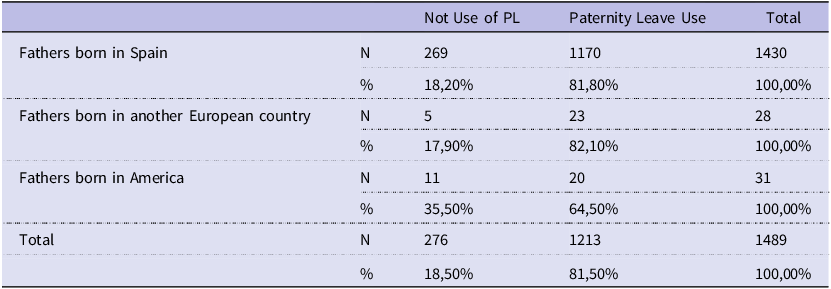
A total of 3100 parents living with a partner were surveyed, with sample quotas evenly distributed by the respondent’s gender and the age of the youngest child (to ensure sufficient numbers of fathers and mothers of children of all ages) and proportionally according to the highest level of education and place of residence of the parents. The raw data were weighted to adjust for the demographic oversampling of parents of younger children and educational levels to ensure statistical representativeness (as determined by the distribution of parents extracted from the Labour Force Survey). The subsample used comprises 1489 fathers, of whom 1430 were born in Spain, 28 in another European country, and 31 in another American country.
Logistic regression is used to predict how a dependent variable behaves according to one or more independent variables and to estimate the explanatory power of the model (Escobar et al., Reference Escobar, Bernardi and Fernández2009). In this study, a multivariate binary logistic regression model is employed to assess the use of paternity leave (a binary dependent variable) by the population based on their place of birth (an independent variable), while controlling for various relevant factors affecting paternity leave usage.
Use of Paternity Leave (Dependent Variable): How long did you use paternity leave to care for your children? (If you are currently on leave, indicate the expected duration; if you did not use it, mark 0.) This variable is dichotomised, with 0 for those who did not use paternity leave; and 1 for those who used 1 or more weeks of leave.
Place of Birth (Independent Variable): Could you tell us if you were born in Spain or another country? Recoded into three categories: 1 for Spain, 2 for Other European country, and 3 for Other American country. The remaining responses have been recoded and excluded from the analysis (sysmis) due to the small sample sizes of these other nationalities, which do not permit multivariate analysis.
Father’s Age (Control Variable): How old are you? This variable is numeric, corresponding to the time of the survey (2021), and is incorporated into the model as such.
Educational Level (Control Variable): What is the highest level of education you have completed? Responses are recoded into three categories: 1 for No education or Primary education, 2 for Secondary education, and 3 for Higher education.
Use of Parental Leave (Control Variable): We would like to know how long you took parental leave to care for your youngest (or only) child. Responses are recoded as follows: 1 for No (0 weeks), and 2 for Yes (1 or more weeks).
Use of Reduced Working Hours for Childcare (Control Variable): We would like to know how long you used reduced working hours to care for your youngest (or only) child. Responses are recoded as follows: 1 for No (0 weeks), and 2 for Yes (1 or more weeks).
Partner’s Place of Birth (Control Variable): Was your partner born in Spain or in another country? Response recoded: 1 for Spain, 2 for Another European country, and 3 for Another American country. Other responses have been recoded and excluded from the analysis (sysmis).
Employment Situation (Control Variable): What is your current employment situation? Responses are recoded: 1 for Permanent contract, 2 for Temporary contract, and 3 for Other employment situation.
Frequency of Grandparents’ Visits (Control Variable): How often do your children see their maternal/paternal grandparents? Responses are recoded as follows: 1 for ‘Daily or several times a week’, 2 for ‘Once a week or several times a month’, and 3 for ‘Less frequently or no grandparents’.
Monthly Net Family Income (Control Variable): Considering the net income entering your household each month, including your own, which of the following income brackets does your household fall into? The brackets are recoded as: 1 for Family net incomes: More than €2071 per month, 2 for Less than €1100 per month, and 3 for Between €1101 and €2070 per month.
Number of Children (Control Variable): In total, how many children do you have? Responses are recoded as: 1 for 1 child, 2 for 2 children, and 3 for 3 or more children.
Self-definition of Religious Beliefs (Control Variable): How do you define your religious beliefs? Responses are recoded as: 1 for Catholic, 2 for Another religion, 3 for Agnostic, Atheist, Indifferent, and 4 for Prefer not to answer. Other religions, apart from Catholicism, are grouped together due to their small absolute numbers.
Children and Career (Control Variable): On a scale from 1 (not at all) to 10 (completely), to what extent have children been a hindrance to your career (e.g., working possibilities, salary improvement, promotion, etc.)? Responses range from 0 to 10.
Men and Fatherhood (Control Variable): A father cannot have as close a relationship with his child as a mother can. Responses range from 1 (strongly agree) to 5 (strongly disagree).
Father and Care (Control Variable): Fathers should spend as much time caring for the children as mothers do. Responses range from 1 (strongly agree) to 5 (strongly disagree).
Parenting and Well-being (Control Variable): Parenting is a source of daily well-being. Responses range from 1 (strongly agree) to 5 (strongly disagree).
Results and discussion
In Table 1, using data from the Quidan 2021 survey, we present a similar descriptive analysis from the fathers’ perspective. We compare the use of paternity leave among fathers born in Spain, America, and other European countries. The results seem consistent with previous findings: fathers born in America use paternity leave less frequently (64.5 per cent) compared to fathers born in Spain (81.8 per cent). In this case, the use of paternity leave by fathers born in another European country does not differ significantly from that of Spanish-born fathers (82.1 per cent).
Migrant fathers (by region of birth) and use of paternity leave

Source: Own elaboration. QUIDAN survey, 2021.
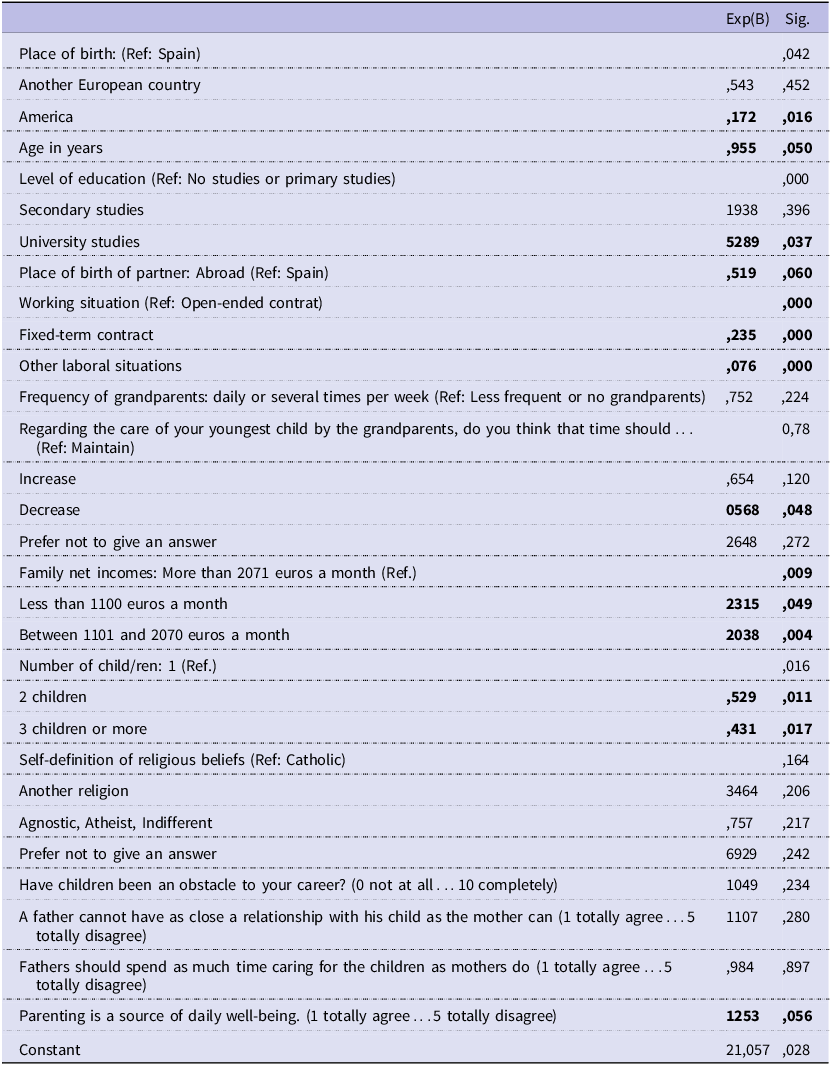
In Table 2, we conducted a multivariable analysis comparing the degree of paternity leave utilisation by fathers born in America with that of fathers born in Spain. Unlike previous analyses, this model controls for relevant variables related to the use of leave by men. The dichotomous dependent variable is ‘Use (or not) of paternity leave’. The model has an explanatory capacity, through Nagelkerke’s R2, of 0.348 and a correctly explained percentage of 89 per cent. The subsample included in the model consists of 972 cases.
Logistic regression model. Dependent variable: Have you used a paternity leave? (with the youngest or only child)

Source: Own elaboration. Database “QUIDAN 1, 2021”.
When we look at our independent variable to be tested, the father’s place of birth, we see that our main hypothesis is confirmed: fathers born in America use paternity leave to a lesser extent than Spanish fathers. Specifically, compared to Spanish fathers, American fathers are more than 8 times less likely (odds ratio = 0.172) to use paternity leave (at a significance level of p-value < 0.05). Therefore, the results are consistent with previous findings that the migrant population generally uses fewer work-life balance resources (Biegel et al., Reference Biegel, Wood and Neels2021; Kingsbury et al., Reference Kingsbury, Findlay, Arim and Wei2021) and parental leave in particular (Ellingsæter et al., Reference Ellingsæter, Kitterød and Østbakken2020; Lapuerta et al., Reference Lapuerta, Baizán and González2011; Escot et al., Reference Escot, Fernández-Cornejo and Poza2014). If we interpret that most migrants born in America residing in Spain speak Spanish, it seems that what Seibel (Reference Seibel2020) noted about the impact of fluency in the host country’s language is not sufficient to equalise the rate of paternity leave utilisation.
These results cannot be generalised to fathers born in other European countries, as they are not significant. It is possible that the more developed parental leave systems in other European countries compared to America may influence their different perceptions and, therefore, different usage by people from both backgrounds (Mussino and Duvander, Reference Mussino and Duvander2016; Mussino et al., Reference Mussino, Tervola and Duvander2019). Additionally, the fact that paternity leave is exclusively reserved for men may be increasing its use among migrants (Tervola et al., Reference Tervola, Duvander and Mussino2017; Ellingsæter et al., Reference Ellingsæter, Kitterød and Østbakken2020). As noted by Biegel et al. (Reference Biegel, Wood and Neels2021) and Seibel and Hedegaard (Reference Seibel and Hedegaard2017), European migrants tend to prefer formal childcare more than other migrants in Europe. This, combined with the comparative advantage of greater citizen protection due to sharing a supranational space, may help reduce the risk of potential negative employment consequences and lead to paternity leave utilisation similar to that of the native population.
Regarding the control variables, older fathers use paternity leave less often. Although in 2012 there were no age-related differences in the use of the two-week paternity leave (Meil et al., Reference Meil, Romero-Balsas and Rogero-García2018a; Romero-Balsas, Reference Romero-Balsas2013), by 2021, for each additional year in the father’s age, the odds ratio of using paternity leave decreased by 4.5 per cent (0.955 at a significance level of p-value < 0.1).
The educational level variable impacts the use of paternity leave at its highest level. Fathers with university or higher education have an odds ratio that is five times greater (5.289, p-value < 0.05) of using paternity leave compared to those with primary education or less. This is consistent with the utilisation of various parental leaves (Geisler and Kreyenfeld, Reference Geisler and Kreyenfeld2019; Lapuerta et al., Reference Lapuerta, Baizán and González2011) but differs from what was found in the use of paternity leave, at least when it lasted two weeks (Escot et al., Reference Escot, Fernández-Cornejo and Poza2014; Meil et al., Reference Meil, Romero-Balsas and Rogero-García2018a; Romero-Balsas, Reference Romero-Balsas2013). This may be because the increased duration of the leave also entails a higher cost for its utilisation, and the effects are seen not only in the length of time taken (Meil et al., Reference Meil, Wall, Atalaia, Escobedo, Dobrotic, Blum and Koslowski2022) but also in its usage.
Fathers (whether native or immigrant) who are partnered with individuals born in Spain use paternity leave to a greater extent. Fathers with a foreign-born partner have an odds ratio 4.8 times greater (0.519, p-value < 0.1) for using paternity leave. Future research should focus on the relationship between migrant couples and binational couples with Spanish mothers in larger samples to understand their implications for the utilisation of work-life balance measures.
Employment status has been found to be crucial for the use of paternity leave in Spain (Meil, Reference Meil, Wall, Atalaia, Escobedo, Dobrotic, Blum and Koslowski2022; Meil et al., Reference Meil, Romero-Balsas and Rogero-García2018a; Romero-Balsas, Reference Romero-Balsas2013; Escot et al., Reference Escot, Fernández-Cornejo and Poza2014), as well as for influencing the use of other parental leaves in Spain (Lapuerta et al., Reference Lapuerta, Baizán and González2011; Romero-Balsas, Reference Romero-Balsas2023). The effects of the type of employment contract on the use of paternity leave are significant, and the model results indicate that fathers with temporary contracts have an odds ratio 7.6 times lower for using paternity leave compared to fathers with permanent contracts (0.235, p-value < 0.01). Fathers in other employment situations have an odds ratio 9.2 times lower (0.076, p-value < 0.01) for using paternity leave.
The regular involvement of grandparents is not significantly relevant in influencing the use of paternity leave. Although it has been found that grandparent involvement in childcare in Spain is associated with reduced use of formal childcare services, paid domestic work, and parental leaves (Meil et al., Reference Meil, Rogero-García and Romero-Balsas2018b), these findings do not align with the use of paternity leave. However, the desire to reduce the time grandparents spend on childcare is linked to lower paternity leave utilisation. Specifically, fathers who would like to reduce the involvement of grandparents have an odds ratio 4.4 times higher (0.568, p-value < 0.05) of using the leave compared to those who wish to maintain the grandparents’ usual involvement in caring for their youngest child. It is possible that using paternity leave allows fathers to reduce dissatisfaction with greater-than-desired grandparent involvement, at least during the first months of life.
Income level impacts the use of paternity leave in an inverted U-shape, with middle incomes using the leave most frequently, while both lower and higher incomes use it less. Fathers earning between 1100 and 2700 euros per month have double the odds ratio (2.038, p-value < 0.05) of using the leave compared to fathers earning more than 2700 euros. For those earning less than 1100 euros, their probability of using the leave is also higher than for those with middle incomes. Specifically, they have an odds ratio 2.3 times higher (2.315, p-value < 0.05) for using the leave. These results align with other studies on the subject, where higher salaries face promotion expectations that conflict with work interruptions (Evertsson, Reference Evertsson2016; Lequien, Reference Lequien2012; Bia et al., Reference Bia, Blanco and Valentova2021), and lower salaries may be a proxy for other types of job insecurities that hinder their use (Ellingsæter et al., Reference Ellingsæter, Kitterød and Østbakken2020).
The number of children impacts the utilisation of paternity leave. Specifically, the likelihood of using paternity leave decreases as the number of children increases. Having two children reduces the odds ratio for using the leave by 4.7 times compared to fathers with only one child (0.529, p-value < 0.01). The probability decreases further with a third child, with the odds ratio for utilisation being 5.7 times lower than for first-time fathers (0.431, p-value < 0.01). These results suggest a shift in how men approach the role of fatherhood, with paternity leave increasingly becoming a standard tool for those taking on parental identity for the first time. These findings are consistent with the increase in paternity leave usage in recent years, reaching a very high percentage as reflected in various previous studies (Meil et al., Reference Meil, Wall, Atalaia, Escobedo, Dobrotic, Blum and Koslowski2022; Recio et al., Reference Recio Alcaide, Jiménez, Vega Martínez and Castellanos Serrano2024).
Regarding beliefs and attitudes, we find minimal impacts on the likelihood of using paternity leave, with the exception of the variable concerning the appreciation of fatherhood. Fathers who view fatherhood as a source of well-being have an odds ratio 25 per cent higher (1.399, p-value < 0.1) for using paternity leave compared to those who do not agree with this statement. This variable presents the issue of not knowing whether their attitude is pre-existing or a result of the experience of fatherhood. However, other perception variables, such as whether children are seen as an obstacle to career advancement or whether fathers can establish as close a relationship with their children as mothers, do not show significant differences in the use of paternity leave. Similarly, no differences are found regarding religious beliefs, where paternity leave usage is similar regardless of creed.
Conclusions
Among the Spanish family and work-life reconciliation measures that have been most modified and expanded in the 21st century is paternity leave. This expansion and alignment with maternity leave have primarily aimed to promote gender equality. At the same time, research on the use of paternity leave and other parental leave by fathers in Spain has increased. However, to date, there has been little research on how migrant populations use these measures. Most studies on this topic have been conducted in Nordic countries and Belgium, employing various methodologies. This study is the first to examine the barrier of being a migrant in the utilisation of paternity leave in Spain, a generous, earmarked, and recently extended leave. This is particularly relevant as Spain has made significant efforts to equalise the conditions and duration of paid leave for both parents, and its impact on the migrant population has yet to be evaluated.
The analysis conducted is quantitative, using data from the QUIDAN 2021 survey. The results indicate that paternity leave is used more by fathers born in Spain than by those born in America, even when controlling for relevant variables such as employment status, educational level, partner’s country of birth, use of other parental leave, and beliefs and attitudes. The lower utilisation of reconciliation policies by the migrant population in the host country has been a consistent finding in previous studies (Biegel et al., Reference Biegel, Wood and Neels2021; Ellingsæter et al., Reference Ellingsæter, Kitterød and Østbakken2020; Kil et al., Reference Kil, Wood and Neels2018; Marynissen et al., Reference Marynissen, Wood and Neels2021; Lapuerta et al., Reference Lapuerta, Baizán and González2011; Escot et al., Reference Escot, Fernández-Cornejo and Poza2014). However, Mussino and Duvander (Reference Mussino and Duvander2016) found different results only during the first year and suggest that the design of leave policies (including the level of remuneration and earmarking) may lead migrant populations to use the leave more equitably (Tervola et al., Reference Tervola, Duvander and Mussino2017; Ellingsæter et al., Reference Ellingsæter, Kitterød and Østbakken2020).
In the case of Spain, the differences in paternity leave usage between fathers born in Spain and those born in America are reduced once other relevant variables, such as employment status, are controlled for, but the difference remains significant. However, no differences are found in the use of paternity leave between Spanish fathers and those born in other European countries. This may be because migrants from European countries may have greater protection than those from outside Europe, and the perception of negative consequences for using such leave might be lower among European workers.
One of the limitations of this study is the sample size, which is relatively small for the migrant population and does not allow for a more precise contextualisation of smaller origin regions within the migrant population. Additionally, some relevant variables are missing, such as the timing of migration and the number of years spent in the country, which would help control for the duration of socialisation in a different institutional context from the origin. Furthermore, many questions remain unanswered, such as how different population groups interpret the Spanish leave system, the specific uses of leave time, or the difficulties encountered in taking it once the right is decided to be exercised.
To address these questions and partially overcome the limitations of this study, two complementary approaches could be taken: firstly, conducting qualitative analyses with parents who have children under the age of seven and have been socialised in the country of origin of the main migrant groups, and secondly, designing a survey with a larger sample of the migrant population and more questions related to this phenomenon, which would allow for a more precise understanding of their caregiving patterns.
Acknowledgements
This research paper is part of a broader research project funded by the Spanish State Research Agency, entitled The impact of parental leave policies and nursery schools on family dynamics in Spain (PID2021-123736NB-I00).