Introduction
Despite decades of research and the relevance of negative and cognitive symptoms for functional outcomes in patients with schizophrenia, treatments for schizophrenia have largely been limited in their efficacy to treat hallucinations, delusions, disorganized thoughts and behavior, and related agitation/aggression. By contrast, due to their functional relevance, assessing and managing negative and cognitive symptoms is relevant when treating individuals with schizophrenia. This article summarizes the phenomenology, clinical diagnosis, measurement, and prevalence of negative symptoms and of cognitive symptoms in patients with schizophrenia. This is followed by a summary of available, as well as currently tested, management approaches, and description of their utility for each of the 2 symptom domains. Although the hypotheses and emerging findings of the biological underpinnings of negative symptoms and cognitive symptoms are relevant and help inform the testing of novel pharmacologic treatment approaches, these aspects are covered elsewhere and beyond the scope of this article.
Negative Symptoms
Phenomenology
Negative symptoms in schizophrenia include asociality, avolition, consummatory and anticipatory anhedonia, affective flattening, and alogia.Reference Kirkpatrick, Strauss and Nguyen1 These symptoms can be consistently separated from positive symptoms, affective symptoms (depression and anxiety), and disorganized thought, speech, and behavior.Reference Blanchard and Cohen2 Factor analyses have shown that the classical 5 symptoms weigh on 2 factors: (1) reduced emotional expression (blunted affect, alogia) and (2) reduced motivation and pleasure (avolition, anhedonia, asociality).Reference Blanchard and Cohen2, Reference Kring, Gur, Blanchard, Horan and Reise3 In fact, avolition as the clinical correlate of reward system deficits has been proposed as the core negative symptom domain.Reference Foussias and Remington4 Anhedonia, specifically “anticipatory anhedonia,”Reference Pizzagalli5 may lead to avolition, in that patients with schizophrenia are able to experience pleasure similar to controls,Reference Foussias and Remington4 but fail to anticipate these activities as controls would do, seemingly forgetting the positive valence that would drive goal-directed behavior toward enjoyable activities.Reference Cohen and Minor6
Clinical diagnosis of negative symptoms
For clinical purposes, it is particularly important to separate primary negative symptoms from secondary negative symptoms, as the latter are amenable to treatment changes (Figure 1). To make this differential diagnosis in a patient with schizophrenia, comorbid psychiatric conditions, including depression, anxiety, dementia, and mental retardation, as well as paranoia that might lead to social withdrawal, need to be ruled out/addressed. Moreover, antipsychotic-related side effects, like sedation and EPS; medical conditions, like chronic pain or sleep apnea; and environmental deprivation, understimulation, or anticipated stigma may present as secondary negative symptoms.
Differential diagnosis of primary versus secondary negative or cognitive symptoms.

While secondary negative symptoms typically respond to treatment of the underlying cause, there are currently only limited treatment options for primary negative symptoms. Primary or secondary negative symptoms that do not resolve, but persist during an otherwise stable illness period, are termed persistent or enduring negative symptoms.Reference Buchanan7 Two additional terms to characterize subgroups include the following:
1. Prominent negative symptoms: ratings of moderate symptom severity on ≥3 Positive and Negative Syndrome Scale (PANSS) negative subscale items or ratings of moderately severe on ≥2 negative subscale itemsReference Kinon, Noordsy, Liu-Seifert, Gulliver, Ascher-Svanum and Kollack-Walker8, Reference Rabinowitz, Berardo, Bugarski-Kirola and Marder9
2. Predominant negative symptoms: a score ≥60 on the Scale for the Assessment of Negative Symptoms (SANS) concomitant with a score ≤50 on the Scale for the Assessment of Positive Symptoms (SAPS) [ie, corresponding to less than moderately ill Clinical Global Impressions-Severity (CGI-S)].Reference Levine and Leucht10
BuchananReference Buchanan7 proposed the differentiation of “persistent negative symptoms in schizophrenia” (ie, any primary negative symptoms of at least moderate severity on an accepted rating scale, eg, PANSS/SANS, which are stable for a period of time) from “schizophrenia with deficit syndrome.” For the latter diagnosis, patients present throughout their illness course predominantly with negative symptoms, ie, ≥2 at of the following 6 at a clinically significant severity persisting for ≥12 months: (1) restricted affect, (2) diminished emotional range, (3) poverty of speech, (4) curbing of interest, (5) diminished sense of purpose, or (6) diminished social drive. Notably, different from persistent negative symptoms, negative symptoms that are part of schizophrenia with deficit syndrome must have been present throughout the majority of the individual’s illness, although they may be difficult to detect during transient episodes of acute psychotic disorganization or decompensation.
While an illness course characterized by persistent negative symptoms is generally recognized, the concept of deficit syndrome schizophrenia as a separate neurobiological entity remains debated.Reference Galderisi and Maj11
Measurement of negative symptoms
In clinical research, valid and reliable quantification of symptomatology is achieved using standardized clinical assessments, but these are only very rarely utilized in clinical practice, although scales support the objective, less observer-dependent monitoring of the disease course and treatment efficacy.Reference Correll, Kishimoto, Nielsen and Kane12, Reference Kane13 Since individuals with schizophrenia are typically not aware of negative symptoms, and rarely report these as a chief complaint,Reference Selten, Wiersma and van den Bosch14 it is very important to (1) observe the patient’s expression and attention during the interview, (2) systematically ask questions regarding frequency/intensity of social contacts and of other enjoyable activities, and (3) interview family members/informants.
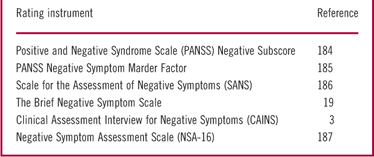
Several interviews and scales have been developed and used in research to measure negative symptoms (Table 1). Two reliable and valid negative symptom scales have been the standard for clinical trialsReference Marder, Alphs and Anghelescu15: the SANS (25 items, covering the 5 domains of affective flattening, alogia, avolition/apathy, anhedonia/asociality, and attention, each rated from 0/absent to 5/severe) and the PANSS negative symptoms subscale (7 items, covering blunted affect, emotional withdrawal, poor rapport, passive social withdrawal, difficulty in abstract thinking, lack of spontaneity and flow of conversation, and stereotyped thinking, each rated from 1/absent to 7/extreme). However, both scales incorporate a cognitive item (SANS: attention; PANSS: difficulty in abstract thinking), which should no longer be counted to the negative symptom, but to the cognitive domain.Reference Alphs, Summerfelt, Lann and Muller16 The Negative Symptom Assessment Scale, NSA-16,Reference Alphs, Summerfelt, Lann and Muller16 or its shortened version, NSA-4,Reference Alphs, Morlock, Coon, Cazorla, Szegedi and Panagides17 additionally captures social interest and sense of purpose, but has not been widely used yet. The Clinical Assessment Interview for Negative Symptoms (CAINS),Reference Kring, Gur, Blanchard, Horan and Reise3 the preliminary product of an ongoing National Institute of Mental Health (NIMH)-initiated scale development process, covers all 5 consensus-based negative symptom domains (asociality, avolition, consummatory and anticipatory anhedonia, affective flattening, and alogia). In contrast to the currently used scales, the CAINS is a semistructured, 7-point, 23-item interview using prompts and follow-up questions for each item, as well as clear anchors for ratings.Reference Kring, Gur, Blanchard, Horan and Reise3, Reference Forbes, Blanchard, Bennett, Horan, Kring and Gur18 The Brief Negative Symptom ScaleReference Strauss, Keller and Buchanan19 has also been developed along novel negative symptom concepts, particularly emphasizing multiple facets of anhedonia and avolition, but in contrast to the CAINS, this scale is also intended for clinical settings. Thirteen items are organized into 6 subscales, and ratings may be based on an interview of about 20 minutes.Reference Strauss, Keller and Buchanan19
Interviews and scales used for the assessment of negative symptoms in schizophrenia
Prevalence of negative symptoms
Baseline data from the large Clinical Antipsychotic Trials of Intervention Effectiveness (CATIE) study showed prominent negative symptoms in 40% of participants with chronic schizophrenia.Reference Rabinowitz, Berardo, Bugarski-Kirola and Marder9 One-half of this subgroup showed prominent negative symptoms without prominent positive symptoms, and the other half showed prominent negative symptoms plus prominent positive symptoms.Reference Rabinowitz, Berardo, Bugarski-Kirola and Marder9 In the European Cardiovascular, Lipid, and Metabolic Outcomes Research in Schizophrenia (CLAMORS) study, 18% of treated subjects presented with all 5 negative symptoms.Reference Bobes, Arango, Garcia-Garcia and Rejas20 The most frequent negative symptom seems to be social or emotional withdrawal,Reference Selten, Wiersma and van den Bosch14, Reference Peralta and Cuesta22, Reference Lyne, O'Donoghue and Owens23 followed by diminished expression and inattention-alogia. Importantly, negative symptoms are not only present in chronic schizophrenia, but have been clearly recognized in early psychosisReference Fulford, Niendam and Floyd24 and during the prodromal period.Reference Fusar-Poli, Borgwardt and Bechdolf25 Persistent negative symptoms can be found in up to 25% during the first 2 years after first-episode schizophrenia, demonstrating high within-subject consistency.Reference Üçok and Ergül26 The prevalence of negative symptoms was higher in menReference Thorup, Albert and Bertelsen27 and in subjects who were unemployed, single, had reduced functioning, and were taking higher antipsychotic dosages.
Impact on outcome
Surprisingly, patients with prominent negative symptoms showed higher ratings of subjective quality of life and of subjective mental health than subjects with predominant positive symptoms, even though they had a significantly higher functional impairment for everyday chores.Reference Rabinowitz, Berardo, Bugarski-Kirola and Marder9 This discrepancy that may be related to low levels of insight questions the sole use of external ratings, and highlights the need for subjective ratings of well-being in clinical studies.
Moreover, a higher burden of negative symptoms is a consistent predictor of negative short-term,Reference Nordon, Rouillon, Azorin, Barry, Urbach and Falissard28 mid-term,Reference Üçok and Ergül26, Reference Gaebel, Riesbeck and Wölwer29 and long-term treatment response and functional outcome.Reference Fervaha, Foussias, Agid and Remington30, Reference Verma, Subramaniam, Abdin, Poon and Chong31 Importantly, the presence of persistent negative symptoms has also been related to prolonged duration of untreated psychosis,Reference Üçok and Ergül26 which in of itself is a very robust predictor of poor treatment response.Reference Carbon and Correll32
Cognitive Symptoms
Phenomenology
Neurocognitive deficits have been well established in schizophrenia as independent disease characteristics in addition to positive and negative symptoms.Reference Bilder, Goldman and Robinson33–Reference Javitt, Doneshka, Grochowski and Ritter35 However, the exact nature and structure of cognitive deficits has long been a topic of debate. Consensus on the major domains affected by schizophrenia was reached 10 years agoReference Green, Nuechterlein and Gold36 and yielded the Measurement and Treatment Research to Improve Cognition in Schizophrenia (MATRICS) battery, which covers 7 key domains: working memory, attention/vigilance, verbal learning and memory, visual learning and memory, reasoning and problem solving, speed of processing, and social cognition. Although antipsychotic treatment may interfere with neurocognitive function,Reference Fusar-Poli, Deste and Smieskova37 neurocognitive impairment has been clearly demonstrated as a core feature of schizophrenia, and not merely a result of positive symptom interference or treatment side effects.Reference Green, Nuechterlein and Gold36 These deficits are present during all phases of the illness, including clinical high-risk cohorts,Reference Fusar-Poli, Deste and Smieskova37–Reference Olvet, Burdick and Cornblatt40 first episode (FE) schizophrenia,Reference Bilder, Goldman and Robinson33, Reference Galderisi, Davidson and Kahn41–Reference Bora and Murray43 and chronic schizophrenia.Reference Andreasen, Rezai and Alliger44–Reference Sponheim, Jung and Seidman49 Deficits have remained mostly stable in longitudinal studies with follow-up from FE to chronic illness phases, without clear further age-inappropriate cognitive decline,Reference Bozikas and Andreou50, Reference Barder, Sundet and Rund51 at least at group means. However, some cognitive decline may occur in the early illness period, ie, from the prodrome until 3–5 years of illness.Reference Bora and Murray43, Reference Mesholam-Gately, Giuliano, Goff, Faraone and Seidman52 Cognitive deficits have also been demonstrated in first-degree relatives of patients with schizophrenia,Reference Sitskoorn, Aleman, Ebisch, Appels and Kahn53 suggesting that cognitive deficits represent a trait characteristic of the illness. In addition to the overall stability of cognitive deficits in schizophrenia, this notion of a trait characteristic is supported by the observation that cognitive measures did not correlate with the longitudinal change in negative symptom severity.Reference Hughes, Kumari and Soni47
Cognitive impairment profiles vary considerably. The most recent meta-analysis on this topicReference Fatouros-Bergman, Cervenka, Flyckt, Edman and Farde42 focused on antipsychotic-naïve patients with schizophrenia-spectrum disorders and included cognitive data from 23 studies, published from 1992–2013, including 1106 patients and 1385 controls. Test data were sorted according to the MATRICS domains.Reference Green, Nuechterlein and Gold36 The domain reasoning/problem solving was not sufficiently represented in the assessed studies and had to be replaced by other executive functioning tests. Across all domains, controls performed significantly better than subjects with schizophrenia spectrum disorders, but the largest deficits were noted in verbal memory, speed of processing, and working memory scores, with large effect sizes amounting to standard mean differences of 1.03, 1.03, and 0.97, respectively. Importantly, this pattern of results in antipsychotic-naïve patients is consistent with an earlier meta-analysis including 43 separate samples of 2204 medicated FE schizophrenia patients.Reference Mesholam-Gately, Giuliano, Goff, Faraone and Seidman52 While the cognitive profile of schizophrenia is clearly worse than in controls, there remains some uncertainty regarding the distinction relative to other psychoses. Earlier studies supported the notion that cognitive deficits are most pronounced in schizophrenia compared to other psychiatric diagnoses.Reference Dickerson, Boronow, Stallings, Origoni, Cole and Yolken54, Reference Krabbendam, Arts, Van Os and Aleman55 For example, when matched for clinical symptoms, subjects with schizophrenia performed 0.5 SD below patients with bipolar disorder.Reference Krabbendam, Arts, Van Os and Aleman55 By contrast, a later meta-analysis compared cognitive performance from 31 studies and 1979 subjects with schizophrenia to 1314 subjects with affective psychosis or schizoaffective disorder, finding only minimal differences in the domains verbal memory, executive functioning, mental speed, and general IQ.Reference Bora, Yucel and Pantelis56 However, the authors emphasized that design and population characteristics may have influenced the results, as schizophrenia patients had larger deficits in studies with a higher proportion of males, subjects with early disease onset, and subjects with pronounced negative symptoms.
While a comprehensive assessment clearly needs the broad, but time-consuming, measurement of all domains, these are by no means entirely independent of each other. Indeed, a principal components analysis (PCA) of CATIE baseline cognitive dataReference Keefe, Bilder and Harvey48 showed considerable correlation among all domains, and PCA identified a single factor accounting for 45% of the test variance. This finding suggests that neurocognitive batteries could be considerably shortened to yield one representative measure of cognition in a short testing period, which would have relevant clinical practice implications. Moreover, although recent concepts of schizophrenia advocate for a clear separation of cognitive deficits and negative symptoms, cognitive impairment measures also modestly correlated with negative symptom severity (r=0.13−0.27) in thisReference Keefe, Bilder and Harvey48 and earlier studies,Reference Bilder, Goldman and Robinson33, Reference Bozikas, Kosmidis, Kioperlidou and Karavatos45–Reference Hughes, Kumari and Soni47, Reference Bora, Yucel and Pantelis56, Reference Pantelis, Stuart, Nelson, Robbins and Barnes57 whereas correlations with positive symptom severity were almost absent.Reference Keefe, Bilder and Harvey48
Clinical diagnosis of cognitive symptoms
Despite the relevance of cognition to neurobiology, outcome, and treatment in schizophrenia, the diagnosis and quantification of cognitive deficits has been relatively neglected in clinical practice.Reference Keefe58 This neglect does not necessarily reflect a lack of knowledge regarding the existence and relevance of cognitive deficits in schizophrenia, but psychiatrists may refrain from referring patients to a lengthy paper-and-pencil neuropsychological assessment, as it is often not feasible during acute illness periods. In more stable patients, the relevance of a detailed cognitive assessment may be questioned, as results would not necessarily lead to a specific treatment or recommendation. However, as with negative symptoms, clinicians need to differentiate primary from secondary cognitive deficits (Figure 1). Therefore, the clinical interview should at least be extended to include open questions regarding the cognitive domains (such as, “Have you been having trouble memorizing items on shopping lists or names of celebrities?” or “Have you been feeling less sharp lately?”). Moreover, as long as standardized, brief neuropsychological bedside screening instruments are not used (see below), cognitive deficits should always be part of the diagnostic interview and be documented by the respective mental status exam component (ie, orientation, serial 7, 5-minute 3 word recall, memory, abstract thinking/reasoning). Finally, since the correlation matrix from the CATIE baseline sample suggests that the removal of any of the domain scores from the composite had little effect on the reliability of the composite score,Reference Keefe, Bilder and Harvey48 it may also be reasonable to bridge the aforementioned research–practice gap by adding the Hopkins Verbal Learning testReference Brandt and Benedict59 to the baseline mental status exam. For this test, individuals need to memorize as many words as possible from a list of 12 words read aloud by the tester. First, verbal memory, in general, and the Hopkins Verbal Learning test, in particular, showed a high correlation with other domains and ranged among the highest correlations for the composite score.Reference Keefe, Bilder and Harvey48 Second, this test is similar to already used, freely interpreted 5-minute recall tests and is easy to administer and score. Third, it is well tolerated even by significantly impaired individuals. The assessment takes approximately 5 minutes with a 25-minute delay to complete (which can be used for other parts of the psychiatric interview) and takes not more than 2 minutes to score. Additional tests that may be clinically useful include the Clock Drawing Test, the Trail Making Test, and the 10-minute Montreal Cognitive Assessment (MoCA), which includes both the Clock Drawing Test and the Trail Making Test.
Measurement of cognitive symptoms
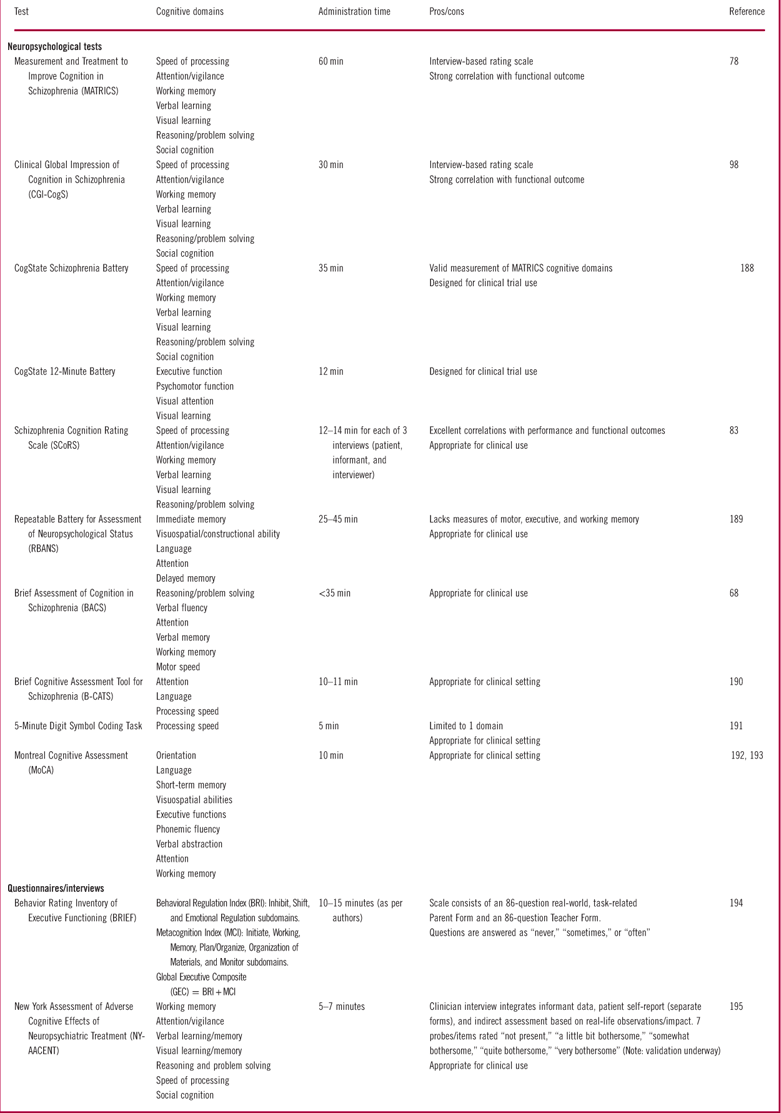
A variety of neuropsychological batteries have been in use for the detection and quantification of cognitive deficits in schizophrenia, but these often are not standardized, can be administered only by specially trained personnel, and take over 2 hours to administer. Thus, efforts have been made to develop more easily applicable batteries (Table 2).
Interviews and scales used for the assessment of cognitive symptoms in schizophrenia
The Repeatable Battery for the Assessment of Neuropsychological Status (RBANS) consists of 12 tasks in a paper-and-pencil test that takes about 30 minutes to administer and covers the areas of immediate and delayed (verbal) memory, visuospatial/constructive abilities, language, and attention.Reference Randolph, Tierney, Mohr and Chase60 The battery was originally not developed for use in schizophrenia, but still has shown some utility in this population. Subjects with schizophrenia underperformed controls by 0.78 SD on this scale,Reference Loughland, Lewin, Carr, Sheedy and Harris61, Reference Chianetta, Lefebvre, LeBlanc and Grignon62 and a clear separation from affective psychoses was demonstrated.Reference Dickerson, Boronow, Stallings, Origoni, Cole and Yolken54 Moreover, the RBANS has been widely used to detect effects of treatment on cognition in schizophrenia.Reference Dickerson, Boronow, Stallings, Origoni, Cole and Yolken54, Reference Ehrenreich, Hinze-Selch and Stawicki63–Reference Olincy, Harris and Johnson65 Nevertheless, the covered domains differ from the 7 MATRICS domainsReference Nuechterlein, Barch, Gold, Goldberg, Green and Heaton66; in particular, the RBANS lacks a measure of reasoning and problem solving, even though executive functioning deficits have long been recognized as a core cognitive deficit in schizophrenia.Reference Pantelis, Barnes and Nelson67
The Brief Assessment of Cognition in Schizophrenia (BACS) was much later developed and only shortly before the MATRICS initiative was started.Reference Keefe, Goldberg, Harvey, Gold, Poe and Coughenour68 The BACS covers the domains of verbal memory, working memory, motor speed, attention, executive functions, and verbal fluency, ie, those cognitive functions that are clearly impaired in schizophrenia. Moreover, the BACS was designed to be easily applicable during clinical trials. It can be used by minimally trained personnel and requires only about 30 minutes of testing time plus minimal extra time for scoring.Reference Keefe, Goldberg, Harvey, Gold, Poe and Coughenour68 The BACS showed high reliability and sensitivity for cognitive impairment in schizophrenia,Reference Keefe, Goldberg, Harvey, Gold, Poe and Coughenour68–Reference Hill, Sweeney and Hamer72 discriminatory power from cognitive deficits in affective psychoses,Reference Dickerson, Boronow, Stallings, Origoni, Cole and Yolken54, Reference Hill, Reilly and Keefe71, Reference Hill, Sweeney and Hamer72 and has been widely utilized in clinical studies.Reference Sellwood, Morrison, Beck, Heffernan, Law and Bentall73–Reference Wang, Xiang and Li75
Because of limited progress in the development of effective treatments for cognitive symptoms, the National Institute of Mental Health (NIMH) started the Measurement and Treatment Research to Improve Cognition in Schizophrenia (MATRICS) project, which involved, among other projects, the development of the MATRICS Consensus Cognitive Battery.Reference Nuechterlein, Barch, Gold, Goldberg, Green and Heaton66, Reference Buchanan, Davis and Goff76 This battery, as a paper-and-pencil test, measures working memory (2 items), attention/vigilance (3 items), verbal learning and memory (2 items), spatial learning (3 items), reasoning and problem solving (4 items), speed of processing (3 items; one from the BACS), and social cognition (4 items). Compared to the RBANS and the BACS, testing with the MATRICS battery takes much longer (about 1 hour), but for use in clinical trials, this amount is still considered appropriate, considering that the MATRICS battery covers a broad spectrum. MATRICS battery data have shown high sensitivity, reliability, and validity, as well as successful application in large clinical trials.Reference Keefe, Bilder and Harvey48, Reference Buchanan, Keefe, Umbricht, Green, Laughren and Marder77–Reference Weiser, Heresco-Levy, Davidson, Javitt, Werbeloff, Gershon, Abramovich, Amital, Doron, Konas, Levkovitz, Liba, Teitelbaum, Mashiach and Zimmerman82
As an alternative to performance-based tests, in which outcome measures may be difficult to understand for affected subjects, caretakers, and clinicians, interview-based measures of the impact of cognitive function on daily life functioning are being developed.Reference Keefe, Poe, Walker, Kang and Harvey83 While being easier to understand, treatment suggestions based on such a measure are expected to yield wider acceptance, and association with outcome measures can be established more easily. The Schizophrenia Cognition Rating Scale (SCoRS) parallels the MATRICS domains (except social cognition), including 18 items as questions, to which scaled answers are given by the patient and an informant/caregiver separately, as well by the interviewer (with 1 for least difficulty to 4 for severe difficulty with the respective issue). Initial measures of inter-rater reliability and associations to measures of real-world functioning were high, but only the interviewer’s global rating correlated most significantly with objective measures of cognition.Reference Keefe, Poe, Walker, Kang and Harvey83 Due to the everyday life association of the questions, this interview-based scale has high face validity for patients, but the insight into cognitive deficits is limited in patients with schizophrenia, such that objective cognitive measures showed little correlation with the perceived deficits as measured with the SCoRS.Reference Poletti, Anselmetti and Riccaboni84 By contrast, administrators’ SCoRS ratings correlated with PANSS total scores, Global Assessment of Functioning (GAF) scores, and psychosocial functioning,Reference Vita, Deste and Barlati85 possibly pointing to a lack of specificity of the global SCoRS rating. Nevertheless, in a clinical study, SCoRS proved to be sensitive enough to document within-group, treatment-related changes in cognition after 3 weeks of treatment with lurasidone or ziprasidone.Reference Harvey, Ogasa, Cucchiaro, Loebel and Keefe86
Prevalence of cognitive impairment in schizophrenia
Cognitive deficits are so common in schizophrenia that the inclusion of cognitive impairment was considered as a diagnostic criterion for the Diagnostic and Statistical Manual of Mental Disorders, Fifth Edition (DSM-5).Reference Bora, Yücel and Pantelis87 However, as cognitive decline precedes full-blown manifestation of psychosis,Reference Brewer, Wood and Phillips38, Reference Bora and Murray43 and because similar cognitive reductions can be found in affective psychoses,Reference Bora, Yucel and Pantelis56 cognitive impairment is not a defining criterion of schizophrenia. As many as 73% of subjects with schizophrenia were deemed cognitively impaired based on clinical neuropsychological assessment,Reference Palmer, Heaton and Paulsen88 and up to 98% performed worse cognitively than would be predicted by their parents’ education level.Reference Keefe, Eesley and Poe89
The impact of cognitive deficits on outcome
Cognitive function closely relates to real-world community functioning.Reference Green90, Reference Evans, Heaton, Paulsen, Palmer, Patterson and Jeste91 However, although several studies showed an association of single, objectively measured cognitive characteristics and longitudinal functional outcome parameters,Reference Gold, Arndt, Nopoulos, O’Leary and Andreasen92–Reference Stirling, White and Lewis95 a comprehensive synthesis of studies failed to demonstrate consistent or specific predictive associations.Reference Rajji, Miranda and Mulsant96, Reference Allott, Liu, Proffitt and Killackey97 Nevertheless, interview-based measures, which are already more closely related to real-world skills, have shown higher predictive value.Reference Vita, Deste and Barlati85, Reference Ventura, Cienfuegos, Boxer and Bilder98, Reference Ventura, Reise and Keefe99 For example, work skills could be predicted in a model that included neuropsychological functioning, functional capacity, and depression in schizophrenia.Reference Bowie, Reichenberg, Patterson, Heaton and Harvey100 Another confound of cognitive assessment that has been highlightedReference Fervaha, Zakzanis, Foussias, Graff-Guerrero, Agid and Remington101, Reference Fervaha, Foussias, Agid and Remington102 is motivation, which clearly affects real-life functioning. Moreover, social cognition has been shown to mediate the association of neurocognitive capacity and functional outcome.Reference Schmidt, Mueller and Roder103 In an overview of 15 studies including 1559 patients, the authors showed that 25% of the variance in functional outcome could be explained in the social cognition mediation model. However, as mentioned above, the effect of cognition on psychosocial functioning should be considered in association with intrinsic motivation.Reference Nakagami, Xie, Hoe and Brekke104
Management of Negative and Cognitive Symptoms
The management of negative and cognitive symptoms requires the adequate recognition and separation of primary and secondary negative symptoms to facilitate corresponding treatment adaptations. Similarly, the knowledge of the individual’s baseline and recent psychosocial and cognitive functioning and any recent changes should guide management strategies. Interventions for cognitive and negative symptoms partly overlap, and a combination of psychopharmacological and psychosocial interventions is needed to address individual needs of patients.
Psychosocial techniques
As part of an overarching approach, general behavioral interventions, which target exercise, sleep hygiene, social engagement, meditation/relaxation, and psychosocial as well as cognitive stimulation, should be used.Reference Keshavan, Vinogradov, Rumsey, Sherrill and Wagner105
Different, specific psychosocial techniques have been designed to support functional status and ideally recovery. Cognitive behavioral therapy (CBT),Reference Grant, Huh, Perivoliotis, Stolar and Beck106 adapted for patients with psychosis,Reference Jauhar, McKenna, Radua, Fung, Salvador and Laws107, Reference Dixon, Dickerson and Bellack108 was originally developed to treat persistent positive symptoms, but currently CBT also aims to change poor motivation and anhedonia together with negative and defeatist beliefs. This technique uses the individual’s strengths and actively engages those strengths to define and achieve goals.Reference Wykes, Steel, Everitt and Tarrier109 A positive, though moderate impact of CBT on negative symptoms (adjunctive to antipsychotic treatment), with a reduction of apathy and enhanced motivation, was shown particularly using individual sessions.Reference Jauhar, McKenna, Radua, Fung, Salvador and Laws107, Reference Elis, Caponigro and Kring110, Reference Klingberg, Wölwer and Engel111
Cognitive remediation therapy (CRT) targets neurocognition and social cognition,Reference Medalia and Saperstein112 and has demonstrated modest efficacy, with mean effect sizes for cognition of 0.45 and some cognitive training effects outlasting active treatment.Reference Wykes, Huddy, Cellard, McGurk and Czobor113 Various variants of CRT have also demonstrated modest negative symptom improvements, in particular in avolition/amotivation.Reference Elis, Caponigro and Kring110, Reference Medalia and Saperstein112, Reference Puig, Penadés and Baeza114 Interestingly, in addition to influencing cognition and negative symptoms, therapeutic benefits of CRT were associated with increased time to relapse in one study that included 55 subjects with up to 5 years retrospective observation.Reference Trapp, Landgrebe and Hoesl115
Social skills training targets negative symptoms by educating patients about expressive and interactive skills needed in community functioning, such as reciprocal use of verbal and nonverbal exchanges.Reference Elis, Caponigro and Kring110, Reference Liberman, Wallace, Blackwell, Kopelowicz, Vaccaro and Mintz116 With the focus on social cognition, this treatment approach partly overlaps with approaches for treating cognitive symptoms. There is evidence to support group social skills training for negative symptoms,Reference Elis, Caponigro and Kring110, Reference Rus-Calafell, Gutiérrez-Maldonado, Ortega-Bravo, Ribas-Sabaté and Caqueo-Urízar117 even in early psychosis.Reference Nordentoft, Melau and Iversen118
Ongoing efforts target computer-assisted training programs for cognitive deficits in schizophrenia.Reference Dickinson, Tenhula and Morris119 A recent meta-analysis of 16 such studiesReference Grynszpan, Perbal and Pelissolo120 found that computer-assisted training programs improved general cognition, with a mean effect size of 0.38. Social cognition improved, with a significant medium effect size of even 0.64. Additionally, verbal memory, working memory, attention, and processing speed improved with small effect sizes. Further refinement of computer-assisted programs is expected, as they are likely to be improved with gamification of the learning tasks. Accessibility is a further advantage. Nevertheless, it remains to be determined whether or not persisting and generalizing treatment effects beyond task-specific training can be achieved.
Psychopharmacology of negative and cognitive symptoms
Antipsychotics
Currently available antipsychotics have only limited efficacy for negative and cognitive symptoms.Reference Millan, Fone, Steckler and Horan121, Reference Leucht, Komossa and Rummel-Kluge122 Moreover, the exact structural and neurochemical correlates of primary negative and cognitive symptoms in schizophrenia are a topic of ongoing research.Reference Galderisi and Maj11, Reference Fervaha, Foussias, Agid and Remington123, Reference Padmanabhan, Tandon and Haller124 Therefore, the development of novel targets relies on mechanisms that are still being investigated.Reference Millan, Fone, Steckler and Horan121, Reference Millan, Fone, Steckler and Horan125, Reference Köster, Carbon and Correll126
A line of preclinical studies has shown that acute treatment with some SGAs, but not first generation antipsychotics (FGAs), selectively relieved experimentally induced N-methyl-D-aspartate-receptor (NMDAR)-mediated psychosis, including negative symptoms at cellular and behavioral levels.Reference Duncan, Zorn and Lieberman127, Reference Millan128 However, the hopes for efficacy of SGAs for negative symptoms have only insufficiently been fulfilled. In a meta-analysis, the 4 SGAs amisulpride, clozapine, olanzapine, and risperidone were more efficacious than FGAs for negative symptoms, while the other 5 studied SGAs (aripiprazole, quetiapine, sertindole, ziprasidone, and zotepine) were not.Reference Leucht, Pitschel-Walz, Engel and Kissling129 Nevertheless, most of the studies in this meta-analysis were not conducted in patients with predominant negative symptoms. Moreover, the results of the CATIE follow-up study suggest only slight efficacy of SGAs for negative symptoms in patients with chronic schizophrenia, with a probable small advantage for clozapine.Reference McEvoy, Lieberman and Stroup130, Reference Stroup, Lieberman and McEvoy131
Although clozapine has been associated in some studies with negative symptom benefits,Reference Souza, Kayo, Tassell, Martins and Elkis132 results have not been universal,Reference Leucht, Komossa and Rummel-Kluge133 and it remains unclear if these are due to very low extrapyramidal side effect liability, greater adherence, and longer follow-up, or whether these findings relate to the unique pharmacologic mechanisms of clozapine. Similarly, although some studies found isolated benefits of specific antipsychotics for cognition in different groups of patients with schizophrenia, including aripiprazole,Reference Kern, Green and Cornblatt134 lurasidone,Reference Harvey, Ogasa, Cucchiaro, Loebel and Keefe135 and even perphenazine,Reference Keefe, Bilder and Davis136 differences were generally restricted to specific tests, which were small and not universally replicated.
Based on the limited effects of antipsychotics, multiple adjunctive treatments added to ongoing antidopaminergic antipsychotic treatment have been tried, but to date no add-on treatments for cognitive or negative symptoms have been approved.
Antidepressants
Several meta-analyses support the adjunctive use of antidepressants in subjects with predominant negative symptomsReference Rummel, Kissling and Leucht137 and patients with mixed positive and negative symptoms.Reference Sepehry, Potvin and Elie138, Reference Singh, Singh and Kar139 In a recent meta-analysis of 4 studies (n=149), however, add-on 5-HT1A partial agonists did not improve negative symptoms more than placebo.Reference Kishi, Meltzer and Iwata140
Serotonergic mechanisms for cognition
5HT1A agonism was used to improve attention and motor performance with buspironeReference Sumiyoshi, Park, Jayathilake, Roy, Ertugrul and Meltzer141 and to improve verbal memory and executive function with tandospirone.Reference Sumiyoshi, Matsui and Yamashita142 The 5HT3 antagonists ondansetronReference Akhondzadeh, Mohammadi and Noroozian143 and tropisetronReference Zhang, Liu and Liu144 were associated with significant cognitive improvement in some domains, and 5HT6 antagonists improved executive functioning.Reference Morozova, Beniashvili, Lepilkina and Rupchev145 However, a recent meta-analysis suggested only weak and mostly nonsignificant effects of serotonergic and other antidepressants for cognitive deficits in schizophrenia.Reference Vernon, Grudnikoff and Seidman146
Glutamatergic mechanisms
A meta-analysis (studies=18, subjects=358) of the effects of glutamatergic substances, such as glycine, D-serine, D-cycloserine, and AMPAkines,Reference Tuominen, Tiihonen and Wahlbeck147 showed therapeutic effects for negative symptoms only for glycine and D-serine. In a later, large study, no significant effect on negative or cognitive symptoms was found for either D-cycloserine or glycine.Reference Tuominen, Tiihonen and Wahlbeck147 Next, D-cycloserine showed improvements for memory consolidation, but worsened negative symptomsReference Buchanan, Javitt and Marder148 and failed other treatment targets.Reference Goff, Cather and Gottlieb149 The mGlu2/3-R agonist pomaglumetad methionil was efficacious in a proof-of-concept study,Reference Patil, Zhang and Martenyi150 but failed to show efficacy for negative symptoms in a subsequent larger clinical study.Reference Stauffer, Millen and Andersen151 A selective modulator at the mGlu2 site, mADX-71149, which is under investigation, was beneficial for negative symptoms in a small study of 47 subjects with predominant negative symptoms.152 Some efficacy for cognitive symptoms was found in small/proof-of-concept studies with acetylcysteineReference Lavoie, Murray and Deppen153 and D-serine.Reference Kantrowitz, Malhotra and Cornblatt154
Glutamate transporter inhibitors
After encouraging pilot data for both negative and cognitive symptoms with glycine transporter-1 inhibitors,Reference Lane, Chang and Liu155, Reference Pinard, Alanine and Alberati156 recent results have been disappointing. In a phase 2b study of 323 patients with predominant negative symptoms, the glycine transporter-1 inhibitor bitopertin was associated with a significant reduction in negative symptoms at the 2 lower doses and in per protocol analyses only, and showed a trend for functional improvement in the lowest dose treatment group relative to placebo.Reference Umbricht, Alberati and Martin-Facklam157 Subsequently, however, in 3 large phase-3 trials in patients with predominant negative symptoms, bitopertin failed to provide any therapeutic benefit at 6 months.Reference Köster, Carbon and Correll126 These results, together with 3 negative studies for exacerbated positive symptoms, has led to a halting of the bitopertin development program.
As an alternative mechanism, inhibition of D-serine degradation via the D-amino-acid-oxidase inhibitor benzoateReference Ferraris and Tsukamoto158 may improve prefrontal glutamatergic signaling and both cognitive and negative symptoms. In a recent, small, randomized, double-blind, placebo-controlled study (n=52),Reference Lane, Lin and Green159 benzoate showed large effect sizes (range 1.16–1.69) for negative and cognitive symptoms.
In summary, interventions targeting the glutamatergic system with improved regional specificity and a focus on D-serine may be one of the most promising drug targets for the treatment of negative and cognitive symptoms in schizophrenia.Reference Millan, Fone, Steckler and Horan121, Reference Hashimoto, Malchow, Falkai and Schmitt160
Cholinergic mechanisms
Both central muscarinic (mAChR) and nicotinic (nAChR) acetylcholine receptor agonists can enhance cognitive functioning in schizophrenia.Reference Jones, Byun and Bubser161 For example, xanomeline,Reference Shekhar, Potter and Lightfoot162 acting via the muscarinic receptor, improved verbal learning, memory function, and attention. Acetylcholinesterase inhibitors donepezil and galantamine showed small procognitive effects,Reference Lee, Lee and Kim163–Reference Schubert, Young and Hicks165 but were ineffective in a meta-analysis.Reference Stip, Sepehry and Chouinard166, Reference Chouinard, Sepehry and Stip167
Currently, at least 3 alpha-7 nicotinic receptor agonists are still being investigated in phase 2 and 3 trial programs for cognition in schizophrenia: encenicline (EVP-6124), AQW-051, and nelonicline (ABT-126). Clinical efficacy results are not available yet for AQW-051 and nelonicline (ABT-126), although a phase 2b study was recently completed for nelonicline.Reference Köster, Carbon and Correll126 However, in a proof-of-concept and a phase 2b trial, adjunctive encenicline (EVP-6124) was associated with improvements in cognition and negative symptoms.Reference Köster, Carbon and Correll126
Sex hormones
Dehydroepiandrosterone (DHEA) is a precursor of estrogens and androgens and has androgenic effects. Three randomized studies (n=100) found significant effects, mainly on negative symptoms.Reference Strous, Maayan and Lapidus168–Reference Ko, Lew and Jung170 In another small study, DHEA improved visual sustained attention as well as visual and movement skills.Reference Ritsner, Gibel, Ratner, Tsinovoy and Strous171 Estrogen augmentation strategies showed favorable effects on negative symptoms in 4 double-blind, placebo-;controlled, randomized studies with 214 female patients.Reference Begemann, Dekker, van Lunenburg and Sommer172 Adjunctive pregnenolone, a neurosteroid, showed improvements in working memory and attention.Reference Ritsner, Gibel and Shleifer173
Psychostimulants
Stimulant medications are known to improve cognition in healthy subjects and are sometimes administered for refractory negative symptoms. In schizophrenia, they have been shown to improve working memory, language, and selective attention.Reference Barch and Carter174 In a recent review, the authors concluded that stimulants used adjunctively to effective, stable antipsychotic treatment show some evidence for the improvement of primary negative symptoms without exacerbation of positive symptoms in carefully selected patients.Reference Lindenmayer, Nasrallah, Pucci, James and Citrome175 This notion was also supported in a subsequent open-label study of adjunctive lisdexamfetamine in 92 patients with predominant negative symptoms,Reference Lasser, Dirks and Nasrallah176 but fear regarding exacerbation of psychosis upon non-adherence with antipsychotics may make this option most feasible in patients on long-acting injectable antipsychotics. By contrast, hopes for efficacy of modafinil or armodafinil have not been supported by recent double-blind, placebo-controlled studies of repeated doses of these agents.Reference Bobo, Woodward, Sim, Jayathilake and Meltzer177–Reference Lohr, Liu and Caligiuri179
Repetitive transcranial magnetic stimulation (rTMS)
The most recent expert consensus guideline on the therapeutic use of rTMS assigned B-level evidence to high frequency rTMS of the left dorsolateral prefrontal cortex as an augmentation strategy for negative symptoms in schizophrenia.Reference Lefaucheur, André-Obadia and Antal180 The effect size for this technique was deemed moderate (0.53)Reference Shi, Yu, Cheung, Shum and Chan181; however, the need for daily stimulation sessions by well-trained clinical personnel may prevent a broad translation into clinical practice.
Miscellaneous agents
Although very preliminary, agents such as the antibiotic minocyclineReference Liu, Guo and Wu182 and N-acetylcysteineReference Berk, Copolov and Dean183 have been associated with some negative symptom benefits.
Summary and Conclusions
Prominent negative symptoms and clinically relevant cognitive impairment are prevalent in schizophrenia, affecting around 40% and 80% of subjects, respectively. Both measures relate closely to real-world functional and vocational outcomes. Effective management of these pressing issues relies on a thorough clinical evaluation of each individual with schizophrenia, as patients will not actively complain about negative symptoms or cognitive impairment. Ideally, the clinical diagnosis is complemented by standardized screening and quantification instruments, such as the CAINS for negative symptoms and the BACS and SCoRS for cognitive impairment. Importantly, psychosocial treatment programs have repeatedly shown good therapeutic benefits, particularly for negative symptoms, which are not amenable to antipsychotic treatment. Thus CBT, cognitive remediation, or social skills training should be added to antipsychotic treatment. Since treatment effects of psychosocial intervention have not reliably been shown to outlast treatment periods (just as psychopharmacological treatment is not expected to do), healthcare insurers should be urged to pay for repeated interventions. Finally, several novel pharmacological strategies are currently being pursued. However, it is clear that additional research is needed before the validity and clinical utility of these approaches will become clear.
Disclosures
Dr. Correll has been a consultant and/or advisor to or has received honoraria from: Actelion, Alexza, American Academy of Child and Adolescent Psychiatry, Bristol-Myers Squibb, Cephalon, Eli Lilly, Genentech, Gerson Lehrman Group, IntraCellular Therapies, Lundbeck, Medavante, Medscape, Merck, National Institute of Mental Health, Janssen/J&J, Otsuka, Pfizer, ProPhase, Roche, Sunovion, Takeda, Teva, and Vanda. He has received grant support from BMS, Feinstein Institute for Medical Research, Janssen/J&J, National Institute of Mental Health, Novo Nordisk A/S, and Otsuka. Dr. Carbon has the same disclosure information as Dr. Correll due to family relationship.