Implications
A high amount of feed wastage can occur when feeding large round-bales in round-bale feeders. Feed is a valuable resource in animal production; therefore, it is very important to minimize feed wastage. However, it is possible to decrease the amount of feed wastage by providing early harvested roughage of good quality or by providing half bales (decreasing the amount of feed in the feeder) or by changing the design of the feeder.
Introduction
Harvested forage for sheep is commonly packed and stored in big round-bales and is often fed in bale feeders on poor pasture or to sheep housed during the winter months. The main argument for feeding big round-bales in round-bale feeders is reduced labor and costs (Sveinbjörnsson, Reference Sveinbjörnsson1999). Unfortunately, one disadvantage with feeding big round-bales is the high feed wastage. Feed wastage is influenced by the presence of a feeder, design of the feeder and type of roughage presented. Without a round-bale feeder, feed wastage has been found to be as high as 38% (McMillan et al., Reference McMillan, Wilson, Golden and Rakowitz2010) and 57% of the round-bale (Martinson et al., Reference Martinson, Wilson, Cleary, Lazarus, Thomas and Hathaway2012) when feeding horses. Many unique designs of round-bale feeders have been developed and some claim to reduce or even eliminate feed wastage. Robertson (Reference Robertson1988) compared three different round-bale feeders for sheep and found hay wastage ranging from 6.6% to 15.5%. Feed wastage varied between 5.6% and 21.5% when using different round-bale feeders for beef cattle (Sparks et al., Reference Sparks, Sexten, McMurphy, Mourer, Brown, Richards and Lalman2013). Correspondingly, Buskirk et al. (Reference Bates, Mächler, Bolker and Walker2003) found that feed wastage from different feeders for beef cows ranged from 3.5% to 14.6%. Few studies have focused on different types of roughage and the effect on wastage when using round-bale feeders. However, feed wastage seems to decrease with increasing roughage quality. Dry, low-quality tall fescue hay resulted in 9% to 19% wastage, whereas high-quality alfalfa haylage resulted in 5% to 7% in beef cattle (Moore and Sexten, Reference Moore and Sexten2015). The size of the round-bale also seems to affect feed wastage. Sveinbjörnsson (Reference Sveinbjörnsson1999) showed that wastage was significantly reduced when feeding half round-bales (a whole round bale cut into two equal cylinders) compared to whole round-bales for ewes. The aim of these experiments was to investigate the effect of feeder design, roughage type (low- and high-quality) and size of round-bales (half and whole bales) on feed wastage in sheep.
Materials and methods
Two experiments were conducted to investigate feed wastage in round-bale feeders for sheep. The experiments were approved by the National Research Authority (http://www.fdu.no/fdu/) and the animals in the experiment were cared for under the guidelines of this authority.
Experiment 1
Experimental design
A three-factor randomized block designed experiment was conducted with round-bale feeder, roughage type and days as the main factors. Four different round-bale feeders (Diagonal Rail Sheep Circular Feeder (RD), Knarrhult Flexible Round-Bale Feeder (KR), Telemark Round-bale Feeder (TR) and Standard Sheep Circular Ring Feeder (RV)) were distributed into four identical experimental pens. The experiment was divided into two periods where Roughage 1 (low-quality) was fed in Period 1 and Roughage 2 (high-quality) in Period 2. Day within treatment period (days 1, 2, 3 and 4) was considered to be an important factor, as the amount of feed in the feeder decreases over time, also feed wastage probably will decrease.
A total of 40 ewes were divided into four groups with 10 ewes in each group. Each group of 10 ewes was subjected to each treatment for 4 days by rotating them among pens. To become accustomed to the test situation, the groups were rotated between the experimental pens and spent 24 h with each feeder before the experiment started (adaption period). Before Period 2, the ewes were allowed 5 days to become accustomed to Roughage 2.
Animals and housing
Forty pregnant ewes (early gestation) of the Norwegian White breed, were randomly selected from the university herd at The Norwegian University of Life Sciences (Ås, Norway). The ewes were divided into four groups with a mean age of 2.2 ± 0.1 years and mean BW of 78.1 ± 2.3 kg. The experiment was conducted in an insulated building with mechanical ventilation, where the air temperature varied between 0.4ºC and 13.3ºC. All four experimental pens (7.2 × 4.9 m; 3.5 m2 per ewe) had solid concrete flooring and contained one round-bale feeder, a lying area and a water bowl. Before the experiment began, ewes had been kept in groups of 20 to 25 animals and fed roughage ad libitum in a feeding trough where all the ewes could eat simultaneously.
Round-bale feeder design
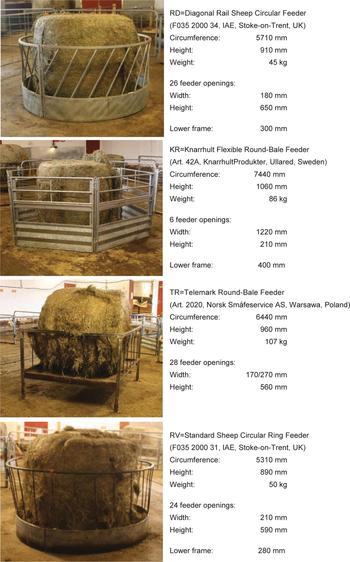
The shapes of the RD- and RV-feeders were round, the KR-feeder was a hexagon (with flexible sides which the ewes could move) and the TR-feeder was square (Figure 1). In the RD-, RV- and KR-feeders, the round-bales were oriented vertically and on the ground, whereas in the TR-feeder, the round-bale was oriented horizontally and located on an elevated platform (45 cm above the ground). The RD-feeder had diagonal dividers, the RV- and TR-feeders had vertical dividers, while the KR-feeder had no dividers.
The round-bale feeders for ewes. RD = Diagonal Rail Sheep Circular Feeder; KR = Knarrhult Flexible Round-Bale Feeder; TR = Telemark Round-Bale Feeder; RV = Standard Sheep Circular Ring Feeder.

The number of ewes that could eat simultaneously (circumference/0.45 m per ewe) was 12.6, 16.5, 14.3 and 11.8 in the RD, KR, TR and RV-feeder, respectively.
Roughage type
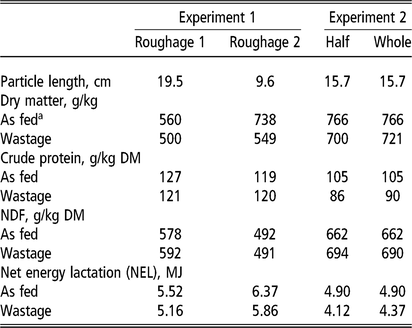
Roughage 1 was a low-quality roughage harvested at a late stage of maturity (grass silage; dry matter (DM) content of 560 g/kg), while Roughage 2 was a high-quality roughage harvested at an early stage of maturity (hay; DM content of 738 g/kg; Table 1). Both roughages were baled to round-bales. The round-bales were approximately 120 cm tall and 132 cm in diameter. Before the round-bales were placed in the round-bale feeders, they were weighed and core samples were taken. The average weight of offered round-bales was 514.0 ± 11.5 kg (287.9 ± 6.5 kg DM) for Roughage 1 and 467.9 ± 8.4 kg (346.2 ± 6.2 kg DM) for Roughage 2. Every fourth day, the remaining roughage inside the round-bale feeders was replaced with a new round-bale.
Particle length, dry matter and nutrient content of roughages fed to the ewes

a Core samples of roughages.
The median particle length of the roughages was measured by hand sorting and were 19.50 cm for Roughage 1 and 9.61 cm for Roughage 2 (Table 1). The leaf : stem ratio was observed to be greater in Roughage 2 than in Roughage 1. DM content of the core samples was determined by drying at 59 ºC to constant weight and weighed when warm. Dried samples were milled through a 1-mm screen (Retsch GmbH cutting mill, Haan, Germany). Before analysis, an equal amount of each core sample for each roughage type was pooled to one sample. Neutral detergent fiber (NDF) was determined according to Mertens (Reference Mertens2002) using sodium-sulfite, heat-stable alpha amylase and ash correction. Crude protein (CP) was determined by the Kjeldahl method on a Kjeltec Auto 2400/2600 (Tecator AB, Höganäs, Sweden). Ash content was determined by ignition of the dried sample at 550 ºC for 4 h. Rumen digestible organic matter (VOS) was determined according to Lindgren (Reference Lindgren1979) and used to calculate the concentration of metabolizable energy (ME) in the roughage according to Lindgren (Reference Lindgren1983) using the equation: MJ ME/kg OM = 0.160 × VOS – 1.91. The concentration of net energy of lactation (NEL) in roughage was calculated from ME according to Van Es (Reference Van Es1978).
Feed wastage
Every morning at 0800, the roughage on the ground surrounding the feeder (wastage) was thoroughly collected, weighted and sampled. Care was taken to minimize contamination of samples with manure, although some contamination was unavoidable. Before analysis, the wastage samples were composited to one sample for each roughage type and feeder. Dry matter content of wastage samples were analyzed as described for the core samples. Because of the variation in the weight of the round-bales it is most correct to present data on feed wastage as kilogram DM per day and not as proportion of the round-bale weight. During rotation number 3 in Period 1, the animals from the different groups were mixed accidentally and wastage data for this rotation are therefore excluded from the analysis.
Behavioral observations
The feeding behavior of the ewes was scored by an observer using instantaneous sampling at 2-min intervals for Days 2 and 4 from 0900 to 1200 h and 1500 to 1800 h for each rotation in Period 2, using the following ethogram:
Feeding behavior (number of ewes):
1. Eating with whole head inside the feeder (both ears inside the feeder)
2. Eating with head partly inside the feeder (at least one ear outside the feeder)
3. Eating from the feeder while climbing with the front legs
4. Eating roughage from the floor around the feeder (<1 m away from the feeder)
Feeding behavior was calculated as proportion (%) of total observations.
Experiment 2
Experimental design
As in Experiment 1, a three-factor randomized block designed experiment was conducted. The same round-bale feeder designs (RD, RV, KR and TR) were used, but now the ewes were offered half (Period 1) and whole (Period 2) round-bales of roughage. The same experimental design, as in Experiment 1, was used, hence, all groups had 4 days with each of the eight treatments. To be accustomed to the test situation and the roughage, the groups were rotated between the experimental pens and spent 48 h with each feeder before the experiment started (adaption period). There was no adaption period between Periods 1 and 2 as the ewes were given the same roughage type.
Animals and housing
Forty pregnant ewes (early gestation) of the Norwegian White breed, were randomly selected (not previously used in Experiment 1). The ewes were divided into four groups with a mean age of 2.3 ± 0.1 years and mean BW of 83.9 ± 1.7 kg. Two ewes were infected with listeriosis and had to be replaced in Period 1 by two ewes of the same age and weight class. The experiment was conducted in the same building and the same experimental pens as in Experiment 1. The air temperature varied between 5.4 ºC and 12.8ºC. Before the experiment began, ewes had been kept in groups of 20 to 25 animals and fed roughage ad libitum in a feeding through where all the ewes could eat simultaneously.
Roughage type
The roughage feed was harvested at a late stage of maturity (hay; DM content of 766 g/kg; Table 1) and the bales were of the same size as in Experiment 1. In Period 1, the round-bales were cut in half and, therefore, measured only half of the height (approximately 60 cm tall). The average weight the round-bales was 188.3 ± 6.0 kg (145.0 ± 4.6 kg DM) for half round-bales and 419.3 ± 9.1 kg (322.8 ± 7.0 kg DM) for whole round-bales. The procedure for feeding, sample collection and feed analysis was done as in Experiment 1 and the median particle length of the hay was 15.70 cm (Table 1). Before analysis, the core samples were composited to one sample.
Feed wastage
Feed wastage was collected, weighted, sampled and analyzed as in Experiment 1.
Behavioral observations
The feeding behaviors were scored with the same method and ethogram as in Experiment 1 with the exception that the morning observations were reduced to only 1 h (due to low feeding activity between 1000 and 1200) for both Periods 1 and 2.
Statistical analyses
All statistical analyses were conducted in R (R Core Team, 2014). Wastage per kg DM/day per ewe (day was the lowest statistical unit) from Experiments 1 and 2 was analyzed with separate linear mixed effect models (LMM; using the lme4 package; Bates et al., Reference Buskirk, Zanella, Harrigan, Van Lente, Gnagey and Kaercher2015), with day of observation (1 to 4), period (roughage type (Experiment 1) and round-bale size), round-bale feeder design (all three included as factor variables) and a period by round-bale feeder design interaction as fixed effects. Group was included as a random effect. The significance of the fixed effects was determined using the ANOVA function, where degree of freedom is calculated using Satterthwaite approximations. Tukey post-hoc tests (using the multcomp package; Hothorn et al., Reference Hothorn, Bretz and Westfall2008) were used to correct for multiple comparisons among days, round-bale feeder design and periods. Approximate normality of the residuals was confirmed using QQ plots and histograms.
The behavioral variables (average number of animals engaged in each behavior) from Experiments 1 and 2 were analyzed with generalized linear mixed models (GLMM; using lme4), one model per variable per experiment. Data from morning and afternoon observations were averaged prior to analysis, making day of observation the lowest statistical unit. The behavioral variables were right-skewed; therefore, the models used a Gamma error distribution with log link functions (adding 0.0001 to variables with zero values to ensure that all values were positive). For the Experiment 1 variables, round-bale feeder design and day of observation were included as fixed effects and group as a random effect. Models for Experiment 2 were the same as for Experiment 1 but included period as a fixed effect also. Overall significance of the fixed effects was determined using Wald chi-square tests (using the car package; Fox and Weisberg, Reference Fox and Weisberg2011). Tukey post-hoc tests were used to correct for multiple comparisons among feeder designs. Significance level was set at P < 0.05.
Results
Experiment 1
Feed wastage
Overall mean feed wastage was 1.08 ± 0.08 kg DM/day per ewe and decreased gradually (F = 8.93, P < 0.001) from Day 1 (1.27 kg DM/day per ewe) to Day 4 (0.86 kg DM/day per ewe). Feed wastage was almost four times as high when feeding Roughage 1 compared to Roughage 2 (Table 2). Feeder design also had significant impact on feed wastage. There was no interaction between roughage type and type of feeder.
Wastage for different feeder designs and Roughage type (Roughage 1 and 2) presented as kg DM/day per ewe (mean ± standard error) in Experiment 1

RD = Diagonal Rail Sheep Circular Feeder; KR = Knarrhult Flexible Round-Bale Feeder; TR = Telemark Round-Bale Feeder; RV = Standard Sheep Circular Ring Feeder.
a,bMeans with different superscript letters differ significantly.
The DM content of the wastage was lower than that in the roughage offered (Table 1). For Roughage 1, the wastage had a decreased content of CP compared to the roughage fed; however, for Roughage 2, the CP content of the roughage and wastage was similar.
Feeding behavior
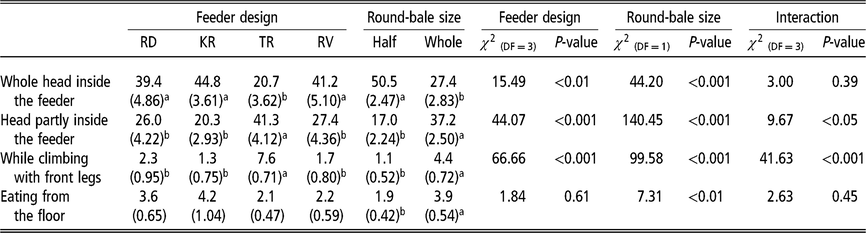
The ewes spent approximately 40% of their time eating during the observation period. Time spent eating with the whole head inside the feeder was significantly lower for the TR-feeder than for the other feeders (Table 3). Eating with the head partly inside the feeder was lowest in the KR-feeder. Climbing with the front legs on the feeder while eating was most prominent in the RV and TR-feeders. Time spent eating wastage from the floor was almost negligible.
Observations (mean ± standard error) of eating behavior of ewes in % of total observations for different feeder design in Experiment 1

RD = Diagonal Rail Sheep Circular Feeder; KR = Knarrhult Flexible Round-Bale Feeder; TR = Telemark Round-Bale Feeder; RV = Standard Sheep Circular Ring Feeder.
a,b,cMeans with different superscript letters differ significantly.
Interestingly, time spent eating with whole head inside the feeder increased from 9.3% at Day 2 to 15.6% at Day 4, while time spent feeding with head partly inside feeder decreased from 30.3% at Day 2 to 20.8% at Day 4. Eating from the feeder while climbing with the front legs decreased only slightly from 3.6% at Day 2 to 2.8% at Day 4.
Experiment 2
Feed wastage
Overall mean feed wastage was 2.19 ± 0.11 kg DM/day per ewe and decreased gradually (F = 36.31, P < 0.001) from Day 1 (2.99 kg DM/day per ewe) to Day 4 (1.37 kg DM/day per ewe). Feed wastage was almost double when feeding whole bales (2.88 kg DM/day per ewe) compared to half bales (Table 4). Feed wastage was highest for the TR-feeder. Interestingly, there was also an interaction between size of round-bales and feeder design so that there was no effect of type of feeder on feed wastage when using whole bales (Figure 2), whereas when using half bales, the feed wastage was highest on the TR-feeder.
Wastage for different feeder designs and round-bale size (half and whole) presented as kg DM/day per ewe (mean ± standard error) in Experiment 2

RD = Diagonal Rail Sheep Circular Feeder; KR = Knarrhult Flexible Round-Bale Feeder; TR = Telemark Round-Bale Feeder; RV = Standard Sheep Circular Ring Feeder.
a,bMeans with different superscript letters differ significantly.
As in Experiment 1, the DM content of the wastage was lower than in the roughage offered (Table 1). The wastage of the half bales had a lower content of NEL than that of the whole bales; otherwise, there were small differences between wastage from half and whole bales.
The interaction effect of feeder design and round-bale size (half and whole bales) on wastage in kg DM/day per ewe (Experiment 2). Means with different superscript letters differ significantly. RD = Diagonal Rail Sheep Circular Feeder; KR = Knarrhult Flexible Round-Bale Feeder; TR = Telemark Round-Bale Feeder; RV = Standard Sheep Circular Ring Feeder.

Feeding behavior
The ewes spent approximately 70% of their time eating during the observation period. Time spent eating with the whole head inside the feeder was much higher when feeding half bales than when feeding whole bales (Table 5). Feeder design also influenced feeding behavior in that time spent eating with the whole head inside the feeder was lower for the TR-feeder. Time spent eating with the head partly inside the feeder was much higher when feeding whole bales and also higher on the TR-feeder compared to the other feeders (Table 5).
Observations (mean ± standard error) of behavior of ewes in % of total observations for different feeder design and round-bale size (half and whole) in Experiment 2

RD = Diagonal Rail Sheep Circular Feeder; KR = Knarrhult Flexible Round-Bale Feeder; TR = Telemark Round-Bale Feeder; RV = Standard Sheep Circular Ring Feeder.
a,bMeans with different superscript letters differ significantly.
Time spent eating while climbing with the front legs on the feeder was significantly higher when feeding whole bales compared to half bales (Table 5) and this behavior was more frequent on the TR-feeder compared to the other feeders. There was also an interaction (Figure 3) showing that eating while climbing with the front legs was only observed on the TR-feeder when feeding half bales.
The interaction effect of feeder design and round-bale size (half and whole bales) on time ewes spent eating while climbing with their front legs on the feeder in percent of total observations (Experiment 2). Means with different superscript letters differ significantly. RD = Diagonal Rail Sheep Circular Feeder; KR = Knarrhult Flexible Round-Bale Feeder; TR = Telemark Round-Bale Feeder; RV = Standard Sheep Circular Ring Feeder.

Time spent consuming feed wastage from the floor was more than double when feeding whole compared to half bales (Table 5). Feeder design had no impact on this behavior.
Discussion
The amount of feed wastage was generally high. For ewes with BW of 80 kg in early gestation, feed intake was estimated to be 1.6 to 2.0 kg DM per day (NRC, 2007) corresponding to the findings of Eknæs et al. (Reference Eknæs, Randby and Nørgaard2009) who reported feed intake of 1.75 kg DM/day per ewe. In the present experiments, feed wastage ranged between 0.48 and 2.88 kg DM/day per ewe, and the amount of feed wastage was actually higher than estimated feed intake in two of four periods. Type of roughage, size of round-bale (half or whole), days within treatment period and feeder design all had a significant impact on feed wastage. The type of roughage was the most important factor.
Data for feed wastage were collected for the first 4 days after supplying a new round-bale and showed that the wastage was highest on Day 1 and then gradually reduced. Similarly, Moore and Sexten (Reference Moore and Sexten2015) found a decrease in feed wastage the first 4 days, but this was, however, not significant. Also Sparks et al. (Reference Sparks, Sexten, McMurphy, Mourer, Brown, Richards and Lalman2013) and Martinson et al. (Reference Martinson, Wilson, Cleary, Lazarus, Thomas and Hathaway2012) reported observations on feed wastage for the first 4 days, but did not look at the effect of day.
When feeding half round-bales, the amount of feed wastage was nearly half compared to that of the whole round-bales. The decreasing amount of feed wastage with decreasing amount of feed in the feeder (the effect of day) explains the reduced feed wastage when supplying only half round-bales. Reduced feed wastage when feeding half round-bales correspond to the results found by Sveinbjörnsson (Reference Sveinbjörnsson1999) where wastage was approximately three times less when feeding half round-bales compared to whole round-bales. One of the reasons for the reduced feed wastage is probably the change in feeding behavior of the ewes. Just like cows (Albright, Reference Albright1993), sheep mainly eat with their heads in the downward position. When feeding whole round-bales, the ewes have to raise their head to ingest the feed. They probably feel uncomfortable (breathing and swallowing difficulties) and will tend to drag the feed out of the feeder to be able to eat in their natural position. This is supported by the data showing that the time spent eating with the head inside the feeder was 27.4% to 50.5% when feeding whole and half round-bales, respectively. The ewes likely dropped more of the potential wastage inside the feeder and not on the ground outside the feeder. This corresponds to the suggestions by Moore and Sexten (Reference Moore and Sexten2015) that animals have to reach further into the feeder when bales are smaller in mass, resulting in potentially reduced wastage.
The major factor influencing feed wastage was type of roughage. In Experiment 1, the feed wastage was nearly four times higher for Roughage 1 than for Roughage 2. Roughage 1 was round-bales harvested at a later stage of maturity than Roughage 2 and, hence, had a lower nutritive value. Late harvested forages are also characterized by an increased proportion of stems in relation to leaves (Rinne and Nykanen, Reference Rinne and Nykanen2000). This is pointed out by the longer particle length of Roughage 1 compared to Roughage 2. In this study, there was an indication of ewes selecting leaves in Roughage 1, as there was a numerical reduction in CP and increase in NDF for wastage compared with the roughage fed. It is evident that the ewes pulled out the long fibrous stems of the feeders and left them as wastage on the floor around the feeder. There were no indications of selection of leaves in Roughage 2 as CP was not different for roughage fed or wastage. Therefore, differences in selection may be a product of a greater leaf:stem ratio in the early compared to the late harvested roughage. This corresponds to Van Soest’s (Reference Van Soest1994) statement that sheep are able to select the most nutritious fractions of forages offered to them. The results of this study also agree with those of Moore and Sexten (Reference Moore and Sexten2015) where wastage was greater for low-quality forage compared to high-quality forage. It seems as though the DM content of the roughage does not have impact on the feed wastage in this study.
In Experiment 2, the roughage used was also of late stage of maturity and the amount of wastage, as a mean for all the feeder designs and round-bale size, was even greater than for Roughage 1 in Experiment 1 (2.88 v. 1.88 kg DM/day per ewe). This reflects a lower quality of roughage in Experiment 2 than Roughage 1 in Experiment 1. The high wastage for late harvested roughage in both experiments indicates that feeding round-bales of late harvested forage in a round-bale feeder can cause high feed wastage.
Although there was a significant effect of feeder design on feed wastage, the real differences were small. It is interesting to compare the data for the different feeders in Experiments 1 and 2. In Experiment 1, the TR-feeder was the feeder with the lowest feed wastage; whereas in Experiment 2, there was an interaction between type of feeder and size of round-bales. When feeding whole round-bales, there were no differences between the round-bale feeders, but when feeding half round-bales, the feed wastage was significantly greater on the TR-feeder. The reason for this might be that half round-bales did not fit properly in the TR-feeder’ design. The order of performance concerning feed wastage for the other feeders also differed between Experiments 1 and 2. There seems to be no clear and pure effect of feeder design on feed wastage. This is not in correspondence to the findings in horses, where Martinson et al. (Reference Martinson, Wilson, Cleary, Lazarus, Thomas and Hathaway2012) found large effect of feeder design on feed wastage. Further, Martinson et al. (Reference Martinson, Wilson, Cleary, Lazarus, Thomas and Hathaway2012) did not observe significant differences regarding feed wastage among circular feeders, which was confirmed by this study. Hay wastage was also similar between circular feeders when feeding beef cattle (Buskirk et al., Reference Bates, Mächler, Bolker and Walker2003). The two feeders with the lowest feed wastage reported by both Sparks et al. (Reference Sparks, Sexten, McMurphy, Mourer, Brown, Richards and Lalman2013) and Buskirk et al. (Reference Bates, Mächler, Bolker and Walker2003) were circular feeders with sheeted bottoms, which aids in containing the feed within the feeder. In this study RD-, KR- and RV-feeder had sheeted bottoms, but we did not have other circular feeders without a sheeted bottom section and cannot confirm the effect.
In general, the ewes spent only little time consuming wastage from the floor. However, they spent more time eating from the floor when feeding from whole round-bales compared to half round-bales in Experiment 2, which is probably related to the larger amount of feed wastage available on the floor. Eating while climbing on the feeder with their front legs had a low frequency in both the experiments and the relevance is probably to improve the access to the feed. When feeding half round-bales, this behavior was less frequent than when feeding whole round-bales, due to lower levels of feed in the feeders. This was not the case for the TR-feeder, because the elevated platform kept the half round-bales on the same level as the whole round-bales.
Conclusion
Providing early harvested roughage reduced feed wastage by nearly four times when compared to roughage harvested at a later stage, and feeding half round-bales gave half of the feed wastage compared to whole round-bales. Feeder design also had a significant impact on feed wastage.
Acknowledgements
This study was a part of the Norwegian research project Fårebygg. The authors would like to thank the staff at The Animal Production Experimental Center at The Norwegian University of Life Sciences for their excellent cooperation during the experiments and for taking good care of the animals. We would also like to thank Rachel Chojnacki for comments on the manuscript and Conor Goold for his statistical advice.
Declaration of interest
Mention of commercial products in this publication is solely for the purpose of providing specific information and does not imply any recommendations. The authors confirm that there are no known conflicts of interest associated with this publication.
Ethics statement
Since the management procedures in this study were comparable to ordinary husbandry practice, no specific approval was needed.
Software and data repository resources
None of the data were deposited in an official repository