Introduction
The World Health Organization (WHO; Geneva, Switzerland) defines a mass gathering as “any occasion, either organized or spontaneous, that attracts sufficient numbers of people to strain the planning and resources of the community, city, or nation hosting the event.”Reference Todkill, Hughes, Elliot, Morbey, Edeghere, Harcourt, Hughes, Endericks, McCloskey, Catchpole, Ibbotson and Smith 1 The Olympics are one of the largest, planned, global mass-gathering events; the London 2012 Olympic Games were the equivalent to hosting 26 World Championships in Athletics simultaneously, providing a challenge to the transport and logistical infrastructure of the host city. 2 Organizers of previous Olympic Games have been concerned about the potential for excessive strain on health services and infrastructure. 3 The characteristic high visitor rate to host cities during the Olympics,Reference Brennan, Keim and Sharp 4 possible efflux of the resident population,Reference Jorm, Thackway and Churches 5 and disruption to usual transport and business 2 have the potential to cause both changes in the health of the population and the usual need for health care. Estimating the impact of these mass-gathering events is critical to future planning.
Syndromic surveillance has a key role in monitoring health conditions relevant to public health during mass-gathering events, providing decision makers with near to real-time public health intelligence. The Real-time Syndromic Surveillance Team (ReSST; Birmingham, United Kingdom) within Public Health England (PHE; London, United Kingdom) operates a suite of syndromic surveillance systems enabling the early detection of emerging threats to public health and providing situational awareness as well as reassurance of lack of impact on public health during or following significant events, such as disease outbreaks or mass gatherings.
In preparation for the 2012 London Olympic Games, the existing PHE suite of syndromic surveillance systems was expanded to include daily general practitioner (GP) out-of-hours (OOH) contactsReference Severi, Heinsbroek and Watson 6 and emergency department (ED) attendancesReference Harcourt, Fletcher and Loveridge 7 at sentinel sites. These new systems offered the opportunity to monitor trends in patient contacts with GPs outside of normal daytime opening hours, as well as the more severe end of the disease spectrum which would present to EDs. These new systems covering unscheduled health care provision by the National Health Service (NHS; London and Leeds, United Kingdom) were of importance as they represented the most likely type of health care to be accessed by a transient population visiting for the Games.
The Games fortunately were free of major incidents. The predecessor organization of PHE, the Health Protection Agency (HPA; London, United Kingdom), produced a daily situation report (SitRep) to both Olympic and Governmental committees responsible for Games-related organization, which highlighted surveillance items of potential public health significance. The most commonly used phrase in the SitRep was “nothing of significance to report.”Reference Elliot, Morbey and Hughes 8
The ReSST reported two incidents during the Games and preceding two months: an unusual rise in asthma/difficulty breathing across all syndromic surveillance systems was identified in mid-July 2012, the cause of which remained unclear; and a rise in the number of calls due to “heat and sun” to the remote health advice line, NHS Direct, also was identified during the time of the Games, which upon further analysis was within expected levels for that time of year.Reference Harcourt, Fletcher and Loveridge 7
The Chief Medical Officer of the Games, Dr. Richard Budgett, in his assessment of the adequacy of surveillance systems and the public health response during London 2012, stated that “the HPA have set a new benchmark for comprehensive surveillance and reporting.”Reference Elliot, Morbey and Hughes 8
Although no public health incidents were identified during the Games period, syndromic surveillance data from the 2012 London Games provide an account of how health care was accessed at sentinel sites during one of the world’s largest mass-gathering events; of crucial use for future planning. This report is the first to describe what effect the Games had on public health and health services as monitored in near real-time by syndromic surveillance of GP OOH contacts and ED attendances. This information then may be used to aid the planning of future events.
Methods
This observational, cross-sectional study used data which were collected prospectively and statistically analyzed contemporaneously as part of the standard syndromic surveillance carried out by ReSST.
Setting
The Emergency Department Syndromic Surveillance System (EDSSS) is a sentinel system, including reporting from individual EDs across England, with particular focus on London. The General Practitioner Out-of-Hours System (GPOOHS) is able to report on a greater population due to the nature of GP OOH service provision in England, with individual providers covering specified geographical areas, rather than a single hospital. The EDSSS and GPOOHS use secure, automated processes to collect anonymized data from a network of providers on a daily basis. The information received for each system includes basic (non-identifiable) patient demographics of age/sex/general geographical location, their clinical diagnosis, severity of presentation, and the date/time of each patient contact.
Data Sources and Participants
The data used here relate to all ED attendances and GP OOH contacts, from eligible participating locations from July 13 to August 26, 2012, and are divided into three distinct time periods: pre-Olympic period (July 13-26, 2012); Olympic period (July 27 to August 12); and post-Olympic period (August 13-26, 2012). Data also were collected from the equivalent time period during 2013 (July 12 to August 25, 2013), beginning on the same day of the week as the 2012 time period.
As the EDSSS has continued to expand since summer 2012, departments were eligible for inclusion in this study only if they had reported continuous daily data during the Olympic period 2012 and the same period during summer 2013. All GPOOHS data for both time periods were used, however, the numbers of patient contacts recorded did increase with changes in the geographical coverage of service providers between years.
Variables
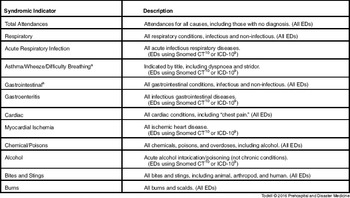
The EDSSS uses a variety of syndromic indicators, based on the diagnosis code entered for each attendance, including those of an infectious nature (eg, gastroenteritis) as well as others related to trauma (eg, fractures), environmental (eg, bites and stings), or lifestyle (eg, acute alcohol intoxication) factors (Table 1). Since not all EDs can report detailed diagnoses (by using either the WHO International Statistical Classification of Diseases and Related Health Problems 10th Revision [ICD-10] 9 or the International Health Terminology Standards Development Organisation SNOMED CT 10 coding systems), a range of indicators is used; for example, all EDs provide information on the generic indicators such as “chemical or poisoning” (which includes all admissions due to chemicals, poisons, overdoses, and alcohol) with a smaller number reporting more detail, such as attendances due to “acute alcohol intoxication.”
EDSSS Syndromic Indicators Included in this Investigation

Abbreviations: ED, emergency department; EDSSS, Emergency Department Syndromic Surveillance System.
a One London ED was unable to report respiratory, asthma, or gastrointestinal conditions during July/August 2013, so has been excluded from all analyses for these conditions. Reporting of other diagnoses was not affected.
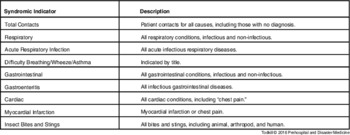
The GPOOHS collects fully anonymized data from GP OOH and unscheduled care service providers in England. Syndromic indicators, similar to those developed for EDSSS, were developed using the diagnoses recorded for each patient contact with the GP OOH service providers (Table 2).
GPOOHS Syndromic Indicators Used in this Investigation

Abbreviation: GPOOHS, General Practitioner Out-Of-Hours Syndromic Surveillance System.
Descriptive & Statistical Analysis
Anonymized ED and GP OOH data were analyzed according to patient age, sex, and the reported diagnosis. Time series plots were constructed for each of the syndromic indicators (Table 1 and Table 2) for England and London separately to identify any unusual trends between the summer of the 2012 Olympics and the same period the following year.
Overall counts and percentages of attendances and contacts for individual syndromic indicators during the Olympic Games were compared with a comparable time period in 2013.
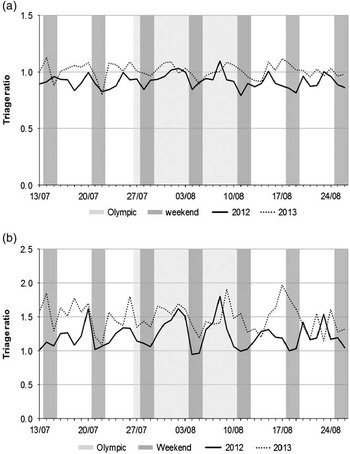
The severity of presentations to EDs (as recorded at triage) was assessed using a triage ratio: the ratio of patients classified as “very urgent” or “urgent” to those classified as “standard” or “non-urgent.” An increase in triage ratio would signify either an increase in more-severe presentations or even a decrease in those presenting with less-severe conditions.
“Spikes” (increased attendances) observed during the visual examination of the time series plots were assessed statistically using the students t-test to compare the spikes with attendances during the equivalent days of the weeks in July and August 2012 and 2013, to provide P values.
Results
Participants and Data Summary
Twenty-three English EDs, including six in London, reported to EDSSS on a daily basis during the period of July 13 to August 26, 2012. The EDSSS is a sentinel system with surveillance activities based on the numbers of attendances in participating departments; the population served by EDs often overlaps with other departments and also includes those not resident locally. The same EDs continued to participate in EDSSS during the following year, though reported a slightly higher number of attendances (+4.3%) for the time period in 2013 reported here (Table 3).
Number of EDs Reporting to EDSSS and Total Attendances Recorded, London and England, Olympic Period 2012 and Comparable Dates 2013

Abbreviations: ED, emergency department; EDSSS, Emergency Department Syndromic Surveillance System.
One London ED failed to report to EDSSS on August 24, 2012; this ED was included in this analysis, as this date fell outside of the core Olympic period (July 27, 2012 to August 12, 2012). The absence of data from this one ED, on a single day, did not account for the lower number of attendances during 2012 overall.
Forty-five GP OOH and unscheduled care providers in England contributed fully anonymized data on a daily basis during the 2012 study period, providing coverage in 119 out of 152 former English Primary Care Trusts (health service administrators). Though the number of providers fell to 43 during 2013, the number of contacts increased between 2012 and 2013, particularly in London. This increase was due to changes in the areas served by individual providers, meaning a larger geographical area was included in 2013 from fewer GP OOH provider organizations (Table 4). This change could not be controlled for in the analysis carried out.
Number of OOH Providers Reporting to GPOOHS and Total Contacts Recorded, London and England, Olympic Period 2012 and Comparable Dates 2013

Abbreviations: GPOOHS, General Practitioner Out-of-Hours Syndromic Surveillance System; OOH, Out-of-Hours.
Overall Attendances to EDs and Contacts to GP OOHs
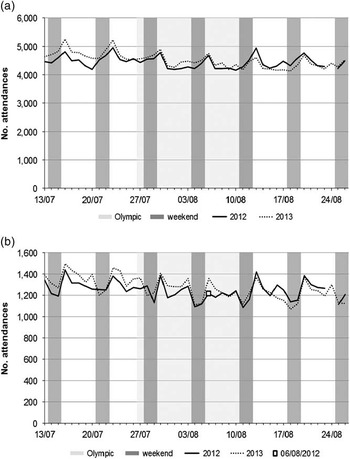
The weekly pattern of daily attendances to EDs was similar during the 2012 Olympic period to that observed in the pre- and post-Olympic periods in 2012, and similar time periods in 2013, in both London and England (Figure 1), with attendances peaking on Mondays.
A. Daily Number of EDSSS Attendances, Summer 2012 and 2013, England. B. Daily Number of EDSSS Attendances, Summer 2012 and 2013, London (Note: 2013 dates are matched on day of the week [eg, 7/13/12 equivalent date is 7/12/13]). Abbreviation: EDSSS, Emergency Department Syndromic Surveillance System.

Though this pattern was consistent nationally, the magnitude of the Monday peak and the daily number of attendances in general were seen to fall from the beginning of August during both 2012 and 2013 (Figure 1). The fall in daily attendances coincided with the Olympics in 2012 and the beginning of the school summer holidays in both years. Nationally, the number of school-aged children attending participating EDs fell by approximately 30% during the last week of July, into the first week of August, in both 2012 and 2013 (data not shown).
Daily numbers of attendances decreased during the Olympic period of both years, but during 2012, returned to pre-Olympic levels in mid-August following the Olympic closing ceremony. However, a similar increase was not observed in 2013 until a week later, at the end of August, though not to the same level as they had been pre-Olympic (Figure 1A).
One exception to the observed Monday spikes in daily ED attendance numbers in London was on Monday, August 6, 2012 (Figure 1B). The usual spike in attendances was not observed and further investigation showed that there were lower than usual attendances from 10:00 am to 2:00 pm. A similar pattern was not observed in 2013 (Figure 1B).
The pattern of GP OOH contacts recorded nationally and within London was characterized by stable numbers during the week (Monday - Friday) with a two-fold increase in daily contacts during the weekend (Saturday - Sunday). As with the EDSSS, a decrease in numbers was reported from the end of July, followed by an increase during late August during both years.
Syndromic Indicators
The contemporaneous syndromic surveillance and daily situation reporting did not flag up any public health impact during the Olympic period, either within London or across England. The majority of the syndromic indicators included in the study, from both EDSSS and GPOOHS, showed consistently similar trends during 2012 and 2013, both nationally and in London.
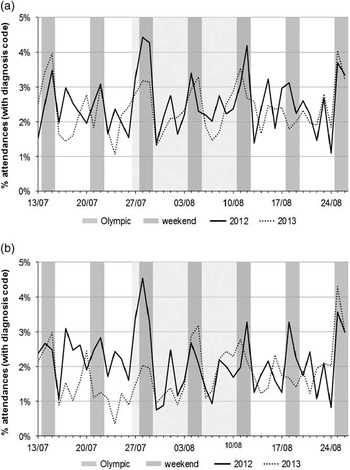
An exception was London EDSSS attendances related to “chemicals and poisons.” This indicator includes accidental and intentional poisonings/overdoses, as well as acute alcohol intoxication-related diagnoses. During the first weekend of the 2012 Olympics, London EDs recorded an increase in attendances with “chemical overdose or poisoning” diagnoses. In those locations able to distinguish between substance types involved, an increase was observed in acute alcohol-related attendances over the same weekend (Figure 2).
A. Daily Percentage of EDSSS Attendances for Chemicals/Poisons-related Diagnoses, London. B. Daily Percentage of EDSSS Attendances for Acute Alcohol-related Diagnoses, Summer 2012 and 2013, London (Note: 2013 dates are matched on day of the week [eg, 7/13/12 equivalent date is 7/12/13]). Abbreviation: EDSSS, Emergency Department Syndromic Surveillance System.

The spike observed around July 28, 2012 was higher than both the preceding and following weeks in 2012, and the same time period in 2013. This pattern coincided with the timing of the Olympic opening ceremony (9:00 pm July 27, 2012 to 1:00 am July 28, 2012) and was not observed nationally or in the GPOOHS. This observed increase in alcohol-related attendances during the opening ceremony period was statistically significantly higher than equivalent days of the weeks in July and August 2012 and 2013 (P value=.0003).
Analysis by hour of arrival at the EDs showed temporal clustering in attendances during the early hours of Saturday, July 28, 2012. This relatively large peak in attendances observed during the tail end of the opening ceremony followed a number of early afternoon and evening attendances prior to the start of the opening ceremony on Friday, July 27, 2012.The hourly numbers of attendances due to “chemical overdose or poisoning” diagnoses (as well as the more specific acute alcohol intoxication attendances) from midnight to 3:00 am on Saturday, July 28, 2012 were around double the numbers seen during the same time period in the preceding and following weekends (data not shown).
Severity of Presentation to Sentinel EDs
The severity of the presentations as recorded at triage and measured by the EDSSS triage ratio was similar during the pre-Olympic, Olympic, and post-Olympic time periods (Figure 3). This implies that there was no change in the overall severity of presentations at participating EDs. There was, however, a notable difference between years, with the daily triage ratios of 2012 consistently lower than those recorded for 2013. Also, the daily triage ratio reported for EDSSS attendances in London (mean 2012 = 1.22, 2013 =1.49; Figure 3B) was found to be higher than that for the whole of England (mean 2012 = 0.92, 2013 = 1.01; Figure 3A).
A. Daily EDSSS Triage Ratios, Summer 2012 and 2013, England. B. Daily EDSSS Triage Ratios, Summer 2012 and 2013, London (Note: 2013 dates are matched on day of the week [eg, 7/13/12 equivalent date is 7/12/13]) Abbreviation: EDSSS, Emergency Department Syndromic Surveillance System.

Discussion
During the 2012 London Olympics, significant increases in unscheduled health care attendances at either sentinel EDs or GP OOH service providers were not observed. Though a difference in levels of reported triage severity between years and in different geographical settings was identified, there was no evidence that any changes occurred during or around the Olympics. There was evidence of increased ED attendances due to alcohol and substance misuse around the time of Olympic-associated ceremonies.
During the London 2012 Olympic Games, clinical activity reported to the EDSSS and GPOOHS were lower than the pre- and post-Olympic periods. Taken in isolation for that one year, this may have been attributed to the Olympics. The pattern was not unique to the Olympic year: a similar pattern was observed in 2013, suggesting this may be a usual summer pattern for the syndromic indicators analyzed. This phenomenon may have been caused by the effects of school holidays, but further investigation is needed. The findings highlight the need for adequate baseline data prior to mass-gathering events and data should be collected for at least one year to enable appropriate comparison.
The absence of the usual Monday spike in ED attendances on August 6 is unexplained. It is likely that this just represents a random or chance deviation from the norm. Nonetheless, the ability of syndromic surveillance to identify and investigate very granular (ie, hourly) changes in daily ED attendances demonstrates the capacity for syndromic surveillance systems to closely monitor changes in health care presentations, which could be critical to detecting and monitoring an emerging threat.
These findings are consistent with the experience of the 1996 Atlanta (Georgia USA) Olympic Games, which found no significant increases in ED presentations at four metropolitan and four non-metropolitan sentinel hospitals during the Games. 3 However, during the Sydney (Australia) 2000 Olympic Games, a small increase (approximately five percent) in presentations to sentinel Sydney EDs was observed when compared to comparable periods in other years.Reference Brennan, Keim and Sharp 4
During the Sydney 2000 Olympic Games, a significantly higher number of presentations for adverse events due to illicit drug use during the two-week Olympic period compared to the lead up to the Games was observed, culminating in a large peak following the closing ceremony. 11 The authors concluded public health resources should focus on prevention and treatment of illicit drug reactions during mass-gathering events, which typically are accompanied by a party atmosphere. 11 The magnitude of the observed increase in attendances for “chemical overdose or poisoning” and acute alcohol intoxication diagnoses reported here may have been the “tip of the iceberg” as it is likely to be an underestimation of attendances linked to alcohol,Reference Indig, Thackway and Jorm 12 given the potential for the primary diagnosis (eg, a fracture) to be recorded rather than any underlying cause (eg, alcohol intoxication).
This report provides a unique description of the impact of the London 2012 Olympic Games on attendances to sentinel EDs and contacts with GP OOH providers, which is of use to decision makers and planners for future large mass-gathering events.
Limitations
There were a number of limitations to this study: neither the EDSSS nor the GPOOHS had total coverage of the English population; and the EDSSS is a sentinel system and not all providers participate in the GPOOHS. Determining the normal pattern of patient contacts, the degree of variation in the pattern that constitutes unusual activity, and what activity can be attributed to communicable diseases incidents is still under development. The GPOOHS also increased coverage over the study period with some changes between 2012 and 2013 as providers expanded or changed boundaries.
As with all syndromic surveillance systems, the indicators used in the study are dependent on accurate and consistent coding of attendances, which was not validated. Due to the level of diagnostic detail required to identify them, some syndromic indicators in the EDSSS in particular had very small numbers of attendances associated with them, with any variation seen potentially due to chance rather than an unidentified cause.
In addition, the changes in trends and patterns observed in this study were not investigated contemporaneously as they quickly returned to normal; as such, causality cannot be inferred from the findings. In addition, possible confounders such as other events during the Olympics were not controlled for.
Conclusion
This study can provide reassurance to those planning future events that during the 2012 London Olympics, trends in ED attendances and GP OOH contacts were similar to that observed in 2013, despite the Games. One exception is the spike in attendances for alcohol and related chemical overdoses during the time of the opening ceremony, which may highlight an opportunity for future public health interventions to modify risky alcohol consumption. Syndromic surveillance has an important role in providing reassurance of lack of adverse health impacts of a mass-gathering event, and has demonstrated the capacity to provide near to real-time monitoring and identify hourly changes in patterns of health care presentations during mass-gathering events. The need for adequate baseline surveillance data (of at least one year) prior to the mass-gathering event to support trend analysis also has been highlighted.
Acknowledgments
The authors wish to thank and acknowledge the Royal College of Emergency Medicine (London, United Kingdom), staff within the respective NHS Trusts, EMIS Health (Leeds, United Kingdom), and L2S2 Ltd (Cambridge, United Kingdom) for emergency department data; also, out-of-hours/unscheduled care providers and Advanced Health & Care (Berkshire, United Kingdom) for the provision of surveillance data.