Sexual assertiveness refers to people’s ability to initiate sexual activity, reject unwanted sexual activity, and use contraceptive methods, developing healthy sexual behaviors. It is based on the human right to self-determination, which assumes that people have the right to make decisions about their own sexual experience and activity (Morokoff et al., Reference Morokoff, Quina, Harlow, Whitmire, Grimley, Gibson and Burkholder1997). It is a central component of human sexuality (Sánchez-Fuentes, Santos-Iglesias, & Sierra, Reference Sánchez-Fuentes, Santos-Iglesias and Sierra2014) and can be associated with three of its major areas: sexual functioning, sexual victimization, and risky sexual behaviors (Santos-Iglesias & Sierra, Reference Santos-Iglesias and Sierra2010). Sexual assertiveness is closely related to sexual functioning (Ménard & Offman, Reference Ménard and Offman2009; Santos-Iglesias, Sierra, & Vallejo-Medina, Reference Santos-Iglesias, Sierra and Vallejo-Medina2013) and marital satisfaction (Santos-Iglesias, Vallejo-Medina, & Sierra, Reference Santos-Iglesias, Vallejo-Medina and Sierra2009; Sierra, Vallejo-Medina, & Santos-Iglesias, Reference Sierra, Vallejo-Medina and Santos-Iglesias2011). However, no studies have explored the influence of sexual assertiveness on the sexual functioning of drug users, even though the latter is seriously damaged by heavy and/or long-term use of drugs (Bang-Ping, Reference Bang-Ping2009; Vallejo-Medina & Sierra, Reference Vallejo-Medina and Sierra2013). Therefore, sexual assertiveness may play an important role in the sexual functioning of drug users, although no empirical studies have explored this relationship.
Little research has focused on the effect of sexual assertiveness on male sexual victimization (Santos-Iglesias & Sierra, Reference Santos-Iglesias and Sierra2010). Morokoff et al. (Reference Morokoff, Redding, Harlow, Cho, Rossi, Meier and Brown-Peterside2009) found that sexual assertiveness is a mediator between risky sexual practices and sexual victimization in males. It has been pointed out that low sexual assertiveness can be both a consequence of victimization and a risk factor for experiencing it (Livingston, Testa, & VanZile-Tamsen, Reference Livingston, Testa and VanZile-Tamsen2007). In male drug users, few studies have assessed the probability of having unwanted sex. Shacham and Cottler (Reference Shacham and Cottler2010) reported that 8.60% of male drug users have had unwanted sex; moreover, 52.75% of cocaine and methamphetamine users admit having taken part in sexual practices that were uncommon to them because they were under the influence of drugs. Clinical practice reveals that they later regret participating in many such practices.
Sexual assertiveness also influences risky sexual behaviors. Many studies have identified the lack of sexual assertiveness as an important predictor of risky sexual behaviors (Noar, Carlyle, & Cole, Reference Noar, Carlyle and Cole2006; Noar, Morokoff, & Redding, Reference Noar, Morokoff and Redding2002; Zamboni, Crawford, & Williams, Reference Zamboni, Crawford and Williams2000). Sexual assertiveness has been related both with intention to use a condom (Baele, Dusseldorp, & Maes, Reference Baele, Dusseldorp and Maes2001; Roberts & Kennedy, Reference Roberts and Kennedy2006) and actual condom use (Auslander, Perfect, Succop, & Rosenthal, Reference Auslander, Perfect, Succop and Rosenthal2007; Crowell, Reference Crowell2004; Morokoff et al., Reference Morokoff, Redding, Harlow, Cho, Rossi, Meier and Brown-Peterside2009). People with low sexual assertiveness have a greater number of sexual partners (Auslander et al., Reference Auslander, Perfect, Succop and Rosenthal2007) and higher chances of having risky sexual partners (Dolcini & Catania, Reference Dolcini and Catania2000). There is a clear relationship between sexual assertiveness and sexually transmitted diseases/human immunodeficiency virus (STDs/HIV). Bertens, Eiling, van den Borne, and Schaalma (Reference Bertens, Eiling, van den Borne and Schaalma2009) and Di Noia and Schinke (Reference Di Noia and Schinke2007) found that interventions aimed at preventing STDs/HIV also led to improvements in sexual assertiveness. Programs designed to increase sexual assertiveness through role-play and behavioral rehearsal reduce the number of risky sexual behaviors (Sikkema, Winett, & Lombard, Reference Sikkema, Winett and Lombard1995; Weinhardt, Carey, Carey, & Verdecias, Reference Weinhardt, Carey, Carey and Verdecias1998). Studies on STDs/HIV usually focus on high-risk context such as men who have sex with other men or male parenteral drug users. However, the prevalence of STDs/HIV is increasing in heterosexual males who use non-injection drugs (Bellis et al., Reference Bellis, Hughes, Calafat, Juan, Ramon, Rodriguez and Phillips-Howard2008; Booth, Kwiatkowski, & Chitwood, Reference Booth, Kwiatkowski and Chitwood2000; Raj, Saitz, Cheng, Winter, & Samet, Reference Raj, Saitz, Cheng, Winter and Samet2007). These men are less likely to use a condom and have safe sex than men who have sex with other men (Ross & Williams, Reference Ross and Williams2001). Although the use of contraceptive methods in drug users has been widely studied, very few studies have approached the subject from the perspective of sexual assertiveness. In a study with female social drinkers who were given a small amount of alcohol, Stoner et al. (Reference Stoner, Norris, George, Morrison, Zawacki, Davis and Hessler2008) observed that occasional alcohol consumption did not seem to have a direct effect on sexual assertiveness but the latter may modulate the effect of alcohol on condom insistence. In another study with methamphetamine consumers in Thailand, a peer education STD prevention program was conducted. The program included elements of sexual assertiveness such as video communication and role-play applied to sex. Subjects who participated in the program reduced their consumption of methamphetamines and moderately increased condom use up to 12 months after the end of the program (Sherman et al., Reference Sherman, Sutcliffe, Srirojn, Latkin, Aramratanna and Celentano2009).
Greene and Navarro (Reference Greene and Navarro1998) consider that assertiveness is specific to each situation. In fact, it has been observed that people who are assertive in their daily lives are not necessarily sexually assertive (Zamboni et al., Reference Zamboni, Crawford and Williams2000). Therefore, it has been suggested that assertiveness in a sexual context should be evaluated using the specific construct of sexual assertiveness (Livingston et al., Reference Livingston, Testa and VanZile-Tamsen2007). In Spain, two sexual assertiveness scales have recently been validated: the Hurlbert Index of Sexual Assertiveness (HISA; Hurlbert, Reference Hurlbert1991; Santos-Iglesias, Vallejo-Medina, & Sierra, Reference Santos-Iglesias, Vallejo-Medina and Sierra2014) and the Sexual Assertiveness Scale (SAS; Morokoff et al., Reference Morokoff, Quina, Harlow, Whitmire, Grimley, Gibson and Burkholder1997; Sierra, Santos-Iglesias, & Vallejo-Medina, Reference Sierra, Santos-Iglesias and Vallejo-Medina2012). Although both are brief self-report scales with good psychometric, we decided to adapt and validate the SAS in a drug user population because its scale dealing with pregnancy prevention and condom use was considered very relevant for this population.
The SAS was created following the semantic and syntactic definition of the construct defined by Morokoff et al. (Reference Morokoff, Quina, Harlow, Whitmire, Grimley, Gibson and Burkholder1997). It is a questionnaire composed of 18 items clustered into three dimensions: 1) Initiation (items 1– 6), which assesses how often the person initiates a sexual relation and whether sex is wanted or not; this dimension is linked to sexual functioning; 2) Refusal (items 7–12), which assesses how often the person refuses an unwanted sexual relation or unwanted sexual practices; this dimension is linked to sexual victimization; and 3) Pregnancy/STD prevention (STD-P; items 13–18), which assesses how often the person insists on use of latex barrier contraceptives with a sexual partner; this dimension is linked to risky sexual behaviors. The Spanish version of the SAS has shown good psychometric properties in both men and women. The total reliability index of the scale was .82; in the subscales, the index was .80 for Initiation, .76 for Refusal, and .85 for STD-P. The original dimensionality of the scale has been replicated with both exploratory and confirmatory factor analyses (Sierra et al., Reference Sierra, Vallejo-Medina and Santos-Iglesias2011) and has shown to be equivalent between men and women (Sierra et al., Reference Sierra, Santos-Iglesias and Vallejo-Medina2012). The SAS has good convergent validity with the HISA (Sierra et al., Reference Sierra, Vallejo-Medina and Santos-Iglesias2011). The American version has also shown a stable factor structure, reliability indices ranging between .66 and .86, and good test-retest reliability (Morokoff et al., Reference Morokoff, Quina, Harlow, Whitmire, Grimley, Gibson and Burkholder1997).
Exploring the sexuality of special populations is a complex task. Drug users are a special population with specific characteristics. That is why we consider that it is essential to use a questionnaire adapted to their knowledge and vocabulary. This implies using simple words and content so that respondents do not have to ask questions about the meaning of the items, which would interfere with the privacy of responses and decrease the reliability of results. In addition, ensuring that all terms are easy to understand reduces the chances of misinterpretations and wrongly answered questions. However, modifying the questionnaire without assessing the equivalence of the forms would also be a serious mistake. It is only possible to compare both forms reliably (i.e., without bias) if factor and content equivalence has been obtained between them. Considering this, the purpose of the present study was to explore a number of psychometric properties of the adaptation of the Sexual Assertiveness Scale (SAS) to drug users in a sample of Spanish male drug users. To this end, we intended to conduct the following activities: analyze the metric properties of the items in the scale, assessing the factor invariance of the scale between a sample of male drug users and a sample of non-clinical males, and test for item bias using Differential Item Functioning (DIF); next, analyze the internal consistency and concurrent validity of the scale using the Changes in Sexual Functioning Questionnaire-Short Form (CSFQ-14; Keller, McGarvey, & Clayton, Reference Keller, McGarvey and Clayton2006) as well as various indicators of the validity of its measures; finally, present the data according to age and main substance used, comparing the drug user group with the non-clinical group.
Method
Participants
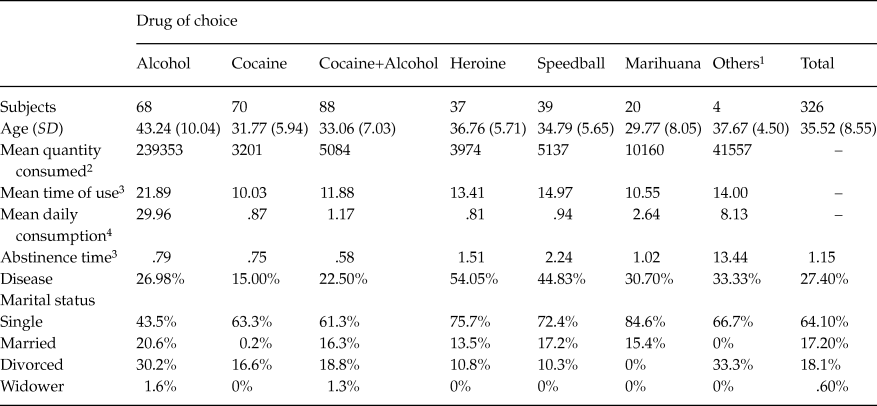
The sample was composed of 326 male drug users aged between 18 and 64 years (M = 35.52; SD = 8.54) and 322 non-clinical males aged between 18 and 73 years (M = 37.18; SD = 12.82). Among participants, 133 non-clinical subjects and 136 drug users had primary education; 89 non-clinical subjects and 91 drug users had secondary education; 69 non-clinical subjects and 63 drug users had completed a cycle of higher education; finally, 31 non-clinical subjects and 26 drug users had university studies. No significant differences were found between both groups regarding age t (644) = 1.93, p = .06 or educational level χ2 (3, 628) = 0.71, p = .87. All drug users were over 18 years old, had been in withdrawal for at least two weeks, could read and write, and were receiving psychological treatment. They had all been diagnosed as drug-dependent and were receiving treatment for substance abuse according to the DSM-IV criteria. They were assessed by a researcher with experience in this field. Participants were recruited by cluster sampling from the following drug treatment centers: ACLAD in A Coruña, AMAD in Santiago de Compostela, Proyecto Hombre Galicia in the different provinces of Galicia, and Fundación Noray-Proyecto Hombre Alicante, all in Spain. Table 1 shows the consumption characteristics of the drug user group according to the preferred substance. The non-clinical sample (community sample) was recruited by convenience sampling from adult training centers, community centers, training courses for jobseekers, and universities. The main objective was to compare the scale in two samples. One drug dependent and the other a community sample, because the SAS was prior validated in community sample where an official recent drug use is about 0.1 or 4% depending of the drug. So we expected this “common” consumption as a part of the community sample.
Consumption characteristics

Note:
1 Methamphetamines and Benzodiazepines (always in units).
2 Total mean quantity consumed throughout life history in g (except for Others, where it is expressed in units).
3 Abstinence and mean time of use expressed in years.
4 Mean daily consumption in g per day.
Instruments
Sexual Assertiveness Scale (SAS; Morokoff et al., Reference Morokoff, Quina, Harlow, Whitmire, Grimley, Gibson and Burkholder1997; Sierra et al., Reference Sierra, Vallejo-Medina and Santos-Iglesias2011, Reference Sierra, Santos-Iglesias and Vallejo-Medina2012)
Its 18 items assess three dimensions (Initiation, Refusal, and STD-P) and are responded on a scale ranging from 0 (never) to 4 (always). Higher scores indicate greater sexual assertiveness. More information is available in the Introduction.
Changes in Sexual Functioning Questionnaire (CSFQ-14; Clayton, McGarvey, & Clavet, Reference Clayton, McGarvey and Clavet1997; Vallejo-Medina, Guillén-Riquelme, & Sierra, Reference Vallejo-Medina, Guillén-Riquelme and Sierra2010)
It is composed of 14 items that assess sexual functioning using a Likert scale with five response options. The psychometric properties of the English version (Clayton et al., Reference Clayton, McGarvey and Clavet1997; Keller et al., Reference Keller, McGarvey and Clayton2006) and the Spanish version (Bobes et al., Reference Bobes, González, Rico-Villademoros, Bascarán, Sarasa and Clayton2000) are adequate. The questionnaire has been also validated in a sample of drug users (Vallejo-Medina et al., Reference Vallejo-Medina, Guillén-Riquelme and Sierra2010), where three dimensions have been isolated (Desire, Pleasure, and Arousal-orgasm), and has shown adequate internal consistency reliability. In the present study, the Cronbach’s alpha of the subscales ranged between .74 and .77. Higher scores indicate better sexual functioning.
Questionnaire on Substance Use (QSU)
This measure was developed for the present study. It is composed of 16 items that briefly reflect the DSM-IV-TR diagnostic criteria. It is useful to diagnose problems of dependence, abuse, and intoxication. Items are responded on a dichotomous (yes/no) scale. Spearman’s correlation with the diagnosis made by the institutions themselves using the European Addiction Severity Index (EuropASI; Stenius & Room, Reference Stenius and Room2004) and personal interviews was .85. The reliability value was .88.
Questionnaire on socio-demographic data and consumption record
Participants were asked about the amount of substance they consumed, the frequency and duration of consumption, and time of abstinence. The questionnaire also recorded age, educational level, disease, marital status, and other socio-demographic variables.
Procedure
The wording of the version of the SAS validated in Spain by Sierra et al. (Reference Sierra, Vallejo-Medina and Santos-Iglesias2011) was adapted to a population of drug users, simplifying the language and using more colloquial terms. The new version was reviewed by five experts in psychometrics, who checked that the rewording of the items was correct. Approval of the items was greater than 85% in all cases. Next, five college students and five drug users were asked to evaluate the clarity of the items. Again, consensus was greater than 85% for all the items.
For the main study twenty subjects were excluded from the analyses because they had recently consumed drugs; another five were excluded because they did not fulfill the DSM-IV-TR substance dependence criteria. The questionnaires were compiled into two different booklets. The first one included the SAS adaptation to drug users. The other one included the original SAS and was administered to the non-clinical population. Questionnaires were administered to participants once they had given their informed consent. Participation was anonymous and voluntary. The entire evaluation took about 30 minutes and the scales were administered following the order used in the instrument section in this paper.
Statistical analyses
We used two different analyses: DIF and factorial invariance. DIF allows detecting some bias in the evaluation while factorial invariance assess if structure and relations between items and subjacent factors are equal in each group. Both uses different methodologies but are complementary when the goal is to compare if both forms are directly comparable.
We conducted analyses to assess factorial invariance. There is factorial invariance when the relationships between items and the construct are identical between several groups. This confirms that the differences found in the measures are not biased by the existence of different relationship patterns (Lubke, Dolan, Kelderman, & Mellenberg, Reference Lubke, Dolan, Kelderman and Mellenberg2003). Factorial invariance with Structural Equation Modeling (SEM) was assessed using AMOS. The indices used to assess global fit were the χ2/degree freedom (χ2/df), Root Mean Square Error of Approximation (RMSEA), and Adjusted Goodness of Fit Index (AFGI). Values considered to indicate good fit were the following: values between 1 and 3 for the χ2/df, greater than .85 for the AFGI, and lower than .08 for the RMSEA. The Comparative Fit Index (CFI), Akaike Information Criterion (AIC), and Δχ2/df were used as indicators of factorial invariance. A lack of increase of the AIC and Δχ2/df compared to the least restrictive model was considered as evidence of invariance. The same consideration applied if the CFI did not increase by more than .01 compared to the previous model (Cheung & Rensvold, Reference Cheung and Rensvold2002). Invariance was evaluated progressively, as in other studies (see Byrne, Reference Byrne2008; Elosua, Reference Elosua2005; Ford, Diamond, Kelder, Sterling, & McAlister, Reference Ford, Diamond, Kelder, Sterling and McAlister2009). Configural invariance was evaluated first (without restrictions in the model); next, the measurement weights were restricted, assessing the equivalence of the weight of each item compared to its corresponding factor; the following step was to limit the structural covariances of the factors, therefore assessing the equivalence of the covariances; finally, the residual measurements were restricted, assessing the equivalence of the errors. The estimation method used was the Generalized Least Squares (GLS), which adjusts well to the sample distribution obtained.
There is Differential Item Functioning (DIF) when subjects with the same level in the characteristic assessed (sexual assertiveness in this case) have a different probability to choose a given response in a certain item depending on the group they belong to (i.e., non-clinical participants or drug users in this study) (Hidalgo, Gómez, & Padilla; Reference Hidalgo, Gómez and Padilla2005). This may be due to cultural and/or language differences between groups, inadequate design, the method or techniques used in preparing the questionnaire, or an incorrect interpretation of the result (Hambleton, Reference Hambleton, Hambleton, Merenda and Spielberger2005). DIF analyses were performed using multinomial logistic regression (Miller & Spray, Reference Miller and Spray1993) with the SPSS statistical package. This technique makes it possible to detect uniform and non-uniform DIF in polytomous items (Hidalgo & López-Pina, Reference Hidalgo and López-Pina2004). If the contribution of Model 2 itself is significant, DIF is uniform; if the contribution of Model 3 is significant, DIF is non-uniform. In this case, the DIF diagnosis must be confirmed using a measure of effect size: the ΔR 2 Nagelkerke. Following the classification made by Jodoin and Gierl (Reference Jodoin and Gierl2001), DIF is negligible when the increase in R 2 is lower than .035, moderate when it falls between .035 and .070, and high when the increase is greater than .070. Next, a purification process in stages is performed for items showing moderate or high DIF. This involves performing a new regression eliminating the items with DIF from the total of the scale. This show whether the presence of DIF attenuated, increased, or concealed the presence of more DIF, and makes it possible to assess DIF without its own bias in the measure. Finally, a cumulative probability model (Mellenbergh, Reference Mellenbergh1995) was used to determine in which category of the response scale DIF was concentrated. The Mellenbergh categories were complemented with a partial odds-ratio measure.
As in the Spanish validation of the SAS, omega was used as an indicator of reliability, since it is less biased than Cronbach’s alpha for categorical response scales (Elosua & Zumbo, Reference Elosua and Zumbo2008). This was done using Factor software (Lorenzo-Seva & Ferrando, Reference Lorenzo-Seva and Ferrando2006). The remaining analyses were performed using SPSS software.
Results
Factor equivalence of the scale (factorial invariance)
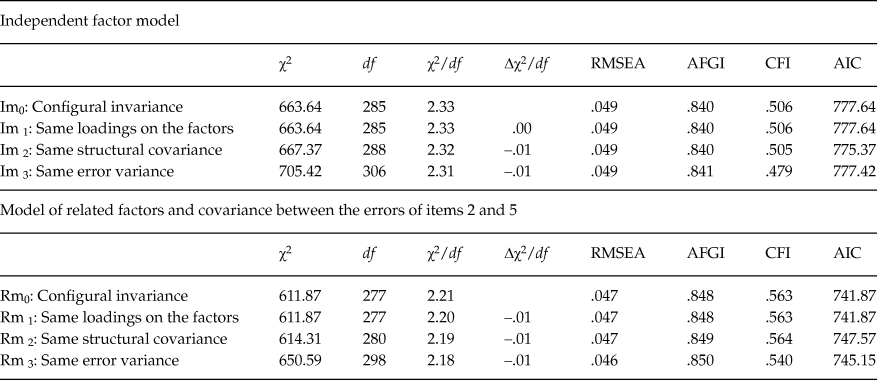
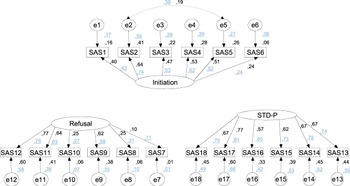
Based on the dimensionality of the scale found in the Spanish validation of the SAS (Sierra et al., Reference Sierra, Vallejo-Medina and Santos-Iglesias2011), the invariance of a three-factor model was tested with the related factors and covariances between the errors of items 2 and 5 (Related model; Rm). Moreover, given the existence of low correlations between the factors, invariance was tested on a three-dimensional model with independent factors and without covariances between the errors of the items (Independent model; Im). As shown on Table 2, both models showed adequate indices for configural invariance. As can be seen, the goodness-of-fit indices of Rm0 were slightly better than those of Im0. When the first restrictions were added and the invariance was evaluated with the same loadings on the factors, the trend obtained was the same as in the evaluation of the configural invariance. This showed adequate fit indices as well as a lack of increase of the CFI and the AIC compared to the least restrictive model; therefore, the evaluation continued. This time, when the structural covariances were limited, we observed that, although fit indices remained adequate in the RMSEA, χ2/df and AFGI, the CFI decreased by .001 in both models and the AIC increased in the Im2. However, the CFI did not reach a decrease of .01 (Cheung & Rensvold, Reference Cheung and Rensvold2002), so the assumption of invariance was maintained until the error variance was restricted. At this last stage, the Im3 obtained a decrease of the CFI greater than .01 and an increase of the AIC compared to the Im2. Therefore, and in spite of having adequate fit indices (RMSEA = .049, AFGI = .841 and χ2/df = 2.31), the independent model could not be considered to have a high level of invariance, therefore reaching a level of invariance up to the structural covariances. As for the related model, all the fit indices slightly improved and the CFI and AIC decreased when the error variance was set. Therefore, the original SAS model with related factors and covariance between e2 and e5 already confirmed by Sierra et al. (Reference Sierra, Vallejo-Medina and Santos-Iglesias2011) in a community population seems to be highly equivalent to its adaptation to drug users in a sample of male drug users. Figure 1 shows the path diagram of the standardized weights.
Goodness-of-fit indices of the invariance model

Standardized estimates of the unconstrained model for Non-clinical and Drug-users groups.

Metric equivalence of the scale (Differential Item Functioning)
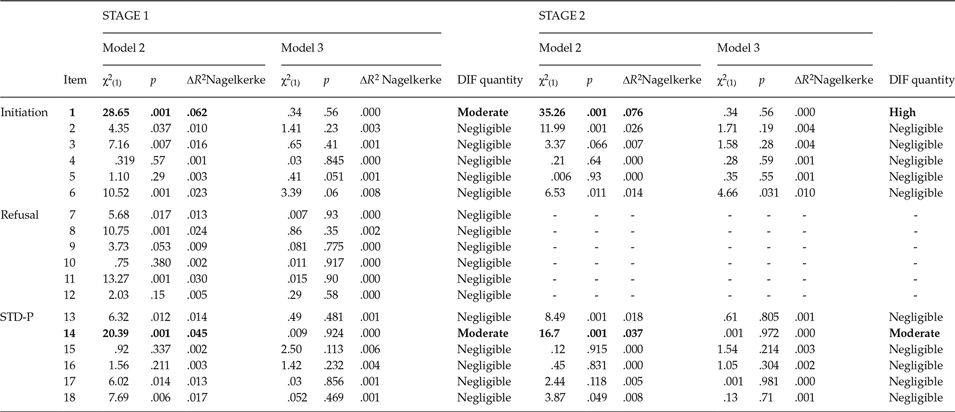
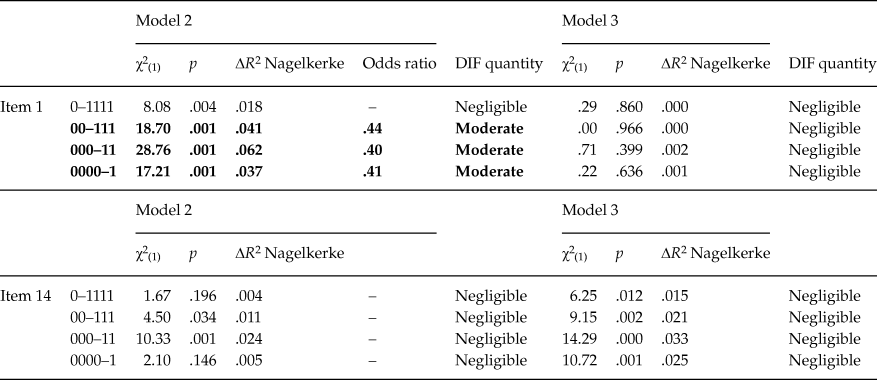
As shown on Table 3, only two out of the 18 items of the questionnaire showed DIF. In the Initiation subscale, item 1 had moderate uniform DIF. After the purification procedure (i.e., eliminating the bias of the item in the subscale total score), the bias of the item was shown to conceal even greater DIF. This DIF seemed to affect virtually all the response categories. However, using Mellenbergh’s categories, DIF was reduced to a moderate level (see Table 4). No item displayed DIF in the Refusal subscale. In the STD-Prevention subscale, moderate uniform DIF was observed in item 14. After the purification procedure, the DIF of item 14 was shown not to conceal another item with DIF and the moderate degree of DIF was maintained. The location of DIF on the response scale (see Table 4) shows that DIF decreased to a negligible level when working in categories.
Initial (Stage 1) and purified (Stage 2) Differential Item Functioning for each subscale

Note: STAGE 1 = Initial regression; STAGE 2 = Purified regression. Model 1 is regression without DIF. Model 2 is regression with grouped variables (uniform DIF). Model 3 includes an interaction between the group score and the total test score (non-uniform DIF).
Initiation: STAGE 1: Model 1 = χ2 (1) = 8.81; p = .003 R 2 = .019. STAGE 2 Model 1 = χ2 (1) = 2.20; p = .13 R 2 = .005.
Refusal: STAGE 1: Model 1 = χ2 (1) = 1.14; p = .23 R 2 = .003.
STD-P: STAGE 1: Model 1 = χ2 (1) = 3.02; p = .08 R2 = .007. STAGE 2 Model 1 = χ2 (1) = 6.55; p = .01 R 2 = .015.
Differential Item Functioning of items 1 and 14 according to Mellenbergh’s categories

Note: Item 1: Model 1 = χ2 1 = 2.20; p = .13; R2 = .005; Item 14: Model 1 = χ2 1 = 3.02; p = .08; R2 = .007. Overall we can observe DIF presence in item 1 in all categories except when both groups mark never (0–1111).
Psychometric properties of the items
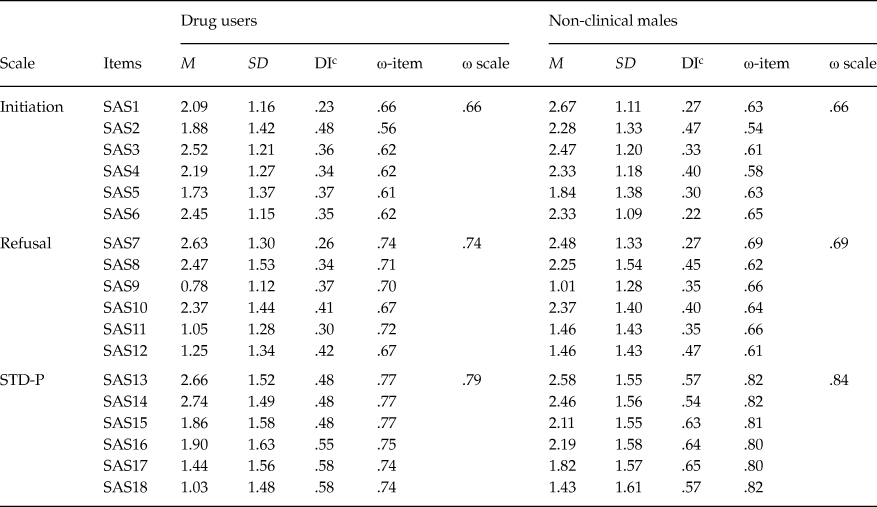
All the response options were chosen at least once. The mean of each item was close to the theoretical mean (2.5) but was slightly lower in the drug user group, as expected. Standard deviations were close to 1. All the subscales showed an adequate reliability index. In the sample of drug users, the corrected Discrimination Index (DI) was lower than .30 in items 1 and 7. However, deleting such items would not increase the reliability of their respective subscales. In the non-clinical sample, items 1, 6 and 7 had a low DI; again, the reliability of the subscales would not improve if any of these items were deleted (see Table 5).
Psychometric properties of items

Note: DIc = Discrimination Index (corrected item-total corω-item = reliability if item deleted; ω = reliability.
External validity
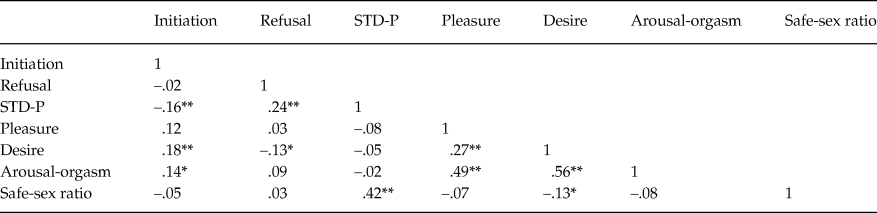
Table 6 shows the correlations between the subscales of the SAS and several variables. Significant but low correlations were found between the Initiation subscale and sexual desire and arousal-orgasm. Low correlations were observed between the subscales of the SAS themselves. Finally, a significant moderate to high correlation was found between STD-P and the safe sex ratio (resulting from dividing the number of sexual partners with whom a condom was used in the last year by the total number of sexual partners in the last year).
Correlations of factors of the SAS with one another and with the CSFQ-D subscales and the safe-sex ratio

Note: *p < .05.
Descriptive analyses for each scale
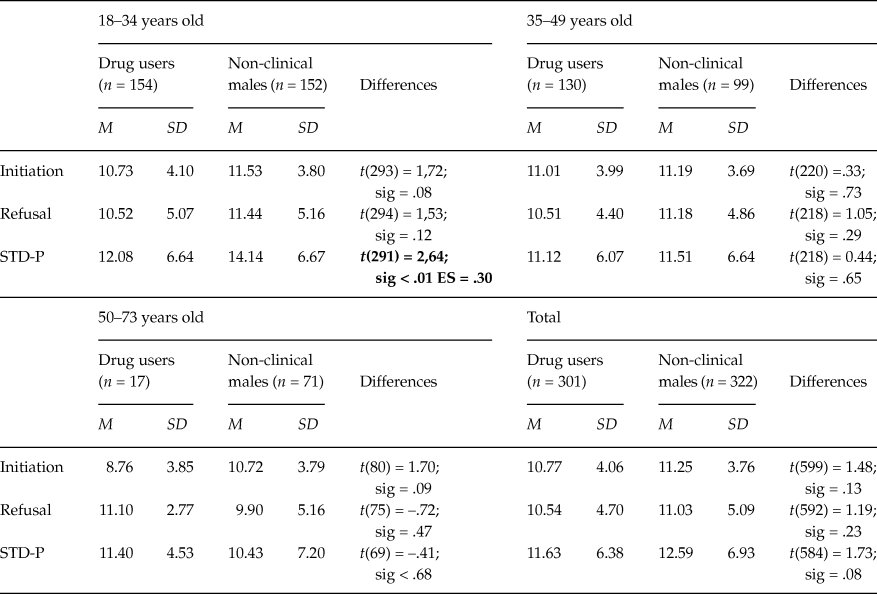
Table 7 shows the means and standard deviations for each scale as well as the differences between the group of substance users and the non-clinical group. Significant differences were found in the Initiation and STD-P subscales in the 18–34 year-old group and in Initiation in the over 50 year-old group. No significant differences were found in any subscales depending on the main substance consumed (Initiation F(7, 274) = 1.73, p = .10; Refusal F(7, 269) = 1.15, p = .33; STD-P F(7, 269) = 1.50, p = .16).
Descriptive analysis for each subscale and group differences

Note: ES = Effect Size (Cohen’s d).
Discussion
The dimensionality of the SAS seems to be the same in non-clinical and drug user males. A few differences were found in the relationship between factors, with different levels of invariance in the independent and the related model. Yet, this does not imply a real practical problem. As highlighted in other studies (Auslander et al., Reference Auslander, Perfect, Succop and Rosenthal2007; Morokoff et al., Reference Morokoff, Quina, Harlow, Whitmire, Grimley, Gibson and Burkholder1997; Sierra et al., Reference Sierra, Vallejo-Medina and Santos-Iglesias2011), the subscales of the SAS behave independently, except for Refusal and STD-P, which are moderately related to each other; in the present study we obtained similar results. In any case, the level of invariance found is sufficient to interpret the forms as being equivalent. Thus, the dimensionality of the scale is virtually identical in the sample of non-clinical males and that of drug users.
After ruling out a possible bias in the dimensionality of the scale, the existence of bias in item functioning was assessed. Results showed that no items in the Refusal subscale exhibited noticeable DIF. However, moderate uniform DIF was found in item 14 (in the STD-P subscale). To analyze the cause of the bias, the content of the item in each form should be examined:
Item 14, non-clinical form: “Si mi pareja insiste, tengo relaciones sexuales sin utilizar condón o barrera de látex, incluso aunque yo no quiera”(I have sex without using a condom or latex barrier if my partner insists, even if I don’t want to).
Item 14, drug user form: “Si mi pareja insiste, tengo relaciones sexuales sin utilizar condón aunque yo quiera usarlo” (I have sex without using a condom if my partner insists, even if I want to use it).
We believe that DIF is due to the complexity with which the item is drafted, as the syntax of the sentence is quite complex in Spanish and includes a negative phrase. Although the sentence was simplified in the drug user form, it appears that either the existing bias was not completely eliminated or the simplification of the item created the bias. In any case, as shown by the data, DIF was quite low – almost negligible – and dispersed when analyzed using Mellenbergh’s categories. Therefore, although DIF was found, probably due to the complex wording of the item, its effect is not expected to affect the results significantly. Finally, high uniform DIF was observed in item 1 of the Initiation subscale. The content of this item applied to both groups “Inicio las relaciones sexuales con mi pareja cuando lo deseo” (I begin sex with my partner when I want to). The wording of this item, written in simple syntax, was the same for both samples. The partial odds-ratio of Mellenbergh’s categories shows that non-clinical subjects have an almost .50 greater probability of obtaining high scores than drug users. Given that drug users have a greater number of casual partners and fewer steady partners than the non-clinical population (Baseman, Reference Baseman1999), it is logical to think that the item may be understood differently in both groups. That is, non-clinical subjects may understand the item as beginning a sexual relation with their partner, whereas a drug user may understand this item as beginning a first sexual relation with a partner. It would be necessary to use focus groups or cognitive interviews to confirm this point. Given the strong presence of DIF in item 1, its score should be omitted if the aim of the study is to compare the two samples. Thus, we strongly recommend not considering item 1 if the goal is to compare a non-clinical sample with a drug user sample.
The distribution of the scores in the scale was adequate. All the responses were used at least once and the mean score of the items and the standard deviation were acceptable. Although some items had a discrimination index (DI) lower than .30, the reliability of the scale was strengthened by the presence of these items. Only item 1 had a low DI, both in the non-clinical sample and the drug user sample. Reliability indices of the scale were adequate; low reliability compared to the original Spanish scale (ω = .80) was only observed in the Initiation subscale (ω = .66) (Sierra et al., Reference Sierra, Vallejo-Medina and Santos-Iglesias2011). The subscales Refusal (ω = .74) and STD-P (ω = .79) obtained similar indicators to those of the non-clinical Spanish version (ω = .76 and ω = .85, respectively). In short, reliability fell within the range observed by Santos-Iglesias and Sierra (Reference Santos-Iglesias and Sierra2010) in the SAS (from .66 to .86).
The questionnaire showed good convergent validity in the non-clinical Spanish population (Sierra et al., Reference Sierra, Vallejo-Medina and Santos-Iglesias2011); as expected, positive and significant correlations of the Initiation subscale with desire and arousal-orgasm were found in the sample of drug users. The Refusal subscale showed a significant negative correlation with desire. Although such correlations were low, they pointed in the right direction. First, a correlation was observed between Initiation and sexual functioning (Hurlbert et al., Reference Hurlbert, Singh, Menéndez, Fertel, Fernandez and Salgado2005; Ménard & Offman, Reference Ménard and Offman2009); second, individuals with high sexual desire may use the refusal component of sexual assertiveness more rarely, although no previous studies have observed this relationship. The STD-Prevention subscale showed a significant moderate to high and correlation with the safe sex ratio. Other studies have obtained similar results; indeed, Morokoff et al. (Reference Morokoff, Redding, Harlow, Cho, Rossi, Meier and Brown-Peterside2009) pointed out a .39 correlation between STD-P and the safe sex ratio; the same study found results where STD-P also correlated consistently with frequency of condom use and condom stage of change.
The sample of young people showed significant but small differences in STD-P in the direction expected. It is logical to expect few differences, given that drug users had not consumed drugs for one year and four months on average. It should be noted that the main objective was not to compare both groups from a clinical approach, as the non-clinical group was not a control group (we did not exclude drug consumption). A clinical comparison between both forms would require creating a control group and excluding drug consumption. Therefore, results may be different with more recent drug consumption and/or with a real control group. However, we obtained preliminary results that may indicate sexual assertiveness problems.
First, the fact that young drug users have lower sexual assertiveness regarding STD-P than non-users is cause for concern. It should be highlighted that sexual assertiveness is a good predictor of both intention to use a condom (Baele et al., Reference Baele, Dusseldorp and Maes2001; Roberts & Kennedy, Reference Roberts and Kennedy2006) and actual condom use (Auslander et al., Reference Auslander, Perfect, Succop and Rosenthal2007; Rickert, Sanghvi, & Wiemann, Reference Rickert, Sanghvi and Wiemann2002; Schick, Zucker, & Bay-Cheng, Reference Schick, Zucker and Bay-Cheng2008; Zamboni et al., Reference Zamboni, Crawford and Williams2000). Compared to non-users, drug users have a high risk of contracting sexually transmitted diseases (Bellis et al., Reference Bellis, Hughes, Calafat, Juan, Ramon, Rodriguez and Phillips-Howard2008; Booth et al., Reference Booth, Kwiatkowski and Chitwood2000; Raj et al., Reference Raj, Saitz, Cheng, Winter and Samet2007) and are less likely to use a condom and have safe sex (Hendershot, Magnan, & Bryan, Reference Hendershot, Magnan and Bryan2010; Quinn & Fromme, Reference Quinn and Fromme2010; Reynolds et al., Reference Reynolds, Magidson, Bornovalova, Gwadz, Ewart, Daughters and Lejuez2010; Ross & Williams, Reference Ross and Williams2001). Therefore, it is of great importance to deal with sexual assertiveness in therapy, since it can promote condom use, as quitting drugs does (Sherman et al., Reference Sherman, Sutcliffe, Srirojn, Latkin, Aramratanna and Celentano2009). Second, no differences were observed in the Initiation or Refusal subscales, possibly because low initiation or refusal assertiveness only occurs in the population that is under the effect of the drug (Shacham & Cottler, Reference Shacham and Cottler2010). Therefore, future studies should explore this dimension focusing on a shorter time of abstinence (1 or 2 months). Finally, the type of substances consumed does not seem to affect sexual assertiveness differently.
Conclusions
Overall, the psychometric properties of the adaptation of the SAS are adequate. Reaching a level of strict invariance would make it possible not only to compare the means of the items and factors of each group with minimal bias, but would also indicate that the measure is equally accurate in both groups (Dimitrov, Reference Dimitrov2010). However, although both forms showed equivalent dimensionality, the strong presence of DIF in item 1 indicates the presence of bias in this item. Thus, we strongly recommend not using item 1 if the aim of the research is to compare drug user samples with non-clinical samples.
Use of a non-clinical sample is adequate if the aim is to compare the equivalence of several forms of the scale. Yet, if the aim is to perform a clinical comparison, a control group should be used and drug use should be excluded. The present data are provided to indicate external validity and should not be used to draw clinical conclusions. Studies should explore clinical hypotheses in the future.
Finally, the present paper has some limitations. First, we used non-probabilistic sampling so results may not be generalizable. Our date distribution cannot be consider normal, this can explain why our CFI is far away from the correct values (.95) which is also is a study limitation. Moreover, most of the information obtained on consumption characteristics was self-reported, which has its shortcomings. Finally, studies on the sexual assertiveness of drug users are virtually nonexistent, so it is difficult to obtain a specific theoretical framework for this study. However, we believe that the best way to explore a field is to start by validating a questionnaire that minimizes measurement bias for the target population.