





Introduction
Rice is a staple in the diet of more than half of the world’s population (Muthayya et al. Reference Muthayya, Sugimoto, Montgomery and Maberly2014). The United States accounted for 1.1 million ha of all rice production in 2021, with more than 183,000 ha produced in the state of Louisiana (USDA-NASS 2020). Before the release of herbicide-resistant rice (Harrell and Saichuk Reference Harrell, Saichuk and Saichuk2014), water-seeded rice production was a common cultural practice in Louisiana for controlling problematic infestations of weedy rice (O. sativa L.). While water-seeded production has decreased due to the widespread adoption of the imidazolinone-resistant and acetyl-CoA carboxylase–resistant rice, water-seeded planting applied to more than 17% of rice produced in Louisiana in 2020 (Harrell Reference Harrell2020).
In a water-seeded production system, pre-germinated rice seedlings are aerially sown into an existing flood, and the water is then drained within 24 h (Harrell and Saichuk Reference Harrell, Saichuk and Saichuk2014). A drainage period of 4 to 7 d allows seedling radicles to anchor in soil and establish a root system. Water management in a water-seeded production system can be categorized as delayed, pinpoint, or continuous flooding. In a pinpoint flood system, the most common method used in Louisiana, the water level is raised to a depth that keeps the rice tip above the flood. This flood level is increased as the rice grows until a final flood depth of 5 to 10 cm is reached.
Ducksalad is an annual freshwater aquatic plant in the Pontederiaceae family that is native to North and South America and frequents wet areas that include rice fields (Bryson and Delfice Reference Bryson and Delfice2009). Ducksalad can float freely or root in saturated soil, with both indeterminate vegetative stems and determinate flowering stems that bear a single leaf, spathe, and terminal inflorescence (Horn Reference Horn2003). Leaves of ducksalad and other members of the Heteranthera species can be characterized as sessile or petiolate (Horn Reference Horn1988). Seedlings initially develop sessile leaves that are linear, with a blade-like enlargement at their apex, and all grow submersed under water. Later-developing petiolate leaves have a distinct petiole that grows to the water surface, and an expanded obtuse leaf blade that grows above the water surface. The change from sessile to petiolate leaf development is abrupt and can occur in a matter of days. Ducksalad can grow up to 15 cm tall, with a rhizomatous growth habit, and has narrowed to acute, obtuse, or slightly heart-shaped leaves (Horn Reference Horn2003). Inflorescences contain a single blue or white flower with six petals.
Ducksalad germination begins shortly after soil saturation or establishment of a permanent flood in rice (Smith Reference Smith1968, Reference Smith1988). Water-seeded production systems are more prone to ducksalad infestations due to early season flood establishment, which is used for suppressing other problematic weeds such as weedy rice. Approximately 2 wk of early season ducksalad interference can reduce water-seeded rice yield by up to 10%, whereas full-season interference can reduce yield by as much as 30%. Management of ducksalad during the first 4 wk of germination is essential due to early season competition with the growing rice seedlings (Smith Reference Smith1968).
Numerous management strategies including cultural, biological, and chemical methods for ducksalad control have been researched in the past. The primary cultural control method is to water-seed rice between 90 and 135 kg ha−1 to ensure rice canopy closure as early as possible to outcompete ducksalad for light and space (Smith Reference Smith1988). A delayed-flood, drill-seeded system can also be used to give rice a competitive advantage over ducksalad prior to permanent flood establishment. Oraze and Grigarick (Reference Oraze and Grigarick1992) also found that biological control with natural populations of waterlily aphids reduced ducksalad total biomass by as much as 87% by allowing the insects to feed on above-water vegetation. Natural populations of waterlily aphids occur worldwide and can reduce late-season ducksalad growth.
Options for managing ducksalad have included applying herbicides as a foliar spray and coated onto the surface of a urea fertilizer pellet. Ducksalad treated with bensulfuron-coated fertilizer at 111 g ai ha−1 resulted in 86% to 96% control (Braverman Reference Braverman1995). Similarly, ducksalad treated with a foliar spray application of benzobicyclon at 493 to 1,232 g ai ha−1 was controlled by 83% to 93% (McKnight et al. Reference McKnight, Webster and Blouin2018). Combining cultural and chemical management strategies is essential for controlling ducksalad and other problematic weed species in rice production.
In 2018, florpyrauxifen-benzyl (Loyant; Corteva Agriscience, Indianapolis, IN) was released for commercial use in U.S. rice production. This auxin herbicide, in the 6-aryl-picolinate class, was labeled for use on rice and in crawfish [Procambarus clarkii (Girard)] production and provides an additional mode of action for controlling problematic weeds in rice production such as alligatorweed [Alternanthera philoxeroides (Mart.) Griseb.], rice flatsedge (Cyperus iria L.), hemp sesbania [Sesbania herbacea (Mill.) McVaugh], indian jointvetch (Aeschynomene indica L.), and several Sagittaria species (Corteva 2017). Florpyrauxifen-benzyl must be metabolically converted into an active form, florpyrauxifen-acid, by enzymatic hydrolysis inside the plant (Epp et al. Reference Epp, Alexander, Balko, Bussye, Brewster, Bryan, Daeuble, Fields, Gast, Green, Irvine, Lo, Lowe, Renga, Richburg, Ruiz, Satchivi, Schmitzer, Siddall, Webster, Weimer, Whiteker and Yerkes2016; Jeschke Reference Jeschke2015; Miller and Norsworthy Reference Miller and Norsworthy2018b). Establishing a permanent flood within 5 d is recommended for optimal herbicide uptake, translocation, and metabolism of florpyrauxifen-benzyl (Corteva 2017).
Establishing a permanent flood in a timely manner is essential in water-seeded rice production, especially for weed suppression (Webster Reference Webster and Saichuk2014). Flooding a rice field creates a conducive environment for weed suppression due to the lack of available oxygen in the soil, which subsequently prevents seed germination. Early flood establishment that is often associated with water-seeding practices leads to increased aerial pesticide applications. These applications are more costly and increase the risk of off-target movement of herbicides onto neighboring sensitive vegetation (Butts et al. Reference Butts, Fritz, Kouame, Norsworthy, Barber, Ross, Lorenz, Thrash, Bateman and Adamczyk2022). Similar to other auxin herbicides, susceptible plants such as soybean [Glycine max (L.) Merr.] are extremely sensitive to florpyrauxifen-benzyl and can be injured at low doses if the herbicide drifts (Miller and Norsworthy Reference Miller and Norsworthy2018c; Walker et al. Reference Walker, Webster, Stephenson, Rustom, Webster, Greer and Williams2021). Herbicide-coated fertilizer can reduce off-target movement due to physical characteristics such as the higher density of fertilizer granules compared to spray droplets (Braverman Reference Braverman1995). Herbicide-coated fertilizers have been evaluated in several crops, including water-seeded rice systems (Braverman Reference Braverman1995; Dean et al. Reference Dean, Cahoon, Collins, Jordan, Taylor, Forehand, de Sanctis and Lee2025; Koscelny and Peeper Reference Koscelny and Peeper1995; Mudge et al Reference Mudge, Webster, Zhang and Leon2005).
Nitrogen is most often deficient in soil and is often the most required nutrient for crops, including rice (Linquist et al. Reference Linquist, Liu, Kessel and Groenigen2013). Nitrogen in the form of urea (46-0-0) is the most used form of nitrogen in rice production and is a candidate for coating herbicides onto urea prills, or pellets, as a form of application. In a drill-seeded delayed flood system, the bulk of urea typically goes out prior to permanent flood establishment to minimize nitrogen loss through volatilization (Norman et al. Reference Norman, Wilson, Slaton, Griggs, Bushong and Gbur2009). However, in a pinpoint flooded rice system, one-third of the rice’s nitrogen should be applied during the brief draining period after planting and reflooding (Levy et al. Reference Levy, Webster, Dalla Lana, Price, Hebert, Zaunbrecher, Fontenot, Deshotel, Angira, Kongchum, Famoso and Wilson2026). The second one-third of nitrogen should be applied 1 to 2 wk later, and the third by the green ring rice growth stage. The multiple application timings of urea in a pinpoint flooded rice system allow for several opportunities to save on herbicide application costs by surface-coating herbicide onto urea.
Rustom (Reference Rustom2020) found that aquatic weed control could be achieved with foliar spray applications of florpyrauxifen-benzyl at reduced rates, but activity with reduced rates was dependent upon targeted species. Control of alligatorweed, ducksalad, grassy arrowhead (Sagittaria graminea Michx. var. graminea), and pickerelweed (Pontederia cordata L.) could be achieved with rates of florpyrauxifen-benzyl at less than the maximum rate of 29.2 g ha−1, but other aquatic weeds such as floating primrose-willow [Ludwigia peploides (Kunth) P.H. Raven] treated with florpyrauxifen-benzyl were controlled by less than 50% at any rate evaluated. Ducksalad control with florpyrauxifen-benzyl applied at 7.3 g ha−1 was similar to ducksalad control observed with florpyrauxifen-benzyl applied at 29.2 g ha−1, which suggests that reduced rates of florpyrauxifen-benzyl can be used for the control of ducksalad.
Florpyrauxifen-benzyl has low water solubility, is tightly bound to the soil, and is primarily degraded by microbial activity (Miller and Norsworthy Reference Miller and Norsworthy2018a). These chemical properties suggest that florpyrauxifen-benzyl should be nonpersistent in soils and should provide little residual activity. Greer et al. (Reference Greer, Webster, Webster, Rustom, Walker and Williams2021) reported that emerged ducksalad could be controlled with reduced rates of florpyrauxifen-benzyl applied as both a foliar spray and coated on the surface of urea prills. Limited research has been conducted on the residual activity of florpyrauxifen-benzyl applied as a postflood application into a weed-free environment, thus the objective of this study was to evaluate the residual control of florpyrauxifen-benzyl applied postflood into a weed-free environment as surface-coated urea or as a spray.
Materials and Methods
Field studies were conducted in 2020 and 2021 at the Louisiana State University Agricultural Center H. Rouse Caffey Rice Research Station near Crowley, Louisiana (30.1761ºN, 92.3492ºW). Florpyrauxifen-benzyl was evaluated as a foliar spray and surface-coated on urea for the residual control of ducksalad. Soil at the study location was a Crowley silt loam (fine smectic, thermic Typic Albaqualfs), pH 6.5, and with 2.3% organic matter. Field preparation included a fall and spring disking followed by two passes in opposite directions with a two-way bed conditioner consisting of S-tine harrows and rolling baskets set at a depth of 6 cm.
Following seedbed preparation, plots measuring 1.5 × 1.5 m−2 were established. Galvanized metal rings measuring 53 cm diam and 30 cm deep were inserted approximately 5 cm into the soil in each plot. The galvanized metal rings were pressed into the soil to isolate the treatment area and prevent dilution of florpyrauxifen-benzyl after application. Rice was not planted in this study, and the plots contained only the metal galvanized rings. Similar rings have been used in previous research for herbicide containment without the use of individually leveed plots (McKnight et al. Reference McKnight, Webster and Blouin2018; Rustom Reference Rustom2020; Sekino et al. Reference Sekino, Koyanagi, Ikuta and Yamada2008). The research area is naturally infested with ducksalad and was chosen due to the high levels of ducksalad pressure in previous years.
A simulated water-seeded rice system with a pinpoint flood management system was used for this field study. To manage emerged vegetation prior to permanent flood establishment, a 2% solution of glyphosate was applied with a 15-L pump-up backpack sprayer (Husqvarna Professional Products, Inc., Charlotte, NC) inside each ring. A permanent flood was established 4 d later, and flood depth was increased every 2 to 3 d until a 10-cm permanent flood depth was achieved to simulate a pin-point flooded system.
The study was conducted as a randomized complete block design with a two-factor arrangement of treatments with three replications. Factor A consisted of herbicide application method: either as a postflood spray or coated onto the surface of a urea fertilizer. Factor B consisted of florpyrauxifen-benzyl applied at rates of 0, 7.3, 14.6, 21.9, and 29.2 g ai ha−1. All postflood spray applications included methylated seed oil (Leci-Tech; Loveland Products, Loveland, CO) at a rate of 10 mL L−1.
Herbicides were applied approximately 7 d after the glyphosate application when the permanent flood was increased to a depth of 10 cm and the flood was maintained for the duration of the study. The florpyrauxifen-benzyl treatments were applied on April 30, 2020, and May 14, 2021. Postflood herbicide sprays were applied with a CO2-pressurized backpack sprayer calibrated to deliver 140 L ha−1 using a spray boom consisting of five flat-fan nozzles (110015 Flat Fan AirMix Venturi Nozzle; Greenleaf Technologies, Covington, LA) with 38-cm spacings.
To apply the herbicide-coated urea, a storage bag (Ziploc; S.C. Johnson & Son, Inc., Racine, WI) was assigned to each treatment, and each storage bag contained 454 g of 46-0-0 (N-P-K) urea fertilizer. The required amount of concentrated florpyrauxifen-benzyl for each treatment was measured and slowly added into individual storage bags while the bags were shaken continuously by hand to ensure even coverage. When all the florpyrauxifen-benzyl was added to the fertilizer, each storage bag was sealed to allow air to remain inside and the bag was shaken vigorously to ensure an even coating across the granules. The urea granules were visually inspected to ensure uniform coverage of florpyrauxifen-benzyl. The bulk mix was then used to weigh 4.9 g of herbicide-coated urea needed for each ring. The amount of fertilizer applied was equivalent to 168 kg ha−1. Treatments that did not include herbicide-coated urea received a nontreated application of urea at 168 kg ha−1 to equalize the same amount of nitrogen across the field study. Once the florpyrauxifen-benzyl surface-coated urea dried it was then applied evenly across the galvanized metal ring by hand into a 10-cm flood.
Visual ratings for ducksalad percent emergence and petiolate leaf development were recorded at 14, 28, 42, 56, and 70 d after treatment (DAT). Visual ratings for ducksalad percent flowering were recorded at 28, 42, 56, and 70 DAT. These visual ratings were evaluated on a scale of 0 to 100 with 0 = no emergence, petiolate, or flowering growth; and 100 = complete emergence, petiolate, or flowering growth compared with plants in nontreated plots. At 70 DAT, all aboveground ducksalad biomass was hand-harvested from each ring and weighed immediately to obtain fresh weight.
Ducksalad emergence, petiolate leaf development, and flowering data were subject to repeated measures analysis, while fresh biomass data were not subject to repeated measures because there was only one evaluation date. Data were subjected to the MIXED procedure in SAS software (v. 9.4; SAS Institute, Cary, NC). Year, replication (nested within treatments), and all interactions containing any of these effects were considered random effects. Considering year and replication as random effects accounts for different environmental conditions that may have been encountered in that year and allows treatment inferences to be extended across a broader range of environmental conditions (Carmer et al. Reference Carmer, Nyquist and Walker1989; Hager et al. Reference Hager, Wax, Bollero and Stroller2003). Fixed effects included application method, florpyrauxifen-benzyl rate, and evaluation timing. Type III statistics were used to test all possible interactions of fixed effects. A Tukey HSD test was used to separate means at a probability level of 5% (α ≤ 0.05). Mean separations were generated using the PLM procedure in SAS software. The 0 g ai ha−1 treatment served as a nontreated comparison and was included for biological reference and as a basis for biomass reductions. However, because ducksalad emergence, petiolate leaf development, and flowering approached maximum values in the absence of herbicide, the nontreated plants were excluded from the statistical analysis of these variables to allow comparisons among florpyrauxifen-benzyl rates and application methods without the disproportionate influence of a nontreated control.
Results and Discussion
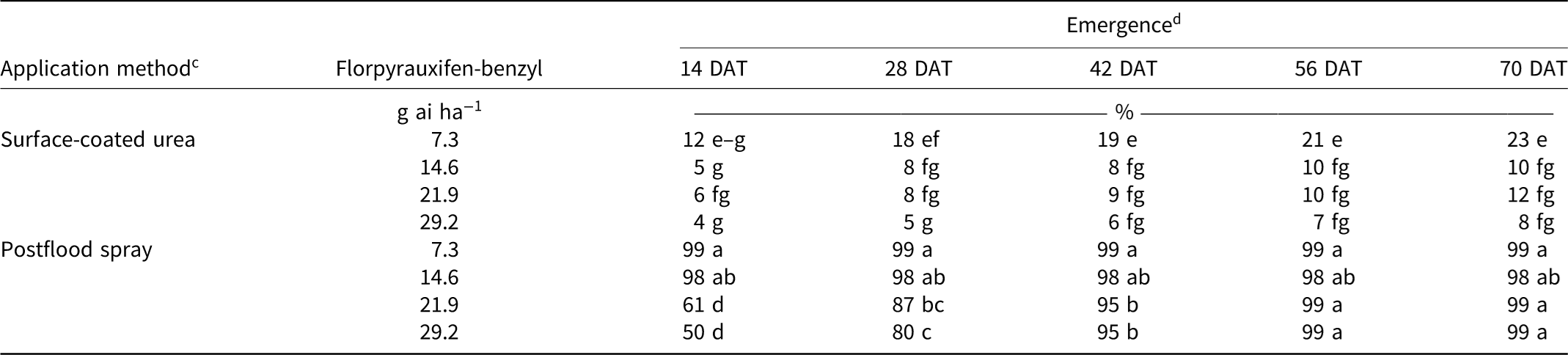
An interaction of application method by florpyrauxifen-benzyl rate by evaluation timing occurred for ducksalad emergence (Table 1). Overall, surface-coated urea provided substantially greater residual suppression of ducksalad emergence than postflood spray across all evaluation timings. Ducksalad emergence following surface-coated urea applications never exceeded 23%, whereas emergence following postflood spray applications reached 98% to 99% by 56 DAT.

Table 1. Long description
The table presents data on ducksalad emergence under different application methods and rates of florpyrauxifen-benzyl over various days after treatment (DAT). It has 10 rows and 6 columns. The columns are labeled ‘Application method’, ‘Florpyrauxifen-benzyl g ai ha⁻¹’, ‘14 DAT %’, ‘28 DAT %’, ‘42 DAT %’, ‘56 DAT %’, and ‘70 DAT %’. The rows are labeled with different application methods and rates: Surface-coated urea with rates 7.3, 14.6, 21.9, and 29.2 g ai ha⁻¹, and Postflood spray with the same rates. Each cell contains the percentage of ducksalad emergence for the corresponding application method, rate, and days after treatment. Notable trends include lower emergence percentages for surface-coated urea compared to postflood spray across all evaluation timings. Surface-coated urea never exceeded 23% emergence, while postflood spray reached 98% to 99% by 56 DAT.
a Abbreviation: DAT, days after treatment.
b Means followed by a common letter do not significantly differ at α = 0.05 using a Tukey HSD test.
c The florpyrauxifen-benzyl herbicide at a rate of 168 kg ha−1 was coated onto the surface of a urea pellet and dropped directly into the flood water or sprayed directly onto the surface of the water applied with a CO2-pressurized backpack sprayer calibrated to deliver 140 L ha−1.
d Emergence was measured on a scale of 0% = no emergence to 100% = complete emergence based on visual observations.
No increases in ducksalad germination were observed for any rate of florpyrauxifen-benzyl from 14 DAT to 70 DAT when it was coated onto urea. At 42 DAT, ducksalad emergence decreased from 19% to 8% as the florpyrauxifen-benzyl rate increased from 7.3 to 14.5 g ha−1 when it was applied coated to the surface of urea. However, when florpyrauxifen-benzyl was applied as a postflood spray at 7.3 to 14.6 g ha−1 ducksalad emergence was 98% to 99% at all rating dates. At 14 DAT, ducksalad emergence was 50% to 61% when it was treated with florpyrauxifen-benzyl at 29.2 and 21.9 g ha−1, respectively, when applied as a postflood spray. Conversely to surface-coated formulations, florpyrauxifen-benzyl applied at 21.9 to 29.2 g ha−1 as a postflood spray resulted in increases in ducksalad emergence across rating dates.
These data suggest that when targeting ducksalad with a preemergence application of florpyrauxifen-benzyl into the flood, a surface-coated urea formulation will be more effective at reducing emergence than a postflood spray formulation, regardless of rate. Applying florpyrauxifen-benzyl onto urea granules directly to the floodwater surface likely increased herbicide availability near the soil surface where ducksalad germination occurs. These data indicate that florpyrauxifen-benzyl has longer residual activity when applied to water as a surface-coated fertilizer than previously reported (US EPA 2017).
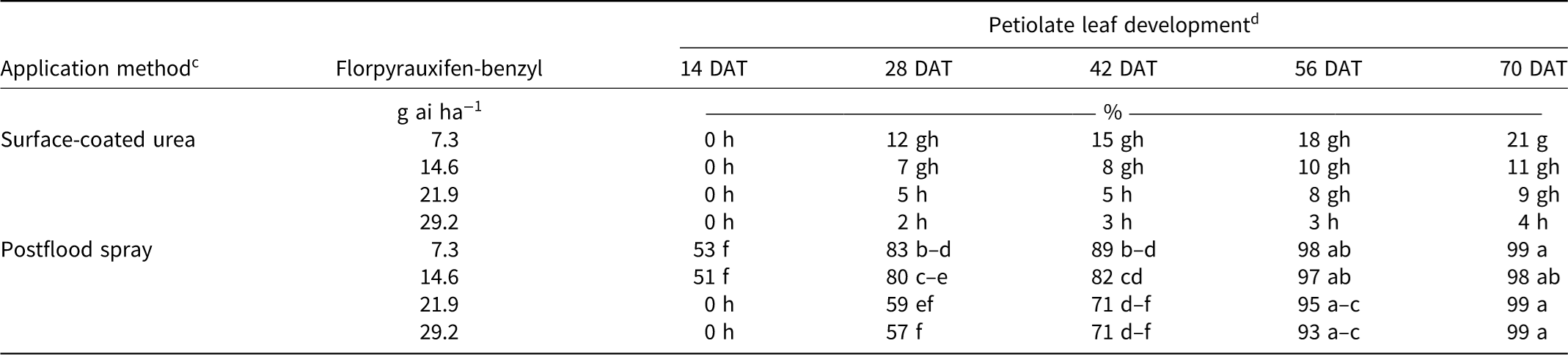
Because surface-coated urea formulations resulted in less ducksalad emergence, subsequent effects on plant development were also observed. An interaction of application method by florpyrauxifen-benzyl rate by evaluation timing occurred for ducksalad petiolate leaf development (Table 2). When florpyrauxifen-benzyl was applied as a surface-coated urea formulation, no petiolate leaf development was observed at 14 DAT, and petiolate leaf development did not increase between 28 DAT and 70 DAT. At 14 DAT, florpyrauxifen-benzyl applied at 7.3 and 14.6 g ha−1 as a postflood spray resulted in ducksalad petiolate leaf development at 53% and 51%, respectively. By 56 DAT, 93% to 99% of ducksalad treated with florpyrauxifen-benzyl as a postflood spray, regardless of rate, had reached the petiolate leaf stage compared with 3% to 18% when the herbicide was applied as a surface-coated urea formulation. Similar to emergence responses, petiolate leaf development was greatly reduced following surface-coated urea applications, indicating that delayed emergence translated into prolonged suppression of ducksalad growth and development.
Ducksalad percent petiolate leaf development when treated with various rates of florpyrauxifen-benzyl.a,b

Table 2. Long description
A table with 8 rows and 7 columns comparing petiolate leaf development in ducksalad under different application methods and rates of florpyrauxifen-benzyl. The columns are labeled ‘Application method’, ‘Florpyrauxifen-benzyl’, ‘14 DAT’, ‘28 DAT’, ‘42 DAT’, ‘56 DAT’, and ‘70 DAT’. The rows are labeled with different application methods and rates of florpyrauxifen-benzyl. The values in the table represent the percentage of petiolate leaf development at different days after treatment (DAT). Notable trends include varying levels of petiolate leaf development based on the application method and rate of florpyrauxifen-benzyl. For example, surface-coated urea formulations resulted in less petiolate leaf development compared to postflood spray applications.
a Abbreviation: DAT, days after treatment.
b Means followed by a common letter do not significantly differ at α = 0.05 using a Tukey HSD test.
c The florpyrauxifen-benzyl herbicide at a rate of 168 kg ha−1 was coated onto the surface of a urea pellet and dropped directly into the flood water or sprayed directly onto the surface of the water applied with a CO2-pressurized backpack sprayer calibrated to deliver 140 L ha−1.
d Leaf development was measured on a scale of 0% = no petiolate leaf development to 100% = complete development based on visual observations.
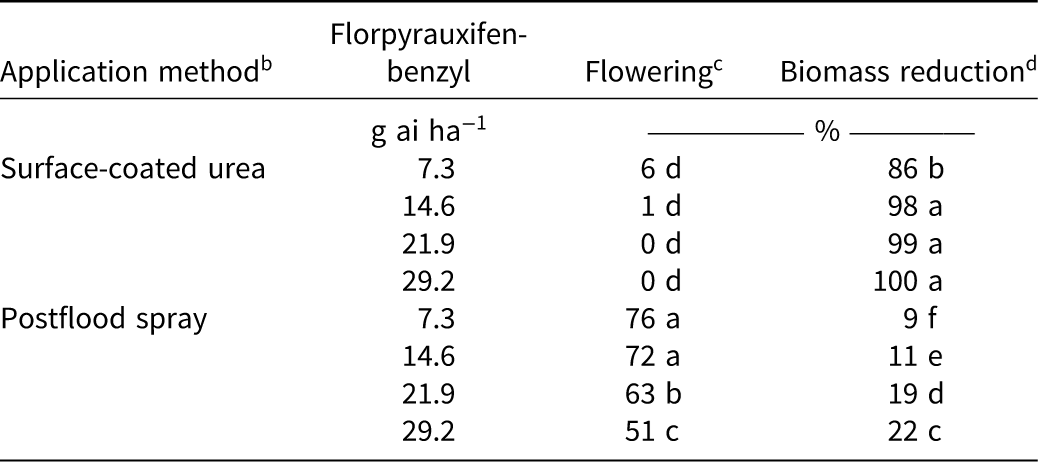
An application method by florpyrauxifen-benzyl rate interaction occurred for ducksalad flower development; therefore, data were averaged across evaluation dates (Table 3). Florpyrauxifen-benzyl applied in a surface-coated urea formulation resulted in 0% to 6% ducksalad flowering; however, an increase in ducksalad flowering was observed when florpyrauxifen-benzyl was applied as a postflood spray, resulting in flowering of 51% to 76%. Similar to ducksalad emergence and petiolate leaf development, applying florpyrauxifen-benzyl as a surface-coated urea formulation reduced ducksalad flowering compared with postflood spray formulations. This reduction in flowering throughout the growing season could reduce seed production and ultimately reduce future ducksalad infestations.
Ducksalad percent flowering and biomass reduction when treated with various rates of florpyrauxifen-benzyl. Flowering data averaged over evaluation dates. a

Table 3. Long description
A table comparing the effects of florpyrauxifen-benzyl application methods on ducksalad flowering and biomass reduction. The table has 3 columns and 8 rows. Column headers are Application method, Florpyrauxifen-benzyl, Flowering, and Biomass reduction. Row labels are Surface-coated urea and Postflood spray. Row 1: Application method, Surface-coated urea; Florpyrauxifen-benzyl, 7.3 g ai ha^-1; Flowering, 6 d; Biomass reduction, 86 percent. Row 2: Application method, Surface-coated urea; Florpyrauxifen-benzyl, 14.6 g ai ha^-1; Flowering, 1 d; Biomass reduction, 98 percent. Row 3: Application method, Surface-coated urea; Florpyrauxifen-benzyl, 21.9 g ai ha^-1; Flowering, 0 d; Biomass reduction, 99 percent. Row 4: Application method, Surface-coated urea; Florpyrauxifen-benzyl, 29.2 g ai ha^-1; Flowering, 0 d; Biomass reduction, 100 percent. Row 5: Application method, Postflood spray; Florpyrauxifen-benzyl, 7.3 g ai ha^-1; Flowering, 76 d; Biomass reduction, 9 percent. Row 6: Application method, Postflood spray; Florpyrauxifen-benzyl, 14.6 g ai ha^-1; Flowering, 72 d; Biomass reduction, 11 percent. Row 7: Application method, Postflood spray; Florpyrauxifen-benzyl, 21.9 g ai ha^-1; Flowering, 63 d; Biomass reduction, 19 percent. Row 8: Application method, Postflood spray; Florpyrauxifen-benzyl, 29.2 g ai ha^-1; Flowering, 51 d; Biomass reduction, 22 percent.
a Means followed by a common letter do not significantly differ at α = 0.05 using a Tukey HSD test.
b The florpyrauxifen-benzyl herbicide at a rate of 168 kg ha−1 was coated onto the surface of a urea pellet and dropped directly into the flood water or sprayed directly onto the surface of the water applied with a CO2-pressurized backpack sprayer calibrated to deliver 140 L ha−1.
c Flower development was measured on a scale of 0% = no development to 100% = complete flower emergence based on visual observations.
d Reduction in ducksalad biomass relative to the nontreated. Biomass was 3,445 g for ducksalad. A separate Tukey test was used to analyze biomass reduction at α = 0.05.
An interaction of application method by florpyrauxifen-benzyl rate occurred for ducksalad biomass (Table 3). Ducksalad treated with a surface-coated urea formulation of florpyrauxifen-benzyl at 14.6 to 29.2 g ha−1 resulted in a reduction in fresh weight biomass of 98% to 100% of nontreated plants. Applying florpyrauxifen-benzyl at the lowest rate of 7.3 g ha−1 in a surface-coated urea formulation reduced ducksalad fresh weight biomass to 86% of nontreated plants. Biomass reductions of 98% to 100% were observed when the rate of florpyrauxifen-benzyl applied in a surface-coated urea formulation was ≥14.6 g ha−1. Postflood spray applications at any rate of florpyrauxifen-benzyl did not produce a reduction in ducksalad biomass by more than 22% of nontreated plants. Biomass data support the emergence (Table 1), petiolate leaf development (Table 2), and flowering development (Table 3) data that were collected throughout this study. Florpyrauxifen-benzyl applied as surface-coated urea formulations produced reductions in ducksalad biomass compared with postflood spray formulations under the same conditions.
In conclusion, surface-coated urea applications of florpyrauxifen-benzyl consistently reduced ducksalad emergence, petiolate leaf development, flowering, and biomass compared with postflood spray applications. The reduced establishment and development of ducksalad suggest that surface-coated urea formulations increased herbicide availability at the soil surface where germination occurred. Consequently, florpyrauxifen-benzyl applied as a surface-coated urea formulation may provide a practical alternative for improving residual ducksalad management in water-seeded rice systems.
Although rice competition was absent in this study, it can be insinuated that a rice canopy would assist in the suppression of ducksalad with both application types. These data suggest that ducksalad emergence following a surface-coated urea application of florpyrauxifen-benzyl at 14.6 g ha−1 was similar to emergence observed following the product label rate of 29.2 g ha−1 applied in the same manner. Postflood spray applications of florpyrauxifen-benzyl were not effective at controlling ducksalad prior to emergence. This is likely a result of postflood spray applications of florpyrauxifen-benzyl dissipating with downward movement through the water column. Increasing the rate of florpyrauxifen-benzyl in postflood spray applications also resulted in improved performance, but not to the levels of surface-coated urea applications. Surface-coated urea formulations of florpyrauxifen-benzyl are likely to reach the soil surface more rapidly, thereby reducing herbicide dissipation within the water column. Reaching the soil surface quickly increases the amount of florpyrauxifen-benzyl available at the soil surface to inhibit emergence and growth of ducksalad and potentially other germinating weeds.
Rustom (Reference Rustom2020) reported variable weed control among species treated with florpyrauxifen-benzyl, and a similar response may occur with surface-coated urea applications used for residual weed control. Ducksalad was controlled with the lowest rate of florpyrauxifen-benzyl (7.3 g ha−1) applied postemergence and demonstrates the sensitivity of ducksalad to florpyrauxifen-benzyl. Although ducksalad emergence of 23% at 70 DAT was observed in this study when florpyrauxifen-benzyl was applied as a residual surface-coated urea formulation, more research is needed to determine whether similar results can be achieved with other weed species.
Cotter et al. (Reference Cotter, Norsworthy, Butts, Roberts and Mauromoustakos2024a) evaluated florpyrauxifen-benzyl applied as a spray compared to a coated onto urea prior to permanent flood establishment for the postemergence control of barnyardgrass [Echinochloa crus-galli (L.) P. Beauv.], yellow nutsedge (Cyperus esculentus L.), broadleaf signalgrass [Urochloa platyphylla (Munro ex C. Wright) R.D. Webster], and hemp sesbania. No differences were observed in the control of hemp sesbania or broadleaf signalgrass as both application types provided at least 98% control of both species. As for yellow nutsedge, spraying florpyrauxifen-benzyl resulted in an increase of 37 percentage points in control 3 wk after treatment compared to the surface-coated urea application. Likewise, when florpyrauxifen-benzyl was applied as a spray the day the permanent flood was establishmed, barnyardgrass control was 98% compared with 89% when florpyrauxifen-benzyl was applied as a surface-coated urea formulation at the same timing. The results from this study further suggest the species and application timing dependency of florpyrauxifen-benzyl activity when applied surface-coated on to urea.
Practical Implications
Applying herbicides as surface-coated fertilizer formulations can save time and costs by reducing the number of times a herbicide is applied to a given area (Braverman Reference Braverman1995). By combining herbicide and fertilizer in a single application, growers can eliminate an additional trip across the field. This research also indicates that lower rates of florpyrauxifen-benzyl can be used to achieve higher levels of residual ducksalad control by altering the application method from a traditional postflood spray to a surface-coated fertilizer. Early ducksalad infestations in pinpoint-flooded water-seeded rice are a concern due to the competitive advantage ducksalad has with seedling rice. Residual ducksalad control allows rice to establish and achieve canopy closure before competition occurs.
In addition to saving time and money, herbicide-coated fertilizers have been shown to reduce the off-target movement of herbicides (Braverman Reference Braverman1995; Cotter et al. Reference Cotter, Norsworthy, Butts, Roberts and Mauromoustakos2024b). Florpyrauxifen-benzyl off-target movement to soybeans is a major concern in areas where rice and soybeans are grown in proximity. Previous research conducted by Cotter et al. (Reference Cotter, Norsworthy, Butts, Roberts and Mauromoustakos2024b) concluded that florpyrauxifen-benzyl coated onto the surface of fertilizer pellets lowered the risk of off-target movement by reducing foliar interception.
Several considerations associated with herbicide-coated fertilizers may be overlooked. Similar to cleaning out sprayers, fertilizer-mixing equipment, tenders, and application equipment need to be cleaned to remove any florpyrauxifen-benzyl residue. If fertilizer equipment is not properly cleaned cross-contamination of florpyrauxifen-benzyl to other crops can occur. In addition to cleaning equipment, high-quality fertilizers should be used to minimize the amount of dust particles containing florpyrauxifen-benzyl that could potentially move off-target during an application.
Acknowledgments
Published with the approval of the Director of the Louisiana Agricultural Experiment Station and the Louisiana State University Agricultural Center as manuscript 2026-306-40895. We thank the staff of the Louisiana State University Agricultural Center’s H. Rouse Caffey Rice Research Station.
Funding
The Louisiana Rice Research Board provided partial funding for this project.
Competing Interests
The authors declare they have no competing interests.

 Open access

