This paper reports source identifications for a sample of obsidian prismatic blades from the site of Cerro Portezuelo, Mexico. Cerro Portezuelo was a small regional center, located in the southeastern part of the Valley of Mexico, midway between Texcoco and Chalco (Hicks Reference Hicks2005, Reference Hicks2013; Hicks and Nicholson Reference Hicks and Nicholson1964; Nichols et al. Reference Nichols, Neff and Cowgill2013). It was occupied over a long span of time, representing four major periods. The first occupation was contemporary with the later phases of Classic Teotihuacan (particularly the Tlamimilolpa phase; a.d. 300−500), the second during the Epiclassic period (Coyotlatelco phase; a.d. 650−850), the third during the Early Postclassic period (Toltec, Mazapan phase; a.d. 900−1200), and the fourth during the Late Postclassic period (Aztec; a.d. 1200−1500). As the Toltec and Aztec deposits at Cerro Portezuelo were thoroughly mixed, we will discuss them as a singular ‘Postclassic period’ in the following discussion.
CONTEXTS AND DATING
The specimens discussed here were excavated in 1955 from two areas within Cerro Portezuelo. The first, designated Trench 93 (in Complex C), included the remains of a buried Classic platform, with a number of Epiclassic burials intruded into its surface, as well as overlying Postclassic debris. The other area, designated Trench 96 (in Complex D), included Postclassic domestic structures, along with some Epiclassic and Classic debris (Hicks Reference Hicks2005, Reference Hicks2013; see also Nichols et al. [Reference Nichols, Neff and Cowgill2013:Figure 3] for trench locations at the site). The majority of excavated deposits in both areas represent mixed construction fill containing sherds from all four periods (Hicks Reference Hicks2005:Table 5-1).
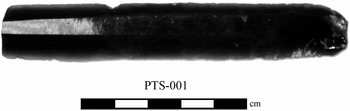
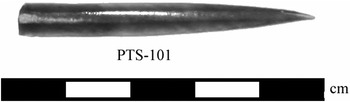
As was typical of excavations in the 1950s, relatively large excavation units were employed. The dimensions of these units ranged from 2 × 2 m to 5 × 5 m, divided into arbitrary vertical levels of 30 cm (Hicks Reference Hicks2005:1–6, 1–8). Only two of the obsidian specimens have more precise provenience. Sample PTS-001 (Figure 1) is the proximal half of an unusually large (10.4 × 1.7 × 0.4 cm) prismatic blade, with a single facet (unground) platform, found inside a ceramic bowl in an Epiclassic burial in Trench 93 (Cache 17 = Burial 93-10). Sample PTS-101 (Figure 2) is the tip of a small, pointed blade, with fine ventral retouch at the tip, that may be from another Epiclassic burial (Trench 93, Cache 20 = Burial 93-11). Unfortunately, the label on this specimen is ambiguous.
Specimen PTS-001, a proximal fragment of a large blade, Ucareo obsidian. Trench 93, found inside a Coyotlatelco bowl in Burial 93-10 (item 11).

Specimen PTS-101, a distal fragment of a pointed blade with fine ventral retouch, Zaragoza obsidian. Trench 93, ambiguous provenience (either Burial 93-11 or N3E).

The remaining specimens, for the most part, cannot be individually dated, but it appears (based on ceramics) that Postclassic materials predominate in Trench 96, while Classic and Epiclassic specimens are relatively more abundant (although still a minority) in Trench 93. Six of the specimens from Trench 93 (PTS-011, -012, -020, -045, -053, -057) came from levels with almost unmixed Classic ceramics and very likely date to the Classic period. Two of these six blades have platforms—both unground, which is consistent with a Classic (or Epiclassic) date.
Postclassic blades almost always have ground platforms. Of blade fragments with platforms in Trench 96, 15 of 16 (94%) platforms are ground, suggesting that nearly all of the specimens date to the Postclassic period. In Trench 93, 11 of 17 (65%) platforms are ground, indicating that about one-third of specimens are Classic or Epiclassic.
THE SAMPLE
Unfortunately, the assemblage of obsidian artifacts from Cerro Portezuelo is highly biased, and this limits the inferences that can be drawn. Excavated sediment was not screened. Rather, “two workmen were assigned to each trench. One shoveled the fill onto the ground beside the trench, while the other examined it for material to be retained. Workmen were instructed to retain only those pottery fragments at least one inch…in diameter” (Hicks Reference Hicks2005:1–5). It seems likely that some workers also applied this rule to obsidian, as the collection includes few specimens of less than an inch. Certainly, many artifacts were overlooked, and only relatively large or symmetrical specimens were recovered. This biased recovery is reflected in the ratio of blades to cores in the collection. From Trenches 93 and 96 there are 26 fragments of blade cores and 111 fragments of prismatic blades (including retouched tools not sampled in this study). This yields a ratio of only 4.3 blades per core. One would expect this ratio to be at least 50 blade fragments per core, suggesting that cores were at least ten times more likely to be recovered than blades.
Of the artifacts that were retained (and can now be located), a number were never labeled and have been excluded from the present analysis, as have specimens whose labels are mostly illegible. Even the specimens that retained labels had sometimes been labeled incorrectly (listing nonexistent or impossible proveniences). Of the 101 specimens ultimately selected for analysis, at least 28 had partially illegible, unclear, incomplete, or incorrect labels. Thus, provenience information is uncertain for a significant number of the specimens.
Another source of bias results from previous analysis. In 1967, the bulk of the collection (approximately 700 labeled obsidian artifacts) was loaned to Joseph W. Michels, then at Pennsylvania State University (PSU), for obsidian hydration dating. Among the specimens that he selected for dating were 25 bifacial projectile points (and/or knives)—nearly all of the available potentially diagnostic obsidian artifacts. When the collection was returned to the University of California, Los Angeles (UCLA) in 1973, these 25 projectile points were retained by Michael Manfredo at PSU for source analysis by neutron activation analysis (NAA). These specimens cannot be located now, and photographs are unavailable. This circumstance severely limits any interpretation of the bifacial artifacts.
Subsequently, 13 specimens—including 12 prismatic blades—were subject to NAA by Sidrys (Reference Sidrys1977). Of these specimens 11 have been located, and 10 were included in the present analysis (specimens PTS-002–PTS-011: our identifications agree with Sidrys).
Because of the biases, and the differential recovery of different classes of obsidian artifacts, we decided to restrict the source analysis to prismatic blades. All prismatic blade fragments from excavated contexts in Trenches 93 and 96 (excluding specimens with extensive retouch) that retained mostly legible labels were selected for source analysis. By chance, these totaled exactly 100 specimens. One additional specimen from the top level of Trench 94 (previously analyzed by Sidrys [Reference Sidrys1977]) was also included.
PROCEDURES
Nondestructive elemental analysis of the obsidian artifacts was performed at the University of Missouri, using an ElvaX desktop energy-dispersive X-ray fluorescence (ED-XRF) spectrometer. The instrument was operated at 35 kV with a tube current of 45 µA and a measuring time of 400 seconds. Concentrations are calculated in parts per million based on a calibration established from analysis of a series of obsidian reference samples previously characterized by XRF and NAA at the University of Missouri Research Reactor (MURR). The analysis permits quantification of the following elements: potassium (K), titanium (Ti), manganese (Mn), iron (Fe), zinc (Zn), gallium (Ga), rubidium (Rb), strontium (Sr), yttrium (Y), zirconium (Zr), and niobium (Nb). Comparison of the XRF results to previous data for obsidian sources in central Mexico allowed sources to be determined for all of the artifacts from Cerro Portezuelo.
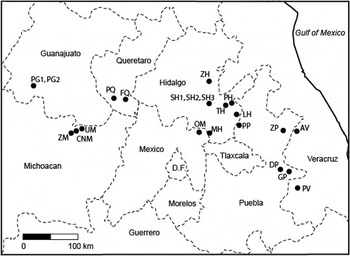
Locations of the known sources in central Mexico are shown in Figure 3. Although sources for none of the artifacts analyzed thus far were ambiguous after completion of XRF, NAA was available, if necessary, to obtain higher precision data. (See Glascock [Reference Glascock and Shackley2011] for a more detailed discussion of XRF and NAA analysis.)
Map of obsidian sources in Mexico (after Glascock Reference Glascock and Shackley2011). Sources mentioned in this article include Sierra de Pachuca (SH), Otumba (OM), Malpais (MH), Paredon (PP), Ucareo (UM), Zacualtipan (ZH), and Zaragoza (ZP).

RESULTS: SUMMARY
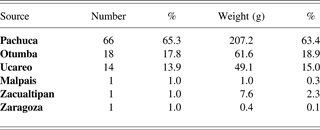
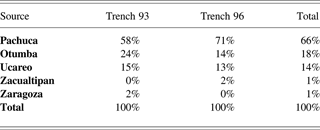
Source identifications for each specimen are presented in Appendix 1 and summarized in Table 1. Since the analysis was restricted to prismatic blades, there was not a lot of variation in size among the specimens, and the proportions from each source based on the number of specimens are not significantly different from the proportions based on total weight of the specimens. Therefore, subsequent tables will present only the counts, not the weights.
Summary of source identifications
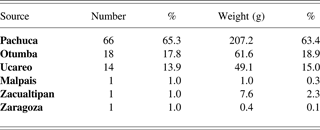
Nearly two-thirds of the blades from Cerro Portezuelo were made from the distinctive green obsidian from the Sierra de Pachuca (or Cerro de las Navajas) source, located in the state of Hidalgo, about 100 km north of Cerro Portezuelo (Pastrana Reference Pastrana1998). The other blades were all made from gray or black obsidian from five different sources. The second most common source, representing nearly one-fifth of the blades, was the Otumba source, located east of Teotihuacan, about 40 km north of Cerro Portezuelo. One specimen from the Malpais source, located just northeast of the Otumba source, has been combined with Otumba in Table 2. The third most common source, representing 14% of the blades, was the distant Ucareo source, located near Zinapecuaro in the state of Michoacan, about 250 km west of Cerro Portezuelo. Finally, one blade was from the Zacualtipan source, located in the state of Hidalgo about 150 km north of Cerro Portezuelo, and one blade (PTS-101) was from the distant Zaragoza (or Oyameles) source in the state of Puebla, about 250 km northeast of Cerro Portezuelo (Figure 3) (for descriptions of these individual sources see Charlton and Spence Reference Charlton, Spence, Weigand and Gwynne1982; Cobean Reference Cobean2002; Glascock Reference Glascock and Shackley2011).
Comparison of Trench 93 and Trench 96
RESULTS: CHANGE OVER TIME
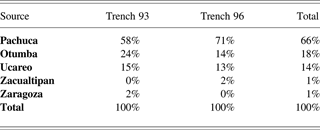
A comparison of Trench 93 and Trench 96 suggests that patterns of source utilization may have changed slightly over time (Table 2). The most obvious difference is an increase in Pachuca obsidian, from 58% in Trench 93 to 71% in Trench 96. (A similar pattern was noted earlier in the larger sample studied by Hicks [Reference Hicks2005:128–129].) However, compared to other sites in the Basin of Mexico, the proportion of Pachuca obsidian is unusually low in both trenches. At Classic Teotihuacan, located 35 km north of Cerro Portezuelo, Pachuca obsidian typically exceeds 80% of the assemblage and 95% of the blades (the remainder being predominantly Otumba obsidian). The same is true of the Late Postclassic (Aztec) town of Otumba (TA-80), located east of Teotihuacan (Glascock et al. Reference Glascock, Parry, Charlton, Charlton and Neff1999; Parry Reference Parry2001, Reference Parry, Hirth and Andrews2002), as well as other Aztec sites in the Valley of Mexico (Smith Reference Smith1990). Likewise, at the major Early Postclassic (Toltec) center of Tula, located 90 km northwest of Cerro Portezuelo, 80–90% of Tollan phase obsidian was Pachuca obsidian, the remainder being mostly from Ucareo (Healan Reference Healan1993, Reference Healan, Hirth and Andrews2002). The only known exceptions to this pattern occur during the Epiclassic period, where several sites have only 10–20% Pachuca obsidian, the majority instead being from Ucareo. This is true of Epiclassic (Coyotlatelco phase) deposits at Tula, as well as Azcapotzalco, located about 35 km west of Cerro Portezuelo, and Xochicalco in the state of Morelos, 70 km southeast of Cerro Portezuelo (Andrews Reference Andrews2002; Healan Reference Healan1993; Hirth Reference Hirth, Hirth and Andrews2002).
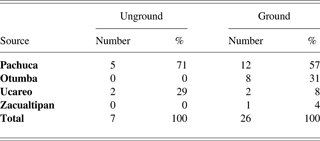
The most parsimonious explanation for the obsidian proportions at Cerro Portezuelo is that they reflect a mixture of, on the one hand, Classic plus Postclassic assemblages dominated by Pachuca obsidian and, on the other hand, an Epiclassic assemblage dominated by Ucareo obsidian. However, a closer examination of the data suggests a more complex situation. The six specimens from probable Classic contexts in Trench 93 include four Pachuca and two Ucareo, indicating that Ucareo obsidian may have been relatively common during the Classic period at Cerro Portezuelo, not just during the Epiclassic period. In addition to these six specimens (only two of which have platforms, both unground), there are five blades from other contexts with unground platforms (Table 3). One of these, of Ucareo obsidian, is Epiclassic (PTS-001 from Burial 93-10). The other four are Pachuca obsidian, from mixed contexts (three from Trench 93, one from Trench 96), probably Classic or Epiclassic.
Comparison of blades with unground and ground platforms
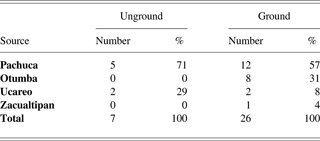
Nevertheless, two blades of Ucareo obsidian with ground platforms (both from mixed contexts in Trench 93) are most likely Postclassic—although ground platforms sometimes occur at some Epiclassic sites (for example, at Xochicalco [Hirth Reference Hirth, Hirth and Andrews2002] but not Tula [Healan Reference Healan1993]). Thus, it appears possible that obsidian blades from the distant Ucareo source may have been relatively common imports to Cerro Portezuelo during the Classic, Epiclassic, and Postclassic periods. Although the sample is very small (n = 6), it is possible that during the Classic period perhaps 30% of blades were Ucareo obsidian.
This pattern contrasts strikingly with Classic Teotihuacan, where Ucareo obsidian was uncommon. In two previous analyses (unpublished MURR records), Ucareo obsidian composed only 2% of analyzed specimens from Teotihuacan (1 of 50, and 2 of 111 specimens). Both of these were nonrandom samples, and it is likely that the proportions of Ucareo obsidian would be even lower in a random sample from Classic Teotihuacan. Interestingly, both of the samples had exactly the same amounts of Zaragoza obsidian (1 of 50 and 2 of 111 specimens) as Ucareo obsidian, while Cerro Portezuelo had 14 times as much Ucareo as Zaragoza obsidian. This contrast implies that Cerro Portezuelo was not importing all of its obsidian directly from Teotihuacan during the Classic period but, rather, was obtaining some quantity of Ucareo obsidian from other sites, most likely located to the west. This trade pattern would eventually spread throughout the Basin of Mexico after the fall of Teotihuacan, but it is foreshadowed during the Classic period at Cerro Portezuelo.
One other contrast with Teotihuacan is the absence of any blades from the Paredon (or Tecocomulco) source in the Cerro Portezuelo sample. This source is located about 80 km northeast of Cerro Portezuelo (Charlton and Spence Reference Charlton, Spence, Weigand and Gwynne1982). In a nonrandom sample (unpublished MURR records) from the Feathered Serpent Pyramid at Teotihuacan, 5 of 111 specimens were of Paredon obsidian (contrasted with two each of Ucareo and Zaragoza). It appears that Paredon was the third most important obsidian source for Teotihuacan (after Pachuca and Otumba), and Paredon obsidian was widely traded during the Formative and Classic periods (Charlton et al. Reference Charlton, Grove and Hopke1978). Thus, the absence of Paredon obsidian in the Cerro Portezuelo sample again suggests that this site was not obtaining its obsidian directly from Teotihuacan.
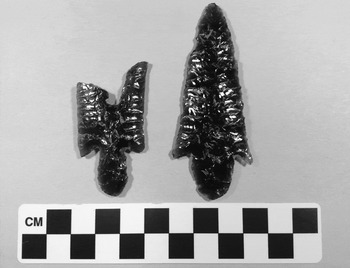
One other hint about the relationship of Cerro Portezuelo and Teotihuacan is provided by two very fine projectile points or eccentrics that were recovered during limited excavations at Cerro Portezuelo in 1957, which still remain in the collection. They apparently were recovered in Complex C (vicinity of Trench 93), near a Classic platform (Hicks Reference Hicks2013). Both are gray obsidian (source not analyzed). One (Figure 4, right) is identical in form and flaking pattern to the finest projectile points from offerings associated with sacrificial burials in the Moon Pyramid at Teotihuacan (Sugiyama and Cabrera Reference Sugiyama and Rubén2004). These points appear to have been ritual or symbolic objects, and they differ from the more irregular points found in domestic contexts at Teotihuacan. Its presence at Cerro Portezuelo may indicate a link to Teotihuacan, at least in terms of ritual practice. The other specimen (Figure 4, left) may have begun life as a similar point, but it has been reworked into a unique form. It is damaged, but probably formed a Y-shaped eccentric—again, a ritual object. This form is unknown at Teotihuacan and therefore reflects a contrast with the ritual practices at that site.
Two finely flaked points or eccentrics of gray obsidian. Complex C (vicinity of Trench 93), 1957 excavations. Left: CPS-57-9; Right: 1957 Trench 3, Level 2, south of structure.

RESULTS: REGIONAL EXCHANGE
As noted above, only one specimen (PTS-101) from the Zaragoza source was identified, contrasted with 14 from the Ucareo source. Both sources are equally distant from Cerro Portezuelo (about 250 km), but in opposite directions—Ucareo to the west and Zaragoza to the east. Unfortunately, the provenience of specimen PTS-101 is uncertain. It was housed with specimens from Cache 20 (Burial 93-11), and this Epiclassic burial was reported to include a fragment of obsidian (Frederic Hicks [1955], unpublished field notes at UCLA). However, the blade is labeled “PTS 93 N3 E,” which is not consistent with that burial. In either case, this specimen from Trench 93 is most likely Classic or Epiclassic.
Zaragoza obsidian was heavily used at several major sites during the Classic, Epiclassic, and Early Postclassic periods. These include Cholula in the state of Puebla (Healan Reference Healan1993) and a number of sites in the state of Veracruz: El Tajin (Healan Reference Healan1993), Cerro de las Mesas and vicinity (Stark et al. Reference Stark, Heller, Glascock, Elam and Neff1992), and Matacapan and vicinity (Santley and Barrett Reference Santley, Barrett, Hirth and Andrews2002). At all of these sites, a large majority of obsidian was from the Zaragoza source. On the Pacific coast of Oaxaca, the pattern was more similar to the Basin of Mexico with the majority of obsidian from the Pachuca source during the Early Classic (contemporary with Teotihuacan) period, and from the Ucareo source during the Late Classic (contemporary with Epiclassic) and Early Postclassic periods. However, during all three periods the second most common source of obsidian was Zaragoza (Joyce et al. Reference Joyce, Elam, Glascock, Neff and Winter1995; Levine et al. Reference Levine, Joyce and Glascock2011).
The presence of small amounts of Zaragoza obsidian at Cerro Portezuelo (1 out of 101 specimens), Teotihuacan (2 of 111 specimens), and Xochicalco (1 of 75 specimens) (Andrews Reference Andrews2002) indicates some interaction among these sites and centers to the east (Gulf Coast) and south (Oaxaca), but these relationships seem to have been of much less importance to Cerro Portezuelo than the interactions with Teotihuacan and Tula to the north and other sites (perhaps including Azcapotzalco) to the west.
UNRESOLVED QUESTIONS
Because of the poor chronological control and the extreme biases in the Cerro Portezuelo sample, few conclusions are possible. Obviously, new excavations would be desirable to provide a better sample. Due to these limitations, we have chosen to focus here on obsidian prismatic blades. However, the lithic assemblage also includes other products and byproducts of the blade industry (cores, macroblades, percussion blades, etc.) as well as the products and byproducts of two other industries: bifacial tools (projectile points and knives) and expedient flake tools. The raw material preferences for these other industries appear to differ slightly from the blades. Although most of the obsidian projectile points are no longer available for analysis, an inventory of the 25 specimens from Trenches 93 and 96 that were removed for hydration dating seems to indicate that 6 specimens (24%) were green Pachuca obsidian. This is a much lower proportion of Pachuca obsidian than in the blades, which were 65% Pachuca. This same pattern has been observed at other sites, such as Teotihuacan, where a large majority of blades were made from green Pachuca obsidian while a majority of bifacial projectile points were gray Otumba obsidian.
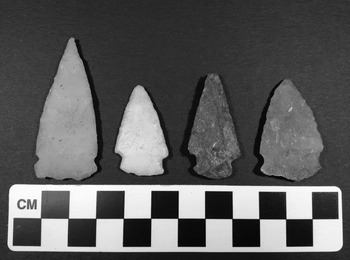
In addition, at Cerro Portezuelo an unusual proportion of bifaces and flake tools were made from chert. In the total collection, nearly 8% of lithic artifacts (by weight) are chert (Hicks Reference Hicks2005:126). There are five intact projectile points of chert from Trenches 93 and 96 (representing 17% of perhaps 30 points that were reported from these units). These have broad stems and small corner or side notches and probably date to the Epiclassic or Early Postclassic period. Three are red-brown chert, and two are white or light gray (Figure 5). Also, there are three fragments of laurel leaf-shaped sacrificial knives, all of fine brown chert, that resemble some Aztec specimens from the Templo Mayor (on display in the site museum). There are other biface and preform fragments, as well as numerous flake tools and cores of chert, in various colors (white, pink, red, or brown).
Four chert points from Trenches 93 and 96. From left to right: light gray chert, PTS 96 N6 D-11; white chert, PTS 96 H6 B; red chert, PTS 93 J2 NW 5; red chert, PTS 96 L7 A.

Chert was infrequently used at other sites in the Basin of Mexico. At the Aztec town of Otumba (TA-80), 99.9% of lithics from controlled surface collections were obsidian, and only 0.1% were chert (Parry Reference Parry2001). Similar low proportions of chert occur in Classic Teotihuacan assemblages. At both of these sites, nearly all of the chert artifacts are a coarse white material, which may have a source in the region. The exception to this pattern occurs at Teotihuacan among corner-notched projectile points, probably of Epiclassic date, which include an unusual proportion made from chert (Spence Reference Spence1979). Many of these points were made from red, brown, or dark gray cherts, possibly from distant sources. (The examples from Cerro Portezuelo include both white and red-brown cherts.) This observation hints at the possibility of a dramatic shift in regional interactions during the Epiclassic period, as well as another possible contrast between Cerro Portezuelo and Teotihuacan during other periods.
Unfortunately, the sources of the chert artifacts cannot be identified. Because chert has much lower concentrations of trace elements than obsidian, XRF is not effective, and even NAA has a low success rate. More critically, the geological sources of the chert have not been identified, so no source samples are available for comparison. The white chert probably occurs somewhere within the Basin of Mexico (perhaps in the limestone formations around Tula in the northern part of the basin), but the gray, red, and brown cherts may derive from distant sources. Geological field surveys are needed to locate the chert sources. Sourcing of chert artifacts could prove as informative as obsidian for investigating trade and interaction networks, particularly for the Epiclassic period when chert seems to have been more intensively used and extensively exchanged. Could this chert derive from the homeland of the Epiclassic immigrants? If it proves to be from west Mexico—like the Ucareo obsidian—this might support the migration hypotheses discussed by Cowgill (Reference Cowgill2013).
As mentioned earlier, many sites in central Mexico show a dramatic shift in obsidian procurement patterns after the fall of Teotihuacan. Early Classic assemblages are dominated by green Pachuca obsidian, the distribution of which is presumed to have been controlled by Teotihuacan. Post-Teotihuacan (Epiclassic or Late Classic) assemblages show a marked increase in Ucareo obsidian, reflecting a profound shift in connections toward the west. However inadequate the sample from Cerro Portezuelo, it does provide a hint that this shift may have begun earlier there and that the site was not obtaining all of its obsidian directly from Teotihuacan. This agrees with the evidence from ceramics, architecture, and ritual deposits, which all show that “Teotihuacan's direct involvement with Cerro Portezuelo appears to have been very limited” (Clayton Reference Clayton2013). Better samples of obsidian and chert artifacts from new excavations are needed to strengthen this conclusion.
RESUMEN
El trabajo presenta la identificación de una muestra de obsidiana seleccionada específicamente de navajas prismáticas del sitio de Cerro Portezuelo, México, procedentes de una excavación realizada en 1955 de dos calas (93 y 96). El material estudiado es muestra de 100 navajas prismáticas de contextos estratigráficamente mezclados. Se enfocaron exclusivamente en las navajas ya que parte del material se perdió; otros materiales ya no tenían sus etiquetas y no se tenía la información de su procedencia. La comparación del material de ambas calas sugiere un patrón en que la obsidiana utilizada no tuvo un cambio significativo a lo largo del tiempo. Sin embargo, parece que hubo un incremento en la obsidiana de Pachuca del 58% de la cala 93 a un 71% de la cala 96.
Según los autores la explicación de las proporciones de los diferentes tipos de obsidiana en el sitio, es que éstas reflejan un contexto mezclado: por una parte el material del clásico y del posclásico está dominado por la obsidiana de Pachuca y por la otra, el epiclásico está dominado por la obsidiana de Ucareo. Según ellos esto es más complejo ya que seis especímenes de la Trinchera 93 incluyen 4 de Pachuca y dos de Ucareo indicando que la obsidiana de Ucareo tenía un alto uso en el clásico, no sólo durante el epiclásico. Además de estos seis especímenes (sólo dos tienen plataformas pulidas) hay otras seis navajas de otros contextos sin plataforma pulida, una de ellas es de Ucareo y fecha al epiclásico y las otras cuatro son de Pachuca de contextos mezclados del clásico o epiclásico. Por otro lado, dos navajas de Ucareo con plataforma pulida, ambas de contextos mezclados son más del posclásico, aún cuando las plataformas algunas veces ocurren en los sitios del epiclásico pero no en Tula, por lo que según los autores cantidades significativas de navajas de obsidiana del yacimiento de Ucareo fueron importadas a Cerro Portezuelo durante el clásico, epiclásico y posclásico. Aún cuando la muestra es muy pequeña parece ser que durante el clásico el 30% de las navajas fueron de Ucareo.
Los autores hacen notar que el contraste de la presencia de los diferentes tipos de obsidiana con el clásico teotihuacano, donde la obsidiana de Ucareo no era común. Cerro Portezuelo no estaba importando toda su obsidiana de Teotihuacan durante el clásico, sino que estaba importando cantidades significativas de obsidiana de Ucareo y este patrón de intercambio eventualmente se disperso por toda la Cuenca de México después de la caída de Teotihuacan.
No hay obsidiana de Paredón aún cuando fue el tercer proveedor de obsidiana para Teotihuacan. Pocas conclusiones son posibles según los autores en relación con la muestra, el material se compone también de otros artefactos y parece ser que las preferencias en cuanto a la materia prima de estos artefactos difieren ligeramente de la muestra de las navajas analizadas. El artículo al final presenta una síntesis de los otros materiales enfocándose principalmente en los objetos de pedernal (chert).
ACKNOWLEDGMENTS
We thank George L. Cowgill, Deborah L. Nichols, and Wendy G. Teeter for the opportunity to study these materials as well as Sarah Clayton and Destiny Crider for their assistance in locating some specimens at UCLA (including the important PTS-001 and PTS-101). We thank J. Heath Anderson and Alejandro Pastrana for helpful comments on an earlier draft; Pastrana also kindly wrote the Spanish resumen. Norman Kennard photographed Figures 4 and 5.
This material is based upon work supported by the National Science Foundation under Grant No. 0514187 (Dartmouth College), No. 0513979 (Arizona State University) and No. 0504015 (Missouri University Research Reactor). Additional support has been provided by the Claire Garber Goodman Fund, Dartmouth College; Rockefeller Center Urban Studies Grant, Dartmouth College; the School of Human Evolution and Social Change, Arizona State University; and the Archaeological Research Institute, Arizona State University.
Any opinions, findings, and conclusions or recommendations expressed in this material are those of the author(s) and do not necessarily reflect the views of the National Science Foundation.
Appendix 1. Results of source analysis of obsidian prismatic blades from Cerro Portezuelo. For each specimen: sample number, provenience, condition, blade width (cm), weight (g), source identification.
PTS-001 / PTS 93 Cache 17, No. 6 [=Burial 93-10 item 11] / proximal / 1.7 cm / 9.7 g / Ucareo
PTS-002 / PTS 96 K8 B / medial / 1.7 cm / 2.5 g / Ucareo
PTS-003 / PTS 96 L6 C [?] / medial / 1.5 cm / 3.9 g / Ucareo
PTS-004 / PTS 96 K6 D / medial / 1.3 cm / 3.0 g / Ucareo
PTS-005 / PTS 94 A / distal / 2.2 cm / 6.7 g / Otumba
PTS-006 / PTS 96 N6 B / medial / 1.5 cm / 3.2 g / Pachuca
PTS-007 / PTS 96 K6 A / proximal / 1.4 cm / 2.7 g / Pachuca
PTS-008 / PTS 96 K9 B / medial / 1.4 cm / 3.3 g / Pachuca
PTS-009 / PTS 96 N6 [?] A / medial / 1.5 cm / 3.1 g / Pachuca
PTS-010 / PTS 96 N7 D-33 / medial / 1.8 cm / 3.6 g / Pachuca
PTS-011 / PTS 93 N3NE C / medial / 1.6 cm / 2.2 g / Pachuca
PTS-012 / PTS 93 N3NE C / proximal / 1.3 cm / 3.3 g / Pachuca
PTS-013 / PTS 96 K + L8 [?] D-29 / medial / 1.2 cm / 1.3 g / Ucareo
PTS-014 / PTS 93 I3NE B / medial / 1.7 cm / 3.1 g / Otumba
PTS-015 / PTS 93 L3SW _ [?] / medial / 1.0 cm / 1.1 g / Otumba
PTS-016 / PTS 93 M3 C / proximal / 1.3 cm / 3.1 g / Ucareo
PTS-017 / PTS 93 M3 [M5?] NW D / medial / 1.5 cm / 4.3 g / Ucareo
PTS-018 / PTS 93 L5 A / medial / 1.4 cm / 1.5 g / Pachuca
PTS-019 / PTS 93 L4NE ? / proximal / 1.7 cm / 5.2 g / Otumba
PTS-020 / PTS 93 M5SW D / medial / 1.5 cm / 4.0 g / Ucareo
PTS-021 / PTS 96 K7 D [?] / medial / 1.6 cm / 2.7 g / Ucareo
PTS-022 / PTS 96 K + L8 D-29 / proximal / 1.3 cm / 3.4 g / Otumba
PTS-023 / PTS 96 N8 E / medial / 2.2 cm / 2.7 g / Otumba
PTS-024 / PTS 93 J8 [J3?] NW C / proximal / 1.3 cm / 2.3 g / Pachuca
PTS-025 / PTS 93 L8 [L3?] A / distal / 1.5 cm / 4.1 g / Pachuca
PTS-026 / PTS 96 L7 D / medial / 1.4 cm / 5.8 g / Pachuca
PTS-027 / PTS 96 M6 _ [?] / medial / 1.3 cm / 1.6 g / Pachuca
PTS-028 / PTS 96 N6 B / proximal / 1.7 cm / 7.6 g / Zacultipan
PTS-029 / PTS 96 N7 E-32 / medial / 1.7 cm / 1.9 g / Pachuca
PTS-030 / PTS 96 O6 D / medial / 1.9 cm / 2.8 g / Pachuca
PTS-031 / PTS 93 J8 [J3?] NW C / medial / 1.1 cm / 1.0 g / Malpais
PTS-032 / PTS 93 K1SW B / proximal / 1.2 cm / 1.9 g / Otumba
PTS-033 / PTS 93 N5SE B / medial / 1.8 cm / 1.5 g / Otumba
PTS-034 / PTS 96 K6 _ [?] / proximal / 1.5 cm / 1.9 g / Otumba
PTS-035 / PTS 96 K7 C / proximal / 2.4 cm / 1.7 g / Otumba
PTS-036 / PTS 96 K7 D / medial / 1.7 cm / 1.9 g / Pachuca
PTS-037 / PTS 96 L8 D / proximal / 1.6 cm / 5.1 g / Otumba
PTS-038 / PTS 96 M6 D / medial / 1.9 cm / 5.1 g / Pachuca
PTS-039 / PTS 96 M8 A / medial / 1.5 cm / 3.7 g / Otumba
PTS-040 / PTS 96 N7 D-33 / medial / 1.6 cm / 2.4 g / Otumba
PTS-041 / PTS 93 F4S A / proximal / 1.6 cm / 3.1 g / Otumba
PTS-042 / PTS 93 G4SE A / medial / 1.6 cm / 6.4 g / Otumba
PTS-043 / PTS 93 J2SE B / medial / 1.3 cm / 1.6 g / Otumba
PTS-044 / PTS 93 N3SE A / proximal / 1.6 cm / 2.3 g / Ucareo
PTS-045 / PTS 93 N3NE C / proximal / 1.1 cm / 1.6 g / Ucareo
PTS-046 / PTS 96 N7 [?] D-33 / medial / 1.6 cm / 7.0 g / Otumba
PTS-047 / PTS 96 K7 [?] D / medial / 1.4 cm / 2.6 g / Ucareo
PTS-048 / PTS 96 L6 C / proximal / 1.7 cm / 3.1 g / Otumba
PTS-049 / PTS 96 N6 B / medial / 1.7 cm / 3.3 g / Ucareo
PTS-050 / PTS 96 N9 C / medial / 1.6 cm / 4.8 g / Ucareo
PTS-051 / PTS 93 F4 [F9?] SE B / intact / 1.5 cm / 5.6 g / Pachuca
PTS-052 / PTS 93 G3 [?] NW D / distal / 1.8 cm / 3.7 g / Pachuca
PTS-053 / PTS 93 H3SW E [?] / medial / 2.4 cm / 5.2 g / Pachuca
PTS-054 / PTS 93 I3NE B [?] / distal / 1.4 cm / 1.9 g / Pachuca
PTS-055 / PTS 93 I3NE C [?] / proximal / 1.5 cm / 2.0 g / Pachuca
PTS-056 / PTS 93 J1SE C / proximal / 2.0 cm / 3.3 g / Pachuca
PTS-057 / PTS 93 J1SE G / medial / 1.2 cm / 2.1 g / Pachuca
PTS-058 / PTS 93 J2NW B / intact / 1.3 cm / 4.8 g / Pachuca
PTS-059 / PTS 93 K2NE A / medial / 1.5 cm / 3.9 g / Pachuca
PTS-060 / PTS 93 K2NE A / medial / 1.1 cm / 1.8 g / Pachuca
PTS-061 / PTS 93 K2NW E / medial / 1.6 cm / 3.2 g / Pachuca
PTS-062 / PTS 93 K2NW _ [?] / proximal / 1.1 cm / 1.6 g / Pachuca
PTS-063 / PTS 93 K6 A / medial / 1.1 cm / 1.5 g / Pachuca
PTS-064 / PTS 93 L2NE F / proximal / 1.4 cm / 2.2 g / Pachuca
PTS-065 / PTS 93 L3SW _ [?] / proximal / 1.0 cm / 0.8 g / Pachuca
PTS-066 / PTS 93 M2S B / proximal / 1.3 cm / 3.1 g / Pachuca
PTS-067 / PTS 93 N6_ _ [?] / medial / 1.6 cm / 2.8 g / Pachuca
PTS-068 / PTS 96 K6 C / medial / 1.5 cm / 5.9 g / Pachuca
PTS-069 / PTS 96 K7 B / distal / 1.8 cm / 4.7 g / Pachuca
PTS-070 / PTS 96 K7 B-14 / proximal / 1.2 cm / 4.1 g / Pachuca
PTS-071 / PTS 96 K7 C [?] / medial / 1.5 cm / 5.7 g / Pachuca
PTS-072 / PTS 96 K8 B / distal / 1.4 cm / 3.5 g / Pachuca
PTS-073 / PTS 96 K8 C / medial / 0.7 cm / 0.8 g / Pachuca
PTS-074 / PTS 96 K8 C / medial / 1.2 cm / 1.4 g / Pachuca
PTS-075 / PTS 96 K9 D [?] / distal / 1.7 cm / 1.5 g / Pachuca
PTS-076 / PTS 96 L6 C [?] / proximal / 1.3 cm / 5.1 g / Pachuca
PTS-077 / PTS 96 L7 B [?] / medial / 1.8 cm / 2.9 g / Pachuca
PTS-078 / PTS 96 L7 C / proximal / 1.5 cm / 1.4 g / Pachuca
PTS-079 / PTS 96 L7 C / medial / 1.8 cm / 3.7 g / Pachuca
PTS-080 / PTS 96 L8 95 C [?] / medial / 1.8 cm / 3.4 g / Pachuca
PTS-081 / PTS 96 M6 A / medial / 1.5 cm / 0.9 g / Pachuca
PTS-082 / PTS 96 M6 B / medial / 1.4 cm / 2.9 g / Pachuca
PTS-083 / PTS 96 M6 B [?] / proximal / 1.6 cm / 2.7 g / Pachuca
PTS-084 / PTS 96 M6 C / proximal / 1.3 cm / 2.3 g / Pachuca
PTS-085 / PTS 96 M8 D / medial / 1.5 cm / 1.8 g / Pachuca
PTS-086 / PTS 96 M8 _ [?] / proximal / 1.2 cm / 1.8 g / Pachuca
PTS-087 / PTS 96 N6 A / distal / 1.6 cm / 2.6 g / Pachuca
PTS-088 / PTS 96 N7 A / proximal / 1.8 cm / 5.7 g / Pachuca
PTS-089 / PTS 96 N7 B / medial / 1.7 cm / 3.1 g / Pachuca
PTS-090 / PTS 96 N7 D / medial / 2.0 cm / 7.7 g / Pachuca
PTS-091 / PTS 96 N7 D / intact / 1.3 cm / 5.4 g / Pachuca
PTS-092 / PTS 96 N8 B / medial / 2.0 cm / 3.8 g / Pachuca
PTS-093 / PTS 96 N8 E / proximal / 2.0 cm / 4.4 g / Pachuca
PTS-094 / PTS 96 O6 A / medial / 1.6 cm / 1.8 g / Pachuca
PTS-095 / PTS 96 O6 B / medial / 1.7 cm / 4.7 g / Pachuca
PTS-096 / PTS 96 O6 D / distal / 1.5 cm / 3.6 g / Pachuca
PTS-097 / PTS 96 O7 D / distal / 0.9 cm / 1.5 g / Pachuca
PTS-098 / PTS 96 O8 A / medial / 1.6 cm / 2.1 g / Pachuca
PTS-099 / PTS 96 O8 B / medial / 1.3 cm / 3.3 g / Pachuca
PTS-100 / PTS 96 O8 C / medial / 1.4 cm / 3.1 g / Pachuca
PTS-101 / PTS 93 cache 20 [or] N3 E / distal / 0.5 cm / 0.4 g / Zaragoza