I. Introduction
A) Motivation
The continuing growth of solid flash memories together with the ubiquitous introduction of digital media services generates the necessity to stream, copy, and move ever bigger chunks of data. Digital media streaming services are replacing terrestrial TV and radio services, and allow the access to news and entertainment services on portable and mobile platforms. The introduction of High Definition Television (HDTV), Voice Over Internet Protocol (VoIP), 3D-video, high-resolution internet games lead to an explosion of data rate.
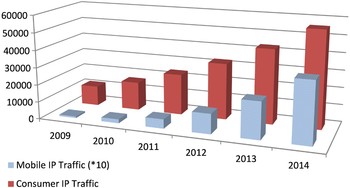
According to a White Paper from CISCO [1], the total internet traffic quadruples between 2009 and 2014. In the same period of time, the mobile data traffic grows at a rate of more than 100% per year and reaches in 2014 about 40 times the amount of 2009. The growth of mobile IP traffic (for better visualization multiplied by a factor of 10), and consumer IP traffic is illustrated in Fig. 1.
Growth of consumer IP-traffic and mobile IP-traffic in Pbytes/month [1].

B) The potential of 60 GHz systems
In order to cope with this huge increase in traffic, disruptive technologies are needed. Linear scaling of existing WLAN will not allow to cope with this huge amount of traffic. Despite the introduction of Multiple Input Multiple Output (MIMO) technologies and increased bandwidth, already nowadays Wireless Local Area Networks (WLANs) do reach the limit of their capacity in hot-spot areas. To facilitate transporting significantly more data on a number of measures are needed:
– Firstly, we do need small cells in order to limit the cumulative data rate per access point.
– Secondly, we do need more bandwidth for higher data rates per channel.
– Thirdly, we do need techniques for spatial reuse such as beamforming with interference limitation between several terminals in one cell.
All those requirements can be fulfilled by communication systems operating in the 60 GHz band:
– The high free space loss as well as the O2 absorption do allow the construction of small cells.
– The available bandwidth and power levels are unprecedented. Worldwide there is about 7 GHz of bandwidth available as an Industrial, Scientific, Medical (ISM) band. This is more than all other ISM-bands at lower frequencies together.
– Thirdly, the small wavelength and the small antenna size do support the application of beamforming.
Even though a lot of mobile internet traffic will be routed over cellular systems such as Long Term Evolution (LTE)-Advanced, other technologies are required to alleviate the burden on those cellular systems wherever possible. The mobile network can only cope with this huge amount of traffic if cooperative strategies between different technologies are introduced. Such strategies must route the mobile traffic via WLAN access points whenever possible, utilize the high-capacity 60 GHz mode wherever available, and use cellular systems such as Universal Mobile Telecommunications System (UMTS), High Speed Downlink Packet Access (HSDPA), LTE, and LTE-Advanced only if no WLAN-alternative is available.
Therefore, communication systems operating in the 60 GHz band will, in the next decade, play an important role to close the gap between excessive growth of mobile data traffic and available capacity in traditional WLAN frequency bands around 2.4 and 5 GHz. This overview article will highlight some aspects of frequency regulation, standardization, and applications related to the 60 GHz band.
Currently, a number of research projects deal with 60 GHz communication systems. In Germany, 14 partners of the project “EASY-A” [2] have joined to develop 60 GHz systems. A number of EASY-A partners have developed integrated mm-Wave 60 GHz frontends. On the EU-level, a number of European institutions have joined forces in the project QSTREAM [3]. In the project OMEGA [4], 60 GHz technology is investigated in the context of future home networks. The project IPHOBAC [5] investigates the use of photonic components for 60 GHz communication as well as for higher frequency bands.
At the University of California, Berkeley, the project “On-silicon Gigahertz Radio Exploration” has developed early solutions for mm-Wave communications [6]. At the NICT in Japan, a number of projects have supported the development of 60 GHz technology and standardization [Reference Kato7].
IBM is involved in NASA and DARPA funded projects on 60 GHz technology for quite some time. As a result, a complete transceiver in silicon technology was developed. The company SIBEAM has developed a complete system for wireless HDMI transmission, which is available as product.
II. PROPAGATION CHARACTERISTICS AND FREQUENCY REGULATION
A) Propagation characteristics
From a physics point of view, due to the short wavelength of about 5 mm, radio propagation at 60 GHz is similar to the propagation of visible light. Objects of a size of more than the wavelength in the line-of-sight path do lead to shadowing effects. For smaller objects, the diffraction will lead to no significant shadowing.
Solid concrete and brick walls cannot be penetrated by 60 GHz waves. Therefore, typically at least one access point is needed per room.
According to Friis equation, the free space path loss (FSPL) of a 60 GHz link at 1 m distance is FSPL = 68 dB. Doubling the distance causes 6 dB more attenuation. This high path loss is owed to the short wave length. To improve the link budget, it is hence recommended to use multi-antenna systems.
Another physical effect is the relatively strong absorption of 60 GHz radio waves by O2 molecules. The typical attenuation is around 15 dB/km. This means for typical indoor applications with a distance in the order of 10 m the attenuation by O2 absorption is just 0.15 dB and hence has virtually no effect on the total path loss. However, for long-distance point-to point links over a distance in the order of 1 km this effect has to be taken into account.
Since antenna dimensions depend on the wavelength, 60 GHz antenna elements can be very small. Typically, patch antenna elements have a size of about 5 mm2. This means that many elements can be integrated to form a patch array antenna. Such a patch array antenna can be designed for a very high antenna gain. This way, very narrow focused beams can be generated with relatively small antenna dimensions.
B) International and European frequency regulation
The 60 GHz frequency band has been used as an ISM band for many years. However, in the past only small amounts of spectrum were available. In Europe, there was a 500 MHz ISM band from 61 to 61.5 GHz available. The research- and commercial interest in the 60 GHz frequency band rapidly grew, after the US frequency regulator FCC made 7 GHz of unlicensed spectrum available in 2001. Subsequently, the frequency regulation bodies of many other countries followed suit. After a long consultation phase, Europe decided in 2009 to make even 9 GHz of bandwidth available [8]. Nowadays, practically in all regions of the world an ISM band around 60 GHz exists. The specified power levels allow the application of highly directive antennas.
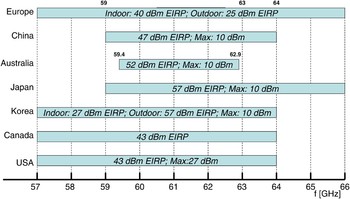
Figure 2 shows the 60-GHz-band unlicensed frequency spectrum that has been allocated in several countries. In North America and South Korea, 7 GHz bandwidth is allocated from 57 to 64 GHz. Japan has the same bandwidth but ranging from 59 to 66 GHz. China and Australia have narrower bandwidth than 7 GHz. Europe has allocated 9 GHz bandwidth from 57 to 66 GHz.
Overview of international 60-GHz-frequency regulation with power levels.

The 60 GHz frequency regulations also define the limitation of maximum transmit output power in terms of maximum transmitter power into the antenna and peak effective isotropic radiated power (EIRP). As indicated in Fig. 2, the maximum transmit power into the antenna is limited to 10 dBm in many countries.
In Europe, there is no limit on the maximum transmit power into the antenna. However, the frequency regulation distinguishes between indoor use (max. 40 dBm EIRP) and outdoor use (max. 25 dBm EIRP). The limited power levels for outdoor applications are specified in order to protect point-to-point (PTP) communication links in fixed installations. They are regulated separately. In Germany, for instance, the frequency band from 59 to 63 GHz is allocated for fixed PTP links. The power level for this application is limited to 40 dBm EIRP whereby the antenna gain has to be at least 35 dBi. In Europe, the band from 61 to 61.5 GHz is open for any application, including RADAR. For this 500 MHz band, the power level is limited to 100 mW EIRP. In addition to the above said, the band from 57 to 64 GHz can be used for tank level probing radars with a relatively high power of 43 dBm EIRP. Here the required attenuation of the (metal) tank or container must guarantee that no interference with other systems occurs.
The huge available bandwidth as well as the international availability for unlicensed operation has triggered a lot of research and commercial activities and the development of several international standards.
III. STANDARDIZATION
A) Common channel plan
Currently, there are two released international standards on 60 GHz communication systems, ECMA 387 [9], and IEEE 802.15.3c [16]. Furthermore, another IEEE standard IEEE 802.11ad will be released in mid-2011 [14]. The 60-GHz frequency regulation does not specify any channel parameters. Therefore, these parameters had to be specified in the appropriate standards. Fortunately, all three standards use the same basic channel plan shown in Table 1. From 57 to 66 GHz, four independent channels were defined. Within the range of the unlicensed 60 GHz frequency band allocated by a governmental agency, a 60 GHz communication device chooses a channel while keeping the assigned center frequency and maximum channel bandwidth.
Basic channel spacing for standards ECMA387, IEEE802.15.3c and IEEE802.11ad (Draft 1.0).

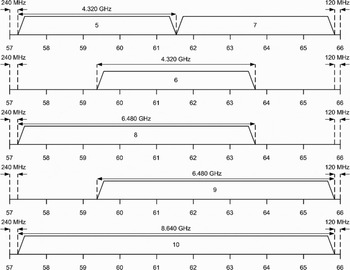
In addition to the four individual channels shown in Table 1, the ECMA 387 standard allows channel bonding. A graphical representation of the options for channel bonding is shown in Fig. 3. The bonded channels are numbered from 5 to 10. The largest channel bandwidth that can be used is almost 9 GHz. This large bandwidth would allow data rates of well beyond 10 Gb/s.
Possible options for channel bonding in standard ECMA 387 [9].

B) Basic parameters of physical layers
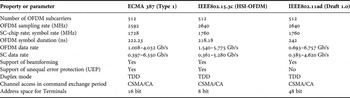
The main PHY parameters of the three different standards are compared in Table 2. This comparison is somewhat difficult since there are many different modes of operation. In ECMA 387 three different device types are specified. The parameters in Table 2 mainly apply to Type 1 devices.
Comparison of main PHY-related parameters for standards ECMA387, IEEE802.15.3c, and IEEE802.11ad.

In addition to a class of single-carrier (SC) modes the IEEE802.15.3c standard specifies two different Orthogonal Frequency Division Multiplex (OFDM) modes: The “high-speed interface mode” (HSI mode) and the “audio/visual mode” (AV mode). The OFDM parameters for the two modes are slightly different. Within the AV mode, a low-rate-PHY mode using a narrow bandwidth of about 100 MHz is specified. This can be used for audio distribution and signaling purposes. Furthermore, this standard defines a common mode with a high spreading factor which also can be used signaling purposes for co-existence between different modes. The AV mode and the common mode are not considered in Table 2.
For IEEE802.11ad it should be noted that this standard is not yet released. Therefore parameters and properties may change. The final standard is expected to be released in mid-2011.
IV. APPLICATIONS
A) Videostreaming and WLAN
Videostreaming and wireless displays (wireless HDMI) are seen as attractive applications for 60 GHz communications systems. In fact, the first products for this class of applications were developed by the company SIBEAM. The typical maximum distance is about 10 m and the highest provided data rate is around 4 Gb/s. Since in the target home environment multipath propagation will occur, the modulation scheme OFDM is well suited. Furthermore, beamforming should be used to improve the link budget.
Similar arguments apply for WLAN applications in a business, public, or home environment. Despite of using OFDM, blocking of the line-of-sight path can lead to a severe attenuation and disruption of the link. Therefore, a 60 GHz system should be combined with an alternative technology such as IEEE 802.11x or UWB. For this purpose the IEEE802.11ad standard provides mechanisms for fast session transfer. This way, a seamless handover from one physical layer technology to an alternative can be assured. Again, for this class of applications beamforming seems mandatory.
The disadvantage of OFDM modulation is high peak-to-average power ratio which induces the high requirements on the linearity of the power amplifier. This does lead to a high back-off ratio typically between 6 and 10 dB. This in turn does reduce the efficiency of the power amplifier further. With a typical saturated power efficiency of around 15% and 10 dB backoff, the overall efficiency is only 1.5%. This can be a significant disadvantage for mobile devices. Constant envelope modulation techniques would achieve a significantly better power efficiency.
B) Cable replacement and kiosk
Another class of applications includes the wireless connection of peripheral devices such as harddisk to a PC. Also uploading of videos from a camcorder to a PC or downloading of movies from a data kiosk to a mobile device are seen in this category. Here the distance can be very small, in the order of 1 m. However, the required data rate should be very high up to even 10 Gb/s. Since the blockage of the line-of-sight path can be avoided, SC modulation techniques appear most suitable. The power efficiency of the analog frontend can be higher than for OFDM transmission. This is because the linearity requirements on the power amplifier are relaxed. Additionally, SC modulation has relaxed requirements on other analog frontend imperfections such as phase noise, I/Q imbalance and frequency offset. Furthermore, the baseband processor for a SC modulation system can be of lower complexity due to less stringent requirements for analog-to-digital converters.
In particular for mobile, battery operated devices SC modulation is therefore an interesting option.
C) Backhaul networks
One of the upcoming applications of millimeter wavelength wireless systems is driven by the fast development of cellular telephony. The ever increasing demand for additional high-speed data access to use smart phones as the most important access to internet was the motor for the standardization of HSDPA, HSDPA+, LTE, and LTE-Advanced. While HSDPA provides up to 14 Mb/s, the following standards rapidly allows higher access speeds up to 300 Mb/s in LTE-Advanced. Since bandwidth in the interesting frequency range up to 10 GHz is a scarce resource, an enormous increase in spectral efficiency is needed. While HSDPA achieves a spectral efficiency of 2.8 b/s Hz, for LTE already 16.3 b/s Hz is required, and LTE-Advanced goes well beyond a spectral efficiency of 30 b/s Hz. Such a high spectral efficiency leads to high demands with respect to signal-to-interference-plus-noise ratio (SINR). Good SINR values can be achieved by several different measures such as increasing the transmission power, decreasing the cell sizes, using spatial and time diversity approaches, etc. This article is not focused on such approaches, but as a consequence of combining several of the above-mentioned means a couple of tendencies in cellular network development take place:
– The cell-size is decreasing from several kilometers to just a few hundred of meters.
– The interconnection between base stations to communicate parameters of channel quality, MIMO estimations, phase and time values, etc. on high-resolution time scales becomes essential for the cellular systems operation.
– The cost for base station interconnect becomes a extremely high portion of the total CAPEX of the cellar system.
The base station interconnect network is called the backhaul network of the system. Today these backhaul networks are mainly realized by wired or fiber systems and they are dimensioned for backhaul speed of several 100 Mb/s. An LTE-Advanced backhaul network, however, demands much higher speed up to several Gb/s. Furthermore, the decreasing cell diameters lead to an increased number of base stations such that one base station only covers a few thousand m2. Today's backhaul networks can fulfill neither the density nor the speed demands.
Wireless backhaul technology is a good way to solve this challenge. In the 60 GHz ISM band, a spectrum of 7 GHz is available worldwide. PTP connections of up to 5 Gb/s have already been demonstrated using a 2 GHz bandwidth on short distances (~20 m). These experiments have been conducted using small Vivaldi antennas with only little antenna gain of 6 dBi and an emitted power of approximately 10 dBm. Calculating a complete link budget for a 60 GHz backhaul link and taking into account the permitted emitted power values of 40 dBm (EIRP), a distance of more than 1 km can been achieved.
Market predictions [10] say that by 2015 more than 50% of all backhaul networks will be based on wireless connections. Especially in urban areas, the cost of sophisticated backhaul topologies is much lower using wireless interconnects. Two basic flavors of wireless interconnect are explored:
– PTP is mainly used in rural areas. Relatively long distances can be bridged (40–50 km) but the provided transmission capacity is very limited. For modern LTE networks, PTP will also be used in urban areas. Here short-range links (500–100 m) will be used with data rates of 1–10 Gb/s.
– Point-to-multipoint (PTM) is being used to build a hierarchy of access points. From a single central point, several access points can be reached. This reduces the number of connections and decreases the complexity of the interconnect network. The data rate demands for modern LTE networks; however, will most probably prohibit the use of PTM approaches.
Both approaches can be used in different frequency bands. While in former systems microwave links in the 20, 30, and 40 GHz bands have been used, modern backhaul networks will operate in the 60 GHz or the 70/80 GHz bands. Both bands provide sufficient bandwidth for the realization of backhaul networks with several Gb/s data rates. While the 60 GHz band is an ISM band and freely available, the 70/80 GHz band is a licensed band dedicated for backhaul and other interconnect network.
So there is a huge market opportunity for 60 GHz interconnect technology. Since the high-level integration of analog frontends systems allows a dramatic cost reduction for the interconnect system, the market for these systems will grow very quickly in the coming years.
V. RESEARCH CHALLENGES AND FURTHER WORK
A) Multiple antenna technology and polarization
One of advantages in millimeter-wave 60 GHz wireless systems with respect to microwave systems is smaller size of antennas that comes from shorter wavelength. It enables to realize a multiple antenna configuration in small dimension. Implementation complexities of multiple RF transceivers have been a challenging issue; however, high level integration of 60 GHz systems have been recently realized with advanced silicon millimeter-wave circuit technologies. These multiple antenna technologies are particularly expected to be promising solutions to the problems that 60 GHz wireless systems inherently have, for example, line-of-sight (LOS) constraint and high attenuation loss.
A transmitter switching diversity is the simplest way to alleviate the LOS constraint problem in terms of hardware implementation. In addition, it mitigates two-path interference fading effects that are most likely to occur in desktop environments. For these reasons, the IEEE 802.15.3c and ECMA standards adopted this switching diversity schemes and an optimized frame structure to support it.
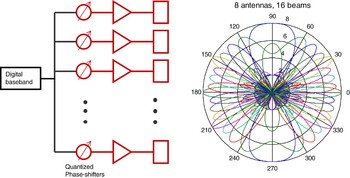
Beamforming techniques are the most attractive multiple antenna technologies for 60 GHz wireless systems in terms of performance gain. They make it possible to steer beam direction to the best path from a transmitter to a receiver. This process can be performed anew when the link condition changes, for example, an LOS link becomes blocked by a person in indoor environments. In other words, they offer not only high link gain but also LOS blockage avoidance by changing beam direction adaptively. Suppressed multi-path fading is another benefit from the narrow beam width of beamformed links. For these reasons, the IEEE 802.11ad and IEEE 802.15.3c standards support protocols and frame architectures for beamforming in 60 GHz systems. Figure 4 shows the 60 GHz beamforming architecture specified in IEEE 802.15.3c. It consists of multiple RF transceiver arrays and one digital baseband processor. Unlike conventional digital beamforming systems where received signals at different antennas are processed and combined in digital domain, it performs such spatial signal processing in the analog RF transceiver in order to keep the baseband architecture as simple as possible. This is particularly advantageous in 60 GHz wireless systems where the complexity and power consumption of multigigabit baseband processors and the respective ADCs are limiting factors. The IEEE 802.15.3c standard also defines the 2-bit based beamforming codebook for hardware simplification of 60 GHz phase shifters.
Beamforming architecture specified in IEEE 802.15.3c.

High gain and narrow beam-width of beamforming arrays makes it possible for 60 GHz systems to employ spatial reuse techniques. They enable multiple devices to simultaneously use the same channels in different spatial domain, which promises higher total throughput in high-density usage scenarios. The IEEE 802.11ad standard draft defines such spatial reuse techniques on the top of beamforming systems. To mitigate interference between different 60 GHz devices that spatially reuse channels (co-channel operation), it is important for beamforming to adaptively null out the co-channel interference from other devices. However it turns out that the 2-bit-based codebook approach specified in the IEEE 802.15.3c is not sufficient in beamforming receivers. To resolve the interference mitigation problem, we, IHP, proposed a new beamforming structure with continuous analog phase shifters and its relevant beamforming protocol [Reference Choi, Elkhouly, Grass and Scheytt11, Reference Elkhouly, Choi, Glisic, Scheytt and Ellinger12].
B) Ranging and localization
Location awareness of persons and objects is more and more of interest in many applications. Some example applications are: your position in a building, a route to an exhibition booth, or information about an item in a museum. There are also a lot of business application in the area of security and surveillance or smart factories including autonomous guided vehicles and car-to-car communications.
Global Navigation Satellite Systems are in general not or only very poorly available in indoor environments and do not fulfill the resolution and accuracy requirements for most indoor applications.
Further on, there is an increasing interest to combine communication and localization. The radio communication infrastructure should include precise localization functions to get location aware services without additional infrastructure. Basically, in radio networks four localization techniques can be distinguished: cell of origin, angle of arrival, received signal strength, and propagation time. The achievable accuracy of the different techniques varies enormously. In general, the propagation time-based approaches are the most accurate ones. While cell of origin and signal strength methods do not benefit from the 60 GHz band, the propagation time-based approaches gets an important profit. The resolution of the time-based methods is mainly limited by the bandwidth. In the 60 GHz band, a very high bandwidth is available. Therefore, the 60 GHz band offers a high potential for time-based localization approaches with a resolution in the lower centimeter range or even in the millimeter range. Furthermore, the 60 GHz band allows the combination of communication with high data rates and localization with high spatial resolution.
In [Reference Ohlemüller, Winkler and Grass13] a localization concept is presented, which measures the round trip time-of-flight between two radio stations. One station sends ranging data to a second station. The second station sends the received ranging data back to the first station. The received ranging data in the first station contain twice the propagation time. This concept has been implemented in a 60 GHz OFDM demonstration communication system with 2 GHz bandwidth. The resolution of this implementation is 1.7 cm.
Because of the high bandwidth the transmitted data packets are very short in time. Therefore, a ranging measurement can be done in a very short interval (below 10 µs). Measured data can also be exchanged between the stations very fast. This is important if the stations move with high velocity like cars, etc.
A benefit of the 60 GHz band is, on the one hand, that there is no interference with other radio and satellite communication systems like GSM, GPS, GALILEO, WLAN IEEE802.11/a/b/g/n and, on the other hand, the limited operating distance caused by the relatively high attenuation in air. Because a 60 GHz localization system does not interfere with other systems in cars, trains or airplanes, it offers new application fields.
C) System aspects, MAC protocol, and interfaces
Any physical layer communication link providing a certain data throughput in the physical layer is to be integrated into a communication system. The manner of integration and the kind of problems to be solved strongly depend on the architecture of the whole system.
The simplest system is the unidirectional (simplex) data transfer from a transmitter to a receiver. Cable replacement for wireless displays, e.g. for a beamer, is an example relevant in 60 GHz communications. If the radio channel is not to be shared with other systems, there is no need for a policy for medium access control (MAC). Because of the lack of a return channel, acknowledgements and retransmissions of undelivered frames are impossible. Hence, a MAC protocol is not required. The data are usually transferred as a stream, but may also be disassembled into packets.
A bidirectional PTP connection, when operating in time division multiplex, normally provides some simple MAC and ARQ schemes (automatic repeat request, retransmission of not correctly received frames). These are indispensable in wireless networks (WLAN's) with many stations. Several MAC protocols have been standardized. Examples for 60 GHz standards are IEEE 802.11ad [14], IEEE 802.15.3c [16], and ECMA-387 [9]. Most MAC challenges are not specific to the 60 GHz band, but common for any ultrahigh-speed wireless network. The most important one is to avoid “dead” times not used to transfer data. Examples are the preamble of a frame and inter-frame spacings, which scale poorly with increasing data rate. Typical WLAN values are around a few microseconds, which is equivalent to a loss in data transfer capability of a few kilobytes in a WLAN network providing 8 Gb/s.
A MAC extension specific for 60 GHz systems is the optional support for beamforming in IEEE 802.11ad and IEEE 802.15.3c. ECMA-387 provides support for directional antennas.
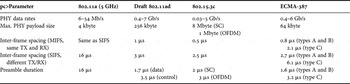
Performance losses due to preambles, inter-frame spacings, etc. can be reduced by increasing the frame size. For gigabit networks, a frame payload size in the order of at least 64 kbyte is desirable [Reference Kraemer and Katz17]. Therefore, the high-speed versions of all relevant WLAN standards provide larger frame size than their traditional counterparts (Table 3). Normally, also a procedure for frame aggregation is standardized, which combines several network packets (typically IP packets of 1.5 kbyte) into one longer WLAN frame.
Comparison of MAC parameters for three different 60 GHz standards with 5 GHz WLAN.

The extreme example for “dead” time is the immediate acknowledgement frame, where 1 bit of information (ACK or non-ACK) is transferred in a complete frame. Therefore, all high-speed WLAN standards define block or implicit acknowledgements to avoid the extremely inefficient direct acknowledgements.
Table 3 gives a simplified overview over important MAC-related parameters standardized for 60 GHz systems and compares them with a conventional IEEE 802.11a WLAN in the 5 GHz band.
The interface of the 60 GHz module to its environment is another potential bottleneck. There is not much choice above 10 Gb/s, except optical fibre and upcoming 10 Gb Ethernet. For a few Gb/s, several standard interfaces are available or under development. Their main properties according to [15] are briefly summarized in Table 4.
Computer interfaces providing Gb/s data rates.

Even though the physical interface may support data rates of 10 Gb/s and beyond, often the device drivers may limit the data rate. Therefore, an efficient software stack is as important as high-speed interface hardware.
VI. CONCLUSIONS
This paper gives an overview of issues related to communications systems operating in the 60 GHz unlicensed band. Starting with motivation and general propagation characteristics, the international frequency regulation is discussed. Furthermore, three different international standards are investigated and compared with each other. The common channel plan for these three standards is presented and the main characteristics are listed. Some high-potential applications for systems operating in the 60 GHz band are detailed and future challenges are outlined. For future WLAN applications, in particular, beamforming and polarization techniques, methods for localization and ranging as well as protocol (MAC) and network related issues have to be investigated.
Potentially, in 3–5 years WLAN and WPAN systems operating in the 60 GHz band can have a similar market penetration as known WiFi systems do have now.
ACKNOWLEDGEMENTS
The authors acknowledge the excellent cooperation with all project partners within the EASY-A project and the support by the German Federal Ministry of Education and Science (BMBF).
 Eckhard Grass received the Dr.-Ing. degree in electronics from the Humboldt University in Berlin, Germany, in 1993. He was a Visiting Research Fellow at Loughborough University, UK, from 1993 to 1995, and a Senior Lecturer in Microelectronics at the University of Westminster, London, UK, from 1995 to 1999. Since 1999, he has been with IHP (www.ihp-microelectronics.com), leading several projects on the implementation of wireless broadband communication systems. Since 2008, Dr. Grass is leading a project on the development and implementation of a 60-GHz high-data-rate communication system. He is team leader of the Wireless Broadband Communications Group at IHP. E. Grass has published about 80 papers at international conferences and in international journals. His research topics include wireless communication systems, asynchronous circuit design, and digital signal processing architectures.
 Klaus Tittelbach-Helmrich received the diploma degree in physics from the Humboldt-University, Berlin, Germany, in 1984. After having worked in the field of experimental semiconductor physics at the Institute for Semiconductor Physics, Frankfurt (Oder), he joined the Systems Department of the IHP, Frankfurt (Oder), Germany, in 1995. Here he is working on communication protocols for broadband wireless communication systems, such as IEEE 802.11 and IEEE 802.15. His special research interest is dedicated to the optimization of such implementations for low power and/or high performance by using hardware-software co-design and dedicated hardware accelerators for time-critical protocol functions.
 Changsoon Choi received B.S., M.S., and Ph.D. degrees in electrical and electronic engineering from Yonsei University, Seoul, Korea, in 1999, 2001, and 2005, respectively. His doctoral dissertation concerned fiber-supported millimeter-wave wireless communication systems. He is now with NTT DoCoMo communication laboratories Europe GmbH, Germany, where he is working on cooperative MIMO systems for LTE-Advanced. His industrial experience includes affiliations with the National Institute of Information and Communications Technology (NICT), Japan, from 2005 to 2007 and with IHP Microelectronics GmbH, Germany, where he worked on millimeter-wave wireless LAN/PAN systems, particularly multi-Gbps OFDM and millimeter-wave beamforming systems.
 Frank Winkler studied at the Technical University Dresden and the Humboldt-University Berlin, where he received his diploma (1981) and Dr.-Ing. (1986) in Information Technology. He is with the Signal Processing Group in the Department of Computer Science at the Humboldt-University Berlin. His research focus is on embedded communication systems, circuit design and FPGA implementation.
 Thilo Ohlemüller received a degree in computer science from the Humboldt-University Berlin, Germany in 2009. Afterwards he became a research assistant at the Humboldt University Berlin. Since end of 2009 he is also with IHP Microelectronics in Frankfurt (Oder). His research interests include propagation time based ranging and localization methods in wireless networks and digital systems based on FPGAs.
 Prof. Dr.-Ing. Rolf Kraemer received his diploma and Ph.D. from RWTH Aachen in electrical engineering and computer-science in 1979 and 1985. He joined the Philips Research Laboratories in 1985 where he worked on distributed operating systems, communication systems, wireless high speed communication, and embedded control- and management-software in different positions and responsibilities until 1998 in Hamburg and Aachen. In 1998 he became a Professor at the Technical University of Cottbus with the joined appointment of the department head of wireless systems at the IHP in Frankfurt (Oder). His teaching obligations address the area of distributed operating systems, mobile communication, and sensor networks. In the IHP he leads a research department with approximately 40 researchers in topics of high speed wireless communication, context aware middleware, sensor networks as well as embedded processors for encryption and protocol acceleration.