Introduction
Modern agriculture faces several important challenges. One of the challenges is to develop pest management strategies that increase agricultural production but do not have a negative impact on the biodiversity of agro-ecosystems. This challenge has resulted in numerous studies being conducted to develop strategies that conserve and even augment arthropod diversity when integrated into intensive agricultural practices (Whittingham, Reference Whittingham2007, Reference Whittingham2011; Leng et al., Reference Leng, Musters and de Snoo2010; Smith et al., Reference Smith, Öckinger and Rundlöf2010; Krauss et al., Reference Krauss, Gallenberger and Steffan-Dewenter2011).
The use of insecticides in the control of insect pests is a major factor contributing to the loss of biodiversity in agro-ecosystems (Heinrichs, Reference Heinrichs2005; Teodorescu and Cogãlniceanu, Reference Teodorescu and Cogãlniceanu2005; Heong et al., Reference Heong, Manza, Catindig, Villareal and Jacobsen2007; Desneux et al., Reference Desneux, Decourtye and Delpuech2007; Boutin et al., Reference Boutin, Martin and Baril2009; Geiger et al., Reference Geiger, Wãckers and Bianchi2009; Das et al., Reference Das, Roy and Mukhopadhyay2010; Falcone and DeWald, Reference Falcone and DeWald2010). The loss of biodiversity includes the decimation of arthropod natural enemies in the orders Coleoptera, Araneae and Acarina (Fountain et al., Reference Fountain, Brown, Gange, Symondson and Murray2007; Amalin et al., Reference Amalin, Peña, Duncan, Leavengood and Koptur2009; Das et al., Reference Das, Roy and Mukhopadhyay2010). The negative impact of insecticides on natural enemies in tropical rice fields has been documented in studies conducted in Asia (Heinrichs, Reference Heinrichs1994; Heong and Schoenly, Reference Heong, Schoenly, Haskell and McEwen1998; Heong et al., Reference Heong, Manza, Catindig, Villareal and Jacobsen2007; Gangurde, Reference Gangurde2007).
Brazil is among the world's major rice producers, occupying the eighth position on a global scale (USDA, 2011) with more than 50% of the Brazilian rice being produced in the states of Rio Grande do Sul and Santa Catarina in subtropical, southern Brazil. Rice production at 7 tons/ha in southern Brazil is among the highest in the world (CONAB, 2011). In spite of these high yields, insect pests have become important factors that prevent even higher yields as they attack rice from germination to harvest (Ferreira and Martins, Reference Ferreira and Martins1984; Link et al., Reference Link, Costa and Marchesan1987; Martins et al., Reference Martins, Ribeiro and Terres1989; Oliveira and Kempf, Reference Oliveira and Kempf1989). Because of higher yields, the potential economic losses due to pests are also higher (some countries have rice yields of less than 2 tons/ha). Thus, even low pest populations in Brazil can have a significant impact on economic yield losses.
Key insect pests in irrigated rice fields of Rio Grande do Sul include the rice water weevil Oryzophagus oryzae (Costa Lima) (Coleoptera: Curculionidae), the stink bugs Tibraca limbativentris (Stål) and Oebalus poecilus (Dallas) (both Hemiptera: Pentatomidae) and the noctuids Spodoptera frugiperda (J.E. Smith), Pseudaletia adultera (Schaus) and Pseudaletia sequax (Franclemont) (all Lepidoptera: Noctuidae). The application of synthetic insecticides is the major method used to control these pests in Brazil (Oliveira and Freitas, Reference Oliveira and Freitas2009), and one of the most commonly used insecticides is the pyrethroid lambdacyhalothrin. The insecticide attacks their nerve membranes, which are connected to sodium channels, thereby instantly stopping the transmission of nerve impulses, promoting the loss of muscle control and causing death of the insect (Davey et al., Reference Davey, Ahrens and George1992).
The aim of this study was to evaluate the impact of lambdacyhalothrin on communities of arthropod natural enemies in irrigated rice fields in the subtropical zone of southern Brazil. In addition, the diversity of these arthropods present in the irrigated rice agro-ecosystem was evaluated.
Materials and methods
Study area
The study was conducted during the crop years 2007/2008 and 2008/2009 in irrigated rice fields located in the districts of Cachoeira do Sul (30th 13′ 31.12″S; 52nd 56′ 44.23″ W), Eldorado do Sul (30th 00′ 53.14″S; 51st 24′ 28.19″W) and Capivari do Sul (30th 09′ 41.14″S; 50th 30′ 53.9″W), all located in the state of Rio Grande do Sul, Brazil. In each location, the experiment was conducted in two subareas of 1200 m2, each subarea consisting of four plots each with an area of 300 m2. One of the subareas received 150 ml/ha of lambdacyhalothrin CS 50, while the other subarea was untreated. Lambdacyhalothrin was chosen because it is widely used by rice farmers in Rio Grande do Sul. To avoid the contact between the subareas, the treated and untreated subareas were separated by a mud levee and preventive measures to minimize the effects of the contamination of untreated subareas were observed, including wind direction and product application in days without rain. During the vegetative stage of rice growth, the insecticide was applied via a sprayer propelled by CO2 with a pressure set at 35 lb/in2 and equipped with four-cone-type nozzles spaced equidistant at 0.5 m.
Collection and identification of natural enemies
Arthropods were collected with the aid of a sweep net (40 × 36 cm) by making 50 swinging movements per plot across the canopy of the rice plants. The use of this type of net is recommended for capturing insects that inhabit the leafy portion of the plant as in rice fields. Sweep net samples were collected at 2, 16, 31 and 45 days after the application of the insecticide. The sweep net sampling ensures the collection of a significant number of the insects from which it is possible to determine the relative abundance and diversity of the arthropods (Arida and Heong, Reference Arida and Heong1992; Azevedo Filho and Junior, Reference Azevedo Filho and Junior2000). Sweep net samples were obtained in January and February 2007/2008 and 2008/2009 by two separate sampling expeditions carried out for each month. Subsequently, the samples were individualized by placing in plastic bottles containing 70% alcohol and taken to the UNISINOS laboratory (São Leopoldo, Brazil). In the laboratory, the arthropods were counted and taxonomically identified to the family level using a standard stereoscopic microscope and dichotomous keys (Borror et al., Reference Borror, Triplehorn and Johnson1989; Heinrichs, Reference Heinrichs1994; Heinrichs and Barrion, Reference Heinrichs and Barrion2004). Some specimens were submitted to taxonomic specialists with expertise in identifying specific groups.
Data analyses
The impact of the insecticide on the communities of arthropod natural enemies was analysed by comparing the abundance of the orders and families in the treated versus untreated plots at each site. We first employed the factorial analysis of variance to compare the total abundance of arthropods and the abundance of the more frequent orders in each site. Shannon's index of diversity was used to compare these treatments.
Next, the dates were organized into two matrices: one with the data collected in the first 2 weeks of the experiment and the other with the data collected in the last 2 weeks of the experiment. This procedure was adopted because preliminary results suggested that the insecticidal impact on insects was most accentuated in the first 50 days after the application of the insecticide. This process was followed to verify whether the distance between the treated and untreated areas decreased with time. This showed that the impact of the insecticide was most severe at 15 days after the application of the insecticide. In these analyses, we included only the families present in all areas and all sites.
Principal components analysis (PCA) was used to analyse the distribution pattern of these families between areas, sites and years (Jongman et al., Reference Jongman, Ter Braak and Van Tongeren1995; Legendre and Legendre, 1998). The values were transformed by the expression log10(x+1) to compensate for the deviations caused by low abundance and higher densities of insects (TerBraak, Reference Ter Braak1995). PC-ORD 4.0 (McCune and Mefford, Reference McCune and Mefford1999) was utilized for these analyses. For the PCA, the correlation matrix was used since the variables were estimated by different units of measurement. Only eigenvalues >1 were used as criteria for the extraction of principal components. To facilitate the interpretation of results, data were analysed using the varimax rotation matrix method. Only 17 families were utilized for these analyses, and the taxa with low frequencies and those not present in all the sample sites were excluded from analyses.
Results
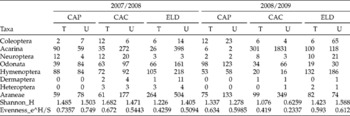
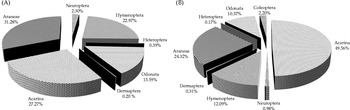
Data on the abundance of the main arthropod orders collected during this study are presented in Table 1 by site, year and area. A total of 7498 specimens of arthropod natural enemies were collected, with 2090 insects in the treated areas and 5408 insects in the untreated areas. The frequency data showed that Acarina, Odonata, Hymenoptera and Araneae were the dominant orders in both years and in both insecticide-treated and untreated areas (Fig. 1).
Number of specimens of arthropod natural enemy taxa captured by site (CAP, Capivari do Sul; CAC, Cachoeira do Sul; ELD, Eldorado do Sul), year (2007/2008; 2008/2009) and area (T, treated; U, untreated)

Relative abundance (%) of the major arthropod natural enemies in (A) the insecticide-treated and (B) untreated irrigated rice plots.

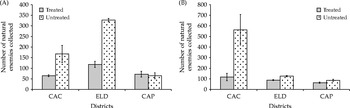
Statistical analyses of the total abundance of natural enemies during the four sample dates showed significant differences between the treated and untreated areas in Cachoeira do Sul 2007/2008 (F= 6741, df = 1, 24, P= 0.016) and 2008/2009 (F= 6423, df = 3, 24, P= 0.002); Eldorado do Sul 2007/2008 (F= 5429, df = 3, 24, P= 0.005) and 2008/2009 (F= 8165, df = 3, 24, P= 0.001) and Capivari do Sul 2008/2009 (F= 4662, df = 1, 24, P= 0.041). Only in Capivari do Sul 2007/2008, the difference between the treated and untreated areas was not significant (Fig. 2). The statistical analyses of the abundance of the main orders of natural enemies also showed similar patterns (F values not shown).
Abundance of arthropod natural enemies in the insecticide-treated and untreated areas of each district in (A) 2007/2008 and (B) 2008/2009. CAC, Cachoeira do Sul; ELD, Eldorado do Sul; CAP, Capivari do Sul.

There was also a significant (P< 0.005) interaction between arthropod abundance and sample days in Eldorado do Sul and Capivari do Sul. Before proceeding to grouping, the two samples were compared using a χ2 test and the differences were not significant. As a result of this interaction, we divided our dataset into two subsets: subset 1 comprising the 2nd and 16th day collection data and subset 2 containing the 31st and 45th day collection data.
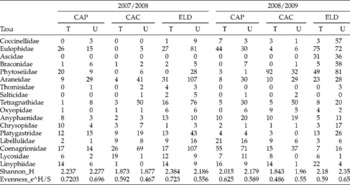
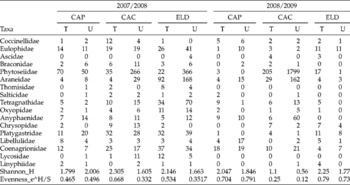
To get a more detailed view of these differences, we employed the PCA. The matrix for the PCA was constructed using the samples obtained from the three sites at the different sampling points (treated and untreated). In total, 12 samples and 17 variables (families) were analysed in two subset matrices (Tables 2 and 3). The PCA indicates the existence of five principal components only weakly correlated among themselves, but with a strong correlation within each subset of data.
Number of specimens of various arthropod families in the first data subset used in the PCA

CAP, Capivari do Sul; CAC, Cachoeira do Sul; ELD, Eldorado do Sul; T, treated; U, untreated.
Number of specimens of various arthropod families in the second data subset used in the PCA

CAP, Capivari do Sul; CAC, Cachoeira do Sul; ELD, Eldorado do Sul; T, treated; U, untreated.
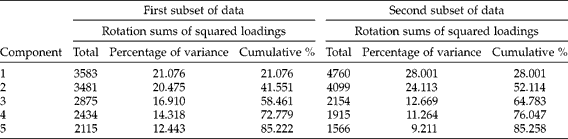
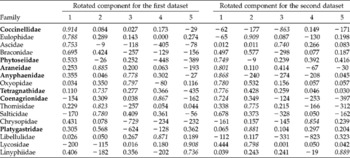
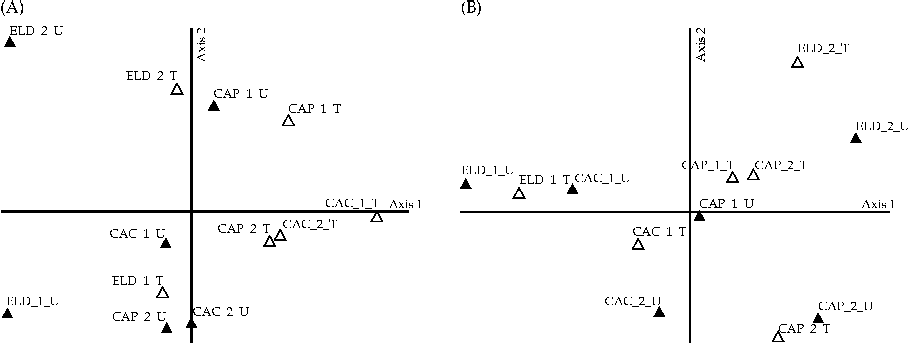
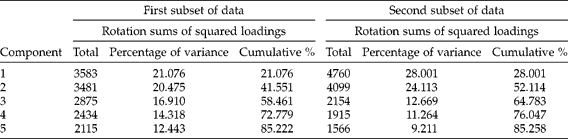
For each subset, there were five components that explained 85% of the variance observed (Table 4). In Table 5, the variables with a correlation greater than 0.7 with their respective principal components are italicized. The separation of the areas analysed based on principal components for the first dataset is shown in Fig. 3. A good separation between the treated and untreated areas in each site, with the exception of Capivari do Sul in the first year, is shown in Fig. 3A. The separation of the areas analysed based on principal components for the second dataset is shown in Fig. 3B. It shows that the treated and untreated areas of the same sites are generally closer. The only exception occurred in Cachoeira do Sul (CAC_2_T and CAC_2_U) in the second year.
Eigenvalues and percentages of variance explained and accumulated as found by the PCA method for each data subset
Correlation matrix between the biological variables and principal components selected using the varimax rotation method for each data subset

+The families indicated in bold font are the main families used to show the difference between the insecticide-treated and untreated areas. Variables with a correlation >0.7 are italicized.
Ordination of the insecticide-treated and untreated communities according to the two main components of the principal components analysis using the frequency of 17 families as variables. (A) Subset 1 and (B) subset 2. ▲, Untreated areas; Δ, treated areas. CAP, Capivari do Sul; CAC, Cachoeira do Sul; ELD, Eldorado do Sul.
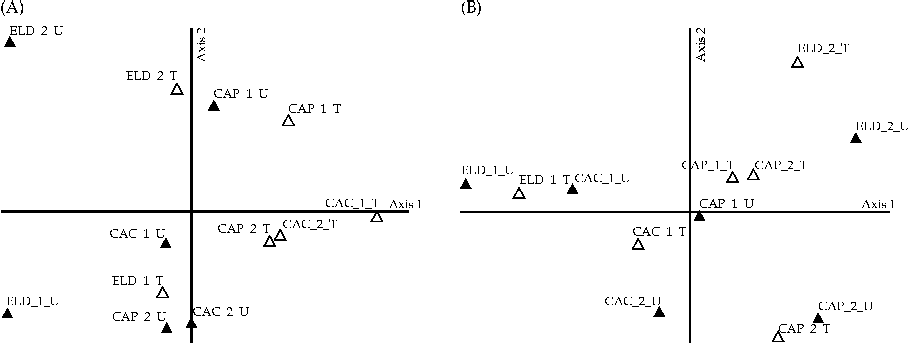
In the aforementioned analysis, it should be noted that there are three sources of variation: insecticide, year and sites. Thus, the distribution of the sample sites in the biplot graphic is influenced by treatment effect, localization of the site (spatial variation) and the year of sampling (temporal variation). To identify the families that contributed most to the differences between the treated and untreated areas, we compared the observed and expected values in each site and year using the χ2 statistic. The families that showed significant differences between the treated and untreated areas were Araneidae (χ2= 10.526, df = 1, P< 0.001) (CAP_1); Tetragnathidae (χ2= 13.931, df = 1, P< 0.001) and Araneidae (χ2= 12.737, df = 1, P< 0.001) (CAP_U_2); Araneidae (χ2= 23.040, df = 1, P< 0.001), Tetragnathidae (χ2= 36.646, df = 1, P< 0.001), Coenagrionidae (χ2= 15.242, df = 1, P< 0.001) and Phytoseiidae (χ2= 29.032, df = 1, P< 0.001) (CAC_U_1 and CAC_U_2); and Coccinellidae (χ2= 28.000, df = 1, P< 0.001), Phytoseiidae (χ2= 28.000, df = 1, P< 0.001), Araneidae (χ2= 41.855, df = 1, P< 0.001), Tetragnathidae (χ2= 39.130, df = 1, P< 0.001), Eulophidae (χ2= 27.000, df = 1, P< 0.001), Braconidae (χ2= 48.600, df = 1, P< 0.001), Linyphiidae (χ2= 10.667, df = 1, P< 0.001) and Coenagrionidae (χ2= 65.323, df = 1, P< 0.001) (ELD_U_1 and ELD_U_2) in the first subset of the data. In the second subset of the data, the number of families that showed significant differences was smaller. Only Phytoseiidae (χ2= 175.749, df = 1, P< 0.001 in CAC_1; χ2= 1267.882, df = 1, P< 0.001 in CAC_2; and χ2= 304.990, df = 1, P< 0.001 in ELD_2) and Araneidae (χ2= 17.471, df = 1, P< 0.001 in CAC_1; χ2= 91.228, df = 1, P< 0.001 in CAC_2; and χ2= 22.215, df = 1, P< 0.001 in ELD_1) had significantly higher frequencies in the untreated areas than in the treated areas at 45 days after the application of the insecticide in the first and second years. Phytoseiids were represented by Neoseiulus paraibensis (Moraes and McMurtry), an important Acarina predator. The other families in the PCA (Table 5, italicized) are related to spatial or temporal variations in the rice ecosystem.
Discussion
Our results show consistent differences between the treated and untreated areas in the abundance of arthropod natural enemies primarily in the first 2 weeks after the application of the insecticide. After this period, the number of natural enemies in most arthropod families recovered to levels similar to those of the untreated plots. These results are consistent with other studies showing the negative impact of lambdacyhalothrin on beneficial arthropods in agro-ecosystems (Costa and Link, Reference Costa and Link1999; Kharboutli et al., Reference Kharboutli, Allen, Capps, Earnest and Oosterhuis2000; Colignon et al., Reference Colignon, Hastir, Gaspar and Francis2001; Costa, 2007). Wick and Freier (Reference Wick and Freier2000) and Hand et al. (Reference Hand, Kuet, Lane, Maund, Warinton and Hill2001) showed that lambdacyhalothrin has a high initial impact, but low persistence.
The impact of lambdacyhalothrin on Phytoseiidae and Araneidae is of special interest. In contrast to other families, even at 45 days after the application of the insecticide, populations of these families did not recover. The differences in the abundance of these two families are indicated by the distance between them in the biplot graphic (Fig. 3B). Pyrethroids such as lambdacyhalothrin usually show high toxicity on predatory phytoseiids (Rock, Reference Rock1979; Croft, Reference Croft1990; Raudonis, Reference Raudonis2006) and spiders (Wick and Freier, Reference Wick and Freier2000; Martins et al., Reference Martins, Toscano, Tomquelski and Maruyama2009). These facts are of major concern because Arachnidae are the most abundant arthropods in agro-ecosystems (including our study) and predators of a wide range of insect pests (Marc et al., Reference Marc, Canard and Ysnel1999). Several studies have demonstrated the importance of spiders in the reduction of prey numbers and their contribution to pest control (Riechert and Lawrence, Reference Riechert and Lawrence1997; Marc et al., Reference Marc, Canard and Ysnel1999; Nyffeler and Sunderland, Reference Nyffeler and Sunderland2003; Oberg, Reference Oberg2007; Seyfulina, Reference Seyfulina2010).
The present study revealed a great diversity of natural enemies in rice fields in the subtropical environment in southern Brazil, similar to that found in tropical environments. Natural enemies are an important component in integrated pest management (IPM), so it is important to reduce the impact of insecticides in an effort to conserve these biocontrol agents. Modifications to agro-ecosystems that favour natural enemies have contributed to the success of the biological control approach (Ehler, Reference Ehler and Barbosa1998; Heong et al., Reference Heong, Manza, Catindig, Villareal and Jacobsen2007). Our results showed a great diversity and abundance of natural enemies present in rice fields in southern Brazil. These factors suggest the need to develop strategies to conserve these arthropods and to utilize them as a key component in the IPM of rice insect pests in Brazil. Such strategies have been developed for the management of rice pests in Asia.
Studies in Asian rice have shown that the pyrethroids cypermethrin (Vorley, Reference Vorley1985), decamethrin (Heinrichs et al., Reference Heinrichs, Reissig, Valencia and Chelliah1982) and deltamethrin (IRRI, 1984) cause resurgence of the brown planthopper (BPH) Nilaparvata lugens (Stål) and are highly toxic to natural enemies. It has been shown that deltamethrin when applied three times at a rate of 0.03 kg ai/ha to a BPH-susceptible variety causes a resurgence of N. lugens populations, reaching 850 planthoppers/hill compared with the untreated check plot at 60 planthoppers/hill (IRRI, 1984). It has also been reported that the pyrethroid cypermethrin also causes a resurgence of the white-backed planthopper Sogatella furcifera (Horvath) in Malaysia (Vorley, Reference Vorley1985).
A number of factors are involved in the resurgence phenomenon in Asian rice including the destruction of the major predators of N. lugens and S. furcifera: the mirid bug Cyrtorhinus lividipennis (Reuter), the ripple bug Microvelia atrolineata (Bergroth) and the spider Lycosa pseudoannulata (Boes. et Str.) (Lycosidae) (Heinrichs et al., Reference Heinrichs, Reissig, Valencia and Chelliah1982; Fabellar and Heinrichs, Reference Fabellar and Heinrichs1984; IRRI, 1984; Salim and Heinrichs, Reference Salim and Heinrichs1985). Lambdacyhalothrin is applied early in the vegetative stage for the control of the rice water weevil Lissorhoptrus oryzophilus (Kuschel) in California, where it has been reported to be highly toxic to general predators and parasites of rice pests (UC Davis). Lambdacyhalothrin is also used for the control of the rice water weevil O. oryzae in southern Brazil, where we have reported that it suppresses populations of natural enemies including predacious spiders.
To cope with the destruction of natural enemies and the subsequent resurgence problem of N. lugens in Asia, a number of tactics have been developed:
1 The International Rice Research Institute recommends that farmers should not apply insecticides for the first 40 days after sowing, and should only apply insecticides later after a careful assessment of the need for control applications (Vorley, Reference Vorley1985).
2 Studies have shown that a reduction in the number of insecticide applications and rates contributes to the maintenance of predators in rice fields (Settle et al., Reference Settle, Ariawan, Astuti, Cahyana, Hakim, Hindayana and Lestari1996; Matteson, Reference Matteson2000; Berg, Reference Berg2002).
3 Another alternative is the use of highly selective insecticides. In the Philippines, buprofezin (Applaud®) was highly selective, providing an effective control of N. lugens and S. furcifera nymphs at low rates, but was safe to the predators L. pseudoannulata (Boes. and Str.) (Lycosidae), C. lividipennis Reuter (Miridae) and M. atrolineata (Bergroth) (Veliidae) (Heinrichs et al., Reference Heinrichs, Basilio and Valencia1984). In California, the growth regulator diflubenzuron (Dimilin®), when applied to rice, has been reported to be moderately toxic to general predators and with low toxicity to parasites (UC Davis).
4 The breeding of rice varieties with resistance to early season pests, an important tactic, permits a delay in the application of insecticides for 40 days and allows a build-up of natural enemies.
A combination of these tactics must be integrated into a pest management strategy specifically targeted at southern Brazil. With the rice water weevil O. oryzae being a major early season pest, some modifications of the Asian strategy must be developed for southern Brazil.
Conclusion
This study, similar to the one by Wilby et al. (Reference Wilby, Lan, Heong, Huyen, Quang, Minh and Thomas2006), confirms the great diversity and high population levels of arthropod natural enemies in rice fields in southern Brazil. However, the insecticide lambdacyhalothrin shows a negative impact on beneficial arthropods in this agro-ecosystem, suggesting the need to develop strategies to conserve these arthropods and to utilize them as a key component in the IPM of rice insect pests in Brazil. The combination of IPM techniques successfully used in other countries (Heinrichs et al., Reference Heinrichs, Basilio and Valencia1984; Vorley, Reference Vorley1985; UC Davis) for the management of N. lugens must be integrated into a pest management strategy tailor-made for southern Brazil. Among others, it should include (1) the development of insect-resistant rice varieties suitable to southern Brazil, (2) the reduction in the number of application of insecticides and (3) the identification of selective insecticides with low toxicity to natural enemies, but effective against major pests.
Acknowledgements
We thank the following experts for their assistance in arthropod identification: Everton Nei Lopes Rodrigues, for the identification of the Araneae order; Maria Helena Mainieri Galileo, André Franco Franceschini and Luciano de Azevedo Moura of the Museu de Ciências Naturais da Fundação Zoobotânica do RS, for the identification of some coleopteron specimens; Jocélia Grazia and Caroline Greve of the Universidade Federal do Rio Grande do Sul (UFRGS), for the identification of the Heteroptera; Celso Oliveira Azevedo and Marcelo Tavares of the Universidade Federal do Espírito Santo, for help in identifying the Hymenoptera; and Noeli Juarez Ferla and Liana Johann of the Museu de Ciências Naturais da Univates in Lajeado, Rio Grande do Sul, for the identification of mites. We acknowledge the Fulbright Foundation USA/Brazil for the fellowship provided to Dr Heinrichs to conduct this study at UNISINOS.