

Context
Tourette syndrome (TS) is a neurobiological disorder of uncertain and complex aetiology (Efron & Dale, Reference Efron and Dale2018). Its most commonly recognised characteristics include motor and vocal tics that commence in childhood and continue through life, generally easing in adulthood. Despite its use as a comedic device in popular culture (such as in the film Deuce Bigalow: Male Gigolo from 1999), TS is anything but funny to those who live with the condition. In an educational setting, the logistical difficulties of tics and comorbidity with obsessive–compulsive disorder (OCD), attention-deficit/hyperactivity disorder, and other learning disorders associated with TS (Claussen, Bitsko, Holbrook, Bloomfield, & Giordano, Reference Claussen, Bitsko, Holbrook, Bloomfield and Giordano2018) present significant challenges for students and their teachers. However, research has affirmed that TS has minimal impact on IQ (Debes, Lange, Jessen, Hjalgrim, & Skov, Reference Debes, Lange, Jessen, Hjalgrim and Skov2011; Stewart, Greene, Lessov-Schlaggar, Church, & Schlaggar, Reference Stewart, Greene, Lessov-Schlaggar, Church and Schlaggar2015) and that attempting to reduce tics will not improve the student’s learning ability (Kalsi, Tambelli, Aceto, & Lai, Reference Kalsi, Tambelli, Aceto and Lai2015; Stebbins et al., Reference Stebbins, Singh, Weiner, Wilson, Goetz and Gabrieli1995).
The Tertiary Preparation Pathway equips students with the skills and knowledge needed to succeed in undergraduate degree studies. The young adult (we use the pronoun ‘they’ to protect the student’s privacy) enrolled in this university bridging program had an extraordinary case of TS. They experienced a wide range of intense, complex tics that affected them almost all the time. Powerful, physically harmful motor tics and outbursts of ‘colourful’ language (comorbid with OCD) had been expressed by this student for many years. Each of us was employed (at different times) as one-on-one tutor for the student, who also had a non-teaching support worker.
Gaps and Possibilities
Claussen et al. (Reference Claussen, Bitsko, Holbrook, Bloomfield and Giordano2018) argued that students with TS are best supported when their teachers and caregivers are aware of the challenges associated with the condition. The teaching team supporting the student first sought to do an audit of the existing resources and literature available on TS and the necessary educational adjustments to the learning experience that would be required. We discovered considerable research and recommendations available to teachers in the primary and secondary schooling years and guidance for people with TS embarking on university studies (Tourettes Action, 2014), but there was very little practical advice for educators in the higher education setting. Furthermore, the severity of our student’s condition meant that the available resources provided inadequate information and support for our situation. The difficulty we experienced in locating suggestions relevant to the university setting in inclusive education literature prompted this paper.
What We Discovered
Overall, we favoured a democratic and egalitarian approach to education with a focus on a community of learners cooperating together. This helps in building connections and a sense of belonging between all learners. This philosophy aligned with research by Swanson (Reference Swanson, Hoskyn and Lee1999), who found that small interactive groups are a valuable instructional component of successful interventions for students with learning disabilities. Brad Cohen, a teacher with TS, wrote in his autobiography Front of the Class: How Tourette Syndrome Made Me the Teacher I Never Had (Cohen, Reference Cohen and Wysocky2005) that his academic life improved enormously when his high school arranged for him to explain the nature of his condition to the other students. We saw that there could be potential benefits to be gained by enabling and supporting the student’s attendance at scheduled classes. In preparation for this, one of us arranged for a small group of fellow students who, after being appropriately prepared for the situation, were keen to work with the student with TS. This arrangement benefited these students because they gained knowledge of the diversity inherent in social and collaborative learning. However, after a short time of working with our student, it became apparent that the severity of the student’s physical and verbal tics would make inclusion in lectures and tutorials difficult.
TS is a source of distress for those who have it, never more so than when tics intrude upon his or her sense of privacy or modesty. One of the few things many people know about TS is that 15–20% of those with this condition display obscene language and behaviour (coprophenomena; Efron & Dale, Reference Efron and Dale2018). Teachers and other professionals must understand that the student is aware of this behaviour but has little or no control over his or her language, sounds, or movements. Those who do attempt to control their words and actions may succeed for a short time, but it is difficult, uncomfortable, and ultimately unproductive. In fact, research suggests that worrying or even thinking about tics can lead to their onset (O’Connor, St-Pierre-Delorme, Leclerc, Lavoie, & Blais, Reference O’Connor, St-Pierre-Delorme, Leclerc, Lavoie and Blais2014). We found that it was a simple matter to distinguish a verbal tic from a deliberate utterance, and so we could ignore the tics. One of us laughed, involuntarily, at an obscene verbal tic and immediately apologised. The student replied, ‘You can laugh, it’s funny’. We were, however, always careful to distinguish between what the TS caused the student to say and what the student actually chose to say.
There is a sensory component to tics (Efron & Dale, Reference Efron and Dale2018) that led to our student tearing paper and breaking pens and pencils and other items in proximity. John Hilkevich, the editor of a collection of stories about people with TS and who also has TS himself (Seligman & Hilkevich, Reference Seligman and Hilkevich1992), noted that individuals with TS can be sensitive to many external triggers, including the texture of class materials and the intensity of the light. For us, computers were damaged by the powerful and uncontrollable spasms associated with TS. Laptops suffered particularly, as the keyboard, which was often the target of physical tics such as punching, had the mechanics located directly beneath. We sourced unused computer hardware from the university’s IT department so that we could plug in an external keyboard and mouse and our student could manage the computer themselves. We carried a supply of inexpensive writing implements so that we could quickly hand over a new pen when one was destroyed.
The student was aware of the problems that the condition may cause and was active in helping to manage it and would say, ‘Can you move that away from me, please?’ or ‘Don’t give me that, I’ll break it’. However, corners of desks and other sharp edges could create a hazard. Limiting the risk of harm to the student or teacher was paramount, so we considered our physical positioning in the learning space. Covering any sharp edges and remaining out of the way of any TS action was a priority. Being on the receiving end of a powerful motor tic was not only painful for the teacher but also embarrassing for the student. We sat opposite our student rather than next to them so that we were out of reach of tic action. We removed potentially dangerous implements such as rulers or scissors that may cause student and teacher harm.
OCD is a frequent companion of TS (Claussen et al., Reference Claussen, Bitsko, Holbrook, Bloomfield and Giordano2018), but it is not easy to distinguish between the two conditions. In one case, a striking tic was aimed at the book being held by one of us, and we moved it away. ‘No, wait’, the adult student said. ‘I have to do it three times’. We accepted the OCD behaviours as we did the TS behaviours, and it all became part of the classroom.
The medical and psychological research on TS indicates that it is much more than a movement disorder (Cavanna et al., Reference Cavanna, Critchley, Orth, Stern, Young and Robertson2011; Efron & Dale, Reference Efron and Dale2018). The visible and audible symptoms of TS are merely the tip of the iceberg; the internal disorder to which the person with TS is subject can be even greater. The inability to inhibit their involuntary behaviour is a defining characteristic of TS and can be disruptive to a student’s ability to maintain attention during teaching (Channon, Crawford, Vakili, & Robertson, Reference Channon, Crawford, Vakili and Robertson2003). A person who is behaviourally inhibited is usually shy and withdrawn in novel situations (Svihra & Katzman, Reference Svihra and Katzman2004), but a person with a deficiency in inhibiting behaviour is the opposite. Therefore, people with TS are likely to show cognitive limitations that will impact their education. Cavanna et al. (Reference Cavanna, Critchley, Orth, Stern, Young and Robertson2011) noted that those with TS have difficulty with sustaining attention, and thus a 50-minute formal lecture would be a challenge to the student. The complications associated with distractibility and inattention in the classroom are well known to teachers, but students with TS present special challenges.
Stebbins (Reference Stebbins, Singh, Weiner, Wilson, Goetz and Gabrieli1995) indicated that people with TS have difficulties with strategic organisation, which involves planning towards the achievement of specific goals. Deficits in this area will affect a person’s preparation for lessons and the many assessment tasks. It will also mean that students with TS will have difficulties keeping study materials in order and on hand. A formal process of goal setting will help to cater for inadequacies in strategic organisation. Fuchs and Fuchs (Reference Fuchs and Fuchs1986) reported on the efficacy of setting challenging short-term and long-term goals for students with special education needs. Specific goals for each lesson and targets for the semester need to be developed in negotiation with the student.
People with TS have shown memory deficits in many research studies. Stebbins et al. (Reference Stebbins, Singh, Weiner, Wilson, Goetz and Gabrieli1995) found deficiencies in working memory and the processing of new information. Working memory is described by Meltzer (Reference Meltzer2010, p. 113) as the ‘central executive that directs all other cognitive processes’ and she noted that skills, such as the completion of tasks, the taking of notes, comprehension and written language, are all negatively impacted by inefficient working memory. Channon, Pratt, and Robertson (Reference Channon, Pratt and Robertson2003) declared that people with TS have deficits in explicit or declarative memory that hinders their recall of facts and information. In the classroom, TS may affect the memory and understanding of definitions, facts, and events (Archer & Hughes, Reference Archer and Hughes2011). A number of researchers (Kéri, Szlobodnyik, Benedek, Janka, & Gádoros, Reference Kéri, Szlobodnyik, Benedek, Janka and Gádoros2002; Marsh et al., Reference Marsh, Alexander, Packard, Zhu, Wingard, Quackenbush and Peterson2004; Stebbins et al., Reference Stebbins, Singh, Weiner, Wilson, Goetz and Gabrieli1995) have found shortcomings in procedural memory and habit learning. Procedural memory relates to the memory of how things are done, and habit learning is learning to do things by repetition. These two types of memory are what we use when learning how to drive a car, take notes, write an essay, or play an instrument (Archer & Hughes, Reference Archer and Hughes2011). Over time, most students develop good study habits using procedural memory, but these skills may not come naturally to the student with TS. Furthermore, students with TS and its related conditions may have difficulty filtering out unnecessary information (Konishi, Shishikura, Nakaaki, Komatsu, & Mimura, Reference Konishi, Shishikura, Nakaaki, Komatsu and Mimura2011), and this superfluous material is a burden that will diminish the student’s ability to process the lesson content. People with TS may also experience fatigue due to medication or because TS will often result in disrupted sleep. Whenever possible, we scheduled tuition for times when the student was most alert, but this time could vary, and so we allowed extra time for learning.
Problem-solving was identified as a concern by Channon et al. (Reference Channon, Crawford, Vakili and Robertson2003), who noted that those with TS found it difficult to create original solutions to complex problems. In the same study, they discovered that their participants with TS did not perceive any impairment in their performance. Much education is based on problem-solving and self-assessment of performance and this is frequently required in tertiary study. In fact, Hattie (Reference Hattie2009) researched over 800 papers and found that self-assessment had the greatest positive effect on achievement. The provision of exemplars aided the student to see what was expected of them and allowed them to make comparisons with their own work. Exemplars also help teachers to demonstrate the similarities and differences in structure and quality between the exemplar and the work submitted.
Review, repetition, and rehearsal are vital to the learning of students with executive function deficits (Meltzer, Reference Meltzer2010). Spending time at the beginning of the lesson reviewing key learnings from the previous session, identifying prior knowledge before introducing new material, and the creation of concept maps after each lesson were useful. The visual display of information in a graphic organiser can help the student with disability to improve his or her recall of the content by aiding organisation and visualisation (Giordano, Reference Giordano2016; Kim, Vaughn, Wanzek, & Wei, Reference Kim, Vaughn, Wanzek and Wei2004).
Through our experiences working with this student, we developed a deep empathy for the various challenges associated with the syndrome, and it became clear that we needed to take a learner-centred and strengths-based approach rather than basing our practice around our preferences or what bought us success in teaching previously. We needed to be flexible and creative.
Discovery Into Practice
From the abundance of theories and principles developed over time, the importance of three crucial elements has endured. These are that effective pedagogy is learner centred, involves the scaffolding of learning, and engages students actively in the learning process. We discovered that universal design for learning (Rose & Meyer, Reference Rose and Meyer2002) offered us a framework to guide our practice. It attended to our requirements for learner-centred, scaffolded, and flexible learning experiences that recognise and respect individual differences.
Universal Design for Learning
Universal design for learning (UDL) embeds accessible pedagogy into three specific and central considerations in teaching: the means of representing information, the means for students’ expression of knowledge, and the means of engagement in learning (Rose & Meyer, Reference Rose and Meyer2002; Rose, Meyer, & Hitchcock, Reference Rose, Meyer and Hitchcock2005). It was advantageous to consider the student’s needs through this lens, following the three primary principles of UDL. Over the semesters, partly through research and reading, but mostly through trial and error, we developed systems that created an effective learning environment.
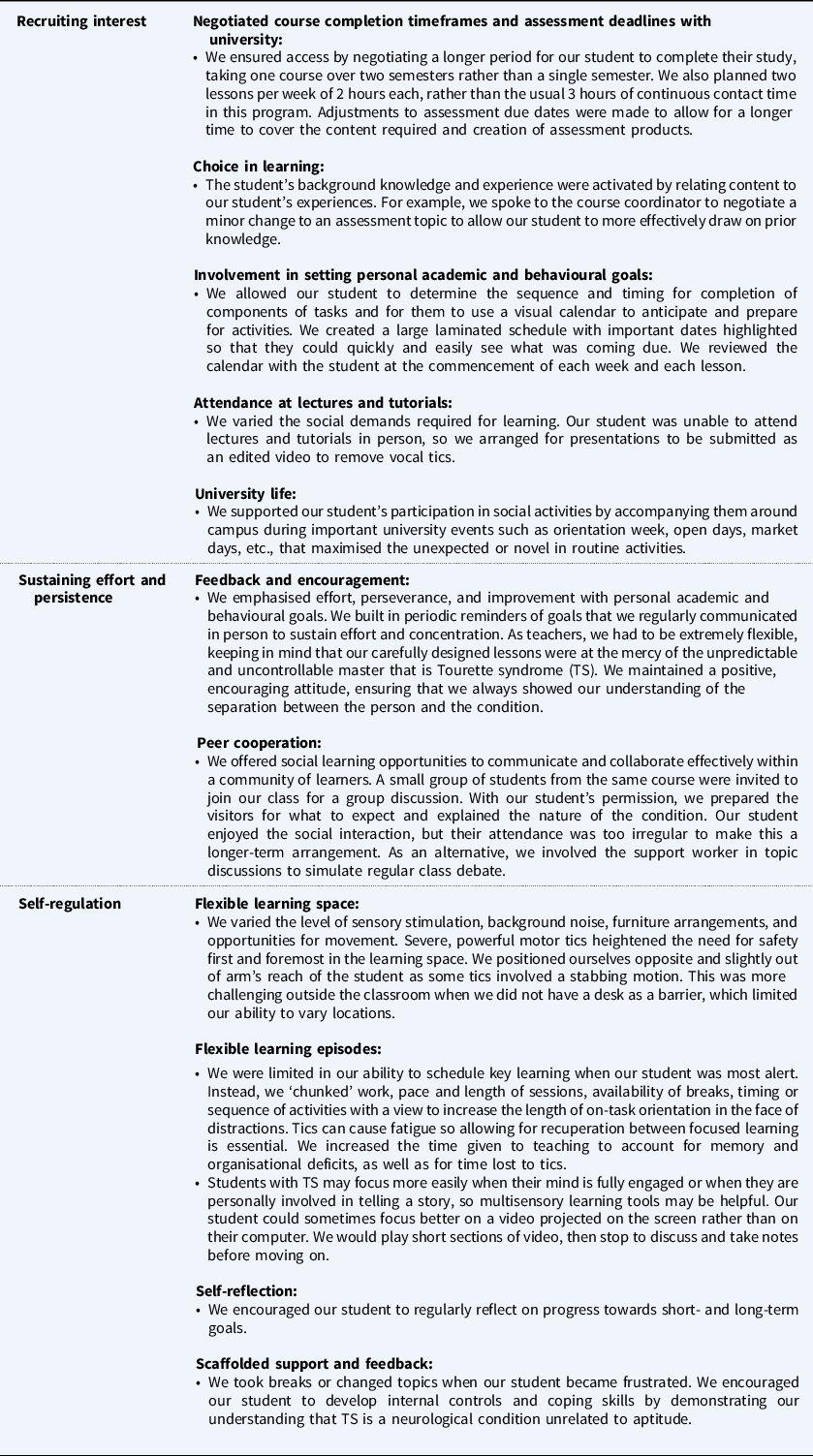
In providing multiple means of engagement, the key adjustments, shown in Table 1, were made. Table 1 also provides examples of the teaching strategies employed.
Adjustments to the Regular Learning Environment and Examples of Strategies Consistent With Universal Design for Learning Practice of Providing Multiple Means of Engagement

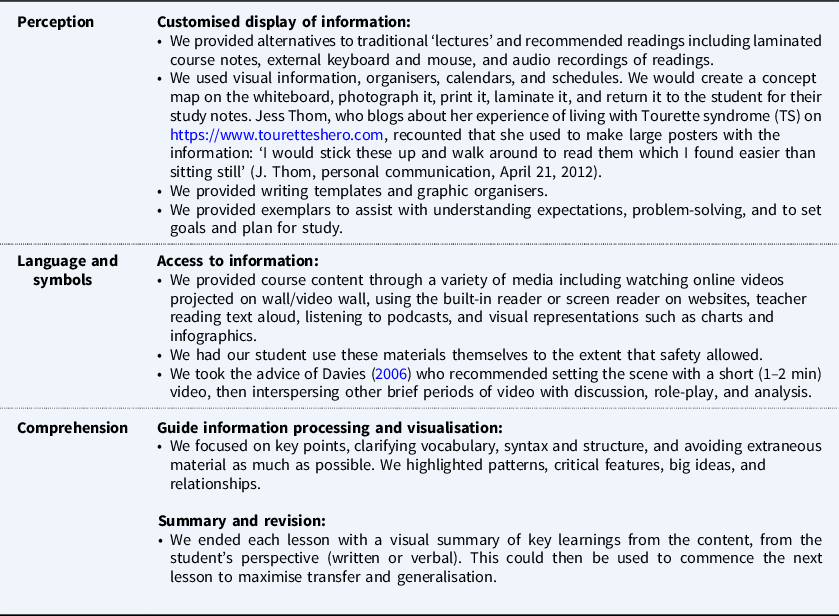
In providing multiple means of representation, the adjustments, shown in Table 2, were made.
Adjustments and Examples of Strategies Consistent With Universal Design for Learning Practice of Providing Multiple Means of Representation

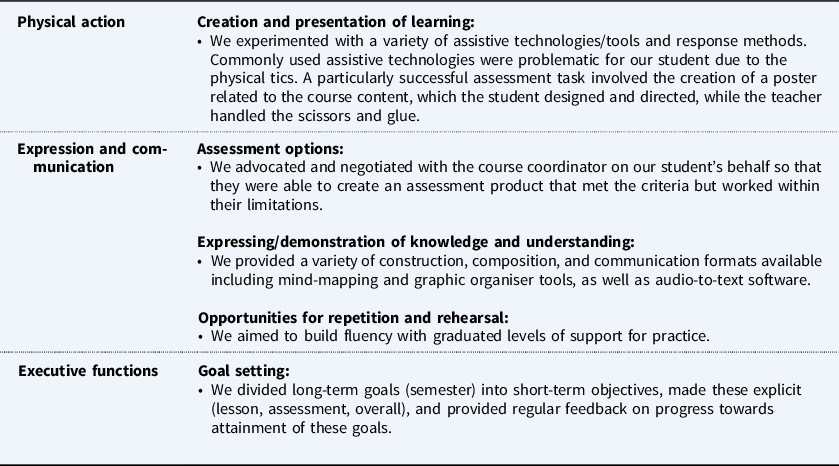
In providing multiple means of action and expression, the key adjustments, shown in Table 3, were made.
Adjustments and Examples of Strategies Consistent With Universal Design for Learning Practice of Providing Multiple Means of Action and Expression

New Understandings and Appreciation
The initial momentum and enthusiasm the teaching staff had for a community-centred, cooperative learning approach diminished as we discovered the challenges social learning presents for students with severe TS. The anticipated reciprocal benefits for all students involved in gaining knowledge of the diversity inherent in social and collaborative learning could not occur in this situation. We do not suggest that this will be the case for all students with TS. Our student’s condition was severe and extraordinary. The role of supporting a student with TS provided multiple challenges for the teaching staff. Although we were not aware of it at the time, this opportunity to expand our teaching ‘toolkit’ had a direct and positive effect on us, our pedagogy, and our work roles. What was learned from this experience was beneficial and informs what we do today.
For the first author, this challenging pedagogical experience generated a passion for supporting ‘second-chance’ learners through creative and innovative learning experiences. The UDL principles remind us that to address the needs of students with a wide range of abilities, experiences, and conditions, we need to be purposeful, proactive, and reflective in our design. The co-author has led the creation of an institution blended learning framework that identifies UDL as one of the seven domains of blended learning. Bringing UDL to the forefront of educators’ approaches through practical professional learning opportunities will help raise awareness at scale.
With the benefit of hindsight, reflection, and further experience, we have identified the most important takeaways from this unique pedagogical experience. First, the student and the behaviours associated with TS are separate. TS is a very challenging condition, but as teachers, we could walk away from it at the end of the lesson. Our student dealt with it on a constant basis without escape. Even though tics may seem directed and often personal, this is the nature of the condition and not the nature of the person. Teaching a student with severe TS is exhausting and often frustrating. Teachers must understand that progress will be slow and disjointed. Teachers must be highly flexible, resilient, and patient. Having somebody else who understands the situation and with whom the teacher can debrief will be helpful. Small victories must be celebrated to maintain motivation for both student and teacher. Those victories, however, can bring great reward that has perhaps been enhanced by the struggle to achieve them. Our student was clearly proud to describe themselves as a university student.
Conclusion
Higher education for a person with TS can be both challenging and rewarding for student and teacher alike. The logistical complications relating to the tics of TS may be readily apparent, but observation by the teaching staff has indicated (and our research confirmed this) that TS presents a broad range of less obvious complications that impact on teaching and learning. These range from the need to consider the learning space and equipment, to student fatigue, memory, attention, reflection, and problem-solving deficiencies. Teachers must be also be patient, understanding, and creative in order to develop solutions and workarounds appropriate for each new situation. They must also constantly review and adjust their methods, as each student and situation presents different and changing challenges. Ultimately, an increased awareness of the condition and its pedagogical demands will be of benefit to the students and to their educators.
Although this paper provides suggestions to support students with TS in higher education, the UDL guidelines are not meant to be applied to an individual or even one group of students. With many universities facing increasing pressure to adopt innovative pedagogies to meet the needs of a more diverse student body and improve student learning (Henderson, Selwyn, & Aston, Reference Henderson, Selwyn and Aston2017), the UDL guidelines are a tool that can be used to support the development of a shared language in the design of learning that leads to accessible and challenging experiences for all.