





Introduction
Internationally, several models have been developed which seek to improve access to palliative care for specific indigenous or minority groups (Clarke and Holtslander Reference Clarke and Holtslander2010; McGrath Reference McGrath2010; Kelley et al. Reference Kelley, Prince and Nadin2018; Moeke-Maxwell et al. Reference Moeke-Maxwell, Collier and Wiles2020). Such models typically act as an addendum to existing palliative care systems, supporting the development of understanding, access, and a shared language. These models are created for, or adapted by, specific communities and not intended to be generalizable or transferable. Despite this, indigenous models often share key features: the importance of relationality, collectivism, the role of family, the importance of spirituality (Clarke and Holtslander Reference Clarke and Holtslander2010; Moeke-Maxwell et al. Reference Moeke-Maxwell, Collier and Wiles2020), and personal advocacy and empowerment (McGrath Reference McGrath2010). These models address issues of access and understanding and enable minority groups to navigate palliative care using familiar language and concepts. Despite their importance to communities, there has been little research aimed at validating cultural models; little is known about how these models are used in practice and the impact on the care of indigenous and minority communities.
Despite calls to ensure palliative care services are accessible to all (World Health Organization 2018), many minority groups face barriers to primary and specialist palliative care (Oduro et al. Reference Oduro, Jackson and Fu2025). In New Zealand, there are known gaps in the service delivery of palliative care for Pacific peoples (Foliaki et al. Reference Foliaki, Pulu and Denison2020). A recent literature review on Pacific people’s palliative care use found that palliative care is still largely informed by Western models of care (Churchward et al. Reference Churchward, Pokino and Henry2026). This assertion is similarly supported by Shah et al. (Reference Shah, Ramalho and Ameratunga2025), who found that such models do not meet the relational needs of ethnic minority communities living in New Zealand. Service design and organizational routines have likewise been shown to function in ways that do not support the involvement of larger families or the spiritual needs of families (Churchward et al. Reference Churchward, Pokino and Henry2026). Further, at the interpersonal level, misunderstandings and breakdowns of communication lead to gaps in care (Foliaki et al. Reference Foliaki, Pulu and Denison2020; Fanueli et al. Reference Fanueli, Wiles and Gott2026). These gaps were found to be more prominent for families with lower levels of English language proficiency or low health literacy (Churchward et al. Reference Churchward, Pokino and Henry2026).
Recently, there has been a focus on ethnic-specific research that addresses and seeks to understand the unique health needs of communities. In New Zealand, the Pacific population makes up 8.9% of the population (Statistics New Zealand 2025). New Zealand has historic relationships with the people of the Pacific through shared genealogy with New Zealand Māori and through colonial relationships. The Islands of the Cook Islands, Niue, and Tokelau remain part of the New Zealand realm. The Cook Islands are a self-governing nation in free association with New Zealand. Cook Islands Māori are New Zealand citizens, and because of this shared citizenship, many reside in New Zealand. As New Zealand citizens, Cook Islands Māori have free access to the New Zealand health system, including rights of travel to access health care treatment unavailable within the Cook Islands (Masters Reference Masters2012, Reference Masters2014). Understanding this unique relationship is therefore a key part of ensuring the Cook Islands Māori community in New Zealand has equitable access to palliative care.
Understanding the underlying concepts and motivations for accessing health care services such as palliative care is an important first step toward developing a palliative care framework that can be applied in practice. To address this, a conceptual model of care developed in a previous study (Henry et al. Reference Henry, Jones and Surgenor2025) was used to understand the underlying drivers or motivations for families when caring for a family member. The current study seeks to deepen the understanding of the enablers and barriers to accessing palliative care within the New Zealand health system while maintaining cultural values and concepts. By exploring Cook Islands Māori community members' understanding of palliative care services, this study seeks to determine when and where along the palliative care journey the implementation of a cultural model of care would have the most impact.
Methods
The current research is part of a larger study investigating the use of a palliative care model for Cook Islands Māori in New Zealand. Further information about the study is reported elsewhere (Henry et al. Reference Henry, Tautolo and Herman2026). This phase of the study used the Tivaevae methodology, an indigenous methodology named after the traditional quilt in the Cook Islands (Futter-Puati and Maua-Hodges Reference Futter-Puati and Maua-Hodges2019). Pacific methodologies are grounded in Pacific worldviews and indigenous epistemologies that are aligned with Pacific peoples' understanding and sense-making (Sanga and Reynolds Reference Sanga and Reynolds2017). The Tivaevae methodology is relational by design; this is evidenced in the method of knowledge creation. In practice, a tivaevae (quilt) is sewn by a group; the practice of collectively creating a tivaevae is a metaphor for the research process. This collective creation is a process of co-constructing meaning. The process of knowledge creation is underpinned by 5 key values: Taokotai – collaboration, Tu akangateitei – respect, Uriuri kite – reciprocity, Tu inangaro – relationships and Akairi kite – shared vision (Te Ava et al. Reference Te Ava, Airini and Rubie-davies2011). These values can be used as a guide alongside the researcher's own positionality (Houghton Reference Houghton2023), to ensure suitable respect is shown and the research has meaning to the community from which it originates.
Recruitment and data collection
Participants were recruited through purposive and snowball sampling over a 5-month period. Local community networks were used to disseminate information on the study. A total of 18 participants were interviewed who met the following criteria: over the age of 18 years, of Cook Islands Māori ancestry, and willing to participate in a focus group interview on palliative care. Experience using palliative care services was not a requirement to participate in the study; this was to ensure a range of community members could participate and not only those who have accessed palliative care services. As many Pacific communities prefer caring for family members at home (Churchward et al. Reference Churchward, Pokino and Henry2026), experience as a primary carer or as part of the wider family support system was expected, and many participants reported having cared for a family member at end-of-life.
Participants who met the criteria were invited to attend one of the focus group meetings. In total 3 focus group interviews were conducted. All participants provided written informed consent to participate in the interview. Two focus group meetings were conducted in person at local community facilities in Auckland, New Zealand. One meeting was held online via Microsoft Teams. The inclusion of an online focus group was to allow persons who had expressed interest in the study but were unable to meet in person to participate. Each interview started with a prayer and introductions. The discussion was facilitated using a semi-structured interview guide. However, participants were able to talk freely to follow a line of thought rather than a linear trajectory. The interviews were audio-recorded and lasted from 60 to 90 minutes. Each interview was attended by 2 researchers of Cook Islands ancestry. The in-person meetings were also attended by a member of the advisory group who provided translation and cultural guidance.
Data analysis
The audio recordings were transcribed using a professional transcription service; the transcriber signed a confidentiality agreement prior to transcribing. The transcripts were analyzed using NVivo software. Data analysis was conducted by 2 researchers independently, and the data analysis summary was reviewed by the research team.
The concept of a shared vision from Tivaevae methodology guided the coding process for this study. A shared vision has been described as a community-led vision to be understood from the perspective of the community (Kokaua-Balfour et al. Reference Kokaua-Balfour, Taripo-walter and Moeroa2025) and, in this study, focused on the practical potential of the community's vision. The first interview was coded independently by 2 researchers. The codes from the first interview were used to create a code book. The code book was then used as a guide to code the subsequent interviews. This was followed by tuitui te tivaevae (to sew each section); this describes the process of the draft codes being checked against new data, allowing patterns to emerge. A summary of the codes and preliminary themes was presented and reviewed by an advisory group which consisted of 2 Cook Islands community members with health practice and research experience and the research group. This stage was followed by akamānea te tivaevae, when the tivaevae is tidied, and decoration added (Maua Hodges Reference Maua Hodges2018). The themes were then refined with a focus on developing a shared vision. The findings of the focus groups are presented as a collective voice; therefore, quotes are not attributed to individual participants. This is to capture the developing shared vision and present the work as a collective effort.
Results
Three major themes were found from analysis of the focus groups. These were navigating health information, community-guided care pathways, and realm-based health care.
The theme of navigating health information explored the need for greater access to resources, information, and enhanced communication. These issues were discussed frequently; 148 coded references referred to the need for greater access to information. In contrast, palliative and end-of-life care preferences had 42 coded references, and 60 coded references relating to cultural, spiritual, and community support grouped under the theme of community-guided care pathways. The third theme, realm-based care, had fewer coded references, 30 in total. This theme was determined to be important due to the unique position of the Cook Islands people living in New Zealand. Of the 18 participants, only 1 participant was male. This may have been influenced by the recruitment method, as the local community groups included traditional arts and craft groups. Additionally, caring may be seen as a traditional role for females.
Theme 1 – Navigating health information
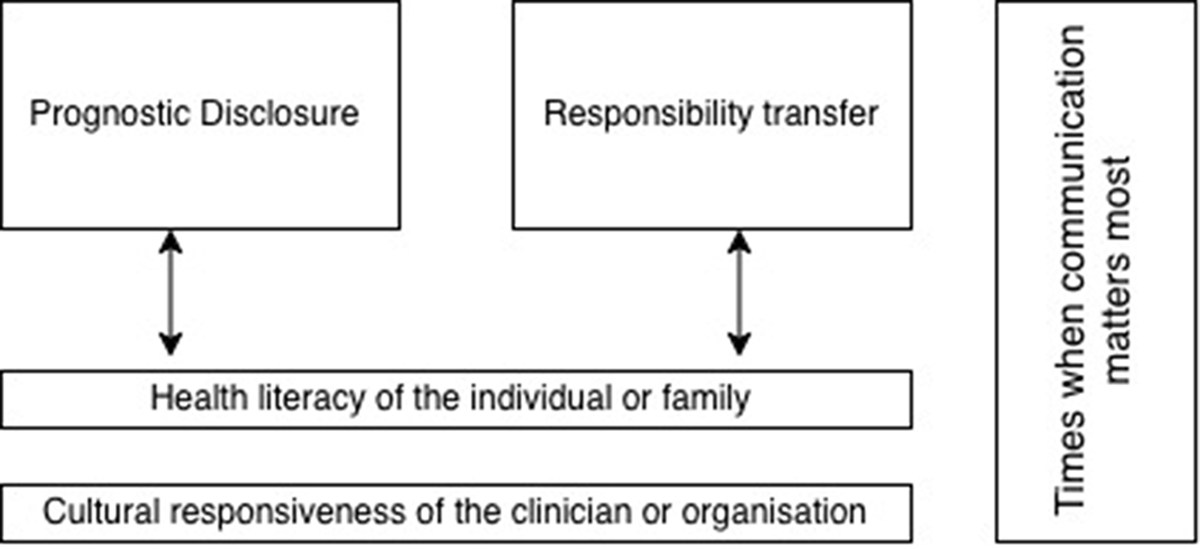
The most prominent finding from this study was the lack of information and understanding of palliative care. The theme was divided into 3 subthemes. As the focus of this study is practical application, the subthemes were developed by noting when these knowledge gaps were the most prominent or had the greatest impact on access to information (see Table 1). The 2 key points in the care process where communication breakdowns had a notable impact on family outcomes were at the time of prognostic disclosure and when the responsibilities of care were likely to shift to the family or to the clinical team. The third subtheme, cultural contexts of health literacy, refers to the ease with which health information was found and understood along the journey.
Participant quotes supporting Theme 1: Navigating health information

Table 1 Long description
Participant quotations are grouped into three subthemes and paired with codes describing issues in navigating health information. Under prognostic disclosure, quotes describe doctors using language patients do not understand, limited honesty or clarity, poor explanation of care plans, mismatched expectations about recovery, incomplete discussion of options, and lack of basic information such as cancer type. Under responsibility transfer, families report being expected to administer comfort care at home with little instruction, unclear overnight guidance, short timeframes to learn tasks while stressed, and uncertainty about what services will do when staff are not present. Under cultural contexts of health literacy, quotes describe gaining confidence to advocate with clinicians, clinicians checking understanding in culturally familiar ways, and reflections on missing equipment or services and the burden when caregivers are unaware of available supports. The entries are qualitative examples rather than counts, so they illustrate recurring concerns but do not indicate how often each issue occurred.
Prognostic disclosure is considered a key component of palliative care planning for clinicians and patients. Prognostic acceptance is associated with positive outcomes for patients, including improved quality of life (QOL), patients’ ability to make informed decisions and to prepare for end of life (Hui et al. Reference Hui, Mo and Paiva2021). As 1 participant stated when reflecting on the experiences of other community members, “the inequity is they’re not being carefully explained, not just their condition, but their care plan” (Int2). Similarly, another participant stated, “there’s no person in between the doctor and the hospice” expressing the need for greater support to understand the plan of care for their family member, to understand their options and make an informed choice. They continued, “I think even the fear of knowing ‘Hospice’. When they hear it,” indicating that without access to information, assumptions may fill the information gap. This highlights the need for culturally appropriate communication to ensure families can understand their options, their right to make an informed choice, and their right to an explanation of their condition.
The second subtheme, responsibility transfer (see Table 1), builds on the previous subtheme and includes the process of openly communicating with a person and their family on the likely course of their illness, particularly when the tasks of caring shift from the nurse or clinical team to the family or from the family to the health care team. Pre-emptive, open communication during this handover of care allowed families to plan. When pre-emptive care was delivered in a way that aligned with the person’s communication needs, participants expressed trusting the service and a positive experience, as shown in the following quote. “She had a good experience with that care because…they took her through the process of making her understand the place, the care to be given, where this particular room is, what’s available in the room.” This highlights the benefit of developing relationships and trust with families as part of communicating and negotiating a plan of care.
When a family member becomes palliative, care responsibilities shift back and forth. Family provides emotional, cultural, and daily support; health professionals step in for symptom management and comfort care. As the illness progresses, families become increasingly responsible for clinical tasks. When the responsibility of caring moves beyond daily cares, this may be challenging for families and may go beyond what they believed their role would be as family members. In the following example, a daughter discussed being in the position where they were expected to administer subcutaneous pain relief: “(we) were just a bit reluctant to give her more pain medication. It was the first time, right, so we don’t know.” For one other focus group member, families being asked to administer subcutaneous medication was a surprise, as this was seen as the role of the nurse, not the family.
The third subtheme, cultural contexts of health literacy, presents the role of health literacy for individuals and for the community. Participants described being unsure where to find information or who, besides their primary health care doctor, they can ask for information: “It’s the first priority for people to know, where they go to from the doctors.” Participants in all 3 focus groups discussed the need for accessible information in a format that can be reached by the community: “(there is a) need for more social intervention in terms of the information dissemination using the platforms or the mediums that we have available now.” The first focus group discussed the need for access to advanced care planning to avoid what was described as “ugly funerals” where families were underprepared for the death of their family member. The second focus group focused on community access to “how to – information,” focusing on informing people where to go for help and making the process easier.
Theme 2 – Community-guided care pathways
As this study focused on understanding Cook Islands community members' understanding of palliative care, practical suggestions were brought forth by the community participants. Community-guided care pathways highlight the essential role of the wider community in shaping palliative care experiences and decision-making. Participants emphasized that care is not solely a family matter; it is supported by church groups, community groups, and cultural networks. This theme includes the hardships for families who were isolated from wider support groups.
The importance of faith, prayer, and spiritual connection in how Cook Islands families understand and cope with end-of-life experiences was noted throughout the interviews. Participants highlighted the role of pastors, church communities, and spiritual practices in offering guidance, easing emotional burdens, and providing reassurance for both the patient and their loved ones. The importance of spirituality was additionally a concern raised when considering using hospice services, “if we are looking at the spiritual side of things it’s that whole holistic”.... “Are they going to take care of A, B and C, how many times a day?”
The subtheme, looking after our own, represents the strong desire among Cook Islands families to care for loved ones at home during palliative and end-of-life stages (see Table 2). Participants expressed that home is not only a place of comfort, but a culturally meaningful space where family, spirituality, and identity remain intact. Participants voiced caring for families at home as being part of family and cultural identity, as shown in the following quote. “For Cook Islanders, we don’t like to give our family to somebody else to look after. That’s just us. We have to look after our own.” The idea of family members being cared for outside of the home was additionally discussed as an issue of trust “it’s trusting are they going to get that care in that space? How do we know?” Trust in this sense was discussed as being able to provide care in a way that was seen as safe care. Conversely, participants who had positive experiences with hospice expressed changing their view about hospice care, as shown in the following quote “But when I walked into hospice and saw the beautiful care, I would rather… I told my husband”.. “If cancer comes back, I want to take me (to hospice).”
Theme 2 – Community-guided care pathways

Table 2 Long description
Qualitative themes link representative quotations to codes describing preferred community-guided care pathways and end-of-life support. For community-guided pathways, participants emphasize using existing community platforms and leaders to spread information, and creating locally based resources to reduce confusion and avoid over-centralized services. Faith-based education pathways are highlighted, with church leaders positioned as trusted messengers alongside other community group leaders. For end-of-life spiritual strength, quotations stress involving the church minister in outreach, allowing prayer and devotions in hospice settings, and providing ongoing spiritual encouragement. For caring for family at home, participants describe bringing relatives home to die, social expectations to provide home care as a sign of love and honour, and family decision making when the patient cannot communicate. Findings reflect coded perceptions from quotes rather than counts or prevalence, so they indicate priorities and values rather than how common each view is.
Theme 3 – Healthcare within the realm
This theme captures the ways Cook Islands families navigate palliative care across national borders, drawing on connections to both Aotearoa New Zealand and the Cook Islands (see Table 3). Participants described healthcare as inherently transnational, influenced by mobility, family dispersion, and cultural identity. Decisions about palliative care were shaped not only by services available in New Zealand, but also by obligations, beliefs, and practical considerations tied to the homeland. The desire to return home to the Cook Islands meant families had to plan early if they wished to live out their days at home, before being deemed unfit to fly, as shown in the following quote “if that’s what you feel like you want to do, then go, go like, go now, don’t wait. Because the longer you wait, you may not have the opportunity. Like that window closes really, really quickly.” This highlights the need for early planning to ensure families could return home.
Theme 3 – Healthcare within the realm

Table 3 Long description
Qualitative quotes are paired with four issues affecting people transferred to New Zealand for healthcare. One quote describes a person sleeping on a couch while receiving leukaemia care, linked to transfer without a clear plan of care. Another quote reflects being told there is no further care available in New Zealand and to return home, linked to end-of-life return to the Islands. A third quote notes Cook Islanders with cancer being “just accommodated,” with families’ homes described as overcrowded and underfunded, highlighting housing strain during treatment. A fourth quote points to the referral system, stating people get lost in it, emphasizing the need to keep track of transferred patients. The entries are illustrative narratives rather than counts, so they indicate recurring themes but not how often each problem occurs.
For some families, returning to the Cook Islands for end-of-life care was expressed as an aspiration motivated by cultural belonging, the desire to “go home” or the wish to be surrounded by familiar land, language, and community. Others highlighted the logistical and medical challenges that make such a return difficult, including limited specialist services, travel barriers, and the need for stable medical support. This is captured in the following story from a participant describing supporting a community member during a specialist appointment “do you understand that means that you have to stay here? So, she’s going to put you on a waiting list for a transplant. You can’t go back home for Christmas, Uncle, you’ve got to stay here.” Conversely, some Cook Islands Māori coming from the Islands to New Zealand experienced difficulty navigating the New Zealand health system, as shown in Table 3. The quotes discuss people being sent from the Cook Islands health system to New Zealand for cancer treatment without a clear plan for accommodation or financial support. The complexities in deciding where to seek treatment or to return to the Islands created tension and were emotionally complex decisions about where care should occur and where a person should spend their final days.
Discussion
To our knowledge, this is the first study which aimed to understand the palliative care enablers, barriers, and community aspirations of Cook Islands Māori community members in New Zealand. This study aimed to develop practical solutions for improved access to palliative care for Cook Islands Māori. We have reported new findings which could be used to guide future practice and confirmed previously known understandings for Pacific people’s palliative care. The first finding themed navigating health information highlighted 2 key moments when communication had a notable impact on the palliative care journey, during prognostic disclosure and during times of responsibility transfer. These key times along the palliative care journey require adaptation depending on the family’s health literacy and the cultural responsiveness of the clinician or organization (see Figure 1). Highlighting the significance of these time points along the palliative care journey may allow clinicians and services to taper services to ensure adequate preparation and time is allocated to these key moments.
Key communication times and mediating factors.

It has been shown that early access to integrated palliative care improves a range of measures including QOL and symptom control (Temel et al. Reference Temel, Greer and Muzikansky2010). While this has been known for some time, minority groups have continued to experience poorer access to palliative care. More recent studies have sought to understand key delivery times for palliative care interventions. The large, randomized controlled study by Temel et al. (Reference Temel, Jackson and El-jawahri2024) investigated a stepped care model. The study found introducing palliative care at the time of diagnosis and at key times along the palliative care journey based on hospital admissions or assessed QOL needs provides similar QOL outcomes as early palliative care interventions (Temel et al. Reference Temel, Jackson and El-jawahri2024). In this study, participants reported family members not understanding their prognosis and what care was available to them, identifying a gap in communication and subsequent follow-up with a palliative care team.
Prognostic disclosure is important for palliative care planning. Patients and families need timely prognostic information to plan for their family members' care needs and to understand the dying process (Engel et al. Reference Engel, Kars and Teunissen2023). Previous studies show prognosis communication occurs less regularly when there is ethnic discordance between patient and clinician (Ingersoll et al. Reference Ingersoll, Alexander and Priest2019). Additionally, prognostic misunderstandings between patients and clinicians occur more frequently for persons from minority groups (Gramling et al. Reference Gramling, Fiscella and Xing2016). For the Cook Islands Māori community members in this study, the need for clear prognostic information was important for planning if the family member wanted to return home to the Cook Islands or for families to plan for their family member to be cared for at home. The desire to care for family members at home by Pacific families is well documented in the literature (Foliaki et al. Reference Foliaki, Pulu and Denison2020; Henry Reference Henry2020; Fanueli et al. Reference Fanueli, Wiles and Gott2026).
International research has identified the need for improved communication in palliative care for minority populations (Mayeda and Ward Reference Mayeda and Ward2019). In the New Zealand context, the literature similarly highlights the importance of strengthening communication, providing culturally responsive care, and increasing the Pacific health care workforce (Churchward et al. Reference Churchward, Pokino and Henry2026; Fanueli et al. Reference Fanueli, Wiles and Gott2026). Participants in this study focused on trust and relationships, shifting the focus from a “good death” to “good relationships” as the key concern for community members. Culturally responsive care practices have been found to bridge understanding between clinicians and minority groups (Clarke and Holtslander Reference Clarke and Holtslander2010; Kelley et al. Reference Kelley, Prince and Nadin2018). However, there is limited understanding of the role of such practices in palliative care and how they are applied in practice. While this study focuses on Cook Islands Māori in New Zealand, understanding the key times when communication may need to be enhanced and culturally responsive care prioritised, are lessons that can be applied to other minority groups. This study has shown the need for further research into how gaps in communication at key points along the palliative care trajectory may explain some of the disparities seen in palliative care understanding, access and use for minority groups.
Limitations of this study
As a qualitative study with a sample size of 18, the findings from this study are not generalizable. This study offers a view into the lived experience of members of the Cook Islands Māori community. The findings from this study provide insights into these experiences and highlight areas for future research.
Acknowledgments
The Authors thank the Cook Islands development agency New Zealand (CIDANZ) for their support and promotion of this study.
Funding
Funding for this study was provided by the Health Research Council of New Zealand (25/111)
Competing interests
Ethical approval was granted by the AUT ethics committee (25/105).



 Open access

