Introduction
The areas of the Coastal Plain of Rio Grande do Sul (CPRS), found in the far south of Brazil, are characterized by their great diversity of habitats, such as wetlands, floodplains, riparian forests, and beaches. Floral studies in the region have demonstrated that it is an ecotone between the Atlantic Forest; sensu stricto (with characteristics of a tropical ecosystem); and the areas dominated by the Pampa Biome (which have characteristics of a temperate ecosystem) (Venzke, Reference Venzke2012).
This coastal region suffers high anthropogenic pressure due to cattle and sheep ranching, extraction of wood and sand, urbanization demands (on the remnants of the Atlantic Forest in the vicinity), and the production of rice and other monocultures (MMA, 2000; 2007). Such extractive and productive activities are responsible for the fragmentation of the natural areas, causing alterations in the dynamical variation and composition of species. Today, less than 5% of the native forest and meadows remain preserved (Roesch et al., Reference Roesch, Vieira, Pereira, Schünemann, Teixeira, Senna and Stefon2009; Venzke, Reference Venzke2012).
Fragmentation happens when portions of the forest become isolated and suffer physical modifications. This alters the natural communities and species composition of those areas. For example, the environment can become unfavorable to species adapted to a forest interior, and favorable to those adapted to open environments; these might then begin to become established in the fragment (Lovejoy et al., Reference Lovejoy, Rankin, Bierregaard, Brown, Emmons, Vander Voor and Nitecki1984, Reference Lovejoy, Bierregaard, Rylands, Malcon, Quintela, Harper, Brown, Powell, Powell, Schubart, Hays and Soule1986).
To ascertain such changes in species composition, insects provide a simple, sensitive, and low-cost approach, allowing researchers to measure anthropogenic ‘stress’ on biodiversity and the environment (Kim, Reference Kim1993). Doing through this, they can gain important insights into the natural state of an area. On ecosystems everywhere, it is possible to use this knowledge to enhance management, minimize the impact of exploitative activities, conserve natural resources, or even aid recuperation from degraded states (Melo, Reference Melo2008).
By way of large faunal surveys, additionally, it is possible to provide scientific understanding of the taxonomy and the natural history of an area; it is common to collect a large number of taxa during these efforts (Marinoni & Dutra, Reference Marinoni and Dutra1993; Marinoni et al., Reference Marinoni, Miranda and Thompson2004; Löwenberg-Neto & de Carvalho, Reference Löwenberg-Neto and de Carvalho2013).
Among the insects in the order Diptera, the Syrphidae are especially well-suited to indicating the environmental quality of forests (D'Almeida & Lopes, Reference D'Almeida and Lopes1983; Wells, Reference Wells1991, Paraluppi & Castellon, Reference Paraluppi and Castellon1994). Species of this family are found in the majority of the earth's ecosystems and their larvae have diverse dietary habits (Ferrar, Reference Ferrar and Lyneborg1987; Vockeroth & Thompson, Reference Vockeroth, Thompson and McAlpine1987; Sommaggio, Reference Sommaggio1999; Thompson, Reference Thompson1999; Smith et al., Reference Smith, Gittings, Wilson, French, Oxbrough, O'Donoghue, O'Halloran, Kelly, Mitchell, Kelly, Iremonger, McKee and Giller2008; Thompson et al., Reference Thompson, Rotheray, Zumbado, Brown, Borkent, Cumming, Wood, Woodley and Zumbado2010). There are around 6000 species of Syrphidae, divided into four subfamilies. In Brazil, a little more than 1000 species are known, but the estimated number of species is around 2500, with 1500 probably occurring in the South of the country (Thompson et al., Reference Thompson, Vockeroth, Sedman and Papavero1976; Marinoni & Thompson, Reference Marinoni and Thompson2003). Syrphidae are not only of great ecological and biological importance, but they are also taxonomically diverse (Thompson, Reference Thompson1999; Marinoni & Thompson, Reference Marinoni and Thompson2003), thus fulfilling the requirements for a diversity study in the CPRS.
The objective of this study is to ascertain the diversity of Syrphidae in the South region of Brazil by estimating its species’ richness, and to use this data to identify new areas for conservation.
Materials and methods
Collecting areas and times
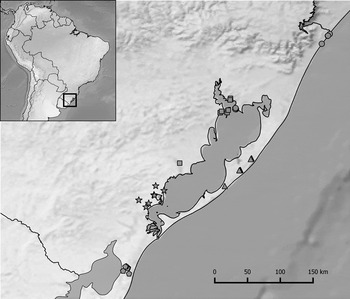
The sampled areas in the CPRS (fig. 1) were selected in accordance with the priorities indicated by the Ministry of the Environment for the conservation of invertebrates (MMA, 2000, 2007). The five regions of study are described in Kirst (Reference Kirst2014). The collecting periods and meteorological data, obtained with the National Institute of Meteorology (INMET), are depicted in table 1.
Partial map of South America, with details of the Coastal Plain of Rio Grande do Sul (Brazil). The marked points refer to collecting areas (groups of 4 traps). Star = Region 1; Square = Region 2; Pentagon = Region 3; Circle = Region 4; Triangle = Region 5.

Averages of meteorological variables corresponding to periods of Malaise trap exposure in the five sampled regions of the Coastal Plain of Rio Grande do Sul.

Tmax, average of maximum temperatures; Tmin, average of minimum temperatures; RH%, average percentage of relative humidity in the air. Data obtained from the INMET.
Collection, storage, and identification of material
In total, 140 Malaise traps, with modifications in the collecting flask (Townes, Reference Townes1972; Brown, Reference Brown2005; Duarte et al., Reference Duarte, Krüger, de Carvalho and Ribeiro2010), were installed in five regions of the CPRS (fig. 1): Region 1, corresponding to the Arroio Pelotas and Arroio Corrientes basins, in the municipality of Pelotas, and the Arroio Grande basin in the municipality of São Lourenço do Sul; Region 2, corresponding to the reserves, Reserva Biológica do Lami José Lutzenberger, in the municipality of Porto Alegre, Reserva Particular de Patrimônio Natural Barba Negra, in the municipality of Barra do Ribeiro, and the riparian forest fragment in Rio Camaquã, in Vila Pacheca, in the municipality of Camaquã; Region 3, corresponding to the Estação Ecológica do Taim (ESEC Taim) and its surroundings, located in the municipality of Rio Grande; Region 4, corresponding to the reserves, Parque Estadual do Itapuã, in the municipality of Viamão, Parque Natural Municipal Tupancy, in the municipality of Arroio do Sal, and Parque Estadual de Itapeva and Parque da Guarita, in the municipality of Torres; and Region 5, corresponding to the Parque Nacional da Lagoa do Peixe, with the traps located in the municipalities of Tavares, Mostardas, and São José do Norte. These areas will be referred to as R1, R2, R3, R4 and R5, respectively. For each of the five regions, seven areas were sampled, and each area was equipped with four traps, equidistant from one another, totaling 28 traps per region. Every group of four traps corresponded to one area of collection. The traps were set in sites as far as possible from the borders of the fragment. The distances from the traps to the edges were unequal, as the fragment sizes were variable.
All traps remained in the field for 8 days. At the end of this period, the specimens were preserved in a 70% alcohol solution, identified, and then deposited in the Coleção Entomológica Padre Jesus Santiago Moure, of the Departamento de Zoologia, in the Universidade Federal do Paraná. All information obtained was added to the species database of Rede Paranaense de Coleções Biológicas – Taxonline (http://taxonline.bio.br/).
Identifications were undertaken with taxonomic keys for Neotropical groups (Curran, Reference Curran1939; Thompson, Reference Thompson1972, Reference Thompson1997, Reference Thompson1999; Marinoni et al., Reference Marinoni, Morales and Spaler2007; Cheng & Thompson, Reference Cheng and Thompson2008; Morales & Marinoni, Reference Morales and Marinoni2009; Reemer & Ståhls, Reference Reemer and Ståhls2013). They were confirmed by comparing with material from the National Museum of Natural History, Smithsonian Institution, and the Coleção Entomológica Padre Jesus Santiago Moure.
Data analysis
Data analyses and discussion thereof are based only on Regions 1–3, due to the low frequency of species in Regions 4 and 5, a reflection of adverse abiotic factors (table 1). All tests were carried out in the statistical program R (R Development Team, 2014). Sampling efficiency was verified by interpolation and extrapolation method proposed by Colwell et al. (Reference Colwell, Chao, Gotelli, Lin, Mao, Chazdon and Longino2012) and Chao et al. (Reference Chao, Gotelli, Hsieh, Sander, Ma, Colwell and Ellison2014). We generated individual-based rarefaction curves using R package iNEXT (Hsieh, et al., Reference Hsieh, Ma and Chao2013; R Core Team, 2014). We calculated the Hill number Order ‘1’ and ‘2’ (Jost, Reference Jost2006), which weights each species exactly by its frequency in each habitat type (i.e. favoring neither rare nor common species).
We performed a GLM (generalized linear model) procedure (Poisson), which was tested by analysis of variance (ANOVA) in the Chi-square (χ2), as suggested by Crawley (Reference Crawley2007), to compare differences among regions and areas for species richness and abundance. With R package ‘vegan’ we performed the test PERMANOVA, with 999 permutations, to find differences between regions and locals. In addition, we built a non-metric multidimensional scaling to represent species composition for regions and locals, both with ‘Bray-Curtis’ distances. All analysis described in this paragraph considered P < 0.05.
Results
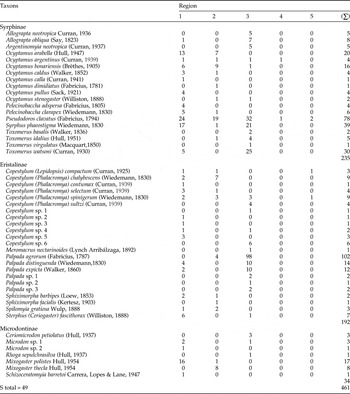
A total of 453 Syrphidae individuals were collected, from 18 genera and 49 species (table 2). Of the four subfamilies of Syrphidae, three were represented in the samples; Eristalinae had the greatest number of species (n = 23), followed by Syrphinae (n = 19), and Microdontinae (n = 7). With regards to the number of specimens collected, Syphinae was the most numerous (n = 235), followed by Eristalinae (n = 192), and Microdontinae (n = 34). These CPRS samples expanded the known geographic distributions of 11 species of Syrphidae, recorded for the first time in Rio Grande do Sul: Pelecinobaccha adspersa (Fabricius, 1805), Ocyptamus calla (Curran, 1941), O. pullus (Sack, 1921), Toxomerus idalius (Hull, 1951), Copestylum (P.) sultzi (Curran, Reference Curran1939), Spilomyia gratiosa Wulp, 1888, Sterphus (Ceriogaster) fascithorax (Williston, 1888), Ceriomicrodon petiolatus (Hull, 1937), Mixogaster polistes Hull, 1954, M. thecla Hull, 1954, and Schizoceratomyia barretoi Carrera, Lopes & Lane, 1947.
List of species by collection region.

(∑), total number of collected individuals; S, species richness.
The only species present in all the five regions was Pseudodoros clavatus (Fabricius, 1794), but in Regions 4 and 5 its frequency was very low, with just two recorded specimens per region. The following species were shared by Regions 1–3: Pseudodoros clavatus, Copestylum spingerum (Wiedemann, 1830), Ocyptamus argentinus (Curran, Reference Curran1939), O. bonariensis (Brèthes, 1905), and Syrphus phaeostigma Wiedemann, 1830.
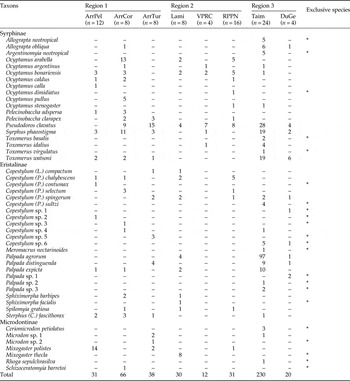
Samples of only five species amounted to more than 20 individuals: Ocyptamus arabella (Hull, 1947) (n = 20), Toxomerus watsoni (Curran, 1930) (n = 30), Pseudodoros clavatus (n = 78), Syrphus phaeostigma (n = 39), and Palpada agrorum (Fabricius, 1787) (n = 102). On the other hand, some species were found in only one of the regions (table 3). In R1, nine species were exclusive; in R2, three species were exclusive, all in Conservation Units (CU); and in R3, 13 species were exclusive, 10 from ESEC Taim, and three from an area outside the ecological station.
Taxa collected in the three regions as a function of collecting areas grouped by hydrographic basins (Region 1) or Conservation Units (CU) (Regions 2 and 3).

ArrPel, Arroio Pelotas; ArrCor, Arroio Corrientes; ArrTur, Arroio Turuçu; Lami, Reserva Biológica do Lami; RCam, Vila Pacheca, on the margins of Rio Camaquã; RPPN, Reserva Particular de Patrimônio Natural Barba Negra; Taim, Estação Ecológica do Taim; DuGe, area on the property of Mr Getúlio Vargas.
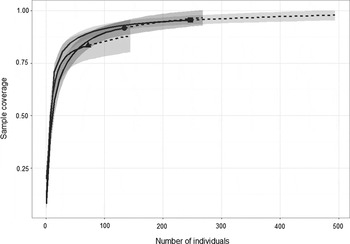
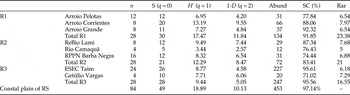
Rarefaction analysis provided a comparison of species richness between areas/regions, using as a reference the fewest number of individuals collected in an area/region (=standard number of individuals). With this in mind, we note in table 4 that R1 possessed the largest number of species (n = 23) by the standard number of individuals (n = 72). Within R1, the area known as Arroio Corrientes had the greatest number of species (8) by the standard number (12). Additionally, the sample coverage curve (fig. 2) shows that we reached 91.8% of estimated diversity for R1, 83.4% for R2 and 95.5% of estimated species for R3, for the locals we can see in the table 4.
Sample coverage curves based on the number of individuals of Syrphidae per region in the Coastal Plain of Rio Grande do Sul (Brazil). The shaded area represents the confidence intervals. Continuous line = interpolated data; dotted line = extrapolated data; Circle = Region 1; Triangle = Region 2; Square = Region 3.

Richness estimators by location and region of collection.

R1, Region 1; R2, Region 2; R3, Region 3; n, number of traps per location; S, species richness; H’, Shannon Diversity; 1-D, Simpson Diversity; Abund, abundance; SC, sample coverage; Rar, rarefaction. In the rarefaction data by location, the standard number of individuals was 12, and by region the standard number of individuals was 72.
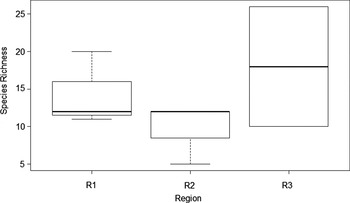
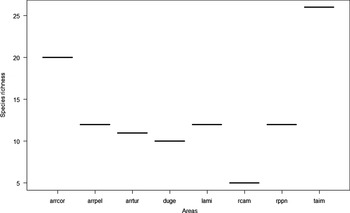
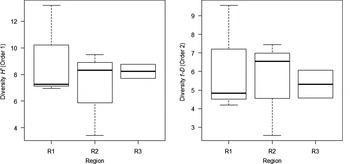
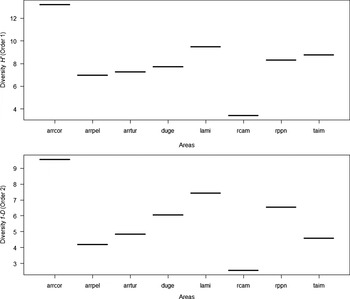
According to the GLM we obtained a significant difference of species richness between regions and between areas (GLM-poisson, test = χ2, Df = 2, P = 0.0389 (fig. 3); Df = 7, P = 0.0039 respectively (fig. 4)). Diversity orders 1 and 2 GLM were not significantly different between regions (GLM-poisson, test = χ2, Df = 2, P = 0.6739 (fig. 5a); Df = 2, P = 0.907, respectively (fig. 5b)), or between areas (GLM-poisson, test = χ2, Df = 7, P = 0.4633 (fig. 6a); Df = 7, P = 0.5687, respectively (fig. 6b)).
Boxplot of species richness per region, with mean, standard deviation and standard error. R1 = Region 1, R2 = Region 2, R3 = Region 3.

Barplot of species richness per areas. arrcor = Arroio Corrientes; arrpel = Arroio Pelotas; arrtur = Arroio Turuçu; duge = area on the property of Mr Getúlio Vargas; lami = Reserva Biológica do Lami; rcam = Vila Pacheca, on the margins of Rio Camaquã; rppn = Reserva Particular de Patrimônio Natural Barba Negra; taim = Estação Ecológica do Taim.

(a) Boxplot of diversity order 1 (H’) per region. (b) Boxplot of diversity order 2 (1-D) per region. With mean, standard deviation and standard error. R1 = Region 1, R2 = Region 2, R3 = Region 3.

(a) Barplot of diversity order 1 (H’) per areas. (b) Boxplot of diversity order 2 (1-D) per areas. arrcor = Arroio Corrientes; arrpel = Arroio Pelotas; arrtur = Arroio Turuçu; duge = area on the property of Mr Getúlio Vargas; lami = Reserva Biológica do Lami; rcam = Vila Pacheca, on the margins of Rio Camaquã; rppn = Reserva Particular de Patrimônio Natural Barba Negra; taim = Estação Ecológica do Taim.

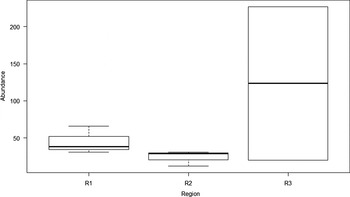
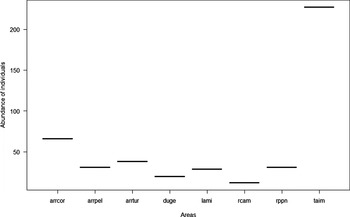
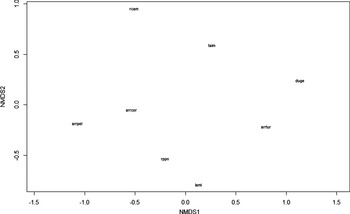
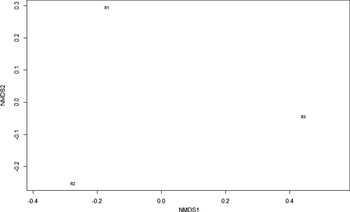
The abundance of individuals is significantly different between regions and areas (GLM-poisson, test = χ2, Df = 2, P < 0.001 (fig. 7); Df = 7, P < 0.001, respectively (fig. 8)). The composition of species among regions is significantly different (PERMANOVA-Bray-Curtis, F2;5 = 1.3999; P = 0.024) (fig. 9), whereas species composition is not significantly different among areas (PERMANOVA-Bray-Curtis, F7;0 = 0; P = 1) (fig. 10).
Boxplot of abundance of Syphidae per region, with mean, standard deviation and standard error. R1 = Region 1, R2 = Region 2, R3 = Region 3.

Barplot of abundance of Syrphidae per areas. arrcor = Arroio Corrientes; arrpel = Arroio Pelotas; arrtur = Arroio Turuçu; duge = area on the property of Mr Getúlio Vargas; lami = Reserva Biológica do Lami; rcam = Vila Pacheca, on the margins of Rio Camaquã; rppn = Reserva Particular de Patrimônio Natural Barba Negra; taim = Estação Ecológica do Taim.

Ordering graphic for non-metric multidimensional scaling (NMDS) based on Bray–Curtis index showing the dissimilarity of the composition of Syrphidae assemblages between the regions. NMDS stress = 0. R1 = Region 1, R2 = Region 2, R3 = Region 3.

Ordering graphic for non-metric multidimensional scaling (NMDS) based on Bray–Curtis index showing the dissimilarity of the composition of Syrphidae assemblages between the areas. NMDS stress = 0.0513. arrcor = Arroio Corrientes; arrpel = Arroio Pelotas; arrtur = Arroio Turuçu; duge = area on the property of Mr Getúlio Vargas; lami = Reserva Biológica do Lami; rcam = Vila Pacheca, on the margins of Rio Camaquã; rppn = Reserva Particular de Patrimônio Natural Barba Negra; taim = Estação Ecológica do Taim.

Discussion
The results indicate that type of habitat has an influence on communities of Syrphidae in the CPRS. In open areas of the Arroio Corrientes (R1), forest fragments of ESEC Taim (R3) and REBIO Lami (R2) riparian areas presented the largest individual-based estimators, Rarefaction, and species richness and diversity. These last two are Conservation Units (CU), but the first one does not have any area legally designated for the protection of biodiversity.
In the open areas of Arroio Corrientes, there is a high incidence of sunlight, as well as small vegetation fragments with borders that are very close to areas where traps were installed. Frequently, shorter distances to the border were associated with greater Syrphidae richness and abundance, due to the association of these Diptera with floral vegetation, which supports a diet of nectar and pollen (Vockeroth & Thompson, Reference Vockeroth, Thompson and McAlpine1987; Owen, Reference Owen1991; Marinoni et al., Reference Marinoni, Miranda and Thompson2004; Jorge et al., Reference Jorge, Marinoni and Marinoni2007). At the borders there are also more niches available, with large offerings of dietary resources – as much to the larvae as to adult syrphids (Jorge et al., Reference Jorge, Marinoni and Marinoni2007). The observed and the estimated richness there was due also to the greater richness of Syrphinae, a subfamily that includes species with predatory larvae that prey particularly on aphids (Gilbert, Reference Gilbert1986; Ferrar, Reference Ferrar and Lyneborg1987). There are more aphids in open areas, or areas in initial successional states, than in areas in more advanced successional stages (Brown, Reference Brown1984), and the former tend to exhibit a predominance of grasses, with herbaceous plants whose flowers serve as sources of food (nectar and pollen) to syrphid adults and larvae (aphids).
The CU ESEC Taim becomes a swampy area during some periods of the year, hosting vegetation favorable to the growth and development of immature Syrphidae with aquatic habitats. Eristalinae, for example, was very rich in species in this region. As of now, the Eristalinae species with known larval behavior develop in areas rich in decomposing organic material. They are found in the water tanks of Bromeliaceae, humid cavities in trees, dead trees, or dead vegetative material in water tanks (Ferrar, Reference Ferrar and Lyneborg1987; Vockeroth & Thompson, Reference Vockeroth, Thompson and McAlpine1987; Thompson et al., Reference Thompson, Rotheray, Zumbado, Brown, Borkent, Cumming, Wood, Woodley and Zumbado2010); habitats commonly found in the Taim region.
The differences in the frequency of occurrence of Syrphidae subfamilies (in connection with known environments of the CPRS), owes to the diversity of habits displayed by adults and larvae (Ferrar, Reference Ferrar and Lyneborg1987). A given species can, during the course of its life cycle, occupy completely different environments; for example, adults of a given species can inhabit open areas with a high incidence of sunlight and availability of flowers, but in their immature stage prefer shady areas rich in decomposing organic matter. Because of this, interpreting the results based on adults captured by Malaise traps is complex (Namaghi & Husseini, Reference Namaghi and Husseini2009; Marcos-García et al., Reference Marcos-García, García-López, Zumbado and Rotheray2012), often leading to several different hypotheses that each need to be tested with different collecting methods – aiming to envelop a large diversity of habitats. Biological and ecological studies concerning the Neotropical Syrphidae fauna must be conducted, to accomplish this. Recent works, such as Ricarte et al. (Reference Ricarte, Marcos-García and Moreno2011), showed that environmental heterogeneity must be adequately preserved and adequately maintained in order to provide the necessary resources for the development of each of the different phases of the syrphid life cycle.
The species richness found in this study is less than that found by Morales & Köhler (Reference Morales and Köhler2006, Reference Morales and Köhler2008), Marinoni et al. (Reference Marinoni, Miranda and Thompson2004, Reference Marinoni, Marinoni, Jorge and Bonatto2006), Jorge et al. (Reference Jorge, Marinoni and Marinoni2007), and de Souza et al. (Reference de Souza, Marinoni and Marinoni2014). However, methodological differences between those studies and ours, beginning with the collecting method, preclude direct comparisons. According to Namaghi & Husseini (Reference Namaghi and Husseini2009) and Marcos-García et al. (Reference Marcos-García, García-López, Zumbado and Rotheray2012), the collecting method can influence the diversity and richness of species obtained, and this might explain the large difference between our results and the results of Morales & Köhler (Reference Morales and Köhler2006, Reference Morales and Köhler2008). The latter authors used a manual collecting method, and the 2006 study was specifically directed at obtaining flies from Eryngium horridum Malme (Apiaceae).
Another difference that might explain the disparity between the results of this study and those cited above agrees with a general pattern found for other groups of animals, and can be explained by the latitudinal gradient (Gaston & Williams, Reference Gaston, Williams and Gaston1996; Gaston & Blackburn, Reference Gaston, Blackburn, Blackburn and Gaston2000; Ruggiero, Reference Ruggiero, Llorente Bousquets and Morrone2001; Whittaker et al., Reference Whittaker, Willis and Field2001, Rodriguero & Gorla, Reference Rodriguero and Gorla2004). Paraná is located at a lower latitude than is Rio Grande do Sul, and this may explain the greater species richness found by Marinoni et al. (Reference Marinoni, Miranda and Thompson2004, Reference Marinoni, Marinoni, Jorge and Bonatto2006), Jorge et al. (Reference Jorge, Marinoni and Marinoni2007), and de Souza et al. (Reference de Souza, Marinoni and Marinoni2014).
The third explanation is the time of collection, the temporal effort vs. the number of traps. In Marinoni et al. (Reference Marinoni, Marinoni, Jorge and Bonatto2006) and Jorge et al. (Reference Jorge, Marinoni and Marinoni2007), the effort corresponded to 416 and 260 samples, respectively. This number is much greater than the 140 samples we collected in the CPRS. It should be noted that these 140 samples, obtained in Regions 4 and 5, were probably compromised by climatic conditions, including high temperature and high relative humidity. A total of 54 traps from these regions were not used in the analysis.
In addition to the points discussed above, the traps in our study were placed differently in relation to vegetation fragments. While Marinoni et al. (Reference Marinoni, Miranda and Thompson2004) and de Souza et al. (Reference de Souza, Marinoni and Marinoni2014) observed that traps in border areas captured a larger number of species; the majority of the traps of this study were placed in the interior of preserved forests. Given this, we can corroborate the hypotheses of Jorge et al. (Reference Jorge, Marinoni and Marinoni2007) and de Souza et al. (Reference de Souza, Marinoni and Marinoni2014) that areas within well-preserved forest tend to maintain a lesser number of species and a more even abundance, when compared with areas that have been impacted, or which are in their primary stages of regeneration, – this being what we observed in our work, also. Additionally, in urbanized areas urban gardens serve as a refugee for most species. In these sites Syrphidae diversity is 4× greater than at the vicinity of high traffic roads (Bankowska, Reference Bankowska1980).
We believe that, with the exception of R2, where we collected 83% of the estimated fauna, the CPRS regions were well-sampled. Moreover, in Arroio Pelotas, Rio Camaquã, RPPN Barba Negra and Getúlio Vargas areas, we reached a value under 80% of the estimated value. The estimates, primarily from individual-based estimators, were well above the observed richness in the other regions, due to the large number of ‘singletons’ and ‘doubletons’ – rare species that were collected. On the other hand, when analyzing CPRS as whole, the value is close to 100% (97.14%). These rare species influenced the diversity estimates in the assemblages. A similar result was observed by Jorge et al. (Reference Jorge, Marinoni and Marinoni2007) and is a common phenomenon in biological survey studies (Erwin, Reference Erwin, Wilson and Peter1988).
The CPRS regions show different species richness, abundance and species composition among each other. The areas have the same behavior regarding species richness and abundance. Despite being located in the same geological formation, these sites have distinct phytophysiognomies (Villwock & Tomazelli, Reference Villwock, Tomazelli, Becker, Ramos and Moura2007), favoring some species over others, as previously discussed for Eristalinae in the ESEC Taim, for example. On the other hand, species composition is not different among areas, with some of them in different regions having similar faunas, as discussed above for riparian and open areas, for example.
It should be noted that this is one of the first efforts to collect insects in areas of high conservation priority in the CPRS, but especially in the federal conservation units like ESEC Taim. In this location, until now, only the dipteran families Muscidae (Zafalon-Silva, Reference Zafalon-Silva2013) and Sciomyzidae (Kirst et al., Reference Kirst, Marinoni and Krüger2015) had been studied.
Additionally, the results obtained here provide a basis for expanding the area of conservation of ESEC Taim to locations with vegetation dunes and forest fragments. Although today they lie outside of that CU, they have been pleaded for in expansion proposals (MMA, 2013) for this important conservation area of the wetlands in the south of Brazil.
Furthermore, Syrphidae diversity is naturally reduced in urban ecosystems when compared with sites nearby woods and forests (Bankowska, Reference Bankowska1980). Therefore, areas such as Arroio Pelotas and Arroio Corrientes, which according to our results are areas with high diversity, are also under high anthropic pressure (Burger & Ramos Reference Burger, Ramos, Becker, Ramos and Moura2007). Accordingly, we indicate the necessity of creating a new CU in the region surrounding these areas, to maintain the habitat heterogeneity there – a property associated, generally, with high species richness (which was in fact observed in our study for that region). In addition, Burger & Ramos (Reference Burger, Ramos, Becker, Ramos and Moura2007) had indicated R1 as priority for conservation; we have corroborated their recommendations in this work, highlighting the need to ease anthropogenic activities in R1.
Acknowledgements
We thank CAPES for Postdoctoral scholarship and CNPq for the PhD scholarship awarded to the first author, and for financing the project Diptera da Planície Costeira do Rio Grande do Sul (DIPLAN) (process no. 473949/2010-5). We also thank Msc. Ândrio Zafalon Silva and for his dedicated help in the field, Dr Mírian Nunes Morales and Dr Christian F. Thompson for help with identification, Dr Kirstern Lica Follmann Haseyama for assisting in the final manuscript writing and the administration of the conservation units where collecting was conducted.
Disclosure
All authors have seen and agreed with the contents of the manuscript and there is no conflict of interest, including specific financial interest and relationships and affiliations relevant to the subject of manuscript.