1 Introduction
Hopper & Traugott's (Reference Hopper and Traugott2003: 126) call for reliable statistical studies to diagnose grammaticalization has witnessed a recent increase in studies which apply variationist methodologies to elucidating the processes ‘whereby a lexical item or construction in certain uses takes on grammatical characteristics, or through which a grammatical item becomes more grammatical’ (Hopper & Traugott Reference Traugott2003: 2). The framework of grammaticalization provides testable hypotheses about the nature and trajectory of changes (decategorialization, desemanticization, etc.) which may be observable in fluid patterns of synchronic dialect variation by virtue of the fact that these changes typically occur as a series of micro-steps (Traugott & Trousdale Reference Traugott, Trousdale, Traugott and Trousdale2010). The methodological framework of variationist sociolinguistics enables scholars to operationalize these hypotheses as independent linguistic variables conditioning synchronic variation (Poplack Reference Poplack, Narrog and Heine2011; Torres Cacoullos Reference Torres Cacoullos and Diaz-Campos2011), and to systematically compare the distribution and linguistic conditioning of variant choice across different age groups. This combined approach allows scholars to identify and track grammaticalization pathways in apparent time, as illustrated, for example, in Poplack & Tagliamonte (Reference Poplack and Tagliamonte1999).
Previous attempts to synergize these frameworks in synchronic dialect studies have illuminated the grammaticalization of morphosyntactic features such as clause-combining constructions and tense-aspect markers (see, for example, Sankoff & Brown Reference Sankoff and Brown1976; Poplack & Tagliamonte Reference Poplack and Tagliamonte1999, Reference Poplack and Tagliamonte2001; Schwenter & Torres Cacoullos Reference Schwenter and Cacoullos2008). These studies have improved understanding of grammaticalization processes and given rise to important theoretical and methodological refinements: scholars have recognized the need to situate the analysis of grammaticalizing elements in relation to the broader grammatical subsystems which host them (see, for example, Poplack & Tagliamonte Reference Poplack, Tagliamonte and Baker1996; Tagliamonte & Smith Reference Tagliamonte and Smith2006), and have enhanced procedures for identifying and tracking subtle shifts in the linguistic conditioning of variant choice over time (see, for example, Poplack Reference Poplack, Narrog and Heine2011). In addition, scholars have increasingly recognized the value of extending this combined approach to the synchronic study of discourse-level features (see, for example, Tagliamonte & Hudson Reference Tagliamonte and Hudson1999; D'Arcy Reference D'Arcy2005).Footnote 2
In this article, we adopt this synthesized approach to investigate recent claims that grammaticalization processes are implicated in the synchronic variability of general extenders (henceforth GEs), i.e. phrase- or clause-final constructions which exhibit extensive variability, as illustrated in (1) and (2) below.Footnote 3
(1) I don't think it's a Berwick word, moggy. You hear it on the telly and that, moggy, or cartoons or whatever. Moggy.Footnote 4
(2) Everyone in Spittal were fishermen or whatever. And all the wives were, you know, doing the nets and stuff like that, so that everyone was in Spittal. Just like all the people out at Scremerston were miners and all the rest of it.
Arguing that frequent GE variants have undergone a set of changes associated with grammaticalization, i.e. phonetic reduction, decategorialization and semantic-pragmatic change, recent studies attribute synchronic patterns of variation in the formal, morphosyntactic and functional characteristics of GE variants to their differential positioning along a continuum of grammaticalization (Aijmer Reference Aijmer2002; Cheshire Reference Cheshire2007; Tagliamonte & Denis Reference Tagliamonte and Denis2010). Our analysis, which is based on a socially stratified corpus of interview data collected in Berwick-upon-Tweed, northeast England, builds on these recent studies in order to (i) situate patterns of GE variation in this peripheral variety in relation to those uncovered for mainstream varieties of English; (ii) establish whether GEs in this variety are the locus of ongoing change, and, if so, whether grammaticalization is implicated; and (iii) evaluate the extent to which synchronic dialect data can offer a window on the diachronic evolution of GEs.
In section 2, we review the literature which provides the impetus for the present study, and examine claims that GEs are grammaticalizing in contemporary varieties of English. We then detail our method for tracking grammaticalization in our corpus in section 3. In section 4, we present the results of our analysis and situate them in relation to previous research. We then interpret these results and discuss their implications in section 5, before concluding and pointing to areas of further study in section 6.
2 Previous research on GEs
2.1 Social and geographical variation
GE variability has been investigated in many varieties of English, including the English of England (Aijmer Reference Aijmer2002; Cheshire Reference Cheshire2007; Denis MS; Levey MS); Scotland (Macaulay Reference Macaulay1991); Ireland (O'Keeffe Reference O'Keeffe2004); America (Overstreet Reference Overstreet1999; Overstreet & Yule Reference Overstreet and Yule1997, Reference Overstreet and Yule2002); Canada (Tagliamonte & Denis Reference Tagliamonte and Denis2010); New Zealand (Britain Reference Britain1992; Stubbe & Holmes Reference Stubbe and Holmes1995); and Australia (Dines Reference Dines1980; Norrby & Winter Reference Norrby and Winter2002). These studies have correlated variability in GE usage with a number of social factors, including age, sex, socioeconomic class and locality.
The most consistent sociolinguistic patterns have been uncovered for age. Although overall mean frequencies vary, young people typically make the greatest use of GEs across varieties (Stubbe & Holmes Reference Stubbe and Holmes1995; Tagliamonte & Denis Reference Tagliamonte and Denis2010; Denis MS; but see Stenström et al. Reference Stenström, Andersen and Hasund2002: 89). This may be a result of either age-grading (Dubois Reference Dubois1992) or ongoing change (Stubbe & Holmes Reference Stubbe and Holmes1995: 83).
Significant patterns of sex differentiation have been reported for New Zealand English (Britain Reference Britain1992), with females using GEs more often than males. Other studies, however, have either noted no marked differences in rates of use associated with sex (Norrby & Winter Reference Norrby and Winter2002; Cheshire Reference Cheshire2007), or observed that the effect of sex on variant choice is weaker than that of other social variables (Tagliamonte & Denis Reference Tagliamonte and Denis2010). An interaction of sex with socioeconomic class is noted by Stubbe & Holmes (Reference Stubbe and Holmes1995: 77) for New Zealand English: young middle-class females and young working-class males are the most prolific users of GEs.
Dines (Reference Dines1980), Macaulay (Reference Macaulay1991) and Britain (Reference Britain1992) found that GEs are more commonly used by working-class than middle-class speakers in Australian, Scottish and New Zealand English. Cheshire (Reference Cheshire2007) reported the absence of consistent social class differences in the frequency of GE usage amongst adolescents in England. However, she found that the use of specific variants is sensitive to social class membership: while middle-class adolescents favour and stuff and and things, working-class adolescents favour and (all) that. The strong association of and that with young working-class speech is also reported in Levey's (MS) study of London pre-adolescents.
Cross-variety comparisons reveal interesting correlations of GE usage with locality. Overall, and that is strongly associated with New Zealand and British English varieties (Britain Reference Britain1992; Cheshire Reference Cheshire2007; Denis MS; Levey MS), while and stuff is strongly associated with North American English varieties (Overstreet & Yule Reference Overstreet and Yule1997; Overstreet Reference Overstreet2005; Tagliamonte & Denis Reference Tagliamonte and Denis2010). However, the high frequency of and stuff amongst middle-class adolescents in Cheshire's (Reference Cheshire2007) data from Reading, Milton Keynes and Hull, three towns in southeastern and northern England, as well as its noted frequency in Denis's (MS) data from York, a city in northern England, suggest that this variant is on the increase in urban varieties of British English.
2.2 Formal and functional variation
Dines (Reference Dines1980: 18) describes the structural configuration of GEs using the following schema: AND/OR [PRO FORM] (LIKE THAT), where PRO FORM includes generic referents such as anything, stuff, something, things, and parentheses indicate optional lexical material. The connectors and/or provide the basis for a structural subdivision between two main types of GEs: adjunctive variants (e.g. and stuff, and things) and disjunctive variants (e.g. or something like that). Use of a connector, while common, is not obligatory (e.g. things like that, anything like that).
Early studies of GEs were generally more concerned with characterizing their function rather than their form. Dines (Reference Dines1980: 22), for example, emphasized their set-marking function, claiming that GEs are prototypically used to ‘cue the listener to interpret the preceding element as an illustrative example of a more general case’. This usage is exemplified in (3), where or whatever evokes the fully lexicalized category of ‘business people’ (an interpretation supported by the explicit mention of the category in the immediately following clause), and (4), where and stuff evokes an ad hoc or ‘fuzzy categor[y]’ (Overstreet Reference Overstreet1999: 43) related to concepts such as ‘speaking politely’, ‘speaking standard English’, etc.
(3) Berwick was run by what they call freemen and burgesses. And these people were the, generally the wealthy people in the town. Or the tradesmen, the goldsmiths or the silversmiths, or the butchersor whatever. The people who've had businesses.
(4) If it's like the bank, I mean, of course you have to speak clearlyand stuff.
The highly context-driven interpretation of GEs has prompted scholars to increasingly recognize that GEs can be exploited for a range of interactional purposes which extend beyond set-marking, including interpersonal functions such as signalling politeness or solidarity (Overstreet Reference Overstreet1999; Aijmer Reference Aijmer2002; Norrby & Winter Reference Norrby and Winter2002; Cheshire Reference Cheshire2007), and textual functions such as signalling turn-exchange or transitions (Aijmer Reference Aijmer2002; Cheshire Reference Cheshire2007). Aijmer (Reference Aijmer2002: 217–18) and Cheshire (Reference Cheshire2007: 183) suggest that the multifunctionality of GEs in synchronic data may be the result of gradual semantic-pragmatic changes over time, with interpersonal and textual functions developing from the putatively original set-marking function. These developments are commonly situated within a larger set of changes associated with grammaticalization.
2.3 GE variability and grammaticalization
Much recent research on GEs has focused on assessing the extent to which GEs have undergone the processes that are collectively associated with grammaticalization (Heine Reference Heine2003: 579): phonetic reduction, characterized by the loss of phonetic substance (Erman Reference Erman, Moen, Simonsen and Lødrup1995: 145; Overstreet & Yule Reference Overstreet and Yule1997; Overstreet Reference Overstreet1999; Aijmer Reference Aijmer2002: 227); decategorialization, involving the loss of morphosyntactic characteristics of source forms, and their extension beyond their originally defining morphosyntactic contexts (Erman Reference Erman, Moen, Simonsen and Lødrup1995; Overstreet & Yule Reference Overstreet and Yule1997; Overstreet Reference Overstreet1999: 27; Aijmer Reference Aijmer2002: 217–18); as well as semantic-pragmatic change, whereby forms become semantically bleached and acquire new pragmatic meanings over time (Erman Reference Erman, Moen, Simonsen and Lødrup1995; Overstreet & Yule Reference Overstreet and Yule1997; Aijmer Reference Aijmer2002: 217–18). To track the grammaticalization of GEs in synchronic data sets of British and Canadian English, Cheshire (Reference Cheshire2007) and Tagliamonte & Denis (Reference Tagliamonte and Denis2010) operationalized the aforementioned processes as independent variables for quantitative analysis.
Drawing on hypotheses about the evolution of short GE variants from longer variants (e.g. or something < or something like that), Cheshire (Reference Cheshire2007) equated phonetic reduction with loss of lexical material (e.g. like that), and argued that in the British English varieties of Reading, Milton Keynes and Hull, some variants (e.g. and everything, and that) were more advanced in terms of phonetic reduction than others (e.g. or something). While Denis (MS) claimed to have uncovered evidence of increasing phonetic reduction for variants containing the generics stuff, things and something in his data from York (UK), Tagliamonte & Denis (Reference Tagliamonte and Denis2010) did so only for something variants in their Toronto data. In both York and Toronto, GEs containing other generic nouns generally exhibited considerable stability in apparent time between long and short variants.
Decategorialization was gauged by Cheshire (Reference Cheshire2007), Tagliamonte & Denis (Reference Tagliamonte and Denis2010) and Levey (MS) in terms of mismatches between the morphosyntactic and semantic properties of the generic in GEs (e.g. thing(s), stuff) and those of the NPs to which GEs are appended, as well as the nature of the antecedent phrase (e.g. VP, AdjP). This diagnostic is illustrated in (5)–(7):
(5) I have seen it frae time to time on maybe a news itemor something like that.
(6) It's usually all on history programmesand stuff.
(7) They're no being aggressiveor anything.
In (5), the properties of the generic, something, in the GE ([+COUNT] [+SINGULAR] [+INANIMATE]) match those of the preceding head noun news item. By contrast, in (6) and (7), there is a mismatch between the properties of the generic noun in the GE and the antecedent phrase: the generic noun stuff in (6) is not appended to an expected mass noun, but to a plural inanimate count noun, history programmes; in (7), the GE is appended to an AdjP, exemplifying the putative extension of GEs to new contexts (Himmelmann Reference Himmelmann, Bisang, Himmelmann and Wiemer2004). Contexts exemplified in (5) have been construed in the literature as the original host context for GEs, while those in (6) and (7) are seen to instantiate later stages in the grammaticalization process.
Applying these measures, Cheshire (Reference Cheshire2007), Tagliamonte & Denis (Reference Tagliamonte and Denis2010) and Levey (MS) found that individual GE variants exhibited varying degrees of decategorialization. However, Tagliamonte & Denis's (Reference Tagliamonte and Denis2010) apparent-time study revealed little evidence to support claims that GEs were becoming increasingly decategorialized. With the exception of and things, the distribution of GEs across different morphosyntactic contexts was found to be relatively stable in their Toronto data.
To track the semantic-pragmatic development of GEs in their corpora, Cheshire (Reference Cheshire2007) and Tagliamonte & Denis (Reference Tagliamonte and Denis2010) first coded each token for loss of referential meaning. Reasoning that the source meaning of GEs is to implicate a more general set (Dines Reference Dines1980), they operationalized the absence of a set-marking function as an indication of semantic bleaching. A token implicating a lexicalized superordinate category, (8), was thus taken to be less advanced in terms of semantic bleaching than a token not implicating a superordinate category, (9).
(8) You never hear Berwick making the news because of attacks on peopleand stuff like that. [larger category of ‘crime’ or ‘violence’]
(9) We found that eh stuffand that was dearer for a while.
In Cheshire's (Reference Cheshire2007) data, short GEs were reported to have undergone some degree of semantic bleaching, with and that affected the most. Tagliamonte & Denis (Reference Tagliamonte and Denis2010) found minimal evidence of semantic bleaching of GEs in their Toronto data. Although stuff variants were more likely to be void of a set-marking function amongst younger speakers, patterns of variability in apparent time did not provide any unequivocal evidence of ongoing change.
Finally, in order to determine the degree of pragmatic change in GE usage, Cheshire (Reference Cheshire2007) and Tagliamonte & Denis (Reference Tagliamonte and Denis2010) coded all GE tokens for their co-occurrence with other discourse-level features in the ambient discourse. Arguing that GEs in the earlier stages of pragmatic change will tend to be reinforced by the presence of additional discourse-level features performing similar functions, they interpreted low levels of co-occurrence to be an indication of advanced pragmatic change. While co-occurrence patterns were generally low in Cheshire's (Reference Cheshire2007: 185) British English data, they tended to be higher in Tagliamonte & Denis's (Reference Tagliamonte and Denis2010: 357) Toronto English data. Crucially, Tagliamonte & Denis (Reference Tagliamonte and Denis2010) did not uncover any evidence to suggest that co-occurrence patterns are decreasing in apparent time.
In concluding this section, we note that Cheshire's (Reference Cheshire2007) proposal that GEs in contemporary varieties of English are grammaticalizing must be treated cautiously since it is based on the analysis of adolescent speech only, and is not confirmed by Tagliamonte & Denis's (Reference Tagliamonte and Denis2010) apparent-time study of GE variability in Toronto English.
3 Data and methodology
In this section, we introduce the methodology we implement to probe the existence and characterize the potential direction of grammaticalizing changes in our corpus. In doing so, we critically review some of the measures that have previously been invoked by researchers to detect and track ongoing grammaticalization of GEs in synchronic data. Among the methodological refinements that we introduce are revised criteria for operationalizing the syntagmatic length of GEs as a measure of grammaticalization as well as a novel approach to assessing semantic-pragmatic change.
3.1 Data
Our study is based on a 260,000-word corpus collected between 2003 and 2005 in Berwick-upon-Tweed, a small market town of just over 13,000 inhabitants located in the far northeast of England.Footnote 5 The data were gathered using the interview protocol designed for the Survey of Regional English to solicit information about informants’ use of local dialect words and attitudes towards their locality and dialect (Llamas Reference Llamas2007). Various fieldwork techniques were utilized to mitigate potential effects of the Observer's Paradox (Labov Reference Labov1972: 209), including conducting interviews with self-selected pairs in informants’ homes (Labov Reference Labov1972: 210). The quality of the data suggests that such effects were successfully attenuated, as reflected by the rich repository of vernacular features characteristic of casual and unmonitored speech styles (Labov Reference Labov1972: 85–99), such as non-standard was, relativizer what, negative concord and double modal constructions.
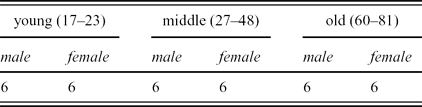
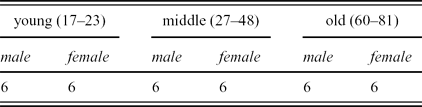
As shown in table 1, the sample includes 36 speakers who are equally stratified across sex and three emically defined age cohorts reflecting shared life stages: teenagers and young adults in temporary non-career employment or full-time education, and co-habiting with their parents (17–23); adults in full-time salaried employment with dependent children and their own household (27–48); retired people with no dependent children (60–81). They represent a socially homogeneous group of working-class speakers, as determined via a combination of traditional social-class indicators (housing, education, occupation) and speakers’ own assessment of their social class membership.
Speaker sample
The design of our study affords new insights into GE variability: the focus on the geographically peripheral variety of Berwick English (BwE) complements the recent focus on mainstream varieties (Cheshire Reference Cheshire2007; Tagliamonte & Denis Reference Tagliamonte and Denis2010; Denis MS; Levey MS), and the inclusion of three age groups transcends the limitations of studies which have inferred change in GEs from investigation of one age group only (Cheshire Reference Cheshire2007; Levey MS).
3.2 Methodology
3.2.1 Definition of the variable and circumscription of the variable context
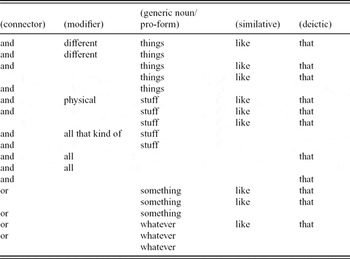
Dines's (Reference Denis1980: 23) functionally based definition of the variable context, which assumes that GEs share the unitary function of marking the preceding element as a member of a set, is not supported by recent studies that foreground the functional versatility of GEs (see section 2.2 above). Given the difficulties in defining membership of the set of GEs by function, we adopt Pichler's (Reference Pichler2010) structure-based conceptualization of discourse variables. We define GEs as semi-fixed constructions which prototypically share the following schematic pattern: (connector) (modifier) (generic noun/pro-form) (similative) (deictic), where parentheses indicate the optionality of individual components, as illustrated in table 2. We also include in the variable context less prototypical GE variants which appear to be more fixed in terms of their structural configuration such as and all the rest of it, and so on (like that), or whatever it is, type of thing. The inclusion of these constructions in the variable context is justified on the grounds that they occur in the same syntactic environments as more prototypical variants, and perform a similar range of functions to these. This approach to defining the variable context allows us to study the whole spectrum of GE variants under the umbrella of one variable, while still catering for the variable's inherent multifunctionality and potential semantic-pragmatic changes over time.
Prototypical structural pattern of GE variants

Having defined the variable context in this way, we exhaustively extracted all GE constructions from the data. We excluded tokens whose surface form could not be disambiguated, tokens where insufficient context hampered unambiguous data interpretation, and tokens that occurred in quoted speech, repair sequences, or contexts that did not unequivocally support GE interpretations. In total, 783 GE tokens were retained for analysis.
3.2.2 Coding
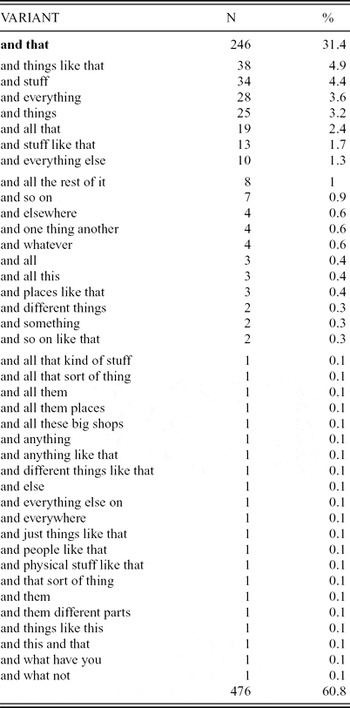
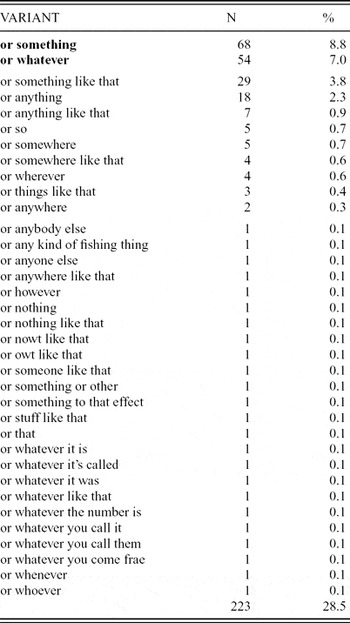
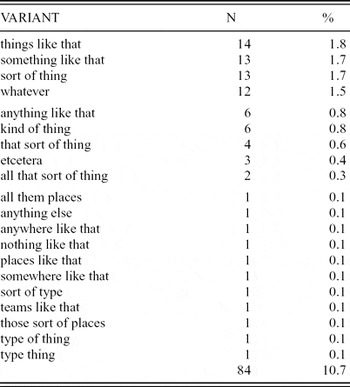
To investigate GE variability and grammaticalization in BwE, each GE token in the data set was coded for its variant form (see appendices 1–3 for a full breakdown of individual variants). Additionally, each GE token was coded for speaker sex, one of the three age cohorts as well as for syntagmatic length, decategorialization and semantic-pragmatic change.
In operationalizing syntagmatic length as a diagnostic of grammaticalization, we depart from previous approaches which appeal to diachronic processes of phonetic reduction (Cheshire Reference Cheshire2007). We do this for two reasons. Firstly, the derivation of short variants from longer variants (e.g. and things < and things like that) is questionable from a historical perspective (see, for example, Carroll Reference Carroll2008 who reports that short variants such as and such feature among the earliest attestations of GEs). Secondly, as acknowledged by Tagliamonte & Denis (Reference Tagliamonte and Denis2010), scholars of grammaticalization habitually characterize phonetic reduction in terms of segmental loss concomitant with shifts in morpheme boundaries (e.g. going to > gonna), rather than in terms of the loss of whole morphemes. In this study, we hypothesize that if morphologically lighter forms tend to be more grammaticalized than morphologically heavier forms (Hopper & Traugott Reference Traugott2003: 106; see also Givón's (Reference Givón1990) ‘quantity principle’), then grammaticalization may be evidenced in apparent time by an increase in the number of short GE variants relative to long ones (see also Levey MS). To operationalize syntagmatic length as an independent variable, we therefore coded all GE tokens for whether they were short (1 or 2 lexemes) or long (3+ lexemes).
To assess decategorialization, we follow the lead of Cheshire (Reference Cheshire2007) and Tagliamonte & Denis (Reference Tagliamonte and Denis2010) and examine the collocation of variants with expected NPs, where GE generics match the morphosyntactic features of preceding NPs (10); cases where there is a mismatch between preceding NPs and appended GEs in terms of these features (11); and cases where GEs are appended to non-nominal phrases, i.e. VPs, AdjPs, numerical expressions, clauses and quoted speech (12). Tokens that occur after elicited dialect words, as in (13), were coded separately because their categorization is not straightforward.Footnote 6
- (10)
(a) It must depend on like the weatherand stuff.
(b) I think they have got to go through an act of parliamentor something.
- (11)
(a) You never hear Berwick making the news because of attacks on peopleand stuff like that.
(b) See the dolphins here and everything sometimes, you know.
- (12)
(a) You never hear of people getting murderedand things like that in Berwick, you know.
(b) I think it's probably homelyand everything.
(c) It's the same thing that's in itand everything.
(d) And the media goes, ‘Gerard K.O.’and that.
(13) I probably say eh knackeredor something like that.
We used a slightly modified protocol to gauge the decategorialization of GE variants such as and that and or whatever, which do not contain a generic noun that can be co-referenced with an antecedent NP. We coded these variants for whether they occurred with NPs, (14), or in extended contexts with non-nominal phrases, (15).Footnote 7
- (14)
(a) I don't know whether it's the adult sheepor whatever.
(b) And she's a good artistand that.
- (15)
(a) If you wanted to be anonymousor whatever.
(b) And eh we split upand that.
Our investigation of semantic-pragmatic change diverges from recent approaches which operationalized this parameter as if it consisted of two independent processes, and inferred pragmatic shift from the co-occurrence of GEs with other discourse-level features (Cheshire Reference Cheshire2007; Tagliamonte & Denis Reference Tagliamonte and Denis2010). These approaches are based on the questionable assumptions that co-occurrence patterns are functionally motivated, and that they constitute a straightforward metric of semantic-pragmatic change (see Cameron & Flores-Ferrán Reference Cameron and Flores-Ferrán2004 and Pichler & Levey Reference Pichler and Levey2010 for evidence to the contrary). With others, we believe that the interplay of referential and pragmatic/procedural meanings is intrinsic to semantic-pragmatic change during the incipient stages of change (Heine Reference Heine, Wischer and Diewald2002; Company Reference Athanasiadou, Canakis and Cornillie2006), and that set-marking GEs are inherently intersubjective because they appeal to common frames of knowledge by implicitly evoking a more general set (O'Keeffe Reference O'Keeffe2004). Any operationalization of semantic-pragmatic change should reflect this. Thus, we submit that in the course of semantic-pragmatic change, the set-marking meaning of GEs gradually recedes while their intersubjective and other pragmatic/procedural meanings increasingly come to the fore (see Hopper & Traugott Reference Traugott2003: 94).
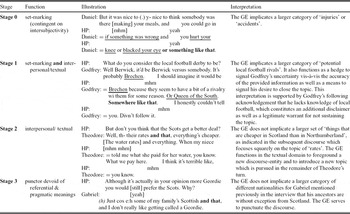
To model this process, we coded every GE token in the data for whether or not it performed (a) the referential function of implicating a more general set (see examples (8)–(9) in section 2.3), and (b) one or more interpersonal and/or textual functions, as illustrated in (16)–(18). In (16), Janet's use of or something signals her uncertainty about whether the preceding expression ‘ulterior motives’ is the one she intended, which is also reflected in the false starts and truncated question at the beginning of her turn. In (17), Patrick uses and things like that as a means to secure his hold on the floor and prevent his interview partner Carol, who repeatedly signals her desire to contribute to the discussion (‘yeah’, ‘yeah, like’ and in-breath), from taking the floor. Finally, in (18), Alicia's and stuff like that serves as a retrospective hedge on the preceding description of her own accent as well as a turn-yielding signal, an effect which is achieved by the production of the GE in a separate tone unit and with a falling intonation contour.Footnote 8
(16)

(17)
(18)

Tokens following dialect words and measurements were not coded for their semantic and pragmatic meanings: with elicited dialect words the general set had been invoked by the interviewer (e.g. ‘Are there any dialect words for tired?’); with measurements it is unclear whether they are indeed intended to evoke a category of possible measurements (see Cheshire Reference Cheshire2007: 176). Tokens which implicate a more general set by invoking shared frames of reference were coded as not performing a pragmatic function since, as noted above, their appeal to shared knowledge is intrinsic to these tokens’ set-marking function.
Drawing on current hypotheses about the unidirectionality and regularity of semantic-pragmatic change (truth-conditional/content/non-subjective > non-truth-conditional/procedural/(inter)subjective) (Traugott & Dasher Reference Traugott and Dasher2002: 40), we used the coding protocol detailed above to elaborate the taxonomy outlined in table 3. The taxonomy models the continuous shifts in the semantic-pragmatic evolution of GEs along a cline of grammaticalization, similar to that outlined in Heine (Reference Heine, Wischer and Diewald2002) for grammaticalizing material more generally. At stage 0, tokens perform the core referential function of GEs, i.e. they mark the preceding referent as a member of a more general set. Stage 1 gives rise to the interpersonal and textual meanings inherent in the source form which co-exist with the original referential meaning, with the layering of meanings reflecting the gradualness of semantic-pragmatic change. At stage 2, the referential meaning fades away and pragmatic meanings are strengthened. Finally, at stage 3, in line with Traugott & Heine's (Reference Traugott and Heine1991) implicational hierarchy of the type semantic > pragmatic > less semantic-pragmatic, earlier semantic-pragmatic meanings fade away, and GEs come to function as ‘punctors’ (Vincent & Sankoff Reference Vincent and Sankoff1992), i.e. tokens which are entirely desemanticized and which serve to punctuate or bracket units of discourse (see also Macaulay Reference Macaulay and Görlach1985; Cheshire Reference Cheshire2007).
Taxonomy of semantic-pragmatic change in GEs

4 Results
4.1 Distributional results
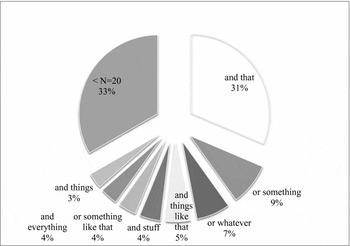
Figure 1 reveals the uneven distribution of GE variants in our data. The most frequent variant, and that, constitutes almost one-third of all GE tokens in the data. Or something, or whatever and and things like that are the next most frequent variants, constituting 9, 7 and 5 per cent of the data respectively. Together with and that, these variants account for just over half of all GE tokens in the data set. And stuff, or something like that, and everything as well as and things are also comparatively frequent, although none accounts for more than 3–4 per cent of the data. The remaining 33 per cent of GE tokens comprises 86 variants, each instantiated fewer than twenty times in the corpus. Inspection of age patterns (not shown here) confirms that and that and or something are the most frequent variants in each age cohort. Among the other frequent variants, we notice the following trends: a slight decline of and everything and stark decline of or whatever among the youngest speakers; a decline of things variants among middle and young speakers; and a gradual rise of and stuff from older to younger speakers. With regard to the infrequent variants in the data, apparent-time distributions (not shown here) reveal that older male speakers have a much larger inventory of these than the other speaker groups (see further table 8 below).
Overall distribution of productive variants

The highly fragmented nature of the variable context is by no means an isolated finding. Denis's (MS) corpus of York English contains 87 GE variants which are also unevenly partitioned between a limited number of relatively frequent variants and a much larger number of relatively infrequent ones. Cross-variety comparisons reveal additional similarities: and that and or something are consistently among the most productive variants in the British English varieties examined to date (Aijmer Reference Aijmer2002; Cheshire Reference Cheshire2007; Denis MS; Levey MS). Considering the working-class composition of our speaker sample, the elevated frequency in our data of and that also bolsters previous claims that this variant is indexical of British English working-class speech (Cheshire Reference Cheshire2007; Levey MS).
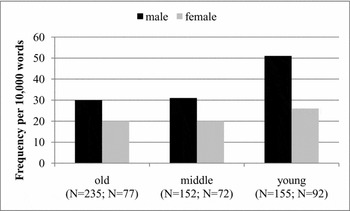
Figure 2 compares the normalized distribution of GEs across sex and age. Males in every age cohort, particularly the youngest, use GEs more frequently than females, and younger speakers as a whole use GEs more than older ones. In the absence of a significant increase in GE usage between the old and middle groups, higher rates of GE use by the young group are suggestive of an age-graded effect, which has been widely reported for other varieties, both in Britain and beyond (Tagliamonte & Denis Reference Tagliamonte and Denis2010; Denis MS).
Frequency of GEs per 10,000 words by age and sex

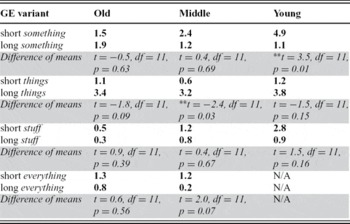
The formal distribution of GE variants in figure 1 above reveals that the more frequent variants in our data tend to be syntagmatically short. In order to examine whether this tendency is indicative of possible ongoing change associated with grammaticalization, we conducted paired-sample t-tests. These tests reveal whether differences in the mean frequency of short and long GE variants are statistically significant within each age group. Comparison of the results across age groups will then reveal whether there are changes in apparent time in the distribution of long versus short variants.Footnote 9Table 4 reveals that short something variants increase in apparent time, concomitant with a reduction in the use of long something variants. Only in the youngest age cohort, however, does the difference in syntagmatic length achieve statistical significance (see Denis MS for similar results). By contrast, variants containing generic things reveal no propensity to be short, as evidenced by the fact that long things variants are more common in each age cohort (see Cheshire Reference Cheshire2007 and Denis MS for similar results). No significant differences emerge for stuff variants, although short constructions are more common than longer ones, particularly in the youngest group. In the case of everything variants, short constructions are more frequent than long ones in the old and middle cohorts (young speakers are omitted due to sparse data), but the difference of means is not significant. Summarizing, with the possible exception of something variants, our analysis yields little evidence to suggest that long variants are gradually being supplanted by short variants (see Tagliamonte & Denis Reference Tagliamonte and Denis2010 for similar results).
Results of paired-sample t-tests for distribution of variants by syntagmatic length (bolded figures indicate frequency of variants per 10,000 words; N/A indicates insufficient data; ** indicates statistical significance)

We take these findings as a provisional indication that stability, rather than change, may be a key determinant of patterns of GE variability in our data. In order to substantiate this hypothesis, we next examine the underlying structure of surface patterns of GE variability. This structure emerges from detailed multivariate analyses of the social and linguistic factors conditioning variant choice when all factors are considered simultaneously.
4.2 Results of multivariate analyses
The highly skewed formal distribution of GEs in our data presents a particular challenge for statistical analysis. Only a small minority of GE variants occur frequently enough to permit viable multivariate analyses of individual variants. An analysis which focused exclusively on the proportionally most dominant variants would necessarily entail the neglect of a large portion of the variable context containing the bulk of the remaining variants. To circumvent this problem, we configure the data in such a way that allows us to conduct multivariate analyses of all variants, including frequent and infrequent ones. At least two reasons justify this approach. Firstly, it allows us to contextualize any potential changes instantiated by the most frequent GE variants in relation to the larger linguistic subsystem in which they are embedded (see Weinreich et al. Reference Weinreich, Labov, Herzog, Lehmann and Malkiel1968 on the ‘embedding problem’), a fortiori because change does not occur in a systemic vacuum (Traugott & Trousdale Reference Traugott, Trousdale, Traugott and Trousdale2010: 29). Secondly, it allows us to explore whether low-frequency GE variants may be just as susceptible to grammaticalization processes as frequent variants, as recently hypothesized by Hoffmann (Reference Hoffmann2005) and Brems (Reference Brems2007) with regard to other variables.
With these considerations in mind, we configure the ensuing multivariate analyses as follows. Table 5 focuses on the proportionally most dominant variant, and that. This variant is sufficiently frequent in the data to allow independent multivariate analyses to be conducted for each age group. This enables us to track any potential trajectories of change in apparent time. In table 6, we focus on the next most frequent variants in the data: or something and or whatever. As neither variant is quantitatively sufficient to conduct independent multivariate analyses for each age group, we examine these variants across all groups combined. While this configuration of the data does not afford an apparent-time window on the linguistic conditioning of variant selection, it does enable us to ascertain whether each variant is increasing or decreasing in apparent time when age is factored into the analysis as an independent variable. Table 7 presents the results of an apparent-time analysis of other frequent GE variants containing a generic referent. Because of the relatively low numbers of individual variants, these variants are analysed in the aggregate. Infrequent variants (N<20) are also treated as an aggregate, and the results of the apparent-time analysis are displayed in table 8. While aggregated sets of variants underpinning the analyses in tables 7 and 8 may obscure the behaviour of individual variants, comparison among the analyses presented in tables 5–8 validates each as an important means of building up a composite picture of patterns of variation and change in the BwE GE cohort.
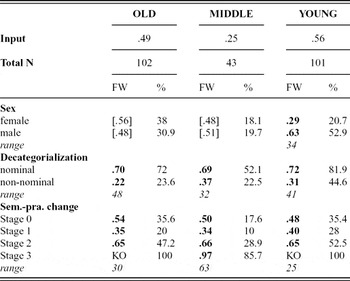
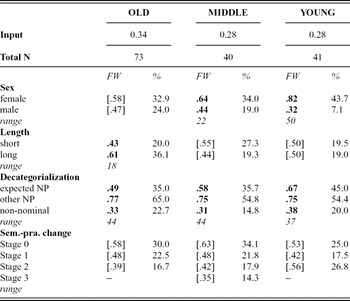
Three independent multivariate analyses of the contribution of factors to the probability of and that by age

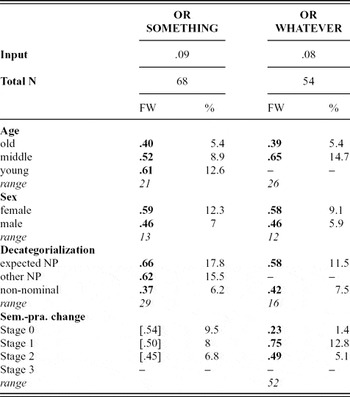
Multivariate analyses of the contribution of factors to the probability of or something and or whatever

Three independent multivariate analyses of the contribution of factors to the probability of other frequent variants by age (other frequent variants = and things like that, and stuff, or something like that, and everything, and things)

Three independent multivariate analyses of the contribution of factors to the probability of infrequent variants (N < 20) by age

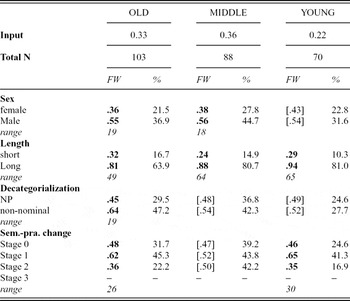
To model the variability in the data, and to identify the relative contribution to variant choice of the independent variables (also known as ‘factor groups’) described in section 3.2 (age, sex, syntagmatic length, decategorialization, semantic-pragmatic change), we make use of the stepwise multiple regression procedure in GoldVarb X (Sankoff et al. Reference Sankoff, Tagliamonte and Smith2005). We derive three lines of evidence from the multivariate analyses (Poplack & Tagliamonte Reference Poplack and Tagliamonte2001: 93–4): (i) the statistical significance of individual factors (at the 0.05 level); (ii) the range, which indicates the relative strength of factor groups included in the analysis; and (iii) the constraint hierarchy, which is the ordering of factor weights within a factor group offering a window on the grammar underlying the surface variability.Footnote 10 In each of the multivariate analyses shown in tables 5–8, the input value indicates the overall probability of variant occurrence. Factor weights indicate the likelihood of occurrence of variants in the contexts listed on the left-hand-side of the tables. Factor weights >.50 favour the selection of the variant (or aggregates of variants) in the environment in question; factor weights <.50 disfavour variant selection. KO indicates a KnockOut value, i.e. instances where GoldVarb cannot calculate factor weights because the variant is realized either 0 or 100 per cent of the time in a given context within a factor group. Factor weights enclosed in square brackets are non-significant. The range enables us to rank the magnitude of individual effects with respect to one another: the greater the range, the greater the effect of the factor group on variant choice. The em-rule indicates that a factor was not included in the analysis due to insufficient data. We make use of these numerical formalisms to (a) determine the relative contribution of social and linguistic factors to variant choice; and (b) ascertain whether systematic comparisons of variable structure across the age cohorts reveal any evidence of ongoing change implicating grammaticalization.
Table 5 presents the results for and that. The input values for the three age groups indicate that this variant is more frequent among older and particularly younger speakers than among speakers from the middle age group, a pattern we will return to in section 5 below. The effect of speaker sex appears to have been substantially reweighted in apparent time: we witness a mild but non-significant tendency for women to use and that more than men in the oldest group, but this effect is neutralized in the middle group. Only in the youngest cohort is sex a significant determinant of variant choice, with young males clearly favouring and that. The range values show that decategorialization is highly significant in all three age groups. The constraint hierarchies indicate stable patterns of variability in apparent time: and that is consistently favoured with nominals. The factor weights for semantic-pragmatic change in table 5 (as well as those in tables 6–8) suggest that the meaning of GEs cannot be reduced to a set-marking function (stage 0), routinely assumed in the literature to be the ‘core’ or primary function of GEs. On the contrary, multifunctionality is an intrinsic feature of the use of GEs in our data, as evidenced by their probability of occurrence with other stages of our functional taxonomy (see also tables 6–8). More specifically, the patterns in table 5 show that and that is consistently favoured by all three age groups as a marker encoding interpersonal/textual functions (stage 2), and is overwhelmingly favoured as a desemanticized punctor (stage 3). In fact, and that is the only variant that occurs at stage 3 in the old and young age groups, as indicated by the KO values. In sum, the constraint hierarchies for all linguistic factor groups contrast with those for social factor groups in remaining essentially stable in apparent time, vitiating any inference of ongoing grammaticalization for the most frequent GE variant in BwE.
Table 6 displays the results for or something and or whatever. The factor weights for age reveal that or something is increasingly favoured with decreasing age. By contrast, or whatever peaks in the middle group but recedes dramatically in the youngest group where it is almost non-existent. The two variants also differ with regard to semantic-pragmatic meaning: this factor group is not selected as significant for or something but contributes a strong effect on or whatever. Or whatever exhibits a greater propensity than or something to occur in contexts associated with set-marking and interpersonal/textual functions (stage 1). There are, however, also similarities in the patterning of the two variants: both are favoured by females and with nominal antecedents. While we cannot establish from these results whether the linguistic conditioning of or something and or whatever is changing in apparent time, the patterns revealed here demonstrate that the frequency of or something is increasing in apparent time, and that there is some degree of social and functional differentiation between the two variants.
Comparison across age of the input values for the aggregated set of other frequent variants in table 7 reveals that this group of variants occurs most often in the oldest cohort. Other frequent variants are consistently more likely to occur in female than male speech, and the effect of sex increases in apparent time. With regard to linguistic factors, the significant preference for long variants instantiated in the oldest group is reversed in the middle group (where the difference is non-significant), and is neutralized in the youngest group. Decategorialization makes a strong contribution in all three age groups (see the elevated range values): other frequent variants are consistently favoured with NPs, suggesting that they are not undergoing categorial shift. Finally, semantic-pragmatic change is not selected as significant for any age group. The constraint hierarchies are largely parallel across age, with the exception of the youngest speakers, where the most favouring factor is stage 2. As in the case of and that, the picture that emerges from the results for the aggregate of other frequent variants is one which depicts changes in apparent time in the social conditioning of variability but shows no changes in linguistic conditioning.
Turning finally to the infrequent variants, table 8 reveals a number of important similarities as well as contrasts with those shown in table 7. Judging from the input values, infrequent forms, when considered in the aggregate, are less likely to be used by the youngest cohort than the middle and older cohorts. Infrequent variants are consistently associated with males, although not significantly so with young speakers. In terms of linguistic conditioning, syntagmatic length makes the most significant contribution to the occurrence of infrequent variants: these are predominantly long in all three age groups. The results further reveal quantitative evidence of decategorialization. In the oldest group, infrequent variants are highly favoured in non-nominal contexts. However, the fact that this effect is non-significant in the middle group, and is all but neutralized in the young group, is inconsistent with what would be expected if gradual decategorialization were underway. Nor can the results for semantic-pragmatic change be construed as evidence of change in progress: constraint hierarchies are parallel across all age groups, with variants most likely to occur at stage 1. Once again, these patterns provide no evidence for ongoing linguistic change, but show clear evidence of ongoing social change in the GE cohort: older (male) speakers in this community use a broader inventory of GE variants than younger speakers.
Comparison of the results in tables 5–8 offers some insight into the relationship between frequency and patterns of variability in our data. The linguistic conditioning of variability differs quite markedly across frequent and infrequent variants, and furnishes little support for construing frequent variants as an analogical model for less frequent variants (see Hoffmann's (Reference Hoffmann2005: 195) recent claims on the interplay between frequency and analogy in grammaticalization).
5 Discussion
The apparent-time analyses presented in section 4 revealed substantive evidence of structured variability in GE usage in BwE. However, apparent-time comparisons of the constraint hierarchies for linguistic factors turned up no compelling evidence of grammaticalization in progress. Even in cases where differences in the significance and direction of linguistic effects obtain between age cohorts, the resultant patterns remain inconsistent with any inference of change in progress. With none of the multivariate analyses furnishing evidence of ongoing grammaticalization, it remains to be determined whether the synchronically stable patterns of GE variability in our data – and, for that matter, in other synchronic data sets (e.g. Tagliamonte & Denis Reference Tagliamonte and Denis2010) – are in fact the product of grammaticalization processes that may have been operative at an earlier stage of the language, predating the time-span in our corpus.
A number of arguments can be marshalled in favour of the hypothesis that stable synchronic patterns of GE variation preserve the effects of diachronic grammaticalization processes. As shown in section 4, all the linguistic measures specifically operationalized in our study to track grammaticalization revealed considerable variability in terms of the formal, morphosyntactic and functional properties of GEs. The patterning of individual GE variants along these linguistic measures is consonant with previous research which has shown that the various processes constituting grammaticalization may not unfold concurrently (Croft Reference Croft1990: 244), and that none of these processes, once initiated, necessarily has to go to completion (Traugott & Trousdale Reference Traugott, Trousdale, Traugott and Trousdale2010: 28). The net result of arrested sets of changes that have not evolved in synchrony may be a ‘ragged and incomplete subsystem that is not evidently moving in some identifiable direction’ (Hopper & Traugott Reference Traugott2003: 131). If we hypothesize that the stable linguistic conditioning of GE variants in our synchronic data is the reflex of such incomplete and asynchronous grammaticalization processes, then Hopper and Traugott's observation may explain how individual GE variants in our data came to be synchronically fossilized at different points along different grammaticalization clines. Consider, for example, and that, which is favoured in extended semantic-pragmatic contexts that are semantically bleached, yet disfavoured in extended morphosyntactic contexts following non-nominal referents.
Furthermore, inter-variant differences in the linguistic patterning of GEs across factor groups are consistent with previous research which has shown that different variants of a grammaticalizing construction do not ‘march . . . through the [grammaticalization] changes in lockstep’ (Bybee & Torres Cacoullos Reference Bybee, Cacoullos, Corrigan, Moravcsik, Ouali and Wheatley2009: 214). If we assume that the stable linguistic conditioning of GE variants in our synchronic data is the reflex of non-uniform grammaticalization processes, then Bybee & Torres Cacoullos's observation may explain why different GE variants, or different aggregates of variants, pattern differently across independent linguistic variables. Consider, for example, or something and or whatever: in the community as a whole, the former is weakly preferred in stage 0 of our functional taxonomy, while the latter is strongly disfavoured in this environment.
While stable patterns of GE variability may in theory be compatible with a grammaticalization scenario, such a scenario awaits confirmation from diachronic analyses. Without an appropriate real-time benchmark, reconstruction of the diachronic transitions that have given rise to contemporary patterns of GE variability, as well as inferences that these patterns are the result of change, must remain speculative. We foreground this point because a number of recent studies (e.g. Cheshire Reference Cheshire2007; Tagliamonte & Denis Reference Tagliamonte and Denis2010) have paid insufficient attention to key methodological requirements for ratifying the existence and directionality of change, and uncritically assumed that synchronic patterns of GE variation can provide a window on their evolution.
A crucial step in the empirical establishment of change involves discriminating authentic changes from cases of inherent variability. As Poplack & Levey (Reference Poplack, Levey, Auer and Schmidt2010) point out, because variation is a precondition for change, but does not necessarily equate with change in and of itself (see also Weinreich et al. Reference Weinreich, Labov, Herzog, Lehmann and Malkiel1968: 188), variation may easily be mistaken for change. A good illustration of this point can be found in patterns of variation which persist for considerable lengths of time without being actively engaged in any known trajectory of change: synchronically productive variables such as (t/d)-deletion and (ing) are two well-known cases of stable variability that are deeply rooted in the history of the English language (Romaine Reference Romaine1985). Without diachronic evidence, we cannot rule out the possibility that variation in GEs represents a similar case of longstanding variability. Another issue to be considered is that even if we assume that contemporary patterns of GE variation are ultimately the result of a sequence of changes associated with grammaticalization (or even changes independent of grammaticalization), any changes may have unfolded centuries ago. If this is the case, then the temporal span included in conventional apparent-time analyses will be inadequate to identify and chart the full progression of such changes, which are typically slow and protracted (Lichtenberk Reference Lichtenberk1991: 195; Heine Reference Heine, Wischer and Diewald2002: 95).
The caveats discussed above, while not sufficient to refute the grammaticalization hypothesis, certainly suggest a critical reassessment. For example, Tagliamonte & Denis's (Reference Tagliamonte and Denis2010: 362) recent suggestion that cross-dialectal differences in patterns of GE variability ‘may reflect different degrees of grammaticalization or even different grammaticalization paths’ must be interpreted cautiously when the historical record is not available to elucidate the evolution of GEs. Joseph (Reference Joseph, Fischer, Norde and Perridon2004: 60) counsels against reconstructing grammaticalization pathways using synchronic data when the ‘range of details of the development and unfolding of a form through time’ is incomplete or unknown. This problem needs to be addressed in future research: suitable diachronic data need to be located to track the historical evolution of GEs.
In stark contrast to the stability uncovered in the linguistic conditioning of GE variants, our analysis revealed strong evidence of instability in the social conditioning of variant choice. The results indicate that GEs are prime candidates for the marking of social differentiation. Because GEs in our data reveal no compelling evidence of ongoing grammaticalization, increased rates of use by the young (male) speakers in the sample cannot be interpreted unequivocally as a change in progress but may instead be indicative of age-grading (Dubois Reference Dubois1992). Of particular interest with regard to age-differentiated patterns are the input values for and that (see table 5 above), which show striking resemblance to Downes's (Reference Downes1998: 224) U-curve distribution: in contrast to speakers from the middle age group, speakers from the old and young age groups share similarly elevated frequency rates for this variant. This pattern may be suggestive of speakers retreating from the use of and that as they enter the marché linguistique (Bourdieu & Boltanski Reference Bourdieu and Boltanski1975) before picking it up again as they grow older. Whether this behaviour is motivated by the increasing association in this community of and that with a male working-class sociolect awaits further investigation.
Our analysis also revealed dramatic changes in the frequency of individual GE variants in contemporary BwE (e.g. or whatever rapidly decreases between the middle and young age groups; and stuff sharply increases in the youngest group; things variants decline across age). These patterns mirror those reported elsewhere (Tagliamonte & Denis Reference Tagliamonte and Denis2010; Denis MS), and support Labov's (Reference Labov, Lehmann and Malkiel1982: 76) observation that scholars need to look beyond the linguistic conditioning to the social embedding of language in order to fully understand the renewal of individual variants. While social and internal changes in discourse frequently tend to operate in unison (e.g. Tagliamonte & D'Arcy Reference Tagliamonte and D'Arcy2007; Tagliamonte Reference Tagliamonte2008), the results presented here suggest that – with some discourse variables at least – social changes in variant choice may occur despite stable linguistic conditioning.
6 Conclusion
Our study of GEs in a peripheral variety of northeast England has extended the geographical focus of variationist research on GEs in British English. Our findings broadly resemble those obtained by Cheshire (Reference Cheshire2007), Tagliamonte & Denis (Reference Tagliamonte and Denis2010), Denis (MS) and Levey (MS) for mainstream British and Canadian English varieties with regard to the highly differentiated nature of the variable context; the propensity for individual variants to wax and wane in apparent time; and the recruitment of specific variants to mark social differences. In addition, the inclusion in our analysis of an apparent-time component has offered an important check on Cheshire's (Reference Cheshire2007) foundational claims that GEs are grammaticalizing in contemporary British English. Our rigorous quantitative analysis did not uncover any systematic incremental patterns in apparent time that would enable us to confirm Cheshire's (Reference Cheshire2007) hypotheses and characterize variability in terms of ongoing grammaticalization. As we have indicated above, these findings have important analytical and methodological ramifications for the interpretation of recent work on GE variability as well as the design of future studies of GEs and discourse variables more generally.
A much-needed extension to current variationist work on GEs is the incorporation of a real-time component to increase the time-depth of data analysed. The exploration of diachronic surrogates of oral data may enable us to ascertain the extent to which GEs have been implicated in change, and to determine the role of grammaticalization in any trajectories of change uncovered. The social embedding of GE variability, which is subject to rapid changes within a compressed time frame (see also Tagliamonte & Denis Reference Tagliamonte and Denis2010), is an additional key area for further investigation both within and across varieties. Close inspection of the social constraints on variant choice in BwE indicates that and that may be in the process of becoming the default variant among young (male) speakers. Future research will show whether the variant and stuff, which is increasing to varying degrees in our peripheral variety and Cheshire's (Reference Cheshire2007) and Denis's (MS) mainstream varieties, will become a serious contender among the youngest generation.
Crucial to elucidating patterns of GE variation and change in synchronic and diachronic data sets is the development of an empirically accountable analytical framework which caters for GEs’ extensive formal variability as well as their inherent multifunctionality. In this article, we built on Cheshire's (Reference Cheshire2007) foundational framework for studying GEs in several pivotal ways. Firstly, our operationalization of syntagmatic length in terms of the variation between morphologically ‘heavier’ and morphologically ‘lighter’ variants allowed us to side-step the problems associated with conceptualizing this measure of grammaticalization in terms of diachronically unsubstantiated phonetic reduction processes. Secondly, our elaboration of a replicable taxonomy for assessing the functional properties of GEs enabled us to systematically investigate semantic-pragmatic change in apparent time, and corroborated the importance of function in accounting for GE variability and discourse-pragmatic variability more generally. Finally, we departed from previous investigations of GEs which have tended to privilege the most productive GE variants at the expense of less frequent ones which often constitute the bulk of the data. Our inclusion of the entire set of GE variants in the variable context enabled us to probe previously uninvestigated differences in the patterning of high- and low-frequency variants. Further cross-varietal research, judiciously informed by a diachronic perspective, will allow scholars to resolve some of the outstanding issues we have raised in connection with the role (if any) of grammaticalization in patterns of variation and change in GEs.
Full inventory of adjunctive GE variants

Full inventory of disjunctive GE variants

Full inventory of GE variants without connectors