‘Imperial and naval history’ is an idiosyncratic couplet. Its complex relation to world history charts curious twists and turns in twentieth-century historiography. The first Vere Harmsworth professor, John Holland Rose, presented his inaugural – ‘Naval History and National History’ – on Trafalgar Day, 1919. Well might he do so, since the chair was originally dedicated solely to naval history.Footnote 1 Prompted by the Royal Empire Society, ‘imperial’ was only added in 1932, and was in place for the election of Admiral Sir Herbert Richmond. And yet Richmond reverted to naval history even more strongly than Rose. Historicizing and contextualizing his own profession, he presented ‘Naval History and the Citizen’ as his inaugural in 1934.Footnote 2 Since then, the study of imperial history has dominated the work of successive Vere Harmsworth chairs, with land-history and sea-history receding and advancing, like the tides: Walker's South African frontier; Rich's Hudson's Bay Company; Gallagher's imperialism of free trade; Fieldhouse's decolonization. And in recent years, under the watch of the late Professor Sir Christopher Bayly, Cambridge's ‘imperial’ history emphatically shifted to nominate the extra-European world.
If ‘imperial’ has become ‘world’, so ‘naval’ might well become ‘oceanic’ history for the twenty-first century. This shift captures pressing conversations that link maritime history, world history, and environmental history. Indeed, historians of oceans characteristically stake a claim on world history, for better or worse. Felipe Fernandez-Armesto boldly states that the ocean ‘is the supreme arena of the events that constitute global history…maritime history is world history’.Footnote 3 Amélia Polónia argues similarly that maritime history is not just a ‘gateway to global history’, but that ‘world history requires maritime history as a research field in order to understand global dynamics’.Footnote 4 And thus, one model of world history comes to be told from and through the sea, through ‘aquacentric systems’.Footnote 5 We might think, for example, of Philip de Souza's Seafaring and civilization, or Lincoln Paine's Sea and civilization, also billed as maritime histories of the world.Footnote 6 Such claims unfold from maritime history's characteristically large temporal and geographic scale and scope, not least after Fernand Braudel's work. Accordingly, these studies sit somewhere between the Braudelian deployment of ‘civilization’ and North American scholarly inclinations towards tracking apparently progressive ‘civilizations’ as the foundational world history narrative.Footnote 7 There has been a slide from the maritime ‘worlds’ of Braudel's Mediterranean to the maritime ‘world’ of global history.Footnote 8 Far closer to the Cambridge tradition of world history-writing, in which ‘world’ primarily signals an extra-European domain, a generation of Indian Ocean scholars have neatly overturned the dominance of a Mediterranean ‘cradle of civilization’ by comprehending their region as the ‘cradle of globalization’.Footnote 9 And from a different scholarly tradition again – via early twentieth-century geopolitics – Carl Schmitt wrote Land und Meer; what he called a ‘world-historical meditation’ that turned on the relationship between humans, land, and sea.Footnote 10 Much of world history, then, has been navigated through oceans, to use Patrick Manning's nautical term.Footnote 11
In this inaugural lecture, I collapse the enduring couplets – land and sea, earth and ocean, imperial and naval – into a new historiographical and conceptual formation, ‘terraqueous history’. The term terraqueous serves world historians well in several ways. It comes to us directly from the history of globes, a reminder of the genealogy of ‘global’ history. In that context, ‘terraqueous’ had an expansive early modern meaning, signalling not just land and sea, but the transforming matter that constantly connected them: atmospheres, vapours, airs, and waters. This is useful for current historical conversation that has a renewed interest in the relationship between climates and humans in the past. The compound construction of ‘terraqueous’ serves neatly to foreground the meeting of land and sea that has engaged so many historians of different periods and places, substantively, symbolically, and epistemologically: coastlines, beaches, islands, ships. These geographies are good to think with as well as about,Footnote 12 and in this spirit, I shall set out briefly my own current terraqueous meeting place of choice: the quarantine island. A global archipelago of quarantine islands concentrates many of the great developments of world history, including the emergence of states, over the long modern period. Quarantine islands are intriguing objects of inquiry, but they also serve as a kind of method for the comprehension of globalization (and counterforces to globalization) that for centuries took terraqueous form.
I
What has been the scholarly conversation about history and the sea, since the first Vere Harmsworth professor discoursed on navy and nation in 1919? His own period and progress is to the point. Rose's valedictory lecture was far more interesting than his inaugural, and more expansive. Man and the sea: stages in maritime and human progress was published as a book in 1935. Now a fascinating period piece, it captures an early moment when geography and history were in strong conversation; Lucien Febvre's Geographical introduction to history, for example.Footnote 13 Rose's book, including its subtitle, ‘stages in maritime and human progress’, would appear to be Annales-derived, even Braudelian. Yet Man and the sea anticipated Braudel's work on the Mediterranean (in fact, the Cambridge professor had just completed The Mediterranean in the ancient world in 1933).Footnote 14 A relentless focus on Annales as an origin-point for oceanic and environmental historiography can deflect our attention from the fact that geographical history and historical geography was one of the great scholarly trends of the period, across French, German, English, American, Japanese, and Indian scholarship alike. It is thus more accurate, more useful, and more interesting to comprehend Rose's focus on the sea, as well as his structuring ideas about long and successive stages of social and political progress, as characteristic of the interwar period's wider interest in the relationship between earth, water, and human history.
Ocean-oriented world historians, like environmental historians, are disinclined to recognize the ‘geopolitical’ provenance of their own field. Yet one tradition of maritime historical geography lay with geostrategists: Mahan, Mackinder, and the German geopolitiker. Crude as their debates about land power/sea power were (and I would include Carl Schmitt's Land und Meer), this geopolitical scholarship opened all seas and oceans to imperative historical analysis. In studies such as Karl Haushofer's Geopolitik des pazifischen Ozeans (1925), environment, human history, and power were conceptualized as distinctly maritime phenomena.Footnote 15 He looked to oceans, winds, weather, and currents as history-determining phenomena, and filled his book with meteorological charts of the Pacific Ocean. For Haushofer, as for Rose, oceanography and meteorology were geography, all shaping history.
Rose's Man and the sea opened with a set of Mediterranean chapters, including a musing on roving Odysseus and the possibility that the Phoenicians circumnavigated Africa.Footnote 16 But Rose was, in truth, a modern British and French historian, and this made him an historian of the Pacific as well, tracking Cook, Bougainville, La Pérouse, and their encounters with Polynesian navigators and Melanesian traders. Trying to understand ‘Early Man in the Pacific’, he borrowed ‘argonauts of the western Pacific’ from his contemporary Malinowski, another conflation of referents from the Mediterranean and Oceania.Footnote 17 Far larger in geographic scope than anything emerging from the Annales School, events in and around the Pacific, the Atlantic, and the Mediterranean constituted Rose's ‘stages in maritime and human progress’. He was, in other words, already writing a version of world history from the oceans.
The Indian Ocean was the one region that Rose did not consider. Yet it has proven critical to formations of world history, as well as world historiography. One provenance of Indian Ocean scholarship lies in the extension, but also subversion, of ‘civilizational’ world history, of which Man and the sea and Braudel's Mediterranean and the Mediterranean Sea are both early exemplars. Chaudhuri's Trade and civilisation in the Indian Ocean (1985) displaced European maritime expansion as the main story, arguing that early trade from the South China Sea to the Eastern Mediterranean constituted ‘the First World of human societies’.Footnote 18 Since then, ‘Indian Ocean World History’ has become a research and teaching staple, sliding with telling ease between ‘history of the Indian Ocean world’, the ‘Indian Ocean in world history’, and even ‘the Indian Ocean as world history’.Footnote 19 Throughout, it has been the shoreline connections that have mattered and that have upscaled this regional history into a key site of, and for, world history: the terraqueous lives of merchants, fishers, traders, pilgrims, migrants.
Sugata Bose's A hundred horizons: the Indian Ocean in an age of global empire has been key to the field, inspired in part by then new Atlantic histories.Footnote 20 In the context of delivering the Vere Harsmworth inaugural lecture, it is profitable to recall that Bose's chair at Harvard is the Gardiner Chair of Oceanic History and Affairs. This is not incidental. We can track twentieth-century political and scholarly trajectories in the intellectual and institutional spaces of these named chairs. Indeed, a traditional geopolitical idea about sea power underwrote the funding and founding of both professorships after two world wars, respectively in 1919 and 1948. The University of Cambridge's chair was in ‘naval history’, and as we have seen, Rose dutifully wrote on the geopolitical staple ‘Sea Power v. Land Power’.Footnote 21 Harvard's chair was endowed, more interestingly, as ‘oceanic’ from its inception. Its Cold War foundation (1948) was in honour of a president of the United States Navy League and foreign policy consultant to Roosevelt. Yet both chairs have since proven terraqueous. They morphed, amphibiously, from the sea: first onto land as histories of empires, then towards South Asian and Indian history, and now, it turns out, back to oceanic history, but of a twenty-first century kind.
The historiographical connections between old-style geopolitical and maritime histories like Man and the sea, traditional area studies, and extra-European world history are more interesting to press than to dismiss. One version of oceanic history (studies of the Indian Ocean) is an unexpected outcome of area studies grafted onto colonial and post-colonial scholarship. At the same time, it is ‘area studies’, ironically, that has sometimes liberated world histories from a dominating narrative of European imperial expansion and colonial encounter.Footnote 22 All along, oceanic histories have demonstrated and inspired what later came to be called ‘transnational history’. Connections and flows are perhaps more readily identifiable across water than across land, easily, one might even say naturally, displacing national geographies. The Atlantic, the Pacific, the Indian and the Southern oceans all do ‘connecting’ work, historically and historiographically.Footnote 23 Accordingly, oceans have become a kind of method, as well as substantive objects of inquiry in themselves. A recent issue of History Compass considers Indian Ocean worlds as method, for example, showing how a transregional and transnational approach is almost required when considering the history of this part of the world.Footnote 24 So, too, have cognate disciplines. ‘Oceanic Studies’ is placed in the theories and methodologies section of a recent issue of the Proceedings of the Modern Languages Association, for example. It includes the work of scholars who in Cambridge rubric are world historians: the Hawaiian scholar Noelani Arista, South African Isabel Hofmeyr who gave us Gandhi's printing press, and Africanist Gaurav Desai who gave us the descriptor and concept, Afrasia.Footnote 25
Historical geographers are also busy with ‘post-terrestrial’ area studies.Footnote 26 Extending Wallerstein's ‘world system’, geographer Philip Steinberg has argued that the seas are ‘a special space, within world-society but outside the territorial states that comprised its paradigmatic spatial structure’.Footnote 27 Each phase of capitalism, he suggests, had a particular spatiality on land, and a complementary spatiality at sea. Industrial capitalism, for instance, has a special interest in an empty ‘deep sea’ – the non-territory of free trade. Troubling the distinction between national ‘land’ histories and international ‘sea’ histories, his Social construction of the ocean tracks territoriality in, around, under, and on the sea: the possibilities of possession, the freedom of the seas in the deep ocean, and control of sea in coastal waters. Steinberg has thus comprehended oceans within the history of global political economy, insisting that conventional models are not aquatic enough.Footnote 28 Indeed, minor battles proceed over just how watery or territorial maritime history or oceanic history is, can, or should be. The Indian Ocean historian Michael Pearson has suggested we proceed with ‘amphibious history’ and with ‘littoral history’.Footnote 29 I suggest that ‘terraqueous history’ is an improvement.
II
‘Terraqueous’ serves world historians well for at least three reasons. First, the term usefully recalls historical scholarship on the provenance of the globe in global history. Originally, a ‘globe’ was not the world; it was just a shape. It did not signify the Earth, but rather those small artificial spherical bodies that represented the Earth.Footnote 30 Terraqueous or terrestrial globes displaying oceans and continents were distinct from celestial globes that represented the heavens. In Christian and Islamic, as well as Ming and Qing versions, celestial globes were a sphere that surrounded another sphere, the Earth, and thus celestial globes were charts of the heavenly bodies observed from a position beyond those fixed stars.Footnote 31 The most frequent use of the term ‘terraqueous’ is thus to be found in seventeenth- and eighteenth-century descriptions of globes crafted across Christendom, Persia, and India.Footnote 32 For Mughal rulers and their European counterparts, terraqueous globes themselves, and possibly more importantly the representational conceit of the ruler holding a terraqueous globe, mapped and declared authority and sovereignty over worldly regions and peoples.Footnote 33
The early modern meaning of ‘terraqueous’ was expansive in terms of the description and comprehension of matter and processes. In its original usage in Anglophone texts, terraqueous matter could and did include ‘atmosphere, mass of air, vapours, and clouds’.Footnote 34 The exchange of waters was in grand balance, dependent on the area of both land and sea. Physician and geologist John Woodward, for example, asserted that the same quantity of water returned back in rain ‘to the whole terraqueous Globe, as was exhaled from it in Vapours’.Footnote 35 And as the natural theologian William Derham put it, earth and waters were in terraqueous equipoise, ‘the northern balanceth the southern ocean, the Atlantick the Pacifick sea. The American dry land is a counterpoise to the European, Asiatick and African.’Footnote 36 The earthly and aquatic properties of the globe were not fixed and irreducible matter. Rather, airs, waters, and places transferred and transmuted. Ebenezer Gilchrist's 1757 work on The use of sea voyages in medicine set out the ‘great quantity of vapour’ that arises from the vast seas that cover at least half of the globe. ‘From the whole terraqueous globe there are constantly arising in steams, more or less perceptible, innumerable particles of matter; being part of all bodies that earth and water contain.’Footnote 37 Eighteenth-century studies of the physical distribution of land and sea shifted from an emphasis on location to a new physical geography of climate and climates.Footnote 38
As Roy Porter noted in 1980, ‘the dialectic of land and sea formed the central conundrum of eighteenth-century theories of the earth’.Footnote 39 He considered this dialectic to have been neglected by historians, who instead analysed global geography through distinct twentieth-century fields: glaciology, sedimentology, meteorology, or oceanography.Footnote 40 This separation of expertise no longer holds, however. Twentieth-first-century scholarship has leapt beyond late modern divisions, or else reversed and reverted to an early modern understanding of the Earth as a terraqueous whole. Geologists, geographers, and historians are talking together now in ways, and to an extent, of which Porter could only have dreamt. In particular, scholarship on climates and constitutions has been energized by discussion of a new geological era, the Anthropocene, which is natural, political, economic, scientific, and ecological in equal measure.Footnote 41 In this new vocabulary, human impact on atmospheres, hydrospheres, biospheres, and geospheres together constitute the terraqueous globe under the heavens. This is terraqueous history of human interaction with mutually constituting land, water, and air, even if that land is increasingly made of plastic, the water increasingly filled with oils, and the air warmer than it used to be. The old atmospheric significance of ‘terraqueous’ should be resurrected and returned, precisely because the business of key world historians is now humans, climate, capital, and periodization.Footnote 42
The second major conceptual benefit of ‘terraqueous’ history for oceanic historians lies, paradoxically, in ‘terra’. This seemingly soil-bound signifier foregrounds in ocean and maritime studies the history of aquatic space as claimable territory: terra not as a matter of land, but as definable and bounded space that might be possessed, like land, for better or worse. Coastal waters, contiguous zones, territorial seas, fishing zones, continental shelves are all legal geographies made out of terraqueous histories. This is the history, for instance, of the twelve nautical miles of an exclusive economic zone that gives coastal nation-states rights to all living and non-living resources within it.Footnote 43 The history of the law of the sea is clearly important here, the long history of mare liberum and its exception, mare clausum. Disputes and agreements over freedoms in coastal waters and across some oceans constitute a major problem that sits at the intersection of global history (of trade and the movement of goods and people across and around seas and oceans), international history (of the invention and assertion of mare liberum and mare clausum), and imperial history (of the assertion of alien maritime rights of navigation or trade monopolies, over local customs, either of freedom or alternative possession).Footnote 44
A world history approach, not just an intellectual or international history approach, is critical to comprehend fully non-European systems, to appreciate entirely different, even incommensurable epistemologies and ontologies of what constitutes sea, land, territory, usage, possession, and dominion. In some regions, recognition of the seas as open was more or less customary; for maritime traders between Gujarat and ports in the Red Sea, for example, and between India and the Malay world. In other regions, ownership over, or the assertion of, fishing rights within coastal seas was more common. In a fuller sense, then, ‘terraqueous’ signals the long history of claims over tidal and coastal zones by societies whose polity is not necessarily coterminous with land. Domestic territory – home – can be aquatic, and water spaces have been, and continue to be, territorialized: many ocean-spaces of Micronesia, for example, or for the Sama-Bajau people of maritime south-east Asia. Historians need to recognize and analyse this difference not least because the law itself so often has. In many coastal zones of the world the law of the sea meets ‘land rights’ every day. This is so in the Torres Strait, for instance, where all history is terraqueous. In such regions, concepts of ‘archipelagic waters’ and ‘sea country’ are in intriguing historical, legal, and inter-cultural conversation.Footnote 45
Third, ‘terraqueous’ is conceptually useful because its compound construction signals meeting places between land and sea, sites that have engaged, and even enchanted many maritime and oceanic historians. It helps us conceptualize the lives of fisherfolk, mariners, coastal dwellers. In short, all littoral societies can be usefully defined as terraqueous.Footnote 46 And the compounded meeting place ‘terrraqueous’ brings scholarship on frontiers and borderlands to a different kind of historical and conceptual edge.
Lincoln Paine invites us to consider the question ‘what is maritime history’ by considering its unasked twin ‘what is terrestrial history’?Footnote 47 Yet the pressing point for human history is surely where land and sea meet, on the one hand as islands,Footnote 48 on another as coasts.Footnote 49 A history of world coastlines inhabits just such a terraqueous meeting place, without naming it. In his recently published The human shore: seacoasts in history, John Gillis suggests that large-scale, deep-time human history should be told and comprehended from the shoreline; that land-based origin stories, including gardens of Eden, should really be coastal stories. Interiors are not origins, shores are, he argues: homo sapiens is an edge species. In yet another grand claim linking world history and oceans, Gillis expresses surprise: in writing a history of seacoasts, he found himself in fact ‘writing an alternative account of global history’.Footnote 50 While the poetics of shorefolk and coastal edges is what energizes some historians, it is the political history of coasts that interests me most. These zones need historicizing as terraqueous because of their contested territorial character, and because of their colonial and post-colonial histories.Footnote 51
A terraqueous meeting place of a different order is, of course, the ship. Vessels and the humans who inhabit them turn oceanic history into maritime history, and the social history of seafarers has constituted one important line of inquiry, in the tradition of Marcus Rediker's Between the devil and the deep blue sea, or, from an economic history corpus in Gopalan Balachandran's Globalizing labour? Indian seafarers and world shipping.Footnote 52 Vessels in oceans have long been assessed as floating islands and, more pressingly, as floating states.Footnote 53 They have served as distilled and sometimes experimental sites for governance, punishment, and alternative rules of conduct. The great interest in mutiny and piracy is in large part about tracking and analysing the counter-states that occasionally arise on ships. Thus, Rediker's book progressed structurally and conceptually from ports to pirates, from state-regulated harbours towards a ‘self-sufficient maritime society that rejected terrestrial laws and customs’.Footnote 54 In that tradition, ships have been ‘other places’, functioning on alternative codes, classic heterotopias.Footnote 55
The history of ships and of beaches are closely connected. Yet far from functioning as a floating state, or alternative state, the historiographical beach has been analysed as a place of pure human encounter. Greg Dening's Beach crossings: voyaging across times, cultures and self recounts such meetings in the pre-eminent terraqueous zone, Oceania. This history is crowded with beach-sited stand-offs, cross-cultural handshakes, commodity exchanges, violent encounters, somatic communication, and misunderstandings. Eighteenth-century Pacific beaches were landscapes where radically different cultures were encountered, but also where histories met; that is to say, where different conceptions of time abruptly came up against one another. Cultures in which before and after are indistinct encountered cultures of linear time and progressive history.Footnote 56 There is a certain Pacific historical sensibility that scrambles historical time. This is something that J. G. A. Pocock noted when reflecting on, as he put it, ‘what it is to write history from New Zealand’, the ‘antipodean perception’ essay that opened his collection, tellingly titled The discovery of islands. Footnote 57
Scholars based in Atlantic and Mediterranean traditions frequently claim that Pacific history was a latecomer to oceanic conversations, that it has been minimally treated, or sometimes barely formulated.Footnote 58 In truth, this only appears to be so from a North Atlantic perspective and with a failed literature review. In other words, long-standing scholarship on the Pacific (already evident even in Rose's Man and the sea) is oftentimes simply not read.Footnote 59 There is an important terraqueous history here, however, especially since insular and coastal geographies have long governed the entire Pacific studies field: the indigenous ‘sea of islands’ and the geo-economic ‘rim’. Oceania is the only region nominated not just as a particular ocean, but as ocean itself.Footnote 60
If coastlines (especially the Pacific Rim), islands, and ships are different kinds of terraqueous meeting sites, occasionally they can be analysed as one assemblage. I am currently engaged in the historical study of a particular insular geography, a precise terraqueous ‘scape’: the quarantine station. Characteristically located on small islands close to major coastal port-towns, the practice of quarantine involved the creation of hygienic borders in terraqueous zones. On beaches and jetties, in ships and unmoving hulks, in coastal architectures for disinfection and separation, ‘quarantine’ has long been performed as both a geographic and a temporal state, place and time prophylactically suspended.
III
A global archipelago of quarantine islands came to connect the world's oceans from the Mediterranean to the South Pacific, from Atlantic coasts to the Red Sea. A common pattern of activity, architecture, and authority emerged and converged. In ways sometimes quotidian, sometimes dramatic, ships were detained, goods were fumigated or destroyed, travellers, immigrants, traders, and pilgrims were processed, inspected, and treated. Human lives were lost and saved, animals escaped or were killed. Accordingly, commerce was both interrupted and permitted, contagion was both contained and spread, borders were both created and crossed. Many of the great trends of modern world history were concentrated in these tiny spaces, as states experimented with authority over commercial bodies seeking to keep goods in circulation; as individuals experimented with the idea of ‘liberty’ over states seeking compulsorily to detain them; as nations asserted newfound sovereignty at their maritime edges; and as experimental international orders were imagined and then tested.
The English prison reformer John Howard wrote an Account of the principal lazarettos of Europe in the pivotal year 1789, yet there is room for an account of the principal lazarettos of the world.Footnote 61 Such a global carceral archipelago reveals a terraqueous past that brings oceans together, that links eastern and western, northern and southern hemispheres, and that thereby connects old world and new world histories.Footnote 62 This is one way of analysing the Mediterranean, the Red Sea, the Atlantic, Pacific, and Indian Oceans within one project, as surely as the shipping lines themselves navigated from one body of water to another. It is a way, in fact, of historicizing what oceanographers call the world ocean.
Quarantine islands were curious terraqueous meeting places of ship and shore. Indeed, they were often ships on land, architecturally speaking. Their design deliberately mirrored the spatial organization of a vessel, separating out first- and steerage-class accommodation. Indeed, given that not a few quarantine stations were artificial islands, they were as constructed as vessels themselves: the stunning early eighteenth-century pentagonal structure in Ancona, for example, or the quarantine islands in New York Harbour, constructed in the 1870s. Terraqueous miracles, their engineers, architects, and labourers turned water into land. Conversely, ships sometimes functioned as quarantine stations; stationary islands, anchored off port, or as permanent hulks. On occasion, ships were themselves floating quarantine islands. In the Suez Canal, as Valeska Huber has explained, a system of strictly isolating steamers through the Red Sea passage sometimes substituted for time and space on a designated quarantine station.Footnote 63 In terms of trade and perishable commodities, it was preferable to isolate the ship while moving it through waters, than suspend it in time and space moored to a quarantine island. Put another way it was more time-efficient to turn the vessel into a mobile quarantine station than move people onto a stationary one.
If ships were sometimes floating quarantine islands, they were equally, on occasion, floating plague towns. One of the key differences between early modern Mediterranean quarantine and later quarantine practices in other oceans is that plague ships could be and were turned away from Mediterranean ports, even those with substantial quarantine facilities. They were moved on to somewhere else, anywhere else. In Pacific and Atlantic quarantine, by contrast, these were the very ships for which quarantine islands were created. Far from turning the vessel away, quarantine was imperative and would be insisted upon. In any of these arrangements, maritime quarantine was a purposeful rearrangement of space and time, in which terra firma was segregated by aqua.
I am interested in the methodological prospects that quarantine islands hold for terraqueous history. These tiny insular sites are intriguing distillations of their geographical inverse: the terraqueous world. They connect scales of historical activity from local to global. Historians often find ‘scale’ extremely rich conceptually, but in practice sometimes struggle to locate adequate sites that legitimately connect local, regional, national, and global dynamics.Footnote 64 And this makes comparison difficult too. As Roy Bin Wong has recently explained, sites and practices are rarely legitimately comparable, especially across long periods: ‘spatial units are not easily matched to each other’. Indeed, he goes so far as to question whether ‘our expectation for precise spatial units is in fact reasonable’.Footnote 65 Yet quarantine islands serve as intriguing constants for global and longue durée comparison. Their rationale and function was broadly common across eras and across regions. They sustained architectures, aspirations, rituals, and practices that remained recognizable over centuries; curiously so, given the great changes in technologies, perceptions of disease, scales, and forms of international governance, and patterns of human movement and maritime commercial exchange over the long modern period. Spatially contained, and therefore methodologically self-contained, quarantine islands serve as the constant that keeps longue durée and global comparisons in hand. This is a global archipelago of very local spaces whose insular logic and purpose only ever made sense in a multi-regional, multi-sea, polycentric network of maritime trade and movement. The quarantine archipelago thus holds a genuinely ‘translocal’ history.Footnote 66 As such, I suggest that they are unique portals into the history of maritime globalization, and its state-inspired counterforces.
Maritime quarantine yields a material culture with a terraqueous history, inviting historians to analyse artefacts, objects, landscapes, seascapes, and non-traditional sources to understand the past.Footnote 67 Because quarantine was about goods, as well as humans and animals, quarantine islands yield a particularly strong history of commodities and their day-to-day management. The tradition of writing world histories through commodities is a rich one: cotton, salt, cod, furs, pearls have each been used as a way into connected histories and global histories of capitalism. The history of quarantine is one in which all of these and more were vehicles of contagion, as well as objects of value to be traded. Yet there is one object that operated in an alternative economy of value and exchange: the paper on which letters circulated. Contagion, touch, and communication have deeply connected cultural histories, in ways that are quite apparent. And yet I am equally interested in an elaborate technical history in a maritime world that subjected paper and velum to terraqueous treatments. In the common practice of disinfecting mail, letters were punched or slit, the smoke or chemical entering and neutralizing agents of disease, however comprehended. Medical officers put letters into watertight jars, casting them far and deep, as physicians in Fiji's quarantine station in the 1880s were instructed, for example.Footnote 68 The sea itself rendered contagious matter inert, or so it was long thought. A therapeutic rendition of letters in bottles; for our purposes this was a late modern enactment of antique concepts of disease and matter. This is why fumigating and disinfecting mail remained part of quarantine practice well into the twentieth century.Footnote 69 Humoural ‘airs, waters and places’ endured as explanatory rules of contagion, morphing into germ theories, not in the least displaced by them, as is so often supposed.Footnote 70 Herein lies one application of an expansive early modern meaning of ‘terraqueous’, one that pays attention to properties of atmospheres, winds, vapours, and clouds.
Another instance of the local and global folding together as material terraqueous history lies in the tradition of graffiti on quarantine islands. Quarantine was time as well as space; a place of suspension and of waiting, in which people often passed time making marks in walls, cliffs, rocks. The record of carceral graffiti and memorialization on quarantine islands is extensive, from Renaissance Venetian islands to Angel Island, San Francisco, where aspiring Chinese immigrants left thousands of poems and messages in the late nineteenth and early twentieth centuries. On Malta's Manoel Island, too, ships, names, dates, travellers are recorded in the seventeenth- and eighteenth-century ruins. In Sydney's quarantine station, there are around 1,400 such inscriptions, dating from the early 1830s.Footnote 71 These ‘stories from the sandstone’ are often highly individualized markers of presence, and occasionally loss. Some are reflections on separation, death, homeland, or painful journeys. Others bring the ships onto shore: formalized mementos of a vessels’ journey, arrival, and threatening disease event. Together, they enable a study of global movement through highly localized stories. It is useful to conceptualize each of these inscriptions as a portal to the lives and journeys that made up a maritime world, and that constituted quarantine islands as heterotopias where momentarily disconnected people were concentrated. Each inscription is literally grounded, yet signals mobility. Each was one of millions of journeys that rendered oceanic history into world history over the long modern period.
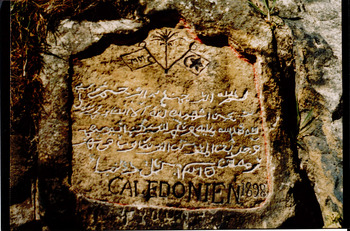
No lives were more terraqueous than those of mariners and seafarers. When they landed, they often made their mark. One instance is an Arabic inscription carved into the sandstone cliff-face at the quarantine station in Sydney Harbour (Figure 1). It begins with a blessing: ‘In the name of God, the Compassionate, the Merciful…I testify that there is no God but God, and Muhammad is the Apostle of God, blessing and peace upon him.’ The isolated carver recorded the Coptic month and the year, 1315.Footnote 72 The steamship on which he had arrived in the south-west Pacific was the Calédonien, in the Christian year 1898. On this particular journey, thirty-three men were picked up at Port Said as firemen, stokers for the steamship, and smallpox was introduced.Footnote 73 Endemic in Europe, smallpox was a quarantinable disease in much of the Pacific and Oceania over the nineteenth century. And so, although as the chief medical officer confessed at the time, ‘it would in the old country be regarded as absurd’ to quarantine for smallpox, all aboard from the captain to cabin boy were isolated for twenty-one days.Footnote 74 Like so many merchant mariners, Egyptian stokers often found themselves in quarantine.Footnote 75 This one, far from home, passed his time at the dramatic Pacific cliff, adding his Arabic message to an assemblage of hundreds of previous carvings in English, Chinese, Japanese, Greek, Cyrillic, and more.
This Arabic inscription in Sydney Harbour's cliffs is dated 1898

For those who observe it today, the inscription serves as a portal to another time, a maritime durée when quarantine was a possibility, even a probability, for any voyage and voyager. For its carver, it connected him geographically and culturally to other regions of the world. Part of the Marseilles-based Messageries Maritimes fleet, the Calédonien departed the western Mediterranean to Port Said, through the Suez Canal to Aden, Colombo, thence around the Australian continent from Fremantle on its west coast, Adelaide on its south coast, on to Melbourne and Sydney on its east coast. Its final destination was Nouméa, Nouvelle-Calédonie. The Calédonien thus took in the Mediterranean, the Red Sea, the Indian Ocean, the Southern Ocean, and the Pacific Ocean to its destination in Oceania. The outgoing and incoming journey linked the ‘old world’ Mediterranean and the ‘new world’ Pacific, year in, year out, in a post-Suez global geography that connected the ‘Great Sea’ to the ‘Great Ocean’.Footnote 76 There were many quarantine stations along the way, terraqueous sites that always effected strange suspensions of people, time and space.
Paradoxically, given that quarantine islands were semi-carceral holding places, they point to modern identities formed by mobility, some resolutely terraqueous. Consider the semiotics of this Arabic inscription. Perhaps serving to direct prayer, the carving connected the quarantined stoker religiously, geographically, and culturally to other parts of the world and to Muslims everywhere, symbolized by the palm. But there are two flags as well: one is that of khedivate Egypt, the crescent and five-pointed-star. The other, MM, is the houseflag of the Marseilles-based shipping line. An idiosyncratic late modern mixed identity: a faith, a nation – Egypt – but one in 1898 sitting tensely between the Ottoman Empire and the British Empire; and an identification with a famous merchant shipping line, at least as much ‘home’ to mariners as Egypt itself. The carver's world and identity was truly one of land and sea.
Quarantine islands, as carceral places, always had the capacity to switch and invert meanings and uses. In 1970s Sydney, for instance, the quarantine station became an immigration station, a place to house unauthorized entrants awaiting deportation and repatriation; Tongan, Fijian, Indian, Chinese, Indonesian, and Timorese men. Some passed their time reading the 1898 verses of the Qu'ran carved into the rocks, awaiting their deportation. And they continued the tradition, leaving a rich graffiti record themselves. A Javanese deportee was forgiving rather than resentful of authorities carrying out their duty. His Indonesian lines gestured to ‘immigration’ in both the substance and the form of an acrostic graffiti that conflates English and Bahasa. In translation, it reads:
In the mid-1970s, this resigned Indonesian man forecast and represented his deportation not by boat but by plane.
Popular plane flight would seem to be the end date for any periodization of world history as terraqueous history. But a globalized maritime world endures in at least three ways. First, the massive significance of containerization for ongoing history of maritime globalization, including piracy and its national and international regulation. Second, the maritime transportation of humans exists in the space of tourism and leisure (and, intriguingly, quarantine islands are often developed and adaptively reused as five-star complexes). And a third terraqueous identity was launched in the 1970s: ‘boat people’.
In the year that this Indonesian man forecast his deportation by plane, 1976, refugees started to arrive on Australian shores from Vietnam and Cambodia. The practice of fleeing by boat, and national and intergovernmental responses to it – Mare Nostrum for example – unexpectedly links the south-west Pacific and the Mediterranean in a complex global history of quarantine, migration, ocean crossings, and territorial borders. The regions now share this history and controversial present in which geopolitics and biosecurity meet once again. Yet the phenomenon of the vessel banned from ports, floating in oceans, unable to dock and disembark, has a provenance in the early modern Mediterranean world when ships were turned away as the crudest measure of protection against plague. ‘Turning back the boats’ was anticipated in the late nineteenth century as well. In 1888, for example, the Afghan departed Hong Kong, but was forced to anchor offshore in Melbourne and then Sydney, its passengers controversially banned by a contested Chinese immigration restriction law. Similarly, in 1914, the Komagata Maru anchored off Vancouver, British Columbia, for six months, its Indian passengers denied entry and ultimately turned back across the Pacific to find themselves unwelcome at other ports.Footnote 78 In such histories, the territoriality of modern nation-states was enacted powerfully on those borders where land met the sea.
IV
Such long world histories can be told in fresh ways through the comparative study of world seas and oceans, and as terraqueous histories. The transforming aquatic matter that engaged eighteenth-century natural historians might well help us formulate global histories in the Anthropocene. We might, for example, pursue polar history as terraqueous: ice is sometimes land to be walked upon and claimed, but it melts into water and disappears. What a conundrum in international law that proved to be.Footnote 79
In other instances, rising seas mean land and homelands are disappearing.Footnote 80 Earth, in this case, is turning into water. The terraqueous history of islands like Banaba, so-called Ocean Island, part of the Republic of Kiribati, is literally constituted by the bones of generations of buried ancestors. Extensively mined for phosphate from 1900, its ‘soil’ was exported across the seas to create fertility in alien lands. Between mining and rising sea levels, a homeland has all but gone, and the Banaban diaspora is now as dispersed as the ancestor-soil itself, as anthropologist Katerina Teaiwa recounts in her rich book, Consuming Ocean Island.Footnote 81 There is a terraqueous history here, of soil and water, earth and sea, that brings together modern political belonging and a modern world of diasporic movement, identity, and migration. ‘Terraqueous’, then, offers a framework within which to place a politico-scientific history of soil and water with the paradox that characterizes modernity; the fixity of national belonging in a world defined by mobility.
These are some of the possibilities of the idea of terraqueous history. It is the conceptual connecting that the compound enables that is most suggestive to me. For better or worse, my research career has been built from seeing and pursuing eclectic connections in modern world history, as in historiography. Rather like the Egyptian stoker, perhaps, this inclination has taken me as an historian from ocean to land, from soil to water, from the south-west Pacific to the Atlantic carrying multiple historiographical identities along the way. And like the early idea of the terraqueous globe, the surface of my successive histories reveals political contours of the changing modern world, sometimes the natural contours, and sometimes the biospheric whole.Footnote 82 This is a catholic approach to the past and its analysis, in which compounds and connections are everything. The project of world history, of all our sub-fields, is one which most needs a sensibility and capacity to think simultaneously about parts and wholes, but where the whole is formed, critically, by the connecting spaces in between. ‘Terraqueous histories’ is one concept through which to comprehend and consider modern human endeavours where land and water meet. It is, I hope, an enabling idea that signals the possibility, at least for some of us, of history as compounds and fusions, and thus new formations.