


Introduction
Social anxiety disorder (SAD) is characterized by an intense fear of embarrassment, humiliation, or scrutiny by others in social or performance situations. Cognitive behavioral models suggest that people with SAD use a number of processes intended to protect themselves before, during, and after feared situations. Unfortunately these processes often fail to help. One such process is biased post event processing.
Post event processing (PEP) involves detailed reviewing of social information after the social event has ended. PEP is thought to be unhelpful as it prevents a person from disconfirming negative thoughts about the social interaction, may trigger negative social memories, and even lead the individual to misinterpret ambiguous information as threatening upon review.
There is a clear relationship between PEP and social anxiety symptoms (for a detailed review see Brozovich and Heimberg, Reference Brozovich and Heimberg2008). However it is not clear whether PEP can be experimentally induced, which, if possible, could help us further study the causal relationships between PEP and anxiety. The current study attempted to experimentally manipulate the degree of PEP in a group of individuals with SAD by providing half of the sample with “focus” instructions while the other half received a distraction task. Focus instructions were intended to provoke PEP while the distraction task was intended to disrupt and minimize PEP. We hypothesized that individuals asked to focus on their performance on these tasks would report: (1) more PEP during the post speech experimental period; (2) greater post task anxiety levels; and (3) higher anxiety levels concerning the task the following day as compared to individuals asked to complete a distraction task.
Method
Participants
Forty-one patients [mean age of 37 years (SD = 12.7), 61% female] with a principal diagnosis of generalized SAD completed this study.
Measures
Participants completed the Social Phobia Inventory (SPIN; Connor et al., Reference Connor, Davidson, Churchill, Sherwood, Foa and Weisler2000) to measure symptoms of social anxiety, provided a subjective anxiety rating from 0–100 before the speech task, after the experimental manipulation, and 24 hours after the task, and completed the revised version of the Post Event Processing Questionnaire (PEPQ-R; McEvoy and Kingsep, Reference McEvoy and Kingsep2006).Footnote 1 Degree of post event rumination that occurred during the 24 hours following the experiment was assessed using a single item from the PEPQ-R that asked: “Did your memories and thoughts about the tasks keep coming into your head even when you did not want to think about them again? If so, to what degree?”
Procedure
Participants were asked to give an impromptu speech in front of a research assistant and video camera. Anxiety ratings were taken immediately before completing the speech. After completing the speech, participants were randomly assigned to either (1) a focus condition where they were instructed to focus on their performance on the task or (2) a distract condition where they were asked to note examples of certain animals described on an audiotape. The researcher then left the room for a 3-minute period after which participants rated their current levels of anxiety and completed the PEPQ-R. Participants were also contacted the following day by telephone to provide ratings of their level of anxiety over the 24-hour period and degree of post event rumination.
Results
Baseline group differences
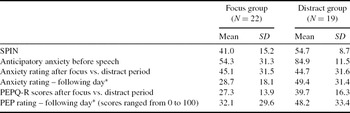
Groups did not differ on any demographic variables. The distract group reported higher scores on the SPIN, t (35) = −3.3, p = .01 and on anticipatory anxiety, t (39) = −4.0, p < .01 than the focus group. See Table 1 for means and standard deviations of relevant variables.
Means and standard deviations of variables

Note. *Indicates that analyses were run using N = 19 for focus group and N = 17 for distract group due to missing data.
Anxiety levels for focus vs. distract conditions
Given the baseline differences in anxiety severity between groups, we examined change in anxiety symptoms by conducting a 2 (focus vs. distract) by 3 (baseline vs. post-experiment vs. follow-up) repeated measures Analysis of Variance (ANOVA) with anxiety scores as the dependent variable. There was a significant effect of time, F (2, 33) = 22.7, p < .01, with anxiety scores from all participants decreasing from baseline to post-experiment, F (1, 39) = 29.3, p < .01, but not from post-experiment to follow-up. There was also a significant interaction between time and group, F (2, 33) = 3.7, p < .04. The distract group showed a greater decrease in anxiety scores from baseline to post-experiment than did the focus group, F (1, 39) = 11.6, p < .01, with no further decreases from post-experiment to follow-up.
Degree of post event processing and related anxiety
Surprisingly, the distract group reported more PEP than did the focus group, t (39) = −2.6, p = .01. However, PEPQ-R scores were significantly correlated with baseline anxiety ratings (r = .59, p < .01) and anxiety ratings after the experimental manipulation (r = .34, p < .05).
Relationship between anxiety and PEP in the follow-up period
Results indicated a positive correlation between the degree of self-reported PEP and general anxiety levels over the 24 hours, regardless of experimental condition, r = .66, p < .01. This correlation remained strong even when initial social anxiety symptom severity was controlled for, r = .54, p < .01.
Discussion
This pilot study attempted to experimentally manipulate the degree of PEP in SAD to examine the relationship of this core construct and resulting anxiety levels. Unfortunately, baseline group differences in social anxiety symptoms and state anxiety make it difficult to clearly interpret results, and our choice of induction techniques was possibly not rigorous enough to manipulate PEP to the extent intended. Hypothesis one, that participants instructed to focus on their performance would engage in more PEP than those provided with a distracting task, was not supported. Instead, individuals given a distraction task reported higher levels of PEP. This relationship appears to be accounted for, at least in part, by the positive and significant relationship between baseline anxiety and degree of PEP.
Hypothesis two, that individuals asked to focus on their speech performance would have higher anxiety ratings than those instructed to distract, was partially supported. The distract group evidenced a greater drop in anxiety from baseline to post-distraction period, while individuals in the focus group had a smaller drop in anxiety. Thus, instead of a focus task causing a greater increase in anxiety, a distraction task contributed to a greater recovery from high anxiety, similar to Kocovski, MacKenzie and Rector (Reference Kocovski, MacKenzie and Rector2011) and Wong and Moulds (Reference Wong and Moulds2009).
Hypothesis three, that individuals asked to focus on their speech performance would have higher anxiety ratings the day following the task, was not supported. Mean anxiety scores for participants in both groups were similar the following day, with a significant relationship between degree of self-reported PEP over the day following the experiment and degree of anxiety experienced by all participants, regardless of experimental group.
The results of this study suggest that people with SAD engage in PEP about stressful events, and this may occur regardless of explicit instructions of what to focus on after a stressful task. Simply asking people to focus on their performance does not yield elevated PEP, while providing an absorbing distraction task does not make people immune to engaging in PEP. On the other hand, a distraction task, even alongside the presence of naturally-occurring PEP, appears to provide some anxiolytic effects. Our results, while leaving open the question of whether PEP can be effectively induced, do clearly demonstrate a significant positive relationship between PEP and level of anxiety and provide further support for cognitive behavioral therapy techniques that aim to reduce the degree of PEP in people with SAD.




Comments
No Comments have been published for this article.