Introduction
Tobacco production has traditionally relied on intensive tillage prior to transplanting. Chemical weed control utilizes a limited number of soil-residual herbicides. Acetyl CoA carboxylase (ACCase; Group 1) inhibitors and pigment inhibitor (Group 13) herbicides are labeled for POST use, but the former control only grasses and the latter only have residual activity; cultivation is thus also used for in-season weed management (WM). Given the amount of soil disturbance used to produce tobacco, utilizing strip tillage (which limits tillage to the crop rows) and cover crops may provide soil conservation benefits for tobacco producers. Though in-season cultivation is more difficult with these management practices, the combination of cover crops with strip tillage may contribute to WM by creating surface mulches that reduce weed emergence and suppress growth (Brainard et al. Reference Brainard, Peachey, Haramoto, Luna and Rangarajan2013). Our previous research with strip-tilled tobacco has shown that more cover crop residue led to lower weed density but that a soil-residual herbicide was still necessary for adequate weed control (Haramoto and Pearce Reference Haramoto and Pearce2019). Although soil-residual herbicides do not provide adequate full-season control, they may still interfere with successful establishment and growth of subsequently planted cover crops (Cornelius and Bradley Reference Cornelius and Bradley2017; Palhano et al. Reference Palhano, Norsworthy and Barber2018). If this results in lower cover crop biomass, less weed suppression may also result. Tobacco is typically grown in the same field for 2 to 4 yr before accumulation of soilborne disease necessitates rotation to another crop (Pearce et al. Reference Pearce, Bailey and Walker2019), so studying the interaction between soil-residual herbicides, cover crop establishment and growth, and weed suppression will help growers make better-informed choices about whole-system, multi-year management.
Wheat remains the most common cover crop for Kentucky’s tobacco producers (R. Pearce, personal observation), but cereal rye may also be adopted depending on the growers’ goals. Across a wide range of geographic locations, in most years cereal rye grown as a cover crop or a forage produced more biomass than wheat (Bauer and Reeves Reference Bauer and Reeves1999; Duiker Reference Duiker2014; Haramoto Reference Haramoto2019; Kaspar and Bakker Reference Kaspar and Bakker2015; McCormick et al. Reference McCormick, Sulc, Barker and Beuerlein2006; Price et al. Reference Price, Reeves and Patterson2006; Reeves et al. Reference Reeves, Price and Patterson2005), probably as a result of better cold tolerance and less freeze-related damage and mortality (Leonard and Martin Reference Leonard and Martin1963; Peltonen-Sainio et al. Reference Peltonen-Sainio, Hakala and Jauhiainen2011). Earlier tobacco harvest dates (i.e., early to mid-September for early-maturing varieties) allow tobacco growers to also utilize legume cover crops that require earlier planting dates (Clark Reference Clark2012). Tobacco is typically fertilized with high rates of N fertilizer (Pearce et al. Reference Pearce, Bailey and Walker2019), and cover crop mixtures containing legumes did not increase yields beyond a monoculture wheat cover crop (Haramoto and Pearce Reference Haramoto and Pearce2019). However, cover crop mixtures including legumes are promoted by agencies such as the USDA National Resource Conservation Service for their soil-building properties (NRCS n.d.). In Kentucky, crimson clover can be successfully planted later than most other legumes (KY NRCS 2015), allowing more flexibility for growers who want to utilize it as a cover crop. More information on the benefits and the potential challenges of including these cover crop mixtures in tobacco production systems is needed for growers interested in adoption.
Herbicide programs in tobacco generally include a preplant application of a protoporphyrinogen oxidase (Group 14) inhibitor such as sulfentrazone, often in combination with carfentrazone (as Spartan Charge®; Pearce et al. Reference Pearce, Bailey and Walker2019). Other herbicides that may be applied prior to or immediately after planting include clomazone or pendimethalin, whereas Group 1 herbicides may also be used POST for grass control. There are no labeled POST herbicides for broadleaf weed control in Kentucky. Persistence of any given herbicide is affected by numerous factors, such as soil characteristics like clay and organic matter content, cation exchange capacity, and pH; interactions of these factors with weather conditions and climate also play a major role (Bailey Reference Bailey2003; Moyer et al. Reference Moyer, Coen, Dunn and Smith2010). Thus, herbicide longevity ranges widely depending on location and should be thoroughly evaluated across combinations of herbicides, locations, and soil types. As individual plant species also vary greatly in their sensitivity to different herbicide active ingredients (Cornelius and Bradley Reference Cornelius and Bradley2017), cover crops of interest should be compared with the herbicides used in tobacco.
Sulfentrazone half-life in soil has been reported as 121 to 302 d, whereas carfentrazone is rapidly degraded in soil (Shaner Reference Shaner2014). In Missouri, sulfentrazone alone reduced both wheat density and cereal rye biomass by 33% in different environmental conditions, whereas crimson clover was not affected (Cornelius and Bradley Reference Cornelius and Bradley2017). In Arkansas, low doses of sulfentrazone (17.5 g ai ha–1) applied immediately after cover crop planting did not affect cereal rye or wheat density or biomass but reduced crimson clover density by an average of 27% over 2 yr (Palhano et al. Reference Palhano, Norsworthy and Barber2018). Cover crops are not mentioned on the Spartan Charge® label (FMC 2017a). Herbicide labels may provide crop rotational intervals because of potential for crop damage or the possibility of illegal amounts of herbicide residue. Thus, their restrictions may not be informative for predicting cover crop damage. However, the Spartan Charge® label does give a crop rotational interval of 4 mo for wheat and cereal rye; crimson clover and other Trifolium species do not appear in the crop rotational interval chart and thus would require a minimum 12-mo interval given a successful field bioassay.
Clomazone has a reported average half-life of 24 d in field conditions (Shaner Reference Shaner2014). Clomazone caused 19% to 25% visible injury to wheat planted 3 to 5 mo after application in Missouri (Walsh et al. Reference Walsh, DeFelice and Sims1993a), and slight chlorosis on wheat was reported in 1 yr for 2.2 and 3.4 kg ai ha-1 in southern Illinois (Krausz et al. Reference Krausz, Kapusta and Knake1992). Greater amounts of wheat injury from clomazone plus pendimethalin (30% to 53% in 1 yr and > 95% in another) was also reported in Michigan; injury in this study was attributed to the clomazone, as wheat injury was not observed with pendimethalin alone (Renner and Powell Reference Renner and Powell1992). Clomazone did not affect crimson clover establishment or biomass production (Walsh et al. Reference Walsh, DeFelice and Sims1993b). To our knowledge, the impact of clomazone on cereal rye establishment and growth has not been reported. The label for Command® states that cover crop stand reductions may occur but allows their planting following application, yet does not specify what cover crops may be more susceptible to damage (FMC 2017b). Following guidelines for tobacco, wheat can be planted 12 mo after application, whereas cereal rye and crimson clover would require a 16-mo rotational interval.
Pendimethalin is a dinitroaniline seedling root growth/microtubule inhibitor–type herbicide (Group 3) with an average half-life in the soil of 44 d (longer if incorporated, as dissipation is slowed; Shaner Reference Shaner2014). Impacts of pendimethalin have been evaluated on crimson clover establishment that was planted within 6 to 7 wk of application (i.e., timing more relevant for interseeded cover crops) rather than 3 to 5 mo after application (i.e., timing more relevant for cover crops seeded after an annual cash crop harvest). Significant crimson clover injury was only noted if it was planted on the same day as pendimethalin application; planting at least 15 to 17 d after application led to no significant injury (Tharp and Kells Reference Tharp and Kells2000). The Prowl 3.3 EC® label also states that stand reductions may occur with legume cover crops (BASF 2008). The label also allows wheat planting 4 mo after application, assuming at least 30 cm of precipitation has fallen and that the soil is not a muck soil (BASF 2008). Cereal rye is not on the label and thus cannot be planted in the same year of application.
In the absence of tillage, as found in the area between rows in strip-tilled tobacco, intact cover crop residues contribute to WM by reducing light penetration to the soil surface (Teasdale and Mohler Reference Teasdale and Mohler1993) and acting as a physical impediment to emergence (Teasdale and Mohler Reference Teasdale and Mohler2000). Residues tend to be more effective in suppressing small-seeded, broadleaf weeds relative to grasses and perennials (Mirsky et al. Reference Mirsky, Curran, Mortensen, Ryan and Shumway2011; Mohler and Teasdale Reference Mohler and Teasdale1993; Teasdale et al. Reference Teasdale, Beste and Potts1991). For example, intact cereal rye and hairy vetch (Vicia villosa Roth) residues within no-till sweet corn (Zea mays L.) did not reduce large crabgrass [Digitaria sanguinalis (L.) Scop.], stinkgrass [Eragrostis cilianensis (All.) Vign. ex Janch.], or goosegrass [Eleusine indica (L.) Gaertn.] densities relative to a control with no cover crop (Teasdale et al. Reference Teasdale, Beste and Potts1991). Emergence of two small-seeded broadleaf species [redroot pigweed (Amaranthus retroflexus L.) and common lambsquarters (Chenopodium album L.)] through various cover crop mulches was lower relative to that of an annual grass species [giant foxtail (Setaria faberi Herrm.] and a large-seeded broadleaf species [velvetleaf (Abutilon theophrasti Medik.); Teasdale and Mohler Reference Teasdale and Mohler2000]. The degree of in-season weed suppression by intact cover crop residues, however, is positively related to the amount of biomass produced (Ryan et al. Reference Ryan, Mirsky, Mortensen, Teasdale and Curran2011; Webster et al. Reference Webster, Simmons, Culpepper, Grey, Bridges and Scully2016); if herbicide carryover results in lower cover crop biomass, less weed suppression may result. Lower cover crop biomass and more cover crop residue degradation can be expected in strip-tilled tobacco given the timing of agronomic practices. In central Kentucky, tobacco is typically planted from late May to late June, and best management practices recommend terminating cover crops relatively early to ensure optimal planting conditions and maximum yields (Pearce et al. Reference Pearce, Ditsch, Zeleznik and Turner2002). Ideally, they are terminated prior to the small-grain boot stage so aboveground biomass is limited, and this may occur 2 to 3 mo before tobacco planting. Cover crop residues will degrade during the intervening time, reducing mulch thickness and probably weed suppression (Price et al. Reference Price, Reeves and Patterson2006; Reeves et al. Reference Reeves, Price and Patterson2005; Stanton and Haramoto Reference Stanton and Haramoto2019; Wiggins et al. Reference Wiggins, Hayes, Nichols and Steckel2017). Although these residues are not expected to provide complete control, strip-till tobacco growers utilizing cover crops can still expect some suppression, and the use of mulches can still be an important contribution to cultural WM (Norsworthy et al. Reference Norsworthy, Ward, Shaw, Llewellyn, Nichols, Webster, Bradley, Frisvold, Powles, Burgos, Witt and Barrett2012).
One specific objective of this experiment was to determine whether common tobacco herbicide programs affect establishment and biomass production of wheat plus crimson clover or cereal rye plus crimson clover mixtures. A second objective was to determine if cover crop mixtures change the herbicide-based WM efficacy, relative to a fallow with no cover crop, and provide any additional WM benefits. The latter was evaluated across the tilled in-row zone and the untilled between-row zone of the field.
We hypothesized that the herbicides used would not affect cover crop establishment or biomass production. We also hypothesized that the cover crop residues would reduce weed emergence in this strip-tilled system, particularly in the untilled between-row zone and particularly for small-seeded annual broadleaf species that are affected more by surface mulches.
Materials and Methods
Plot Establishment and Tobacco Production
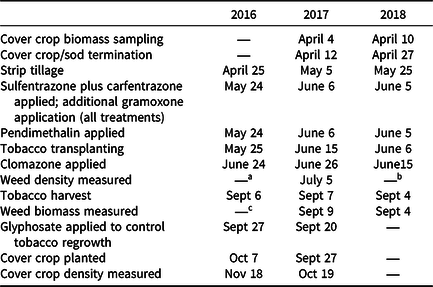
This experiment was conducted at the University of Kentucky’s North Farm outside of Lexington, KY (38.12° N, 84.51° W). A split-plot randomized complete-block design was utilized with the winter cover crop mixture as the main plot factor and the tobacco WM program as the subplot factor. Tobacco was planted for three consecutive years starting in 2016, with cover crops planted after tobacco harvest in the fall of 2016 and 2017 (Table 1). The same plots were utilized for the entire course of the experiment. Although this limits our ability to detect treatment effects based on factors such as soil type or landscape position, it is more reflective of the actual rotational scheme used in tobacco production.
Timeline of relevant field operations for this experiment conducted from 2016 through 2018 in Lexington, KY.

a Weed density from 2016 is not reported, as the cover crop treatments had not yet been imposed.
b Weed density from 2018 was not collected because of wet soil conditions.
c Weed biomass at tobacco harvest was not collected in 2016.
The soil type was a McAfee silt loam (fine, mixed, active, mesic Mollic Hapludalfs with 2% to 6% slope). The area had been in sod for at least 15 yr prior to the start of this experiment, and the specific field was split into four blocks to account for variability in landscape position. Each block was split into three main plots measuring 4 m wide and 54 m long for examination of the cover crop treatments, and each main plot split into six subplots (4 m wide and 9 m long) for examination of the WM treatments.
Lime was applied on April 17, 2016 (6,700 kg ha–1), and the sod was treated on April 18, 2016, with glyphosate (Roundup Powermax®, 1.6 kg ae ha–1; Monsanto, St. Louis, MO). The following section describes the general tobacco planting and management practices utilized in each year (see Table 1 for dates for all years). The site was strip-tilled utilizing an implement with a smooth coulter followed by a subsoil shank (running depth 20 to 25 cm), then followed by notched coulters to direct the loosened soil back to the middle of the row and rolling baskets to provide secondary tillage and smooth the strips. Fertilizer was applied prior to planting with a drop spreader [225 kg N ha–1 as urea treated with a urease inhibitor, and 280 kg K ha–1 as potassium sulfate (0-0-50)]; a multivator was used to incorporate fertilizer only in the tilled strips. This step also widened the tilled strips to approximately 30 cm and provided additional secondary tillage. Tobacco (variety ‘TN 90LC’) was then transplanted at the four-leaf stage into the entire field; chlorantraniliprole (Coragen®, 102 g ai ha–1; E.I. DuPont de Nemours Co., Wilmington, DE) and thiamethoxam (Platinum 75 SG®, 158 g ai ha–1; Syngenta Crop Protection, Greensboro, NC) were applied in the transplant water (in a drench of approximately 2,800 L ha–1) for control of aphids (Myzus spp.), tobacco flea beetles (Epitrix hirtipennis F.E. Melsheimer), and tobacco hornworms (Manduca sexta L.).
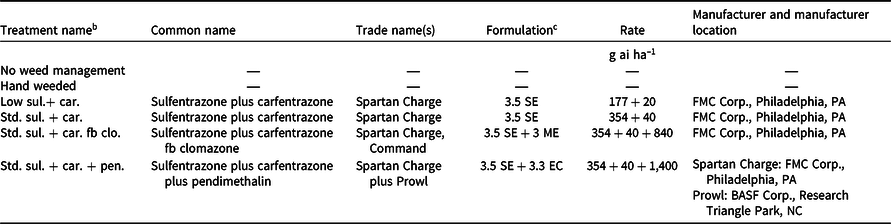
Six WM treatments were applied to subplots (Table 2). Two different control treatments were utilized: a weedy control that received neither herbicides nor hand weeding (“no weed management”), and a control in which weeds were removed periodically by hand with no herbicide use (“hand weeded”). The former allowed us to assess whether the cover crops contributed to any weed suppression in the absence of herbicide use, whereas the latter was used as a “best-case” scenario for cover crop establishment—no plant residue to impede emergence and also no herbicide carryover. The hand-weeded treatment was not maintained weed-free throughout the entire season, but weeds were removed approximately 3 to 5 wk after transplanting and prior to seed rain; no weeds were present at tobacco harvest. Two rates of sulfentrazone plus carfentrazone as a prepackaged mixture were examined: 177 plus 20 g ai ha–1, respectively (“Low sul. + car.”); and 354 plus 40 g ai ha–1, respectively (“Std. sul. + car.”). Additional treatments included the standard rate of the prepackaged mixture plus pendimethalin as a mix at 1,400 g ai ha–1 (“Std. sul. + car. + pen.”), and the standard rate of the prepackaged mixture followed by (fb) a POST application of clomazone at 840 g ai ha–1 (“Std. sul. + car. fb clo.”). See Table 1 for application dates in each year. The intervals between the PRE herbicide application and cover crop planting were 113 and 136 d in 2017 and 2016, respectively. In 2016, 105 d elapsed between clomazone application and cover crop planting, but only 93 d elapsed in 2017.
Tobacco weed management treatments utilized in this trial conducted from 2016 through 2018 in Lexington, KY.a

a Refer to Table 1 for application timing.
b Abbreviations: car., carfentrazone; clo., clomazone; EC, emulsifiable concentrate; fb, followed by; ME, micro-encapsulated; pen., pendimethalin; SE, suspoemulsion; std., standard; sul., sulfentrazone.
c The numbers given with the formulations indicate pounds of active ingredient per gallon of product (e.g., 3.5 SE = 3.5 pounds of active ingredient per gallon of product in a suspoemulsion).
Tobacco was managed following best production practices. Tobacco was harvested in September of each year (Table 1). Following tobacco harvest, glyphosate (1.6 kg ae ha–1) was applied to control weeds and tobacco plant regrowth. Cover crop treatments [fallow, wheat (variety ‘AG2581’) plus crimson clover (variety ‘Kentucky Pride’), or cereal rye (a grazing mixture comprising equal parts by weight of ‘Elbon’, ‘Maton’, and ‘Southern Blue’) plus crimson clover] were assigned to one main plot in each block. Cereal rye and wheat seed sizes differed (20 and 38 g per 1,000 seeds, respectively), and they were sown at 79 and 112 kg ha–1 pure live seed, respectively, or approximately 250 pure live seeds per square meter. Pre-inoculated crimson clover was sown at 34 kg ha–1 pure live seed, or approximately 450 pure live seeds per square meter. All seed was sown using a no-till drill with the small grains in the large-seed box and crimson clover seed in the small-seed box. Approximately 20 mm of irrigation was applied in late October 2016 with a traveling gun to facilitate cover crop establishment. Paraquat (Gramoxone SL 2.0®, 1.05 kg ai ha–1; Syngenta Crop Protection, Greensboro, NC) plus crop oil concentrate (COC; Maximizer®, 1% v/v, Loveland Products, Greeley, CO) was used to terminate cover crops in 2017 and 2018. Paraquat plus COC were applied at the same rates again to all plots when the PRE herbicides were applied to kill weeds that had emerged in the interim period (Table 1); this application also controlled the minimal crimson clover regrowth that occurred.
Data Collection
Cover Crops
Cover crop density was assessed after planting but prior to tillering. Because conditions in fall 2016 were extremely dry, cover crop density was not assessed until > 1 mo after planting (after irrigation). Density was measured by counting the number of cover crop plants in two 0.25-m2 quadrats in each subplot; quadrats spanned a consistent number of drilled cover crop rows. Biomass was sampled prior to termination in each spring by cutting all biomass from two 0.25-m2 quadrats in each subplot; all biomass was separated into the small-grain, crimson clover, and weed components, then dried at 60 C until a constant mass was achieved, and then weighed.
Weeds
Weed density in the tobacco was measured once 3 wk after transplanting in 2017 before exponential growth began in the tobacco, after the POST clomazone treatment, and immediately prior to the first hand-weeding operation in the hand-weeded treatment (Table 1). Some earlier-season impacts of the cover crops on weed density may have been missed because of this timing. However, it represents the time that growers must decide whether to start cultivating or, particularly in reduced-tillage systems, hand weeding for management. Wet soil conditions persisted in 2018 and did not allow us to count weed density after transplanting prior to tobacco canopy closure; counting after canopy closure risks too much damage to the tobacco leaves and can reduce yield. Weeds were identified to species and counted in two 0.25-m2 quadrats in both the tilled in-row and untilled between-row zones. Weed biomass at tobacco harvest was collected from all subplots in 2017 and 2018. Biomass was collected from quadrats as described above; all biomass was dried at 60 C until a constant mass was achieved, and then weighed.
Tobacco Yield
Plants in the two center rows of each plot were cut at ground level and speared onto wooden sticks. Five sticks consisting of six stalks per stick were tagged. Consistent with standard burley tobacco harvesting methods, the cut tobacco was field-wilted for 2 d then hung on rail wagons for three additional days. Sticks were then hung in a conventional tobacco barn and air cured for 8 to 10 wk. After curing, the leaves were removed from the stalk and separated by stalk position grades for weight. Yields are presented as the total weight of cured leaf per hectare.
Data Analysis
All statistical analyses were performed in R (R Development Core Team 2018) using the nlme package for linear, mixed-effect models (Pinheiro et al. Reference Pinheiro, Bates, DebRoy, Sarkar and Core Team2018). Effects were considered significant using α = 0.05 and marginally significant using α = 0.10. The data were checked for assumptions of normality and, when necessary, data were log-transformed to meet model assumptions. When data were found to be heteroscedastic, the varIdent function within nlme was used to group variances and Akaike information criterion was used to select the best model. All transformations and groupings utilized within analyses are specified in individual table and figure legends. In all analyses for data collected over multiple years, Akaike information criterion values were compared to determine whether it was necessary to account for autocorrelation between years in the model using year as a repeated measure. Model parsimony was never improved by treating year as a repeated measure, so years were considered independent. Comparison of least-square means was performed using the least significant difference test in the emmeans package in R (Lenth Reference Lenth2018).
The model used to examine the effect of previous WM treatment on crimson clover density and biomass included WM, small-grain cover crop species present in the mixture (cereal rye or wheat), and year as fixed effects, and WM nested within cover crop mixture nested within block as the random effect. If significant interactions were detected with the component small-grain species, then crimson clover density and biomass were analyzed separately. When examining the effect of WM on cereal rye or wheat density and biomass, WM and year were fixed effects, and WM nested within block was the random effect. Cereal rye and wheat data were analyzed separately.
To evaluate differences in early-season weed density, cover crop species, WM, and zone (tilled in-row and untilled between-row) were treated as fixed effects, and the random effect was WM nested within cover crop nested within block. Years were analyzed separately. Weeds were analyzed by functional groups based on annual grasses, small-seeded broadleaves, and perennials. Analysis of weed biomass at tobacco harvest was similar to that described above, but biomass was not separated into functional groups; instead, biomass was evaluated across the whole community.
Analysis for differences in tobacco yield included WM, cover crop (including fallow), as well as their interactions, as fixed effects, and WM nested within cover crop mixture nested within block was a random effect. Because the experiment started during the tobacco phase, there was no preceding cover crop effect within tobacco the first year (2016). Additionally, for both weed biomass and tobacco yield there were interactions between the effects of WM or cover crop with year, so years were analyzed separately.
Results and Discussion
Weather Conditions
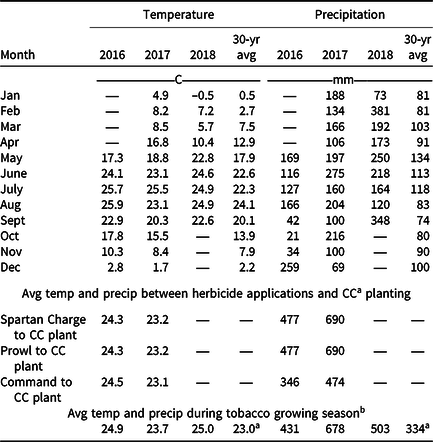
Weather conditions in the 3 yr of this trial are summarized in Table 3. Rainfall was adequate for herbicide activation, with 70 to 84 mm of precipitation within 2 wk of the PRE herbicide applications in the 3 yr. In the 2-wk period following the POST application of clomazone, 50 mm of precipitation fell in 2016, and > 120 mm fell in 2017 and 2018. During the entire tobacco growing season, conditions were warmer and wetter than average in each year. Greater amounts of precipitation reduce carryover potential (Tharp and Kells Reference Tharp and Kells2000) and resulted in less herbicide retention on surface residues (Ghadiri et al. Reference Ghadiri, Shea and Wicks1984). Moreover, sulfentrazone plus carfentrazone applied over heavy cover crop residues resulted in good weed control when rainfall occurred soon after application, suggesting retention on residues was not occurring (Haramoto and Pearce Reference Haramoto and Pearce2019). In 2016, 346 and 477 mm of precipitation fell between herbicide applications (the POST clomazone and the PREs, respectively) and cover crop planting, whereas 474 and 690 mm of precipitation fell in 2017 during these intervals. Conditions during cover crop establishment in the fall of 2016 were dry and warm, and followed by a relatively mild winter. In contrast, fall conditions in 2017 were much wetter than average and were followed by a winter with periods of unusually cold weather for Kentucky.
Weather conditions during the course of this experiment in Lexington, KY, collected from a weather station approximately 2 km from the experimental field.

a Abbreviation: CC, cover crop.
b Given different planting dates, these growing season estimations start on June 1 and end on September 7.
Cover Crops
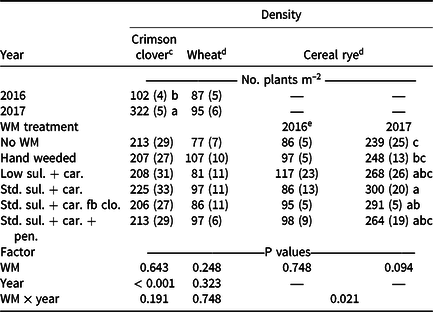
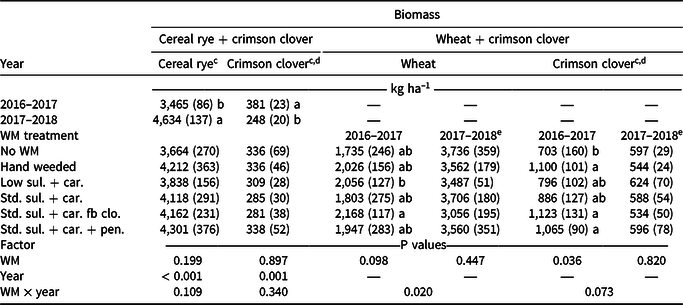
No differences in initial crimson clover density were detected between cereal rye or wheat mixtures across both years (year by small-grain species by WM, P = 0.411), so crimson clover density data were pooled over the two mixtures. Neither initial crimson clover density (averaged over both mixtures) nor wheat density was affected by previous WM treatment (Table 4). A significant year-by-WM interaction was detected for cereal rye density, with marginally significant differences detected among previous WM treatments in 2017 but no differences in 2016. In 2017, cereal rye density was highest for all herbicide treatments, with all having similar densities; no weed management had the lowest cereal rye density. These results could suggest that cereal rye establishment in the fall was favored by improved summer weed control in these herbicide-based treatments (see below); less weedy residue would improve drilled cover crop establishment success. It is unclear, though, why this would be observed for cereal rye and not the other two species. Crimson clover seed is smaller than cereal rye (6.9 g per 1,000 seeds vs. 28 g per 1,000 seeds, respectively), and interference from existing weedy residue would be more likely with this smaller seed.
Mean (±SE) initial density of cereal rye, wheat, and crimson clover (averaged over both mixtures) in November 2016 and October 2017, and P values from a two-way ANOVA of weed management (WM) and year.a, b

a Mean ± SE is given in parentheses after each initial density number. Within a species, means followed by the same letter are not significantly different at α = 0.05.
b See Table 2 for herbicide products, rates, and abbreviations.
c Crimson clover density was averaged across both mixtures as no effect of the small-grain species was detected on crimson clover density (species by WM by year, P = 0.411). Additionally, because crimson clover data was heteroscedastic, variances were grouped by WM treatment.
d To improve normality, wheat and 2016 cereal rye data were log transformed.
e Effects slicing indicated no significant differences in cereal rye density between WM strategies in 2016; thus, means are not separated.
Initial crimson clover density (averaged across both mixtures) and cereal rye density were greater in fall 2017 compared to fall 2016 (Table 4); wheat density did not differ between years. Lower density of both crimson clover and cereal rye in 2016 relative to 2017 was probably due to the extremely dry conditions that persisted after planting in the fall of 2016. It is unclear why wheat density did not differ between years, as seeding rate was adjusted for seed germination percentage.
Crimson clover biomass was affected by small-grain component in the mixture (year by small-grain species by WM, P = 0.035), so it was analyzed separately for each mixture. Neither cereal rye biomass nor crimson clover biomass in mixture with cereal rye was affected by previous WM treatment (Table 5). Biomass of both components of the wheat plus crimson clover mixture differed between the previous WM treatment in 2016 to 2017, but not in 2017 to 2018; the impact of WM treatment on wheat biomass was marginally significant. Wheat biomass was greater in the sulfentrazone plus carfentrazone fb clomazone treatment compared to the low rate of sulfentrazone plus carfentrazone. However, as a result of large and unequal variances among the other treatments, we did not detect any other differences among previous WM treatments. Crimson clover biomass in mixture with wheat was lower following the no weed management control relative to WM treatments with either pendimethalin or clomazone, or the hand-weeded control. As with cereal rye establishment, these results suggest that interference from summer weed residue potentially reduced crimson clover growth in the weedy control and the low and standard rates of sulfentrazone plus carfentrazone. As we did not detect reduced crimson clover density following these treatments, any effects observed would be due to reduced growth of the cover crops rather than reduced establishment. In any case, none of the previous herbicide-based WM treatments resulted in lower cover crop biomass relative to the WM treatments without herbicides.
Mean (±SE) aboveground biomass of cereal rye, wheat, and crimson clover within each mixture in April 2017 and 2018, and P values from a two-way ANOVA of weed management (WM) and year.a, b

a Mean ± SE is given in parentheses after each biomass number. Within a species, means followed by the same letter are not significantly different at α = 0.05.
b See Table 2 for herbicide products, rates, and abbreviations.
c To improve normality, cereal rye, crimson clover in mixture with cereal rye, and crimson clover in mixture with wheat in 2016 to 2017 were log transformed.
d Because crimson clover data were heteroscedastic, variances were grouped by WM treatment.
e Effects slicing indicated no significant differences in biomass of wheat or of crimson clover in mixture with wheat in 2017 to 2018, so means are not separated.
Crimson clover biomass was lower with cereal rye than with wheat (P < 0.001 for the interaction between small-grain species by year; Table 5); cereal rye presents a more competitive environment compared to wheat. Crimson clover biomass was also lower in 2017 to 2018 compared to 2016 to 2017, and the converse was true for the small-grain cover crop biomass, which was greater in 2017 to 2018 than in 2016 to 2017 (Table 5). Other researchers have noted that small grains, particularly cereal rye, can dominate cover crop mixtures (Baraibar et al. Reference Baraibar, Hunter, Schipanski, Hamilton and Mortensen2018; Finney et al. Reference Finney, White and Kaye2016). The dry weather in fall 2016 probably limited biomass production potential despite favorable growing conditions for the rest of that season (Table 3). Cereal rye produced more aboveground biomass than wheat in both years. This is consistent with previous research from central Kentucky and elsewhere showing generally greater aboveground biomass production from cereal rye relative to wheat (Bauer and Reeves Reference Bauer and Reeves1999; Duiker Reference Duiker2014; Haramoto Reference Haramoto2019; Kaspar and Bakker Reference Kaspar and Bakker2015; McCormick et al. Reference McCormick, Sulc, Barker and Beuerlein2006; Price et al. Reference Price, Reeves and Patterson2006; Reeves et al. Reference Reeves, Price and Patterson2005). Winter weed biomass in the cover-cropped plots was negligible (< 50 kg ha–1) and was not analyzed.
We did not detect significant effects of our previous tobacco WM treatments on wheat, cereal rye, or crimson clover establishment, nor on crimson clover or cereal rye biomass production. These results are largely in accordance with previous research showing few impacts of sulfentrazone, carfentrazone, clomazone, and pendimethalin on establishment and growth potential of these cover crop species (Cornelius and Bradley Reference Cornelius and Bradley2017; Palhano et al. Reference Palhano, Norsworthy and Barber2018; Renner and Powell Reference Renner and Powell1992; Tharp and Kells Reference Tharp and Kells2000; Wallace et al. Reference Wallace, Curran, Mirsky and Ryan2017; Walsh et al. Reference Walsh, DeFelice and Sims1993a, Reference Walsh, DeFelice and Sims1993b). Whereas previous studies have evaluated these impacts with longer intervals between the herbicide application and planting, our study shows few impacts on cover crops planted 3.5 or 5 mo after herbicide applications. Ample rainfall and warm temperatures between herbicide application and cover crop planting most likely reduced potential for herbicide carryover to the cover crops.
Weeds in Tobacco Crop
Early-Season Tobacco Weed Density
Early-season weed density (3 wk after transplanting) was evaluated in 2017. The annual grass community was dominated by large crabgrass and yellow foxtail [Setaria pumila (Poir.) Roem. & Schult.]. Small-seeded broadleaves included mostly carpetweed (Mollugo verticillata L.) and smooth pigweed (Amaranthus hybridus L.), with lower densities of prostrate spurge (Euphorbia maculata L.) and Eastern black nightshade (Solanum ptychanthum Dunal). Perennials included primarily horsenettle (Solanum carolinense L.), honeyvine milkweed [Cynanchum laeve (Michx.) Pers.], buckhorn plantain (Plantago lanceolata L.), and low densities of yellow nutsedge (Cyperus esculentus L.) and Canada thistle (Cirsium arvense L.).
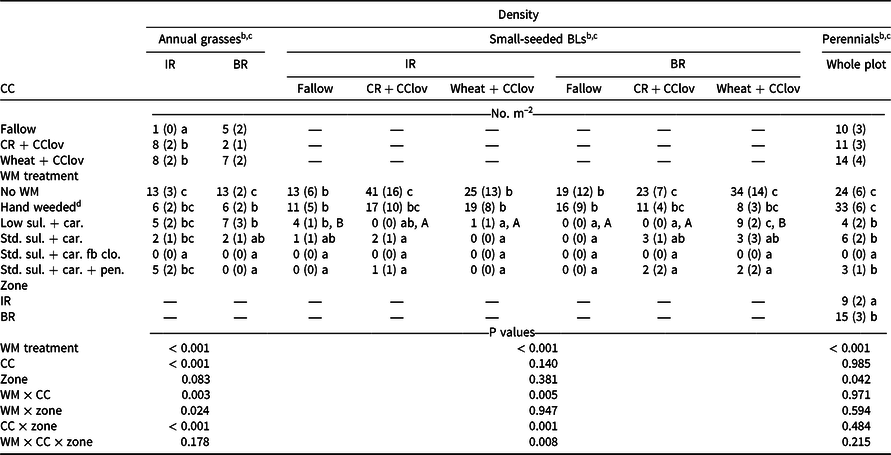
The effect of both preceding cover crop mixture and WM treatments varied across the two strip-tillage zones (Table 6). In the tilled in-row zone, annual grass density was greater following the two cover crop mixtures relative to following fallow, whereas density was unaffected by cover crop treatments in the untilled between-row zone. Variable effects of cover crops, both incorporated and not, on annual grass density have been reported by other researchers. In a tilled system, greater large crabgrass emergence was reported following cereal rye incorporation relative to following fallow (Brainard et al. Reference Brainard, Bryant, Noyes, Haramoto and Szendrei2016). In the absence of tillage, annual grass density, including large crabgrass, was unaffected by surface cereal rye cover crop mulches (Teasdale et al. Reference Teasdale, Beste and Potts1991). Using artificial seedbanks and no herbicides, large crabgrass density was reduced by cereal rye residue relative to fallow in no-till cotton (Gossypium hirsutum L.; Vasilakoglou et al. Reference Vasilakoglou, Dhima, Eleftherohorinos and Lithourgidis2006), but not in no-till corn (Dhima et al. Reference Dhima, Vasilakoglou, Eleftherohorinos and Lithourgidis2006).
Mean (±SE) density of weed community groups [annual grass, small-seeded broadleaves (BLs), and perennials] in 2017 counted 3 wk after transplanting, with P values from a three-way ANOVA of weed management (WM), preceding cover crop (CC) treatment, and zone.a

a Mean ± SE is given in parentheses after each initial density number. Within a CC mixture, means followed by the same letter are not significantly different at α = 0.05.Within a group and zone column, means followed by the same lowercase letter are not significantly different at α = 0.05. Within WM treatment Low sul. + car., means within a zone followed by the same capital letter are not significantly different at α = 0.05. See Table 2 for herbicide products, rates, and abbreviations.
b To improve normality, density of annual grasses, small-seeded BLs, and perennials was log-transformed. Because data were heteroscedastic, variances were grouped by WM treatments.
c Abbreviations: BR, untilled between-row zone; CClov, crimson clover; CR, cereal rye; IR, tilled in-row zone.
d Density was evaluated before commencing hand weeding.
Both pendimethalin and clomazone are labeled for PRE control of large crabgrass and Setaria species (BASF 2008; FMC 2017b); our timing of the clomazone application would provide additional residual control beyond that provided by the pendimethalin. As expected, our results show that both clomazone applied POST and pendimethalin applied PRE resulted in improved annual grass control relative to the low rate of sulfentrazone plus carfentrazone and the two control treatments. The standard rate of sulfentrazone plus carfentrazone resulted in intermediate density, though this product is not labeled for PRE annual grass control. Lower annual grass density in the hand-weeded treatment (significant only in the untilled zone) shows the potential for hand weeding that removes weeds prior to viable seed production.
The effect of preceding cover crop mixture on the density of small-seeded broadleaf weeds varied across both zones and WM treatments (Table 6). When examining the cover crop effect within each WM treatment, we only detected differences within the low rate of sulfentrazone plus carfentrazone (see capital letters on this row on Table 6). In the tilled in-row zone, small-seeded broadleaf weed density was greater following fallow (4 m–2) relative to the cereal rye mixture (0 m–2) and wheat mixture (1 m–2). In the untilled between-row zone, both the fallow and cereal rye mixture had no small-seeded broadleaf weeds, whereas the wheat mixture had 9 m–2. The absence of a cover crop effect on small-seeded broadleaf weed density across most WM treatments, particularly in the untilled between-row zone, refutes our hypothesis that cover crops would exert the strongest effects on these species in the absence of tillage. The reason that we only observed cover crop effects in one WM treatment is unclear. Carpetweed and smooth pigweed were the two dominant small-seeded broadleaf species. Emergence of carpetweed and similar Amaranthus species has been reported to be reduced by cover crop residues (Teasdale et al. Reference Teasdale, Beste and Potts1991; Teasdale and Mohler Reference Teasdale and Mohler2000).
When examining the effect of WM treatments within each cover crop treatment, we found that small-seeded broadleaf weed density following the cereal rye mixture was similar across all WM treatments that received at least one herbicide application in both the tilled in-row and the untilled between-row zone. We also observed a similar effect following wheat in the in-row zone and fallow in the between-row zone. Following wheat in the between-row zone, density was similar across the high rate of sulfentrazone plus carfentrazone, and where clomazone or pendimethalin was applied. Carpetweed was the predominant species in this group; pendimethalin has activity against this species (BASF 2008), but the effects of sulfentrazone plus carfentrazone or clomazone on this species is unknown.
Finally, perennial weed density was not affected by the preceding cover crop species (Table 6). Perennials are typically not affected by surface cover crop residues (e.g., Mirsky et al. Reference Mirsky, Curran, Mortensen, Ryan and Shumway2011), because they store greater amounts of energy reserves in vegetative structures. Perennial density was greater in the untilled zone relative to where tillage was used, and in herbicide-based WM programs relative to those receiving no herbicides. The herbicides used in this trial are not labeled for control of many perennial species, including those in this trial. We noted that most perennials in the current trial became established from vegetative structures; buckhorn plantain did establish primarily from seed. VanGessel (Reference VanGessel1999) noted that many soil-residual herbicides including sulfentrazone and pendimethalin can reduce perennial emergence from seeds, but did not evaluate buckhorn plantain. Thus, it is possible that these herbicides had some impact on seedling emergence of perennials.
The lack of strong and consistent cover crop effects on weed density, particularly for the small-seeded broadleaf species, was probably influenced by tobacco production practices. Early termination to limit cover crop biomass production helps growers to optimize strip tilling and the transplant operation. In addition, residue degradation between termination and tobacco planting probably further decreased the ability of these residues to suppress weeds.
Weed Biomass at Harvest
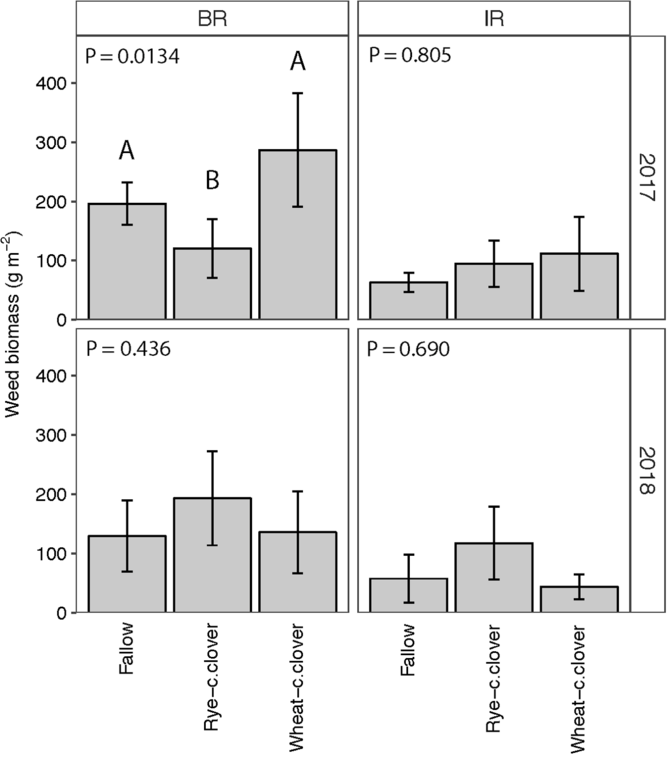
Effects of the preceding cover crop mixture varied across the 2 yr in the untilled between-row zone (P < 0.001), whereas effects of the WM treatments varied across the 2 yr in each zone (P = 0.039 and 0.010 for the untilled between-row zone and tilled in-row zone, respectively). In 2017, weed biomass in the untilled between-row zone was reduced by approximately 30% following the cereal rye plus crimson clover mixture relative to fallow and the wheat plus crimson clover mixture (Figure 1). However, we found that preceding cover crop mixture had no effect in the untilled between-row zone in 2018, or in the tilled in-row zone in either year. That cereal rye plus crimson clover resulted in lower weed biomass at harvest while not affecting weed density suggests that growth of existing weeds within cereal rye plus crimson clover was reduced. Cereal rye cover crops can immobilize soil N and reduce weed growth (Wells et al. Reference Wells, Reberg Horton, Smith and Grossman2013), potentially leading to reduced growth. Our cereal rye plus crimson clover mixture in 2016 to 2017 contained approximately 10% crimson clover by mass, whereas the mixture in 2017 to 2018 produced approximately 20% more biomass and contained only 5% crimson clover by mass (Table 5). If N immobilization reduced weed growth, it would have been more likely to occur during the 2018 tobacco season than in 2017. However, weed density was overall greater in 2017 than in 2018; combined with very high precipitation, these weeds could have been more N limited.
Weed biomass at tobacco harvest in 2017 (top) and 2018 (bottom) across the untilled between-row (BR) zone (left) and the tilled in-row (IR) zone (right) in different cover crop (CC) treatments. Error bars represent ± 1 SE. Zones were analyzed separately. The P values for year × CC interactions were 0.0002 and 0.180 for the untilled BR and tilled IR zones, respectively. P values for CC effects slicing within each zone and year combination are provided in each panel. Within each panel, bars with the same letter are not significantly different at α = 0.05. Abbreviations: c. clover, crimson clover; Rye, cereal rye.

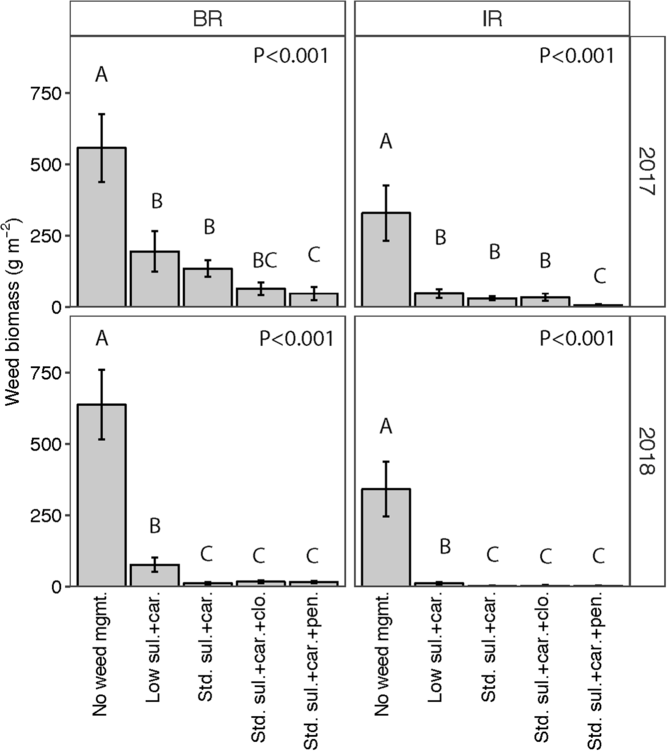
The effect of WM on weed biomass at tobacco harvest were generally consistent across the two zones within each year (Figure 2). In both zones, all herbicide-based WM treatments reduced weed biomass relative to the no weed management control. In 2017, only the addition of pendimethalin reduced weed biomass relative to both rates of the sulfentrazone plus carfentrazone treatment. In 2018, the low rate of sulfentrazone plus carfentrazone resulted in greater weed biomass than the other herbicide-based WM treatments across each zone.
Weed biomass at tobacco harvest in 2017 (top) and 2018 (bottom) across the untilled between-row (BR) zone (left) and the tilled in-row (IR) zone (right) following different weed management (WM) treatments. Error bars represent ± 1 SE. The P values for year × WM interactions were 0.039 and 0.010 for the untilled BR and tilled IR zones, respectively. P values for the WM effects slicing within each zone and year combinations are provided in each panel. Within each panel, bars with the same letter are not significantly different at α = 0.05. See Table 2 for herbicide products, rates, and abbreviations.

Tobacco Yield
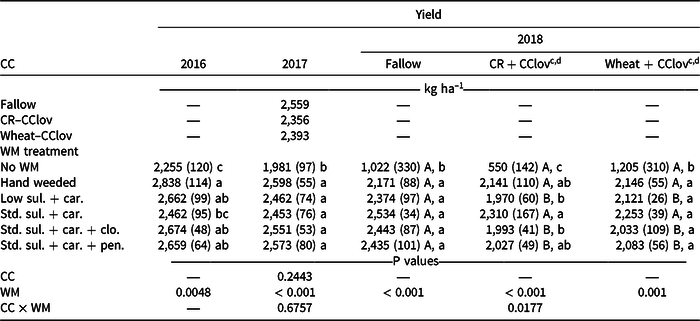
The effect of both preceding cover crop mixture and WM treatments on tobacco yield varied between study years (Table 7). Cover crops did not influence tobacco yield in 2017, though yield was reduced following both cover crop mixtures relative to fallow in some WM treatments in 2018. Specifically, yield was reduced with both cover crop mixtures relative to fallow following the low rate of sulfentrazone plus carfentrazone and where either clomazone or pendimethalin was applied with the standard rate of sulfentrazone plus carfentrazone (Table 7). Though the same trend was observed within the standard rate of sulfentrazone plus carfentrazone, the high variability observed most likely prevented the detection of a significant cover crop effect. Tobacco yields were greater in all years with WM treatments that utilized either herbicides or hand weeding relative to the weedy control (Table 7).
Mean (±SE) tobacco yield in 2016, 2017, and 2018, and P values from a two-way ANOVA of weed management (WM) and cover crop (CC) mixture.a,b

a Years were analyzed separately. Within each year (or year × CC), means followed by the same letter are not significantly different at α = 0.05. Within 2018 for a given WM treatment, means followed by the same capital letter are not significantly different at α = 0.05.
b See Table 2 for herbicide products, rates, and abbreviations.
c Because 2018 yield data were heteroscedastic, variances were grouped by WM treatment.
d Abbreviations: CClov, crimson clover; CR, cereal rye.
We did not detect an interaction between the cover crop species and the WM treatments on final weed biomass in 2018 (analysis results not shown); in each zone, weed biomass was similar in all herbicide-based treatments except the low rate of sulfentrazone plus carfentrazone (Figure 2). Yield reductions in the final year with the same cover crop treatments may have resulted from increased disease pressure or N limitation. We observed tissue chlorosis in 2018 indicating potential N limitation. Heavy rainfall soon after N application (75 mm over 3 d following this application, before the strip tillage was accomplished) may have reduced our effective N fertilization rate in 2018.
Our study shows that cereal rye plus crimson clover and wheat plus crimson clover establishment and growth were not affected by residual activity of herbicides commonly used in tobacco. Between 93 and 105 d elapsed between clomazone application and cover crop planting, with 113 to 136 d between sulfentrazone plus carfentrazone and pendimethalin application and planting. Ample rainfall during these periods in 2016 and 2017 may have helped reduce carryover potential. Weed biomass at harvest was lower following the cereal rye plus crimson clover mixture in 2017, but we observed no other weed management benefits of the cover crops. The addition of both POST clomazone and PRE pendimethalin to the standard rate of sulfentrazone plus carfentrazone resulted in more consistent weed suppression. Tobacco yield reductions due to the cover crops were only noted in the final year of this 3-yr study and may be a result of disease accumulation that was exacerbated by extremely high precipitation during this study, or N immobilization. Both warrant further study, as cover crops offer many important benefits to reducing the environmental impact of tobacco production.
Acknowledgments
The Council for Burley Tobacco and the Kentucky Tobacco Research and Development Center provided funding for this research, originally received by Dr. Ben Goff. The authors specifically acknowledge Matthew Allen, Jack Zeleznik, Sara Carter, Laura Harris, Gene Olson, Vinicius dos Santos Cunha, Tori Stanton, Austin Sherman, Ryan Collins, Mitchell Richmond, Nolan Stephenson, Haley Taylor, and many undergraduate assistants for field help on this project, as well as Tori Stanton for data analysis. Any opinions, findings, conclusions, or recommendations expressed in this publication are those of the authors and do not necessarily reflect the view of the US Department of Agriculture (USDA). Mention of trade names or commercial products in this publication is solely for the purpose of providing specific information and does not imply recommendation or endorsement by the USDA. The USDA is an equal opportunity provider and employer. No conflicts of interest have been declared.