If reports in the media are any indication, political scandals resulting from corruption or personal indiscretions are ubiquitous (Entman Reference Entman2012; Sabato, Stencel, and Lichter Reference Sabato, Stencel and Lichter2000). Governors fly to international locations for extra-marital trysts or attempt to sell Senate seats. Presidents and their senior staff conspire to cover up political crimes. Political nominees are accused of financial misdeeds related to federal income tax returns. Governors are impeached and removed from office for serious crimes. Other observers and scholars concur with these grim assessments (Dunn Reference Dunn1999; Marion Reference Marion2010; Sabato Reference Sabato1993). Scandals are argued to be on the rise because the media is more invasive, communications technology is more pervasive, laws are stricter, and political opponents thrive in using these tactics as political weapons (Garment Reference Garment1992; Ginsberg and Shefter Reference Ginsberg and Shefter1999; Nyhan Reference Nyhan2009).
Clearly, scandals are a common part of political life for most chief executives, but which factors shorten or lengthen the duration of a scandal? The emergence of scandals presents strategic choices that relate to the political environment, most prominently the amount of political strength a politician possesses (Kurtz Reference Kurtz1991). For instance, one factor often referenced in the survival of a scandal is the amount of political support for a politician in the legislature, where greater numbers within the politician's political party provide for “pillars of support” (Shear Reference Shear2011). The state of the economy is also often pointed to as a factor in surviving scandal. For instance, President Clinton was suggested to have survived the Monica Lewinsky scandal because he presided over a robust economy (Zaller Reference Zaller1999). Public approval may also play a role where greater political strength for an executive flows from higher poll numbers (Andolina and Wilcox Reference Andolina, Wilcox, Rozell and Wilcox2000). Of course, the “entertainment” value of a scandal, often related to salacious charges of infidelity or indiscretions, often factor into a quick end for politicians embroiled in scandal (Garment Reference Garment1992). These political disruptions, both short and long, may have consequences for the durability of elected officials.
The survival of scandal, then, has serious implications for governance at the state and national level. In this article, I examine the life cycle of executive scandals to determine which factors hasten an ignominious end to individuals facing scandal. If scandal is “politics by other means” (Ginsberg and Shefter Reference Ginsberg and Shefter1999; Kurtz Reference Kurtz1991), then the fate of politicians' political scandals should be tied to the environmental factors governors and presidents face. I argue that political strength is the key to surviving scandal: the stronger politicians are the more likely they are to weather the effects of (or “survive”) a scandal. Using two new data sets of political scandals involving presidents at the national level and governors at the state level from 1972 to 2011, I chart the duration of each scandal faced by an elected official, their staff, or nominees. Then, the relevant political and economic factors to this time span are connected to investigate what factors quicken the “end” of the scandal, defined as when the scandal ends in a negative outcome for the individual or the administration. These results help clarify the conventional wisdom of how chief executives manage crises and the role of the political environment in affecting the scope of accusations of scandal.
POLITICAL STRENGTH AND SURVIVING SCANDAL
The crux of the argument is simple: the more political strengths chief executives have, the more likely they are to weather a scandal in which they or their political associates find themselves. As political strategies shifted from “electoral” to “institutional” combat, politicians have been forced to confront their political opponents in alternative institutional venues, often through accusations of wrongdoing leading to scandal (Ginsberg and Shefter Reference Ginsberg and Shefter1999). This means, among other things, politicians must use their institutional political power to quell opposition within the system. This “public integrity war” has made it impossible for the public and the media to distinguish between legitimate character issues and those motivated by ideology (Roberts and Doss Reference Roberts and Doss1997). An unsupportive (or unsympathetic) political environment often creates a negative effect for a president in the wake of scandal (Brody and Shapiro Reference Brody and Shapiro1989). Of course, the definition of political strength is potentially extensive and can be operated in many ways. This section identifies three key institutional and political elements that encompass political strength: partisan legislative strength, public approval, and economic success.
The first factor in predicting survival of scandal is partisan legislative support. Specifically, surviving scandal is intimately linked to the ability of the chief executive to continue to govern. One element of this is related to the likelihood of removal from office for the crimes associated with the scandal (Baumgartner and Kada Reference Baumgartner and Kada2003).Footnote 1 The ability to stay in office is directly related to the amount of support a chief executive might have, when more partisans in the legislature is likely to mean a greater chance of political survival (see Dimock and Jacobson Reference Dimock and Jacobson1995). Put another way, more partisans create a “legislative” shield for the chief executive (Hinojosa and Perez-Linan Reference Hinojosa and Perez-Linan2006). A chief executive's fellow partisans are less likely to vote to impeach or remove a chief executive from office and can therefore be counted on as a measure of political strength during a scandal. If chief executives are unable to govern in the aftermath of a scandal, in the form of blocked initiatives, delayed votes, or lengthy and distracting investigatory hearings (Busby Reference Busby1999; Quirk Reference Quirk1998), they may be more likely to step aside after a scandal breaks. Indeed, Meinke and Anderson (Reference Meinke and Anderson2001) found that scandals have significant negative effects on presidential support on key legislation, suggesting a negative relationship between effective governing and scandal-ridden presidents. Nyhan (Reference Nyhan2009) similarly found that there were more verified scandals when government was divided, suggesting institutional friction leads to more accusations of scandal. The ability to govern (and govern effectively) through partisan support should be related to the duration of a scandal.
Second, public approval is also argued to play an important role in enhancing the political strength of a chief executive. If the public backs a politician (by virtue of having a successful political career) who is linked to a scandal, the politician should have a reservoir of support to preclude removing that person from their position. An impeachment move would be unpopular for legislators, and it would be unwise for a chief executive to step down considering strong popular backing. Presidents under fire from scandal may maintain positive public support by being linked to popular initiatives (Quirk Reference Quirk1998) or by successful public relations (Sonner and Wilcox Reference Sonner and Wilcox1999). Approval and legislative strength may be linked, as Hinojosa and Perez-Linan (Reference Hinojosa and Perez-Linan2006) note for presidents, where “popular presidents are more capable of enduring accusations, while declining presidential approval typically provides a strong signal for legislators to defect from the president's camp” (655).
Third, the state of the economy is often pointed to as a key factor for politicians, especially presidents, in weathering charges of scandal. By some standard, a strong economy is the result of effective governing, and voters and legislators ought to be less likely to remove a chief executive who has governed over economic success while in office. Chief executives are inoculated by strong economic growth during scandal because the public, separating the job of the chief executive from their private lives even during scandals, rewards success in governing (Miller Reference Miller1999). For instance, retrospective and prospective appraisals were advantageous for President Clinton who faced damaging details about a personal affair. Andolina and Wilcox (Reference Andolina, Wilcox, Rozell and Wilcox2000) note that the public recalled when economic times were worse in past administration and “with most trends tilting in a positive direction, they were loath to rock the boat” (183). A strong economy indirectly helped President Clinton maintain high approval ratings “despite the media frenzy surrounding the Monica Lewinsky scandal” (Ginsberg and Shefter Reference Ginsberg and Shefter1999, 173).
METHODS AND DATA
Defining Scandal
Several definitions of political scandals exist. For instance, Marion (Reference Marion2010) requires that a public figure has been “accused of unethical or immoral behavior” defined as offending behavior or an event “that is disgraceful, shameful or discredits someone” or that transgresses “societal norms, moral codes or values” (11). Thompson (Reference Thompson2000) offers a detailed definition that requires that actions “transgress or contravene certain values, norms or moral codes” (13) and that the actions' disclosure might damage responsible individuals' reputations, so that they attempt to conceal the action. My definition requires that a scandal must involve allegations of illegal, unethical, or immoral wrongdoing. The definition includes adultery because of the unique place of inappropriate sexual relationships in the panacea of political scandals (Rosen Reference Rosen2009). Including sex scandals ensures that we include “transgressions” of conventional morality, but we wish to exclude gossip, innuendo, and unsubstantiated rumors of private behavior.Footnote 2 For scandals of nonsexual nature, an alleged violation of law or a code of ethics is the threshold question. This definition intentionally excludes executive branch incompetence, unpopular policy decisions, or negative press.
This definition of executive scandal requires that the misbehavior identified here must involve the president, a governor, a senior administration official, or a federal nominee. At the federal level, scandals involving the vice president, cabinet secretaries, officials with cabinet level rank (the White House Chief of Staff, or the Director of the Office of Management and Budget), agency heads at the federal level, high-level political appointees (down to the level of deputy, assistant or under secretary), ambassadors and envoys, the First Lady, and senior campaign staff are included. Nominees for national executive- or judicial-branch positions during the period when a nomination is under Senate consideration are also considered. At the state level, I include scandals involving the governor, senior staff (including agency heads and high-level political appointees), the spouse of the governor, and senior campaign staff. I also included lieutenant governors when they were elected as part of a “ticket” with the governor. Other independent state-level executive offices (attorney general, comptroller, auditor, treasurer) are excluded because these individuals are most often elected independent of the governor. The scandal had to take place during the individual's time in office (not, for instance, revelations after the principal or staff member left office). To summarize, only scandals involving executive office elected officials (presidents and governors), affiliated persons, and nominees revealed before an administration ends are considered.Footnote 3
Using this definition, I identified 87 presidential level scandals (involving 126 individuals) that occurred between 1972 and 2009 (ending in January of 2009 with the end of the George W. Bush term) and 39 gubernatorial level scandals (involving 54 individuals) between 1972 and 2011.Footnote 4 Using secondary texts follows the lead of other scholars who have searched for a universe of political scandals (Kim and Bahry Reference Kim and Bahry2008; Puglisi and Snyder Reference Puglisi and Snyder2011). If the principle focus of the scandal was the chief executive, I recorded this as well and included it in the model to control for the fact that the duration of the scandal will be different for the elected chief executive than others, as discussed. This strategy also allows comparable evaluation of chief executives, at both the state and national level, who share similar institutional settings with respect to legislatures and heading an executive branch. The online appendix uploaded to the PS website https://journals.cambridge.org/action/displayJournal?jid=PSC lists all the scandals and the individuals associated with each scandal. Although some scandals are more important than others, alternative models in the appendix demonstrate that, even using multiple measures of the significance of a scandal, that there is no independent effect on surviving scandal.Footnote 5
Type of Scandal
Individual scandals are classified into three types: financial, political corruption, and personal. Financial scandals are scandals when individuals personally financially profit from their actions, such as embezzlement of funds, accepting bribes or political payoffs, and nonpayment of state or federal taxes (Thompson Reference Thompson2000). Political corruption scandals involve abuse of the authority of an individual's office (which is not financial in nature or when an individual does not profit financially from his or her involvement), a breach of public trust, or violation of an individual's oath of office (Markovits and Silverstein Reference Markovits, Silverstein, Markovits and Meier1988). These scandals involve violation of separation of powers (Watergate), violations of the Constitution, the (illegal) injection of politics into nonpartisan decisions, campaign violations, or rules violations (Governor Blagojevich “selling” a Senate seat). Personal scandals involve the immoral or unethical personal behavior of an individual, especially adulterous in nature (Lewinsky affair during the Clinton administration) but also includes use of illegal drugs (Supreme Court nominee Douglas Ginsberg), illegal household staff (Secretary of Labor nominee Linda Chavez), or theft (see Kagay Reference Kagay1999). For purposes of analysis, I only use two categories: financial scandals (Financial Scandal) and personal scandal (Personal Scandal).
Institutional Variables
To examine the effect of institutional variables, I review the relationship between the executive and legislative branches through four variables. First, I use a variable for the size of the opposition (Opponent Average in Congress) by averaging the size (in total percent of seats) of the opposition party in both chambers for each legislative session. Second, I include a dichotomous measure of divided government, where any amount of divided government (in either or both chambers at the federal or state level) is treated as divided government (Divided). Third, variables for the number of copartisans in both the upper (President's or Governors' Partisans Senate) and lower (President's or Governor's Partisans House) chamber in the same party as the president or governor are given.Footnote 6 National-level data were taken from Vital Statistics on American Politics (Reference Stanley and Niemi2011). State data are taken from Klarner (Reference Klarner2003), available on the State Politics and Policy website.Footnote 7
Approval
To measure executive approval at both the national and state level, I recorded the approval measure of the president or governor taken as close as possible to the date of the break of the scandal story (but not after the story broke) (Approval). The question asked “Do you approve or disapprove of the way [President or Governor (name)] is handling his job as [(president) or (governor)]?” Responses are collapsed into positive and negative values, excluding those who responded “don't know.” National-level data were taken from iPoll's report of Gallup Poll data for the appropriate time period. The state-level data was taken from the US Officials' Job Approval Ratings (JARs), a Cooperative Project of the University of Rochester, the University of North Carolina at Chapel Hill, and George Washington University.Footnote 8 When more accurate state-level data could be located at Survey USA, those data were used.Footnote 9
Economic Variables
To measure the state of the economy, we use the change in Gross Domestic Product (GDP) to represent national-level economic conditions and Gross State Product (GSP) at the state level to represent state-level economic conditions. First, for measuring change in GDP at the national level, I calculate the percentage change in gross domestic product from the previous year (in real dollars) as tabulated by the US Census Bureau (GDP Change). Second, I calculated percent change in Gross State Product from the previous year, the sum of incomes earned by labor and capital, including the wages and salaries that workers earn, the incomes earned by individuals and corporations, business taxes, and federal excise taxes (GSP Change).Footnote 10
Control Variables
To examine any temporal aspects of the survival of scandal, I include control variables in the models. First, several states have the provision for a recall, where citizens can remove and replace public officials before the end of their term in office. The variable recall (Recall) was coded dichotomously, where “1” means that the state has the provision for a recall.Footnote 11 Second, because presidents and governors might be more vulnerable in their second terms, I include a variable to measure whether the scandal broke in the respective chief executive's second term (Second Term). This is coded dichotomously where “1” indicates the chief executive is in his or her second term. Third, states that have term limits on their governors' terms in office are coded dichotomously. Of primary concern is whether or not the governor is in his or her last term and is term limited from being elected again. This is coded dichotomously where “1” indicates the chief executives are in their second term of a term-limited time in office (Term Limited Final Term).Footnote 12 Most state constitutions also limit a governor's term to two consecutive or two lifetime terms. In all but one instance in the data (Nevada), the governor is term limited to four years. The president, by virtue of the Twenty-Second Amendment, can only serve two consecutive four-year terms. Fourth, I include a “counter” variable (Scandal Count) that counts the number of scandals starting from the first scandal in an administration that buttresses the independence of the scandals for each administration. An administration official may be more vulnerable to removal if the administration has had more scandals since the administration began reflecting scandal “fatigue” among the media and public (Kumlin and Esaiasson Reference Kumlin and Esaiasson2012; Waisbord Reference Waisbord2004).
Model
Because I am interested in the factors that contribute to a president or governor's “survival” of a scandal, I use a series of duration models.Footnote 13 A Cox proportional hazard model is a semiparametric model that allows the hazard function to be unestimated—this is especially useful when the shape of the baseline hazard model is unknown (Cleves et al. Reference Cleves, Gould, Gutierrez and Marchenko2010).Footnote 14 This model also assumes the shape of the hazard is the same for all the subjects, a reasonable assumption considering that the effect of scandal in the modern era (especially post-Watergate) should be theoretically similar. The Cox model asserts that a hazard rate for the jth subject in the data is h(t| xj ) = h 0(t) exp(x j β x ), where the regression coefficients, βx, are estimated from the data (Cox Reference Cox1972). This also helps control for duration dependence (Zorn Reference Zorn2000). The parameterized effects of each variable are measured with the variables using categorical and continuous variables. We also cluster by scandal because the effects of each scandal (including the severity and personnel involved) are likely to be similar within each scandal, providing within-subject correlation (Lin and Wei Reference Lin and Wei1989). This provides a valid representation of the “sample-to-sample variability” of the coefficients (Cleves et al. Reference Cleves, Gould, Gutierrez and Marchenko2010). Although selection effects are problematic for some duration models (Boehmke, Morley, and Shannon Reference Boehmke, Morley and Shannon2006), the nature of the data collection for these data resolves these possible issues.Footnote 15
Scandal Length and “Failure”
In establishing a time span for the models as required for duration models, the scandal begins (t 1x) when the charges are made public for the first time and a scandal is considered ended (t nx) when the accused individual is exonerated, formally leaves his or her position, or the presidential or gubernatorial administration ends. The origin of the scandal can involve a news story in a major daily newspaper (searched in Lexis-Nexis), a report to Congress, an internal investigation, or other secondary sources. This variable spans the life cycle of the scandal from the first break of the story to the end of the scandal whether that end be politically or legally favorable for the individual charged in the scandal. However, to be more specific as required for predicting the end to the span of the sequence, “failure” in the duration models (or the right censored variable) is identified as when the scandal ends in a negative outcome for the individual or the administration. This includes the following scenarios: an individual being fired from their position, resigning (or being forced to resign), being indicted at any level or removed from their position or office in some way. Failure in this case excludes instances where an individual is charged with a crime after they leave office or they are indicted but remain in office until their term runs out. Each scandal has a definite temporal beginning and end, allowing for completion of the duration models. Several examples are identified in the next section.
DURATION OF EXECUTIVE SCANDALS
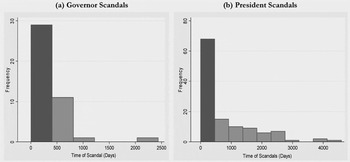
In general, scandals tend to be short lived events (Markovits and Silverstein Reference Markovits, Silverstein, Markovits and Meier1988, 3). Figure 1a depicts a histogram of governor-related scandals. The average length of a scandal (excluding one outlier) is 255 days.Footnote 16 Most state-level scandals last for less than 100 days, with only a few lasting longer. For instance, governor James McGreevey of New Jersey admitted that he was a homosexual and had an affair with another man the same day he announced he planned to step down as governor (the end of the scandal, or “failure” in the model). Scandals do not always end badly for governors, even if they are short. For instance, governor Bill Sheffield of Alaska, who was accused of misusing his office and lying under oath, was spared from impeachment after just 11 days of hearings after the Senate decided that there was not enough credible evidence to impeach him. In this instance, the scandal did not end in “failure” (as defined earlier). Longer scandals are generally those that require time to investigate. For instance governor Marvin Mandel of Maryland was arrested in 1975 for allegedly taking financial remuneration for assisting his codefendants in acquiring interest in horse racing tracks and increasing the number of days the state would allow racecourses to race horses (Franklin Reference Franklin1977). After two trials on charges of racketeering and mail fraud, he was found guilty and forced to resign his seat by state law.
Histogram of Presidential and Gubernatorial Scandals
Note: Gubernatorial data span 1972 to 2011. Presidential data span 1972 to 2009.

The data on presidential scandals also demonstrate that most national chief executive scandals end quickly. In fact, 19 scandals required less than one month from start to finish. Figure 1b presents a histogram of the duration of time until the scandal ended—like gubernatorial scandals, most of the cases are over within 100 days. Often, these fast-concluding scandals involve nominees, such as Bernard Kerik (Secretary of Homeland Security nominee), Douglas Ginsburg (Supreme Court nominee) and three “Nannygate” nominees (Kimba Wood, Zoe Baird, and Linda Chavez). Among office holders, Eli Segal, the first CEO of Americorps, resigned abruptly when it was alleged that he had conducted improper business relationships. Peter Bourne, President Carter's Drug Czar, resigned when he was caught writing a prescription for a fictitious individual (under the guise of giving the prescription to a White House colleague). In each case, because the scandal ended in resignation or firing of the official, each was classified as a “failure.” The median scandal lasts six months, but some scandals last much longer, particularly when an independent counsel is brought into play. For instance, the scandal involving President Clinton harassing Paula Jones lasted 53 months.
WHAT INCREASES THE RISK OF A SCANDAL ENDING BADLY?
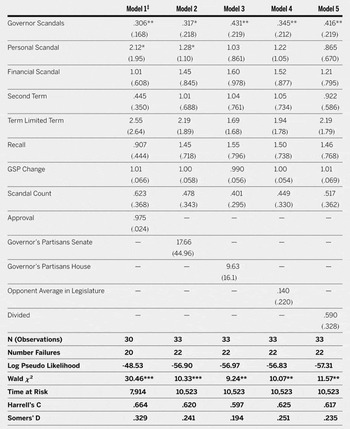
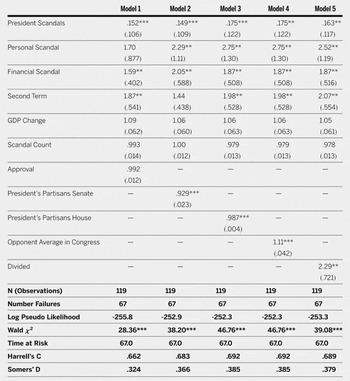
The analysis in tables 1 (state-level executives) and 2 (national-level executives) are the results of the models run with a Cox proportional hazard model as specified previously.Footnote 17 Parameterized models (included in the online appendix https://journals.cambridge.org/action/displayJournal?jid=PSC) demonstrate similar findings, suggesting robustness to the findings. In general, the data fit the model well. Cox-Snell (Cox and Snell Reference Cox and Snell1968) residuals plotted against Nelson-Aalen cumulative hazard function demonstrates substantial similarity, suggesting that the model fits the data. In addition, both tables 1 and 2 list the Harrell's C concordance statistic and the Somers' D statistic, measures of the agreement of predictions with observed failure (Harrell et al. Reference Harrell, Califf, Prior, Lee and Rosati1982; Harrell, Lee, and Mark Reference Harrell, Lee and Mark1996)—these demonstrate moderate to high levels of correctly identified order of the survival times.Footnote 18 The coefficients in each table are exponentiated coefficients of the hazard ratio, meaning that these coefficients have an interpretation of the ratio of the hazard for a 1-unit change in the corresponding covariate (Cleves et al. Reference Cleves, Gould, Gutierrez and Marchenko2010). Hazard ratios less than 1.0 indicate an increase in duration to “failure,” whereas hazard ratios greater than 1.0 indicate a decrease in duration. In essence, the models substantively explain the amount of time to “failure” based on the conditions outlined earlier—coefficients greater than 1.0 show a quicker negative end to a scandal, where coefficients less than 1.0 show a longer negative end to a scandal (akin to “surviving” scandal).
Gubernatorial Scandals Duration Models

‡ Truncated from 1993 to 2009 because of availability of approval data. Coefficients are exponentiated coefficients of the hazard ratio. Dependent variable: total time (in days) from when the story broke to when the scandal ended. Failure means the resolution to the scandal ended in resignation, firing or removal from office. The standard errors are robust standard errors, clustered by each scandal.
*** indicates statistical significance at p < .01.
** p < .05.
* p < .10.
Robust standard errors in parentheses.
Presidential Scandals Duration Models

Note: Coefficients are exponentiated coefficients of the hazard ratio. Dependent variable: total time (in days) from when the story broke to when the scandal ended. Failure means the resolution to the scandal ended in resignation, firing or removal from office. The standard errors are robust standard errors, clustered by each scandal.
*** indicates statistical significance at p < .01.
** p < .05.
* p < .10. Robust standard errors in parentheses.
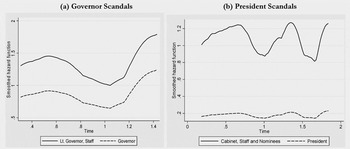
Table 1 identifies scandals involving state-level chief executives or staff.Footnote 19 The most consistent predictor of “failure” (or non-“failure”) in the duration models in each specification is whetherthe target was the governor. In each model specification, being the governor was associated with a 50% to 70% decline in the hazard of having the scandal result in removal from office, resignation, indictment, or conviction (our defined “negative” end). Being a powerful state official means that these individuals can more easily weather scandal because they are more protected by vested political interests and seek to keep a tight grip on state power (see Brown Reference Brown2006, Reference Brown2007). Putting it another way, figure 2a uses a kernel smoother to graph the hazard function for the “survival” of each political actor at the state level. The plotted lines show that the likelihood of a governor having a negative end to a scandal is significantly less than for others. The change in the probability of “failure” for governor and staff over time parallel each other, suggesting a degree of shared fate among state-level executive officials.
Cox Proportional Hazard Smoothed Functions: Chief Executive versus Staff
Note: Cumulative hazard functions of chief executives versus staff. Kernel smoother (Gaussian) employed which averages values over a moving window of data.

Personal scandals hasten a quick negative end to scandal at the state level (in models 1 and 2), where individuals facing personal scandals were three times more likely to have their careers end in removal from office, resignation, indictment, or conviction than scandals not of a personal nature. This finding fits a pattern found previously when personal scandals are more likely to be shorter than financial ones (Basinger and Rottinghaus Reference Basinger and Rottinghaus2012a) because alleged financial wrongdoing may require time to investigate and involve criminal wrongdoing, which tends to prolong their duration relative to personal scandals that rarely trigger criminal liability for the individuals involved. Indeed, such financial scandals are treated differently than other types of scandals (Andolina and Wilcox Reference Andolina, Wilcox, Rozell and Wilcox2000). The media also focus more attention on scandals that are salacious (Kiousis Reference Kiousis2003; Maurer Reference Maurer1999). Individuals also seek to limit personal embarrassment to themselves or their family when revelations of a personal scandal become public so they often resign more quickly when faced with a personal scandal.
Importantly, neither the institutional, economic, nor the public approval variables are statistically significant for cases involving state-level scandals in any of the modeles in Table 1.Footnote 20 First, for the institutional variables, this includes measures of political support such as the number of fellow partisans in the legislature (in either chamber) or measures of opposition such as divided government, or the average size of the opposition in the legislature. This suggests that governors' and their staffs' survival during scandal is not related to their institutional support or opposition.Footnote 21 Second, gubernatorial approval when the scandal breaks is also not statistically significant in model 1 (the time is truncated to 1993 to 2011 because of the availability of accurate polling data). The nature of the scandal seems to be of greater importance than the ability of the governors or their staff to count on loyal partisans for survival assistance. Because most of the cases of state-level executive scandals involve the governor and governors are less likely to have scandals end their political careers, institutional and political issues may not play a major role in affecting their chances for survival. Third, the change in GDP, signaling an improving economy, had no effect on the survival of governors. This finding is contrary to what other scholars have asserted, as discussed earlier, where a positive economy was thought to be a boon to surviving scandal.
Turning to national chief executive scandals, table 2 identifies the results of several model specifications involving the president, the cabinet, the White House staff, or executive nominees. Even more so than for governors, presidents are substantially less likely to end a scandal with removal from office, resignation, indictment, or conviction than their staff or executive nominees. Clearly the White House seeks to protect the president, even at the expense of public accountability. The formal structure of the White House encourages individuals who are damaging the administration to step aside. These staff can be thought of as political “lightning rods,” which are erected to draw the heat of blame away from more highly ranked administrators (Ellis Reference Ellis1994). Indeed, embattled political advisers historically have been the first to depart from office in the aftermath of a scandal (Cannon Reference Cannon2005). Figure 2b uses a kernel smoother to graph the hazard function for the “survival” of both types of political actors at the federal level. The plotted lines again show that the likelihood of a president having a negative end to a scandal is significantly less than for others, even more than the difference between the governor and gubernatorial staff in figure 2a.
Mirroring the modest effect found for governors, presidential scandals involving personal matters or financial matters tend to result in removal from office, resignation, indictment, or conviction much more quickly than financial scandals. The results show that the hazard of the scandal ending in “failure” is between one-and-a-half and two-and-a-half times greater for personal scandals than financial scandals. Both personal and financial scandals quicken an end to a political career, but personal scandals tend to do so more quickly. Although personal scandals (especially scandals involving personal indiscretions) may not be a “career killer” as it once was, the results from table 2 demonstrate that scandals involving personal indiscretions do hasten a more quick end to a political career (Baker Reference Baker2009). The public does distinguish between types of scandals (Doherty, Dowling, and Miller Reference Doherty, Dowling and Miller2011; Kagay Reference Kagay1999), and while both financial and personal scandals have different negative effects, when charting whether each scandal causes a more rapid end to a political career, personal scandals seem more damaging.
Considering the political and institutional mechanisms for surviving scandal, polled approval has no effect, but institutional factors have a large effect.Footnote 22 Like that of governors in table 1, the approval of the president before the scandal breaks has no effect on the duration of a scandal. On one hand, in terms of institutional support, when presidents have more support from copartisan members of the House or Senate, they are 9% and 10% (respectively) less likely to have a scandal end in removal from office, resignation, indictment, or conviction. On the other hand, putative opposition to the president has a positive effect on scandals ending in a politically challenging manner. When presidents have a greater percentage of opponents in Congress, scandals are 10% more likely to end in removal from office, resignation, indictment, or conviction, whereas when government is divided, presidents are 20% more likely to have scandals end in their removal from office, resignation, indictment, or conviction. In short, political strength in the form of more partisan supporters leads to a greater probability of survival whereas more opposition leads to a quick and negative end, consistent with expectations. This finding mirrors what scholars find in other presidential democracies (Kim and Bahry Reference Kim and Bahry2008).
Similar to the gubernatorial scandal findings, national economic success has an effect on scandal survival. Similar to table 1 explaining gubernatorial scandals, in table 2 the survival of presidential scandals are not affected by a change in Gross Domestic Product from the prior year. Although a good economy may serve as ballast against surviving some scandals, in general, there is no substantive effect of economic success on the likelihood of an executive scandal ending badly. The institutional support or opposition for the president is a more significant predictor of the survival of a scandal.
CONCLUSION
Scandals can result in untold damage to chief executives (Bowler and Karp Reference Bowler and Karp2004; Genovese Reference Genovese, Genovese and Farrar-Myers2012; Quirk Reference Quirk1998). Among other outcomes, scandals can decrease trust in government (Chanley, Rudolph, and Rahn Reference Chanley, Rudolph and Rahn2000), generate negative policy implications (Szasz Reference Szasz1986) and create extensive and often far reaching ramifications for American politics (Farrar-Myers Reference Farrar-Myers, Genovese and Morgan2012; Genovese and Morgan Reference Genovese and Morgan2012). Witcher (Reference Witcher, Jeffrey and Maxwell-Long2004) reminds us that three of the last eight presidents (Richard Nixon, Ronald Reagan, and Bill Clinton) have undergone a major investigation into their behavior and that of their advisers or associates. Journalists also lament that news reports consistently reveal “headlines from Washington to New York and beyond filled with word of scandal or allegations of wrongdoing” (Zeleny Reference Zeleny2010). Given this ubiquity and the importance of scandal and the toll that such events have on cooperation and governing, we need to better understand the dynamics of what shapes the duration of a scandal and the way scandals conclude.
Conventional wisdom holds that politicians must be cunning strategists, effective leaders, and popular to survive a political scandal (Kurtz Reference Kurtz1991; Shear Reference Shear2011). Although there is some general truth to this, this article shows some consistent patterns affecting national and state chief executives. If surviving scandal is the politician's (or staff 's) goal, it is better to be the elected representative and have greater support in the legislature. If a scandal is personal, financial, or when opposition within the legislature is great, scandal is much more difficult to survive. A booming economy does not necessarily help executive officials survive a scandal. And, although more popular politicians are thought to find it easier to weather a scandal (Sonner and Wilcox Reference Sonner and Wilcox1999), these data demonstrate approval of either presidents or governors has no effect on the duration of scandal. Greater political support from a president's (but not a governor's) partisans is generally helpful in surviving scandal. The ability to survive scandal, then, is connected to the executive's ability to govern and maintain a viable political coalition rather than the amount of adulation received by the public, affirming the partisan institutional importance of governing in crisis.