Introduction
As the keyboardist struck up a biguine, the bamboo flute player I had just met abruptly walked out of the weekly jam session going down at Le Vieux Foyal, one of the few restaurants or bars that was still open on a late weeknight in downtown Fort-de-France, Martinique.Footnote 1 I found him outside having a smoke break, semi-fuming from the musical turn of events. When I asked him what was up, he explained that he didn't play that ‘genre’ of music because it was, in his terms, ‘macaque’ music, ‘monkey’ music played by black Antillean musicians to entertain white French audiences. (He prefers ‘free jazz’.)Footnote 2 His strong reaction testified to the resentment many still feel about the colonial conditions of the biguine's performance and circulation since its emergence at the turn of the 20th century. The legacy of French colonial and imperial power, combined with histories of pan-Caribbean cultural migration and creolisation, have made the musicking and musicology of the French West Indies an ideologically charged and territorial endeavour – so much so that the Creole proverb Sa ki taw, se taw, sa ki pa taw, laissé i (That which is yours is yours, that which isn't yours, leave it be) has become a leitmotif in narratives of Antillean musical history.Footnote 3 Serving as a warning as much as an encouragement to have pride in one's own cultural traditions and history, the formulation's tone expresses anxiety over dynamics of mimicry, mixing and expropriation. But while the proverb incites us to safeguard ‘ours’ and to leave ‘theirs’ aside, it tells us little about how to discern the difference between the two, and it turns a deaf ear to the histories of métissage and creolisation that blur its inside-outside binary logic, indeed forming the very conditions of possibility for its own Creolophone expression.
Given the ideologically fraught web of contesting claims about the self-exoticism (doudouisme), cultural assimilation and geographic belonging of the biguine, how can or should the scholar navigate its music or locate its generic and cultural boundaries? Jacqueline Rosemain, in La musique dans la société antillaise: 1635–1902 Martinique Guadeloupe (Reference Rosemain1986), adopts the strategy of empirical neutrality: ‘Nous n'avons nullement la prétention de détenir la vérité’ (We don't pretend to hold the truth), she writes. ‘Nous avons tenté de signifier les faits sans esprit partisan’ (We have tried to represent the facts without bias). ‘Nous avons choisi délibérément de rester en dehors de toutes querelles politiques et ethniques. […] La route est parfois ardue, mais, combien enrichissante’ (We have deliberately chosen to stay outside of political and ethnic debates. […] The path is arduous, but, so enriching) (Rosemain Reference Rosemain1986, p. 9). Rosemain's stance assumes empirical musical facts suffice as criteria for the identification of generic boundaries, but considering the hybrid nature of Antillean musical culture, strictly empirical constructions still must pick and choose which musical elements (dance, rhythm, instrumentation, language, lyrical content) count more and which count less. Even then some genres may defy categorisation while remaining stubbornly charged with ideological implications. Attempted neutrality ends up constituting its own position-taking gesture.
Jocelyn Guilbault (Reference Guilbault, Dale and Sheehy1998) points towards this problematic in her history of Guadeloupian musical traditions, but she too shies away from directly inserting herself in the debate:
[F]or generations, questions of what Guadeloupian music is, and what it is not, have been controversial. Since music is part of the power structure (Rosemain Reference Rosemain1986, p. 12) and historically served to control slaves, the definition of Guadeloupian music has always had great political significance for the local population. Appropriated by separatist parties and associated with their rejection of colonial influences (and thus of any European-derived music), this controversy, articulated most intensively from the late 1970s to the mid-1980s, has incited local musicologists, journalists, and musical activists to hold public debates about their traditions. The problem remains: by which criteria does one distinguish between traditional and modern music, and between local and imported music? Everyone agrees that drumming is an essential element of Guadeloupian music. But how to evaluate the local quadrille – as a relic of a European tradition? or as a new reality, with a new local meaning? And the beguine – as a variant of European ballroom dances? Instead of engaging in this debate (which would centre more on political orientations than on musical practices), I will examine how musical traditions in Guadeloupe show unity in diversity. (Guilbault Reference Guilbault, Dale and Sheehy1998, pp. 874–5)
Guilbault pinpoints the difficulty of ‘evaluating’ Antillean musical practices given their hybridity and the ways in which they have been mobilised politically, but she avoids ‘engaging in the debate’ by casting the torn ideological terrain of Guadeloupean musical practices and productions as ‘unity in diversity’. Guilbault's and Rosemain's critical gestures are admirable. They demonstrate cultural sensitivity and avoid assuming the position of outside (imperial/scholar) arbiter. Their approaches strive for musicological rigour and attempt to keep political ideology out of the analysis while respecting competing local and regional claims and histories. But does the ‘unity in diversity’ call, which highlights the undeniable commonality of Caribbean musical practices and structures, not risk resonating with island paradise discourse by silencing the dissonant social relations behind the apparent musical harmony? Does this not admit that Antillean musical meaning and value do not, after all, only rely on the empirical, but rather on a range of ideological forces, affective investments and histories of power animating the field of culture production in which it manifests?
Instead of engaging in this musical debate about the origins and generic boundaries of the biguine, and instead of turning a deaf ear to the ideological dissonance in Antillean musical diversity and creolisation, I suggest that biguine scholars trace and lay claim to the genre even as it crosses national, musical and cultural boundaries. Following the transnational and transatlantic approaches of scholars like Paul Gilroy (Reference Gilroy1993) and Brent Hayes Edwards (Reference Edwards2003), this approach is not at all radical; it is instead purposely inclusive. Discourses of racial and cultural mixing – whether ideologically read as assimilation, métissage or miscegenation – constitute a key dimension of biguine cultural history, one that can expand, rather than restrict, our appreciation of how biguine music circulates in the world. This means paying attention to the various ways musicians and audiences located the genre within problematic colonial discourses and mythologies of race, but it also means thinking through the ways the genre's dynamics of national, racial and cultural line-crossing undermine these same mythologies.
Following the biguine as it moves through the black Atlantic in chanson coloniale and jazz genres, this paper extends biguine discussion beyond its empirical musicological elements to suggest its influence on musical creativity and racial imagination on both sides of the black Atlantic. I adopt Gilroy's conceptual Black Atlantic (Reference Gilroy1993) model, to critique the ways in which black diasporic musical traditions serve in discourses of racial essentialism despite their manifest hybridity, and emphasise the importance of the dynamics of travel and diaspora in biguine cultural history. I ask: What do French chanson coloniale and American jazz say about the French West Indian biguine? Specifically, how do two well-known songs about the biguine – the chanson classic ‘La Biguine’ (1932) by French comedian Dranem (1869–1935), and the American jazz standard ‘Begin the Beguine’ (1935) by Cole Porter (1891–1964) – circulate the genre musically, discursively and generically, along with ideas about it? ‘La Biguine’ and ‘Begin the Beguine’ are not, nor do they necessarily purport to be, biguines in their musical form; rather, they are songs about the biguine, articulated from different musical positions. In this way they speak to the imperial conditions of the biguine's renown in France and abroad, and tell us about the fantasies of travel and contact with others that proved crucial in mapping black Atlantic modernity.
Jazz Age Paris, negrophilia and le tumulte noir
In the early 20th century black Atlantic and ‘colonial’ music, dance forms and performers – the biguine included – captured the French imagination and made Paris, especially ‘the quarter called Harlem in Montmartre’ (Shack Reference Shack2001) and the section of Montparnasse that featured Antillean music, famous for its nightlife.
Music-hall revues staged against the backdrop of spectacular colorful settings perpetuated a culture of fantasy, depicting other worlds and other peoples. At the Folies-Bergère, Moorish decorations complete with a Turkish bath and luxuriant green plants created an illusion of a scene from the Arabian Nights. Black Antilleans gave life to static stage props; black Americans gave to musical revues a melange of high-jinks, comic burlesque, and song and dance not hitherto witnessed. (Shack Reference Shack2001, p. 8)
French orientalism and imperialism animated the staging of this international ‘collection’ of musical cultures, even as the power of their combination and juxtaposition constituted its own force. ‘La Biguine’ and even ‘Begin the Beguine’ must be heard within the context of France's diverse musical scene and the logic of French imperial fantasy. Before proceeding to a close reading of these songs, it is important to craft an analytical vocabulary that specifically resonates, as these songs do, with the biguine's dynamics of black diasporic movement and hybridity, and with its embeddedness in French imperial discourse and colonial history. Terms like Jazz Age Paris, negrophilia and tumulte noir must be carefully examined to understand the range of common perceptions and analytical perspectives adopted then and now in the evaluation of the history and meaning of black musical practices and performances in France during the first half of the 20th century.
‘Jazz Age Paris’ or ‘Jazz Age France’ denotes a more or less clearly defined period in music history within a particular cosmopolitan context. It focuses mostly on the experiences of black and white American expatriate communities in France, and suggests juxtapositions and parallels in the experiences of black cultural life on both sides of the Atlantic (demonstrated in the formulation ‘Harlem in Montmartre’). ‘The Jazz Age in Paris, 1914–1940’, curated by the Smithsonian Institution Traveling Exhibition Service (SITES) between 2001 and 2003, portrayed the cultural moment as part of America's jazz heritage. This perspective obscures the range of music and performance styles in France since the turn of the century, and the work of people of colour from around the world who participated in this cultural musical history. Jazz Age discourse often erases the voices of colonial populations and downplays the imperial conditions of black diasporic cultural practices in France, overlaying French imperial fantasy with American imperial consumption. I will suggest a critical revision of this double erasure to consider the ways in which black Atlantic and ‘colonial’ musical performances and practices, precisely in their diversity, literally and figuratively disrupted imperial scenes of power.Footnote 4
Negrophilia discursive framework (see, for example, Berliner Reference Berliner2002 and Archer-Straw Reference Archer Straw2000) is attuned to the intersections between black Atlantic musical culture and the racial dynamics of imperial power, and focuses on the ambivalence of colonial desire – the ways black people and cultures have always been subject to dominant culture's simultaneous fascination and repulsion.Footnote 5 The term negrophilia has been around since the early 19th century in the context of slavery and abolition. While the term carried some positive associations by the 1920s in France, when negrophile could refer to a learned individual interested in African art and artefacts, its earlier usage carried negative connotations in dominant white-supremacist slave and colonial society:
To be called a ‘negrophile’ or ‘nigger lover’ in the nineteenth century was to be damned as a supporter of liberal attitudes towards slavery and its abolition. Even more negatively, negrophiles were sometimes accused of having a deviant sexual appetite for blacks, thereby placing them outside ‘civilized’ society's moral boundaries. (Archer-Straw Reference Archer Straw2000, p. 9)
The connotations of sexual deviance that negrophilia carried in the 19th century, pathologising white and black relations, continued into the 20th century. However, in the French context at least, interest in African art and the popularity of African American and Antillean musical culture in the early and mid-20th century transformed the social and cultural conditions of interracial imperial fantasy, consumption and contact.
Tumulte noir does not have the kind of currency as a historical musical period that Jazz Age Paris does, nor does it have the longstanding historical and critical currency of negrophilia discourse; however, I believe it can serve as the name for another crucial analytical perspective on black Atlantic musical practices in France. The word tumulte aptly evokes the associations with disorder, sound and movement specifically manifest in biguine cultural history; one might even extend it to reference the tensions manifest in biguine music on the islands as well. Admittedly, this mostly referred at first to the arrival of Josephine Baker in La Revue nègre (1925), for which the French artist Paul Colin drew a collection of lithographs titled Le Tumulte noir (1927). Colin's poster art for La Revue nègre and his collection of lithographs crystallised the striking cultural and social upheavals of modernity taking place through the imperial and cosmopolitan intersections, sparked by war, black diasporic and colonial migration, and the French tourist industry (Blake Reference Blake1999). Considering that Colin's style was obviously inspired by Mexican artist and anthropologist Miguel Covarrubias's work, which included the costumes and set designs for the Baker show, the collection of lithographs itself was the product of the dynamics of trans-Atlantic influence, exchange and appropriation that the analytical perspective of tumulte noir can conceptually emphasise. Jody Blake (Reference Blake1999) pays careful attention to tumulte discourse even though, regrettably, by the end of her study she often interchanges tumulte noir with jazz-age (at times hyphenated and at times presented as two words) without distinction. I think it useful to affirm and continue Blake's critical and linguistic impulse in order to examine the ways in which black musical mobility and hybridity functioned within, and flowed through, specifically French and Francophone historical and discursive frameworks. In this way the tumulte noir can signify the ‘disorderly’, ‘out-of-control’ consumption of black diasporic cultures in France, whose ‘noisy’, sonic dynamics of travel and migration instigated profound upheavals in the aesthetic and ethical norms of dominant white society, and produced heteroclite juxtapositions, encounters and mixings in everyday cultural life.
The use of the term tumulte noir in practice and criticism reveals how these associations function as a common trope in the attempts to represent a musical-cultural moment. Often figured as the ‘storming’ of Europe by black entertainers, tumulte noir resonates in 1920s France with the language of war, and accordingly evokes the idea of black musical cultures raucously, if playfully, invading and overwhelming French society. For example, Karen Dalton and Henry Louis Gates, Jr. describe the way ‘Josephine Baker, and her act, La Revue Nègre, took Paris by storm in 1925’ (Dalton and Gates Reference Dalton and Gates1998, p. 903, my emphasis). More generally in this vein tumulte noir discourse suggests a perceived suddenness of popularity as well as a disruption of dominant cultural rhythms. The autobiography of Ada ‘Bricktop’ Smith, one of the pioneers of black cabaret jazz culture in the first half of the 20th century, demonstrates the contemporary use of the term: ‘By 1925 [when Josephine Baker arrived with La Revue nègre] Paris was having its own version of the Harlem Renaissance. It was called Le Tumulte Noir. I may have benefitted from this great interest in Negro things, but Josephine became a star overnight’ (Smith and Haskins Reference Smith and Haskins2000 [1983], p. 107). As Bricktop's quote shows, negrophilia, jazz age and tumulte noir discourses do not function in mutually exclusive ways. Smith parallels le tumulte noir, the Harlem Renaissance (Jazz Age discourse) and a ‘great interest in Negro things’ (negrophilia discourse), but her periodisation subtly points to the fact that the cultural moment preceded Baker's arrival, and her characterisation of the tumulte relates to the sudden sense of success. Tumulte noir discourse often references ‘gusts’ and ‘winds’ of change in French modernity that create madness and disorder, whether cast in a playful light as in the Folies-Bergère show Un Vent de folie [Crazy Wind, or Wind of Madness] starring Baker in 1927, or in a critical light, as for example in Jean Cocteau's disparaging notes in Cock and Harlequin (1921) about the American band he viewed at the Casino de Paris with its ‘hurricane of rhythm and beating of drums, a sort of tame catastrophe which left them quite intoxicated and blinded under the glare of six anti-aircraft searchlights’ (Cocteau Reference Cocteau and Myers1921, p. 14; see Jackson Reference Jackson2003, p. 20).
Contemporary historians and cultural critics still utilise tumulte noir discourse even if they aim to problematise some of the dynamics of negrophilia within it. For example, in Making Jazz French Jeffrey Jackson describes the negative reaction to black cultural art forms and entertainment in France:
Not everyone appreciated the sounds of syncopated music, roaring improvisations, or clashing drums imported from beyond French borders. Jazz's detractors argued that, among other things, as a music it was nothing but noise. As a cultural phenomenon they charged it with being a symbol of decadence and danger in an already tumultuous age. (Jackson 1999, p. 180, my emphasis)
Tyler Stovall adopts the same language: ‘At the center of that storm the French called les années folles, the crazy years, stood black jazz musicians and performers’ (Stovall Reference Stovall1996, p. 26, my emphasis). As Stovall's pioneering work ultimately indicates, this tumulte was the boisterous movement across national and racial lines, but it was also the disoriented perception of black cultural movement as registered through mythologies of otherness. Jackson, Dalton and Gates, and Stovall reference tumulte discourse to emphasise the popularity of black performance in France, and to suggest the ways in which fascination with that performance disrupted the cultural, colonial and racial boundaries of the French nation.
While negrophilia emphasises desire, tumulte emphasises transformation of local landscape or transport to an ‘exotic’ other place. When fantasies of physical transport fuel fantasies of romantic transport, the perceived origins and location of musical performance play an important role in its commodification and consumption. Just as dominant American and French societies perceived race differently, the racial valence of black Atlantic music shifts as it crosses borders, and these shifts influence patterns of consumption. Micol Seigel's (Reference Seigel2005) study of the curious process of whitening that takes place within the international consumption of the Brazilian maxixe Footnote 6 demonstrates the race work done through the transnational flow of musical cultures across the Atlantic between France, the US and the Caribbean:
The interlinked aspects of this process tellingly illustrate the broader ideological context. Maxixe was stripped of its Afro-diasporic or Brazilian affiliations, celebrated as kin to tango and to France, and finally, absorbed into jazz as jazz itself was increasingly proclaimed a racially neutral, ‘American’ form. (Seigel Reference Seigel2005, p. 99)
As Seigel suggests, language and naming play an important role in the ways in which the travelling trajectory of musical culture inflects the construction, performance and consumption of its perceived racial and cultural difference. The French language and purported provenance of the maxixe, Seigel shows, helped make the dance form more appealing for white popular audiences in the US. ‘Promoters of maxixe in the United States played up its Frenchness and French success with zeal. […] Many offered maxixe titles and descriptions in French or gave the genre name in French’ (Seigel Reference Seigel2005, p. 101).
At the same time, American perceptions of the value of French culture are full of ambivalence and contradiction. Seigel shows that the American music industry sought to capitalise on American associations of ‘Frenchness’ with cultural refinement and prestige, but Americans also associated France with sexual excess and cultural decadence, an important part of which included French notions of race and the rules of racial relations – notions that contrasted sharply with those of the US.Footnote 7 Jody Blake explains that
at least in the cosmopolitan Latin Quarter, blacks from Africa and the Caribbean joined the other devotees of the fox-trot and the tango on the dance floor. The Bal Bullier, for example, had a long-standing tradition of welcoming blacks. When Vanity Fair published an article on this dance hall in 1914, its most noteworthy feature from the point of view of American readers was apparently that ‘No Color Line Is Drawn at the Bal Bullier’. (Blake Reference Blake1999, p. 54)
The notoriety of the supposed liberal negrophilia and cultural mixing of French society and culture locates France, and Paris particularly, in the trans-Atlantic imagination as a place where consumption of black bodies and cultures took place, but also where lasting bonds might be formed across national, racial and cultural lines.
The tumulte noir created occasions for encounters and exchanges across race and nationality otherwise seen as threatening to American and French cultural norms. ‘As a colonial metropolis’, Jennifer Boittin (Reference Boittin2010, p. 39) writes, ‘Paris provided locales for interracial encounters that moved from public to private spaces, encounters that were not only intellectual and artistic but also personal, and that were not merely passing, but also enduring’. Just as ‘the success of [Colin's] images relied upon the presence of white and black within the same frame’ (Blake Reference Blake1999) the success of biguine music in France and in the Antilles comes from the ways it put blacks and whites into the same frame – lyrically, musically, on the stage and on the dance floor. In fact this turn of phrase can be taken quite literally: Colin's work served as the decor for the backdrop at La Boule Blanche, one of the most popular biguine clubs of the 1930s (see Roland-François Lack's analysis of photographs of Antillean clubs in the 1930s within a larger study of filmic maps of Paris). As Brassaï's Paris secret des années 30 (The Secret Paris of the 30s) (Reference Lack1976) shows, the club nights featuring Antillean musicians became especially renowned as sites for interracial encounters: ‘Color was not a barrier to having fun at Le Bal Nègre but rather a catalyst, and when they danced together, explained one journalist, “blacks and blacks, whites and blacks, blacks and whites possessed the same frenetic rhythms”’ (Jackson Reference Jackson2003, p. 44).
Part of this extended contact comes from the fact that, while the earliest African American musicians associated with the period arrived in the 1910s or 1920s (such as James ‘Reese’ Europe or William Marion Cook), the French West Indian community in Paris predates the network of musicians, writers, artists and US soldiers that formed the tight-knit black American expatriate community in Paris crucial to the ‘Jazz Age’. Indeed, as Martinique, Guadeloupe and French Guyana were the oldest colonies in the French empire (since 1635), they have a long history of cultural mixing (assimilation, métissage, creolisation), a subject of fascination in French imperial discourse.
The Colonial Exposition of 1931 in Paris sought to demonstrate the ‘special’ history of relations between continental France and the French West Indies by featuring live performances by Alexandre Stellio's biguine ensemble in the Martinican pavilion. As Patricia Morton shows, the Exposition inscribed difference between colonial cultures and imperial framework into the very architecture and spatial layout of the exposition grounds with a ‘strict architectural hierarchy: a variant of Art Deco for the metropolitan pavilions of the colonies […], and “naïve” styles for the pavilions of the colonies’ (Morton Reference Morton2003, p. 89). However, the Exposition took a different tack with les anciennes colonies by creating a more ‘modern’ architectural style for the French West Indian pavilions. Further, ‘the architectural and political integration of the Caribbean colonies into La plus grande France had a sexual equivalent at the dance hall, where Caribbean women danced the beguine and the Charleston with Frenchmen’. As she notes:
Writer Géo Baysse celebrated these contacts in his book, En dansant la biguine [souvenir de l'Exposition coloniale 1931], an homage to the women of Guadeloupe and Martinique[.] Baysse effused about their ‘natural’ suppleness and rhythm and called on them to take their rightful place in French civilization. He composed a conversation between Georges, the French narrator, and Flore, his Guadeloupan [sic] interlocutor, in which Georges hypothesized the transformation she might produce in a naive Frenchman. On conversing with her, the Frenchman would be surprised to find that her language and expressions were his and that the color that she brought to their conversation captivated and haunted him. Baysse speculated that, many years later, the Frenchman would ‘recall with pleasure the memory of the little flirtation that you had on one of those lovely, unforgettable summer evenings, while dancing the beguine …’. (Morton Reference Morton2003, pp. 32–3)
The melancholy that Americans and French heard in the biguine, that they transformed into romantic intrigue and colonial nostalgia, was likely in part reflecting, and resonating with, the nostalgia for home Antilleans felt in continental France. The Bal Nègre was a meeting spot frequented by French West Indians before it was ‘discovered’ by the French and tourists (Léardée Reference Léardée, Meunier and Léardée1989). But narratives like the one constructed by Guy Baysse and others rerouted the pathos of Antillean musical performance and practices with French imperial nostalgia and the longing for French Creole women. While the French associated jazz in a large part with American modernity, biguine music was encoded as quaint and folkloric. Eventually, as Jeffrey Jackson shows, generations of French musicians incorporated jazz into French musical culture, but such has not been the case for the biguine genre. Rather than adopting the musical style itself, songs like ‘Begin the Beguine’ and ‘La Biguine’ are biguine in name only, in order to play on the dynamics of negrophilia, French colonial mythology and tumulte noir associated with and manifest in biguine cultural history.
Le béguin for ‘La Biguine’: French chanson's crushing embrace
Dranem's ‘La Biguine’ (1932) crystallises the types of French imperial mythologies that saturated the staging and reception of biguine cultural practices in France, and which, I contend, likely influenced Porter's song as well. ‘La Biguine’ further amplifies the perceived relationship between Antillean musicality and stereotypes of Antillean women and sexuality that date back to the story of the tragic Creole mulatta who used her musical talents to seduce and please white Frenchmen.Footnote 8Chanson coloniale, as well as colonial literature and film, participate in the construction of this idea about the musicality of the Antillaise. For example, Simone Simon's 1934 ‘Moi tout faire pour te plaire’ (Me Do Anything to Please You) depicted young Antillean maids as ideally available for all types of domestic, musical and sexual labour. And Dranem was not the only chansonnier to reference the biguine within non-biguine musical contexts. From the comedic song of Charles Trenet (‘Biguine à Bango’, 1940) to that of the 1970s French group Les Charlots (‘La Biguine au biniou’, 1976), French popular musicians consistently employ wordplay to equate la biguine with sex, especially sex with black or mixed-race Antillean women. Unlike ‘La Biguine’, ‘Biguine à Bango’ or ‘Biguine au biniou’, ‘La Biguine’ inscribes the biguine among other popular dance genres from the Americas, all of which are thrown into association with Parisian promiscuity, cast as the amusing pastimes of colonial subjects and sexual deviants that threaten to spread to the highest places.
Au conseil du cabinet l'autre jour on parlait
de nos colonies lorsque voici
le ministre intéressé qui se met à danser
roulant comme ceci son nombril
Les autres secrétaires se piquaient
mais lui leur répliquait
n'être pas fou ni pas saoul
Je danse un pas colonial
c'est original
très couleur local
At the cabinet meeting
the other day they were speaking
about our colonies when
the minister in charge starts dancing
the other secretaries were upset
but he responded
he wasn't crazy or drunk
I'm dancing a colonial step
it's very original
very local colour
Dranem's biguine comedy has to do with the incongruence between the dance and its manifestation in French space, specifically the domestic space of the bedroom and the space of imperial institutions and administration. The dance's playful irruption in each space provokes the potential eruption of disorder, requiring an explanation, providing the occasion for double entendre punchlines. The spread of the genre through spaces of popular culture, domesticity and state power equates its popularity with promiscuity, betraying anxieties about miscegenation in its humour. In ‘La Biguine’, instead of representing black bodies as overly sexed and promiscuous, the lyrics depict white bodies, marital partners and government representatives as unable to remain faithful to the roles and responsibilities of race, gender and empire because of the irresistibility of the dance.
Dranem's ‘La Biguine’ demonstrates the ways in which ideas about the biguine resonated with the attraction to, and fear of, black and colonial culture disrupting the norms, hierarchies and racial boundaries that distinguish the French from its colonial others, and thus ensures imperial and racial privilege. It might not be misreading Dranem to suggest that, despite dismissing the biguine, the song's subtext pointedly mocks the authority and rhetoric of official imperial discourse and the dominance of French high culture. Still, Dranem's song echoes one of the dominant features of colonial love narratives: colonial love never lasts. The song marks the biguine as an uncontrollable but also unsustainable passion. The sequence of ‘dance seasons’ that opens the song, evoking ‘exotic’ climate zones and bodies as much as the passing fads of dance culture, serves to reassure that the biguine will have no staying power. In the song's temporal logic, these genres do not co-exist as they did in actuality. Instead the imperial subject samples a range of national, colonial, ethnic and racial others in a series of (temporally, geographically and discursively) discrete and erotically charged encounters. Dranem emphasises the sexual nature of everyone's enthusiasm for the latest American dance with ‘local colour’, lines that he makes sure to deliver with the proper slurred emphasis. In short, sampling the biguine in this logic means sampling a sexual, cultural and even geographic experience of otherness, or at least fantasising about doing so. But, like many colonial love narratives, ‘La Biguine’ ultimately represents the genre's temporality in tension, casting its ephemerality (reason not to worry about its attraction) against its iterativity and contagion (reason to stress its appeal).
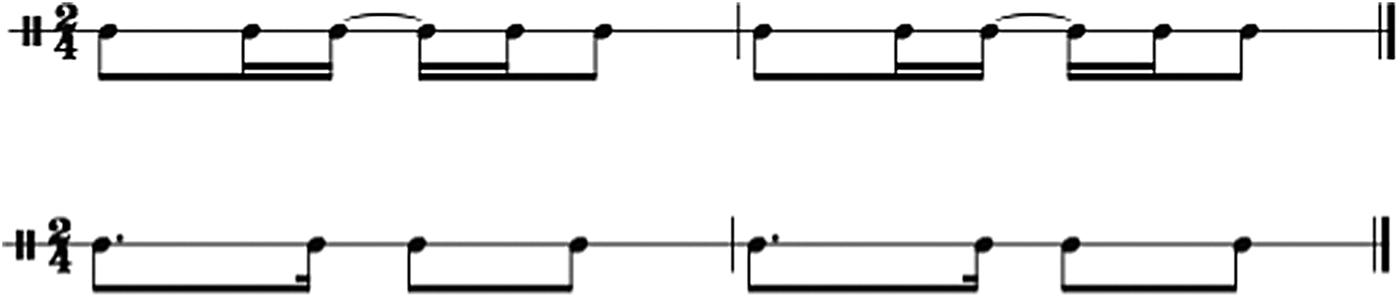
The temporal encoding of the biguine also takes place at the level of rhythm. ‘La Biguine’ hints at, but fails to represent accurately, the Caribbean cinquillo, the distinctive rhythmic base of a group of Antillean genres including the biguine. Using castanets, instead of the chacha shaker typically used and often noted in French cultural descriptions of Antillean musical practices, Dranem's ‘La Biguine’ straightens out the syncopation of the cinquillo even if the rhythmic reference still comes through (represented in Figure 1 by the upper line's five notes as opposed to the four in Dranem's ‘faux’ cinquillo). The rhythmic clave in ‘La Biguine’ more closely resembles a tango rhythm than a biguine cinquillo. Dranem laughs his way through the verses, and as the prosody of the lyrics falls clumsily about the faux cinquillo, the repeated vowel sounds evoke both petit-nègre (a colonial stereotype and imperial construction of black speech) and the stammering of a drunk, forming the basis of the song's off-kilter lyrical scansion. The temporal encoding of the song at lyrical and musical levels serves crucially to ensure comedy prevails over anxiety in this (faux) biguine representation of racial and colonial mixing.
Cinquillo rhythm (top) vs. ‘faux’ cinquillo in Dranem's ‘La Biguine’ (bottom).

What is this thing Cole Porter calls ‘beguine’?
While Dranem's biguine plays on the French expression ‘to have le béguin’, a passing fancy, Cole Porter's internationally popular ‘Begin the Beguine’ represents the genre as an ‘exotic’ musical transport to a place of impossible renewals and ‘evergreen memories’. Porter's song adopts tumulte noir discourse, tying the biguine to a crucial thematic in his work more generally: how by changing one's space one can explore unconventional ways of loving. Porter's classic ‘What Is This Thing Called Love?’ (1929) crystallises this theme. On the one hand, the question in the refrain sounds rhetorical and distinctly dismissive: ‘this thing’ sounds both foreign and material, but worn or of dubious value. As if looking for the words to explain and identify it, and coming up empty, ‘this thing’ lies at the border of representation and relevance. On the other hand, the question suggests an encounter with something new, and possibly useful, calling for experimentation.
In Porter's aesthetic, experimenting with new genres of love, and questioning the traditional conditions of intimacy, becomes possible especially through musical, linguistic and cultural displacement. In Porter's lyrics, modern cosmopolitan love often involves frank engagement with international economies of material gain – or, to put it differently, ‘Love for sale / appetizing young love for sale / love that's fresh and still unspoiled / love that's only slightly soiled / love for sale’ (‘Love for Sale’).Footnote 9 Here, crude material and cultural exchanges do not exclude the possibility that (imperial) cosmopolitan love may still offer something, some ‘remainder’, that transcends its harsh conditions of possibility, and that creates the space and time for forms of intimacy otherwise condemned in dominant imperial culture.
Critics and biographers have been reluctant to acknowledge the influence of Porter's international travels on his work. Schleifer, for example, writes:
Throughout his life, Porter himself repeatedly claimed exotic origins for his songs based upon his lifelong world travels: ‘Night and Day,’ he claimed, originated in Morocco; ‘Begin the Beguine’ in Kalabahai; ‘You're the Top’ in a faltboot as he floated down the Rhine; ‘What Is This Thing Called Love?’ in Marrakesh – though Porter's biographer […] suggests that Porter is not quite honest in these accounts. But more than his sophisticated internationalism, the metonymic displacements emphasize the rhythms of desire that inhabit his songs and music. (Schleifer Reference Schleifer1999, p. 8)
Whether or not his travels left concrete musical traces of inspiration on his work, Porter's aesthetic explores modern love and desire through travel and displacement. From this perspective, ‘Let's Do It’, for example, serves as an evocation of the many sites and ways of loving available to the modern world. The lyric charts an international itinerary that implies just as many ways to love and make love: ‘In Spain the best upper sets do it / Lithuanians and Letts do it / Let's do it, let's fall in love // The Dutch in old Amsterdam do it / Not to mention the Fins / Folks in Siam do it, think of Siamese twins / Some Argentines, without means, do it / People say in Boston even beans do it / Let's do it, let's fall in love.’ There's still something imperial about it, but breaking down conventional barriers to a range of intimate possibility serves as a musical Noah's ark, saving humanity from the deluge of destruction that marks the mid-20th century.
‘Let's Do It’ is one of Porter's list songs, a genre that, as David Savran explains, ‘both represents and produces desire by catalog[u]ing a wide range of coveted people, places, and things’ (Savran Reference Savran2012, p. 535). ‘Begin the Beguine’ is not a list song, but it participates in the construction of an inventory of ‘people, places, and things’ that Porter musically assembles in his work. ‘Beguine’ functions as a signifier in the metonymic chain of desire that builds on the ambivalence of language and double-entendre, the confusion of musical genres, and the paradoxes of colonial desire in order to create queer spaces for love. Brassaï's photographic collection of the ‘darker’ side of the City of Light supports this metonymic reading of Porter's ‘exoticism’. Le Paris secret des années 30 (The Secret Paris of the 30s) includes iconic photographs of queer spaces of Parisian nightlife alongside photographs of white women dancing with black men at the Antillean clubs Le Bal Nègre, La Boule Blanche and La Cabane Cubaine. Brassaï's ethnographic aesthetic recalls the gender play in Porter's work, passing under the signifier of musical difference and with the traffic of cultural exoticism and imperial discourse.
Porter situates France as a most important site for personally and discursively mapping modern cosmopolitan love and its spaces of sexual dissidence. Active on the Parisian musical scene in the interwar years, his musical takes on France and French-located cosmopolitanism are now part of the American songbook and live on in the American cultural imagination. Here France is a place full of romance, beauty, fashion and passion, but also full of decadence, heteroclite to the point of violence and chaos (tumulte), and flaunting its moral degradation like it was the latest style (all themes highly resonant with miscegenation discourse). Similarly, ‘I'm Always True to You (In My Fashion)’ (1948) exemplifies this decadent ‘queer’ modern love. Here a woman promises her own rules of fidelity, one with caveats for financial and material opportunities for gain elsewhere, especially in France: ‘Mr Harris, plutocrat wants to give my cheek a pat / If the Harris pat means a Paris hat / bébé ooh la la! / Mais je suis toujours fidèle darling in my fashion / Oui je suis toujours fidèle darlin in my way.’Footnote 10 The recent Broadway revival recording of Kiss me Kate (2000) goes much further than some recordings to emphasise these exotic love interests through rhythmic and melodic cultural references and stereotypes. After the French interjection ‘ooh la la’ the band interjects a musical citation from Jacques Offenbach's operetta Geneviève de Brabant, ‘Couplet des deux hommes d'armes’, also known as ‘The gendarmes’ duet'. (A tune re-scripted in American popular culture and known as ‘Marine's Hymn’, with the opening lines ‘From the halls of Montezuma’, it is an imperial narrative of American military might and bravery around the world.) Following this musical interjection there is a break during which the rhythm and horn sections drop out, and the voice sings to the solo accompaniment of an accordion in tempo rubato, completing the French musical resonance.
But what Porter's musical formation and imagination owes to France,Footnote 11 it also owes to the ‘exotic’ international musical culture and pleasure industry that powerfully emerged there during the early and mid-20th century. Not only French but ‘tropical’ or ‘colonial’ references frequently constitute the backdrop of Porter's love songs: for example, ‘Night and Day’ evokes a love ‘Like the beat, beat, beat of the tom tom / when the jungle shadows fall’. While displacements in place or time make alternate love formations possible, ‘Night and Day’ situates the constancy of love as proof of the possibility of deep intimacy between self and other in the past and the present. Porter's transnational musical fashioning of love suggests alternate ways of being true to oneself, to the other and to the relation. Trafficking in the contingencies of place and time for an alternate definition of truth, Porter's work explores the possibility of renegotiating and exchanging ideas about romantic duty – challenging the ways intimacy with others can legitimately serve to enable self-worth. Alternate temporal, geographic and cultural economies of romance, inscribed in French, but also in ‘exotic’ musical references likely inspired by personal experiences of travel, posit ‘true’ love as one that keeps pace with the passing modes of cultural expression, exchange and consumption that constitute the modern world.
It is in this interrogation of modern love through boundary crossing, replete with the French imperial imagination as well as with the American imagination of France, that we can locate ‘Begin the Beguine’. Originally composed for the two-act musical comedy Jubilee (1935), the song quickly became a jazz standard, recorded by countless greats from Artie Shaw (1938), Django Reinhardt (1940), Les Paul (1944), Charlie Parker (1952) and Art Pepper (1958) to Ella Fitzgerald (1956) and Sammy Davis, Jr (1961). Porter's original arrangement calls for a swing feel and a big band, but the song has been reimagined in many different styles, from the Latin jazz arrangements of Gillespie and Parker, to Julio Iglesias' jazz-disco Spanish-language version (1981) and Sheryl Crow's sultry bossa nova (2004). But I have yet to find a single recording of ‘Begin the Beguine’ played as an actual biguine.
While the disjunction between biguine musicking and place in Dranem's ‘La Biguine’ introduces comedic scenes of social and racial disorder into French space, in Porter's song the biguine magically transports the subject to relive an impossible romance:
[…]
it brings back a night of tropical splendour
it brings back a memory evergreen
I'm with you once more under the stars
and down by the shore an orchestra's playing
and even the palms seem to be swaying
when they begin the beguine
Returning its singing subject to another musical place and time, Porter's song situates the ‘biguine’ in notions of enrapture and dreamy transport typical of tumulte noir discourse. The references to sunny days by the shore ruined suddenly by ‘clouds that came along’ resonates with the ‘storm’ trope of tumulte noir discourse, and it suggests the colonial desire saturating this impossible lost romance. Accordingly, the singer's attitude wavers (‘Don't let them begin the beguine’ becomes ‘Oh yes! Let them begin the beguine’). On the other hand, the sudden transformation from tropical paradise to tropical storm relates to the stereotype of the capricious Creole lover who can turn, in colonial romance narratives, from innocent sweetheart to treacherous femme fatale in the space of a drum beat.Footnote 12 Still, ultimately the ‘biguine’ does memory work for the singing subject in this song just as it does often in French West Indian culture.
Musically, Porter develops this theme of instability and ambivalence at the bridge, cycling through a ii-V-I progression beginning on the flat seven, ending with a dramatic half-step alternation between flat six and five, before finally stabilising in the original tonic. Sheryl Crow's arrangement takes this ambivalence a step further by transposing the song from its original major key to minor, thus making this final return to the tonic (i) still feel unresolved; the bass line enhances this by lingering further on the dominant, reinforcing uncertainty in harmonic time and space.
These musical disjunctions signal that the subject has missed her time: the music's reference to the past reflects the feeling of what she has lost. This love was a ‘waste’, and its ruin resonates with the miscegenational decadence of intimacy at the (cultural, musical, geographic) border; yet when she hears the biguine, she hopes for a sudden musical (as well as cultural and geographic) ravishment. This ‘other’ music triggers a flickering between the here and now and the then and elsewhere: incommensurability, non-translation, the unsounded presence of the biguine, and other ruptures between the self and the other, prevent full transport to that other time and place. But just as the biguine does not wash away the complications of this love, it helps deal with the time-place rupture.
Language difference constitutes a crucial aspect of time-space shifts in biguine's transnational and transcolonial discourse. Not unlike the play with multiple languages in Langston Hughes's poem ‘Jazz Band in a Parisian Café’, Cole Porter's lyrics record and perform the multilingual exchanges taking place in Parisian black Atlantic musical practices, and these exchanges in representation centre on the transnational meanings and values of intimacy, beauty and modernity. ‘It's divine, dear, it's diveen, dear, / It's de-wunderbar, it's de-victory, / It's de-vallop, it's de-vinner, it's de-volks, it's de-lovely’: Porter's language play spins off from multiple languages into multiple accents as the musical narrative unfolds these multiplicities into so many vantage points and perspectives on the possibilities of love. At the same time as he explores the neologisms of love-language, he posits musical cultures as viable sites for experimentation with new forms of love.
‘C'est magnifique’ is a classic example of Porter's re-location of love in France: ‘When love comes in and takes you for a spin / Oh la la la, c'est magnifique / When every night your loved one holds you tight / oh la la la c'est magnifique / But then one day your loved one drifts away / oh la la la, it is so tragique, / but then once more she whispers Je t'adore / c'est magnifique.’ Here the key moments of love – falling in love, drifting away, coming back together again – all take place in the French language. If translation is key to projects of transnationalism, as Brent Hayes Edwards (Reference Edwards2003) contends, then the biguine transnational discourse shows how popular musical culture constitutes a crucial site wherein such translations and mistranslations, as well as other economies of cultural symbolic exchange and relation, take place. The plurilingual exchanges (full of translation and non-translation) between Creolophone biguines from the Antilles, Porter's ‘biguine’ in English and Dranem's ‘biguines’ in French, show how the activity of translating, and translingual dialogue, occurred in personal meetings between musicians and dancers, and through music and musical practices. ‘The forms themselves’, Seigel writes, ‘served as cultural meeting grounds, occasions for syncretism and innovation’ (Seigel Reference Seigel2005, p. 102). This translating and plurilingual activity linked ideas about the sound of the other's voice – in speech, accents, language and music – to stereotypes of genres – of people, race and nation.
Ultimately, in tracing the transnational and translingual flow of the biguine one reveals the practice of rewriting and translating American popular songs for French audiences and cultural contexts. This flow of performance and recording history is indicative of the way European artists mimicking American artists were mimicking and dialoguing with Antillean and Caribbean artists as well. Several French artists, perhaps most notably Léo Marjane (Thérèse Gérard), the famous chanteuse with a low alto voice, have recorded French language versions of Porter's song under the title ‘Divine Biguine’. If none of these songs is technically a biguine in musical terms, as Hettie Malcomson asks, through what dimension of musical practice does one define the boundaries of a genre? ‘[S]hould the invention of a genre (such as mambo) be characterised by: instrumentation; orchestration; rhythmic, harmonic or melodic strategies; a notated version of these; a name; or other markers?’ (Malcomson Reference Malcomson2011, p. 268) We can see that the boundaries of a genre's discourse can extend completely beyond the musical or choreographic dimensions of the genre itself. Considering all these versions of ‘the biguine’, we can see the way the genre and its cultural practice served as a meeting place – between cultural traditions, beyond the boundaries of continental French, beyond the French West Indies.
Conclusion
In the uneven encounters between musical genres (biguine, jazz, chanson coloniale) outlined here, larger national and imperial genres are constructed to dominate the space of the cultural field, by naming and signifying those smaller genres while transforming them beyond musical and cultural recognition. But any critique of the imperial dynamics of consumption and desire functioning within the circulation of dance cultures and musical genres must not ignore the sentimental, aesthetic and intellectual exchanges that take place in the music. Rather than return to the origins of the biguine in an effort to shore up its cultural boundaries, my strategy follows the genre's cultural flows, and suggests that the biguine might usefully be reconsidered as a genre of transnational relation, musically engaged in historic fantasies of colonial desire, transnational relations and dissident intimacies.
Both ‘La Biguine’ and ‘Begin the Beguine’ stage cross-cultural tropical romance as central to the genre's musical praxis. In other words, to begin the biguine is to cross geographic, racial, cultural and colonial lines, musically and romantically. For many in France and in the US biguine musical culture perhaps only represented an occasion to fantasise about ‘tropical romance’ and to imagine breaking sexual taboos around race, gender and ethnicity. Imperial and black radical discourses cast this discourse of ‘love across the line’ as impossible, and this genre of musical miscegenation as borderline pathological. But, if we must deconstruct the incommensurability between ‘other’ and ‘authentic’, or between, as the Creole proverb puts it, sa ki taw and sa ki pa taw (that which is yours is yours and that which isn't yours), then we must consider the possibility that – defying the cliché of authentic love as a relation with the one who ‘knows you the best’ – ‘authentic love’ may only be possible with one to whom you always remain a mystery. What looks like colonial desire may in fact constitute a form of intimacy that emerges in respect for the opacity of the other, even as it flirts with fetishising difference.
Echoes of love and loss in ‘faux’ biguines must be claimed and not ‘discounted’ in biguine histories, for they make profoundly resonant the shocks of modernity that formed biguine culture in the first place. Following generic cultural flows serves to de-territorialise and de-naturalise constructed logics of difference and space, as well as their implied hierarchies of value, belonging and ownership. By letting go of origins and following flows, we can see that black Atlantic cultural practices and practitioners were actively involved in the ‘colonisation of Montmartre’. Eschewing the impulse to make claims on the biguine's origins, or interventions in local debates about its authenticity, this tactic suggests we ‘provincialise Europe’ by actively reclaiming what seem like ruins in the spaces of empire, and relocate them as post-imperial sonic outposts of the black Atlantic.