


Introduction
Management and organization scholars have shown growing interest in qualitative research in Chinese contexts, driven by the country’s rapid transformation, distinctive institutional systems, and experimental organizational practices (Nee & Opper, Reference Nee and Opper2012; Wang & Steele, Reference Wang and Steele2024). China’s porous boundaries between state and market, its dynamic digital economy, and its expanding global footprint have created empirical contexts rich in theoretical potential (Chen, Reference Chen2025). Yet, despite this promise, publishing qualitative studies based on Chinese contexts in leading management journals remains challenging.
Editors and reviewers often praise the originality of China-based qualitative research but question its generalizability. The very features that make China intriguing, including its institutional configurations, cultural norms, and governance models, are often viewed as reasons to doubt its theoretical reach (Zhang, Reference Zhang2025). Reviewers commonly express concerns that the strong role of the state makes qualitative findings in China relevant only to contexts with high state involvement, and they often urge authors to demonstrate that the processes identified in China also apply to Western or liberal-market contexts. These critiques reflect a persistent tension in research set in Chinese contexts, particularly in qualitative research: distinctiveness may be celebrated as novel yet discounted as parochial (Barney & Zhang, Reference Barney and Zhang2009).
The challenge, therefore, lies not in the empirical quality of Chinese contexts but in how scholars justify and position them as theoretically generative. How can qualitative studies situated in Chinese contexts contribute to broader conversations in management and organization theory without erasing the very distinctiveness that makes them insightful? This editorial seeks to address this question by outlining three complementary modes of theoretical justification that help scholars frame and motivate their qualitative research in Chinese contexts at the outset of a manuscript, before theoretical contributions can be fully elaborated later in the paper.Footnote 1
As this editorial is explicitly concerned with qualitative research, it is important to clarify what theoretical generality entails in such work. Consistent with the qualitative methodological literature, we adopt a logic of analytical rather than statistical generalization (Eisenhardt, Reference Eisenhardt1989; Yin, Reference Yin2009). In this tradition, qualitative studies – including various approaches such as case studies, grounded theory, process research, and ethnography – contribute to theory not by claiming population representativeness but by revealing mechanisms, processes, and conceptual relationships that can be abstracted beyond the focal setting (Bansal, Smith, & Vaara, Reference Bansal, Smith and Vaara2018; Gehman et al., Reference Gehman, Glaser, Eisenhardt, Gioia, Langley and Corley2018; Howard-Grenville, Nelson, Vough, & Zilber, Reference Howard-Grenville, Nelson, Vough and Zilber2021). The three modes of theoretical justification we outline are therefore not general strategies for theorizing; rather, they are structured ways for researchers to motivate and connect empirical contexts to broader theoretical conversations, thereby transforming contextual distinctiveness into a theoretical asset rather than a liability.
Three Justificatory Modes
Contrastive Framing
The first mode of justifying qualitative research in Chinese contexts involves the use of China as a contrastive lens that illuminates hidden assumptions in dominant theories and enables the construction of alternative, conceptually novel ideas. Rather than treating China as an exceptional or idiosyncratic context, this approach mobilizes its distinct cultural and institutional logics, characterized by relational governance, moralized hierarchy, and the intertwining of state authority and market exchange (Chen, Chen, & Huang, Reference Chen, Chen and Huang2013; Greve & Zhang, Reference Greve and Zhang2017), to expose the partiality of ostensibly universalist theories grounded in American individualism or market neoliberalism. In this sense, the Chinese context serves as a theoretically informative contrast that reveals theory’s blind spots, rather than as an empirical outlier to be explained.
Through this justification, scholars seek to build theoretical contributions by introducing new constructs, mechanisms, or assumptions that reinterpret core relationships in management and organization theory, such as self and organization, autonomy and hierarchy, rationality and morality, and emotion and governance. The goal is to reconstruct or extend concepts in ways that challenge the presumed universality of existing models and reveal alternative pathways of organizing. By doing so, qualitative studies situated in China expand global management knowledge, demonstrating that Western, often American, theories are themselves contextually situated and that integrating insights from Chinese or other underexamined contexts can produce synthetic frameworks that better capture variation in human motivation, organizational behavior, and institutional order. In short, the core move of contrastive framing is not to test or translate Western theory in China, but to use Chinese contexts as theoretically productive contrasts through which existing theories can be critically rethought, thereby advancing a more plural, reflexive, and contextually grounded management scholarship.
For example, Chuang, Hsu, Wang, and Judge (Reference Chuang, Hsu, Wang and Judge2015) explicitly use China as a contrastive context to question the Western, individualistic view underlying traditional person–environment (P–E) fit theory. They argue that dominant models assume an independent self who actively selects and shapes environments to achieve self-consistency, whereas Chinese cultural traditions emphasize a ‘relational self’ embedded within networks of social obligations and moral cultivation. Based on an inductive analysis of interviews with Chinese employees, the authors identify fit not as a static congruence but as a dynamic process of achieving harmony through self-cultivation in relation to others. China thus functions as a theoretical lens that exposes the partiality of ‘universalist’ fit models and generates a contextually grounded alternative – the relational and holistic model of P–E fit. In this way, the paper exemplifies how contrastive framing uses Chinese contexts to reconstruct, rather than merely test, existing Western theories.
In a complementary example, Chu (Reference Chu2024) uses a Chinese migrant-school setting to unsettle dominant assumptions about the sources of normative control. Drawing on rich ethnography of a not-for-profit school, Chu shows that parents – external beneficiaries rather than managers or peers – can be staged as the primary agents of socialization through sequenced interactions (home visits, retreats, episodic shaming, and parent validation). Because China’s institutional arrangements (e.g., hukou-driven migrant schools) and culturally salient narratives of parental sacrifice make beneficiary stories especially potent, the paper argues that normative control can originate outside the organization and be ritualized inward. In doing so, Chu exposes the bias of dominant theories that treat normative control as primarily internal and offers a contextually grounded alternative in which external beneficiaries act as central socialization agents.
Extreme Focusing
A second mode of justifying qualitative research in Chinese contexts builds on the logic of extreme focusing – the use of China’s institutionally complex and rapidly changing environments to illuminate theoretical mechanisms that are otherwise difficult to detect (Wang, Lounsbury, Chen, & Ren, Reference Wang, Lounsbury, Chen and Ren2025). As Creed, DeJordy, and Lok (Reference Creed, DeJordy and Lok2010: 1340) note, an extreme case provides the opportunity to gain ‘insights into processes and mechanisms that may not be as easily discernible under more moderate conditions’. Rather than positioning China as merely contrastive or complementary, this approach leverages its amplified cultural and institutional features, ranging from strong state involvement and rapid economic transitions to high-stakes political tensions and dense social interdependence, as a natural laboratory for theory building (Raynard, Lu, & Jing, Reference Raynard, Lu and Jing2020; Wang & Greenwood, Reference Wang and Greenwood2026). When mechanisms of institutional change, legitimation, or emotion work are intensified and accelerated in such environments, scholars can observe how they unfold, interact, and self-reinforce in ways that remain obscured in more stable or mature, and therefore less extreme, settings.
In this justificatory mode, China serves as a contextual amplifier: its enduring state–society entanglement, sharp transitions from a command to a market economy, and rising global presence heighten the visibility of underlying dynamics. The aim is not to portray China as extreme for its own sake but to use its extremity analytically – to surface dynamics, boundary conditions, and feedback loops of general theoretical processes such as institutional transformation, legitimacy repair, or social evaluation. In doing so, this approach generates theories that explain how change unfolds under heightened institutional strain or social tension. By exploiting China’s amplified conditions, scholars can identify the temporal sequencing, turning points, and emotional or political triggers of transformation, thereby contributing analytically generalizable insights into how organizations and social systems evolve under pressure.
For example, Wang, Raynard, and Greenwood (Reference Wang, Raynard and Greenwood2021) investigate how the once-prestigious medical profession in China descended into patient hostility and even violence amid health care reforms. They chose China because its rapid marketization of medicine and the conflicting expectations among professional ethics, state policy, and public welfare created an unusually intense environment for examining how professional prestige unravels. In this high-pressure context, the mechanisms of professional stigmatization – from moral transgression and public discontent to collective labeling and disapproval – become sharply visible. The authors theorize a dynamic process in which widespread violations, spirals of voice, and authoritative judgments interact to propel a profession from approval toward stigma. China’s institutional tensions thus function as a natural amplifier, enabling the articulation of a transferable process model of how professions lose social standing amid accelerated institutional change.
In a separate example, Li and Piezunka (Reference Li and Piezunka2020) examine the difficulty of single-domain role transitions within multiplex relationships in Chinese family firms. The phenomenon is especially salient in China because founder-led private firms are embedded in social norms of filial piety, while operating in a rapidly professionalizing market economy. Intergenerational succession thus concentrates overlapping family and organizational hierarchies in a particularly acute form: attempts to reverse authority in the firm directly challenge culturally entrenched father–son role expectations in the family. Through an inductive multi-case study, the authors show that the presence of a ‘uniplex third’ – a network position that separates domains – shapes whether authority reversals succeed. By theorizing the uniplex third, they offer a framework for how actors can overcome relational inertia in multiplex networks. The Chinese family firm context thus serves as a relational amplifier, making visible the micro-mechanisms through which relational stability is either reproduced or strategically reconfigured.
Indigenous Exploring
A third mode of justifying qualitative research in Chinese contexts involves indigenous exploring – treating China not merely as a setting that contrasts with or amplifies existing theory, but as an origin site where new concepts, mechanisms, and organizing logics emerge endogenously and can then be abstracted and potentially generalized beyond the Chinese context. Unlike contrastive framing, which reconstructs existing assumptions, or extreme focusing, which surfaces intensified mechanisms under heightened conditions, indigenous exploring begins with phenomena that are not yet fully theorized within dominant perspectives. By foregrounding locally emergent practices, this mode enables scholars to introduce new conceptual vocabularies that may subsequently develop into new theories and extend the frontier of global management knowledge. In this approach, China’s distinctive institutional architecture, governance arrangements, and entrepreneurial ecosystems provide particularly fertile ground for inductive theorizing. Rather than adapting Western theories to explain Chinese realities, scholars begin with these phenomena and develop new theoretical accounts that can diffuse beyond the focal context (Chen, Reference Chen2025).
In this justificatory mode, China functions as a theory-originating context, a site where high-speed policy experimentation, large-scale social coordination, intense shop-floor pressures, and disruptive technological change produce organizational innovations not yet captured by prevailing theoretical frameworks. By examining how firms and institutions operate in these arrangements – where government guidance, market competition, organizational design, and technological intermediation coevolve – scholars can identify new models, mechanisms, and organizing logics (e.g., ecosystem orchestration and platform governance). These models are not culturally bound but are analytically general: they capture previously unarticulated mechanisms of coordination, adaptation, and innovation that existing theories have yet to theorize and that may recur across diverse economies. In short, indigenous exploring positions China as a generator of theoretical novelty, turning its distinctive practices and institutions into building blocks for a more globally inclusive management and organization theory.
For example, Shi, Liang, and Ansari (Reference Shi, Liang and Ansari2024) develop a model of ecosystem leadership based on a longitudinal case study of Xiaomi. Unlike prior ecosystem research that centers on resource-rich focal firms, Xiaomi began as a resource-disadvantaged complementor in the Android ecosystem and rose to become an orchestrator by mobilizing a user community around shared identity and co-creation. Drawing on this phenomenon, the authors inductively theorize a process in which demand-side mobilization precedes supply-side orchestration, introducing new concepts such as the foothold resource and identity movement. China’s dynamic digital economy provides the empirical conditions for observing this novel organizing logic, which challenges supply-centric assumptions in strategy research. The resulting framework travels beyond China, offering a generalizable theory of how under-resourced firms can architect and lead ecosystems.
Similarly, Aoki (Reference Aoki2020) develops a process model of how material artifacts mediate the learning–performance paradox from a longitudinal study of two transformation projects in a Chinese manufacturing firm. Unlike extant accounts that treat artifacts as boundary objects, the study begins with empirically observed practices in which artifacts act as ‘epistemic objects’ that trigger, support, connect, or disconnect actor attention. The author inductively introduces the paired constructs of competing and interrelating epistemic objects to explain why some projects regress to performance-only routines while others achieve persistent learning–performance integration. The Chinese empirical setting – characterized by intense customer demands and hierarchical firm structures – provides fertile conditions for surfacing these sociomaterial micro-mechanisms. The resultant conceptual account can be abstracted and applied beyond China to other hierarchical, high-pressure service contexts.
Discussion
Selecting From and Using the Three Approaches in Practice
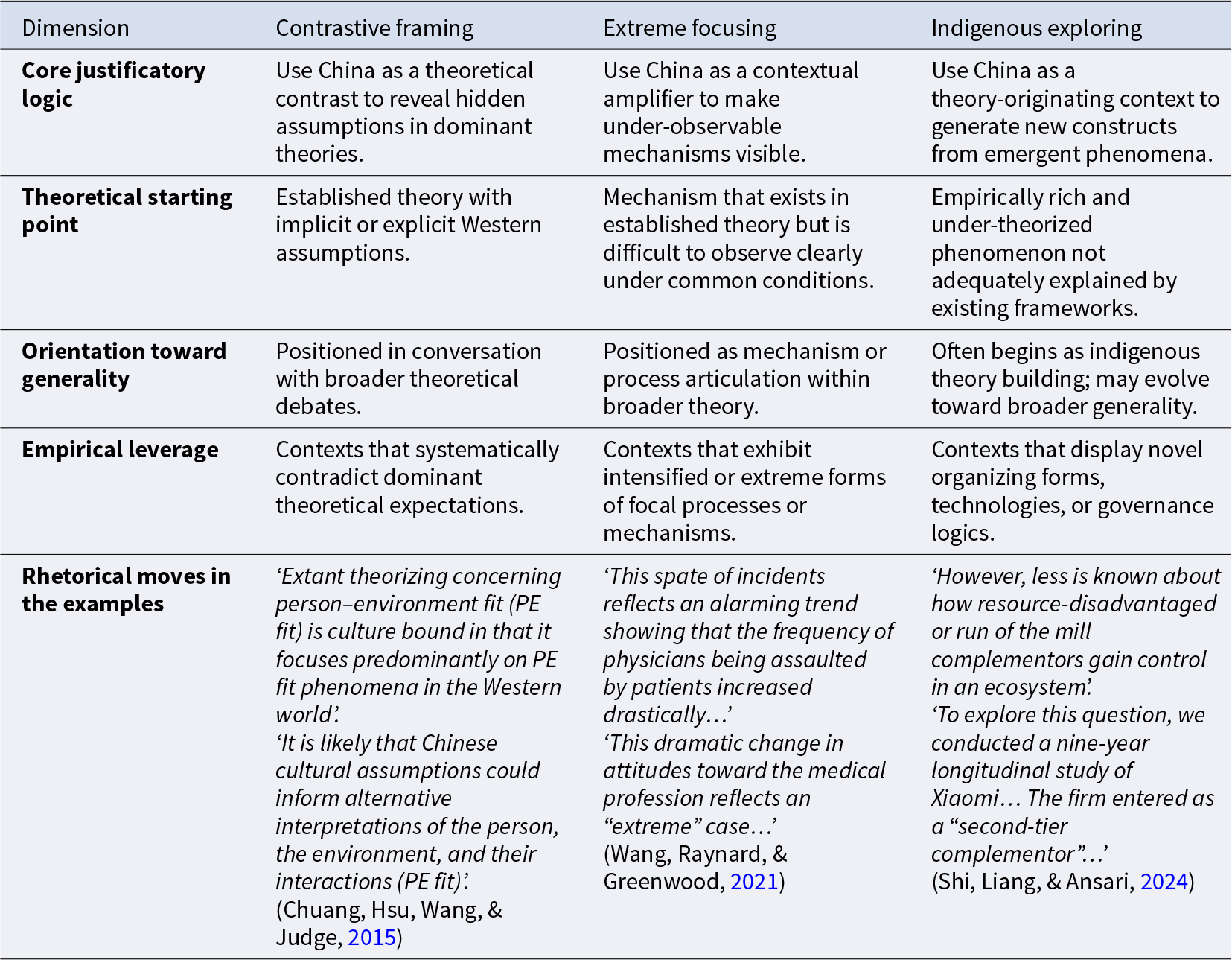
Our framework, together with the illustrative examples above, clarifies three distinct approaches to theoretically justifying qualitative research in Chinese contexts – contrastive framing, extreme focusing, and indigenous exploring. Table 1 summarizes these justificatory modes across key dimensions, including their justificatory logic, theoretical starting point, empirical leverage, and characteristic textual moves. As discussed earlier, authors should consider how to choose among these modes, or combine them, when designing their qualitative studies. Each mode becomes most generative under particular conditions.
Comparing three modes of justifying qualitative research in Chinese contexts

Table 1 Long description
The table compares three modes for justifying qualitative research using Chinese contexts across six dimensions: justificatory logic, theoretical starting point, generality, empirical leverage, and typical rhetorical moves. Contrastive framing treats China as a theoretical foil to surface hidden assumptions in dominant (often Western-leaning) theories, starting from established theory and seeking cases that contradict expected patterns. Extreme focusing uses China as a contextual amplifier to make difficult-to-observe mechanisms visible, starting from a known mechanism and selecting intensified or extreme instances of the focal process. Indigenous exploring treats China as a theory-originating setting, starting from empirically rich but under-theorized phenomena and using novel organizing forms, technologies, or governance logics to generate new constructs. In orientation toward generality, contrastive framing and extreme focusing are positioned within broader theoretical debates, while indigenous exploring often begins with local theory building that may later generalize. Example quotations illustrate each mode’s rhetoric: culture-bound critique and alternative interpretations (contrastive), “extreme case” language around intensified incidents (extreme focusing), and longitudinal exploration of an underexplained ecosystem role (indigenous exploring). The dimensions describe distinct argumentative strategies rather than ranking quality or implying that any mode is universally preferable.
Contrastive framing is most effective when an existing theory rests on assumptions that are taken for granted in Western (or American) societies and may thus encounter systematic tension in the Chinese context. This approach is especially powerful when the focal theory or mechanism presumes values or norms such as individualism, market primacy, and short-term orientation, whereas the Chinese setting foregrounds relational embeddedness, strong state engagement, and longer-term orientation. Under these conditions, China provides a theoretically informative contrast that exposes hidden assumptions and enables the reconstruction or extension of dominant theories.
Extreme focusing is most appropriate when a theoretical mechanism is acknowledged but difficult to observe clearly under more stable Western conditions. This approach is especially effective when the focal mechanism can be amplified by the institutional, cultural, or temporal intensity offered by the Chinese context, such as rapid marketization, strong state intervention, or high-stakes organizational change. In these cases, core causal chains or dynamics that exist elsewhere in attenuated form become more visible and tractable in Chinese contexts.
Indigenous exploring is most generative when scholars encounter empirically rich and conceptually under-theorized practices that cannot be adequately explained by adapting existing Western frameworks. This mode is particularly appropriate for novel organizational forms, technological ecosystems, and governance arrangements that either emerge in China (such as hybrid state–market orchestration) or evolve in parallel with, yet differently from, Western counterparts (such as AI-enabled coordination and platform organizing). In such situations, theory building begins from the phenomenon itself, with new constructs inductively generated and later abstracted to demonstrate transferability beyond China.
Specifically, we offer three practical questions that help authors choose a justificatory mode: (1) Is the goal to reveal blind spots in an existing theory, to surface mechanisms that are poorly observable under dominant conditions, or to uncover new, locally generated concepts and organizing logics? (2) Does the phenomenon contradict typical Western cases, amplify processes that are otherwise attenuated in the West, or represent an emergent practice developing along a distinct pathway from Western counterparts? (3) Do the available empirical materials and access match the demands of the chosen mode? Answers to these questions guide whether authors should favor contrastive framing (using contradictory contexts to reveal blind spots), extreme focusing (using amplified contexts to surface under-observed mechanisms), indigenous exploring (using emergent phenomena to generate new constructs), or a combination of modes.
Importantly, the three modes should not be read as mutually exclusive. Rather, they are analytically distinct but empirically combinable. For example, a study may use contrastive framing to reveal the partiality of a core theoretical assumption, while also adopting extreme focusing to exploit an amplified institutional condition that renders the mechanism more visible. Similarly, indigenous exploring can be combined with contrastive framing when a new, locally emergent construct is used to challenge an extant assumption. We therefore encourage authors to creatively apply one mode or a combination of modes to justify their qualitative studies, choosing the mix that best aligns with their research aims and empirical leverage.
A related question concerns how the three modes map onto indigenous and universal theorizing. Drawing on Chen’s (Reference Chen2025) evolution-of-theories framework, we suggest that indigenous exploring is particularly suited to motivating qualitative research at an indigenous stage: it can justify a study grounded in locally emergent phenomena that explain focal outcomes within a specific context. In contrast, contrastive framing and extreme focusing more directly justify qualitative studies that seek to reconstruct existing assumptions or clarify mechanisms under intensified conditions, often in conversation with established theoretical literatures. Importantly, indigenous theories need not remain context-bound; they may evolve into more general theories that travel across settings. Conversely, some studies may intentionally aim to theorize a novel phenomenon indigenously before broader generalization is possible. We thus encourage scholars to state explicitly whether their qualitative research aims primarily to articulate a novel indigenous account or to advance it toward broader theoretical scope.
Finally, we clarify that justificatory demands differ across journals and audiences. While Management and Organization Review is centrally committed to Chinese management research and is particularly receptive to studies that use Chinese contexts to advance theory, qualitative authors are still expected to articulate clearly how their empirical setting yields theoretical insight rather than merely documenting descriptive patterns. In contrast, outlets such as Academy of Management Journal and Administrative Science Quarterly more strongly foreground claims about broader generality and thus may require stronger front-end justification of cross-contextual relevance. Our framework is intended to be adaptable: it helps the authors writing for MOR sharpen the theoretical articulation of context-rich qualitative studies while also offering a structured way for scholars seeking to tailor their front-end justification when targeting journals that prioritize broader generalization.
Justifying Other Underexamined Contexts
Although we develop these three justification modes from Chinese scholarship, their utility extends beyond Chinese contexts per se. Each mode provides a generalizable framework for theoretically justifying underexamined contexts across the Global South, where institutional complexity, cultural distinctiveness, and rapid transformation often defy assumptions embedded in dominant Western theories (George, Corbishley, Khayesi, Haas, & Tihanyi, Reference George, Corbishley, Khayesi, Haas and Tihanyi2016).
For instance, contrastive framing can help scholars who are interested in African, Latin American, or South Asian contexts articulate how locally grounded logics – such as communal reciprocity, informal institutions, or indigenous entrepreneurship – reveal blind spots in mainstream theory and inspire alternative conceptualizations. Extreme focusing applies equally to high-volatility environments such as frontier markets or postcolonial economies, where institutional contradictions and tensions are magnified, allowing researchers to observe mechanisms of adaptation and legitimation that remain muted in more stable settings. Finally, indigenous exploring is relevant to emerging digital ecosystems or AI-driven industries in these regions, where novel organizing models, human–machine arrangements, and algorithmic governance practices generate concepts that can enrich global theory.
More broadly, adopting these justification modes encourages a theory-building design for qualitative studies that begins from phenomena rather than assumptions, positioning context not as a boundary condition but as a source of insight. Doing so enables scholars to develop contextually grounded yet globally resonant theories, thereby expanding the empirical and conceptual foundations of management and organization studies.
Conclusion
We close by urging scholars to treat China not as an empirical outlier to be explained away but as a generative arena for theory building. By distinguishing contrastive framing, extreme focusing, and indigenous exploring, this editorial offers concrete front-end frames that help qualitative researchers justify why Chinese contexts matter for broader theorizing. Used singly or in combination, these modes turn contextual distinctiveness into analytic leverage, surfacing blind spots, amplifying hidden mechanisms, and originating novel concepts that can travel beyond China. We hope this typology energizes scholars to write bolder and more transparent front-end justifications, to design richer inductive studies, and ultimately to expand management and organization theory in ways that are more empirically adventurous and globally inclusive.
Acknowledgements
We are indebted to Editor Xiao-Ping Chen for her thoughtful guidance, and to two anonymous reviewers for their constructive feedback. This research was supported by the National Natural Science Foundation of China (Grant Numbers: 72232009, 72595862).
Milo Shaoqing Wang (milo.wang@asu.edu) is an assistant professor in the Department of Management and Entrepreneurship at the W. P. Carey School of Business, Arizona State University. His research examines societal challenges at the intersection of institutions, digital technologies, and social evaluations. He currently serves as a deputy editor at Management and Organization Review. He received his PhD from the University of Alberta.
Xiao-Yun Xie (xiexy@zju.edu.cn) is a full professor of management at Zhejiang University. His current research focuses on organizational design, human–AI teaming, and human-technology interaction in digital contexts. He serves as Editor-in-Chief of the Journal of Digital Management and as director of the Digital Intelligence Innovation and Management Laboratory at Zhejiang University.
Royston Greenwood (rgreenwo@ualberta.ca) is Professor Emeritus at the University of Alberta. He received his PhD from the University of Birmingham in the UK. He is a Fellow of the Academy of Management, an Honorary Member of the European Group for Organization Studies, and a Fellow of the Royal Society of Canada. He is a former editor of the Academy of Management Annals and Strategic Organization. His current work applies institutional analysis to corruption and professional wrongdoing.

 Open access

