Introduction
Impaired mitochondrial function represents an important common aspect of brain aging and age-related neurodegenerative diseases leading to reduced glucose consumption, reduced energy (ATP) production, impaired synaptic function, and finally cell death (Mattson, Reference Mattson2007). Synaptic function is probably mostly sensitive to mitochondrial dysfunction due to the high ATP demand at the synaptic level, which is usually taken care of by a high number of mitochondria densely packed at the synaptic level. An important reason for the high energy need at the synaptic level is their ability to adapt dynamically to variations in functional demand (neuroplasticity). Although plasticity phenomena are already possible at the level of synaptic neurotransmission (e.g. receptor up- or downregulation), structural neuroplasticity including neurogenesis, neuritogenesis, spine morphology, and long-term potentiation (LTP) is probably most relevant. Neuroplasticity is increasingly impaired in the continuum from normal to pathological brain aging and seems to be a major cause of the cognitive deficits in neurogenerative diseases like Alzheimer's disease (AD). Accordingly, improving impaired neuroplasticity has become a major strategy for antidementia drug development (Mattson et al., Reference Mattson, Gleichmann and Cheng2008).
As improvement of mitochondrial function emerges as a basic mechanism of the action of standardized Ginkgo biloba extract EGb 761® at the cellular level (Eckert et al., Reference Eckert, Keil, Scherping, Hauptmann and Müller2005; Leuner et al., Reference Leuner2007; Abdel-Kader et al., Reference Abdel-Kader2007; Plaschke et al., Reference Plaschke, Bergmann and Kopitz2011), explaining many of its therapeutical benefits, it is conceivable that EGb 761® improves neuronal plasticity in aging and/or neurodegenerative disease. In this paper we summarize the preclinical evidence for this.
EGb 761® is a dry extract from Ginkgo biloba leaves (35–67:1), extraction solvent acetone 60 % (w/w). The extract is adjusted to 22.0–27.0% ginkgo flavonoids and 5.4–6.6% terpene lactones, consisting of 2.8–3.4% ginkgolides A, B, and C and 2.6–3.2% bilobalide, and contains less than 5 ppm ginkgolic acids.
Long-term potentiation (LTP)
LTP, a mechanism by which information arriving at the neuronal level as a sequence of subthreshold impulses is finally engraved into the receiving cell by an excitory potential, probably represents the most relevant mechanism for learning at the cellular level. Three published studies have investigated the ability of EGb 761® to improve LTP after impairment by aging or dementia (Williams et al., Reference Williams, Watanabe, Schultz, Rimbach and Krucker2004; Wang et al., Reference Wang, Wang, Wu and Cai2006; Zhang and Wang, Reference Zhang, Wang and 2008). Aged mice (1–24 months old) and aged rats (18–20 months) showed a significant decrease in hippocampal LTP intensity, which could be substantially improved by subchronical treatment with EGb 761®. A similar treatment was without effect in young mice or rats (Williams et al., Reference Williams, Watanabe, Schultz, Rimbach and Krucker2004; Wang et al., Reference Wang, Wang, Wu and Cai2006). Under similar conditions, the aged rats showed a decrease in spatial learning (watermaze) which was improved by EGb 761®. Again, young rats treated similarly did not benefit from the same treatment (Wang et al., Reference Wang, Wang, Wu and Cai2006). Similarly, in a rat model of vascular dementia, EGb 761® treatment seemed to improve impaired cognition (watermaze) and impaired hippocampal LTP (Zhang and Wang, Reference Zhang, Wang and 2008).
In conclusion, while EGb 761® does not have an effect on hippocampal LTP per se, it improves reduced LTP due to aging or vascular brain damage. This effect parallels improved learning abilities.
Spine morphology and density
Changes in spine density, the postsynaptic part of synapses, are typically seen in brain aging and are substantially intensified in AD (Hof and Morrison, 2007). Spine density seems to be regulated by drebrin, a neuron-specific F-actin-binding protein, whose determination can be used as a marker of spine density (Ivanov et al., Reference Ivanov, Esclapez, Pellegrino, Shirao and Ferhat2009). Using this method, spine density was found to be substantially reduced on dendrites of primary rat hippocampal neurons following ß-amyloid (Aß) treatment. Preincubation of the neurons with several ingredients of EGb 761® as bilobalide or quercetin significantly reduced the effects of Aß on spine density (Tschantchon et al., Reference Tchantchou2009). Other data on possible effects of EGb 761® on spine structure or density, e.g. after in-vivo treatment, are not available with respect to aging or dementia. However, evidence for a positive effect of EGb 761® on spine formation was also seen in cats after unilateral lesion of the vestibular system (Lacour et al., Reference Lacour, Ez-Zaher and Raymond1991).
Neurogenesis
In contrast to long-held beliefs about the brain, the adult human or animal brain is not fully differentiated but capable of synthesizing new neurons even if this effect is restricted to two small brain regions, the subventricular zone along the lateral ventricles and the dentate gyrus as part of the hippocampus. Among other effects, impaired neurogenesis might be involved in the cognitive decline during aging or AD, even it is not clear if the severely reduced hippocampal neurogenesis in aging can be reactivated enough to a functionally relevant level (Lazarov et al., Reference Lazarov, Mattson, Peterson, Pimplikar and van Praag2010; Rodriguez and Verkhratsky, Reference Rodriguez and Verkhratsky2011).
Three studies have addressed the effect of EGb 761® on neurogenesis in the brain of adult (but not aged) mice or rats. After 28 days of treatment with 40mg/kg or 100 mg/kg EGb 761® daily, a dose dependent increase in neurogenesis (proliferation, neuronal differentiation) was observed in the dentate gyrus of young (8-week-old) mice (Yoo et al., Reference Yoo2011). A positive effect of EGb 761® on reduced hippocampal neurogenesis was also seen in a mouse model for AD (TgAPP/PS1). The young (6 months old) and aged (22 months old) transgenic mice responded although the effect was stronger for the young transgenic animals (Tchantchou et al., Reference Tchantchou, Xu, Wu, Christen and Luo2007). Young control animals did not respond to EGb 761® treatment while the aged control animals showed a small increase following treatment. In all cases, only proliferation was measured. Effects of several major constituents of EGb 761® on proliferation of hippocampal neuronal cells in tissue culture were also reported, e.g. for bilobalide, quercetin, and some ginkgolides (Tchantchou et al., Reference Tchantchou2009). Taken together, impaired neurogenesis seems to benefit from subchronic EGb 761® treatment.
Neuritogenesis
Neuritogenesis, the ability for neuritic arborization (axon, dentrides), is substantially reduced in brain aging and specifically in AD, where, as with synapse density, it correlates best with impaired cognition (Mattson, Reference Mattson2007). Mitochondrial dysfunction and elevated oxidative stress play important roles (Mattson, Reference Mattson2007; Mattson et al., Reference Mattson, Gleichmann and Cheng2008). Accordingly, free radical scavenging or mitochondrial protection seems to be attainable treatment strategies with beneficial effects (Mattson et al., Reference Mattson, Gleichmann and Cheng2008; Garcia-Alloza et al., Reference Garcia-Alloza, Borrelli, Hyman and Bacskai2010). EGb 761® or its constituents have been repeatedly shown to stimulate or enhance neurite outgrowth. In a first study using neuroblastoma cells expressing Aß (Xu et al., Reference Xu, Cui, Pang, Christen and Luo2007), EGb 761® increased the levels of phosphorylated CREB (pCREB), an important transcription factor for BDNF and a relevant regulator of neuritogenesis. BDNF was also elevated. Elevated pCREB and BDNF levels were later also seen in primary hippocampal neurons treated with EGb 761® constituents like bilobalide or quercetin. More importantly, substantially increased dendritic lengths were seen under the same conditions (Tchantschou et al., Reference Tchantchou2009). In agreement with these studies in vitro, positive effects on neuritic morphology were seen following treatment with EGb 761® using a transgenic mouse AD model (Garcia-Alloza et al., Reference Garcia-Alloza, Borrelli, Hyman and Bacskai2010).
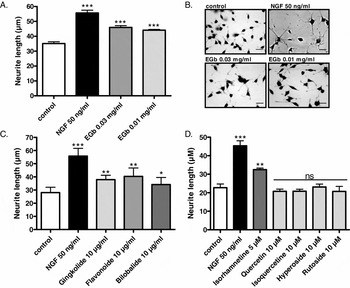
In our own experiments, we used PC12 cells which react to treatment with nerve growth factor (NGF) with neuronal differentiation and neuritic outgrowth, a mechanism which is impaired following cases of mitochondrial dysfunction (Kurz et al., Reference Kurz2010). EGb 761® also enhanced neuritic outgrowth with maximal effects already seen at 30 μmol/l (Figure 1A and 1B). While all three major constituents seem to be active (ginkgolide, bilobalide, flavonoids), the flavonoids are probably mostly active (Figure 1C). We also tested several individual flavonoids and their aglycons. Isorhamnetin was the only one to be active (Figure 1D), which agrees with the findings of Sagara et al. (Reference Sagara, Vanhnasy and Maher2004) about significant effects of isorhamnetine and other flavonoids on PC12 cell differentiation. In summary, our data confirm that EGb 761® improves neuritogenesis, an effect which is likely to have a beneficial effect on cognition.
Effects of EGb 761®, its three major constituents, and of several individual flavonoids on neurite outgrowth of PC12 cells. (A) Effects of different EGb 761® concentrations and of the standard (NGF 50ng/ml) on neuritic length in μm; (B) representative images for the same data; (C) effects of the three major fractions; (D) effects of several individual flavonoids (aglycones). To investigate possible effects of EGb 761® or its constituents on neuritogenesis, PC12 cells were used as described in detail by Kurz et al. (Reference Kurz2010). For the experiments, the cells were incubated for three days with the EGb 761® constituents in the concentrations given or with NGF (nerve growth factor) 50ng/ml. Neuritic length was determined after fixation and staining by using Nikon NIS Elements AR 2.1 Software. Data are mean ± SEM of 5–6 experiments.

Summary
In line with the important role of mitochondrial dysfunction on the decline of neuroplasticity with aging and AD, and the already-mentioned mitochondrial function improving properties of EGb 761®, EGb 761® also improves several aspects of neuronal plasticity. This effect very likely contributes to its beneficial effects on cognitive decline in dementia and brain aging.
Conflict of interest
WEM has received research support from Lundbeck, Schwabe, UCB, and has been a consultant or served on the advisory boards of Astra-Zeneca, Ipsen, Lundbeck, Novartis, Schwabe, UCB.
Description of authors' roles
WEM wrote the paper. JH and KL were involved in the experiments described in the text, and both contributed to the writing of the paper.