INTRODUCTION
Flavour, colour and texture of fruit have a direct effect on the purchase decision in domestic as well as in international markets. These sensory attributes involve the concentration of carbohydrates and carotenoids, as well as changes in cell wall composition (Lizada Reference Lizada, Seymour, Taylor and Tucker1993). Carbohydrates are an important source of energy in living organisms since they are the main substrates of the respiratory process of cells (Mir & Beaudry Reference Mir, Beaudry and Knee2002). Fruits are a major source of carotenoids, β-carotene and cryptoxanthine (Britton & Hornero-Méndez Reference Britton, Hornero-Méndez and Tomás-Barberán1997). These pigments have well-known roles in the absorption of light in plants; however, as nutraceuticals for humans they are responsible for protecting DNA from free radicals (Faulks & Southon Reference Faulks, Southon and Wildman2001). The major soluble sugars and carotenoids in mangoes are sucrose, fructose, glucose and β-carotene, all of which increase in concentration as ripening proceeds (Medlicott & Thompson Reference Medlicott and Thompson1985; Mercadante & Rodriguez-Amaya Reference Mercadante and Rodriguez-Amaya1998); however, evolution of sugars, organic acids and texture development may be affected if fruits are stored under refrigeration (Medlicott et al. Reference Medlicott, Sigrist and Sy1990). Mexican mangoes bound for export are subjected to regulatory quarantine, due to infestation by the Mexican fruit fly, Anastrepha ludens (Loew). In order to export the mango variety Ataulfo to the US and other countries, a hot water treatment is required (46·1°C for 75 min) to eliminate fly larvae. Under normal handling conditions, treated mangoes are maintained at 13°C for 4 days, while transported to the distribution warehouses. In practice, Ataulfo mangoes that have been stored for 4 days or more at 13°C show uneven ripening and poor colour development of the pulp. According to mango traders, longer storage periods at 13°C produce even more severe quality defects (unpublished data, from the present authors).
It has been reported that application of 100 μl ethylene/l of air for 18 h on RM (variety Kent; 4 days at 13°C prior to ethylene exposure) reverted the effect of refrigeration on the content of sucrose, glucose and fructose, produced homogeneous ripening and improved external peel colour (Zamora et al. Reference Zamora, García, Mata and Tovar2004). It has also been reported that very low ethylene concentrations affect the textural firmness of the fruits (Mir & Beaudry Reference Mir, Beaudry and Knee2002). Sergent et al. (Reference Sergent, Schaffer, Lara and Leah1993) noted increased content of soluble solids, which correlated with improved flavour and colour and softer texture in Keitt variety mangoes that were immersed in hot water (52°C for 2) and treated with 2-chloroethylphosphonic acid (Ethephon®) at 1000, 2000 or 4000 mg/kg for 1 or 2 min. Given the rapid market expansion and consumer preference for this Mexican variety, the effect of exogenous ethylene exposure under simulated export handling was investigated. The purpose was to increase sugar and carotenoid content in RM, together with faster and more homogenous ripening to improve their quality and decrease storage costs.
MATERIALS AND METHODS
Fruits and treatments
Export quality Ataulfo mangoes were supplied by Productora Agrícola La Romera SPR de RL, located near Tepic, Nayarit, México. The fruits were subjected to hydrothermal treatment by full immersion of fruits held in plastic crates in water at 46·1°C for 75 min, followed by cooling also by immersion in 21°C water for 30 min, and then taken to the laboratory. Each of the treatments described below used sets of 50 fruits: two sets of control fruit were employed, the first set comprised non-refrigerated mangoes (NRM) that were stored at 25±2°C (85–90% relative humidity (RH)) for ripening and not treated with exogenous ethylene. The second control set comprised RM that were kept for 4 days at 13±1°C (90% RH), not treated with ethylene and then ripened at 25±2°C (85–90% RH). Fruit to be treated with ethylene were stored for 4 days at 13±1°C and 90% RH. On day 5, ethylene was applied at 100 μl/l of air for 12 h; treated mangoes were then stored at 25±2°C and 85–90% RH until fully ripe (RME). Exposure to ethylene was made in 225-litre sealed chambers fitted with a fan, gas inlet and outlet and a flow meter; CO2 absorbers were placed inside (three containers with 500 ml of saturated NaOH). Certified ethylene in synthetic air (Etil-5®) was supplied by Praxair (Praxair, México S.A. de C.V.). Ethylene concentration in the chamber was checked by gas chromatography (GC).
Total soluble solids and sugars
Homogenized and filtered juice was used to measure total soluble solids (TSS) with a Bellingham Stanley Ltd. (London, England) refractometer (AOAC 1984). Sugars were extracted according to Medlicott & Thompson (Reference Medlicott and Thompson1985). The extract was filtered through a 0·45-μm filter, and 20 μl of the filtrate was injected to the high-performance liquid chromatography (HPLC) equipment (GBC) model 01026302 (Dandenong, Australia). Sugars were separated on an Exsil amino column (0·15 m×0·0046 m) at 35°C using an isocratic mobile phase of acetonitrile:water (0·85:0·15) at 1·0 ml/min and a GBC differential refractometer (model LC1420) set at 40°C. Quantification was made by external standards (sucrose, glucose and fructose, 0·998 pure; SIGMA) and results were expressed as g sugar/kg fresh weight (FW).
β-Carotene content
The method of Cano & De Ancos (Reference Cano and De Ancos1994) was used for extraction of β-carotene. The extract was filtered through a 0·45-μm nylon filter in the dark at 4°C and 20 μl of the filtrate was injected to the HPLC. β-Carotene was separated at 25°C on a column 0·25 m long with a particle size of 5 μm (octadecyl silane – ODS – C18) and eluted with a flow rate of 0·8 ml/min of a mobile phase consisting of a gradient of (A) methanol/water (0·75:0·25 v/v) and (B) ethyl acetate. In brief, the elution was 0·3 A and 0·7 B for 10 min followed by a linear gradient of B in 20 min. A GBC diode array (model LC500) detector was used to monitor the β-carotene content at 454 nm. Quantification was made by external standard (β-carotene type I; about 0·95 pure; UV-SIGMA) and results are expressed as g/kg FW.
Textural firmness measurements
Textural firmness of mango samples was measured with an Instron universal tester, model 442, fitted with a 0·005-m cylindrical probe. Fruits were sliced, making cuts parallel to the apex and tip, and allowing 0·01 m between the pulp and the seed. Firmness was measured in three different points: one in the centre and one on each end of the slice, on both sides. Mean values were calculated and expressed in Newtons (N).
Pectinmethylesterase activity
Enzyme extracts were prepared at 4°C and pectinmethylesterase activity (PMEa) was based on the colour change of a pH indicator during the PME-catalysed reaction (Hagerman & Austin Reference Hagerman and Austin1986). This change was continuously monitored by a spectrophotometer at 620 nm. Substrate consisted of 2 ml of 10 g pectin/l distilled water, 0·3 ml of bromthymol blue and 0·25 ml of deionized water. Substrate was incubated at 37°C for 15 min, its pH value was adjusted to 7·5 and 0·1 ml of enzyme extract was added, allowing the reaction to proceed for 60 min. One unit (U) of PMEa was defined as the production of 1 μmol H+/h at 37°C. PMEa was reported as U/mg protein.
Polygalacturonase activity
Extraction was performed at 4°C according to Lazan et al. (Reference Lazan, Selamat and Ali1995). To test for activity, 0·2 ml of a 4 g/kg solution of polygalacturonic acid was mixed with 0·4 ml of acetate buffer 0·05 m at pH 4 and incubated at 37°C for 20 min. Then, 0·2 ml of enzyme extract was added and allowed to react for 3 h. The reaction was stopped by adding 2 ml of sodium borate buffer (100 mm) and 0·6 ml of a solution of 1 g cyanoacetamide/l distilled water heated in a water bath for 20 min and then cooled quickly with ice. Absorbance was measured on a GBC spectrophotometer at 276 nm. One unit (U) of polygalacturonase activity (PGa) was defined as the production of 1 μmol of d-galacturonic acid/h at 37°C. PGa was reported as U/mg of protein.
Protein quantification
Enzyme extract (0·1 ml) was mixed with 5 ml of Bradford reagent (Sigma B-6816) and absorbance was read at 595 nm after 10 min. A standard calibration curve was prepared using bovine serum albumin (Bradford Reference Bradford1976).
Microstructure
Mango mesocarp samples were prepared by taking portions of 0·005×0·005×0·01 m (width×thickness×length) at a distance of 0·01 m from the seed. Samples were fixed with glutaraldehyde (0·001:1 v/v) for 24 h at 4°C. Fixed cuts were rinsed with phosphate buffer 0·1 m, pH 7·2 at 4°C, and then dehydrated by immersing twice in increasing concentrations of ethanol/water solutions (0·10, 0·20, 0·40, 0·60, 0·80, 1 ethanol, v/v) for 30 min each time; finally, samples were immersed twice for 30 min in pure acetone at 4°C. A final drying was made by the critical point method (48 and 77°C, 3410 kg/m2 CO2) using a Technics CPA II drier. Samples were covered with gold–palladium (Jeol Fine Coat Ion Sputter JFC-110) and observed through a scanning electron microscope (Jeol JSM-5600LV) at 20 KV. Selected cells were measured using the scale included in the micrographs for samples obtained from RM and RME fruits.
Statistical analysis
Data were analysed using the statistical package SAS for Windows™ Version 6.11 (SAS Institute, Cary, NC).
RESULTS
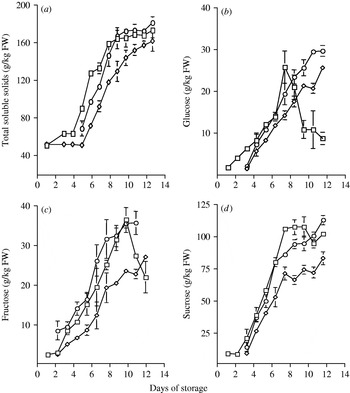
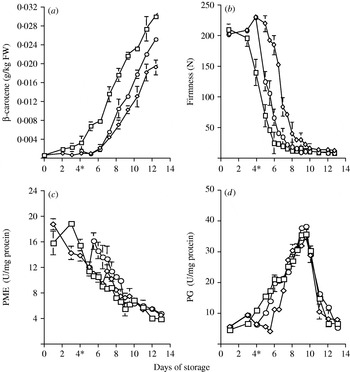
In NRM (Fig. 1a) TSS increased during storage until 174·7 g/kg FW. In RM, TSS increased only after 13 days after fruit were transferred to 25±2°C, while in fully ripe (RME) fruits this rate of increase was faster and similar values were reached on day 9 in NRM. Soluble sugars (glucose, fructose and sucrose) evolved differently in each treatment (Fig. 1b–d). Refrigerated storage for 4 days caused a decrease in all three sugars during ripening at 25±2°C; however, application of exogenous ethylene to RM increased sugar content to concentrations comparable to those of NRM. All the fruits showed a gradual increase in β-carotene content during storage (Fig. 2a). Refrigeration affected β-carotene synthesis, since on day 13, RM fruits had a very low mean value (0·0186 g/kg FW) compared to NRM fruits (0·0308 g/kg FW). Exogenous ethylene promoted synthesis of β-carotene in RME, although its concentration did not approach that of NRM fruits on day 13 (0·0257 g/kg FW) for RME fruits that day.
TSS (a), glucose (b), fructose (c) and sucrose (d) contents of Ataulfo mangoes at 25±1°C (NRM), at 13°C (RM) and then transferred to 25±1°C with no further treatment, or treated with ethylene (RME). Data points represent the mean of four measurements and their standard deviation. NRM=mangoes stored at 25±1°C without ethylene treatment (—□— NRM), RM=mangoes kept for 4 days at 13°C and then transferred to 25±1°C (—◊— RM), RME=mangoes kept for 4 days at 13°C treated with ethylene and then transferred to 25±1°C (—○—).

β-Carotene content (a), textural firmness (b), pectimethylesterase (PME) activity (c) and polygalacturonase (PG) activity (d) of Ataulfo mangoes at 25±1°C (NRM), at 13°C (RM) and then transferred to 25±1°C with no further treatment, or treated with ethylene (RME). Data points represent the mean of four measurements and their standard deviation. NRM=mangoes stored at 25±1°C without ethylene treatment (—□— NRM), RM=mangoes kept for 4 days at 13°C and then transferred to 25±1°C (—◊— RM), RME=mangoes kept for 4 days at 13°C treated with ethylene and then transferred to 25±1°C (—○—).

In RM fruits (Fig. 2b), textural firmness remained elevated during the 4 days of refrigerated storage and it was only after day 10 that their values were not statistically different from NRM and RME fruits. Exogenous ethylene on RME fruit exerted a rapid effect on day 5 (ethylene application and transfer to 25°C), since firmness was lost just after 12 h post-exposure. Despite the rapid loss of firmness of RME fruit, a texture suitable for consumption was measured on day 10 post-harvest (11·73 N).
PMEa was increased in NMR fruits (Fig. 2c) from 17·11 U/mg protein on the first day to 19·72 U/mg protein on day 3, and then a marked decrease was noted from day 4. PMEa in RM fruits diminished from 19·62 U/mg protein on the first day to 11·77 U/mg protein after 6·5 days; nevertheless, on day 7 a slight increase was measured (13·43 U/mg protein) that corresponded to the initial drop in firmness (Fig. 2b). Exogenous ethylene at 100 μl/l of air for 12 h promoted PMEa in RME mangoes and its value was noticeably high on day 6. The highest PGa in NRM fruits (Fig. 2d) was found at day 9 (35·66 U/mg protein), which coincided with the optimal ripening for consumption; however, this point was reached in RM and RME fruits at days 13 and 10, respectively. Refrigerated storage produced a reduction in PGa, but enzyme activity recovered 2 days after the fruit were transferred to 25°C. After ethylene was applied to refrigerated fruit on day 5 (RME), PGa increased (Fig. 2d) and was significantly higher than RM fruits until day 7 and similar to NRM fruits from day 6. Greater activity (37·92 U/mg protein) was measured on day 9.
No differences in cell microstructure were observed in RM fruits that were transferred from 13±1 to 25±2°C at 0, 6, 12 and 18 h after the transfer; however, after 24 h (day 6) at 25±2°C (photographs not shown), cell distortion was more pronounced, but no collapse was evident and some turgor was still present. Slight cell modification after 24 h at 25±2°C appeared at the same storage time (day 6) at which firmness decreased in RM (see Fig. 2b) and the start in the surge of PMEa and PGa (Fig. 2c, d). Exogenous ethylene did not produce structural changes in the cells immediately after its application, nor after 6 h; however, 12 h after ethylene application, parenchyma cells appeared distorted and their size was reduced with a concomitant loss of their natural turgor. It was observed that 18 h after ethylene exposure a large proportion of cells were collapsed. After 24 h post-ethylene application (day 6), cells were arranged in the form of a fine blanket surrounding starch granules and carried along greater PGa. In the tissue of RME fruit, a large proportion of cells were collapsed after 24 h post-ethylene application (day 6), cells were arranged in the form of a fine blanket surrounding starch granules and carried along greater PGa.
DISCUSSION
Increasing TSS during storage at 25°C as a consequence of starch and sucrose hydrolysis has previously been documented (Selvaraj et al. Reference Selvaraj, Kumar and Pal1989). The present data are consistent with reports on Kent (Zamora et al. Reference Zamora, García, Mata and Tovar2004) and Kensington (Zora & Janes Reference Zora and Janes2001) RM that were exposed to ethylene, since it was found that exogenous ethylene eliminated the effect of refrigeration on the evolution of TSS.
It has been reported that amylase activity in Alphonso mangoes decreased due to low-temperature storage (Chhaptar et al. Reference Chhaptar, Mattoo and Modi1971). Thus, RM mangoes could have experienced cold stress, with a concomitant reduction in starch degradation and consequently lower production of glucose and fructose. However, the effect caused by the cold storage was decreased when fruit were taken to 25°C. Starch content decreased in bananas to a very low level after 4 days exposure to ethylene (1000 μl/l) and this event was followed by a rise in soluble sugars, while the activity of sucrose phosphate synthase increased markedly (35–75 μmol/h) after 100 μl was applied for 36 h (Hubbard et al. Reference Hubbard, Pharr and Huber1990). It has been reported that Kent mangoes exposed to 100 μl for 18 h showed an increase in sucrose that reached 132·6 g/kg FW on day 9, which was similar to non-refrigerated control fruit held only at 25°C (139·9 g/kg FW; Zamora et al. Reference Zamora, García, Mata and Tovar2004). It is possible that exposure to a concentration of 100 μl for 12 h may be enough to stimulate the activity of sucrose phosphate synthase in refrigerated fruit. Therefore, it may be suggested that exogenous ethylene was able to reduce the effect of refrigerated storage and the activities of amylases and invertase to accelerate starch and sucrose hydrolysis in refrigerated fruit.
Evolution of β-carotenes in RME fruit was consistent with a previous report (Zamora et al. Reference Zamora, García, Mata and Tovar2004) on refrigerated Kent mangoes. In the present work, it was found that application of 100 μl for 12 h on refrigerated Ataulfo mangoes accelerated the development of yellow colour in the pulp. Montalvo et al. (Reference Montalvo, Garcia, Tovar and Mata2007) noted that RME fruit of homogenized external colour and fruit were totally ripened in a shorter time, 4 days less than RM fruit, which leads to the conclusion that in RME fruit, the highest carotenoid synthesis was noted in both the pulp as well as in the peel, since RM fruit displayed green areas after 13 days of storage. Genes that code for most of the enzymes involved in carotenoid synthesis have been cloned, but regulation of this pathway has not been fully clarified (Mustilli et al. Reference Mustilli, Fenzi, Ciliento, Alfano and Bowler1999). Therefore, it is possible that exogenous ethylene activated the expression of these enzymes for carotenoid biosynthesis in ethylene-treated RM and hence increased β-carotene production. It is also known that storage temperature, light and ethylene play important roles in pigment synthesis in fruits (Mustilli et al. Reference Mustilli, Fenzi, Ciliento, Alfano and Bowler1999).
It has been demonstrated that exogenous ethylene exerts a rapid effect on refrigerated fruit on the day of its application, since firmness has been found to be lost just after 12 h post-exposure (Sane et al. Reference Sane, Chourasia and Nath2005). According to EMEX (1998), firmness values for physiologically mature Ataulfo mangoes that were harvested and stored at 25°C were 160–152 N. Ripening for consumption was reached after 10–13 days, at which time firmness was 15–20 N, while at senescence, firmness decreased to 8–10 N. According to the present data, firmness in RME was reduced faster than for RM, and since this occurred before ethylene exposure, fruit quality of RME may not have been affected, since their mean firmness value after 9 days of storage was 15·4 N.The pattern for PMEa was consistent with a marked drop in textural firmness. Hence, a direct relationship was found between PMEa and texture changes of the fruits. It has been proposed that low temperatures may inhibit pectin-hydrolysing enzymes (Imsabai et al. Reference Imsabai, Ketsa and Van Doorn2002). Hall et al. (Reference Hall, Bird, Picton, Tucker, Seymor and Grierson1994) reported the existence of at least one gene that codes for PME in tomatoes, which responds to ethylene regulation; therefore, it is possible that ethylene could have induced de novo synthesis of PME and its activity that contributed to texture development 12 h after exposure with a probable contribution by PG (see Fig. 2d). The highest PGa coincided with the optimal ripening for consumption (EMEX 1998). Refrigerated storage produced a reduction in PGa, probably due to decreased enzyme activity caused by the lower temperature (Imsabai et al. Reference Imsabai, Ketsa and Van Doorn2002). It was demonstrated that the sequence of the promoter of PG contains ethylene-dependent transcription factors, while RNAm synthesis occurs at very low ethylene concentrations (Sitrit & Bennett Reference Sitrit and Bennett1998). This may explain why PGa increased in RM fruits only 2 days after being transferred to 25°C. It is also likely that the ethylene applied to previously RM on day 5 promoted transcription and synthesis of PG with the consequent rapid loss of firmness.
The microstructure of Ataulfo mangoes was consistent with the report by Parikh et al. (Reference Parikh, Nair and Modi1990) in Alphonso mangoes. The loss in initial cell integrity in all fruits can be explained by the hydrolysis of polysaccharides from the cell wall by the enzymes described above. Size reduction of cells by ethylene was coincidental with firmness reduction and increased PMEa and PGa. Therefore, application of 100 μl/l of air for 12 h on Ataulfo mangoes accelerated cell wall distortion due to increased activity of those hydrolytic enzymes involved in cell wall breakdown.
In conclusion, RM did not reach similar ripening values to the control mangoes (NRM), while ethylene exposure increased sugars and β-carotene content, thus counteracting the effect of refrigeration, with a concomitant improvement in colour and sweetness. Additionally, ethylene caused increased PMEa and PGa, which lead to a collapse of cell structure 24 h after exposure.
The authors gratefully acknowledge the financial support of DGEST through grant Nr. UR600, and CONACyT of México through grant 176787. The valuable contribution of fresh mangoes for the study by Mr. Abelardo N. González Cabrera is truly appreciated.