Implications
Rabbits are very susceptible to heat stress. Exposure of growing rabbits to heat stress during summer adversely affects their production causing economical losses to the producer. On the other hand, royal jelly (RJ) is a honeybee secretion, which is collected and sold as a dietary supplement, claiming various health benefits. This study was conducted to evaluate the ability of RJ to reduce harmful effects resulted from heat stress in broiler rabbit, and if it really proves its ability to counteract heat stress effects, a bee hive in the broiler rabbit farm would be of great economic value.
Introduction
Rabbits are very susceptible to heat stress, since they have few functional sweat glands and have difficulty in eliminating excess body heat, when the environmental temperature is high. Exposure of growing rabbits to heat stress during summer adversely affects their growth and reduces the resistance to diseases and increases postweaning mortality (Marai et al., Reference Marai, Habeb and Gad2002). Exposing rabbits to heat stress reduces their growth rate, average daily gain and feed efficiency (Ayyat et al., Reference Ayyat, Gad, El-Aasar and El-Monem2004; Villalobos et al., Reference Villalobos, Guillén and García2008) leading to major production losses. Physiological changes under heat stress include significant decreases in plasma total protein, albumin, globulin, glucose, thyroid hormone (T3), sodium, potassium, calcium, magnesium and phosphorus, and significant increases in plasma urea-N and creatinine (Marai et al., Reference Marai, Habeb and Gad2005 and Reference Marai, Habeb and Gad2008).
On the other hand, royal jelly (RJ) is a honeybee secretion that is used in the nutrition of the larvae. It is secreted from the hypopharyngeal glands in the heads of young workers and used (among other substances) to feed the larvae in the colony, it is collected and sold as a dietary supplement, claiming various health benefits because of components like B-complex vitamins such as pantothenic acid (vitamin B5) and vitamin B6 (pyridoxine). The overall composition of RJ is 67% water, 12.5% crude protein (including small amounts of many different amino acids) and 11% simple sugars (monosaccharides), also including a relatively high amount (5%) of fatty acids. It also contains many trace minerals, some enzymes, antibacterial and antibiotic components, and trace amounts of vitamin C. Vitamins A, D, E and K are completely absent from RJ (Graham, Reference Graham1992). RJ has been used in animal research, with many benefits; it was shown to protect rats against mutagenic effects of adriamycin and γ radiation (El-Fiky et al., Reference El-Fiky, Othman, Balabel and Abd-Elbaset2008), inhibits lipid peroxidation both in vitro and in vivo (Hang et al., Reference Hang, Ekusa, Iwai, Yonekura, Takahata and Morimatsu2008), shows cardioprotective characteristics in myocardial ischemia rats (Krylov et al., Reference Krylov, Sokolsky and Krylova2006), has immunomodulatory activities (Gasic et al., Reference Gasic, Vucevic, Vasilijic, Antunovic, Chinou and Colic2007), and it was proven that its antioxidant properties may play an important role on its effects on aging process and stress reactions in rats (Ikeda et al., Reference Ikeda, Washizuka, Furuichi, Fukuda and Kuwabara1996).
This study was conducted to evaluate the ability of RJ feeding to reduce physiological strain of broiler rabbits exposed to Egyptian summer conditions.
Material and methods
This study was carried out during the summer season (July and August) at the Poultry Research Center, Poultry Production Department, Faculty of Agriculture, Alexandria University, Egypt.
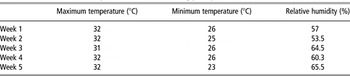
A total number of 48 unsexed V-line weaned rabbits, aged 4 weeks and averaged 722 ± 18 g BW were randomly divided into four experimental groups (12 rabbits each). Each group was subdivided into 3 replicates (4 rabbits each). Rabbits were housed in galvanized wire cages provided with feeders and automatic watery system, in a well ventilated open system rabbitry and were kept under the same managerial, hygienic and environmental conditions, were temperature ranged from high at 32°C to low at 23°C (Table 1).
Maximum, minimum temperature and relative humidity per experimental weeks

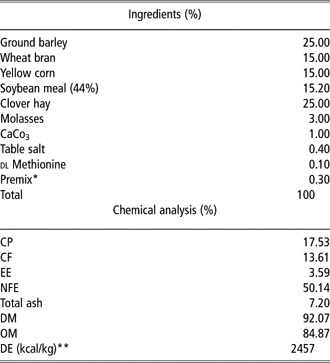
Basal diet (Table 2) was formulated to cover the nutrient requirements of growing rabbits recommended by National Research Council (1977). Animals of the 2nd, 3rd and 4th group were individually orally given 200, 400,or 800 mg RJ mixed with distilled water/kg BW once a week to reach a total volume of 2 ml, respectively. The first group served as control, treated in a like manner except that animals were given distilled water only (2 ml). The experiment lasted 5 weeks.
Composition and chemical analysis of basal diet of growing rabbits

CF = crude fiber; EE = ether extract; NFE = nitrogen free extract; DM = dry matter; OM = organic matter; DE = digestible Energy.
*Each 3 kg of rabbits premix contained: vitamin A 12000000 IU; vitamin D3 2000000 IU; vitamin E 10 000 mg; vitamin K3 2000 mg; vitamin B1 1000 mg; vitamin B2 5000 mg; vitamin B6 1500 mg; vitamin B12 10 mg; Biotin 50 mg; Choline Chloride 250 000 mg; Pantothenic acid 10 000 mg; Nicotinic acid 30 000 mg; Folic acid 1000 mg; Iron 30 000 mg; Copper 10 000 mg; Manganese 60 000 mg; Iodine 1000 mg; Selenium 100 mg; Cobalt 100 mg; Zinc 50 000 mg and Antioxidant, 1000 mg to 3000 g.
**DE calculated according to (Checke, Reference Checke1987).
Data collected
Individual live weight, feed consumption and feed conversion ratio were recorded weekly during the experimental period. At the end of the experimental period, six fasted rabbits from each treatment were randomly taken for slaughter. Blood samples, about 3 ml, were collected before slaughter from the marginal ear vein for biochemical analysis. Hemoglobin (Hb) concentration was measured according to Provan et al. (Reference Provan, Singer, Baglin and Lilleyman2004). Serum total protein was measured by using special kits delivered from sentinel CH Milano, Italy by means of spectrophotometer (Beckman DU-530, Germany) according to guidelines and recommendation of Armstrong and Carr (Reference Armstrong and Carr1964). Serum Albumin was determined by using special kits delivered from sentinel CH Milano, Italy according to the method of Doumas et al. (Reference Doumas, Watson and Biggs1977). Total lipids was determined in blood serum by using special kits delivered from CAL-TECH Diagnostics, Inc., Chino, CA, USA by means of spectrophotometer according to recommendation of Fringes et al. (Reference Fringes, Fendly, Dunn and Queen1972). Serum total cholesterol was determined on individual base using the specific kits according to recommendation of Bogin and Keller (Reference Bogin and Keller1987). The transaminase enzymes activities of Aspartate amino transferase (AST) and plasma Alanine amino transferase (ALT), as U/dl, were determined by calorimetric method of Reitman and Frankel (Reference Reitman and Frankel1957). Serum triglyceride and gamma glutamyl transpeptidase (γ-GT) concentration were determined in blood serum by using special kits delivered from Diagnostics Inc., CA, USA by means of spectrophotometer. Creatinine was assayed calorimetrically according to the method of Caraway (Reference Caraway1963). Alkaline phosphatase (ALP) concentration was determined according to the colorimetric method of Bauer (Reference Bauer1982) plasma concentration of total tri-iodothyronine (T3) was assayed by radioimmunoassay technique using kit from Diagonostic Products Corporation, Los Angeles, USA. Globulin values were obtained by subtracting albumin values from the corresponding values of total protein. Plasma glucose concentrations were measured by the (Trinder, Reference Trinder1969) method using commercial kits. Plasma amylase activity was determined according to Caraway (Reference Caraway1959). Serum immunoglobulin (Ig) fractions were determined according to Micini et al. (Reference Micini, Garbonara and Harmans1965). Uric acid was determined colorimetrically according to Majkic-Singh et al. (Reference Majkic-Singh, Stojanov, Spasic and Berkes1981). Serum calcium and inorganic phosphorus concentrations were determined according to Tietz (Reference Tietz1986).
Statistical analysis
Data were analyzed by ANOVA using the general linear model procedure (Proc GLM; SAS institute, 1996). For the overall means, data were classified according to four treatments and the mean of each treatment was used. Differences among means were determined using Duncan test (Duncan, Reference Duncan1955).
Results and discussion
BW gain and feed conversion ratio
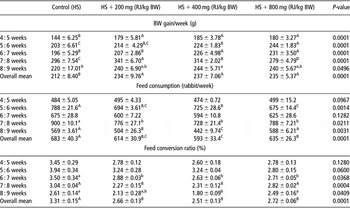
Results concerned with the effect of weekly treatment of V-line rabbits with RJ on BW gain throughout the 5 weeks experimental period are presented in Table 3. Overall, RJ treatments significantly (P = 0.0001) increased weekly BW gain by 10.4, 11.8 and 10.8% of the heat stressed controls’ value with the 200, 400 and 800 mg RJ/kg BW treatments, respectively, with the best weekly BW gain being at the 400 mg RJ/kg BW dose. Overall rabbit’s weekly feed consumption (Table 3), was reduced significantly (P = 0.0001) to reach 90, 86 and 93% of heat stressed control rabbits with the 200, 400 and 800 mg RJ/kg BW treatments, respectively. The improvement in weight gain associated with the reduction in feed consumption resulted in a significantly (P = 0.0001) improved feed conversion ratio (Table 3), which was improved by 20, 24 and 18% compared with control with the 200, 400 and 800 mg RJ/kg BW treatments, respectively, with the best feed conversion ratio observed at the 400 mg RJ/kg BW dose. These findings are in good agreements with the findings of Afifi et al. (Reference Afifi, Khattab, El-Berry and Abdel-Gawaad1989) who found that when guinea-pigs were injected subcutaneously each day with RJ solution at doses of 100, 200 or 300 mg/kg BW the average gain in BW of the animal was 136.2, 144.7 and 150.5 g, respectively, whereas it was 119.5 g with the control. Also, with the findings of Bonomi et al. (Reference Bonomi, Bonomi and Quarantelli2001) who observed weight gain improvement of 11% and 15% and feed utilization improvement by 8.5% and 12.5% when RJ was used in rabbits feeding at 15 and 20 ppm from 30 to 90 days of age. Moreover, Bonomi (Reference Bonomi2003) reported 11% and 14% improvement in weight gain and 5% and 7% improvement in feed utilization when pigs were fed RJ added to mixed feeds at doses of 30 and 50 ppm, respectively.
Mean (±s.e.) weekly BW gain, feed consumption and feed conversion ratio of HS broiler rabbits fed 200, 400, or 800 mg RJ/kg BW

HS = heat stressed; RJ = royal jelly.
a,bDifferent letters within a row denote significant differences between treatments (P < 0.05).
A,B,C,DDifferent letters within a row denote significant differences between treatments (P < 0.01).
Blood biochemical analysis
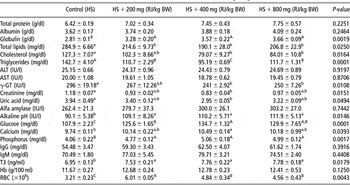
Rabbits blood analysis is shown in Table 4. Serum total protein increased in a dose dependent manner (P = 0.2251), similar trend was observed with serum albumin (P = 0.2464) and serum globulin, which reached 117, 127, and 130% of controls’ value (P = 0.0019) with the three RJ doses, respectively. These findings resemble the findings of Kurkure et al. (Reference Kurkure, Kognole, Pawar, Ganorkar, Bhandarkar, Ingle and Kalorey2000) who reported increased serum albumin when white Leghorn cockerels were orally given 10 μl/bird/day RJ.
Mean (±s.e.) of blood constitutes of HS broiler rabbits treated with 200, 400 and 800 mg RJ/kg BW

HS = heat stressed; RJ = royal jelly; ALT = alanine amino transferase; AST = aspartate amino transferase; γ-GT = gamma glutamyl transpeptidase; IgG = immunoglobulin G; IgM = immunoglobulin M; T3 = thyroid hormone; Hb = Hemoglobin; RBC = red blood cell.
a,bDifferent letters within a row denote significant differences between treatments (P < 0.05).
A,B,CDifferent letters within a row denote significant differences between treatments (P < 0.01).
RJ treatments significantly (P = 0.0250) reduced serum total lipids by 25, 33 and 27% compared with the heat stressed control with the three doses, respectively. Similar trend was observed with cholesterol and triglycerides (P = 0.0164 and 0.0001, respectively) as they were reduced by 19, 38 and 34% and by 22, 33 and 22% compared with control with the three doses of RJ, respectively. These results support the findings of XinNan et al. (Reference XinNan, RuiFang and GengSheng1995) who found that treating rats with experimentally induced hyperlipaemia with 700 mg RJ/kg reduced serum cholesterol levels. In addition, Vittek (Reference Vittek1995) who reported a reduction in serum lipids in rats, rabbits and humans treated with RJ. Moreover, Al-Mufarrej and El-Sarag (Reference Al-Mufarrej and El-Sarag1997) on chickens, as they reported that treating birds with 200 mg RJ reduced blood cholesterol.
During heat stress levels of liver enzymes (ALT and AST) tend to rise suggesting some liver damage in mammals and in birds (QingHua and GenLin, Reference QingHua and GenLin2007; Faisal et al., Reference Faisal, Abdel-Fattah, El-Hommosany, Abdel-Gawad and Ali2008). RJ treatments caused a non-significant reduction in both enzymes (P = 0.9197 and 0.8706, respectively), revealing a slight improvement in liver function. γ-GT that is used as a diagnostic marker for types of liver damage or conditions (Yokoyama, Reference Yokoyama2007) decreased significantly (P = 0.0108) with RJ treatments by 10, 19 and 15% compared with the heat stressed control rabbits, indicating better liver function.
Creatinine and Uric acid concentrations were significantly (P = 0.0151 and 0.0494, respectively) affected by RJ treatments. Creatinine showed a reduction of 21, 30 and 18% and uric acid was reduced by 14, 25 and 18% compared with the heat stressed control with the three doses of RJ, respectively. This indicates an improved kidney function in cleansing blood especially with the elevated blood proteins observed in this study with RJ treatments.
Alfa amylase levels showed a non-significant increase (P = 0.7442) suggesting better starch utilization. Accordingly, glucose level increased significantly (P = 0.0001) with RJ treatments to reach 116, 125, and 120% of heat stressed control level, with the three doses of RJ, respectively.
Both calcium and phosphorus increased significantly with RJ treatments maintaining a constant ratio (P = 0.0393, and 0.0017, respectively). The increase was by 4, 8, and 5% in calcium and was by 17, 25, and 23% in phosphorous with the three RJ doses, respectively. This finding is with harmony with the findings of Hidaka et al. (Reference Hidaka, Okamoto, Uchiyama, Nakatsuma, Hashimoto, Ohnishi and Yamaguchi2006) who suggested that RJ may prevent osteoporosis in rats by enhancing intestinal calcium absorption. Moreover, ALP has significantly increased (P = 0.0146) to reach 121, 122 and 124% of heat stressed level with the three doses of RJ, respectively. This indicates that there could be active bone deposition occurring, as ALP is a well-known marker for bone formation by being a byproduct of osteoblast activity (Shahbazkia et al., Reference Shahbazkia, Aminlari and Mohamadnia2009).
Although without reaching significance (P = 0.3916 and 0.4408), RJ treatments increased IgG and IgM levels in heat stressed growing rabbits. These findings are in harmony with the findings of Yamada et al. (Reference Yamada, Ikeda, Maeda, Shirahata and Murakami1990) who stated that when substances known to have Ig production stimulating factor activity such as RJ were tested on lymph node lymphocytes from breast cancer patients, IgM concentration was increased 2.25-fold.
T3 levels increased significantly (P = 0.0179) to reach 108, 111, and 112% of heat stressed control rabbits with the three doses of RJ, respectively, counteracting the hypothyroid state resulted from heat stress (Elnagar, Reference Elnagar Samar2000). This comes in agreement with the findings of Narita et al. (Reference Narita, Ohta, Suzuki, Nemoto, Abe and Mishima2009) who stated that RJ administration to middle-aged female rats upregulated thyroid-stimulating hormone β mRNA in the pituitary.
Hb concentration tends to decrease under heat stress conditions, as reported by Maurya et al. (Reference Maurya, Naqvi, Joshi and Mittal2007) on sheep. RJ treatment in this study, increased hemoglobin (P = 0.1250), which was also accompanied with significant increase in red blood cells count to reach 187, 151, and 142% of heat stressed rabbits’ counts with the three doses of RJ, respectively.
Conclusion
It can be concluded that RJ administration to growing rabbits subjected to Egyptian summer conditions can reduce physiological strain resulted from heat stress, by improving their performance as observed with better BW gain and feed utilization. This improvement was also mirrored on rabbits’ blood constitutes, indicating better liver and kidney functions, also better feed utilization as observed with starch and mineral utilization. Moreover, better metabolic functions can be predicted from the increased T3 levels counteracting the hypothyroid state that accompanied heat stress.