Implications
Livestock is a major contributor to climate change. In the context of an expected increase in the consumption of animal products, livestock producers must reduce their impact on the environment. A number of strategies have been proposed to reduce greenhouse gas (GHG) emissions from livestock, including ruminants. These strategies are based on changes in feeding, breeding and management practices. However, their implications for the animal’s health and welfare still need to be explored. This paper tabulates and discusses the potential welfare hazards and benefits of implementing the most prominent strategies and identifies the most cost-effective (GHG reduction v. welfare) strategies to mitigate climate change.
Contribution of livestock to global greenhouse gas emissions
The global livestock sector contributes significantly to anthropogenic GHG emissions. Direct emissions (through enteric fermentation and losses from manure) from livestock are estimated to contribute 11% of total anthropogenic GHG emissions (Gerber et al., Reference Gerber, Vellinga, Opio and Steinfeld2013). Due to their greater total biomass than other livestock and their digestive strategy, ruminants are the most significant livestock producers of GHGs (Pitesky et al., 2009). Beef and dairy production account for the majority of emissions, contributing 41% and 20%, respectively, of the sector’s direct emissions (Food and Agriculture Organisation (FAO), 2013), much higher than pig and poultry which contribute 9% and 8%, respectively. Enteric fermentation is considered a primary source of global anthropogenic methane (CH4) emissions, and in 2010 was estimated to be responsible for 30% to 40% of world-wide livestock emissions (CO2-eq/year) followed by nitrous oxide (N2O) (between 17% and 27%) (Weiss and Leip, Reference Weiss and Leip2012; Tubiello et al., Reference Tubiello, Salvatore, Rossi, Ferrara, Fitton and Smith2013). N2O comes from transformations within management and deposition of animal (ruminants and monogastrics) manures on pastures (O’Mara, Reference O’Mara2011). The highest percentage of livestock N2O emissions are derived from cattle (60%), followed by monogastrics (21.6%) and small ruminants (18.8%) (Zervas and Tsiplakou, Reference Zervas and Tsiplakou2012). The severity of the environmental problem is expected to increase as a result of growth of the world population and demand for food. Popp et al. (2010) estimated that agricultural non-CO2 emissions (CH4 and N2O) will triple by 2055, if no mitigation strategies are implemented, due to increased demand for animal products. Estimates from Smith et al. (2007) for 2020 project a 30% growth of CH4 emissions. Besides the environmental concerns, enteric CH4 production negatively affects energy efficiency in ruminants. For instance, up to 11% of gross energy in cattle feed can be lost via eructated CH4 (Moraes et al., 2014). Therefore, emission mitigation can drive an improvement in production efficiency and economic returns for producers.
Animal welfare has been defined in several ways and using numerous criteria (e.g. biological function, behavioural ecology or emotional state). There is one approach that gathers all these aspects to an apparently simple definition of animal welfare; animals are healthy and they have what they want (Dawkins, 2006). This definition stresses the importance of good health and animal needs (either physical or emotional) to achieve good standards of welfare. Animal welfare is considered to be a necessary element of sustainable animal production (Broom et al., Reference Broom, Galindo and Murgueitio2013). Increasingly, society demands that animal welfare be integrated into the concept of sustainable livestock production (Appleby, 2005). A growing number of consumers demand ethical production systems and refuse to buy products if they are produced under morally unacceptable circumstances (Broom et al., Reference Broom, Galindo and Murgueitio2013). For example, Clonan et al. (Reference Clonan, Wilson, Swift, Leibovici and Holdsworth2015) found that welfare is a choice criterion for 88% of surveyed consumers when buying any meat. In the context of climate change mitigation, animal welfare should therefore be maximized, or at least protected from deterioration, when implementing any mitigation strategy.
Some of the husbandry strategies to reduce the carbon footprint of livestock production have already been proven effective under experimental or commercial conditions. Mitigation of GHG emissions in low-input production systems, where there is still much room for nutritional and genetic improvement, can probably be achieved with minimal intensification, reducing emissions intensity (Ei) and improving animal welfare at the same time. But in modern high input livestock systems, the implementation of mitigation measures is likely to be at the cost of animal welfare. However, in many situations there is little information about the potential implications of adopting mitigation measures on the health and welfare of animals. The aims of this review are to identify the potential consequences, either positive or negative, for welfare of implementing strategies with proven efficacy to reduce GHG emissions from livestock, with a particular focus on ruminants, and to classify these strategies according to how they trade-off animal welfare and mitigation effectiveness.
Strategies for greenhouse gas mitigation and their implications for animal welfare
Strategies to mitigate enteric CH4 and manure N2O emissions from livestock production have recently been reviewed (Eckard et al., 2010; Gill et al., 2010; Buddle et al., Reference Buddle, Denis, Attwood, Altermann, Janssen, Ronimus, Pinares-Patiño, Muetzel and Neil Wedlock2011; Zervas and Tsiplakou, Reference Zervas and Tsiplakou2012; Bellarby et al., Reference Bellarby, Tirado, Leip, Weiss, Lesschen and Smith2013; Gerber et al., Reference Gerber, Vellinga, Opio and Steinfeld2013; Hristov et al., Reference Hristov, Oh, Firkins, Dijkstra, Kebreab, Waghorn, Makkar, Adesogan, Yang, Lee, Gerber, Henderson and Tricarico2013a and Reference Hristov, Oh, Giallongo, Frederick, Harper, Weeks, Branco, Moate, Deighton, Williams, Kindermann and Duval2013b). Among these, some strategies focus on reducing the indirect GHG produced during animal production such as, for example, land use change, direct on-farm energy use for livestock production or manure management. Another group of strategies focus on direct emissions from livestock such as CH4 from enteric fermentation. Although indirect mitigation options that reduce GHG emission associated with animal production are of great relevance, these will not be discussed in this review but rather we will focus on direct mitigation strategies. Generally, the main direct strategies to mitigate GHG emissions can be classified as either reducing rumen methanogenesis (Hristov et al., Reference Hristov, Oh, Firkins, Dijkstra, Kebreab, Waghorn, Makkar, Adesogan, Yang, Lee, Gerber, Henderson and Tricarico2013a), which can be addressed either as reducing total emissions, or reducing Ei without directly targeting methanogenesis (relative GHG mitigation) (Hristov et al., Reference Hristov, Oh, Giallongo, Frederick, Harper, Weeks, Branco, Moate, Deighton, Williams, Kindermann and Duval2013b). Strategies to reduce methanogenesis include supplementing with antimethanogenic agents (e.g. antibiotics reducing methanogen populations) or supplementing with electron (H+) acceptors (e.g. nitrate salts). Although proven to be effective in reducing CH4 emissions, these strategies disrupt the natural rumen function and their misuse could lead to rumen disorders (defined below) and potential health and other welfare problems. The second group of strategies are intended for both ruminants and monogastrics, and are based on increasing production efficiency in order to reduce GHG emissions while maintaining the level of production. Notable strategies from this group include increasing feed efficiency or improving the health status of the herd, which act as win–win strategies improving at the same time the environmental sustainability and either economic return or animal welfare, respectively.
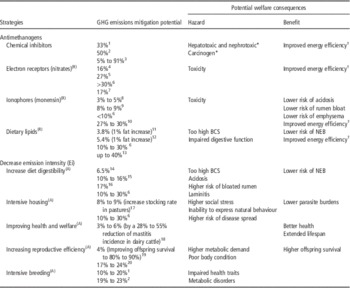
The most relevant strategies (Table 1), in terms of GHG mitigation efficacy, are classified below according to their mode of action and mitigation potential. Hazards and potential benefits of each mitigation strategy are discussed below in order to identify the strategies that are most likely to impact animal welfare or, conversely, the ones offering a dual benefit for the environment and animal welfare.
Potential welfare consequences of the principal strategies to mitigate greenhouse gas (GHG) emissions reported in literature

BCS=body condition score; NEB=negative energy balance.
Superscripts in each strategy refer to the species to which the strategy is likely to be applicable; ‘A’ for all animals, ‘R’ restricted to ruminants.
1Abecia et al. (Reference Abecia, Toral, Martín-García, Martínez, Tomkins, Molina-Alcaide, Newbold and Yaňez-Ruiz2012); 2Tomkins et al. (2009); 3Mitsumori et al. (2012); 4Van Zijderveld et al. (2011); 5Hulshof et al. (Reference Hulshof, Berndt, Gerrits, Dijkstra, Van Zijderveld, Newbold and Perdok2012); 6Gerber et al. (Reference Gerber, Vellinga, Opio and Steinfeld2013); 7Troy et al. (Reference Troy, Duthie, Hyslop, Roehe, Ross, Wallace, Waterhouse and Rooke2015); 8Beauchemin et al. (2010); 9Appuhamy et al. (Reference Appuhamy, Strathe, Jayasundara, Wagner-Riddle, Dijkstra, France and Kebreab2013); 10Guan et al. (2006); 11Martin et al. (2010); 12Beauchemin et al. (2008); 13Machmüller (2006); 14Beauchemin et al. (Reference Beauchemin, Janzen, Little, McAllister and McGinn2011); 15Lovett et al. (2006); 16Hales et al. (2012); 17Pinares-Patino et al. (2007); 18Hospido and Sonesson (2005); 19Beauchemin et al. (Reference Beauchemin, Janzen, Little, McAllister and McGinn2011); 20Garnsworthy (2004).
* Hepatotoxic, nephrotoxic and carcinogen effects are hazards derived from the use of halogenated compounds but exclude the use of 3-nitrooxypropanol.
† Improved energy efficiency applies to all direct antimethanogenic strategies as they reduce energy loss as a result of lower methane emissions.
Antimethanogenic strategies
Ruminants emit CH4 as part of their digestive processes, which involves microbial fermentation (Jungbluth et al., 2001). The process of synthesizing CH4 is performed by highly specialized methanogens (archaea) in order to utilize hydrogen (H2) produced during fermentation (Hook et al., 2010). To a far lesser extent, monogastrics also produce CH4 emissions – in this case as a result of fermentation of fibrous material in the hind-gut. There are also CH4 emissions from manure, with the amount emitted greatly dependent on the way the manure is managed (Zervas and Tsiplakou, Reference Zervas and Tsiplakou2012).
In ruminants, CH4 production is considered an efficiency loss. Strategies that achieve a reduction in CH4 emissions may also benefit energy efficiency. This can be key, both for production and animal welfare, when energy availability is lower than energy needs (e.g. in peak lactation of high-producing dairy cows) preventing metabolic diseases derived from negative energy balance (NEB).
A variety of dietary supplements, targeted towards ruminants, can help to reduce enteric CH4 production. Chemical inhibitors, nitrate and ionophores, and the inclusion of lipids have been suggested for diet supplementation because of their proven ability to reduce CH4 emissions and, in many cases, improve production efficiency. However, these compounds can have deleterious effects on health, ruminal function or metabolism. For instance, rumen fermentation might be impaired if disrupting methanogenesis leads to an accumulation of H2 in the rumen. Hence, further knowledge on their health side effects is needed before widespread application. If they are to be used, it will be crucial to understand inclusion levels (according to weight, nutritional status and stage of production) and to adopt strategies to introduce them into diets gradually.
Chemical inhibitors
Among the most well-described methanogenic inhibitors are bromochloromethane (BCM), 2-bromo-ethane sulphonate (BES) (Mitsumori et al., Reference Mitsumori, Shinkai, Takenaka, Enishi, Higuchi, Kobayashi, Nonaka, Asanuma, Denman and McSweeney2012) and chloroform (Knight et al., Reference Knight, Ronimus, Dey, Tootill, Naylor, Evans, Molano, Smith, Tavendale, Pinares-Patino and Clark2011). These agents can achieve large reductions (from 25% to 95%) in direct CH4 production according to in vivo studies with sheep, goats and cattle (Hristov et al., Reference Hristov, Oh, Firkins, Dijkstra, Kebreab, Waghorn, Makkar, Adesogan, Yang, Lee, Gerber, Henderson and Tricarico2013a; Martinez-Fernandez et al., Reference Martinez-Fernandez, Arco, Abecia, Cantalapiedra-Hijar, Molina-Alcaide, Martin-Garcia, Kindermann, Duval and Yanez-Ruiz2013). This potential however, must be contrasted with the risk to human health (when animal-derived products are consumed) and to the environment (they are themselves potent GHGs), which makes their addition to farm animal diets unlikely. Besides the environmental and public health concerns, halogenated compounds may also threaten animal health. For example, studies with rodents confirmed that halomethanes (i.e. BCM and chloroform) are toxic to the liver and kidney both after single doses (IIett et al., 1973; Smith et al., 1983) and continued exposure (14 days) (Condie et al., 1983). Also in rodent bioassays, Dunnick et al. (1987) reported an increased incidence of adenocarcinomas in the kidney, liver and large intestine after oral administration of BCM. A higher risk of cancer was also described after long-term chloroform exposure in humans (Reitz et al., 1990). The risk of toxicity using supplementation of halomethanes to reduce CH4 emissions in ruminants has been reported by Patra (Reference Patra2012) with effects ranging from liver damage to death after a long period of diet supplementation. Considering all the detrimental side effects of halogenated compounds, it is very unlikely that they could be used as routine supplements for CH4 mitigation.
Recent research has identified alternative chemical compounds capable of inhibiting methanogenesis but, in contrast to halomethanes, without health side effects. The most effective one at present is 3-nitrooxypropanol (3NP), which has achieved a 24% reduction in CH4 emissions in in vivo trials with sheep (Martinez-Fernandez et al., Reference Martinez-Fernandez, Arco, Abecia, Cantalapiedra-Hijar, Molina-Alcaide, Martin-Garcia, Kindermann, Duval and Yanez-Ruiz2013), but more pronounced reductions in cattle (7% to 60%) (Haisan et al., Reference Haisan, Sun, Guan, Beauchemin, Iwaasa, Duval, Barreda and Oba2014; Reynolds et al., Reference Reynolds, Humphries, Kirton, Kindermann, Duval and Steinberg2014). Experiments that have tested 3NP have not reported health side effects attributable to its administration over 3 to 5 weeks. A more recent study (Hristov et al., Reference Hristov, Ott, Tricarico, Rotz, Waghorn, Adesogan, Dijkstra, Montes, Oh, Kebreab, Oosting, Gerber, Henderson, Makkar and Firkins2015) extended the trial to 14 weeks, achieving an average 30% CH4 reduction, and no toxic effects were observed. The 3NP compound is anticipated to be an effective and harmless dietary strategy to mitigate CH4, however, more toxicity focussed studies are warranted to confirm this before it is used on a commercial scale.
Electron acceptors (nitrates)
Methane is synthesized in the rumen by archaea from H2, produced during fermentation, and CO2. Nitrates can replace CO2 as an electron acceptor, forming ammonia, instead of CH4, as an alternative H2 sink in the rumen (McAllister and Newbold, 2008). Recent research with sheep (Nolan et al., 2010; van Zijderveld et al., 2010) and cattle (van Zijderveld et al., Reference Van Zijderveld, Gerrits, Dijkstra, Newbold, Hulshof and Perdok2011; Hulshof et al., Reference Hulshof, Berndt, Gerrits, Dijkstra, Van Zijderveld, Newbold and Perdok2012) has shown promising results with nitrate supplementation, indicating reductions in enteric CH4 production, of up to 50%, especially when supplementing forage-based diets (Troy et al., Reference Troy, Duthie, Hyslop, Roehe, Ross, Wallace, Waterhouse and Rooke2015). However, nitrate must be supplemented with caution as it can be toxic above certain doses leading to methaemoglobinaemia and carcinogenesis (Sinderal and Milkowski, Reference Sinderal and Milkowski2012). The reviews by Bruning-Fann and Kaneene (1993) and more recently by Lee and Beauchemin (Reference Lee and Beauchemin2014) and Yang et al. (Reference Yang, Rooke, Cabeza and Wallace2016) discuss in detail nitrate’s role in metabolism, animal production, enteric CH4 emissions and toxicity, and how it may be safely used in practice.
Nitrite is formed in the rumen as an intermediate in the reduction of nitrate to ammonia. In the unadapted rumen, the rate of nitrate reduction is greater than nitrite reduction, leading to accumulation of nitrite in the rumen and subsequent absorption. In the blood, nitrite has a high affinity for haemoglobin (oxyHb) and forms methaemoglobin (metHb) which is incapable of oxygen transport (Mensinga et al., 2003; Ozmen et al., 2005). High levels of metHb (>50%), result in signs of poisoning characterized by depressed feed intake and production, absence of weight gain, immune suppression, respiratory distress, cyanosis and even death (Bruning-Fann and Kaneene, 1993). Death can occur within 3 h of feeding when cows consume between 0.22 and 0.33 g nitrate/kg BW (Burrows et al., 1987; Bruning-Fann and Kaneene, 1993). However, adapting animals progressively to a diet with nitrate enables the population of nitrite-reducing bacteria to grow, increasing the capacity to reduce nitrite (Allison and Reddy, 1984). In several experiments that tested nitrate supplementation to reduce CH4 emissions, no clinical signs or methaemoglobinaemia were observed (Al-aboudi and Jones, 1985; Nolan et al., 2010) even when in some cases the concentration of metHb was four to fivefold greater than the average levels in control animals (van Zijderveld et al., 2010). Nevertheless, it is anticipated that any potential overdose during routine nitrate supplementation could have severe implications for the health of the animal. In addition, the use of nitrates results in higher excretion of ammonia, if rations are not correctly formulated which also has negative environmental implications as it contaminates soils and water. So, the potential gains for environmental sustainability achieved by GHG mitigation would be partially countered by ammonia pollution.
Ionophores
Antibiotic ionophores, of which Monensin is the most routinely used, have been reported to reduce CH4 emissions in ruminants (Eckard et al., 2010; Gill et al., 2010; Martin et al., 2010; Grainger and Beauchemin, Reference Grainger and Beauchemin2011). In beef cattle, Guan et al. (2006) found a 27% to 30% reduction of enteric CH4 for 2 to 4 weeks but showed decreasing efficacy thereafter due to adaptation of the ruminal microflora to monensin. This effect declines to an 8% to 9% reduction in CH4 when used in dairy cattle (Appuhamy et al., Reference Appuhamy, Strathe, Jayasundara, Wagner-Riddle, Dijkstra, France and Kebreab2013). Ionophores also have the capacity to increase feed efficiency, decreasing the quantity of feed intake required to maintain productivity and thus decrease CH4 emissions per unit of product. Ionophores alter the microbial ecology of the intestine and result in increased carbon and nitrogen retention by the animal (Russell and Strobel, 1989). Monensin can improve feed efficiency in beef cattle on feedlots by 7.5% (Goodrich et al., 1984), on pasture by 15% (Potter et al., 1986) and for dairy cows by 2.5% (Duffield et al., 2008).
Since January 2006, the routine use of ionophores, principally for their growth promoting properties, has been banned in the European Union to control antibiotic resistance, preventing their use as a mitigation strategy in any of the 28 member states of the EU. However, ionophores are currently still used outside of the EU and therefore are still a valuable strategy for use in many other countries around the world.
In addition to helping to mitigate CH4 emissions, ionophores also benefit animal health by several means. Monensin reduces morbidity and mortality among feedlot animals by decreasing the incidence of sub-clinical ruminal acidosis (SARA), bloat and bovine emphysema (Galyean and Owens, 1988; McGuffey et al., 2001). The incidence of acidosis is reduced by inhibition of the major microbial strains that contribute to lactic acid production such as gram-positive bacteria and ciliate protozoa (Dennis et al., 1981; Russell and Strobel, 1989). The anti-bloat effects of monensin are mediated by a direct inhibition of encapsulated (‘slime-producing’) bacteria, as well as a decrease in overall ruminal gas production (Galyean and Owens, 1988). Monensin prevents the bovine emphysema which results from inhalation of skatole produced by rumen lactobacilli (Honeyfield et al., 1985).
Monensin also has the capacity to ameliorate NEB during periods of high energy demand (e.g. early lactation in dairy cows) by enhancing digestibility (discussed in the next section) and reducing the mobilization of body fat (McGuffey et al., 2001). There are numerous studies that demonstrate a decrease in incidence of postpartum sub-clinical ketosis (Jonker et al., 1998; Duffield et al., 1999 and Green et al., 1999) in herds supplemented with monensin.
Contrasting with these multiple benefits, ionophores can be toxic in a single dose of 22 mg/kg BW or more, leading to death in three out of five adult cattle tested (Potter et al., 1984). The same authors tested the effects of continuous doses of monensin over 7 days from 400 to 4000 mg/animal per day and found a reduction in feed intake to the point of anorexia (400 to 1000 mg/day), diarrhoea, depression, rapid breathing, ataxia (2000 mg/day) and death (four out of six at a 2000 mg/day and five out of seven at a 4000 mg/day dose). The dosage of monensin required to reduce direct CH4 emissions are ~32 to 36 mg/kg BW in beef cattle and 21 mg/kg BW in dairy cattle (Guan et al., 2006; Appuhamy et al., Reference Appuhamy, Strathe, Jayasundara, Wagner-Riddle, Dijkstra, France and Kebreab2013), whereas for increasing feed efficiency the required dosage can range from 10 to 40 mg/kg of DM (Sauer et al., 1989; McGuffey et al., 2001; Guan et al., 2006; Martineau et al., 2007). Considering a range of dry matter intake (DMI) for cattle of between 10 and 20 kg/day, animals would be offered between 100 (for the lowest dose and intake) and 800 mg/day (for the highest dose and intake) either to improve feed efficiency or to reduce CH4 emissions. According to previous work (i.e. Potter et al., 1984), if this quantity is supplemented continuously (>7 days) this could be toxic to cattle, whereas other literature established that this range is below the risk threshold (van Zijderveld et al., Reference Van Zijderveld, Gerrits, Dijkstra, Newbold, Hulshof and Perdok2011). These contrasting results suggest that further investigation to define the appropriate dosage and method of administration to prevent ionophore toxicity in cattle is warranted. This lack of knowledge is even more evident in other ruminant species, such as sheep or goats.
Dietary lipids
Medium-chain fatty acids (FAs) are known to reduce methanogenesis by several mechanisms. The main ones are (a) reducing the proportion of energy supply from fermentable carbohydrates, (b) changing the rumen microbial population, particularly inhibiting rumen methanogens and, to a limited extent, (c) biohydrogenation of unsaturated FAs that works as an hydrogen acceptor (Eckard et al., 2010; Machmüller, 2006). The combination of these effects can lead to reductions in CH4 production of between 3.8% and 5.4% per 1% addition in lipids (up to 6% lipid supplementation on a DM basis) (Beauchemin et al., 2008; Martin et al., 2010). However, the direct anti-microbial (bacteria and protozoa) effect of lipids in the rumen (Hristov et al., Reference Hristov, Oh, Firkins, Dijkstra, Kebreab, Waghorn, Makkar, Adesogan, Yang, Lee, Gerber, Henderson and Tricarico2013a) may provoke a dysbiosis of the microbial population which leads to an impairment of ruminal function. As a result, feed intake and the digestibility of non-lipid energy sources (Jenkins and Jenny, 1989) are decreased. For example, adding up to 10% fat into the diet can result in a decrease in fibre digestibility of about 50% (Jenkins, 1993), the effects of which may be less severe when digesting non-structural carbohydrates such as starch (Zinn, 1988). To avoid the adverse effects of lipids on rumen function and productivity in sheep and beef cattle, Hess et al. (2008) suggested that lipid supplementation should not exceed 3% to 4% of total DMI, especially in diets containing a high proportion of fibre. However, if lipid supplementation is used as a CH4 mitigation strategy fat supplementation should reach a 5% to 8% of diet DM (Machmüller, 2006; Grainger and Beauchemin, Reference Grainger and Beauchemin2011). Supplementation of higher quantities of lipids into the diet impacts gastrointestinal function in ruminants, which could affect their nutritional status, influencing not only their welfare but also their production efficiency.
On the other hand, if supplemented appropriately, fat can provide an extra energy input in some high energy-demand production phases, such as gestation or lactation in dairy cattle. In high-producing dairy cows, supplementary fat may alleviate the NEB that occurs during early lactation and consequently improve fertility and milk yield (Grummer and Carroll, 1991; Staples et al., 1998). Also, addition of dietary fat soon after calving may reduce the risk of ketosis and steatosis before peak lactation (Grummer, 1993). If energy requirements are low, provision of lipids as a source of energy can lead to fat deposition that in some cases can impact the animal fitness (e.g. obesity and fatty liver) (Grummer, 1993). Indeed, if supplemented appropriately lipids can decrease CH4 emissions and provide an extra source of energy which can be beneficial when energy requirements are higher than nutritional provision. The quantity of inclusion has to be limited (4% to 8% depending on sources) to avoid impacting nutrition in ruminants.
Strategies to decrease emission intensity
Ei is a measure of the quantity of GHG emissions generated per unit of output. It is (negatively) associated to the productivity of the system, measured in terms of output per animal, or on a whole herd basis, and based on the fact that more efficient systems or processes create less waste (including GHGs) per unit of output (Gerber et al., Reference Gerber, Hristov, Henderson, Makkar, Oh, Lee, Meinen, Montes, Ott, Firkins, Rotz, Dell, Adesogan, Yang, Tricarico, Kebreab, Waghorn, Dijkstra and Oosting2011). For example, increasing efficiency would require fewer animals and/or animals with shorter lifetimes to produce the same quantity of product. This reduces the quantity of inputs necessary for production and hence associated waste (FAO, 2013). This mitigation approach can reduce GHG emissions and increase profitability at the same time. Nevertheless, a drive for improved system efficiency has driven livestock intensification (e.g. concentrate diets, restricted grazing, breeding for higher productivity, etc.) which, when a certain threshold is exceeded, may impair animal welfare (e.g. increasing stocking density). This threshold is more likely to be achieved in intensive systems where animal productivity is often achieved at the cost of animal welfare. In contrast, in less developed production systems, increasing animal efficiency will be achieved by improving breeding, nutrition and/or health with no detrimental (and even potentially beneficial) effects for animal welfare.
Increasing diet digestibility
A promising approach for reducing relative CH4 emissions per unit of output from livestock is by improving the nutrient use efficiency (Gerber et al., Reference Gerber, Hristov, Henderson, Makkar, Oh, Lee, Meinen, Montes, Ott, Firkins, Rotz, Dell, Adesogan, Yang, Tricarico, Kebreab, Waghorn, Dijkstra and Oosting2011). This can be achieved either by adding more digestible feed ingredients (e.g. non-fermentable carbohydrates), or by increasing the efficiency with which animals use the feed (e.g. through physical, chemical or enzymatic pre-feeding treatments). These effects may be translated to effects on CH4 emissions per unit of DM intake or per unit of product (Ei; Blaxter, 1989; Yates et al., 2000). Diets containing a higher proportion of starch reduce rumen pH and favour the production of propionate rather than acetate in the rumen (McAllister and Newbold, 2008), leading to a reduction of net CH4. On the other hand, improving diet quality (either with higher proportions of starch or improving digestibility with pre-feeding treatments) will improve feed efficiency (more kg of product with the same input), which results in a reduction in Ei. Considering these effects, Lovett et al. (2006) showed that when feeding of concentrates increased (from 338 to 1403 kg head/year) in dairy cows, the emissions of GHGs were reduced by 9.5% (CH4) and 16% (N2O), respectively. According to Hales et al. (Reference Hales, Cole and MacDonald2012), CH4 emissions were 17% lower per unit of DMI from steers fed corn processed by steam-flaking compared with dry-rolling which produced a larger particle size. Although these examples are in ruminants, highly digestible diets have also been proposed as a strategy to mitigate GHG emissions in non-ruminant species (Bakker, 1996; Monteny et al., 2006), as improving feed accessibility will result in a greater feed efficiency and therefore a reduction of Ei.
Whilst the use of diets containing higher levels of fermentable carbohydrates can drive productivity, CH4 mitigation and profitability, there are limits to this approach, particularly because of potential negative health consequences of diets containing very high levels of fermentable carbohydrates. Significant effects on CH4 emissions are often achieved using levels of starch that could impair rumen function. In ruminants, both a greater proportion of dietary fermentable carbohydrates and a reduction in feed particle size may increase the risk of acidosis in the rumen (Owens et al., 1998). When rapidly fermentable carbohydrate supply is increased (or the accessibility of carbohydrates enhanced), the supply of total volatile FAs (VFA) and the concentration of lactate in the rumen is increased. When lactate accumulates, it leads to a drop in rumen pH. The low rumen pH and high osmolality associated with rumen acidosis can damage the ruminal and intestinal wall, decrease blood pH and cause dehydration (Owens et al., 1998). Clinical diagnosis of acidosis depends on measurements of ruminal or blood acidity, with ruminal pH of 5.2 and 5.6 as benchmarks for acute acidosis and SARA, respectively (Cooper and Klopfenstein, 1996). In addition to making carbohydrates more accessible, a reduction in particle size reduces chewing activity and saliva secretion in cattle. As saliva acts as a buffer against low pH, a reduction in chewing activity may aggravate the acidosis (Beauchemin et al., 2003). Acute acidosis occurs after an abrupt increase in consumption of readily fermented carbohydrates. Its common clinical signs are anorexia, ataxia and dehydration that, together, can be fatal (Owens et al., 1998). Less severe, but much more frequent and persistent, is SARA in which feed intake and performance may be suppressed. SARA is also associated with other health problems, such as inflammation (liver abscesses or laminitis) associated with pain (Plaizier et al., 2009) or bloat and displaced abomasum (Nocek, 1997; Enemark, 2008; De Vries et al., Reference De Vries, Bokkers, Dijkstra, Van Schaik and De Boer2011). In beef cattle, the health problems associated with acidosis reduce productivity (e.g. requiring an older slaughter age to reach a given carcass conformation), thereby increasing Ei. This highlights some situations in which poorer welfare (that can be due to disease and pain; Fraser et al., Reference Fraser, Duncan, Edwards, Grandin, Gregory, Guyonnet, Hemsworth, Huertas, Huzzey, Mellor, Mench, Špinka and Whay2013), may be related to increased GHG Ei. The relationship between animal welfare, production efficiency and GHG mitigation is discussed later in this paper.
According to Sauvant and Giger-Riverdin (2007), a small to moderate change in the proportion of concentrate in ruminant diets is unlikely to affect enteric CH4 emissions. Instead, marked improvements can be expected beyond a 35% to 40% inclusion of grain in the diet (Gerber et al., Reference Gerber, Vellinga, Opio and Steinfeld2013). For instance, to achieve a decrease of 9.5% CH4 in dairy cattle, Lovett et al. (2006) increased non-fibre carbohydrates more than fourfold (from 338 to 1403 kg/head per year). Diets containing a high proportion of fermentable carbohydrates are common in intensive beef and dairy cattle production as they achieve high production rates. At such a level of starch inclusion, acidosis can be prevented with appropriate feeding management and husbandry practices (Enemark, 2008). However, some degree of SARA may be inevitable both in beef (Nagaraja and Lechtenberg, 2007) and dairy cattle (Kleen et al., 2003) when high proportions of starch are included in the diet. Considering the concentrate inclusion levels to achieve significant CH4 mitigation, the implementation of such a strategy should be accompanied by dietary and management preventive measures to decrease the incidence of side effects to the minimum.
Housing and management
Greater intensification of animal housing and livestock management can also contribute to decreasing the relative GHG emissions at an individual level. Intensification can be defined as the increased use of external inputs and services to increase the system efficiency which is typically associated with lower GHG Ei (Burney et al., 2010; Crosson et al., Reference Crosson, Shalloo, O’Brien, Lanigan, Foley, Boland and Kenny2011). A reduction in the area per animal (increasing the stocking rate) or restricting access to pasture, are characteristic of intensive systems. In dairy cattle, an increase of 33% in stocking rate is associated with a 38% increase in milk/ha according to the DairyMod model (Johnson et al., 2008). Although an increase in stocking rate results in a direct increase in CH4/ha of 26%, it reduces CO2-eq/l milk by 19%. For efficient GHG mitigation, a high stocking density must be matched by an increase in feed supply as increasing stocking density alone would be expected to result in decreased production and increased GHG Ei per animal (Baudracco et al., 2010). In addition, if the stocking rate in grazed systems reaches a threshold (which will vary with the type of pasture ecosystem) the capacity of pastures to operate as a carbon sink may be exceeded (Soussana et al., 2004). The reduction in GHG emissions in intensive systems may be achieved from additional factors as well; improved diet digestibility of grain-based v. forage diets, a smaller proportion of the dietary energy being used for maintenance when animals are confined (Peters et al., 2010) and the ability to capture excreta to restrict N2O emissions.
Increased stocking rate may compromise welfare. Competition for resources may increase f stocking density is increased, resulting in more frequent agonistic interactions and greater social stress, especially in indoor systems (Veissier et al., 2008). For instance, high stocking rates increases aggression, injuries and stress responses in pregnant pigs (Barnett et al., 1992; Salak-Johnson et al., 2007) and can lead to a reduction in survival and productivity in caged hens (Adams and Craig, 1985; Bell et al., 2004). High population density results in increased aggressive behaviour in sheep (Mui and Ledin, 2007) and cattle (Kondo et al., 1989) leading to social stress. In ruminant outdoor systems, increased stocking density may increase the risk of parasitic diseases due to increased pathogen exposure (Taylor, Reference Taylor2012). Considering the 30% to 50% increase in stocking density needed to significantly decrease GHG emissions in ruminants (Pinares-Patino et al., 2007; Johnson et al., 2008), detrimental impacts on the health and non-health aspects of welfare of animals can be anticipated. Conversely, improvements in welfare, for example through reduced social stress, can directly contribute to greater feed intake in cattle (De Vries et al., 2004) and improved feed efficiency in pigs (Vermeer et al., Reference Vermeer, de Greef and Houwers2014) thereby improving production rates and should also be considered as a measure to mitigate GHG emissions.
Grazing restriction can also reduce both N2O and CH4 emissions. DeRamus et al. (2003) demonstrated that restricted grazing resulted in more efficient conversion of forage into meat and milk, leading to a 22% reduction in annual projected CH4 emissions per animal. De Klein et al. (2001) showed a 40% to 57% reduction in N2O emissions from cattle when grazing was restricted to 3 h/day compared with free access.
However, restricting access to pasture may impact the health and welfare of animals. In dairy cattle, restricted grazing requires cows to be confined in housing systems. Lameness is increased in confinement due to contact with slurry and the concussive effects of concrete (Cook et al., 2004; Haskell et al., 2006). Furthermore, cattle and sheep evolved as ‘grazers’ and show a demand for access to pasture provided that their nutritional requirements are met (Legrand et al., 2009). Preventing access to pasture is therefore likely to thwart expression of a natural behaviour, for which there is a high motivation, and cause frustration (Rutter, 2010). Indeed, the definition of animal welfare given previously states that providing the opportunity to have what domestic animals want is key for good standards of welfare. Promoting animal welfare demands that we consider not just the prevention of ‘harms’ to animals, but also provision of opportunities to have positive experiences. Therefore, facilitating grazing in animals that show motivation for it seems necessary for optimal welfare.
Conversely, positive effects of restricted grazing for welfare should be mentioned. For example, the high nutritional requirements of high genetic merit dairy cows are more easily met in intensive systems. For these animals, unless nutritional requirements are met in grazing systems, hunger and poor body condition may compromise health and welfare and require animals to trade-off motivational priorities, such as eating and resting (Charlton et al., Reference Charlton, Rutter, East and Sinclair2011). Additional benefits of indoor housing include provision of shelter in bad weather (heat, cold and wet), protection against predators and reduced exposure to parasites.
In order to optimize the balance between GHG mitigation and animal welfare goals, mixed systems combining indoor housing, in which the nutritional needs can be easily addressed, and access to pasture, should be promoted.
Improving health and welfare
Good standards of animal welfare cannot be achieved in conditions of poor health, as already discussed by Dawkins (2006) and Fraser et al. (Reference Fraser, Duncan, Edwards, Grandin, Gregory, Guyonnet, Hemsworth, Huertas, Huzzey, Mellor, Mench, Špinka and Whay2013). Poorer livestock health and fitness are associated with behavioural and metabolic changes such as reduced feed intake, a reduction in ability to digest food and increased energy requirements for maintenance (Collard et al., 2000; Bareille et al., 2003). This can lead to an increase in the involuntary culling rate that in turn raises GHG Ei (FAO, 2013). Improvements in health may also reduce inefficiencies from product condemnation and poorer productivity of individual animals (Wall et al., 2010; de Boer et al., Reference De Boer, Cederberg, Eady, Gollnow, Kristensen, Macleod, Meul, Nemecek, Phong, Thoma, van der Werf, Williams and Zonderland-Thomassen2011). Taking the example of dairy cattle, both lameness (Warnick et al., 2001) and mastitis (Wilson et al., 1997) reduce milk output, increasing non-CO2 GHG emissions per litre of milk produced.
Better health may reduce culling due to injury and disease, and is therefore very likely to extend the average productive life span of the herd. In dairy cattle, increased average longevity of animals in the herd has been suggested as a means to enhance animal productivity and reduce GHG emissions per kg product (Weiske et al., 2006; Bell et al., Reference Bell, Wall, Simm and Russell2011). The mitigation potential of this measure ranges from 1% (Beauchemin et al., Reference Beauchemin, Janzen, Little, McAllister and McGinn2011) to nearly 13% (Weiske et al., 2006) if the reduction in replacement rate and the export of surplus heifers from the system as newborns are considered.
Extended longevity can be a requirement for and/or an indicator of welfare (Broom, 2007; Farm Animal Welfare Council (FAWC), 2009; Yeates, 2009), but it is closely related to whether a life is worth living. Longevity has been used as an indicator of welfare since it indicates whether health and biological functioning are compromised to such an extent that the life span is affected, although it does not necessarily translate that a long life is a one worth living. From this perspective, what is acceptable can be interpreted more broadly than merely preventing physical or mental discomfort and includes the possibility for animals to flourish and live a natural life (Bruijnis et al., Reference Bruijnis, Meijboom and Stassen2013). In general, an extended life span will enhance production efficiency of breeding animals such as dairy cattle and, at the same time, will improve animal welfare. The impact of this strategy to decrease Ei in species other than cattle (i.e. pigs and sheep) should be studied to quantify its effectiveness in other species.
Improved animal health through the prevention and control of disease and parasites is widely regarded as fundamental to animal welfare (Organization International des Epizooties (OIE), 2012). Animal welfare, however, is determined by health, but also non-health aspects such as comfort, absence of fear or the ability to perform natural behaviours. Improvements in non-health aspects of animal welfare have not yet been tested as a specific strategy to reduce GHG emissions. However, in some circumstances (e.g. lower environmental stress) better animal welfare can benefit productivity and thus GHG Ei (Place and Mitloehner, Reference Place and Mitloehner2014). Significant improvements in welfare and productivity can probably be achieved through basic husbandry changes. For instance, increased stress provoked by negative handling can reduce milk and meat production in dairy (Rushen et al., 1999) and beef cattle (Hemsworth and Coleman, Reference Hemsworth and Coleman2011). In laying hens, social stress induced by overcrowding of caged hens can lead to a reduction in survival and productivity (Adams and Craig, 1985; Bell et al., 2004). The growth rate of pigs subjected to thermal stress, restricted space allowance or regrouping can be depressed by 10%, 16% and 11%, respectively, but by 31% when subjected to all three stressors simultaneously (Hyun et al., 1998). Some strategies that aim to increase animal productivity can thwart animal welfare but at the same time, improvements in animal welfare may, in some cases, improve animal productivity (and economic performance) and reduce GHG Ei.
Increasing reproductive efficiency
Poor fertility means that more breeding animals are required in the herd to meet production targets and more replacements are required to maintain the herd size, which increases the Ei at a herd level. According to Garnsworthy (2004), CH4 emissions could be decreased by 10% to 11% and ammonia (precursor of N2O) emissions by about 9% by restoring average fertility rates in dairy cattle to those in 1995. The reduction in CH4 and ammonia could be as high as 24% and 17%, respectively, if further feasible improvements in fertility were achieved. Nevertheless, increasing reproductive pressure on dams may increase the metabolic demands associated with pregnancy over the cow’s lifetime. Parturition and lactation results in an abrupt shift in the metabolic demands from body reserves to rapid mobilization of lipid and protein stores in support of milk production which frequently leads to NEB (Grummer, 2007). Improved reproductive efficiency (e.g. by reducing the interval between parities or increasing the number of offspring per parity) may increase the likelihood of NEB with detrimental consequences for animal health such as an increased risk of metabolic diseases (e.g. clinical hypocalcaemia and ketosis), reduced immune function and a reduction in subsequent fertility (Roche et al., 2009).
Decreasing the age at first calving has also been proposed as a strategy to mitigate GHG Ei. Farrié et al. (2008) showed that by reducing the age at first calving of heifers from 3 to 2 years in a Charolais beef herd, the live birth rate increased from 5% to 10%. According to Nguyen et al. (Reference Nguyen, Doreau, Corson, Eugène, Delaby, Chesneau, Gallard and Van der Werf2013), decreased calving age seems a promising strategy to mitigate GHG emissions by an estimated 8% to 10%. Heifers younger than 24 months are still growing and the energy requirements implicit in gestation and basal maintenance have to be added to those from growth (Roche et al., 2009). Frequently, aggregate energy requirements cannot be met by nutritional inputs, leading to greater NEB and mobilization of body reserves and an excessive decrease in body condition (Berry et al., 2006; Roche et al., 2007). A poor nutritional status at the point of calving will lead to a high incidence of diseases associated with metabolic exhaustion such as ketosis (Gillund et al., 2001), milk fever (Roche and Berry, 2006), displaced abomasum (Cameron et al., 1998) and fatty liver (Drackley, 1999). In addition, this low nutritional status will impact reproduction rates (i.e. reduced ovulation rate, increased likelihood for pregnancy loss, increased calving to conception interval, etc.) (Walsh et al., Reference Walsh, Williams and Evans2011), therefore impairing the system efficiency which inevitably increases the system Ei. Again, this is an example of a situation in which improving animal welfare (through reduced reproductive pressure) may help to mitigate Ei.
Conversely, stress can impair reproduction and its mitigation can provide significant improvements in reproductive output. In mammalian species, stress (particularly heat stress) can have large effects on most aspects of reproductive function; either male or female gamete formation and function, embryonic development and foetal growth and development (Hansen, 2009). In dairy cows, stress can exacerbate the effects of NEB because of a reduction in appetite and an increase in energy use to meet the demands of the stress response (Shehab-El-Deen et al., 2010). Stress experienced during the early gestation period causes embryonic loss in cattle (Hansen and Block, 2004). It is likely then that the control of stressors during gestation or a reduction in stress sensitivity will improve conception rates and foetal development and hence, benefit productivity and GHG mitigation.
Reproductive output can also be increased by means of an increase in litter size or increase in the number of offspring weaned. Greater litter sizes could have a significant impact on welfare in certain species. For example, increased litter size can have a major effect on offspring mortality (Mellor and Stafford, 2004) associated with a higher risk of starvation and thermal stress for lambs (Dwyer, 2008) and pigs (Rutherford et al., Reference Rutherford, Baxter, D’Eath, Turner, Arnott, Roehe, Ask, Sandøe, Moustsen, Thorup, Edwards, Berg and Lawrence2013). Single or twin lambs are much less likely to die than triplets (Barlow et al., 1987). Similarly, piglets from litters of 16 to 19 are much more likely to die than litters of eight to nine (45 v. 10% to 15%) (Blasco et al., 1995). Conversely, greater numbers of weaned offspring can also be achieved by improving survival after birth. Wall et al. (2010) suggested that improvements in pre-, peri- and postpartum offspring survival through improving calving and maternal traits could mitigate GHG emissions. Beauchemin et al. (Reference Beauchemin, Janzen, Little, McAllister and McGinn2011) described a hypothetical scenario in which a 5% improvement in calf survival rate from birth to weaning (from 85% to 90%) would decrease GHG emissions by up to 4%. The consequences of increasing survival rates for offspring welfare are obvious. In addition, the death of a newborn might cause anxiety or frustration to its mother when appropriate feedback in response to maternal care is not received, as already suggested in sheep (Dwyer, 2008).
In conclusion, excessive reproductive pressure may be detrimental for the health of the mother and progeny. Other strategies to increase reproductive efficiency (i.e. improving offspring survival) may benefit both animal productivity and their welfare. Hence, adequate feeding and management of pregnant livestock and the provision of a suitable birth environment and appropriate care and husbandry for neonates are important determinants not only for fertility and neonatal survival, but also for GHG mitigation.
Breeding for increased productivity
Breeding for more productive animals helps mitigate GHG emissions through the dilution of nutrient requirements for maintenance where a given level of production can be achieved with fewer animals (Van de Haar and St Pierre, 2006; Wall et al., 2010; Bell et al., Reference Bell, Wall, Simm and Russell2011). However, as already described by Rauw et al. (1998) and Lawrence et al. (2004), selective breeding for higher productivity can harm animal health and welfare unless balanced by selection pressure placed on functional traits. Genetic selection for high production efficiency can impair normal biological functioning (Oltenacu, 2009; De Vries et al., Reference De Vries, Bokkers, Dijkstra, Van Schaik and De Boer2011; Fraser et al., Reference Fraser, Duncan, Edwards, Grandin, Gregory, Guyonnet, Hemsworth, Huertas, Huzzey, Mellor, Mench, Špinka and Whay2013) and lead to numerous unexpected consequences (Table 1). A high genetic potential for mobilizing body energy reserves for production can have deleterious effects on health and fertility (Bell et al., Reference Bell, Wall, Simm and Russell2011), as shown by the association between high milk production and an increased incidence of fertility problems and metabolic disorders such as ketosis in dairy cattle (Walsh et al., Reference Walsh, Williams and Evans2011). Evidence of this trade-off are the undesirable genetic correlations between milk yield and ketosis, mastitis and lameness during lactation (r g =0.26 to 0.65, r g =0.15 to 0.68 and r g =0.24 to 0.48, respectively) reviewed by Ingvartsen et al. (2003). The link between breeding for increased production and risk of poor health has also been described in monogastrics. Osteoporosis is widespread in genetically selected commercial laying hens because of excessive loss of bone calcium that is repartitioned to egg shells (Webster, 2004; Whitehead, 2004). Osteoporosis increases the risk of fractured bones in caged birds when they are handled or when hens fall during flight (Lay et al., Reference Lay, Fulton, Hester, Karcher, Kjaer, Mench, Mullens, Newberry, Nicol, O’Sullivan and Porter2011). Moderate to strong genetic correlations have been estimated in pigs between rapid growth, litter size and feed conversion efficiency on the one hand and increased osteochondrosis and leg weakness on the other (Huang et al., 1995; Kadarmideen et al., 2004).
Improved feed efficiency is a promising approach to mitigate GHG emissions and progress has already been made in this direction through breeding. Waghorn and Hegarty (Reference Waghorn and Hegarty2011) estimated that if feed efficiency were selected as the main animal breeding goal for ruminants, a valuable 15% reduction in CH4 emissions could be achieved. Reductions in emissions and Ei with improved feed efficiency should also apply to N2O (Gerber et al., Reference Gerber, Vellinga, Opio and Steinfeld2013), as more N efficient animal will retain more dietary N and therefore N excretion in faeces and urine will decrease. Nevertheless, risks for health and fertility traits have been identified in breeding for greater feed efficiency. For example, if body condition is not included in the prediction of feed efficiency, a decline in fertility could result from body energy reserves being allocated to production rather than reproduction (Pryce et al., Reference Pryce, Wales, De Haas, Veerkamp and Hayes2014). Furthermore, Waasmuth et al. (2000) estimated undesirable genetic correlations (r g ) between a measure of feed efficiency (feed conversion ratio) in growing bulls and health traits in lactating animals (mastitis, r g −0.79; ketosis, r g −0.37).
Whilst the GHG mitigation potential of breeding for increased efficiency and productivity may be significant, past experience highlights the need for broader breeding goals to offset negative welfare consequences that in turn have economic and environmental costs (Lawrence et al., 2004). In this regard, recent literature suggests that non-productive traits such as welfare can be improved in association with productivity traits in dairy cattle (Gaddis et al., Reference Gaddis, Cole, Clay and Maltecca2014), pigs (Rowland et al., Reference Rowland, Lunney and Dekkers2012) and poultry (Kapell et al., Reference Kapell, Hill, Neeteson, McAdam, Koerhuis and Avendaño2012). Reduced welfare is not a necessary consequence of selective breeding per se, and indeed, if used appropriately, animal breeding may have the potential to enhance animal welfare (Jones and Hocking, 1999).
Conclusions
In recent years, animal science has focused on reducing the environmental impacts of production while enhancing efficiency or profitability of herds and flocks as the primary goals, relegating the welfare of individual animals to a secondary consideration (Mellor et al., 2009). However, consumer concern for animal welfare is increasing and it is gradually accepted as an integral component of sustainability. In this context, the implications of strategies to reduce the environmental impact of livestock production for animal welfare are important.
Strategies to reduce GHG emissions from livestock production have come into focus in order to meet the commitments of international treaties on GHG mitigation. The majority of these strategies aim to increase productivity (unit of product per animal), which in most cases cannot be achieved without good standards of animal welfare. In other cases, GHG mitigation is targeted towards manipulating the naturalness of the animals’ environment, risking a reduction in their welfare. For example, strategies focused on changing housing conditions increase the risk of social stress or compromise the expression of natural behaviour, which can cause frustration. Breeding strategies that aim to change animal phenotypes to enhance productivity or efficiency may have wide-ranging implications for welfare unless these effects are measured and controlled. Some dietary measures, such as supplementing ionophores, can effectively reduce GHG emissions without negatively affecting animal welfare, whilst others can even improve it. For example, strategies reducing direct CH4 emissions will increase energy availability benefiting the energy balance which can be critical in high-producing animals. In some cases, improvements in animal welfare may enhance animal productivity, which will provide better economic returns to farmers and the livestock sector as, for example, through decreased social stress, enhanced health status or improved offspring survival. These ‘win-win-win’ strategies, enhancing sustainability with regards to societal, environmental and economic concerns of livestock production should be strongly supported by decision makers.
Beyond the general conclusions above, there is still a great lack of knowledge on the repercussions for animal welfare of the known (and emerging) strategies to reduce GHG emissions. The consequences that such strategies could have on animal welfare must not only be identified, but also quantified and contrasted. This will allow a realistic and informed debate on what strategies should or should not be adopted to improve the environmental sustainability of livestock production without compromising animal welfare.
Acknowledgements
The authors gratefully acknowledge J. A. Rooke and E. Wall for their valuable contributions to this paper. P. Llonch received support from a Marie Curie Intra-European Fellowship within the 7th European Community Framework Programme (PIEF-GA-2012-331505). SRUC receives financial support from the Scottish Government Strategic Research Programme.
Supplementary Material
For supplementary material/s referred to in this article, please visit http://dx.doi.org/10.1017/S1751731116001440