


%20--%3e%3c!DOCTYPE%20svg%20PUBLIC%20'-//W3C//DTD%20SVG%201.0//EN'%20'http://www.w3.org/TR/2001/REC-SVG-20010904/DTD/svg10.dtd'%3e%3csvg%20version='1.0'%20id='Layer_1'%20xmlns='http://www.w3.org/2000/svg'%20xmlns:xlink='http://www.w3.org/1999/xlink'%20x='0px'%20y='0px'%20width='64px'%20height='64px'%20viewBox='5.5%20-3.5%2064%2064'%20enable-background='new%205.5%20-3.5%2064%2064'%20xml:space='preserve'%3e%3cg%3e%3ccircle%20fill='%23FFFFFF'%20fill-opacity='0'%20cx='37.785'%20cy='28.501'%20r='28.836'/%3e%3cpath%20fill='%23595959'%20d='M37.441-3.5c8.951,0,16.572,3.125,22.857,9.372c3.008,3.009,5.295,6.448,6.857,10.314%20c1.561,3.867,2.344,7.971,2.344,12.314c0,4.381-0.773,8.486-2.314,12.313c-1.543,3.828-3.82,7.21-6.828,10.143%20c-3.123,3.085-6.666,5.448-10.629,7.086c-3.961,1.638-8.057,2.457-12.285,2.457s-8.276-0.808-12.143-2.429%20c-3.866-1.618-7.333-3.961-10.4-7.027c-3.067-3.066-5.4-6.524-7-10.372S5.5,32.767,5.5,28.5c0-4.229,0.809-8.295,2.428-12.2%20c1.619-3.905,3.972-7.4,7.057-10.486C21.08-0.394,28.565-3.5,37.441-3.5z%20M37.557,2.272c-7.314,0-13.467,2.553-18.458,7.657%20c-2.515,2.553-4.448,5.419-5.8,8.6c-1.354,3.181-2.029,6.505-2.029,9.972c0,3.429,0.675,6.734,2.029,9.913%20c1.353,3.183,3.285,6.021,5.8,8.516c2.514,2.496,5.351,4.399,8.515,5.715c3.161,1.314,6.476,1.971,9.943,1.971%20c3.428,0,6.75-0.665,9.973-1.999c3.219-1.335,6.121-3.257,8.713-5.771c4.99-4.876,7.484-10.99,7.484-18.344%20c0-3.543-0.648-6.895-1.943-10.057c-1.293-3.162-3.18-5.98-5.654-8.458C50.984,4.844,44.795,2.272,37.557,2.272z%20M37.156,23.187%20l-4.287,2.229c-0.458-0.951-1.019-1.619-1.685-2c-0.667-0.38-1.286-0.571-1.858-0.571c-2.856,0-4.286,1.885-4.286,5.657%20c0,1.714,0.362,3.084,1.085,4.113c0.724,1.029,1.791,1.544,3.201,1.544c1.867,0,3.181-0.915,3.944-2.743l3.942,2%20c-0.838,1.563-2,2.791-3.486,3.686c-1.484,0.896-3.123,1.343-4.914,1.343c-2.857,0-5.163-0.875-6.915-2.629%20c-1.752-1.752-2.628-4.19-2.628-7.313c0-3.048,0.886-5.466,2.657-7.257c1.771-1.79,4.009-2.686,6.715-2.686%20C32.604,18.558,35.441,20.101,37.156,23.187z%20M55.613,23.187l-4.229,2.229c-0.457-0.951-1.02-1.619-1.686-2%20c-0.668-0.38-1.307-0.571-1.914-0.571c-2.857,0-4.287,1.885-4.287,5.657c0,1.714,0.363,3.084,1.086,4.113%20c0.723,1.029,1.789,1.544,3.201,1.544c1.865,0,3.18-0.915,3.941-2.743l4,2c-0.875,1.563-2.057,2.791-3.541,3.686%20c-1.486,0.896-3.105,1.343-4.857,1.343c-2.896,0-5.209-0.875-6.941-2.629c-1.736-1.752-2.602-4.19-2.602-7.313%20c0-3.048,0.885-5.466,2.658-7.257c1.77-1.79,4.008-2.686,6.713-2.686C51.117,18.558,53.938,20.101,55.613,23.187z'/%3e%3c/g%3e%3c/svg%3e)
%20--%3e%3c!DOCTYPE%20svg%20PUBLIC%20'-//W3C//DTD%20SVG%201.0//EN'%20'http://www.w3.org/TR/2001/REC-SVG-20010904/DTD/svg10.dtd'%3e%3csvg%20version='1.0'%20id='Layer_1'%20xmlns='http://www.w3.org/2000/svg'%20xmlns:xlink='http://www.w3.org/1999/xlink'%20x='0px'%20y='0px'%20width='64px'%20height='64px'%20viewBox='5.5%20-3.5%2064%2064'%20enable-background='new%205.5%20-3.5%2064%2064'%20xml:space='preserve'%3e%3cg%3e%3ccircle%20fill='%23FFFFFF'%20fill-opacity='0'%20cx='37.637'%20cy='28.806'%20r='28.276'/%3e%3cg%3e%3cpath%20fill='%23595959'%20d='M37.443-3.5c8.988,0,16.57,3.085,22.742,9.257C66.393,11.967,69.5,19.548,69.5,28.5c0,8.991-3.049,16.476-9.145,22.456%20C53.879,57.319,46.242,60.5,37.443,60.5c-8.649,0-16.153-3.144-22.514-9.43C8.644,44.784,5.5,37.262,5.5,28.5%20c0-8.761,3.144-16.342,9.429-22.742C21.101-0.415,28.604-3.5,37.443-3.5z%20M37.557,2.272c-7.276,0-13.428,2.553-18.457,7.657%20c-5.22,5.334-7.829,11.525-7.829,18.572c0,7.086,2.59,13.22,7.77,18.398c5.181,5.182,11.352,7.771,18.514,7.771%20c7.123,0,13.334-2.607,18.629-7.828c5.029-4.838,7.543-10.952,7.543-18.343c0-7.276-2.553-13.465-7.656-18.571%20C50.967,4.824,44.795,2.272,37.557,2.272z%20M46.129,20.557v13.085h-3.656v15.542h-9.944V33.643h-3.656V20.557%20c0-0.572,0.2-1.057,0.599-1.457c0.401-0.399,0.887-0.6,1.457-0.6h13.144c0.533,0,1.01,0.2,1.428,0.6%20C45.918,19.5,46.129,19.986,46.129,20.557z%20M33.042,12.329c0-3.008,1.485-4.514,4.458-4.514s4.457,1.504,4.457,4.514%20c0,2.971-1.486,4.457-4.457,4.457S33.042,15.3,33.042,12.329z'/%3e%3c/g%3e%3c/g%3e%3c/svg%3e)
Introduction
Outpatient parenteral antimicrobial therapy (OPAT) is a safe and cost-effective way for patients to continue to receive intravenous (IV) antimicrobials outside the hospital setting. Reference Norris, Shrestha and Allison1 Patients appreciate the improved quality of life while continuing to receive care in their home environment. Reference Burch, Ledergerber and Ringer2 Guidelines outline best practices for patients receiving OPAT, Reference Norris, Shrestha and Allison1,Reference Chapman, Patel, Horner, Gilchrist and Seaton3 and dedicated OPAT teams have been shown to decrease overall healthcare costs by decreasing hospital length of stay, readmission rates and emergency department visits. Reference Berrevoets, Ten Oever, Oerlemans, Kullberg, Hulscher and Schouten4,Reference Madaline, Nori and Mowrey5 With increased recognition of the value of OPAT, hospitals, health systems and physician practices have developed multidisciplinary OPAT teams to ensure the safe transition of care from inpatient to ambulatory care. Reference Keller, Ciuffetelli and Bilker6
Despite the many benefits and value of dedicated OPAT teams, no standards exist for what constitutes an OPAT team, and how best to support a program. Additionally, in keeping with new evidence, many Infectious Diseases (ID) clinicians are increasingly using high-risk oral antimicrobials and long-acting injectable antimicrobials in place of traditional IV antimicrobials and taking innovative approaches to the care of patients with substance use disorder (SUD) to best support successful patient outcomes. Reference Li, Rombach and Zambellas7–Reference Douglass, Mayer and Young10 Several publications have demonstrated approaches incorporating electronic health records (EHR) to streamline patient management and follow-up, Reference Canterino, Malinis, Liu, Kashyap, Brandt and Justice11,Reference Munsiff, Burgoyne, Dobson and Yamshchikov12 as well as capture workload associated with OPAT management. Reference Yamshchikov, Burgoyne, Calisir, Goins, Heffer and Munsiff13 Reimbursement structures have also changed, as have methods of following OPAT patients, with increasing use of telehealth, advanced practice providers (APPs) and ID pharmacists. Reference Dietrich and Gums14,Reference Rivera, Mehta, Ryan, Stevens, Tucker and Mahoney15 Given this changing healthcare landscape, we sought to examine how OPAT programs have evolved to encompass changes in healthcare delivery, as well as understand the ongoing barriers to optimal OPAT care among US physicians, pharmacists, and APPs.
The Infectious Diseases Society of America (IDSA) Emerging Infections Network (EIN) is a provider-based sentinel network supported by the Centers for Disease Control and Prevention (CDC). Reference Pillai, Beekmann, Santibanez and Polgreen16 Membership includes ID physicians, ID pharmacists, ID APPs, and public health professionals. Whereas previous EIN surveys focused on physicians, the current survey also included pharmacists and APPs, to understand how the practice of OPAT has evolved since the last survey in 2018. Reference Hamad, Lane, Beekmann, Polgreen and Keller17–Reference Chary, Tice, Martinelli, Liedtke, Plantenga and Strausbaugh19
Methods
Instrument
We developed a survey instrument in collaboration with ID physicians, ID pharmacists, and EIN staff. The instrument contained 12 multiple-choice or Likert items and one free-text item allowing respondents to provide additional comments. The survey was piloted with a group of content experts, and questions were modified based on their feedback. The survey focused on the respondents’ role with OPAT, structure of OPAT provision, location where OPAT is received, providers responsible for managing OPAT, time devoted to OPAT, institutional support given to OPAT, inclusion of high-risk oral-only and long-acting injectable antimicrobials [complex outpatient antimicrobial therapy (COpAT)] within OPAT structures, oversight of OPAT, and barriers to safe OPAT care (Appendix 1). Respondents did not have to answer every question, and hence the results are reported based on the denominator of respondents who answered a particular question. The University of Iowa Institutional Review Board (IRB) determined that the project was deemed non-human subjects research and was thus IRB exempt.
Study population and distribution
The IDSA EIN listserv (electronic mailing list) uses email to disseminate daily (Monday through Friday) ID, clinical, and epidemiologic observations and replies for its membership. The EIN was established as a provider-based emerging infections surveillance network that communicates regularly about emerging infectious diseases and related phenomena. EIN members who are physicians, pharmacists or APPs also volunteer to complete surveys. Baseline geographic and practice characteristics for EIN members are maintained in a database and updated regularly.
Members of the EIN were sent a link to a confidential survey between February 25 and March 19, 2025. Participants were provided reminder emails every other week (two reminders total) after the initial survey request to complete the survey. Participants who reported having a role with OPAT were eligible to answer the survey. Participants were asked to comment on OPAT as it occurs at the primary location where they work. The response rate was calculated based on the total number of EIN members who had ever answered a survey.
Data analysis
Categorical data were presented using frequencies. For categorical variables, chi-squared or analyses of variance (ANOVA) were performed as applicable. Differences were considered statistically significant if P < .05. All quantitative analyses were performed using SAS v9.4 (SAS Institute Inc).
We also analyzed qualitative data. Participants were asked to respond to the item “Additional comments about OPAT and related safety issues” with free-text responses. Four authors (S.K., M.M., C.R, L.C.) systematically read the responses and derived codes. They reached agreement on classification of the responses. Percentages of respondents answering the item and illustrative quotes are presented.
Results
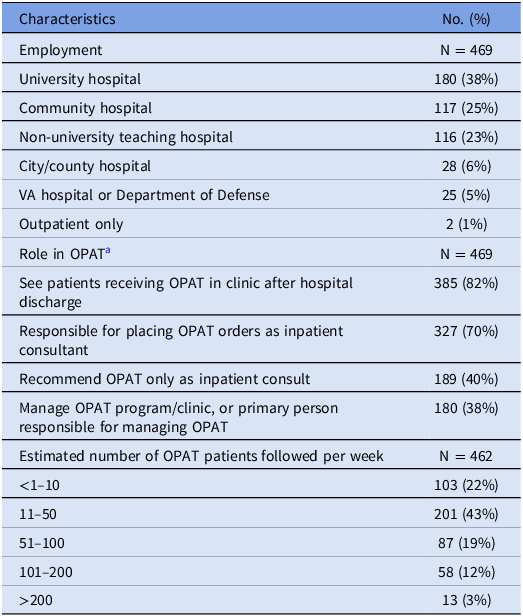
Of 1639 active EIN clinicians who have ever responded to an EIN survey, 622 (38%) responded to this survey, of which 153 (25%) reported no role in OPAT and opted out of the survey. We analyzed results from the remaining 469 EIN members who completed the survey. The EIN member database includes member practice and employment data. Notably most respondents (180/469, 38%) worked at a university hospital, followed by community hospital (117/469, 25%), or non-university teaching hospital (116/469, 25%) (Table 1). Physicians comprised 95% (445/469) of respondents.
Employment and OPAT structures as reported by infectious diseases clinicians in the emerging infections network

Note. ASP, Antimicrobial Stewardship program; ID, infectious diseases; OPAT, outpatient parenteral antimicrobial therapy, VA, veteran’s affairs.
a Respondents were able to select all responses that applied; numbers add to more than 100%.
While 189/469 respondents (40%) recommended OPAT only as an inpatient consultant, 385/469 respondents (82%) also saw OPAT patients in a clinic after hospital discharge (Table 1). Most OPAT programs were responsible for ≤50 patients a week (43%, 201/469, noted that their programs followed 11–50 OPAT patients per week; 22%, 103/469, followed <10 OPAT patients per week. ID physicians were most frequently involved in OPAT (noted by 450/469, 96%), followed by ID pharmacists (noted by 280/469, 60%), nurses (noted by 274/469, 59%), and APPs (noted by 216/469, 46%). Only 47% (222/469) of respondents had administrative support for OPAT (Figure 1). Of respondents who reported having multiple team members, 78% of respondents noted nurses, 64% reported APPs, 63% ID physicians, and 63% ID pharmacists were working at least 4hrs/week. Substantial proportions of respondents noted that dedicating over 20 hours per week on OPAT-related tasks occurred in various team members (nurses 40%, ID pharmacists 29%, APPs 23%, ID physicians 6%, administrative support 17%, other pharmacist 3%) (Figure 1).
Respondents rated the amount of time spent in a usual week managing outpatient parenteral antimicrobial therapy patients by each of the health care workers listed. The numbers are the total number of participants who responded in each category. Each respondent could select more than one category of clinician involved in their program. ID, infectious diseases; LPN, licensed practical nurse; NP, nurse practitioner; OPAT, outpatient parenteral antimicrobial therapy; RN, registered nurse; PA, physician assistant.

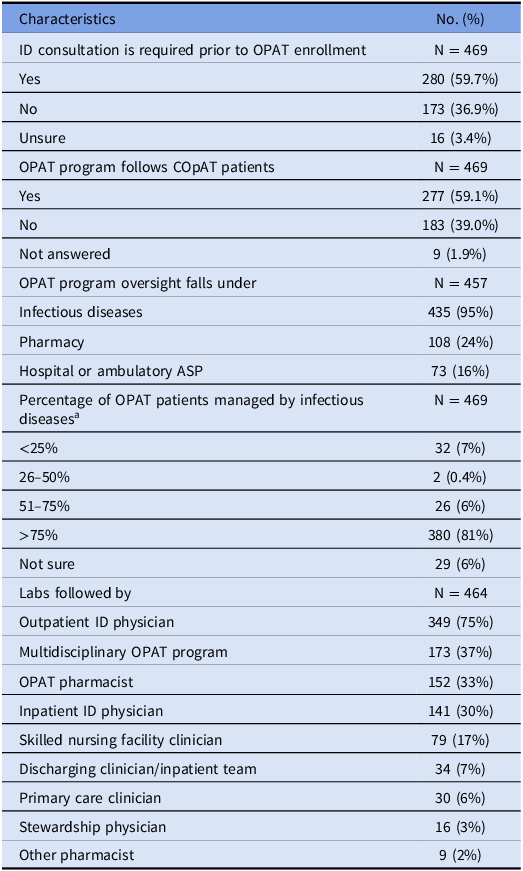
Most respondents (435/457, 95%) reported that their OPAT programs were managed by ID with majority reporting their OPAT programs required ID consultation prior to OPAT enrollment (280/469, 60%) (Table 2). Overwhelmingly, patients received antimicrobials at home, followed by receipt at a skilled nursing facility (SNF) or long-term care facility (Figure 2). Inclusion of COpAT (oral-only and/or long-acting injectable antimicrobial agents) in their OPAT program was reported by 59% of respondents. ID clinicians most often followed OPAT patients postdischarge, with the majority (380/469, 81%) of respondents indicating that >75% of OPAT patients were managed by ID. Outpatient ID physicians were routinely (349/464, 75%) responsible for receipt of and action on laboratory results. Multidisciplinary OPAT teams (173/464, 37%), OPAT pharmacists (152/464, 33%) and inpatient ID physicians (141/464, 30%) were also frequently involved. Having non-specialists (SNF clinician, discharging clinician/inpatient team, primary care clinician, other pharmacist) responsible for laboratory monitoring was reported by 32% (152/464). Laboratory values were most often available via fax/email (193/454, 43%) or by EHR (189/457, 41%); however, calling to request laboratory test results “often/always” was reported by 22% (101/450) of respondents.
Respondents ranked outpatient parenteral antimicrobial therapy delivery sites from the most to least common where 1 is most Frequent and 4 is least frequent.

OPAT program details

Note. OPAT, outpatient parenteral antimicrobial therapy; COpAT, complex antimicrobial therapy; ASP, Antimicrobial Stewardship program; ID, infectious diseases.
The majority did not feel that their OPAT programs had adequate support in terms of data analysis, administrative, information technology, and financial support for clinical staff (Figure 3). Only half the respondents stated they had adequate physical space. Additional barriers to providing safe OPAT care included lack of leadership awareness of the value of OPAT (232/457, 51%), difficulty managing patients with SUD (225/454, 50%), insufficient access to timely laboratory values (222/458, 48%), lack of personnel to retrieve missing laboratory values (211/457, 46%), and struggles with the EHR 193/454, (43%). Inappropriate OPAT enrollment (59/450, 13%), inability to obtain antimicrobials (91/452, 20%), and insufficient OPAT oversight (93/455, 20%) were less commonly identified as challenges (Figure 4).
Respondents rated agreement with the following statement: “The OPAT program at my hospital receives adequate support in the following areas.”

Barriers to safe OPAT care—factors present in providing safe OPAT services on a scale where 1 is “extremely challenging” and 5 is “not challenging at all.”

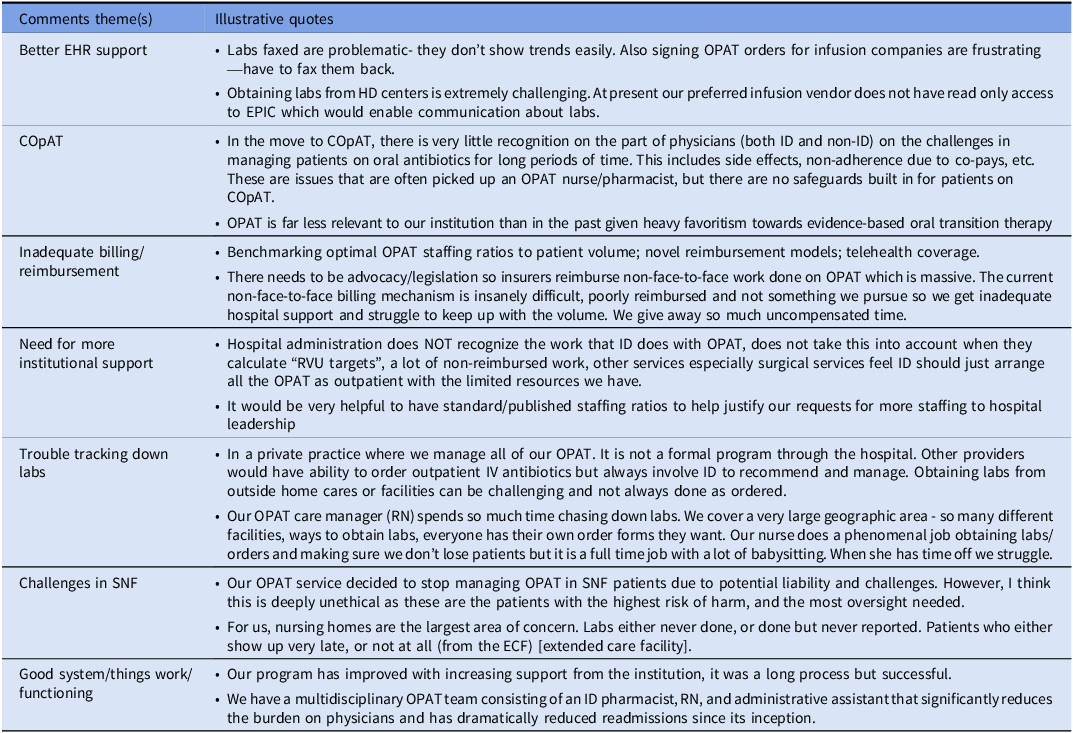
Respondents were liberal with their free text comments with a total of 405 free text comments recorded throughout the survey, of which 103 pertained to additional comments about OPAT and related safety issues (Appendix 1). Several themes emerged from these 103 comments that focused on strategies for and barriers to safe OPAT care (Table 3). Development of a multidisciplinary team was frequently reported, and ranged from having a single nurse, to an ID pharmacist, and/or APP and technology/data analytics support for OPAT. Many comments acknowledged the shift toward oral antimicrobials, while also recognizing the gaps that have emerged in the shift to COpAT, such as lack of managing side effects and non-adherence. Better EHR support, including a desire to end the use of faxes, and trouble tracking down labs were recurring themes. Many comments also highlighted inadequate billing/reimbursement as well as need for more institutional support. Interestingly, many respondents specifically detailed the challenges in following patients in SNFs, with difficulty communicating with SNFs, tracking down labs, and patients not attending outpatient appointments. Some programs reported that they did not follow patients discharged to SNFs. Some respondents felt that their OPAT programs functioned well and noted facilitators including institutional support and a multidisciplinary team.
Select free-response comments about provision of OPAT

Note. EHR, electronic health record; HD, hemodialysis, COpAT, complex antimicrobial therapy; RVU, relative value unit; RN, registered nurse; SNF, skilled nursing facility; ECF, extended care facility.
Discussion
In this survey, one of the first to survey a broad national sample of not only ID physicians but also ID pharmacists and APPs about OPAT, we demonstrate the importance of multidisciplinary teams in the management of OPAT patients and the new incorporation of oral and long-acting injectable antimicrobials into OPAT programs. However, as in previous surveys, many barriers to the safe delivery of OPAT remain.
Notably, barriers to safe care that most respondents reported as “extremely challenging” included a lack of leadership awareness of the value of OPAT, management of patients with SUD, and inability to access laboratory test results. In addition, multiple challenges in communicating with postacute care locations were reported, such as lack of personnel to proactively identify and review laboratory test results, EHR incompatibility, and lack of communication with those administering OPAT. Challenges such as follow-up of patients in postacute care, communication with those administering OPAT (eg, home health organizations, hemodialysis facilities, and SNFs), patients not following up in ID clinic, and lack of clarity about who follows patients were themes in the survey and comments, and were also major barriers noted in prior surveys regarding OPAT practices. Reference Hamad, Lane, Beekmann, Polgreen and Keller17,Reference Lane, Marschall and Beekmann18
Our findings suggest that OPAT team composition continues to expand. Fewer respondents indicated that ID physicians spent >20 hours per week on OPAT-related work than in prior surveys, while more respondents indicated that other groups spent >20 hours per week on OPAT-related work than in prior surveys. Comparing 2018 survey results to 2025 numerically among respondents reporting >20 hours per week on OPAT-related work, ID physician time decreased from 10.5% to 6.0%, while ID pharmacists’ increased from 11.7% to 28.6%, nurses from 26.3% to 39.8%, and APPs from 9.1% to 23.2%. Reference Hamad, Lane, Beekmann, Polgreen and Keller17 This is reassuring, as literature demonstrates that use of multidisciplinary OPAT teams can lead to improved outcomes. Reference Shah, Petrak and Fliegelman20,Reference Saini, Ali, Du, Crook and Zurlo21
While multidisciplinary growth in OPAT programs is encouraging, studies show that OPAT is a resource intensive endeavor, and much of the work is uncompensated. Reference Schranz, Swartwood and Ponder22,Reference Player, Msibi and Bouzigard23 Additionally, 59% of respondents reported following patients on COpAT. While COpAT is cost effective and safe, Reference Marks, Bell and Jones24 and can further decrease healthcare costs, Reference Suzuki, Mosher, Heintz and Livorsi25 there is increasing recognition of the need for close follow-up, Reference Azamgarhi, Shah and Warren26 with wide variation in the recognition by both physicians and programs of the work involved. Reference Douglass, Mayer and Young27 Several comments alluded to the lack of a definition of COpAT, as well as lack of standardized practices regarding follow-up of patients on COpAT.
Most patients received OPAT at home, followed by SNFs. However, an additional theme that emerged from the comments was the lack of oversight of patients receiving OPAT in SNFs or at hemodialysis. While our survey did not specifically ask about follow up of patients in SNFs, prior literature has shown that patients receiving OPAT in SNFs without specific OPAT team oversight tend to have poorer outcomes, Reference Kaul, Haller and Yang28 whereas programs that do follow patients in SNFs note that patients discharged to home versus SNFs have similar outcomes. Reference Player, Msibi and Bouzigard23 Several barriers to following these patients included poor communication, difficulty tracking laboratory test results, and challenges with transportation to follow-up outpatient specialty appointments. In addition, post-COVID era declines in SNF staffing may contribute to some of these outcomes. Reference McGarry, Wilcock, Gandhi, Grabowski, Geng and Barnett29
Our survey has limitations. The response rate was 38%, though overall numbers of respondents was comparable to prior EIN surveys about OPAT, and similar to response rates from other clinician surveys. Reference Foong, Erdil, Campion, Doron and Alsoubani30,Reference Pendergast, Mull and Shin31 The majority of survey respondents were physicians, with some pharmacists and APPs, however nurses were not included in the survey, even though they often dedicate the most time per week to OPAT activities. As OPAT programs continue to grow and evolve, future surveys should include all stakeholders who contribute to the successful implementation of OPAT. Additionally, not all respondents have a dedicated OPAT program. Indeed, many variations in practice set-up were reported, ranging from small practices that follow <10 OPAT patients per week, to large multidisciplinary institutional programs that manage >200 patients per week. This highlights the need to develop a framework that incorporates a range of practice strategies that can be adapted by different practitioners, recognizing that ultimately, the best OPAT program is one that can be adapted for a given practice situation.
Conclusion
While lack of institutional support remains a barrier, our findings suggest the need to develop guidance for optimal staffing ratios, as has been proposed by others Reference Munsiff, Burgoyne, Dobson and Yamshchikov12,Reference Rivera, Mehta, Ryan, Stevens, Tucker and Mahoney15 and development of a definition for COpAT. Reference Pertzborn, Rivera and Tai32 Recognition by leadership of the value added by COpAT care, changes to reimbursement models and strategies to overcome communication barriers and modernize systems to track lab results, are paramount to improved patient outcomes. Toward that end, our findings suggest the need to address operational and legal/compliance barriers, as well as changes in healthcare policy, to encourage the adoption of newer technologies, such as EHR integration to manage laboratory test results, use of artificial intelligence tools to eliminate manual review of data and identify patients at risk for adverse events, and expansion of telehealth to improve patient follow-up, including for those in SNFs.
Supplementary material
The supplementary material for this article can be found at https://doi.org/10.1017/ash.2026.10347.
Acknowledgements
None
Financial support
This work was funded by CDC (cooperative agreement no. 5, grant no NU50CK000574).
Competing interests
All authors report no conflicts of interest relevant to this article.






 Open access

