INTRODUCTION
Common bottlenose dolphins (Tursiops truncatus) are widely distributed in temperate, subtropical and tropical waters and are known for their diverse and variable population structure, social organization and ecological strategies providing a robust basis for the species survival (Wells & Scott, Reference Wells, Scott, Ridgway and Harrison1999). However, there are populations of bottlenose dolphins which are considered to be threatened. One of them is located in the Black Sea, where a morphologically and genetically distinct subspecies was identified, Tursiops truncatus ponticus Barabash-Nikiforov, 1940 (Viaud-Martinez et al., Reference Viaud-Martinez, Brownell, Komnenou and Bohonak2008). The population structure of the Black Sea bottlenose dolphins is little known; it possibly includes offshore and inshore (or coastal) populations (Bushuev, Reference Bushuev and Belkovich2002; Mikhalev, Reference Mikhalev2005; Gol'din & Gladilina, Reference Gol'din and Gladilina2015), and among the latter there can be resident groups (Shpak et al., Reference Shpak, Glazov, Kryukova and Mukhametov2006; Gladilina, Reference Gladilina2012; Gladilina & Gol'din, Reference Gladilina and Gol'din2016), but their number, size, structure, relations and the extent of exchange are virtually unknown; an exception is a local population near Sudak which abundance was recently estimated (Gladilina & Gol'din, Reference Gladilina and Gol'din2016).
Here we assess contacts between local coastal populations of Black Sea bottlenose dolphins in six localities along 800 km of the coastline, based on records of photo-identified animals, and discuss the role of isolation of local populations in their stability and vulnerability.
MATERIALS AND METHODS
Study areas
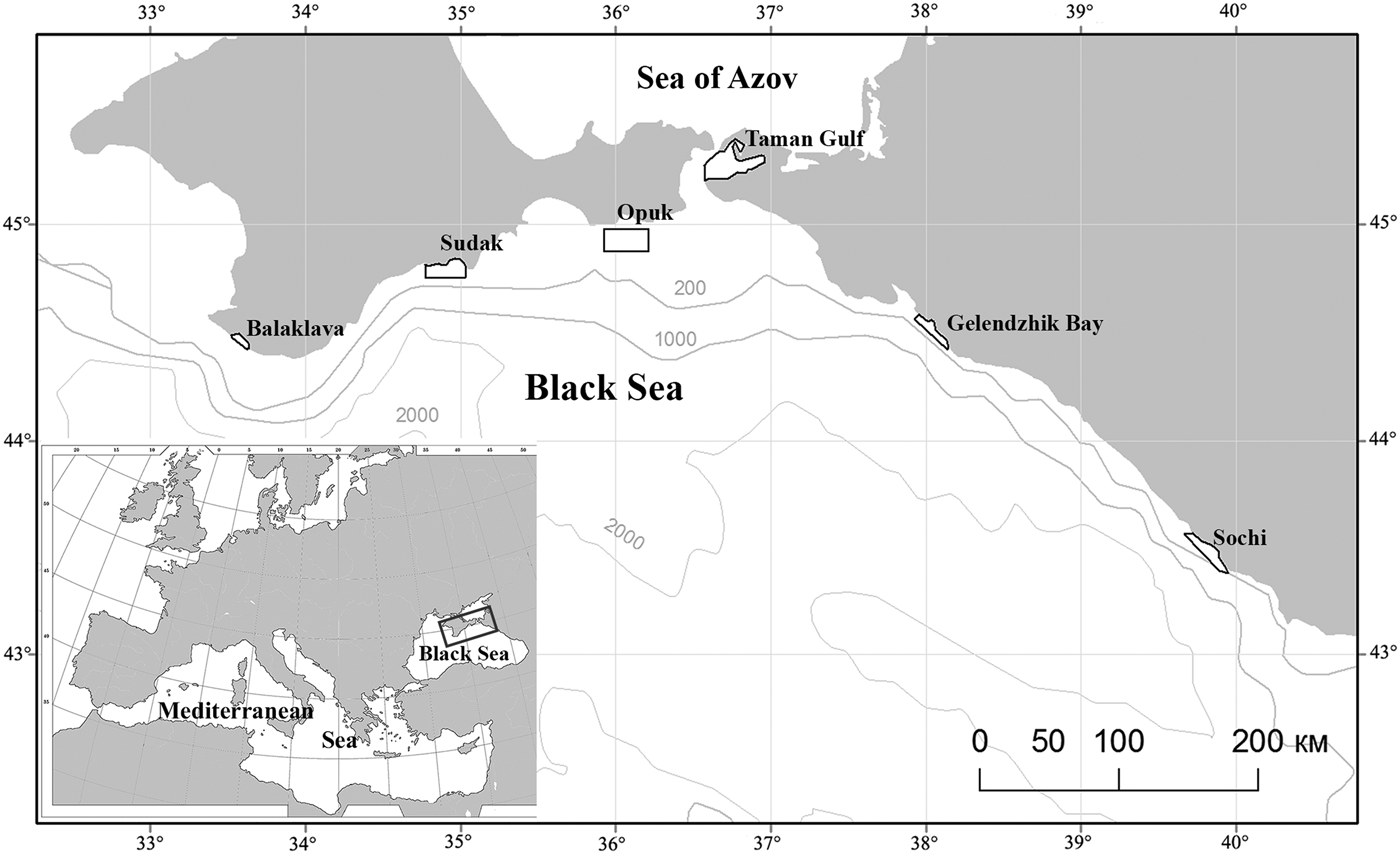
The research was conducted in coastal waters of the northern and eastern Black Sea less than 200 m deep between Fiolent Cape (44°29′N 33°29′E) and Imereti Bay (43°22′N 39°57′E), in six local study areas:
-
(1) Balaklava, waters between Fiolent Cape and Aya Cape (between 44°29′N 33°29′E and 44°25′N 33°39′E).
-
(2) Sudak, waters between Choban-Kule Cape and Meganom Cape (between 44°48′N 34°44′E and 44°47′N 35°02′E).
-
(3) Opuk, waters between Chauda Cape and Opuk Cape (between 44°59′N 35°53′E and 44°59′N 36°12′E).
-
(4) Taman Gulf and adjoining area of the eastern Kerch Strait (between 45°12′N 36°35′E and 45°17′N 36°58′E).
-
(5) Gelendzhik Bay and adjoining area (between 44°35′N 37°56′E and 44°28′N 38°07′E).
-
(6) Sochi, waters between the Sochi River estuary and Imereti Bay (between 43°34′N 39°42′E and 43°22′N 39°57′E) (Figure 1).
Fig. 1.Areas of research of bottlenose dolphins in coastal waters of the northern and eastern Black Sea.


The maximum along-shore distance between the two most distant areas was 800 km.
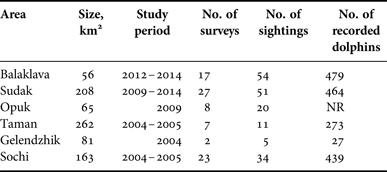
Boat surveys (N = 17) and occasional coastal-based observations in Balaklava were conducted in 2012–2014, in an area of 56 km2; the surveys were conducted less than 1 km from the coastline. In Sudak, the surveys were conducted in 2009 and 2011–2014 (N = 27), in an area of 208 km2, less than 10 km from the coastline. The surveys near the Opuk Cape were conducted in 2009 (N = 8), in an area of 65 km2, 6–15 km from the coastline. The surveys in the Taman Gulf were conducted in 2004 and 2005 (N = 7), in an area of 262 km2, surveys covered the whole gulf. The surveys in Gelendzhik were conducted in 2004 (N = 2), in an area of 81 km2, within 5 km of the coastline. In Sochi, the surveys were conducted in 2004 and 2005 (N = 23), in an area of 163 km2, also within 5 km of the coastline.
Data collection
Data for this study were collected in coastal waters of the northern and eastern Black Sea by three teams: in the areas near Taman Peninsula, Gelendzhik and Sochi in 2004–2005 (team 1), near the Opuk Cape and Sudak in 2009 (team 2) and near Sudak and Balaklava in 2011–2014 (team 3) (Figure 1). In 2009 the research was conducted on board a sprat trawling vessel, whereas the other studies were based on small motor boats or, sometimes, coastal-based platforms.
Spatial distribution, site fidelity and connectivity between localities of bottlenose dolphins were assessed using the method of photo-identification (Würsig & Würsig, Reference Würsig and Würsig1977). Boat surveys were conducted under daylight conditions, at a Beaufort sea state less than 4, no precipitation and visibility of at least 1 km. Observations were conducted using 7, 8 or 10 × binoculars. Images for photo-identification were obtained using digital SLR cameras with telephoto lenses. In 2009 the observer recorded the dolphins which approached the trawler during fishing operations. In other surveys, the boat observers approached dolphin groups and took photos. Whenever possible, each dolphin was photographed from the left and right sides, dorsal fin perpendicular to the camera lens, preferably with no backlight (Würsig & Jefferson, Reference Würsig and Jefferson1990).
Data analysis
The total number of recorded individuals, the number of resightings within the same season and the number of resightings between the seasons were separately calculated for each of the six study areas. Only photos scored as good to excellent quality were added to the catalogue and used for analysis; photos of moderate quality were used only for exceptionally distinctive individuals (for example, partially white specimens), whereas all photos of poor quality were discarded. Dorsal fin images were classified in relation to severity of scarring and individual distinctiveness (Würsig & Jefferson, Reference Würsig and Jefferson1990; Wilson et al., Reference Wilson, Hammond and Thompson1999; Urian et al., Reference Urian, Gorgone, Read, Balmer, Wells, Berggren, Durban, Eguchi, Rayment and Hammond2015): distinctive fins (with permanent fin features: notches, cuts, deep scars and depigmented areas) and subtly marked fins (with temporary markings: scars, scratches, but without any notches on the edge of the fin), the latter ones further classified on Left and Right sides. Only distinctive and Left side subtly marked individuals were used for calculations. (Only Left or Right side subtly marked fins could be used for calculation in addition to distinctive individuals due to possible mismatching of the same subtly marked individual when matching its Left and Right sides. We chose using Left sides because the sample size of this group was higher: 50 Left vs 37 Right.) Total number of identified dolphins, as well as the number of sighted once or resighted individuals, was calculated for distinctive and Left side subtly marked individuals and separately for distinctive individuals (Table 2), whereas abundance estimates were calculated only for distinctive individuals.
The images of resightings were examined by three independent readers for confirmation of individual movements between different study areas. A sighting record was stated as confirmed after agreement of all three readers. If two of three readers positively identified the resighting, it was stated as possible. Single positive opinions were discarded.
Tentative estimates of abundance within each of the localities were calculated as mark-recapture estimates, based on repetitive photo identifications, between two consecutive years of study in four regions: Balaklava, 2013–2014; Sudak, 2011–2012; Taman Gulf, 2004–2005; and Sochi, 2004–2005; the choice of two consecutive years for Balaklava and Sudak areas was conditioned by the greatest number of sampled animals. All calculations were based on two consecutive years to minimize the influence of birth and mortality rates; and the populations were presumed closed based on frequent resightings within the localities and rare resightings between the localities, as reported here (see also Shpak et al., Reference Shpak, Glazov, Kryukova and Mukhametov2006; Gladilina & Gol'din, Reference Gladilina and Gol'din2016). These conditions should be considered as preliminary assumptions, and thus the abundance estimates are only tentative. Only the category of photo-identified ‘marked fins’ (distinctive individuals) was used in abundance calculations. The mark-recapture estimate
 $(\hat N)$
was calculated with the models by Chapman (Chapman, Reference Chapman1951; Caughley, Reference Caughley1977; Wilson et al., Reference Wilson, Hammond and Thompson1999; Hammond, Reference Hammond, Boyd, Bowen and Iverson2010):
 $$\hat N = \displaystyle{{(n_1 + 1) \cdot (n_2 + 1)} \over {m_2 + 1}}\,-1$$
where n 1 = number of marked individuals which were photo-identified during the first time interval; n 2 = number of marked individuals which were photo-identified during the second time interval; m 2 = number of ‘recaptured’ marked individuals.
RESULTS
There were 84 surveys between 2004 and 2014 with 184 encounters of 1682 bottlenose dolphins (the cumulative number of animals seen over multiple encounters) (Table 1). The greatest number of encounters were recorded for Balaklava (N = 54, or 29%), Sudak (N = 51, or 28%) and Sochi (N = 34, or 18%). There were 8700 moderate to excellent photographs entered into the database.
Summary of boat surveys of bottlenose dolphins in coastal areas of northern and eastern Black Sea.

Resightings
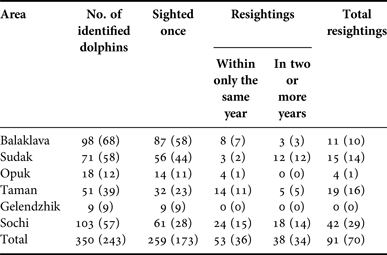
In total, 350 dolphins were photo-identified within the six study areas, of which 91 (26%) were seen within the same area on two or more occasions; 53 (15%) were resighted only within the same year, and 38 (11%) were resighted in 2 or 3 years. Most of the identified dolphins, 243 of 350 (69%), were distinctive (‘marked’). The portion of resighted ‘Marked’ individuals was non-significantly larger than in the overall sample, 29%; and 14% of marked dolphins were resighted in 2 or 3 years within the same area (Table 2).
Resightings of bottlenose dolphins across the study areas: data for Marked + Left side subtly marked individuals (and separately for Marked individuals in parentheses).

Movements between the local coastal populations
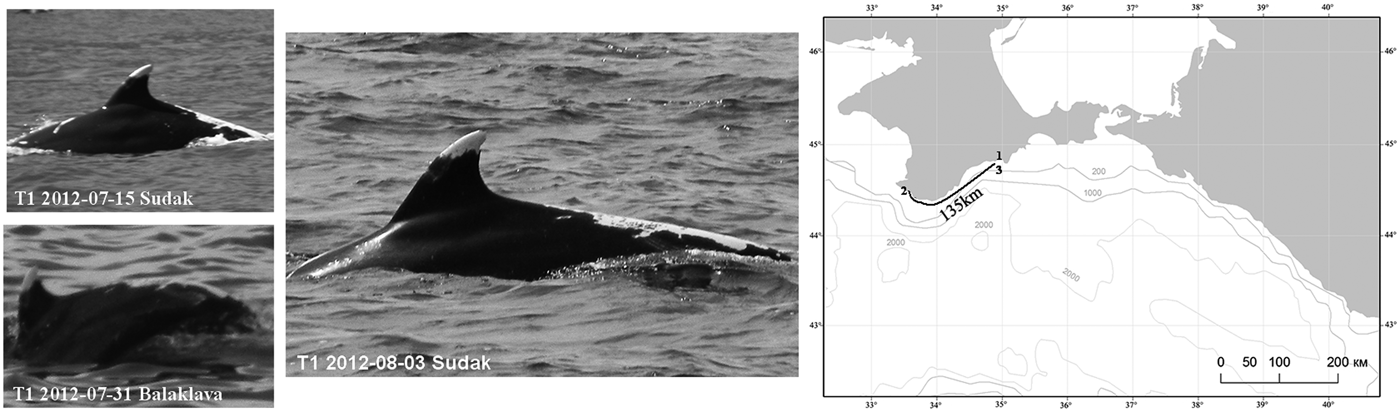
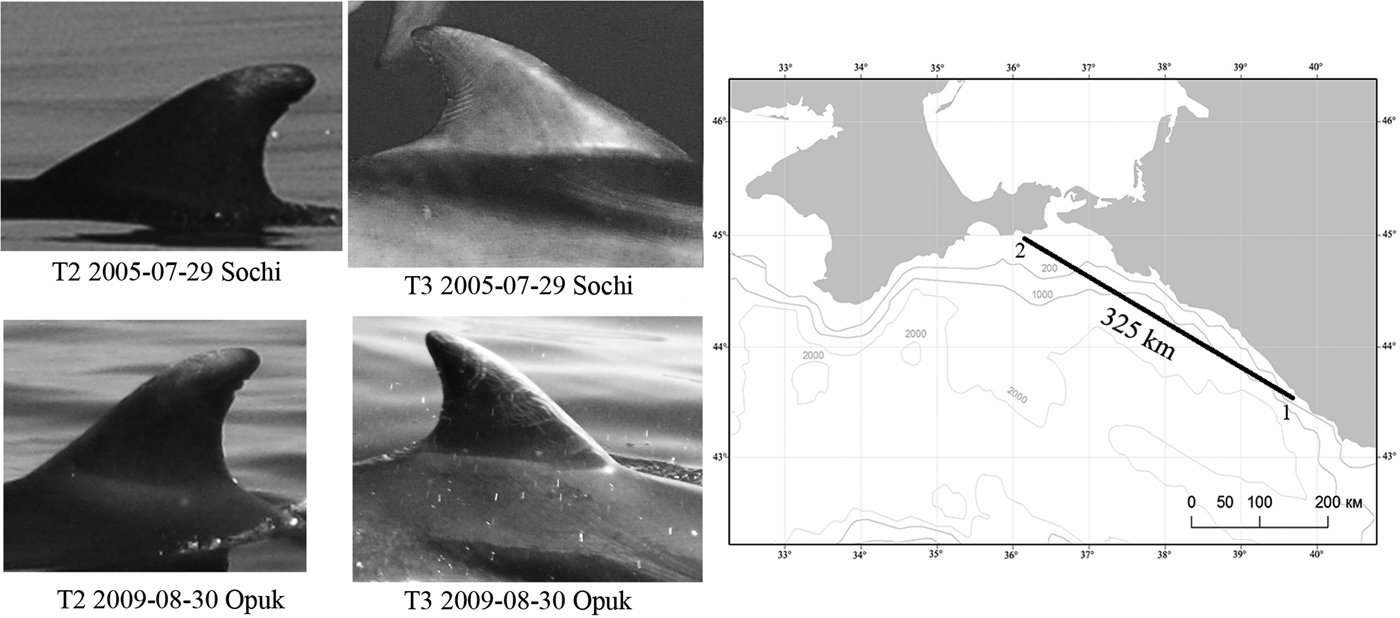
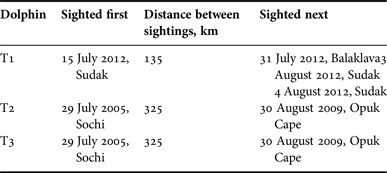
Among all resightings there were only three records of the same individual in two different study areas (Table 3, Figures 2 and 3). Of them, one record was classified as confirmed (T1), and the other two were classified as possible (T2, T3).
Lateral view of the dolphin Т1 which was recorded near Sudak and Balaklava. The records of the individual observed across the different regions are joined with a line, and the distance between the records are indicated below the line. 1, Balaklava; 2, Sudak; 3, Opuk Cape.

Dorsal fins of dolphins Т2, Т3 which were recorded near Sochi and Opuk. The records of individuals observed across the different regions are joined with a line, and the distance between the records are indicated below the line. 1, Balaklava; 3, Opuk Cape.

Movements between local coastal populations of bottlenose dolphins across the study areas.

The dolphin Т1, ID 064-12W (Figure 2), had very distinct natural marks, large white spots on various body parts, which allowed it to be identified even on low quality photographs. This animal was recorded on 15 July 2012, near Sudak when approaching a sprat trawling vessel; later it was recorded on 31 July 2012, near the entrance to the Balaklava Bay; and finally, on 3 and 4 August 2012, it was sighted again in Sudak near a trawling vessel in association with other dolphins earlier observed in the same area. The minimum over-water distance between the sighting points of this individual near Sudak and Balaklava was 135 km.
Resightings Т2 and Т3, although classified as possible, are still reported here, as they are notable and potentially important (Figure 3). Both dolphins were first encountered on 29 July 2005, within the same group near Sochi (ID 0167 and 0171). Then they were ‘possibly’ resighted together near the Opuk Cape, on 30 August 2009 (ID 009-09W and 010–09S). The distance between the points of sightings of these animals near Sochi and Opuk was ~325 km.
Abundance
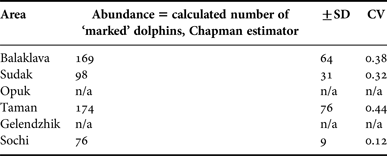
Abundance estimates for the marked portion of the population were obtained for local populations in four examined localities (Table 4). Resulting estimates varied between 76 ± 9 and 174 ± 76 marked individuals in each stock across the regions. The smallest estimate was calculated for Sochi, and the greatest estimate was obtained for the Taman Gulf (Table 4).
Abundance of marked bottlenose dolphins across the study areas.

DISCUSSION
Bottlenose dolphins are distinct for their division into inshore and offshore populations throughout their worldwide range (Ross, Reference Ross1977; Duffield et al., Reference Duffield, Ridgway and Cornell1983; Wells et al., Reference Wells, Scott, Irvine and Genoways1987; Mead & Potter, Reference Mead and Potter1995; Natoli et al., Reference Natoli, Peddemors and Hoelzel2004; Waring et al., Reference Waring, Josephson, Maze-Foley and Rosel2014). Among the inshore populations there are resident and migrating stocks (Waring et al., Reference Waring, Josephson, Maze-Foley and Rosel2014). Resident stocks are local groupings which occupy relatively small areas and are characterized by high site fidelity of individuals and tight social networks. Many of them occupy estuaries, gulfs or narrow straits. Local resident stocks were described from the coastal waters of the Mediterranean Sea (Bearzi et al., Reference Bearzi, Notarbartolo di Sciara and Politi1997, Reference Bearzi, Bonizzoni and Gonzalvo2011; Gnone et al., Reference Gnone, Bellingeri, Dhermain, Dupraz, Nuti, Bedocchi, Moulins, Rosso, Alessi, McCrea and Azzellino2011), the north-eastern and western Atlantic (Speakman et al., Reference Speakman, Zolman, Adams, Defran, Laska, Schwacke, Craigie and Fair2006; Robinson et al., Reference Robinson, O'Brien, Berrow, Cheney, Costa, Eisfeld, Haberlin, Mandleberg, O'Donovan, Oudejans, Ryan, Stevick, Thompson and Whooley2012; Waring et al., Reference Waring, Josephson, Maze-Foley and Rosel2014), the Gulf of Mexico (Wells et al., Reference Wells, Scott, Irvine and Genoways1987), Hawaii (Baird et al., Reference Baird, Gorgone, McSweeney, Ligon, Deakos, Webster, Schorr, Martien, Salden and Mahaffy2009) and waters of Australia and New Zealand (Möller et al., Reference Möller, Allen and Harcourt2002; Lusseau et al., Reference Lusseau, Schneider, Boisseau, Haase, Slooten and Dawson2003). There is some degree of exchange with neighbouring stocks, sometimes involving long individual migrations (Wood, Reference Wood1998; Robinson et al., Reference Robinson, O'Brien, Berrow, Cheney, Costa, Eisfeld, Haberlin, Mandleberg, O'Donovan, Oudejans, Ryan, Stevick, Thompson and Whooley2012). Another category of coastal populations is migrating stocks with complex group structures and large home ranges (Rosel et al., Reference Rosel, Hansen and Hohn2009; Waring et al., Reference Waring, Josephson, Maze-Foley and Rosel2014). Within these stocks, there are frequent individual movements for more than 100 km or even 1000 km (Defran et al., Reference Defran, Weller, Kelly and Espinosa1999). For example, in Californian waters the local groupings form a metapopulation in which the inter-stock exchange rate is 43% (Defran et al., Reference Defran, Weller, Kelly and Espinosa1999; Hwang et al., Reference Hwang, Defran, Bearzi, Maldini, Saylan, Lang, Dudzik, Guzon-Zatarain, Kelly and Weller2014). However, resident stocks can also be connected within a metapopulation structure, although with higher site fidelity and lesser frequency of inter-stock movements, as in north-western and central Mediterranean areas (Bearzi et al., Reference Bearzi, Bonizzoni and Gonzalvo2011; Gnone et al., Reference Gnone, Bellingeri, Dhermain, Dupraz, Nuti, Bedocchi, Moulins, Rosso, Alessi, McCrea and Azzellino2011; Carnabuci et al., Reference Carnabuci, Schiavon, Bellingeri, Fossa, Paoli, Vassallo and Gnone2016; Genov et al., Reference Genov, Angelini, Hace, Palmisano, Petelin, Malačič, Pari and Mazzariol2016), which was also confirmed by genetic studies (Gaspari et al., Reference Gaspari, Holcer, Mackelworth, Fortuna, Frantzis, Genov, Vighi, Natali, Rako, Banchi and Chelazzi2015). Owing to such a structure with a great number of individual transfers within a metapopulation, many coastal stocks of bottlenose dolphins gain a relative sustainability in the long-term, despite their low reproductive rate (Stolen & Barlow, Reference Stolen and Barlow2003).
Until now, spatial distribution and movements of bottlenose dolphins within the Black Sea have been little known. High summer concentration of dolphins in pelagic waters (Mikhalev, Reference Mikhalev2005) implies the existence of an offshore population. The morphological data support this hypothesis: there can be co-existing offshore and inshore putative populations in the Black Sea (Gol'din & Gladilina, Reference Gol'din and Gladilina2015), as has been demonstrated for Mediterranean waters (Gaspari et al., Reference Gaspari, Scheinin, Holcer, Fortuna, Natali, Genov, Frantzis, Ghelazzi and Moura2015a). A few local coastal groupings have already been reported from the northern and eastern Black Sea which occur in coastal waters all year round and thus are probably resident local populations (Shpak et al., Reference Shpak, Glazov, Kryukova and Mukhametov2006; Gladilina, Reference Gladilina2012; Gladilina et al., Reference Gladilina, Lyashenko and Gol'din2013; Gladilina & Gol'din, Reference Gladilina and Gol'din2016). This study supports the earlier reports. In fact, coastal Black Sea bottlenose dolphins form local groupings of a few hundreds of animals (Table 4), with individual site fidelity within, at least, some of them (Table 2) (see also: Shpak et al., Reference Shpak, Glazov, Kryukova and Mukhametov2006; Gladilina & Gol'din, Reference Gladilina and Gol'din2016). There are four to six such localities (depending on the status of groupings near the Opuk Cape and Gelendzhik) only along the coastal area studied here. Notably, there are some other areas along the Caucasian coast (between Taman and Gelendzhik) which are also known for stable occurrence of bottlenose dolphins (Mikhalev, Reference Mikhalev2005), and another coastal local population was earlier described from the waters of the Tarkhankut Peninsula (north to the Balaklava) (Belkovich, Reference Belkovich1978). Therefore, there can be even greater variety of local populations in the region. Each of these groupings can occupy a local area (some of them probably up to several hundred square kilometres) and tends to have loose connections with other coastal groupings: there are only rare individual movements between the localities. As seen from Tables 2 and 3, the number of resightings within the study areas across various time periods is notably greater than the number of movements between the areas. Thus, this structure is the most similar to coastal resident stocks of the Mediterranean semi-enclosed gulfs (such as the Gulf of Amvrakikos), West Atlantic estuaries or Hawaii (Speakman et al., Reference Speakman, Zolman, Adams, Defran, Laska, Schwacke, Craigie and Fair2006; Bearzi et al., Reference Bearzi, Agazzi, Bonizzoni, Costa and Azzellino2008, Reference Bearzi, Bonizzoni and Gonzalvo2011; Baird et al., Reference Baird, Gorgone, McSweeney, Ligon, Deakos, Webster, Schorr, Martien, Salden and Mahaffy2009). It is strikingly similar to the metapopulation structure of bottlenose dolphins in the north-western Mediterranean waters (Carnabuci et al., Reference Carnabuci, Schiavon, Bellingeri, Fossa, Paoli, Vassallo and Gnone2016), but differs from it in looser connectivity and longer distances between local groupings. However, as opposed to these regions, there is no distinct physical or biotic factor causing isolation of dolphins in the coastal Black Sea. Furthermore, the inter-population movements in the Black Sea seem to be rarer than between semi-enclosed gulfs of the Ionian Sea (Bearzi et al., Reference Bearzi, Bonizzoni and Gonzalvo2011). Notably, genetic studies (Natoli et al., Reference Natoli, Birkun, Aguilar, Lopez and Hoelzel2005; Gaspari et al., Reference Gaspari, Holcer, Mackelworth, Fortuna, Frantzis, Genov, Vighi, Natali, Rako, Banchi and Chelazzi2015, Reference Gaspari, Scheinin, Holcer, Fortuna, Natali, Genov, Frantzis, Ghelazzi and Moura2015a) found that genetic structuring and divergence of Mediterranean populations at a larger geographic scale were also not connected to physical factors, and our study, as well as some other photo-identification research (Genov et al., Reference Genov, Angelini, Hace, Palmisano, Petelin, Malačič, Pari and Mazzariol2016), supports this idea.
Our results show that there are dolphins travelling long distances along the Black Sea coast, but such cases are rare rather than regular or usual. The T1 dolphin travelled a minimum 135 km west and returned back to the place of its initial sighting (Sudak) within 3 weeks. It can be an example of individual activity of Black Sea bottlenose dolphins. An example of another strategy is ‘possible’ movement of two dolphins from Sochi to Opuk: therefore, there may be a hypothetical grouping in this area with a wide 300 km range which matches the category of a coastal migrating stock (Waring et al., Reference Waring, Josephson, Maze-Foley and Rosel2014). Thus, two types of coastal stocks, resident and migrating, may be present in the Black Sea across the studied area, and this hypothesis requires further confirmation.
The population structure with numerous distinct groupings, a fairly usual scenario for bottlenose dolphins, can be one of the factors increasing short-term fluctuations in abundance while also increasing the mid-term stability as persistence: some local populations become extinct and replaced by other emerging or spreading groupings (Holling, Reference Holling1973; Roff, Reference Roff1974). Interannual fluctuations of this kind were reported for the Black Sea bottlenose dolphins by earlier studies (Bushuev, Reference Bushuev and Belkovich2002; Mikhalev, Reference Mikhalev2005). In the past, in some years the occurrence of bottlenose dolphins was extremely low: their total abundance in the Black Sea was estimated at 7000 ± 3000 specimens (Sokolov et al., Reference Sokolov, Yaskin and Yukhov1990; Yaskin & Yukhov, Reference Yaskin, Yukhov, Sokolov and Romanenko1997), and in the waters of Ukraine it has been reported to be as low as 1000 specimens (Shcherbak, Reference Shcherbak1994), which meant the Black Sea bottlenose dolphins were critically endangered. Such a trend seems most unusual so far as coastal bottlenose dolphins in the Black Sea are distinct for their rapid body growth, which is indirect evidence for a high rate of generation change and rise of population abundance (Gol'din & Gladilina, Reference Gol'din and Gladilina2015). However, these fluctuations seem to be logical if the metapopulation is fragmented into small portions. In this case an adverse impact can lead to the extinction of some local groupings; hence the total abundance could drastically fall in a short time and rapidly recover after an event of dispersal or recolonization. Now, coastal bottlenose dolphins in the Black Sea are characterized by rapid growth, possibly early maturation, and loosely connected resident local populations. Historical causes for establishment of such a fragmented structure and genetic relationships between the local populations, as well as the origin of each of them, require further research.
Ethical statement
This study did not involve capture or handling of dolphins. All surveys were conducted with minimal disturbance to the animals. The boat slowly approached dolphins in parallel to their course; groups with neonates and calves were not approached closer than 50 m. Funding agencies and supporters did not affect the presentation of results and discussion for this study.
ACKNOWLEDGEMENTS
We thank Oksana Savenko, Andreas Morlock, Karina Vishnyakova, Dmitry Smirnov, Katherine Polyanska, Vladimir Khachikov, Ksenia Solodova, Anna Butrim and Roman Gladilin who helped us in conducting the surveys. Boat access was provided by Yury Musienko in Balaklava and Andrey Averichev in Sudak.
FINANCIAL SUPPORT
The surveys in 2004–05 were funded by the Utrish Dolphinarium Ltd represented by Lev Mukhametov; the survey in Sudak in 2012 was funded by ProWal represented by Andreas Morlock.