


Context
Pottery kilns embody prehistoric pyrotechnic know-how and the social energy required for craft production. From the seventh to the fourth millennia BCE, while numerous and typologically diverse examples are found in Southwest Asia (Padovani Reference Padovani2023), kiln frequency decreases westwards along the primary corridors of Neolithic expansion and subsequent Chalcolithic networks of knowledge exchange. In Anatolia, the Aegean and the Balkans, kilns are rarely documented, perhaps reflecting research biases, misidentification or the use of simpler firing methods. Conversely, the Cucuteni-Trypillia world (now eastern Romania, Republic of Moldova and Ukraine; from the middle of the fifth millennium BCE to first quarter of the fourth millennium BCE) exhibits a higher frequency of varied installations, ranging from downdraught structures to bicameral updraught kilns (Tencariu Reference Tencariu2015). Among them, the Ursoaia kiln stands out as the largest securely documented example of the tradition of this type of kiln. Its scale and context point towards an intensification of production, inviting discussion on prehistoric craft specialisation.
Site and discovery
The Chalcolithic settlement of Ursoaia (Iași County, north-eastern Romania) is on a hilltop in the Moldavian Hilly Plain, at the confluence of the Ursoaia and Roșior streams (Figure 1A). Magnetometer survey conducted in 2024 revealed a settlement of almost 8ha, bounded by a ditch and containing approximately 60 burnt dwellings in small clusters, numerous pits and at least eight kilns (Figure 1B).
A) location of the Ursoaia settlement; B) magnetic map of the site and the anomaly corresponding to the kiln (figure by authors).

Both the settlement layout and the abundant, decorated pottery are characteristic of the Cucuteni B1/Trypillia BII–CI stage (early fourth millennium BCE), a chronological placement further supported by radiocarbon data. A magnetic dipolar anomaly (up to 22nT; Figure 1B), immediately adjacent to the ditch, was interpreted as a firing installation. Targeted trenching exposed an impressive, well-preserved bicameral updraught kiln (Figures 2, 3 & 4, see also online supplementary material).
Lower chamber with grate slabs in situ (A) and after slab removal (B) (figure by authors).

Ursoaia kiln: A) plan; B) transverse and longitudinal sections (figure by authors).

General views and details of the kiln: A) grate slabs in situ; B & C) collapsed slabs; D) lower chamber after slab removal; E & F) cross-sections through channels and supports (figure by authors).

The kiln was set into the inner slope of the ditch, taking advantage of its stability, natural wind shelter and the possibility of controlled access. The buried lower chamber, approximately 3.10 × 2.40m, supports a working surface of greater than 7m2 and features four longitudinal fire channels separated by three massive supports. These supports were carved from the sterile clay during pit preparation, then shaped and levelled with an additional clay lining (Figures 3 & 4E–F). A continuous peripheral threshold was likewise reserved from the primary clay and levelled to match the central supports. Together, the ledge and supports carried a removable platform of modular slabs, separating the lower chamber from the upper firing chamber and supporting the vessels. The slabs, measuring approximately 0.60 × 0.35 × 0.08m with slightly rounded corners and a trapezoidal section, covered the channels to form a permeable grate (Figure 4A–C).
The arrangement of wide channels, robust supports and modular slabs would have promoted a relatively even distribution of heat and reduced thermal stress. The lower chamber functioned as a controlled hot-gas corridor, channelling draught beneath the slabs before gases rose into the upper firing chamber. In updraught kilns, height is important as the vertical distance between the fire mouth and the upper vent creates the stack effect that draws air through the system. On this basis, and considering the preserved structure and vault fragments, the total height is cautiously estimated at around 2.2–2.5m, giving an upper-chamber volume of approximately 12m3. The shallow fore-hearth (Figure 4D) indicates operation from within the adjacent ditch, which was backfilled to the level of the kiln. This design (Figure 5) ensured high load capacity and precise draught control through the slab joints, while also allowing for easy component replacement. Patches of secondary luting and localised thickening of the clay floor, walls and supports indicate maintenance through multiple firing cycles.
Hypothetical sequence for building and operating the kiln (figure by authors).

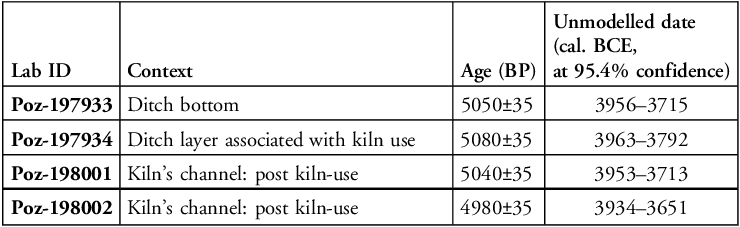
Four radiocarbon dates obtained on faunal remains associated with the kiln (Table 1) indicate use during the second half of the fortieth century to the thirty-ninth century BCE. This result aligns with ceramic decoration from the site (Figure 6A) and with published dates for the Cucuteni B1/Trypillia BII–CI stage (Müller et al. Reference Müller and Hofmann2025). Compared to the absolute chronology of other Cucuteni-Trypillia kilns, the structure from Ursoaia is slightly younger than those at Majdanetske and Stolniceni I but earlier than those at Taljanki and Dobrovody (see Müller et al. Reference Müller and Hofmann2025 for radiocarbon dates).
Radiocarbon dates calibrated using OxCal v.4.4.

Table 1 Long description
A table with four rows and five columns. The columns are labeled Lab ID, Context, Age (BP), and Unmodelled date (cal. BCE, at 95.4% confidence). The rows provide specific data for each radiocarbon date. Row 1: Lab ID Poz-197933, Context Ditch bottom, Age 5050 ±35, Unmodelled date 3956–3715. Row 2: Lab ID Poz-197934, Context Ditch layer associated with kiln use, Age 5080 ±35, Unmodelled date 3963–3792. Row 3: Lab ID Poz-198001, Context Kiln’s channel: post kiln-use, Age 5040 ±35, Unmodelled date 3953–3713. Row 4: Lab ID Poz-198002, Context Kiln’s channel: post kiln-use, Age 4980 ±35, Unmodelled date 3934–3651.
A) pottery from the kiln area; B) SEM images of the kiln samples (figure by authors).

Observations on the kiln lining, floor slabs and associated sherds using scanning electron microscopy with energy-dispersive x-ray spectroscopy (SEM–EDX) provide qualitative indicators of repeated high-temperature firing cycles (Figure 6B), rather than precise temperature measurements. The fully oxidised, vegetal-tempered slabs, lacking vitrification, are consistent with exposure to approximately 800–900°C. Incipient vitrification on vault fragments and glassy zones on the supports may reflect local peaks of 950–1100°C, although variation in raw materials, firing duration and local atmospheric conditions may affect these estimations. This contrast between floor slabs, supports and vault fragments suggests uneven but controlled heat exposure within a large updraught system. The observations are broadly consistent with the vitrification range recorded on ceramic fragments and support an operational model based on long, steady cycles: pre-heating, staged loading, prolonged soaking and controlled cooling.
Position within Cucuteni-Trypillia firing traditions and beyond
The Cucuteni-Trypillia area offers the most coherent European sequence for kiln emergence and standardisation towards fixed installations separating combustion and firing spaces to stabilise temperature and atmosphere. Following early experiments with horizontal-draught installations (e.g. Ariușd/Erősd, Dumești; Tencariu Reference Tencariu2015), the Cucuteni B/Trypillia BII–CI horizon is dominated by standardised bicameral updraught kilns. Within this corpus, the Ursoaia installation is both familiar and exceptional. Using published firing/working-surface estimates, most Cucuteni-Trypillia examples cluster around 2–4m2 (e.g. Maidanetske, Talianki, Nebelivka; Korvin-Piotrovskiy et al. Reference Korvin-Piotrovskiy and Müller2016); even the largest published example, Stolniceni I, is only just above this range (4.6–4.8m2; Ţerna et al. Reference Ţerna2019). The Ursoaia kiln therefore stands apart, setting a new upper bound for Cucuteni-Trypillia firing installations. In a broader Eurasian perspective, Padovani’s (Reference Padovani2023) comprehensive dataset of Early/Middle Chalcolithic (sixth–fifth millennia BCE) kilns in Southwest Asia (n = 238) indicates a mean firing-chamber area of approximately 1.5–1.8m2. Working areas above 7m2 are rare and currently limited to four installations: Tell Abada, vertical-draught (Ubaid 1: middle of the sixth millennium BCE) and single-chamber (Choga Mami Transitional: first half of the sixth millennium BCE) kilns, both at approximately 19.6m2; Tell Ziyada, horizontal-draught (Ubaid 3: first half of the fifth millennium BCE) at around 8.0m2; and Yunus, single-chamber (Mid–Late Halaf: first half of the sixth millennium BCE) at 7.1m2 (Padovani Reference Padovani2023: sup. tab. 1).
Conclusion
The substantial size of the working surface (approximately 7.5m2) and the estimated volume (around 12m3) and sophisticated engineering of the Ursoaia kiln reflect a structure designed for repeated, high-capacity use. Read as qualitative performance indicators rather than precise temperature measurements, the SEM–EDX observations support this interpretation, suggesting repeated exposure to high-temperature firing conditions. The kiln therefore points to a level of production that likely moved beyond domestic requirements towards an intensified model. The presence of several kilns within a relatively small settlement further underscores this potential shift in craft organisation, though definitive characterisation of a ‘community-level’ workshop remains a matter for future investigation. Targeted research within the settlement and its hinterland will provide the data needed to clarify the socioeconomic significance of this specialised pyrotechnology.
Acknowledgements
The authors express their gratitude to local mayor, Ioan Stegariu, for his support during the field research.
Funding statement
This work was supported by a grant from the Romanian Ministry of Research, Innovation and Digitization (CNCS-UEFISCDI, project number PN-IV-P1-PCE-2023-0040).
Online supplementary material (OSM)
To view supplementary material for this article, please visit https://doi.org/10.15184/aqy.2026.10428 and select the supplementary materials tab.
Author contributions: CRediT categories
Diana Măriuca Vornicu: Data curation-Equal, Formal analysis-Equal, Investigation-Equal, Writing - original draft-Equal, Writing - review & editing-Equal. Felix-Adrian Tencariu: Conceptualization-Equal, Data curation-Equal, Funding acquisition-Equal, Investigation-Equal, Methodology-Equal, Supervision-Equal, Writing - original draft-Equal, Writing - review & editing-Equal. Andrei Asăndulesei: Investigation-Equal, Methodology-Equal, Writing - original draft-Equal, Writing - review & editing-Equal. Ana Drob: Investigation-Equal, Methodology-Equal, Writing - original draft-Equal, Writing - review & editing-Equal. Radu-Gabriel Pîrnău: Investigation-Equal, Methodology-Equal, Writing - review & editing-Equal. Maria-Cristina Ciobanu: Investigation-Equal, Methodology-Equal, Writing - review & editing-Equal. Adina Amăriuței: Investigation-Equal, Methodology-Equal, Writing - review & editing-Equal. Analisa Ariton: Investigation-Equal, Methodology-Equal, Writing - review & editing-Equal. Radu-Alexandru Brunchi: Investigation-Equal, Methodology-Equal, Writing - review & editing-Equal. Bogdan-Ștefan Novac: Formal analysis-Supporting, Investigation-Supporting, Methodology-Equal, Writing - review & editing-Equal. Cristin Groapă: Investigation-Equal, Writing - review & editing-Equal.




 Open access

