The Problem
Speech stylization and language crossing have been the focus of a good deal of sociolinguistic interest in recent years.Footnote 2 Stylization involves reflexive communicative action in which speakers produce specially marked and often exaggerated representations of languages, dialects, and styles that lie outside their own habitual repertoire (at least as this is perceived within the situation at hand). Crossing is closely related, but it involves a stronger sense of social or ethnic boundary transgression, the variants being used are more likely to be seen as anomalously “other” for the speaker, and questions of legitimacy and entitlement can arise. As pointedly non-habitual speech practices, stylization and crossing break with ordinary modes of action and interpretation, invite attention to creative agency in language use, and often also contribute to the denaturalization of hegemonic language ideologies.
The institutional genres and interactional frames in which stylization occurs are very varied, but going beyond their description in different field settings, Nik Coupland has recently suggested that Richard Bauman’s notion of artful performance may be particularly relevant for the more general theoretical characterization of stylization. For Bauman, performance involves a “special interpretive frame” in which speakers assume “responsibility for a display of communicative competence” and produce language designed for “enhancement of [the] experience” of their audience (Bauman 1975/2001:178, 1986, 1987; Bauman & Briggs Reference Bauman and Briggs1990; Hymes Reference Hymes, Ben-Amos and Goldstein1975). Following discussion of a wide range of studies of style and stylization, Coupland suggests that “it would be apt to invoke the idea of performance as a quality of most and probably all of the styling practice we have considered” (2007:146), an idea that I have hitherto also supported (e.g. Rampton Reference Rampton and Duranti2001:50).
Bauman’s notion of performance works well with the relatively public, commercial, and/or mass-mediated contexts where Coupland and a number of others investigate stylization, constituted as they are with substantial audiences, professional and other high-profile communicators, rehearsals, and so on (e.g. Coupland Reference Coupland2001, Reference Coupland2007; Pagliai & Farr Reference Pagliai and Farr2000). But in this article, I shall argue that it is much less relevant to the everyday crossing and stylization practices that I have studied in radio-microphone recordings of spontaneous interaction among adolescents in multi-ethnic working-class clubs and schools in England. In my first study (Rampton Reference Rampton2005), where I looked at cross-ethnic uses of Creole, Panjabi, and Indian English and where race and ethnicity were often controversial matters, the performance of other-ethnic styles could actually be rather risky, eliciting strong criticism from the style’s owners/inheritors. In the second (Rampton Reference Rampton2006), where I looked at adolescents doing stylized posh (upper-class) and Cockney accents, the degree of composure and reflexive control implied in artful performance was often hard to reconcile with my informants’ experience of social class as a lived, pressing, sometimes difficult and normally only half-articulated issue. In both sites, there were many cases where Goffman’s notion of interaction ritual works better than Bauman’s performance as an account of the framing for these expressive practices. With Creole, Panjabi, and Asian English, interaction ritual made crossing and stylization acceptable by constructing them as urgent responses to the exigencies of the moment, affiliated with the interests of the main activity, and with posh and Cockney, interaction ritual provides an analytic lens better able to capture the situated immediacy with which acts of stylization articulated the speaker’s apprehension of ongoing processes of high/low social stratification.
I shall try to elaborate these claims in the ensuing discussion, although it is essential to recognize three methodological issues at the outset. First, my discussion is non-exhaustive. “Performance” and “interaction ritual” do not represent the only the options for a higher-level account of the special interpretive framings entailed in stylization and crossing, and any attempt to develop a more comprehensive view could start, for example, with Goffman’s list of the most basic “keys” in which activity is transformed and routine interpretation suspended (“make-believe,” “ceremonials,” “contests,” “technical redoings,” and “regroundings” [1974, ch. 3]). Second, there is an ineradicable element of interpretive leeway in the use of concepts like these. In contrast to constructs like “plural marker,” “fall-rise,” or “second pair part,” neither “performance” nor “interaction ritual” (nor “make-believe,” “ceremonials,” etc.) forms part of a consensual system of high-definition terms referring to readily isolable phenomena. Instead, they are integrative, mid-level concepts used in the interpretive characterization of broadly different configurations in the relationship between cultural convention, participant relations, interactional organization, signs, affect, and cognition.Footnote 3 Third, these two terms aren’t mutually exclusive: There is often a performance element in interaction ritual, as well as elements of interaction ritual in performance, and the “empirical object” can itself be highly motile. As Goffman notes, “Keyings are themselves … vulnerable to rekeying … [There isn’t] any obvious limit … to the number of rekeyings to which a particular strip of activity can be subject” (1974:79–80; see also Bauman 1975/2001:178–79), and this itself presents complications that empirical analysis needs to reckon with. That said, performance and interaction ritual still differ in important ways in the participant relations and orientations to non-routine experience that they entail, and my overall argument in this article is that interaction ritual is likely to be much more influential in crossing and stylization than researchers often appreciate.
In what follows, I shall begin by modeling some of the main pragmatic processes in the interpretation of stylization and crossing, moving from there to Bauman’s and Coupland’s definition of performance. After that, I’ll identify the problems with performance as a frame for interpreting ethnolinguistic crossing and stylization in my first dataset, pointing instead to the significance of contests and interaction ritual. The next section summarizes Goffman’s perspective on interaction ritual, and the following one returns to the ethnolinguistic data, explaining why Goffman’s account of interaction ritual is a much more valuable analytic resource than Bauman’s performance. I then extend this argument to the stylization of posh and Cockney. In its conclusion, the article engages with Coupland’s stimulating speculation about stylization and performance in late modernity.
Stylization and Crossing as Special Interpretive Framings
Following Gumperz’s insistence on the importance of inferential processes (e.g. Prevignano & di Luzio Reference Prevignano, di Luzio, Eerdmans, Prevignano and Thibault2002), and drawing on Auer Reference Auer and Heller1988, Clark (Reference Clark1996:chs. 5, 6, 16), and Ochs Reference Ochs, Gumperz and Levinson(1996; also Rampton Reference Rampton2006:ch. 8.5), it is worth positing a number of partly overlapping practical questions involved in the processing of speech that instigates a different interpretive frame. So in the course of
(A) engagement in an activity of some kind
(B) communicative acts or elements emerge, are produced or encountered that are hard to incorporate as an unexceptional contribution to ongoing activity. In cases where the production of these elements is intended rather than accidental, the following processes are likely to be involved:
(i) A violation of co-occurrence expectations: A speaker produces and – she or he hopes – the recipient(s) perceives linguistic or semiotic forms that don’t fit with the kinds of thing that the activity in play had hitherto led them to expect (⇨‘what?’)
(ii) There is an implicit invitation from the producer and an effort from the recipient(s) to place the unexpected forms among signs they’ve elsewhere/previously encountered and to identify their potential connotations/indexical valence (‘what is that?’)
(iii) There is an invitation/effort to understand the unexpected signs’ relevance to some aspect of the scene or interaction in train (‘why that now?’ part 1)
(iv) There is an invitation/effort to use the unexpected signs to interpret the producer’s stance/self-positioning in/on that aspect of the interaction (‘why that now?’ part 2)
(v) There is an invitation/effort to start formulating a response (‘what next?’)
The answers to these questions may be either settled in an instant or negotiated interactively over several turns, and of course a variety of problems of producer–recipient coordination can occur around each one. But in the analysis of bilingual interaction, these questions help to clarify the traditional distinction between “situational” and “metaphorical” code-switching,Footnote 4 and they are obviously relevant to stylization and crossing, in which speakers shift to styles beyond what is generally seen as their normal range. In stylization and crossing, the disjuncture of speaker and voice violates co-occurrence expectations and makes the subsequent pursuit of normal business in a different frame seem less likely, pushing the recipient toward a figurative reading of the shift’s significance instead (Coupland Reference Coupland2007:154).
The crucial difference between stylization and crossing lies in the extent to which the speaker’s use of another voice turns the participants to wider issues of entitlement. So when young Londoners did stylized posh and Cockney, and when vernacular English speakers with Panjabi backgrounds stylized Indian English, they put on exaggerated accents that they’d never use in ordinary talk with friends. But nobody accused them of expropriating linguistic resources that didn’t belong to them, or of using language to which they had no right. In contrast, the use of Indian English could be very risky for white and black kids, as could white and Asian uses of Caribbean Creole. The circumambient politics of race made ethnolinguistic boundaries very sensitive, and so when crossing recipients encountered the disjuncture between the voice and the speaker’s ethnic background, the question “why that now?” was supplemented with “by what right?.” In cases of aggression, the answers to these two questions could dovetail – “that’s illegitimate” would run with “s/he wants trouble” – but for the most part in the crossing data from the 1980s, the intentions were friendly. So a successful piece of language crossing would find the recipients satisfied on the interactional “why that now” question and pacified (or even entertained) on the ethnopolitical “by what right?.” A clever or funny interactional design could capitalize on ethnic difference and neutralize the political sensitivities, potentially leading to new solidarities; conversely, the politics might be overriding, crashing the original interactional plan; or alternatively, the two could be held in awkward tension, as when people found jokes funny that they also objected to as racist (e.g. Rampton Reference Rampton2005:ch. 2.4).
This sketch of pragmatic inferencing can be extended to cover a number of processes observed in the empirical study of stylization and crossing,Footnote 5 and I shall refer to it later. But it is now worth turning to Bauman’s notion of “performance.”
Bauman and Coupland on Artful Performance
According to Bauman, “It is part of the essence of performance that it offers to the participants a special enhancement of experience, bringing with it a heightened intensity of communicative interaction” (1975/2001:182). More generally:
Performance in its artful sense may be seen as a specially marked way of speaking, one that sets up or represents a special interpretive frame within which the act of speaking is to be understood. In this sense of performance, the act of speaking is put on display, objectified, lifted out to a degree from its contextual surroundings, and opened up to scrutiny by an audience. Performance thus calls forth special attention to and heightened awareness of the act of speaking and gives licence to the audience to regard it and the performer with special intensity. Performance makes one communicatively accountable; it assigns to an audience the responsibility of evaluating the relative skill and effectiveness of the performer’s accomplishment. (1987:8)
The attention to a “special interpretive frame” and to acts of speaking “put on display, objectified, lifted out to a degree from [their] contextual surroundings” resonates with the foregrounding and non-routine inferential work associated with stylization and crossing, and as in the two empirical studies that I shall discuss, political issues may also become relevant when “performances move the use of heterogeneous stylistic resources, context-sensitive meanings, and conflicting ideologies into a reflexive arena where they can be examined critically” (Bauman & Briggs Reference Bauman and Briggs1990:60). Indeed:
Through his performance, the performer elicits the participative attention and energy of his audience, and to the extent that they value his performance, they will allow themselves to be caught up in it. When this happens, the performer gains a measure of prestige and control over the audience … [T]here is … [a] persistently documented tendency for performers to be both admired and feared – admired for their artistic skill and power and for the enhancement of experience they provide, feared because of the potential they represent for subverting and transforming the status quo. (Bauman 1975/2001:183)
Drawing Bauman’s work to the center of his account of stylization, Coupland describes seven dimensions of performance:
[1] Form focusing: The poetic and metalinguistic functions of language come to the fore and considerations of ‘style’ in its most commonplace sense become particularly salient. [2] Meaning focusing: There is an intensity, a density and a depth to utterances or actions, or at least this is assumed to be the case by audiences. [3] Situation focusing: Performers and audiences are not merely co-present, but are ‘gathered’, according to particular dispositional norms. People know their roles. [4] Performer focusing: Performers hold a ‘floor’ or a ‘stage’, literally or at least in participants’ normative understandings of speaker rights and sequencing options. [5] Relational focusing: Performances are for audiences not just to audiences. Although audiences are often public, performers will often have designed their performances for specific groups. [6] Achievement focusing: Performances are enacted in relation to more or less specific demands. ‘Stakes’ (gains, losses and risks) are involved, with potential for praise or censure for good performance. [7] Repertoire focusing: Performers and audiences are generally sensitive to what is given and what is new in a performance. Performances may be versions of known pieces, or at least known genres. Innovative interpretation can be commended. Rehearsal is relevant. (2007:147–48)
And both scholars are also clear that the scale of performance varies. There may be a fuller sense of spectacle in prototypical performance than in the often fleeting actions characteristic of crossing and stylization, but performance can be relatively spontaneous, as in joke-tellings at a party (Bauman 1975/2001:175). Coupland suggests that “we should recognize a scale that runs between … mundane … and high performance” (2007:146–47), and Bauman stresses that it “isn’t all or nothing – [it] may be dominant in the hierarchy of multiple functions, as in ... full performance, or it may be subordinate to other functions – referential, rhetorical, or any other”(1986:3; see also Hymes Reference Hymes, Ben-Amos and Goldstein1975). Indeed, there can come a point where the special interpretive frame is no longer accompanied by any assumption of accountability to an audience, and here Bauman talks of “play” (1975/2001:178).
There seem, then, to be good prima facie grounds for linking stylization and crossing to performance, and this is likely to be increased by the flexibility of the formulations provided by Bauman and Coupland, allowing as they do for reduced forms in which performance is just one function subordinate to others, or even merges into play. So exactly why and how is performance problematic for the account of crossing and stylization in the settings where I have studied it?
Ethno-Linguistic Crossing and Stylization in Ashmead: Problems with Performance, and the Influence of Other Frames
In my study of crossing and stylization among adolescents in a multi-ethnic working-class neighborhood, “Ashmead,” in the 1980s (Rampton Reference Rampton2005), the two varieties most often involved in crossing and stylization were Creole (c. 250 episodes in 145 hours of radio-mic recordings and extensive participant observation) and Indian/Asian English (160 episodes). But this wasn’t an interethnic free-for-all, and local adolescents generally developed a good sense of when they could and couldn’t cross into Creole and Indian/Asian English (and Panjabi as well). White and black kids usually avoided the use of stylized Asian English in the company of Panjabi peers (2005:chs. 2.4, 6.3), and most white and Panjabi youngsters either avoided the use of Creole with black peers, or restricted it to a limited set of fairly stock phrases (2005:ch. 8.3) – those who used a lot were liable to be seen as “silly,” “stupid,” “thinking they’re black,” or as stereotyping black people (2005:ch. 2.1). The public profile of these two languages undoubtedly contributed to these patterns of avoidance. In the 1980s (as well as before and after), Creole occupied a dominant position in popular music and youth culture, while in the mass media at the time, there were often racist images of a ridiculously deferential, uncomprehending Indian English. In view of the parodic public images of it, you didn’t address Asian English to your Panjabi friends in case they took it as racist mockery (2005:ch. 2.4), and if you produced elaborate Creole with black peers, you risked being seen as either mocking or expropriating a widely valued popular resource (2005:ch. 9.2; Hewitt Reference Hewitt1986:162).
These weren’t auspicious conditions for attempting ethnolinguistic crossing and stylization within artful performance, at least not in the fuller senses defined by Bauman and Coupland. With an insistent “by what right” question in the air, youngsters needed to be especially skillful verbally and/or confident of their audience to embrace the performer’s role in either Creole or Asian English, “giv[ing] licence to the audience to regard [the performance] and the performer with special intensity” (Bauman Reference Bauman1987:8). Indeed, with crossing in Panjabi – another variety with local interethnic currency – it was precisely at the point where the public performance of bhangra music and dance started attracting wider interest and prestige that white and black adolescents stepped back (Rampton Reference Rampton2005:60, 70, ch. 10). In contrast to the patterns of avoidance with Creole crossing and the stylization of Asian English, it was generally in the company – and with the encouragement – of friends of Indian and Pakistani descent that white and black kids used Panjabi, in a range of contexts mentioned below (2005:ch. 8.5). But at the time of my fieldwork, bhangra music was also being noticed and becoming popular, and in this more conspicuously performance-oriented context, Asian kids talked negatively about white interest, a lot of male crossers lost interest, and white girls only participated as audience with the personal authorization afforded by (actual or potential) romance with Asian boys.
Certainly, there were a few individuals willing and able to do Creole or Panjabi crossing in fairly “full” performance settings (Rampton Reference Rampton2005:207–11, 240), but these were exceptional, and if the fuller definitions of performance provided by Bauman and Coupland were taken as the essence of crossing and stylization, we would be able to account for only a fragment of the dataset. In fact, though, there were other genres and activities that instituted a “special interpretive frame” and that thereby enabled crossers to use Creole, Asian English, and Panjabi without being accused of mocking Asians or of “acting black.” In terms of Goffman’s list of basic keys, one set of these could be classed as “contests” (cf. Goffman Reference Goffman1974:56–58).
As many scholars have noted, in games, sport, and other contests, there is an agreed relaxation of routine interaction’s rules and constraints (Goffman Reference Goffman1974:ch. 3; Handelman Reference Handelman, Chapman and Foot1977; Turner Reference Turner1982:56; Sutton‑Smith Reference Sutton-Smith and Borman1982; Rampton Reference Rampton2005:ch. 6.7). Among younger kids, chasing games provided a significant context for crossing in Panjabi; Panjabi abuse featured as one way of trying to catch “Its” attention and initiate some chasing (Rampton Reference Rampton2005:ch. 7.2), and more generally during recreational cricket, soccer, tennis, and so on, Asian English was often stylized by Panjabi boys in commentaries improvised either as players themselves or as spectators (Aziz [Pakistani-descent; male; 13 years]: and Kapil Dev is batting now and Aziz is the wicket keeper for Pakistan .. oh yes what a ball .. what a save by the wicket keeper). The role of spectator could merge with that of umpire and scorekeeper, and players could use stylized Asian English to keep the tally, to declare a change in the state of play, and to tell others of the appropriate next action:
(1) Participants and setting: 1987. At the youth club in the evening, Chris [Anglo-descent; Male; 14 years] is playing badminton doubles with Peter [Anglo, M, 14, wearing radio-mic] against Imran [Pakistani-descent, M, 15] and Richard [Anglo M 15] (2005:Ex.II.8)
1 Chris ((to Peter)): what you doin
2 Peter : PLAYING BADMINTON (.)
3 Chris : could have fooled me
4 ? : ( )
5 Rich. : go on you ser[ve
6 Imran : [ ( )
7 Peter : ONE NIL[vʌɳ ɳɪɭ ]
8 Imran : love- love one
In fact, games constituted the only context in which it was relatively safe for white and black boys to use Asian English in the presence of Panjabi peers (cf. ex. 1), and here they also joined them in the use of phrases encoding positive evaluation – very good shot, very good, good shot, shot, shotting – which variously targeted good and poor performance and could be delivered enthusiastically, ironically, nonsensically, or with indifference (Rampton 2005:ch. 6.4). Another well-established and quite clearly framed playground genre that was hospitable to language crossing was jocular abuse, and here too there is an understanding that the assumptions (about truth and falsity) governing everyday life have been suspended (Rampton 2005:ch. 7.3; Labov Reference Labov1972; Goodwin & Goodwin Reference Goodwin, Goodwin and Grimshaw1987). In this context, white and black boys drew Panjabi into displays of quick-witted resourcefulness, and this extended to the playful corruption of collaborative songs and to incrimination traps disguised as language teaching (say [mƐ̃ ʈəʈʈi khɑndɑ] ‘say I eat shit’).
Like artful performance, sports, games, and verbal contests involve the production of a potentially engrossing, non-routine frame designed for the enhancement of experience. Within this, however, the social relations of participation are configured differently. Instead of the speaker–audience asymmetry fundamental to artful performance as defined by Bauman and Coupland, these contests involved protagonists who began from a more or less equal baseline, and rather than seeking admiration for the use of an other-ethnic language, a little bit of judiciously provocative crossing served to spice up the contest. There was also less dependence on ethnically marked representations and practices circulating in public culture generally. Of course, when they are institutionalized, games and sports can also have a very high public profile, with a clear separation of players and spectators. And so when kids played cricket or soccer, they could and often did replay in their imaginations the feats of sporting heroes, also maybe sometimes impressing spectators if any happened to be on hand. But impressing spectators wasn’t the central purpose, and rather than depending on the depth and range of the players’ linguistic knowledge and verbal skill with high-prestige cultural material, the outcome of these games was generally decided by matters such as physical speed or aptitude, the fall of the cards, and so forth.Footnote 6
At the same time, however, there were also a great many other instances of crossing and stylization which would be much harder to construe as varieties of “contest”:
(2) As I was going down the stairs into the gym at the youth club, a small Asian boy (about 12 years old) was walking down in front of me. Jim Cook, the school caretaker, was at the bottom by the doors. He held them open for us and as the boy went through, he turned to Jim as he passed and said in a very strong Panjabi accent (not subsequently maintained in ordinary talk): how are you doing Mr Cook. As I passed through after him, without any hint of annoyance Jim said something like might as well keep the doors open all the time, which he did. [fieldnotes] (Rampton 2005:ex. II.6)
(3) A playback interview involving Ben (the researcher/author, 30+, male, Anglo descent), Asif (15 years old, male, Pakistani descent), Kazim (15, male, Pakistani descent), and Alan (15, male, Anglo descent). Ben is struggling to elicit some retrospective participant commentary on extracts of recorded data, and is on the point of giving up. (Rampton 2005:123–24)
1 Ben: right shall I- shall we shall we stop there
2 Kazim: no
3 Alan: no come [ on carry on
4 Asif: [ do another extract
5 Ben: le- lets have (.) [ then you have to give me more =
6 Alan: [ carry on
7 Ben: =attention gents
8 Asif ((quieter)): yeh [ alright
9 Alan ((quieter)): [ alright
10 Asif ((quieter)): yeh
11 Ben: I need more attention
12 Kazim ((in Asian English)): I AM VERY SORRY BEN JAAD [ɑɪ æm veɾi sɒɾi ben dƷɑːd]
13 Asif ((in Asian English)):ATTENTION BENJAMIN [əthenʃɑːn bendƷəmɪn]
14 [((laughter))
15 Ben: [right well you can- we cn-
16 Alan: [BENJAADEMIN
(4) Ian [An M 15 wearing radio-microphone], Jagdish [In M 15], Richard [An M 15], Conrad [AC M 15]) and a lot of other pupils are queuing up in the corridor waiting to go in for dinner. They notice a pupil of Bangladeshi descent trying to push in. (Rampton 2005:ch. 6.2).
7 Rich: OI EH EH WHERE YOU GOING (.) GET BACK OI
8 : ( )
9 Rich: EH GET BACK (1.0) HEY WHAT A RAAS((= approximation to Creole)) (.)
10 Ian : EH ( ) EH MISS (.) WHERE THEY GOING (.)
11 Rich: MISS THEY’VE PUSHED IN
12 Ian : OI (.) LOOK Baker ((a 6th former)) THESE LOT PUSHED IN
13 (.) THEY JUST (OUR DINNER) THEY (BOUGHT) (.)
14 GET BACK TO THE BACK
15 Rich: GED OU’
16 AnonA: ((in exaggerated Asian English::)) OUT: [ɑʊth]
17 Rich: GED OU’
18 AnonA [M]: ((slowly in stylised Asian English:)) GE:T OU:T [ɡe1ʈ ʌʊ1ʈh]
19 AnonB[M]: ((slow:)): OUT BOY OUT [ʌʊt bhɔI ʌʊt]
20 AnonA ((slow:)): GE:T OU:T [ɡe1ʈ ʌʊ1ʈh]
21 Rich: (those others) pushed in ([)
22 AnonB: [ MOVE IT BO:Y [mʊv it bɔI]
23 Ian : [WELL WHAT’S THE MATTER WITH YOU BAKER (.)
24 : [( )
25 : [( )
26 Ian : see if that was me innit (.) ([kɹɑɑf]) ((= approximation to Creole))
27 ((more laughter and talk for 8.0))
28 Ian((quietly)): fucking Bengalis
(5) 1987 dinnertime. Andrew [14 African-Caribbean descent, male; wearing radio-mic], Adrian [14 AC M], Mashuk [14, Bangladeshi descent, M], AnonF [Anglo, female], AnonF2 [Female], Colin [? M] are in the bike sheds outside, a relatively secluded area where people smoke. Up until line 40 or 41, they are arguing about coursework, but in lines 41 and 42, Adrian and Mashuk notice Colin lighting a cigarette (Rampton 2005:207–11)
38 Andrew: yeh YEH EVERYONE GETS THE SAME YEH (.) yeh (.)
40 Mashuk: it don’t matter how thick or [ ( ) you are =
41 Adrian: ((rapidly:))[ANDREW
42 Mashuk: =you get the same t-(.) AAH CHAA [ ME LIGHT IT UP MAN((= in Creole))
43 Adrian: [ Colin’s behind you
44 Andrew: ((rapidly:)): wh’ Col where’s Colin man I can’t-
45 where’s Colin man where’s Colin where’s Colin
46 ((smile-voice:)) aah dere you are (.)
47 Colin give me a pull please
48 Colin: no hold on
(6) Kazim and Asif [both Pakistani descent; M; 14] pass Laura [African-Caribbean, F. 14] and her friends in the corridor during lunch-time. Micky is Anglo. (Rampton 2005:206)
Kazim: eh heard the new news (.) Micky’s goin’ out with Laura
Asif: ((loudly, approximating Creole ‘gewaan’:)) AAH GO’AAN LAURA
Neither performance nor contests provide a larger context for these instances of crossing and stylization, and instead, it is helpful to turn to Ervin Goffman’s descriptions of interaction ritual.
Goffman’s Interaction Ritual
Offering an interactional reinterpretation of Durkheim’s account of collective rituals, Goffman proposes that participants in an encounter treat each other as being in “possession of a small patrimony of sacredness” (1971:89). But “[w]hen individuals come into one another’s immediate presence, territories of the self bring to the scene a vast filigree of wires which individuals are uniquely equipped to trip over” (1971:135-6), and this continuously threatens to destabilize social relations, throwing the orderly flow of interaction into question. Imbued like this with a regard for moral and territorial boundaries, Goffman’s theory of ritual face work sees an orientation to potential offense pervading all interaction (see also Brown & Levinson Reference Brown and Levinson1987), but in addition, there are actions and sequences that intensify the display of this concern:
Face-to-face interaction … is the location of a special class of quite conventionalised utterances, lexicalisations whose controlling purpose is to give praise, blame, thanks, support, affection or show gratitude, disapproval, dislike, sympathy, or greet, say farewell and so forth. Part of the force of these speech acts comes from the feelings they directly index; little of the force derives from the semantic content of the words. We can refer here to interpersonal verbal rituals. These rituals often serve a bracketing function, celebratively marking a perceived change in the physical and social accessibility of two individual to each other … as well as beginnings and endings – of a day’s activity, a social occasion, a speech, an encounter, an interchange. So in addition to the fact that any act performed during talk will carry ritual significance, some seem to be specialised for this purpose … and these play a special role in the episoding of conversation. (Goffman Reference Goffman1981:20–21)
So “interpersonal verbal rituals” occur in sequences of increasing/increased interactional uncertainty. These moments of jeopardy intensify the need for participants to display regard for the relations on hand and social order more generally (Goffman Reference Goffman1971:126–27), and to do so, people generally amplify the symbolic dimensions of their conduct, shifting briefly away from the appropriately modulated/hedged production of propositional utterances geared to truth and falsity. Instead, they turn up the ritual aspects through a range of inherited symbolic formulae – farewell and greeting routines, apologies, thanks, expletives, expressions of dismay or surprise, even proverbs (Drew & Holt Reference Drew and Holt1988) – and, we can assume, it is by invoking relatively well established material associated with (local or quite general) tradition that they display an orientation to perduring social bonds and collectivities capable of overriding the temporary disturbance immediately on hand. Greetings, for example, use well-known formulas to resolve the indeterminacies that arise at the opening of an encounter, leave-takings provide reassurance against what’s unknown in the period of separation coming up (Goffman 1963, 1971:107), and praise shows that the speaker “is alive to the situation of one who has sustained change, that he will continue his relationship to him” (Goffman Reference Goffman1971:93–94).
From the accounts offered by Bauman, Coupland, and Goffman, it is clear that both artful performance and interaction ritual orient to experience in which the hold of routine assumptions guiding everyday conduct is relaxed, threatened, or disturbed, and this makes them both at least potentially congruent with the non-normal framing associated with stylization and crossing. But there are important differences in the way that they each relate to exceptional experience. With performance, people are asked (and helped) to come away from ordinary activity into the fictive, otherworldly realms created for them by the performer(s), whereas in interaction ritual, instead of participating in a voluntary and controlled release from routine, participants can find themselves confronted with uncertainty. Rather than creating them, acts like praise, blame, thanks and disapproval react to departures from the normative equanimity of ordinary conduct. Interaction ritual actions are evasive or redressive, aimed at preserving or restoring normal relations, re-stabilizing rather than de-stabilizing the ordinary world, escaping not into but out of less charted zones of experience. Performance might be offered for the enhancement of experience, but interaction ritual offers a defense against its vulnerabilities.
With this account of interaction ritual and its difference from performance in place, it is worth now returning to the extracts cited at the end of the previous section. Admittedly, these include several examples of crossing and stylization where it certainly makes sense to speak of reduced forms of performance being slipped into sequences primarily designed for other purposes. But there are others where we can only refer to “performance” if we detach this from Bauman’s and Coupland’s account of full performance and instead equate it much more minimally with a linguistically generated “special interpretive framing” – a framing that is no more intrinsically linked to narrative, public discourse, or media discourse of the kind described by Coupland and Bauman than to contests, interaction rituals, and other practices where routine assumptions are potentially or temporarily suspended.
Interaction Ritual as a Crucible for Crossing and Stylization
Rather than being embedded either in contests or artful performance, the crossing and stylization in extracts (2-6) occur in interaction rituals. Asian English is stylized in a greeting (2), an apology (3), and a demand for remediation (4, lines 16 ff), and there is crossing into Creole in expressions of annoyance (4, line 9; 5) and of admiration/encouragement (6).
For some of the episodes, there certainly seems to be relevance in Bauman’s and Coupland’s account of reduced performance, or performance as one subordinate function among several. Indeed, Goffman’s account of “overlays” makes it clear that even within small-scale practices designed to move the participants past potentially vulnerable moments, there is scope for displaying unorthodox alignments, (re)keying the conventionally expectable ritual actions (cf. Goffman Reference Goffman1971:108, 202 ff). Certainly, in the affirmation of common ground for the resumption of synchronized, affiliative action in orthodox interaction ritual, people often draw on forms that are more elevated (or more intimate) than normal, but these showcase moments for the indexical display of social allegiance can also be used more divergently. They are a prime site for all sorts of improvisation, and it is very common to hear people putting on different kinds of “funny voice” in thanks, greetings, and farewells.Footnote 7 So in (3), the boys’ apology in lines 12 and 13 doesn’t appear to be very serious. The lexical choices (I am very sorry…, attention Benjamin) make a show of providing ritual remediation for the offense I was drawing attention to, but the shift into stylized Asian English seems designed to enhance the fun the boys were having, and following their apology, the interaction continued much as before. Indeed, there are strong signs of their lack of genuine contrition not only in the laughter in line 14, but also in line 12’s ben jaad, a nickname for me which I later discovered to be an accidental peer-group Panjabi invention of Alan’s, falling ambiguously between [ben jɑɾ] ‘Ben, friend’ and [pɛn t∫ɔd] ‘sister fucker’. Similarly, in (6), Asif’s expression of encouragement – aah ge’aan Laura – looks double-edged, designed as much to embarrass or to provoke cross-sex banter as to encourage (Rampton 2005:206), and in instances like these, as well as in the small boy’s Asian English greeting in (2), there is a good case for seeing stylization as “play” or performance in one of its more attenuated forms, artfully inserted into sequences conventionally oriented to other purposes.
But this is much more difficult with other extracts. Rather than subverting interpersonal ritual, reconfiguring it in short performances of individual initiative designed to amuse, stylization can also intensify ritual interaction, and this is clearest in (4). Instead of softening the perception of offense, the shift to stylized Asian English from line 16 seems to upgrade the demand for remediation, using a voice associated with youth cultural incompetence to racialize the episode, playing on a strong vein of local hostility toward Bangladeshi newcomers (Rampton 2005:ch. 6.2; see also Goffman Reference Goffman1971:189 ff). Similarly, there’s little evidence that Richard’s brief shift to Creole in line 9 lightens the sense of affront, and in (5), there are no grounds for thinking that Mashuk isn’t principally intent on having a pull on Colin’s cigarette. Indeed more generally, gewaan and cha were used so often to add conviction to the speaker’s stance on whatever it was he or she had noticed, that they seemed to have been incorporated in the local multi-ethnic vernacular as ordinary ways of expressing strong emotion (cf. Rampton 2005:ch. 8; Hewitt Reference Hewitt1986:129).
In episodes like these, rather than generating “overlay” and taking it in another direction, crossing and stylization seem to be an integral part of interaction ritual. Yes, we can continue to describe stylization as “performance” if this is pared back to “form-focusing,” “meaning-focusing,” and “a special interpretive frame” (cf. discussion of Coupland and Bauman above). But it is difficult to see why this heightened intensity should be intrinsically linked to performance in its fuller forms, construed as an attenuated or incipient version whose elaboration/amplification necessarily runs along a scale leading in the direction of “high” performance of the kind that Bauman and Coupland describe. Full performance is actually rather distinctive (i) in the relations between participants that it constructs/sustains, and (ii) in the way that participants orient and engage with non-routine experience. Interaction ritual differs significantly on both counts, and in fact it is those aspects of interactional ritual which distinguish it from artful performance that help to explain how ethnolinguistic crossing and stylization became widespread, in spite of the constraints I described earlier.
Artful performance tends to be willingly initiated by performers (or at least has their active consent), and in the performance of conversational narrative, for example, the issue occasioning the story may prove incidental to the pleasure provided in the tale-world that the story creates (so that the narrator often has to make a special effort to clarify its relevance to the matters that initially prompted it in the “evaluation” and “coda”). In contrast, ritual actions are typically produced as a response to surprises, transgressions, changes, or uncertainties that are emerging or have emerged independently of the main participants’ volition. Here, the ritual expression can be urgent, interrupting, and often kept quite short in the interest of harmonious relations (since elaboration is generally seen as proportionate to the seriousness of the occurrence that prompts it). The symbols invoked have to be conventional enough for the recipients to recognize their communality, but their raison d’être lies in the immediacy of their exophoric ties to whatever’s just transpired or is transpiring, and they may sound false if there’s any hint that they’re rehearsed (unless, once again, it’s something very serious that prompts them). In addition, instead of seeking individual distinction, the ritual actor acts on behalf of the main collectivity or encounter, seeking to preserve, restore, and/or recalibrate the common interactional project actually or potentially deprived of its bearings.
For most ordinary members of a multi-ethnic friendship group, who lack any exceptional skill in the use of other-ethnic varieties and are sensitive to the ways in which race politics can complicate such practices, the emphasis on renormalization and continuity makes interaction ritual a much more congenial site for experimenting with other-ethnic forms than artful performance (which in contrast, seeks to generate appreciation of, e.g., potentially memorable innovation in the here-and-now). In principle, when you make the shift into a variety that you’re not fully entitled to, the “why that now?” question is answered by whatever pressing exceptional occurrence the ritual action is attending to. Furthermore – and again in contrast to performance, which asks the recipients to dwell on language use – the implicit declaration of affiliation to the activity in which you and your friends had been engaged blends with a commitment to returning to the main business (cf. Goffman Reference Goffman1971:138), and this is potentially capable of moving the recipients quickly past the “by what right?” issue. Indeed, turning from production to reception, even if you don’t use these other-ethnic forms yourself, they’re still going to feel quite an integral part of your world if your ethnic inheritor friends use them to ritually protect the activity, team, or party that you’re jointly involved in. As an audience, performance confronts you with the question of whether or not to let the performer lead you into the realm she or he is projecting, but as long as you’re not a target being excluded, ritual generally co-opts you into the collectivity that’s being reaffirmed and/or protected.
These features of interaction ritual help to explain how ethnolinguistic crossing and stylization came to be such common practice in Ashmead, despite the fact that the “by what right?” question inhibited crossing and stylization in contexts of full performance. Of course, interaction ritual wasn’t the only frame that licensed these practices, and I suggested above that contests, sports, and games also provided a more fertile frame for crossing and stylization than did artful performance. In contests, when recipients encountered verbal forms that violated normal expectations about the producer’s speech repertoire, they could refer at least in part to the nature of the genre in play to settle the questions “why that now?” and “by what right?”, selecting a response from the conventional range of next actions conventionally scripted within the activity in train. Actually, though, this kind of generic framing often isn’t enough on its own to account for the license grabbed and granted in these incidents, since acts of stylization and crossing were also timed at particular interactional junctures. In games, good shot registered exceptional actions that were temporarily changing the balance of power between the protagonists (cf. Goffman Reference Goffman1971:93–94 on “ratificatory rituals”), and although Simon’s Asian English one-nil in (1) looks different in not fitting Goffman’s list of interaction ritual acts (praise, blame, support, disapproval, etc.), it still sought to settle a period of dispute and to reinstate the game’s next phase. The special interpretive frames associated with contests and games can partly explain some of the license for crossing and stylization, but within these, it was interaction ritual that often provided the more immediate pretext.
Interaction ritual, then, provides a much better explanation of the spread of ethnolinguistic crossing and stylization in Ashmead than artful performance. Yes, there were some exceptional individuals who crossed and styled in relatively full performance contexts, and crossing and stylization could and often did introduce innovative, amusing, and more performance-like overlays in interaction ritual. But there were also occasions when, instead of serving as an overlay, crossing and stylization provided an intensification that was integral to interaction ritual sequences, and if we turn from specific episodes to more general theorization of the currency of these expressive practices in Ashmead, full performance faces explanatory problems that interaction ritual overcomes. Certainly, Coupland’s and Bauman’s notions of “form-focusing,” “special interpretive framing,” and “heightened intensity” are essential to analysis of crossing and stylization, but these descriptors have to be unhitched from full performance, pruned back to the more rudimentary processes outlined in the second section above.
In fact, this view of the relationship among artful performance, contests, and interaction ritual has implications that reach far beyond the Ashmead dataset. For quite some time now, cultural commentators have talked about the emergence of “new ethnicities” in the UK, drawing attention to changing representations of identity in popular music, film, and the performance arts more generally (Hall Reference Hall1988; Gilroy Reference Gilroy1987:ch. 5; Back Reference Back1996; Mercer Reference Mercer1994). In the process, they have often also underlined the significance of language mixing and crossing, using examples of full performance in public contexts (e.g. Gilroy Reference Gilroy1987:ch. 5; Back Reference Back1996:ch. 8; Mercer Reference Mercer1994:ch. 2). Unquestionably, artful performance in popular culture makes a substantial contribution to many people’s interest and engagement with other ethnicities, as well as to the ratification of ethnic difference as a normal state of being, but obviously, the relays between public representations and everyday practice are rather complex. From the data reviewed in the previous sections, it is clear that the local uptake of widely circulating forms and practices is mediated by a range of more everyday stances, frames, genres, participant and social relations, and that for the activation of other-ethnic language use in local networks, artful performance may well be subsidiary in influence to contests and to interaction rituals in particular. In sum, if it is too closely pegged to Bauman’s notion of performance, the sociolinguistics of crossing and stylization may be unnecessarily limited in what it can reveal of new forms of low-key urban “conviviality,” in which racism is recognized but “racial and ethnic differences have been rendered unremarkable” (Gilroy Reference Gilroy2006).Footnote 8
Indeed, outside situations of ethnic diversity, there are also limits to the value of performance as a central organizing concept in the analysis of stylization practices where there aren’t any particular issues of boundary or “by what right?” tied to the languages involved. At this point it is worth turning to the stylization of two varieties marked for social class rather than ethnicity – posh and Cockney.
Stylization and Social Class
In the 1990s, I carried out fieldwork in a multi-ethnic secondary school in inner London (“Central High”),Footnote 9 and focused on the links between language and social class (see Rampton Reference Rampton2006:chs. 6–9 for a full account). Youngsters didn’t talk much about social class – race, ethnicity, gender, and sexuality were all much hotter topics – but a small Labovian study showed that traditionally class-marked standard and vernacular forms were closely integrated into their ordinary talk, and that their use of these forms varied in line with the formality of the situation in the way that variationists have so often described (Rampton Reference Rampton2006:ch. 7.3). More significantly here, they also switched into exaggerated stylizations of posh and Cockney, the two most clearly classed varieties in the region,Footnote 10 on average about once every 45 minutes.
Since most young people had a mix of both more and less posh and Cockney variants in their everyday speech, their stylization was unconstrained by the kinds of sensitivity to otherness evidenced in Ashmead, and both in lessons and outside in recreational interaction between peers, there were a number of clear cases of rather full performance, involving rehearsal, active and explicit demarcation of the line between audience and performer, commencement only once the audience was properly assembled, and appraisal both during and after (see e.g. Rampton Reference Rampton2006:280–83, ch. 9.4). At the same time, however, there were other frames for the stylization of posh and Cockney, and there are three major obstacles to using “performance” as the main term for characterizing these practices. First, performance emphasizes the “enhancement of experience,” whereas it often seemed to be a sense of its vulnerability that occasioned the stylization of posh and Cockney. Second, stylization in full performance generally implies the projection of a fairly well delineated persona, whereas stylized posh and Cockney quite often occurred as fleeting coloration added to ordinary interaction, their indexicalities relatively indeterminate and much more a matter of stance than of social type. Third, beyond the empirical distortion entailed in any privileging of enhanced experience and persona projection, a performance account of stylized posh and Cockney would miss the connection to more general theorizations of the meaning of social class. These points can be taken in turn.
First, it was often at ritually sensitive moments that adolescents shifted into stylized posh and Cockney – when they felt humiliated or offended by a teacher, when faced with separation from their pals, and at sharply felt states and changes in the structured flow of social relations. So Hanif, for example, responded to some patronizing over-explanation from Mr. A with a loud, stretched, ultra-posh “^o: : :h” ([əIʊ]) (Rampton Reference Rampton2006:290–93). As with Creole and Asian English, stylization often intensified rather than softened the confrontation in remedial interchanges: When, for instance, Mansur told Rafiq to stop annoying him with if that goes on I’m gonna kill you, Rafiq’s shift into hyper-posh oh no didn’t ease the strain; instead, it opened into further mockery (2006:331–32). Indeed, a sense of ritual offense could itself generate activity that partly resembled performance in its fuller forms. In (7) below, Ninnette and Joanne have just come away from a playground interaction with their form tutor, Mr. Alcott. Mr. A has made a joke and Ninnette has taken this as an unwelcome piece of teasing (2006:ch. 8.3):
(7) Joanne (14 years old, female, Anglo-descent), Ninnette (14, F, African-Caribbean-descent), David, and perhaps a few others. They have been talking about another matter when Ninnette starts to talk about Mr. Alcott in line 2, to whom they had been speaking a couple of minutes earlier (2006:284–90):
1 Jo: I keep singing
2 N: oh this is Mr Alcott
3 (.)
4 erm- no- look
5 this is Mr Alcott
6 ((in a posh accent:)) |oh (.)\no (.) [əʊʔː nɛuː]
7 Jo: >he goes he’s< (1)
8 ((high pitched posh laugh:)) ||ohehehe\haw: [ɑ͂hǝ͂hǝ͂hǝ͂hɔ͂ːə]ə
9 N: ((loud but in normal accent:)) oh I can fly
10 Jo: ((laughs:)) he goes
11 he looks down
12 and he goes
13 ((high pitched posh laugh:)) >ahahahaha haw haw haw haw<[ɑ̃ːhɑ̃hɑ̃hɑ̃hɑ̃hɔ̃hɔ̃hɔ̃hɔ̃]
14 [I go (.)
15 N: [I ( )
16 I want to kick [his bum
17 Jo: [>that’s how I go<
18 N: I want to kick up [the
19 Jo: [I will
20 where is he
21 N: ((laughs))
22 Lin?: ( )
23 Jo: ((quick three-note humming))
24 I’m not going down there with them gay people (3)
25 just go- NINNETTE (.)
26 >(I’m a go) < (.)
27 ba: ng
28 Li: ((seeing someone:)) OH THAT’S SIMON
Before Ninnette breaks into her parodic oh no, she sets the scene and assembles the audience – oh this is Mr Alcott (line 2) and look (line 4) – and in this respect, her actions work toward a performance frame, using methods that she also employs elsewhere in activity that is more easily interpreted as full performance. In fact, though, this is an “expansive, dramatic” version of what Goffman calls “afterburn” – “when one individual finds that others are conducting themselves offensively in their current dealings with him … he can wait until they have closed out the interchange with him and turned from the encounter, and then he can express what he ‘really’ feels about them … he may turn to a member of his encounter … and flood into directed expression” (1971:187–88). Ninnette’s exaggerated Cockney helps her recover from feelings of humiliation. In spite of the introductory elements of performance, she’s not conjuring a different world for the pleasure of it, and Joanne isn’t offering an appraisal of her skills in doing so. Through a hideous exaggeration of what was really only a smile-voice and a half-chuckle from Mr. Alcott (who, incidentally, didn’t speak posh either [Rampton Reference Rampton2006:286–87]), Joanne identifies precisely what has offended Ninnette – the sense of being laughed at (lines 7–8, 10–13) – and she follows this up by volunteering to execute the retaliation herself (lines 18–20).
Representing some variation on the mixing and blending of frames evident in the data on Creole and Asian English, (7) is a case of performance framing emerging hot on the heels of the kinds of experience that calls for a ritual response, and there were many other examples, some of them much more light-hearted. It was quite common, for example, for stylization starting in a greeting to develop into sequences where the elements of performance (or play) were rather pronounced. So in one corridor incident, Ninnette and Joanne picked up on a passing hi and turned it into a duet of sound-play mingling the properties of Cockney with the meowing of cats (see multimediafluids.uam.elogim.com/0521812631), and in another, Simon’s Cockney greeting to Marilyn got extended in derogatory impersonations designed to entertain the other boys (Rampton Reference Rampton2006:351–60). And of course, further from the site of immediate ritual activity, moments and experiences of heightened vulnerability or transgression were remembered, replayed, rehearsed, or hypothesized in stories, jokes, and dramatic (p)re-enactments, with stylization and crossing again drawn in to elaborate (e.g. Rampton Reference Rampton2006:extracts 9.4, 9.10; for examples of Ashmead, Rampton 2005:extracts II.5, II.10).Footnote 11 Nevertheless, even though these expressive practices involved form- and meaning-focusing and some special interpretive framing as proposed by Coupland and Bauman, posh and Cockney stylization oriented as much to the vulnerabilities as to the enhancement of experience, and as such it would be a misrepresentation to foreground performance as the principal frame.
The second problem with centering performance in the analysis of stylized posh and Cockney relates to the delicacy of their integration into ongoing everyday interaction and the vagueness of their indexical resonance. In accounts of full performance, the characters projected through stylization are often quite strongly delineated (cf. Coupland Reference Coupland2007:ch. 6). When a performer changes his or her voice, he or she introduces a figure designed to hold the attention of the audience, and the orchestration of other aspects of the performance – the plot, the scene, the other figures, and so on – assist in the characterization of this persona. Sometimes, the stylization of posh and Cockney certainly did evoke clearly defined and sometimes very traditional characters – snooty, braying toffs in (7), and vulgar female low-lifes on other occasions (Rampton Reference Rampton2006:ch. 9.5). But the stylization was often much less spectacular and more closely woven into ordinary activity, involving, for example, posh or Cockneyfication of just a single syllable. For example, in (8) below, it is only the final syllable of Galaxies in line 11 that gets pronounced in hyper-Cockney:
(8) Hanif (14, male, Bangladeshi-descent; wearing the radio-mic), Arun (14, male, Malaysian descent), Simon (14, male, Anglo-descent) are sharing the same table in science class. Hanif has been away, looking around for a book he needs for the writing work they’ve been set, but now he has arrived back, bringing a copy with him. (See Rampton Reference Rampton2006:ch. 8.4 for fuller discussion).
1 Hanif: ((whistles six notes))
2 what you doing Arun
3 (.)
4 what you doin Arn
5 (.)
6 (>shup<) leave it Dimbo
7 (2)
8 look what you ma-
9 look what you made me do
10 (4)
11 “Stars and Galaxies” [stɑ˜ːz n ɡæləksə˜ɪ˜ːːz]
12 (1)
13 ((quietly reciting page numbers:))
14 one three seven
15 (3)
16 ((fast and loud to the teacher:))
17 >SIR can I go check if there’s any
18 Essential Sciences left<
In lines 2–4, Hanif asks Arun what he’s doing, and after that in line 6, he tries to ward off some kind of territorial incursion. Exactly who’s trying what isn’t clear from the tape, but Hanif follows it with a reproach in lines 8 and 9. There is no audible apology or retort, the matter drops, and Hanif then turns to his worksheet, reading the title aloud and ending the word Galaxies in an exaggerated Cockney diphthong.Footnote 12 The stylization here is most plausibly construed as a way of managing the transition between chat and study, peer group and curriculum (Goffman Reference Goffman1971:ch. 3). Reading the whole title itself, Stars and Galaxies, it looks as though Hanif is talking to himself, dedicating himself to the solitary task ahead. But as well as being adjusted to the audience’s sensibilities, self-talk is often designed to be overheard (Goffman Reference Goffman1981:97–98), and in rounding the title off with an accent that was often associated with informal sociability, Hanif combines a display of “being on task” with signs that he is not a nerd and is still in tune. Elsewhere, Hanif showed an active sense that peer and school activity were potentially at odds, and here his hyper-vernacularized speech looks like a way of mitigating the affiliation to classroom business.
In instances like this, as in interaction ritual much more generally, acts of stylization are often auxiliary rather than focal, valued more for their contribution to dealing with maintaining or restoring normal relations than for qualities of their own. In such contexts, stylization can be seen as the fleeting articulation of stance (Ochs Reference Ochs, Gumperz and Levinson1996), with the exaggeration of posh or Cockney intimating some kind of rather general apprehension of “high/low” or “us/them” social relations. But this indexicality is something much vaguer and more blurred than the evocation of familiar identities, typifications, or stereotypes, and it falls far short of any contribution to fictive character delineation or the projection of non-ordinary personae. Clearly formulated identities, typifications, and stereotypes might well feature prominently in a theoretical account of the origins of this indexical resonance (Ochs Reference Ochs, Gumperz and Levinson1996, Hill Reference Hill2005, Agha Reference Agha2007), but for a close-up description of stylization in episodes like (8), it is important to recognize the relative indeterminacy of the connotational meaning, referring instead to the “pragmatic residue” associated with particular words and accents (Silverstein Reference Silverstein, Basso and Selby1976:51–52; Garrett, Coupland & Williams 1999:323) or to the ways they “taste” of the contexts in which they have lived their socially charged lives (Bakhtin Reference Bakhtin1981:293).
If it was taken, then, as a governing interpretive perspective, Bauman’s and Coupland’s account of artful performance could make it harder to describe the relative delicacy and indeterminacy that posh and Cockney stylization practices sometimes involved, and this is closely related to the third problem with artful performance as a central interpretive resource – its limited theoretical yield in the context of social class.
As I mentioned at the outset of this section, my informants for the most part seemed to lack any elaborate vocabulary for explicitly addressing class stratification or the classing of culture, and there wasn’t much talk about posh-and-Cockney stylization either. Overall, the notion of “class” appeared to have lost the place that it had once held within young people’s discursive consciousness (Rampton Reference Rampton2006:ch. 7.2). At the same time, the patterns of variability revealed in the Labovian analysis suggest that even though they didn’t discuss it much, class hierarchy had a pervasive influence on their practical consciousness/habitus (Bourdieu Reference Bourdieu1991:part.1; Rampton Reference Rampton2006:ch. 7.3).
Faced with the challenge of locating posh and Cockney stylization itself within this situation, I drew on Raymond Williams’s account of class hegemony, which, he says, saturates “the whole substance of lived identities and relationships, to such a depth that the pressures and limits of what can ultimately be seen as a specific economic, political and cultural system seem to most of us the pressures and limits of simple experience and commonsense” (1977:109). In the first instance, this view of hegemony squared with both the lack of discursive consciousness and the routine style-shifting; class stratification wasn’t much discussed because it was a matter of “simple experience and commonsense,” and its saturation of the “whole substance of lived identities and relationships” was attested in the habitual phonological movement “up” and “down” between standard and vernacular. But Williams then goes on to talk of “creative practice” in which “tensions at the edge of semantic availability … active, pressing but not yet fully articulated”, find “specific articulations – new semantic figures … in material practice” (Williams Reference Williams1977:130, 134; see also Bakhtin Reference Bakhtin1981:347). This fitted with how stylized posh and Cockney momentarily denaturalized the routine reproduction of high/low relations, with how youngsters switched into these exaggerated styles in ways that showed they were alive to status degradation in a teacher’s remark, that they were alert to shifts in solidarity in the transition between chat and work, or to the tensions between social decorum and sexual desire (Rampton Reference Rampton2006:chs. 9.2, 9.5).
Linking back to the themes centrally at issue in this article, it seems to me that artful performance is insufficient to do justice to the subtlety of these processes. If one simply equates stylization with artful performance, then there is the risk of a preemptive “persona” and “identity” analysis committing what Williams calls “the basic error,” “the immediate and regular conversion of experience into finished products … the reduction of the social to fixed forms” (1977:128). If it is premature, persona and identity analysis is likely to short-circuit the investigation of how stylization contributes to ideological development, leaving little scope for discerning different degrees in the objectification of “tensions at the very edge of semantic availability,” or for differentiating representations of social relations that are emergent as opposed to well-established. In contrast, interaction ritual draws both analysts and participants right into the unregulated urgency of the unfolding moment, into all the pressures and promise of situated, contingent, cultural, and corporeal experience where people search for some semiotic rendering of the stance-in-social-relations they can sense and assess, but where there can be problems in the coding.
So in the stylized posh and Cockney dataset, interaction ritual provides an analytic lens capable of capturing the situated immediacy and indexical subtlety with which speakers articulated their apprehensions of high/low stratification. Certainly, stylized posh and Cockney were also artfully performed, but as a general perspective, performance implies a level of reflexive control and a recourse to well-defined personae that isn’t especially well tuned either to the insistent insecurities experienced in class relations, or to the multiplicity of occasions in which class hegemony gets noticed and noted symbolically. And of course, once again, there are wider implications. The frequency of the occasions prompting it and the relative ease with which it can be executed make interaction ritual an essential site for any analysis of the politics of everyday relations in situations of subordination. People often find themselves in positions where they lack the interpersonal and/or institutional resources, authority, or opportunity to institute a frame for artful performance, but however powerless they are, they will still encounter situations where displays of ritual regard are required, and there is almost always at least some scope for inflecting these in ways that the initiated ear can hear as intimations of dissent or independent agency (cf. Scott Reference Scott1990; McDermott Reference McDermott and Tannen1988; Varenne & McDermott Reference Varenne and McDermott1998:177).
Conclusion: Stylization as a Sign of the Times?
As I acknowledged right at the start, the special interpretive frames associated with crossing and stylization are unquestionably multiple and often interwoven, and this article has referred to three: interaction ritual, performance and contests/games.Footnote 13 It has dwelt, though, on the contending claims of performance and interaction ritual, and in concluding, I would like to address Coupland’s admittedly speculative but nevertheless performance-based suggestion that stylization is a “sign of the times.”
In his hugely insightful analysis of the hosts’ talk on a Cardiff local radio program, Coupland shows how instead of simply relying on their “natural” or “authentic” possession of the local dialect, the presenters generate regional identification with Wales through exaggerated stylizations of Welsh English. In a context where “there is an increasing awareness that traditional icons of Welsh identity are poorly suited to current Welsh aspirations and opportunities,”
[t]he playful, erratically voiced [stylized] Welshness that the presenters construct, frame-marked for inauthenticity, is a set of traditional symbolic forms held up for scrutiny and offered for reevaluation. These presenters are not ‘guardians of culture’… as much as facilitators of cultural reassessment.” (2001:371).
This draws on Bauman & Briggs’s proposal that “performances move the use of heterogeneous stylistic resources, context-sensitive meanings, and conflicting ideologies into a reflexive arena where they can be examined critically” (1990:60), and Coupland links this to Giddens’s (e.g., 1996) work on reflexive modernization in post-traditional society.Footnote 14
In the extracts and datasets reviewed in this article, youngsters repeatedly held “heterogeneous stylistic resources” up for scrutiny and evaluation. In addition, as outlined in the second section, the very act of switching into a variety that you don’t normally use in routine conversation, or that you’re not entitled to by birth, makes authenticity an issue. But if this is situated within interaction ritual more fully, it is less obvious that the producers of stylization and crossing are acting as the “facilitators of cultural reassessment,” involved in a drive for reflexivity. The linguistic resources may not belong in any straightforward way to the producer of the switch, but in interaction ritual, the switch can often be seen as warranted by the exigencies of the situation, sparked by the incursion of some exceptional event or action, celebrating or condemning it on behalf of the group engaged in the activity that has just been interrupted. At such moments, there is an important sense in which the producers are indeed acting as “guardians of the culture” – culture as enacted in the activity prevailing hitherto (Ochs Reference Ochs, Gumperz and Levinson1996:409). Though selection of another voice may momentarily threaten to de-authenticate the act, it is re-authenticated, not in the pleasure or resonance it succeeds in generating for an audience watching (as Coupland rightly notes in the radio performance setting), but instead in its interactional aptness and its declaration of alignment with the participants engaged in the project or event that has been disturbed.
Coupland ends his 2007 discussion of stylization as a late modern practice with a brief account of “metro-ethnicity,” “a deliberately shallow form of ethnic identification [which] treats ethnic or social allegiance as a fashion accessory” (Coupland Reference Coupland2007:183; cf. Maher Reference Maher2005), and this also connects with debates about postmodernity and the circulation of pastiche and simulation in a public culture committed to commerce and consumption (Jameson Reference Jameson1984; Rampton Reference Rampton2006:ch. 6.6). These are undoubtedly important questions, but there are two major reasons for questioning their relevance to the crossing and stylization data reviewed in this article. First, as we’ve seen, the wider public circulation of ethnic forms in media performance culture actually correlated with the avoidance of crossing and stylization among youths in Ashmead; the prospects of metro-ethnicity seemed, in other words, to operate as a deterrent. Second and maybe more important, there is nothing particularly late modern about interaction ritual. Zygmunt Bauman, commonly regarded as a commentator as broad and perceptive as Giddens, notes in “A sociological theory of postmodernity” that “the rules binding short-distance, face-to-face intercourse between moral agents under conditions of physical and moral proximity … remain as much alive and poignant as ever before” (1992:201; also e.g. Goffman Reference Goffman1983:3). “Face-to-face intercourse” is the domain of interaction ritual, and the prevalence of Goffmanian interaction ritual has been empirically documented in a very wide range of societies, traditional, modern, and postmodern (often addressed as “politeness” in sociolinguistics). And so if we are looking, as we should, to contextualize the speech processes we are studying historically, the ascendance of an individualist, spectacular, and/or reflexive “performance” culture isn’t sufficient. Yes, globalization undoubtedly does intensify the links between people from different backgrounds, and contemporary cultural and economic processes no doubt do position and politicize their relations in new ways. But at ground level at least, in their apprehensions of social stratification and efforts to develop new solidarities from ethnolinguistic difference, it looks as though people draw on interaction ritual practices that may well be fundamental to human sociality in general.
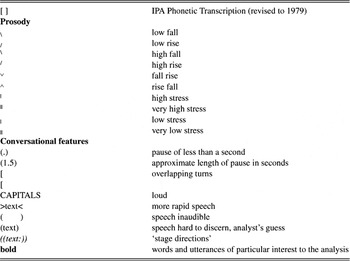
Transcription conventions