





Introduction
The twenty-first century is marked by rapid technological expansion alongside escalating environmental pressures. While frameworks such as Society 5.0 promote the integration of advanced technologies within human-centred systems, including education (McDiarmid & Zhao, Reference McDiarmid and Zhao2023), technological progress alone cannot ensure societal resilience. In this context, education plays a crucial role in cultivating scientific literacy (Bhoi & Binjha, Reference Bhoi and Binjha2025) and sustainability awareness (Kaur & Kaur, Reference Kaur and Kaur2022). These competencies enable individuals to evaluate environmental challenges critically, interpret scientific information and make informed decisions regarding sustainable development. Strengthening these competencies is therefore essential not only for navigating technological transformation but also for fostering a more equitable and sustainable society.
Nevertheless, technological advancement continues to intensify environmental degradation through increasing electronic waste, carbon emissions, resource extraction and related ecological disruptions (Iqbal et al., Reference Iqbal, Dagwar and Dutta2026). These challenges highlight the urgent need for educational approaches capable of equipping learners with both conceptual understanding of sustainability issues and the dispositions required for responsible environmental action. Education for Sustainable Development (ESD), promoted by UNESCO, provides a comprehensive framework for addressing these demands (Olsson et al., Reference Olsson, Gericke, Sass and Boeve-de Pauw2020). By integrating social, economic and environmental dimensions into science education, ESD has demonstrated effectiveness in enhancing students’ sustainability awareness (Kaur & Kaur, Reference Kaur and Kaur2022; Zowada et al., Reference Zowada, Belova and Eilks2021) while also deepening their understanding of scientific concepts (Kemper, Reference Kemper2021).
Despite its recognized potential, implementing ESD in classroom practice remains challenging. Many educators have limited understanding of sustainability concepts and insufficient training or instructional resources to integrate sustainability into science teaching (Cordaro et al., Reference Cordaro, Murphy and Redman2025; Faisal et al., Reference Faisal, Arifin and Martin2025). A preliminary needs analysis in this study further revealed that Grade 9 Indonesian science materials emphasize conceptual knowledge while providing limited opportunities to engage with sustainability issues, real-world contexts, project-based learning and authentic assessment. Consequently, students have fewer opportunities to apply scientific knowledge to environmental challenges and develop competencies aligned with the Sustainable Development Goals (SDGs). This limitation is particularly concerning given Indonesia’s consistently low scientific literacy performance in PISA (OECD, 2023), underscoring the need to strengthen both scientific literacy and sustainability awareness for informed environmental decision-making (OECD, 2023; UNESCO, 2020).
Scientific literacy, the ability to apply knowledge, ask critical questions and draw evidence-based conclusions about natural phenomena and environmental changes (OECD, 2023), is essential for addressing sustainability challenges. The PISA 2025 framework (OECD, 2023) frames it across context, competencies, knowledge and science identity, including environmental awareness and agency. Yet students often struggle with complex, abstract environmental concepts (Aksela, Reference Aksela2025). Complementing this, sustainability awareness reflects sensitivity, values and concern toward environmental issues, promoting pro-environmental behaviours (Fang et al., Reference Fang, Hassan and LePage2022). Developing both competencies together is crucial, as scientific literacy fosters understanding while sustainability awareness drives responsible engagement.
A key limitation in developing scientific literacy and sustainability awareness is the reliance on conventional science textbooks, which primarily emphasize factual knowledge and concept mastery with limited opportunities for contextual problem solving, inquiry and engagement with sustainability issues (Hogan & O’Flaherty, Reference Hogan and O’Flaherty2022; Huang et al., Reference Huang, Chen and Lai2024; Zidny et al., Reference Zidny, Sjöström and Eilks2021). Consequently, these materials provide insufficient opportunities for students to apply scientific knowledge to sustainability challenges or develop the critical thinking, decision-making and sustainability awareness needed for informed action (OECD, 2023; UNESCO, 2020).
Integrating digital technology, such as interactive e-books, offers opportunities to enhance learning through multimedia, navigation tools, embedded assessments and contextual problem scenarios that connect scientific concepts with real-world issues (Chen et al., Reference Chen, Chai and Lin2025). Although ESD-based approaches such as flipped classrooms have demonstrated positive outcomes (Howell, Reference Howell2021), studies on interactive science e-books have primarily focused on learning engagement or conceptual understanding rather than integrating ESD principles to simultaneously promote scientific literacy and sustainability awareness. Consequently, empirical evidence on interactive e-books as comprehensive ESD learning environments remains limited, particularly in secondary science education (Aksela, Reference Aksela2025; Mylonas et al., Reference Mylonas, Hofstaetter, Giannakos, Friedl and Koulouris2023).
Unlike previous studies that focused primarily on environmental knowledge or student engagement, this study develops an ESD-based interactive science e-book that integrates multimedia learning, contextual sustainability issues, formative assessment and project-based activities within a single instructional environment. It also simultaneously examines the effects on both scientific literacy and sustainability awareness, providing evidence for two complementary competencies essential for sustainable development. This study aims to address these gaps by developing and evaluating an interactive science e-book designed according to ESD principles and digital learning design features. The ESD for 2030 framework (UNESCO, 2020) identifies four key principles that guide effective ESD implementation: (1) learning content that incorporates sustainability issues aligned with the SDGs, particularly environmental issues; (2) pedagogy and learning environments that employ interactive, project-based and learner-centred approaches to actively engage students with sustainability concepts; (3) learning outcomes that empower learners to take responsibility for present and future generations; and (4) societal transformation that contributes to achieving the SDGs and building a more sustainable world.
Within this framework, the interactive e-book functions as a technology-enhanced learning environment that integrates multimedia explanations, contextual sustainability problems, embedded learning activities and formative assessments with feedback. The e-book is specifically designed to enhance scientific literacy across its three domains (context, competencies and knowledge) and to support the development of sustainability awareness across its three dimensions (practice, behavioural and attitude and emotional awareness). Particular emphasis is placed on strengthening sustainability awareness through embedded project-based activities and real-world problem scenarios that encourage students to connect scientific concepts with sustainability challenges. By examining the effectiveness of this interactive digital learning resource, the study seeks to provide empirical evidence and design insights for the development of technology-supported learning environments that promote sustainability-oriented science education.
Literature review
The application of interactive e-books in science education
Interactive e-books combine traditional text with multimodal features such as audio, animation, video, narration, embedded quizzes, simulations, real-time feedback and nonlinear navigation, transforming passive reading into active learning (Shemy, Reference Shemy2022). Empirical studies report improved posttest achievement, enhanced performance and motivation through gamification in natural sciences (Benavides-Velasco, Reference Benavides-Velasco2023) and support for personalized, affective and collaborative engagement (Mifsud et al., Reference Mifsud, Georgieva and Kucirkova2021). Effective implementation requires curricular alignment, age-appropriate language, structured progression and integrated assessment (Huang et al., Reference Huang, Chen and Lai2024), although challenges include development time, content updating and visual fatigue (Vackova et al., Reference Vackova, Cermakova and Kucirkova2023). In environmental science education, interactive e-books strengthen conceptual understanding, causal reasoning, solution-oriented thinking and emotional engagement with ecological issues, thereby influencing sustainability attitudes and behaviours (Chen et al., Reference Chen, Chai and Lin2025), yet their systematic integration with sustainability-oriented learning remains underexplored (Zowada et al., Reference Zowada, Belova and Eilks2021).
ESD: concepts and educational goals
ESD launched by the United Nations in 2005, promotes sustainable thinking, values and behaviours by integrating environmental, social and economic dimensions (Zowada et al., Reference Zowada, Belova and Eilks2021). It develops learners’ capacity to identify and mitigate threats to ecosystems and human well-being (Zidny et al., Reference Zidny, Sjöström and Eilks2021) and supports SDG 4 by fostering cognitive, socio-emotional and behavioural competencies (Rieckmann, Reference Rieckmann2017). ESD emphasizes knowledge, skills, values and attitudes for long-term sustainability, including well-being, social justice, cultural diversity, human development and planetary health (Mulà & Tilbury, Reference Mulà and Tilbury2025), while in Indonesia, it also addresses equitable economic resilience and environmental preservation (Zidny et al., Reference Zidny, Sjöström and Eilks2021). Despite its significance, classroom implementation is challenging, highlighting the need for innovative science learning resources that integrate ESD principles (UNESCO, 2020).
Scientific literacy is an essential student competency
Scientific literacy refers to the ability to understand and apply scientific knowledge to meet societal needs (Rudolph, Reference Rudolph2024) and is defined by OECD (2023) as the capacity to use scientific knowledge to pose questions and draw evidence-based conclusions about natural systems and human impacts. In PISA 2025, scientific literacy is structured into four interrelated domains – context, competence, knowledge and science identity – designed to prepare students to address environmental challenges and advance sustainability.
The context domain encompasses personal, local/national and global applications of science, including health, natural resources, environmental change, climate issues, hazards and technology; the competence domain involves explaining phenomena, designing and evaluating investigations and interpreting evidence for informed decision-making (Aksela, Reference Aksela2025); the knowledge domain integrates content (physics, chemistry, biology, earth sciences), procedural (methods of inquiry) and epistemic knowledge (validation and construction of knowledge), with earth sciences and biology underpinning ecological understanding; and the science identity domain promotes engagement through science capital, self-recognition, appreciation, environmental awareness and empowerment, explicitly linking scientific literacy to sustainability (OECD, 2023).
Sustainability awareness: from concept to practice
Sustainability awareness reflects environmental consciousness, encompassing attitudes and behaviours that value preservation while considering social, economic and ecological impacts (Fang et al., Reference Fang, Hassan and LePage2022; Kaur & Kaur, Reference Kaur and Kaur2022). Both knowledge and awareness of appropriate actions are essential for developing this consciousness (Olsson et al., Reference Olsson, Gericke, Sass and Boeve-de Pauw2020). Education fosters sustainability awareness, which is critical for shaping attitudes and behaviours toward environmental protection (Rieckmann, Reference Rieckmann2017). However, students often lack sufficient awareness due to limited understanding of their surroundings, highlighting the need to strengthen scientific reasoning (Faisal et al., Reference Faisal, Arifin and Martin2025). Institutions can support sustainability education by aligning vision, policies and curricula. This study uses an interactive e-book to enhance engagement and embed sustainability concepts across three dimensions: emotional awareness (concern for environmental issues), behavioural and attitude awareness (understanding sustainable actions) and practice awareness (readiness to act sustainably) (Hassan et al., Reference Hassan, Noordin and Sulaiman2010). Through reflection activities, environmental messages and ESD-based worksheets, students critically analyse problems, consider solutions and strengthen both sustainability awareness and scientific understanding of environmental issues.
Research purpose
This study aimed to develop and evaluate an ESD-based interactive science e-book to enhance ninth-grade students’ scientific literacy and sustainability awareness. It examined the e-book’s effectiveness compared to conventional materials and explored users’ perceptions of the resource. Specifically, this study aims to answer the following research questions:
-
1. How effective is the ESD-based interactive science e-book in improving students’ scientific literacy?
-
2. How effective is the ESD-based interactive science e-book in improving students’ sustainability awareness?
-
3. How do students and teachers perceive the use of the ESD-based interactive science e-book in learning environmental issues?
Methods
This study employed a Design-Based Research (DBR) approach, integrating quantitative and qualitative methods in the evaluation phase of an iterative design cycle (Plomp & Nieveen, Reference Plomp and Nieveen2013; Van den Akker et al., Reference Van den Akker, Gravemeijer, McKenney and Nieveen2006). To examine the effectiveness of an ESD-based interactive science e-book, a one-group pre-test–post-test design was used during the DBR evaluation phase. Students engaged in learning activities using the interactive e-book, and quantitative data were collected to measure changes in scientific literacy (PISA 2025 framework) and sustainability awareness.
To complement the quantitative findings, qualitative data from classroom observations, student discussions, interviews and reflective reports captured learning processes, engagement and students’ responses to the intervention. Data integration occurred in the reflection stage of the DBR cycle, where quantitative results indicated learning gains, while qualitative evidence explained how the interactive e-book supported scientific literacy and sustainability awareness. These integrated findings informed iterative refinements of the e-book and empirically grounded design principles.
Participants
Twenty-eight ninth-grade students (aged 14–15 years) from a single class at a junior high school in Sumedang City were recruited through purposive sampling to participate in this study, which was conducted from September to October 2025. The school was selected for its collaboration with the local education office and nearby universities to support curriculum development. Participants voluntarily joined the study and met the inclusion criteria of having no prior ESD-oriented instruction on environmental issues and no previous experience using interactive e-books in science learning. All participants received the same instructional intervention using the ESD-integrated interactive science e-book (Creswell & Clark, Reference Creswell and Clark2018). Table 1 summarizes the demographic characteristics of the participants included in the study.
Demographic information of participants

Table 1. Long description
A table titled ‘Demographic information of participants’ with two rows and three columns. The table summarizes the demographic characteristics of 28 ninth-grade students. The columns are labeled ‘Item’, ‘Type’, ‘Number (N = 28)’, and ‘Percentage’. The rows are labeled ‘Gender’ and ‘Age’. Under ‘Gender’, there are two types: Female and Male. There are 15 females, which is 54 percent, and 13 males, which is 46 percent. Under ‘Age’, there are two types: 14 years old and 15 years old. There are 18 students who are 14 years old, which is 64 percent, and 10 students who are 15 years old, which is 36 percent.
Procedures
The research procedure followed four stages of the DBR model: (1) preliminary, involving needs analysis and material development; (2) preparation, including teacher preparation and resource organization; (3) implementation, consisting of the instructional intervention and data collection; and (4) evaluation, involving post-test analysis and interpretation. Figure 1 illustrates the overall research procedure.
Steps of research procedures.

In the preliminary stage, an interactive science e-book based on ESD was developed using the Four Steps Teaching Material Development (4STMD) method, along with scientific literacy tests and sustainability awareness questionnaires. The preparation stage involved organizing resources, consulting with collaborating teachers and conducting training sessions for the implementing teacher to ensure the feasibility of classroom implementation. During the implementation stage, pre-tests measuring scientific literacy and sustainability awareness were administered, followed by the instructional intervention, reflection activities and data collection. In the final stage, post-test data were collected and analysed to measure students’ scientific literacy and sustainability awareness after learning with the e-book.
Instruments
Two quantitative instruments were used: (1) a scientific literacy test adapted from the PISA 2025 framework (OECD, 2023) and (2) a sustainability awareness questionnaire adapted from Hassan et al. (Reference Hassan, Noordin and Sulaiman2010). Both instruments underwent content validation by five experts, who evaluated their relevance, clarity and alignment with the study objectives. Based on the experts’ feedback, minor revisions were made before the instruments were pilot-tested with 48 tenth-grade students. The finalized instruments were then administered as pre-tests and post-tests to the 28 study participants.
Qualitative data were collected through semi-structured interviews with twelve science teachers, including the implementing teacher and five other teachers from Indonesia, as well as six international teachers from Taiwan, Vietnam and Thailand who evaluated the e-book’s pedagogical quality and ESD integration. Additional data was obtained from interviews with five students, learning response questionnaires and classroom observation.
Scientific literacy test
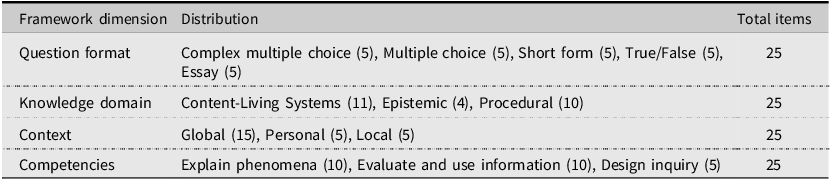
The scientific literacy test was initially developed with 35 items. Item quality was evaluated using MNSQ (Mean Square, ideal value = 1.0), which reflects the match between observed and model-predicted responses, and ZSTD (Standardized Z, ideal value = 0), which tests whether an item’s misfit is statistically significant. An item was considered fit if it met both MNSQ (0.5–1.5) and ZSTD (−2.0 to +2.0) criteria (Sumintono & Widhiarso, Reference Sumintono and Widhiarso2015). Rasch analysis using MINISTEP v.5.8.2 showed high reliability (Cronbach’s α = 0.76, person reliability = 0.74, item reliability = 0.80); 16 items met both criteria and six met one criterion but were retained after expert review, yielding a final 25-item instrument. Content validity index (CVI) (Lawshe, Reference Lawshe1975) was 1.0 (13 easy, 12 difficult items; 15 items with good to very good discriminating power). Table 2 summarizes the distribution of the final scientific literacy test items.
Distribution of scientific literacy test items

Table 2. Long description
A table with four rows and three columns detailing the distribution of scientific literacy test items. The columns are labeled Framework dimension, Distribution, and Total items. The rows are labeled Question format, Knowledge domain, Context, and Competencies. Each row lists specific categories and their respective distributions. For Question format, the categories are Complex multiple choice (5), Multiple choice (5), Short form (5), True/False (5), and Essay (5), totaling 25 items. For Knowledge domain, the categories are Content-Living Systems (11), Epistemic (4), and Procedural (10), totaling 25 items. For Context, the categories are Global (15), Personal (5), and Local (5), totaling 25 items. For Competencies, the categories are Explain phenomena (10), Evaluate and use information (10), and Design inquiry (5), totaling 25 items.
Sustainability awareness questionnaire
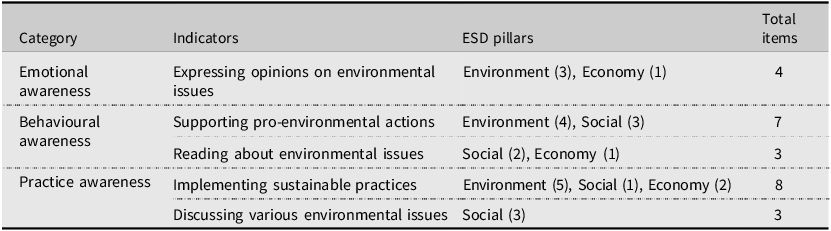
The sustainability awareness questionnaire was initially developed with 35 items, using the same MNSQ and ZSTD criteria (0.5–1.5 and −2.0 to +2.0, respectively). Rasch analysis showed high reliability (Cronbach’s α = 0.80, person reliability = 0.76, item reliability = 0.84); 15 items met both criteria and 10 met one criterion but were retained after expert revision, yielding a final 25-item instrument. CVI was 1.0 (9 easy, 16 difficult items; 16 items very good and 9 good in discriminating power). Table 3 presents the distribution of items.
Distribution of sustainability awareness questionnaire items

Table 3. Long description
A table categorizing sustainability awareness questionnaire items by indicators, ESD pillars, and total items. The table has four rows and four columns. Column headers are Category, Indicators, ESD pillars, and Total items. Row 1: Category, Emotional awareness; Indicators, Expressing opinions on environmental issues; ESD pillars, Environment (3), Economy (1); Total items, 4. Row 2: Category, Behavioural awareness; Indicators, Supporting pro-environmental actions; ESD pillars, Environment (4), Social (3); Total items, 7. Row 3: Category, Behavioural awareness; Indicators, Reading about environmental issues; ESD pillars, Social (2), Economy (1); Total items, 3. Row 4: Category, Practice awareness; Indicators, Implementing sustainable practices; ESD pillars, Environment (5), Social (1), Economy (2); Total items, 8. Row 5: Category, Practice awareness; Indicators, Discussing various environmental issues; ESD pillars, Social (3); Total items, 3.
Both instruments were refined based on expert feedback, addressing language clarity, response format and alignment with students’ developmental levels, before implementation in the main study.
Data analysis
Quantitative analysis
Data were analysed using IBM SPSS Statistics (Version 29). Descriptive statistics were calculated to summarize participants’ performance. Data normality was assessed using the Shapiro–Wilk test. When the normality assumption was met (p > 0.05), paired-samples t-tests were conducted to compare pre-test and post-test scores. When normality was violated (p < 0.05), the Wilcoxon signed-rank test was employed. Statistical significance was established at α = 0.05. Effect sizes were calculated using Cohen’s d and interpreted as small (0.20), medium (0.50) and large (0.80) (Lalongo, Reference Lalongo2016). Learning improvement was further examined using normalized gain (N-gain) scores, categorized as low (<0.30), moderate (0.30–0.69) and high (≥0.70) according to Hake (Reference Hake1998).
Qualitative analysis
Qualitative data was collected through classroom observations, teacher and student interviews and student response questionnaires. A hybrid deductive–inductive content analysis was employed to generate and refine codes into themes aligned with the research objectives (Tie et al., Reference Tie, Birks and Francis2019). Trustworthiness was ensured through constant comparison and member checking (MacLeod, Reference MacLeod2024).
Results
Interactive science e-book based on ESD
This section describes the implementation of an ESD-based interactive science e-book developed to support the learning of environmental issues and scientific literacy. The e-book integrates ESD principles through contextual content, interactive features and multimedia elements designed to engage learners in understanding environmental problems from scientific, social and sustainability perspectives, as illustrated in Figures 2 to 8.
The structure of the interactive science e-book based on ESD.

ESD-based worksheets supporting systematic analysis of environmental issues.

Interactive assessment and reflection features in the ESD-based e-book.

Figure 4. Long description
The collage consists of four separate elements: one diagram, one illustration, one questionnaire, and one crossword puzzle. The first element is a diagram titled ‘Scientific Literacy Test’ which includes text and illustrations about ecosystem imbalance due to water contamination. The second element is an illustration with a pro-environmental message encouraging responsible actions toward environmental protection. The third element is a sustainability awareness questionnaire designed to capture responses related to environmental attitudes and daily practices. The fourth element is a crossword puzzle related to water pollution issues, applied to reinforce key concepts through interactive learning activities.
Interactive content features for enhancing environmental understanding and scientific analysis.

Structural organization and conceptual mapping features.

Figure 6. Long description
Panel A: A section titled ‘Summary’ with a list of key points about environmental issues. The summary includes points on environmental pollution, its types, and impacts on ecosystems and human health. Panel B: A section titled ‘Glossary’ with definitions of terms related to environmental science. Terms include ‘Albinism,’ ‘Biodegradation,’ ‘Eutrophication,’ and ‘Eutrophic.’ Panel C: A section titled ‘Concept Map’ showing a visual representation of relationships among environmental concepts. The concept map includes various interconnected nodes representing different environmental topics.
The pages in interactive science E-book and the “pop-out” screen showing the animation video and scientific literacy test.

Direct assessment feedback in the interactive science e-book.

Effectiveness analysis of scientific literacy scores
To evaluate changes in students’ scientific literacy following the intervention, pre-test–post-test scores were compared using paired-samples t-tests after the normality assumption was confirmed (see Methods). Scientific literacy was measured based on the PISA 2025 framework, covering the knowledge, competency and context dimensions.
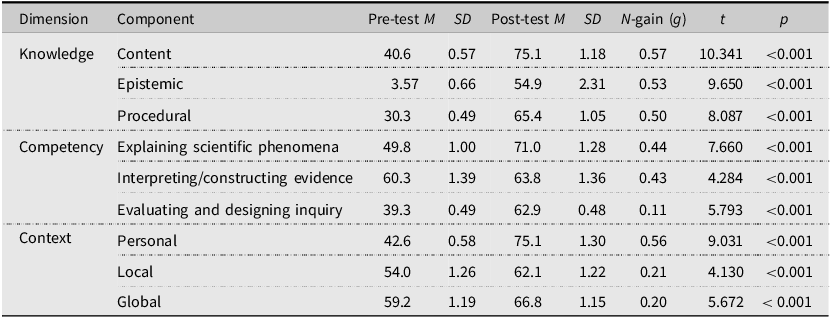
The analysis revealed a significant improvement in students’ scientific literacy, with mean scores increasing from 30.8 (SD = 10.1) on the pre-test to 67.5 (SD = 13.7) on the post-test, t(27) = 11.99, p < 0.001. The mean difference was 36.7, with a large effect size (d = 2.73), indicating a strong impact of the instructional intervention.
Learning effectiveness was further examined using N-gain, which yielded a value of 0.52 (moderate category). Score distributions also improved across all performance levels, with the minimum score increasing from 10 to 34 and the maximum score from 58 to 89, indicating benefits for both lower- and higher-achieving students. Table 4 presents the pre-test and post-test results for each scientific literacy dimension, including N-gain values and paired-samples t-test results.
Improvement of students’ scientific literacy across dimensions

Table 4. Long description
A table with four rows and three columns comparing pre-test and post-test results for scientific literacy dimensions. The table includes columns for pre-test mean, standard deviation, post-test mean, standard deviation, N-gain, t-value, and p-value. The dimensions include Knowledge with components Content, Epistemic, and Procedural; Competency with components Explaining scientific phenomena, Interpreting/constructing evidence, and Evaluating and designing inquiry; and Context with components Personal, Local, and Global. Each row provides specific values for these metrics.
As shown in Table 4, the implementation of the ESD-based interactive science e-book was associated with improvements in students’ scientific literacy. The largest gains were observed in the knowledge dimension, including content, epistemic and procedural knowledge. Moderate gains were observed in explaining scientific phenomena and interpreting/constructing evidence, whereas evaluating and designing inquiry showed a smaller gain. In the context dimension, the largest improvement occurred in the personal context, while smaller gains were observed in the local and global contexts.
The pattern of findings was further supported by students’ and teachers’ qualitative responses. Students reported that contextual sustainability issues, multimedia features and formative activities helped them understand scientific concepts and relate them to real-world environmental problems. Teachers similarly indicated that the combination of scientific explanations, practical examples and sustainability-related contexts supported students’ conceptual understanding and application of scientific knowledge.
The smaller gains observed in evaluating and designing inquiry and in the local and global contexts were also reflected in the qualitative findings, which indicated that students benefited from the structured guidance and contextual activities provided by the e-book. However, the feedback also suggested that more extensive inquiry activities and broader sustainability contexts could provide additional opportunities for students to develop these aspects of scientific literacy.
Effectiveness and comparative analysis of sustainability awareness scores
This study investigated the effect of an ESD-based interactive science e-book on students’ sustainability awareness using a one-group pre-test–post-test design. Sustainability awareness was measured with a 25-item questionnaire adapted from Hassan et al. (Reference Hassan, Noordin and Sulaiman2010), encompassing emotional, behavioural–attitudinal and practice dimensions aligned with the environmental, social and economic pillars of ESD. Data were normally distributed (Shapiro–Wilk, p > 0.05), permitting parametric analysis. A paired-samples t-test revealed a significant increase in scores from pre-test (M = 62.3, SD = 10.8) to post-test (M = 78.8, SD = 8.46), t(27) = −11.25, p < 0.001, with a large effect size (d = 1.73). The average N-gain was 0.46, indicating a moderate improvement in sustainability awareness. Further analysis of each sustainability awareness dimension is presented in Table 5.
Improvement of students’ sustainability awareness based on awareness indicators

Table 5. Long description
The table presents data on the effect of an ESD-based interactive science e-book on students’ sustainability awareness. It includes pre-test and post-test scores for three awareness indicators: emotional awareness, behavioural and attitude awareness, and practice awareness. The table has four rows and seven columns. The columns are labeled Indicator, Pre-test M, SD, Post-test M, SD, N-gain (g), t, and p. Each row provides the mean (M) and standard deviation (SD) for pre-test and post-test scores, along with N-gain, t-value, and p-value for each indicator. Row 1: Emotional awareness, Pre-test M 66.8, SD 0.92, Post-test M 80.4, SD 0.76, N-gain 0.35, t 5.11, p <0.001. Row 2: Behavioural and attitude awareness, Pre-test M 63.4, SD 0.89, Post-test M 79.6, SD 0.84, N-gain 0.44, t 11.07, p <0.001. Row 3: Practice awareness, Pre-test M 59.0, SD 0.88, Post-test M 77.1, SD 0.78, N-gain 0.44, t 10.42, p <0.001.
Table 5 shows significant improvements across all sustainability awareness indicators (p < 0.001). Emotional awareness increased moderately (g = 0.35), while behavioural–attitudinal and practice awareness showed the highest moderate gains (g = 0.44), indicating stronger sustainable intentions and action awareness. Further analysis by ESD pillars is presented in Table 6.
Improvement of students’ sustainability awareness based on ESD pillars

Table 6. Long description
A table comparing pre-test and post-test scores for students’ sustainability awareness across three ESD pillars: Environment, Social, and Economy. The table has four rows and seven columns. Column headers are ESD pillar, Pre-test M, SD, Post-test M, SD, N-gain (g), t, and p. Row labels are Environment, Social, and Economy. For Environment, pre-test M is 62.7, SD is 0.89, post-test M is 78.1, SD is 0.79, N-gain (g) is 12.05, t is 0.41, and p is <0.001. For Social, pre-test M is 58.8, SD is 0.83, post-test M is 76.8, SD is 0.87, N-gain (g) is 7.05, t is 0.42, and p is <0.001. For Economy, pre-test M is 64.7, SD is 0.95, post-test M is 81.5, SD is 0.78, N-gain (g) is 9.82, t is 0.47, and p is <0.001.
As shown in Table 6, statistically significant improvements were observed across all three ESD pillars (p < 0.001). The highest improvement was observed in the economic pillar (g = 0.47), followed by the social (g = 0.42) and environmental (g = 0.41) pillars. These findings demonstrate that the ESD-based interactive science e-book effectively supported students’ holistic understanding of sustainability across environmental, social and economic dimensions.
User evaluation: student responses and teacher feedback
Following validation and refinement by experts, the interactive science e-book based on ESD underwent effectiveness testing through feedback collection from students utilizing the resource and from teachers in Indonesian secondary education settings. The evaluation examined the e-book’s usability, acceptability and perceived effectiveness. The study involved 28 students from the experimental class and two secondary science educators from Indonesia, with data obtained through questionnaires and semi-structured interviews.
Student response analysis
Student responses to the interactive science E-book based on ESD were collected using a questionnaire consisting of 12 items covering four key aspects: (1) design and ease of use, (2) interactivity in content delivery, (3) motivation and attractiveness of learning and (4) effectiveness of teaching materials. Student responses indicated very positive perceptions of the ESD-based interactive science e-book, with high mean scores across design, interactivity, motivation and instructional effectiveness, all classified as very good.
Students perceived the ESD-based interactive science e-book as clear, relevant and well aligned with classroom topics. The material was easy to understand and helped connect scientific concepts to real-life environmental and sustainability issues. As one student noted, “this interactive science e-book based on ESD has been very helpful in understanding the material, and with its layout resembling a paper book, I feel more comfortable learning” (Student 1).
The use of simple and communicative language supported comprehension of complex concepts. Another student stated, “the interactive features, such as images, videos, and quizzes, make it easier for me to understand difficult concepts, making learning more enjoyable and less boring” (Student 3).
Students also highlighted the value of interactivity. Visual elements – images, animations, videos and simulations – helped them visualize abstract processes more effectively than text alone. As reflected by one comment, “this interactive science e-book is very engaging and educational, with content presented clearly and accompanied by images, videos, and simulations that help students understand the material” (Student 2).
The overall layout was described as attractive and comfortable to read, helping students stay focused while engaging with embedded sustainability themes. As one student reflected, “the material is aligned with the principles of ESD, allowing students to learn science while simultaneously understanding the importance of sustainable development” (Student 4).
Interactivity significantly enhanced motivation and engagement. Features such as quizzes and crossword activities encouraged active participation, making learning more varied and enjoyable. One student noted, “by using the interactive science e-book, we can better understand the lessons and make the learning process more varied and enjoyable, as interactive features like images, videos, and quizzes are very helpful in making the material easier to understand” (Student 5).
Some students also reported that interactivity supported independent learning and enhanced their motivation. One student suggested that “the e-book’s color scheme could be adjusted by using brighter and more appealing colors, such as pink or blue, to increase enthusiasm and create a more energizing impression when reading” (Student 6).
Regarding instructional effectiveness, students viewed the learning activities and exercises as relevant and supportive of their understanding of scientific concepts and sustainability issues. The feedback after completing exercises was seen as particularly helpful for reflection and preventing misconceptions. As one student stated, “I now understand what scientific literacy and sustainability awareness are, and by studying environmental issues through this e-book, I gained many insights and was able to grasp the material well” (Student 4).
Similarly, another student emphasized that the alignment with ESD principles allowed them to learn science while developing an understanding of sustainable development, stating that “the material presented is aligned with ESD principles, so we can study science while also understanding the importance of sustainable development” (Student 7).
Overall, students’ qualitative responses show that the ESD-based interactive science e-book was well received and effective as a learning resource. Its clear organization, user-friendly design and interactive features supported understanding and engagement. By aligning activities with ESD principles, the e-book also promoted scientific literacy and sustainability awareness, contributing to both instructional and sustainability-oriented learning outcomes.
Teacher evaluation analysis
Teacher evaluations were conducted to assess the quality and instructional value of the ESD-based interactive science e-book. Twelve secondary science teachers (six from Indonesia and six from Vietnam, Taiwan and Thailand) completed a 15-item questionnaire covering content quality, visual presentation, interactivity, evaluation features and instructional impact. Results showed consistently high mean scores across all aspects, with the e-book rated overall as very good for its strong content quality, effective interactivity and positive instructional impact.
Teachers perceived the e-book as relevant, interactive and well aligned with environmental issues encountered by junior high school students. The clear integration of ESD elements was considered supportive of scientific literacy development and contextual learning. One teacher stated, “the e-book that has been developed is very good, interactive, and relevant to the environmental issues faced by middle school students, and the elements of ESD are clearly conveyed through its content” (Teacher 1).
Another teacher emphasized the effectiveness of combining theoretical explanations with practical, contextual examples. This integration was seen as strengthening students’ conceptual understanding and application of scientific knowledge, as reflected in the statement that “this ESD-based e-book is effective in improving scientific literacy skills because it combines theory and practice very well and provides a real-world context that enriches students’ understanding of science topics” (Teacher 2).
From a media and visual design perspective, teachers highlighted the flipbook format as a key strength that enhanced engagement compared to traditional learning materials. One teacher noted that “using a flipbook format makes the material more dynamic and engaging, as the digital layout, page-flip effect, and interactive elements are more attractive than a static PDF or traditional textbook” (Teacher 3).
However, teachers also provided constructive feedback related to layout consistency and cognitive load. Although the design was considered appealing, further refinement was suggested to improve clarity and usability. One teacher commented that “using different page colors to distinguish elements such as concept maps, guiding questions, and tests could reduce students’ cognitive load and make the layout more consistent and clear” (Teacher 5).
In terms of learning engagement, teachers appreciated the guided structure of the e-book, which encouraged students to think critically and apply scientific reasoning. As one teacher explained, “the guided structure allows students to think beyond the topic and engage in evidence-based critical thinking using the scientific method” (Teacher 4).
Teachers also suggested future improvements by adding more interactive elements to further promote active and independent learning. One teacher emphasized that “adding features such as click-to-reveal elements, animations, or virtual experiment simulations would encourage students to learn more actively rather than reading passively” (Teacher 2).
Teachers perceived the evaluation and exercise components of the e-book as effective in supporting understanding and reducing misconceptions, particularly through immediate feedback on scientific literacy tasks. As one teacher noted, “receiving scores and feedback after answering science literacy questions is very beneficial because it helps students understand correct concepts and avoid misconceptions” (Teacher 1).
They also suggested enhancing the evaluation section by adding reflective and action-oriented activities to strengthen student agency and connect learning with real-world sustainability practices. One teacher proposed that “adding a student action and reflection section could better connect learning with real actions related to sustainability” (Teacher 2).
Teachers also perceived that the interactive science e-book positively influenced students’ learning, particularly in terms of enthusiasm and conceptual understanding. Integrating science content with sustainability themes helped students move beyond factual knowledge toward a more holistic understanding of the human–environment relationship. As one teacher stated, “this approach helps students see the bigger picture of how humans and nature are connected, rather than focusing only on scientific facts” (Teacher 1).
Increased student engagement was also observed during classroom implementation. The interactive format, combined with real-world examples and multimedia elements, made science learning more engaging and meaningful. One teacher noted that “this e-book significantly boosts students’ enthusiasm for learning science because it presents the material interactively and engagingly, supported by multimedia and practical applications” (Teacher 2).
Overall, teachers perceived the ESD-based interactive science e-book as an effective learning resource, highlighting its engaging design, contextual content, interactive features and positive contributions to students’ scientific literacy, motivation and sustainability awareness.
Discussion
Effects on scientific literacy
The results indicate that the ESD-based interactive science e-book was effective in improving students’ scientific literacy. Significant pre–post improvements were observed, accompanied by a large effect size, confirming the instructional value of integrating ESD principles into interactive digital learning environments. These findings align with previous studies in ESD-based science education, which report positive impacts on students’ scientific literacy development (Olsson et al., Reference Olsson, Gericke, Sass and Boeve-de Pauw2020). The e-book integrated contextual sustainability issues, multimedia resources, formative assessment and inquiry-based activities that encouraged students to apply scientific concepts to authentic environmental problems rather than simply acquiring factual knowledge. This finding is consistent with previous studies showing that interactive digital learning environments and active learning approaches promote deeper conceptual understanding and scientific reasoning (Chen et al., Reference Chen, Chai and Lin2025; Howell, Reference Howell2021).
Analysis across scientific literacy dimensions revealed improvements in all knowledge components, with strong gains in epistemic and procedural knowledge. These results suggest that the ESD-based e-book effectively supported students’ understanding of how scientific knowledge is generated, justified and applied. This finding reinforces scholarly arguments that epistemological engagement plays a central role in the development of scientific literacy (Aksela, Reference Aksela2025; Rudolph, Reference Rudolph2024).
In the competency and context dimensions, significant improvements were most evident in explaining scientific phenomena and personal context. This indicates that sustainability issues embedded within the e-book enhanced students’ ability to explain scientific phenomena and strengthened the personal relevance of science learning. In contrast, inquiry-related competencies, data construction skills and broader contextual understanding showed smaller improvements. This finding suggests that developing these competencies may require longer-term learning experiences, additional instructional scaffolding, or alternative instructional approaches, as reported in previous studies (Aksela, Reference Aksela2025; Hogan & O’Flaherty, Reference Hogan and O’Flaherty2022).
Effects on sustainability awareness
The intervention had a stronger impact on students’ sustainability awareness than on scientific literacy. Despite low baseline scores, students showed statistically significant post-intervention improvements with a large effect size, suggesting that sustainability awareness requires targeted pedagogy rather than incidental exposure in conventional science learning. The explicit integration of ESD principles within the interactive science e-book provided opportunities for students to reflect on sustainability issues and connect them with scientific concepts (Zowada et al., Reference Zowada, Belova and Eilks2021). Post-intervention improvements were observed across all sustainability indicators and all ESD pillars, demonstrating that the e-book supported integrated sustainability learning. Stronger gains in the economic pillar highlight the potential of embedding sustainability issues in science instruction to broaden students’ perspectives beyond environmental concerns. By situating sustainability challenges in interdisciplinary, real-world contexts, the e-book fostered a holistic understanding of sustainable development, often underemphasized in conventional science education (Fang et al., Reference Fang, Hassan and LePage2022; Kaur & Kaur, Reference Kaur and Kaur2022).
Learning engagement and user acceptance
Qualitative observations showed increased classroom engagement after the implementation of the ESD-based interactive science e-book. Students demonstrated higher motivation, more active participation and deeper engagement with real-world environmental issues through project-based and inquiry-oriented activities, supporting findings from previous studies on sustainability-oriented learning (Chen et al., Reference Chen, Chai and Lin2025; Shemy, Reference Shemy2022).
Student evaluations indicated very high acceptance of the e-book, particularly in terms of interactivity, motivation and learning effectiveness. Multimedia features such as videos, animations and interactive exercises were perceived as helpful for understanding and maintaining engagement, consistent with prior research on interactive digital learning tools (Mifsud et al., Reference Mifsud, Georgieva and Kucirkova2021).
Teacher feedback indicated positive perceptions of the e-book’s pedagogical value, particularly its integration of scientific content and sustainability principles. Teachers also considered the e-book to have the potential to support classroom discussions and connect scientific concepts with real-life sustainability issues. Overall, these findings suggest that the ESD-based interactive science e-book is an effective approach for promoting scientific literacy and sustainability awareness in secondary science education (Zidny et al., Reference Zidny, Sjöström and Eilks2021; Zowada et al., Reference Zowada, Belova and Eilks2021).
Conclusion and implications
This study examined the effectiveness of an ESD-integrated interactive digital science e-book in enhancing ninth-grade students’ scientific literacy and sustainability awareness, demonstrating moderate to large gains in epistemic and procedural knowledge, explanatory competence and application of scientific understanding across personal, local and global contexts. The findings indicate that sustainability awareness does not develop automatically through environmental content alone but requires explicit integration of ESD principles within interactive digital learning environments. By embedding inquiry-based activities, real-world environmental problems and project-based tasks, the e-book connected scientific concepts with environmental, social and economic dimensions of sustainability, fostering critical and contextualized understanding (Chen et al., Reference Chen, Chai and Lin2025; Hogan & O’Flaherty, Reference Hogan and O’Flaherty2022). The results highlight the role of ESD-integrated interactive digital resources in aligning technology, pedagogy and content to support students’ scientific literacy and sustainability awareness (Zidny et al., Reference Zidny, Sjöström and Eilks2021; Zowada et al., Reference Zowada, Belova and Eilks2021). Limitations include the short intervention period, the single-school sample, the inability to isolate the effects of digital features from ESD integration and teacher feedback that was not limited to classroom implementers. Future research should employ longitudinal designs, broader implementation and larger samples of teachers who actively use the e-book in classroom practice.
Supplementary material
The supplementary material for this article can be found at https://doi.org/10.1017/aee.2026.10211.
Acknowledgements
We gratefully acknowledge the participating school, teachers and students for their participation and support in this study.
Financial support
This research received no specific grant from any funding agency, commercial, or not-for-profit sectors.
Ethical statement
This study was approved by the Graduate Institute of Science Education, National Taiwan Normal University (NTNU), and conducted with permission from the participating school. Permission to conduct the study was also obtained from the participating teachers.
Author Biographies
Rizky Agassy Sihombing is a PhD student in the Graduate Institute of Science Education at National Taiwan Normal University. His research interests include science education, Education for Sustainable Development (ESD), scientific literacy, sustainability awareness and technology-enhanced learning. His current research focuses on developing and evaluating innovative instructional approaches and digital learning media to promote students’ scientific literacy, sustainability competencies and environmental awareness.
Shiang-Yao Liu is a professor in the Graduate Institute of Science Education at National Taiwan Normal University. She obtained her PhD degree in science education from Oregon State University, USA. Her long-standing research interests have focused on integrating socioscientific and environmental issues in science curricula and designing teaching activities to improve students’ scientific literacy.
Muslim Muslim is an associate professor in the Department of Physics Education, Faculty of Mathematics and Natural Sciences Education, Universitas Pendidikan Indonesia, Indonesia. He received his PhD degree in science education from Universitas Pendidikan Indonesia, Indonesia. His research interests include physics education, scientific argumentation, educational assessment, science learning models, critical thinking, scientific reasoning and the development of physics learning and assessment instruments.
Noviansyah Kusmahardhika is a PhD student in the Graduate Institute of Science Education at National Taiwan Normal University and a lecturer in the Department of Biology at Universitas Negeri Malang. His research interests include STEM education, technology-enhanced learning, ethnopedagogy, literacy and socioscientific issues (SSIs).








 Open access

