Introduction
Caregiver burden will become a public health issue given the anticipated rise in the dementia population, with Alzheimer's disease being the most prevalent condition (Alzheimer's Disease International, 2013; Cheng et al., Reference Cheng, Chou and Zarit2013). The Zarit Burden Inventory (ZBI; Zarit et al., Reference Zarit, Reever and Bach-Peterson1980) is probably the most widely adopted instrument for measuring caregiver burden, whether in surveys (e.g. Lin et al., Reference Lin, Tsai, Wang, Hwang and Fuh2012; Werner et al., Reference Werner, Mittelman, Goldstein and Heinik2012; Hayashi et al., Reference Hayashi2013) or as an outcome measure in intervention studies (e.g. Cheng et al., in press; Gaugler et al., Reference Gaugler, Reese and Mittelman2013; Rodriguez-Sanchez et al., Reference Rodriguez-Sanchez2013). While it is most often used as a global measure, researchers have attempted to discover distinguishable dimensions within the scale in order to provide more differentiated information about the impact of caregiving. Differentiating the dimensions may also be useful for intervention research as interventions may not have the same effects across the different dimensions of burden. To do so, researchers have used either exploratory or confirmatory factor analysis to examine the factor structure (a.k.a. measurement model) of the items. However, substantial variations in the factor structure have been found. To date, solutions of 2–5 factors have been reported and not all solutions included the whole scale.
Whitlatch et al., (Reference Whitlatch, Zarit and von Eye1991) were probably the first to examine the dimensions of the ZBI as outcomes in caregiver interventions. Using exploratory factor analysis (EFA), they found two factors, namely Personal Strain (items 1, 4, 5, 8, 9, 14, 16–21) and Role Strain (items 2, 3, 6, 11–13; see Table 3 for item content), which were equally responsive to individual and family counseling as compared with waitlist control, in a sample of 113 US dementia caregivers. Four items were dropped by Whitlatch and colleagues; the last item, itself a measure of global burden, was probably dropped due to simultaneous loading on the two factors (Knight et al., Reference Knight, Fox and Chou2000).
Subsequent efforts, however, have failed to replicate this 2-factor structure. Using confirmatory factor analysis (CFA), Knight et al. (Reference Knight, Fox and Chou2000) found that the Whitlatch model did not fit their data well in another US caregiver sample (n = 220). Instead, they discovered, using EFA, a 3-factor structure consisting of 14 items, namely Patient Dependency (items 2, 8, 14), Embarrassment and Anger (items 4–6, 9–13, 18), and Self-criticism (items 20, 21). CFA showed that this 3-factor structure fit the data moderately well (comparative fit index [CFI] = 0.90, root-mean-square error of approximation [RMSEA] = 0.06) in independent samples of Black (n = 175) and White (n = 225) caregivers in the United States, with factor loadings and factor covariances being invariant (i.e. equivalent) between the two ethnic groups (Longmire and Knight, Reference Longmire and Knight2011).
In a recent study of 206 US caregivers using EFA, Springate and Tremont (Reference Springate and Tremont2014) found five factors with eigenvalues > 1. However, the authors retained only the first three factors because the fourth factor contained just one item and the fifth factor consisted of items conceptually unrelated. The three factors retained were: Impact on Caregiver's Life (items 2, 3, 6, 9–12, 17, 18, 22), Guilt (items 5, 19–21), and Frustration and Embarrassment (items 1, 4, 13, 14). Altogether, 18 items were retained in this final solution, including the last item (number 22) measuring global burden. EFA in a French sample (n = 152) by Ankri et al. (Reference Ankri, Andrieu, Beaufils, Grand and Henrard2005), again including the last global item, also found five factors but the last two factors were dropped for similar reasons. In this study, factor 1 measured Social Impact (items 6, 10–13, 17), factor 2 Psychological Burden (items 4, 5, 9, 18, 19, 22), and factor 3 Guilt (items 15, 16, 20, 21), retaining altogether 16 of the 22 items.
Similar factor analytic analyses have also been conducted in Asian populations. Cheah et al. (Reference Cheah, Han, Chong, Anthony and Lim2012) performed EFA on the full ZBI in a multiethnic Singaporean caregiver sample (n = 130). They found four factors, namely Demands of Care and Social Impact (items 1–4, 7, 8, 11, 12, 14), Loss of Confidence/Control (items 13, 15–18), Psychological Impact (items 5, 6, 9, 10, 19, 22), and Worry about Performance (items 20, 21; same as Knight's Self-criticism factor). Finally, a study of 523 Mainland Chinese caregivers by Lu et al. (Reference Lu, Wang, Yang and Feng2009) found a 5-factor structure, while item 22 was omitted. The largest factor was labeled as Sacrifice (items 3, 7, 8, 10–14) to refer to the cultural value emphasizing one's obligations for family members, but was similar to Whitlatch's role strain factor and the factors framed in terms of daily/social impact in other studies reviewed above. The other factors were Loss of Control (items 15–17, 19), Embarrassment and Anger (items 4–6, 9), Self-criticism (items 20, 21), and Patient Dependency (items 1, 2, 18).
Such variations in factor structure from sample to sample are worrying. The differences in the cultural backgrounds of the samples might have contributed somewhat to this situation, but similar samples from within United States appeared to have caused similar confusions. Another reason was that some of the samples were relatively small, including the one used by Whitlatch et al. (Reference Whitlatch, Zarit and von Eye1991), thus yielding unreliable results. Moreover, an important point to note is that researchers should test whether an existing factor model fit the data before embarking to do another factor analysis. EFA is known as a “garbage in, garbage out” procedure, capturing easily on chance correlations. Thus, finding different results based on another EFA alone is not sufficient justification to establish a new factor model. To date, only Knight and colleagues had performed this check using CFA, before proposing a new factor model. In the present study, we examined whether the factor models reviewed above fit the data in a sample of Hong Kong Alzheimer caregivers, and if not, what an alternative model might be.
Methods
Participants and procedure
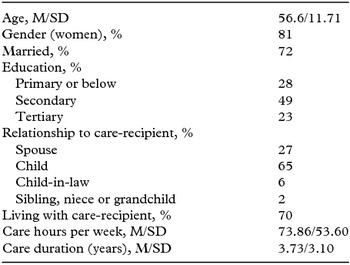
Data were merged from one survey study (Cheng et al., Reference Cheng, Lam and Kwok2013a) and an ongoing trial (baseline measures only; Cheng et al., Reference Cheng, Kwok and Lam2012) of Alzheimer caregivers in Hong Kong. All were caring for someone who had a physician diagnosis of Alzheimer's disease or who met the National Institute of Neurological and Communicative Disorders and Stroke–Alzheimer's Disease and Related Disorders Association criteria for possible Alzheimer's disease (McKhann et al., Reference McKhann, Drachman, Folstein, Katzman, Price and Stadlan1984). Participants were recruited from outpatient and memory clinics, day hospitals, and various nongovernmental organizations. Caregivers provided informed consent to participate. Interviews took place at home or in a private area in clinics/centers. More details about the sample are displayed in Table 1. The survey study and the clinical trial, from which data for this study were obtained, were both approved by the Joint Chinese University of Hong Kong-New Territories East Cluster Clinical Research Ethics Committee and the Central Research Committee of the Hong Kong Institute of Education.
Sample characteristics (N = 395)

Measures
Besides the Zarit Burden Interview (rated on a 5-point scale from 0 = not at all to 4 = extremely; α = 0.88), caregivers responded to (a) Pearlin and colleagues’ 4-item measure of role overload, rated on a 4-point scale from 1 = not at all to 4 = completely (α = 0.80; Pearlin et al., Reference Pearlin, Mullan, Semple and Skaff1990); (b) the Hamilton Depression Rating Scale (α = 0.80; Hamilton, Reference Hamilton1960); (c) self-rated health, being the sum of two items (rating one's health directly and against age- and sex-peers from 1 = very poor to 5 = excellent; α = 0.75); (d) a 4-item measure of satisfaction with social support (Cheng et al., Reference Cheng, Lam, Kwok, Ng and Fung2013b) in terms of comforting and affection, companionship, practical assistance, and advice on caregiving (rated from 1 = very dissatisfied to 6 = very satisfied; α = 0.88); and (e) the Revised Scale for Caregiving Self-Efficacy (Steffen et al., Reference Steffen, McKibbin, Zeiss, Gallagher-Thompson and Bandura2002), with three items each measuring confidence in obtaining respite (α = 0.95), managing disruptive behaviors (α = 0.87), and controlling upsetting thoughts (α = 0.77) on a scale of 0 = cannot do at all to 100 = certain can do. In addition, we constructed measures (five items each) of affection (rated on a 6-point scale from 1 = not at all to 6 = extremely; α = 0.82) and obligation (rated from 1 = strongly disagree to 5 = strongly agree; α = 0.70), by referring to similar measures in the literature (Cicirelli, Reference Cicirelli1993; Cicirelli, Reference Cicirelli2006). Sample items are “How much do you understand (your relative)?” and “Taking into account all factors, how close you are to (your relative)?” for affection, and “I should try my best to help (my relative)” and “If I did not help (my relative), I would feel guilty” for obligation. Lastly, caregivers reported on caregiving hours per week, caregiving duration, relationship to, and whether living together (0 = no, 1 = yes) with the care-recipient.
A few other measures, based partly or fully on the caregiver as an informant, pertained to the condition of the care-recipient: (a) the Clinical Dementia Rating (CDR) sum-of-box (Morris, Reference Morris1993; Tractenberg et al., Reference Tractenberg, Weiner, Cummings, Patterson and Thal2005), yielding two scores, that is, cognition (summed ratings of memory, orientation, and judgment and problem-solving; α = 0.89) and functioning (community affairs, home and hobbies, and personal care; α = 0.84); (b) activities of daily living as measured by a modified version of the OARS Multidimensional Functional Assessment Questionnaire, with 14 items rated as 1 = dependent, 2 = needs assistance, 3 = independent (α = 0.86; Fillenbaum and Smyer, Reference Fillenbaum and Smyer1981); and (c) the Neuropsychiatric Inventory (NPI; Cummings, Reference Cummings1997) assessing 12 behavioral and psychological symptoms (BPSD) in terms of frequency (from 1 = occasionally or less than once a week to 4 = very frequently, once or more per day or continuously) and severity (1 = mild, 2 = moderate, 3 = severe), with the total score being the sum of the product of frequency and severity across 12 items (α = 0.78). Chinese versions of the instruments are all available and have been reported elsewhere (Cheng et al., Reference Cheng, Kwok and Lam2012; Cheng et al., Reference Cheng, Lam and Kwok2013a; Reference Cheng, Lam, Kwok, Ng and Fung2013b; Reference Cheng, Lam, Kwok, Ng and Fung2013c).
Statistical analysis
The covariance matrix of the items was subject to maximum likelihood estimation using LISREL version 8.52. Following some prior studies, item 22 was not included. Because the ZBI data were positively skewed, we report the Satorra–Bentler scaled version of the Chi-square (Satorra and Bentler, Reference Satorra, Bentler, von Eye, Clogg, von Eye and Clogg1994), which corrects the statistic (and all fit indices based on it), along with the standard errors of estimates, for nonnormality. As the Chi-square statistic (the lower, the better) is sensitive to sample size leading to an inflated chance of falsely rejecting the null hypothesis of model and observed data being equivalent, we report additionally CFI, non-normed fit index (NNFI), RMSEA, and standardized root-mean-square residual (SRMR). A well-fitting model should yield CFI/NNFI ≥ 0.95 and RMSEA/SRMR ≤ 0.05, whereas corresponding values of ≥0.90 and ≤0.08 would suggest moderate fit (Marsh et al., Reference Marsh, Hau, Grayson and McArdle2005). Because the models did not always include the same number of items, they were not necessarily nested with each other and the Chi-square difference test could not be used to evaluate relative fit. When necessary, we would refer to the Akaike's information criterion (AIC), which adjusts Chi-square for model complexity, with a difference of ≥10 suggesting an inferior model (Burnham and Anderson, Reference Burnham and Anderson2002). However, EFA using principal component analysis with oblique rotation would be conducted to explore new factor structure if none of the existing models fit the data at least moderately well. Items with loadings ≥0.40 were considered to belong to a specific factor. Finally, product-moment correlations were computed between ZBI subscales (composite scores) as indicated by factor pattern and caregiver and care-recipient variables to tap into the constructs measured by the respective subscales. Because symptom measures were skewed, we took the square roots of NPI and Hamilton depression. Alpha was set at 0.05, two-tailed.
Results
Factor structure
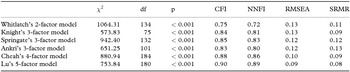
Confirmatory factor analyses on the whole sample (N = 395) showed that none of the models fit the data reasonably well (Table 2). Although Lu and colleagues’ model, discovered in another Chinese sample, produced the most impressive fit indices, the NNFI and RMSEA were still marginally outside the acceptable range. Given these results, we attempted to identify the most fitting model for Chinese Alzheimer caregivers using both exploratory and confirmatory procedures.
Fit indices of various proposed models

We randomly split the sample into two using the random sample function in SPSS version 20, performing EFA on Sample A (n = 183) while using Sample B (n = 212) for an independent verification of the EFA results. Based on Sample A, EFA suggested a 5-factor structure. The last factor had three items with both positive (items 8 and 14) and negative (item 19) factor loading coefficients, hence uninterpretable. Moreover, these three items were loaded simultaneously on the other factors. Instead of dropping these items, as was done in previous studies, we asked for a 4-factor solution. Interestingly, items 1–10 were loaded on factor 1, items 11–14 on factor 2, items 20 and 21 on factor 3, and items 15–19 on factor 4.
This 4-factor structure was then subject to CFA in Sample B, yielding χ 2 (184) = 349.75, p < 0.001, CFI = 0.92, NNFI = 0.91, RMSEA = 0.07, SRMR = 0.08. However, on examining the factor loadings, three items were loaded poorly on their respective factors, namely item 5 = 0.38, item 15 = 0.27, and item 18 = 0.12. Modification indices also suggest two large correlated errors associated with item 5. Part of the reason might be the low endorsement rates of these items, especially item 5 to which a rating of “never” was given by 79% of the participants in Sample B. As a result, we removed these items and fit the model again, yielding even better fit indices: χ 2 (130) = 217.80, p < 0.001, CFI = 0.95, NNFI = 0.94, RMSEA = 0.06, SRMR = 0.06. Although the χ 2 was still statistically significant, the χ 2/df ratio was a respectable 1.68. Moreover, AIC was found to be 299.80, much lower than the AIC value of 344.04 before the three items were removed, suggesting that it was a clearly superior model.
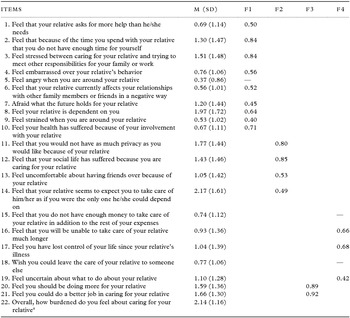
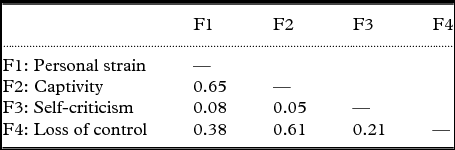
Standardized factor loadings of the final model are presented in Table 3. In light of item contents and previous literature, we named the factors Personal Strain, Captivity, Self-criticism, and Loss of Control, respectively. Nevertheless, on examination of item contents, item 8 appears to be more closely related conceptually to Captivity, and item 7 to Loss of Control. To ascertain that the model presented in Table 3 was indeed optimal, we ran the analysis again with these two items hypothesized to load on Captivity (Alternate A) and Loss of Control (Alternate B), respectively, resulting in (a) Alternate A: χ 2 (130) = 278.33, p < 0.001, CFI = 0.93, NNFI = 0.91, RMSEA = 0.07, SRMR = 0.08, AIC = 360.33; and (b) Alternate B: χ 2 (130) = 235.62, p < 0.001, CFI = 0.94, NNFI = 0.94, RMSEA = 0.06, SRMR = 0.07, AIC = 317.62. Although the fit indices of both of these models were within the acceptable range, their AICs were increased by 60.5 and 17.8 points, respectively, clearly higher than the 10-point threshold. Thus, the model presented in Table 3 remains the model of choice. Factor intercorrelations (Table 4) suggest that Personal Strain, Captivity, and Loss of Control were moderately to strongly correlated with each other, whereas Self-criticism was relatively independent of the other three.
Item descriptive statistics and standardized factor loadings, Sample B (n = 212)

Note: — = item removed due to poor loading. F1 = personal strain; F2 = captivity; F3 = self-criticism; F4 = loss of control.
aNot included in factor analysis.
Factor intercorrelations, Sample B (n = 212)

Correlations with caregiver and care-recipient variables
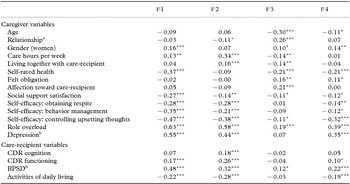
Subscale composites corresponding to the four factors were created and were correlated with selected caregiver and care-recipient variables known to be associated with burden. As a larger sample can yield more precise estimates due to smaller standard errors and is more representative, Samples A and B were merged (N = 395) in this analysis. A noted finding from Table 5 was that, mirroring the factor intercorrelations, Self-criticism showed a correlational pattern that was rather different from those of the other three subscales. Not only was Self-criticism unrelated to many variables but the directions of association were even reversed in some cases, such as when correlated with caregiver age, relationship, care hours, and whether living together. The pattern suggested that caregivers who did not live with the care-recipient, spent less time in providing care, and were children, tended to feel that they should have done more. Self-criticism was also correlated, positively, with affection and obligation, suggesting that this subscale tapped a sense of guilt by family members who felt a strong sense of responsibility for and were close to the care-recipient, but could not provide care as much as one wanted to.
Correlations with caregiver and care-recipient variables, whole sample (N = 395)

Note: *p < 0.05, **p < 0.01, ***p < 0.001. CDR = Clinical Dementia Rating; BPSD = behavioral and psychological symptoms of dementia; F1 = personal strain; F2 = captivity; F3 = self-criticism; F4 = loss of control. Composite scores, not factor scores, were used in computation.
aCoded as 0 = spouse and sibling, 1 = adult child, child-in-law, and grandchild.
bTransformed by taking the square root.
Other than the above, the correlational patterns were consistent with what one might expect from the literature. Of the care-recipient variables, daily functioning was generally more distressing to caregivers than cognitive decline, but the most important predictor of burden was BPSD.
Given the findings concerning the Self-criticism subscale, which consists of only two items, we removed them from the scale, together with the three items already removed in the factor analysis. After the removal, the alpha coefficient was found to be 0.88 for this 17-item version of the ZBI (item 22 included). Had the five items been retained, the alpha coefficient was nonetheless identical. Thus, no internal reliability was lost by removing the five items concerned.
Discussion
This study investigated the dimensions of burden in a sample of Hong Kong Chinese Alzheimer caregivers. As interventions may not address all aspects of caregiver burden, dimensions that can be differentiated from one another may allow researchers to assess the effects of interventions more precisely.
However, none of the factor models reported in the literature were found to fit our data well. The most plausible model appeared to be a 5-factor model found in another Chinese sample using EFA by Lu et al. (Reference Lu, Wang, Yang and Feng2009). Nevertheless, given the limitations of EFA, it was not even certain whether that particular model fit their data well. In any case, their model generated from EFA was very different from our final model. To some extent, it is difficult to compare the results across studies due to differences in the sample and the method employed. At the same time, the variations in findings suggest that more research is necessary to replicate a certain factor structure in any particular cultural group as well as across cultures.
Using a rigorous, multistep procedure, we found that a 4-factor model was optimal for Hong Kong Chinese Alzheimer caregivers. This model bears some resemblance to others reported in the literature but is also unique in important ways. The Self-criticism factor, sometimes labeled as guilt or worry about performance, was found in several other studies (Knight et al., Reference Knight, Fox and Chou2000; Lu et al., Reference Lu, Wang, Yang and Feng2009; Longmire and Knight, Reference Longmire and Knight2011; Cheah et al., Reference Cheah, Han, Chong, Anthony and Lim2012) and appears to be the most stable or generalizable factor across samples and cultures. With further analysis, we showed that this dimension was related to the quality of the dyadic relationship and the feeling that one was obligated to help but was not doing enough for the loved relative. Future research may demonstrate whether such observations hold in other cultural groups. Furthermore, it should be noted that existing interventions tend to focus on tackling psychological strain and distress, activity restriction, physical dependencies, and BPSD (Cheng et al., in press; Gallagher-Thompson et al., Reference Gallagher-Thompson2012; Mittelman, Reference Mittelman, Zarit and Talley2013), while neglecting Self-criticism as a contributory factor to caregiver mental health. Researchers should examine whether addressing performance concerns would further enhance the effectiveness of caregiver interventions, especially in child caregivers.
Personal Strain was the largest dimension of all, being composed of nine items. This dimension incorporates several factors referred to by other researchers as the impacts on one's life and psychological well-being (Cheah et al., Reference Cheah, Han, Chong, Anthony and Lim2012; Springate and Tremont, Reference Springate and Tremont2014). It is no wonder that this dimension was, in general, more strongly correlated with various predictors than the other dimensions of burden. The second dimension was often referred to as social impact by other researchers, although it was not necessarily a separate factor in other studies (Ankri et al., Reference Ankri, Andrieu, Beaufils, Grand and Henrard2005; Cheah et al., Reference Cheah, Han, Chong, Anthony and Lim2012). On examination of the items, we feel that this factor taps the extent to which one is tied to the caregiving role, while the effect on social life may be one aspect of this experience. If this factor was measuring social impact, item 6 would have been loaded on it also. However, not only was item 6 loaded on a different factor but it had a low mean score, whereas items in the Captivity factor had relatively high mean values (Table 3). The mean values of the Captivity items and correlations between the total and various variables of interest suggest that this subscale captures some of the most common and significant concerns of caregivers. Finally, the last factor resembles the Loss of Control factors found in two other Asian/Chinese samples, suggesting that the fear of not being able to manage the situation may be rather common among Asian caregivers. Correlational analysis suggested that it was related somewhat to a sense of obligation for family members, a value system rooted in Chinese/Asian cultures (Table 5).
It is noteworthy that item 5 on anger had the lowest endorsement rate. In another study of Taiwan dementia caregivers, Li and Lewis (Reference Li and Lewis2013) found, within the Level of Expressed Emotion Scale (Cole and Kazarian, Reference Cole and Kazarian1988), that the Attitude toward Illness subscale measuring mostly hostility had low internal reliability (α = 0.55), probably due to very low endorsement rates and low variability of most of the items. The authors attributed this to the cultural belief in fatalism, helping caregivers to accept the role. Similarly, the low endorsement rate of another removed ZBI item, number 18, might be related to the cultural norm that is strongly against abandoning an ill family member, especially the parent. Together with what has been discussed above, clearly more research into cultural factors in caregiver burden is needed.
To conclude, a 4-factor structure of the ZBI discovered through EFA was independently verified through CFA in another sample of Hong Kong Chinese caregivers. Not all items appeared to cohere well; it was found that the internal reliability of the scale remained the same after removing five suspect items. Beyond the factor structure of the ZBI, cultural issues were identified that may be relevant for optimizing the measurement of caregiver burden in the Chinese. As the ZBI can be shortened for the Chinese, more items may be added to subscales with few items to improve measurement of different aspects of burden, without substantially lengthening the administration of the measure. Additionally, Self-criticism may be studied in its own right, and may constitute an independent outcome to be tackled specifically in future intervention studies.
Finally, more studies using larger and more representative samples are needed to demonstrate that this factor structure can be replicated and generalized. In addition, it will be useful to show that the factor structure is also valid for those caring for other types of dementia. This will allow direct comparison of different aspects of caregiver burden across dementia types and at different stages of the different conditions.
Conflict of interest
None.
Description of authors’ roles
S.-T. Cheng is the principal investigator and led study design, data analysis, and writing the paper, while T. Kwok and L.C.W. Lam contributed to study conceptualization, data collection, and writing.
Acknowledgments
This study was supported by Strategic Public Policy Research Grant No. HKIEd1001-SPPR-08 and General Research Fund No. HKIEd140609, both from the Research Grants Council of Hong Kong. The funding source had no involvement in any part of the project.