

Introduction
Each year, business interests spend billions of dollars to influence political outcomes in Washington, D.C. This raises several questions. For example, how powerful are business groups?Footnote 1 And what triggers some firms to become politically active?Footnote 2 This article is about an aspect of corporate political behavior that is essential but figures less prominently in the literature: the choice of issues that a firm lobbies on. Whereas firms A and B might lobby on many of the same issues, firms A and C might lobby on completely different issues. To explain this phenomenon, I ask: What determines whether or not firms lobby on the same policy issues?
To answer this question, I examine the determinants of what I refer to as activity overlap, which measures the similarity between firms’ choices of issues on which they lobby directly. In the literature on corporate political activity (CPA), it is possible to identify two general explanations as to why activity overlap between different companies varies. First, similar firms have similar interests and should, consequently, gravitate towards the same policy issues.Footnote 3 Second, interorganizational relations between firms homogenize political behavior.Footnote 4 In summary, similar interests and interorganizational relations should increase activity overlap between firms.
The main argument of this paper is that low activity overlap is observed when both of these conditions are met. This expectation follows from a set of assumptions: (1) it is advantageous for a firm to focus on so-called issue niches—very specific political areas where allies and enemies rarely encounter each otherFootnote 5—in order to create a unique identity, which in turn gives it political accessFootnote 6; (2) to do so, the firm needs to ensure that its interests are represented on issues that, while important, do not directly relate to its niche(s); (3) this sort of delegation of lobbying requires coordination with other firms with similar interests and (4) coordination with similar others is facilitated by interorganizational relations. In other words, when similarity and ties act in concert, firms can lobby on different policy issues.
If the first assumption is derived from the literature on issue niches, the latter three are derived from collective action theory.Footnote 7 This theory seeks to understand how actors can overcome social dilemmas. As such, it foremost explains why some societal interests are politically underrepresented (or unrepresented), not why activity overlap between firms varies. However, its logic applies to activity overlap as well. The failure of collective action is an uncoordinated pursuit of firm action. This creates a situation in which firms with similar interests lobby on the same policy issues, thereby producing high activity overlap. Collective action, in contrast, allows similar firms to be represented by other entities—such as trade associations, ad-hoc coalitions, or even firms—on issues of shared concern. The failure of collective action is avoided through coordination and monitoring, which is facilitated by interorganizational relations. Therefore, the hypothesis is that similarity, in combination with relations, reduces activity overlap.
The subsequent statistical analysis of the 842 largest American firms confirms this hypothesis. That is, firms have a low activity overlap when they operate in the same industries and score high on proxy variables of interorganizational relations. If only one of the two conditions is met, activity overlap is high. This lends support to the collective action theory, the validity of which has been challenged by numerous empirical investigations.Footnote 8
The paper proceeds as follows. The next section starts with an overview of related works. After this, I submit a set of hypotheses of how similarity and interorganizational relations are conventionally believed to govern activity overlap. I then describe the rationale for why the interaction between the two matters. In conjunction with this, I outline the collective action theory and provide a critical assessment of the attempts to test the theory through the lens of corporate political spending. In the third section, I specify the sample and the methodology and operationalize activity overlap and the independent variables. Thereafter, the results are unveiled. A closing section concludes with the main findings and directions for future research.
Theory and hypotheses
The corpus of corporate political behavior centers around two broad poles of social theory.Footnote 9 One is economic determinism, the other is the rejection of it. What this division encapsulates is the clash between the contention that economic interests steer corporate political behavior and the one asserting that noneconomic factors matter as well. The latter encompasses a broad set of determinants, many pertaining to local institutions and previous patterns of interactions between business, labor, and state.Footnote 10 These institutional properties vary across countries and are, therefore, most relevant for comparative studies. In single country studies, the main noneconomic factors are various types of interorganizational relations, also referred to as interfirm ties. Relations enable firms to interact and to build corporate political cohesion. In brief, to elucidate corporate political behavior, one needs to consider both the economic interests of firms and the social ties that bind them together.
In a host of empirical studies, it has been demonstrated that similar interests and interorganizational ties induce similar corporate political behavior.Footnote 11 It is indeed the case that few of these studies look directly at the tendency to target the same issues. Still, many of them are about business mobilization—when firms and their associations collectively enter into the political arena with the same objective in mind.Footnote 12
As described in the next section, the dependent variable is referred to as activity overlap, where a higher score indicates a greater propensity to lobby on the same issues. In view of the foregoing, two hypotheses are submitted:
H1:
Similar interests are associated with an increase in activity overlap.
H2:
Interorganizational relations are associated with an increase in activity overlap.
It is not my contention that these hypotheses are incorrect. Rather, the central claim of this paper is that similar interests and interorganizational relations jointly reduce activity overlap. This expectation is based on collective action theory and the literature on issue niches. Below, I will discuss these ideas in greater detail before submitting a set of additional hypotheses.
Browne writes that “organized interests define themselves in terms of carefully constructed issue niches. These, in turn, govern their own selection of which issues to address. Issue niches are, in effect, necessary for organizations as lobbyists and other interest representatives differentiate one from the other in competition for policymakers' support.”Footnote 13 What Browne says is that the political arena is a crowded place and in order to gain access to policymakers, organized groups must have something recognizable to offer. This prompts them to occupy policy niches and build expertise around those particular niches.
This is claimed to engender a balkanization of policy domains so that allies and enemies rarely encounter each other.Footnote 14 This picture is partly flawed. First, not all policy domains are balkanized.Footnote 15 Second, some policy issues trigger lobbying bandwagons, which stand in stark contrast to the image offered by Browne.Footnote 16 Third, occupying a niche is not the only tool that reduces transaction costs between legislators and groups. A recognizable political identity can also be created based on representation, ideology, or advocacy methods.Footnote 17 Nonetheless, niches and policy balkanization are two conspicuous properties of interest group politics.Footnote 18
Does that mean that all interest groups carve out niches and exclusively operate within these? Browne argues that it is irrational not to do so. He writes that “given that no interest-group has unlimited lobbying resources […] mobilizing scarce resources on every issue of imputed interest is irrational”Footnote 19 While this is certainly true, it does not automatically entail that an organization is able to give priority to specific policy demands. This depends on how well its interests are represented in other areas. If they are, it can aim for one or several clearly defined niches. If not, it has to adopt a more comprehensive political strategy. In short, the argument is that an organization wants to lobby narrowly, but that this is contingent on other organizations engaging in policy advocacy—directly or indirectly—on its behalf.
To understand what enables this, I turn to collective action theory. Collective action occurs when the members of a group collectively work together to realize common goals. Collective action theory primarily explains why some groups are characterized by political inertia. By linking its insights to niche lobbying, I extend its application into the study of activity overlap.
If a group is unable to act collectively, individual firms must take matters into their own hands. While this gives voice to the group by way of independent members, it signifies the failure of collective action.Footnote 20 What it leads to is a situation in which organizations divert time and resources away from narrow policy advocacy and instead take unilateral action on matters of collective interest. This is referred to as firm (also called private or individual) action. When firms defend collective interests through individual action, they target the same issues, which causes activity overlap to go up.
Collective action, on the other hand, allows firms with shared objectives to pool their resources. The responsibility to advocate on behalf of the group is then handed over to a trade association, ad hoc coalition, or another firm. Of course, as HulaFootnote 21 shows in his book on lobbying coalitions, being a member of a coalition—or an association for that matter—does not necessarily imply that a firm takes a backseat role. On the contrary, some members invest a lot of time and money into collective efforts. Still, by joining a coalition or an association, firms agree to be jointly represented and to—perhaps asymmetrically—share the costs. This means that the members of the group can focus comparatively more on their individual and more specific policy demands and let the coalition or association do the lobbying on the issues of shared interest. As a result, activity overlap is reduced.
What makes collective action possible in the first place is coordination and monitoring. According to theory, group size is a key predictor as members of small groups can more easily coordinate and monitor each other.Footnote 22 In addition, transaction costs of decision-making and communication are lower among fewer actors.Footnote 23 This brings about an inverse relationship between group size and collective action. That said, group size is not the only relevant factor. Coordination and monitoring are facilitated by interorganizational relations of various types, not only by those brought about by small group sizes.Footnote 24
It should be stressed that delegation is not the only possible outcome of collective action. Coordinated mobilization, which serves to demonstrate unity, is also a conceivable outgrowth. This suggests a completely inverted relationship so that coordination produces higher activity overlap. However, mobilization is a costly strategy, and it is often more cost effective to let a business association speak on behalf of the group.Footnote 25 This does not rule out the possibility of coordinated mobilization, but it is a rare outcome, primarily observed in cases of salient issues.Footnote 26 Conversely, there is the argument that delegation is even more likely on salient issues, as some firms want to limit their political exposure.Footnote 27 Regardless of which, I will later control for issue salience to heed the impact that it might have on activity overlap.
To summarize, interorganizational relations, together with similar interests, bring about collective action, which would lower activity overlap. Without relations, similar interests lead to uncoordinated firm action, which increases activity overlap. This begs the question: What is the effect of interorganizational relations on activity overlap in the case of heterogeneous interests? In many studies, interfirm networks are shown to diffuse of a political agenda throughout the whole business community, so that firms from different sectors mobilize on the same issues.Footnote 28 This implies a higher activity overlap than if dissimilar firms were completely disconnected. On that account, I submit two hypotheses, which are represented in table 1.
H3:
Similar interests are associated with a decrease in activity overlap when there are interorganizational relations, but with an increase in activity overlap in the absence of such.
H4:
Interorganizational relations are associated with a decrease in activity overlap when there are similar interests, but with an increase in activity overlap in the absence of such.
The outcomes of similar interests and interorganizational relations.

It should be noted that firm action is not the only failure of collective action. The other face of failure is no action. In large groups, where coordinating and monitoring are difficult, it is rational to free ride. As a result, there is no one that gives voice to the group at large, while its members solely seek private political gains. Consequently, firms operating in the same fragmented industries would exhibit low activity overlap. This runs counter to what was stipulated above. To rule out this possibility, I only analyze largeFootnote 29 firms. Both theory and empirics point to these organizations as the ones least inclined to free ride.Footnote 30 Thus, collective action and firm action remain the two only plausible outcomes.
Given its theoretical framework, this paper presents a test of collective action theory. As applied to CPA, most attempts to test collective action theory have been done through the lens of political spending by firms.Footnote 31 The expectation is that higher market concentration increases the likelihood of firm action since it is no longer rational to free ride when potential benefits outweigh the cost of participation—as will happen when a firm enjoys a sufficiently large market share. This hypothesis has been repeatedly rejected.Footnote 32 Hansen and othersFootnote 33 write that “what is puzzling is the poor empirical support for this argument in the domain where it should work best: there is too much business political activity.”
Despite their valuable contributions, it is my contention that these studies do not undermine collective action theory, as they only test one of two empirical implications. As specified by the theory, high concentration can either produce firm action or collective action. The theory does not offer clear guidance as to which of these two scenarios is most likely to prevail when market structures become concentrated.Footnote 34 Many pieces of research have now failed to establish a significant association—in any direction—between concentration and expenditures.Footnote 35 Hence, the key question is not whether high concentration equals more spending. Rather, the question is if high concentration creates opportunities for large firms to engage in collective action and, thereby, direct more of their attention to issue niches.
Methods
Data and sample
This is a study of large AmericanFootnote 36 firms and their lobbying in Washington, D.C. The population consists of the 842 American corporations that appeared at least once between 2007 and 2014 on the Forbes Global 2000 list, an annual ranking of the 2,000 largest public enterprises in the world. The period, 2007 to 2014, also marks the beginning and the end of the time series. Seven years is a rough estimate of a full business cycle, which is appropriate for the examination of firms.Footnote 37
The unit of analysis is not the firm. Activity overlap implicates at least two parties. When uncovering the relational dimension of lobbying, scholars usually use the dyad—a pair of firms—as the unit of analysis,Footnote 38 and so did I. In the upcoming subsection, activity overlap is operationalized. This is followed by the operationalization of the independent variables: similar interests and interorganizational relations. It is important to emphasize that the independent variables measure the facilitators of collective action, not collective action itself. The same is true for the studies of how concentration affects the political spending by firms.Footnote 39 In other words, collective action—whether it is manifested by co-membership in an association, or a coalition, or any other formal or informal cooperation between two firms—is the unobservable mechanism through which the interaction between similar interests and interorganizational relations reduces activity overlap.
Operationalization of activity overlap
The U.S. Lobbying Disclosure Act of 1995 mandates that interest groups in Washington, D.C., disclose the bills on which they have lobbied. However, to solely use this data for activity overlap would be inadequate. Congressional bills often extend over several domains and encompass a multitude of niches. In order to increase the precision of activity overlap, I also took the reported issue area codes into account.Footnote 40 To each lobbied bill, the organization must attach an issue area code, which is a shorthand description of the specific policy domain.Footnote 41 Accordingly, when two firms report lobbying on the same bill and the same issue area code, their activity overlap goes up. The data on registered bills and issue area codes were accessed through the nonprofit, nonpartisan Center for Responsive Politics. It can be argued that these pieces of information still do not provide a picture that is precise enough. Nevertheless, it is difficult for a quantitative study, like this one, to go deeper than that, and several previous studies on issue niches have utilized the same data.Footnote 42
How reliable are lobbying disclosures as a data source? Albeit legally mandated, information might be excluded by mistake or, worse yet, there is a systematic omission of what is judged to be sensitive. My validation shows that in 95 percent of the legislative hearing testimonies, the firm had included that bill in one of its disclosures. One could argue that this is a weak test, in view of the public nature of congressional hearings, but 95 percent (of 551 instances) is, at any rate, high. This favorable verdict is strengthened by an audit of Lobbying Disclosure Act compliance, undertaken by the Government Accountability Office in 2013.Footnote 43 The audit did not discover any breaches of the law, and it showed that 80 percent of lobbyists were able to produce documentation to authenticate the reported issue area codes, even if the law does not require them to maintain records. Furthermore, the data do not exhibit the type of noise one would observe if the disclosures were to be filled out inaccurately.Footnote 44
To calculate activity overlap, I made use of the cosine similarity metric. This metric assesses the distance between two vectors by comparing their attributes while controlling for their sizes. For my purposes, the vectors are firms and the elements are their registered bills and issue area codes. The cosine similarity metric returns a score that reflects the similarity between two firms’ choices of issues, in relation to how much they lobby overall:
 $${\rm activity\; overlap\;} \lpar {{\rm A},{\rm \; B}} \rpar = \displaystyle{{\mathop \sum \nolimits_{{\rm i} = 1}^{\rm n} {\rm A}_{\rm i}{\rm B}_{\rm i}} \over {\sqrt {\mathop \sum \nolimits_{{\rm i} = 1}^{\rm n} {\rm A}_{\rm i}^2} \sqrt {\mathop \sum \nolimits_{{\rm i} = 1}^{\rm n} {\rm B}_{\rm i}^2}}} $$
where A and B are two firms and i is a combination of a reported bill and issue area code. Each firm is a vector containing all its political activities between 2007 and 2014, where no distinction is made between in-house lobbying activities and those carried out by hired consultants. The formula goes through each element in the universe of bills and issue area codes and sets a score of 1 if the firm has been active on it, otherwise 0. An activity overlap can only be computed if both firms have lobbied at least once. Otherwise, the denominator would take on a value of zero and the overlap would be infinitely high. The activity overlap varies from zero—if two firms never lobby on the same bills and issue area codes—to one—if two firms always lobby on the same bills and issue area codes.
That the cosine similarity metric controls for the magnitude of lobbying is essential. The level of political engagement reflects both supply and demand—both the characteristics of a firm and the government activity in issue areas that are of relevance to the firm.Footnote 45 As a function of the two factors, some firms and industries lobby more than others. If one would not control for this, organizations that are very politically active would automatically be more likely to score higher on activity overlap. What I am interested in is activity overlap relative to how much firms lobby, and the cosine similarity metric serves this purpose.
Operationalization of similar interests
Industry
An industry is viewed as a bastion of like-mindedness.Footnote 46 In fact, collective action theory segments the business community into groups along industrial lines. Surely, operating in the same industry does not guarantee identical political preferences. Nonetheless, it is the standard yardstick of similarity and a strong predictor of corporate political behavior.Footnote 47
The classification of firms into industries is done via the North American Industry Classification System (NAICS). As with activity overlap, the cosine distance metric was employed to generate a dyadic score. The elements of the vectors are CompuStat segment data on revenues made in four-digit NAICS industries. The score ranges from 0 to 1, where 1 indicates full industrial similarity between two firms and 0 the complete lack thereof.
Operationalization of interorganizational relations
Interorganizational relations are very difficult to measure directly. Instead, scholars use proxies. The principal one here is concentration. Two other standard proxies are interlocks and proximity.Footnote 48 Both of them increase political unity between firms.Footnote 49 These three variables are complemented by date of incorporation and ownership. The former captures trust and legitimacy, the latter the ownership ties between firms.
Concentration
To calculate industry concentration, I used the Herfindahl index, which is the formula employed by the U.S. Census Bureau:
 $${\rm H} = \mathop \sum \limits_{{\rm i} = 1}^{\rm N} {\rm s}_{\rm i}^2 $$
where si is firm i's market share by revenue and N is the number of firms in an industry. Again, the industry was defined at the four digits NAICS level, which is normally how concentration is calculated.Footnote 50 Like those of the Census Bureau, my calculations covers the market shares of the fifty largest actors in each industry.Footnote 51 The Herfindahl index ranges from 0 to 1, where 0 denotes a completely fragmented industry and 1 denotes an industry with a single monopolistic producer.
The concentration score assigned to a firm is weighted, based on the Herfindahl indices of the industries in which a firm operates and the proportion of revenues earned by the firm in each one of them. The dyadic variable is the average concentration between the two firms.
Interlocks
Interlocks occur when directors sit on the boards of multiple corporations. To compute interlocks, I used information on board compositions from Orbis and divided the number of directorial interlocks between two firms by their total number of directors.
Proximity
Proximity is the distance, in meters, between the head offices of two organizations.
Incorporation
Incorporation is the number of years that have passed since the youngest of two firms came into existence (year of incorporation marks the birth). StinchcombeFootnote 52 writes that it is harder for younger firms to garner trust from other organizations, and Singh and othersFootnote 53 concur that external legitimacy is something that is built up over time. Hence, interfirm relations are facilitated by the number of years of dual existence.
Ownership
Ownership has for a long time been regarded as an important determinant of corporate political behavior.Footnote 54 It enables information to be transmitted and/or pressure for conformity to be exercised.Footnote 55 The models feature two types of ownership. First, same owners is the degree to which two firms have the same owners. The cosine distance metric was used yet again. A score of 0 is produced when two firms have completely different owners; 1 when they have the same owners with the same invested stakes. Second, cross-ownership is the total percentage of stakes held by two companies in each other. The data on ownership were collected from Orbis and direct as well as indirect ownership—when one firm owns stocks in another through its subsidiaries—were taken into account.
Operationalization of control variables
Political behavior is not only shaped by material interests and interorganizational relations. Firms also act in response to constraints and opportunities imposed by the political system.Footnote 56 To take this into consideration, four control variables were used: regulation, government contracts, unionization, and policy type.
Regulation
Regulation influences behavior in several ways. It spurs firms to increase their political expenditures,Footnote 57 and businesses often unite in their quest to roll back regulation.Footnote 58 Regulation can also create winners and losers, even within an industry, and splinter firms into competing factions.Footnote 59
To operationalize regulation, I used the RegData database.Footnote 60 It contains estimates of regulatory exposure for every four-digit NAICS industry, obtained through quantitative content analysis of the Code of Federal Regulations. To each firm, I assigned a weighted sum of regulatory exposure, where the weights depend on the proportion of sales realized by the firm in various industries. The dyad then received the lowest of the two scores, heeding the assumption that both firms must be exposed to regulation for it to have an effect.Footnote 61
Government contracts
Organizations compete for government contracts.Footnote 62 More opportunities to secure contracts should, all else being equal, increase activity overlap. To control for this, I used a measure developed by Drope and Hansen.Footnote 63 It estimates the government procurement activities for each industry by sampling around 2,000 firms and recording the dollar amount of their contracts. The General Services Administration's Federal Business Opportunity database contains records of all federal government contracts greater than $25,000. For each NAICS four-digit code, the dollar amount was aggregated. Government contracts is an average of the two firms’ weighted sums over the industries in which they operate.
Unionization
In the face of strong labor unions, the business community mobilizes across sectorial lines to deal with this threat.Footnote 64 The strength of the labor movement is commonly operationalized via union density,Footnote 65 defined as union membership in an industry as a proportion of all wage and salary earners employed within it. From NAICS classifications of firms and data on industrial union membership rates provided by the Bureau of Labor Statistics, each firm was assigned a density score. The variable unionization took on the lowest union density score of two firms. This is in accordance with the notion that a threat must be perceived by both actors to have a mobilizing effect.Footnote 66
Policy type
Some issues attract the attention of many organizations.Footnote 67 In these relatively rare instances, business interests may engage in coordinated mobilization. This would allow an industry—or even a business community—to amplify its political message and send a strong signal to policymakers about its unified position on the matter.Footnote 68 Consequently, high activity overlap on these types of issues does not necessarily indicate the failure of collective action but a coordinated response. Alternatively, some firms might want to limit their political exposure on salient issues by hiding behind business associations, which would reduce activity overlap.Footnote 69 Regardless of which, salience should affect activity overlap, and this is something we should control for.
Salience can be gauged by numerous methods. One is to count the number of business organizations active on an issue.Footnote 70 The problem, though, is that a high count could be a sign of deep fracture, as well as unity. An alternative is to look at the lobbying of peak associations, as their presence in the policy process is indicative of business unity.Footnote 71 To operationalize this, a dummy was attached to each bill, set to 1 if one of the quintessential American peak organizations—U.S. Chamber of Commerce or the Business Roundtable—was active. An average for each dyad was then calculated, across the bills both firms had lobbied on. There is a strong correlation between this measure and the one that counts the number of actors, 0.60 (Pearson). Faced with the choice between the two, I decided to use the former since it, presumably, better reflects business unity.
Results
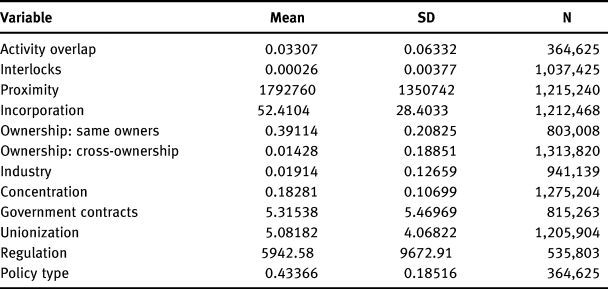
Table 2 presents descriptive statistics for all variables. It is worth noting that the dataset is longitudinal, where each period is the duration of a congress. Between 2007 and 2014, four congresses were in session (110th–113th). The N is, therefore, the number of observations across all dyads and all Congresses. Not all large firms lobby in Washington, D.C. Of the 842 firms, between a third and a half were politically active during a Congress.
Descriptive statistics.

Note: The panel data span four Congresses (110th–113th Congresses). The N is the total number of observations across all dyads and all Congresses.
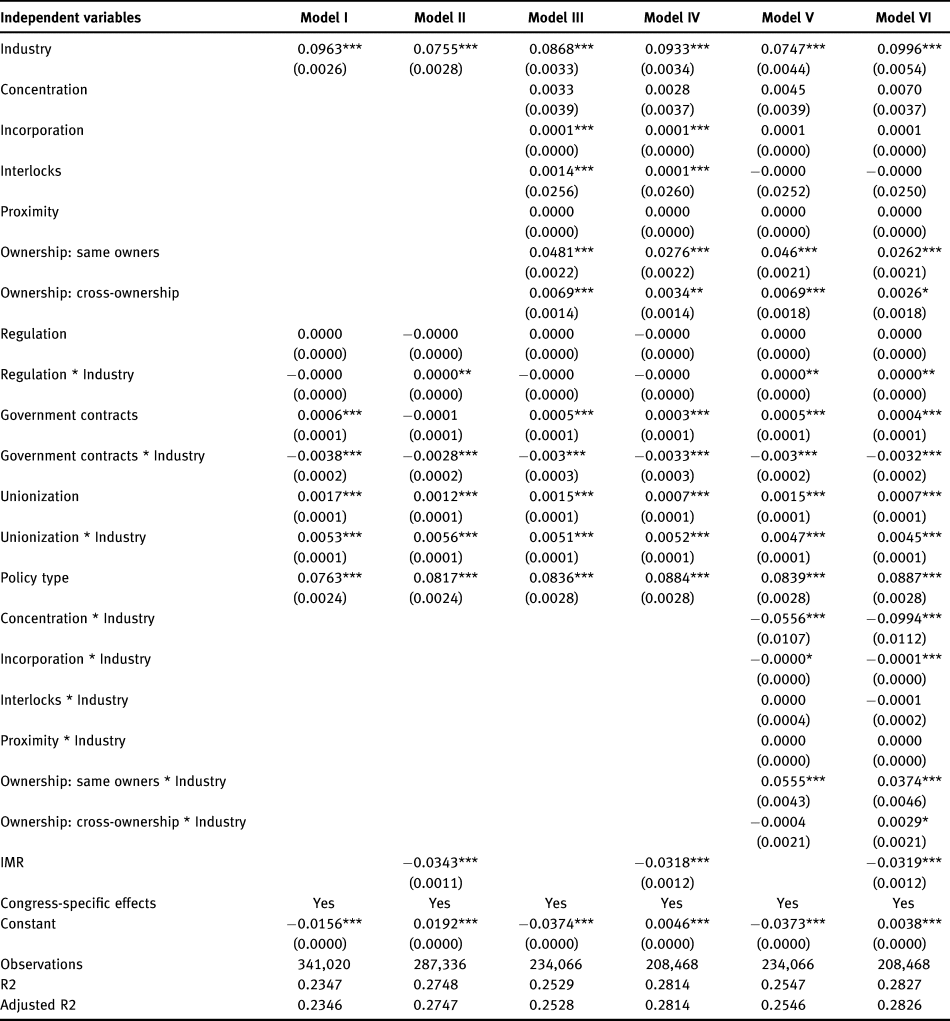
The descriptive table reveals that activity overlap is, in general, very low. The average score is just above 0.033. However, the standard deviation is quite high. To explain the variation in activity overlap, I used regression models. For my purpose, standard regressions techniques are not suitable. The structure of the data violates the prerequisite for linear regressions that the observations are independent of each other. In network data, an observation is two nodes linked to each other. Since one node is linked to many other nodes, the dyads are not completely independent. An alternative, developed by social networks scientists, is the quadratic assignment procedure (QAP).Footnote 72 It is implemented in UcinetFootnote 73 as the Double Dekker Semi-Partialling Multiple Regression Quadratic Assignment Procedure.Footnote 74 The output of this modeling is detailed in table 3.
QAP regression analysis of activity overlap.

Note: Reported coefficients are unstandardized. Standard errors within parentheses. IMR is the Inverse Mills Ratio: variable derived from the Heckman Selection Equation. Significance levels: *p < 0.1; **p < 0.05; ***p < 0.01.
Before analyzing the results, a few remarks need to be made. First, due to missing data on one or several of the variables, many of the dyads were excluded from the analysis. An issue that arises from the discrepancy between the total number of potential observations and the total number of actual observations is selection bias. That is, the findings might only apply to a subset of dyads that are different from the ones excluded. To ameliorate selection bias, I used the Heckman selection model.Footnote 75 Essentially, it treats selection bias as an omitted variable problem. From this selection model, an Inverse Mills Ratio (IMR) is calculated, which is a proxy for the probability of non-missing data. My selection equation comprises a set of antecedents of CPA.Footnote 76 Each model in table 3 comes in two versions, one with and one without IMR. This allows us to track, step by step, how the correction of selection bias influences the results. It turns out that the inclusion/exclusion of IMR only marginally modifies the coefficients. From this, one can draw the conclusion that there is no serious selection bias.
A second remark concerns interaction effects. In the models, I have included interaction effects between, on the one hand, industry and, on the other hand, concentration, interlocks, incorporation, proximity, and ownership. Through these multiplicative interactions, hypotheses three and four are tested. In addition to these, I have created interaction effects between industry and the control variables. This reflects the possibility that although regulation, unionization, and government contracts may affect activity overlap across industries, their effects also depend on whether two firms operate in the same industry or not.Footnote 77
In model I, the effects of industry and the control variables are reported. The main effect of industry has a coefficient of 0.0963. Put simply, full industrial similarity between two firms—on the condition that regulation, government contracts, and unionization are zero—increases activity overlap by 0.0963 units, which exceed the standard deviation of activity overlap. Government contracts have a significant effect on activity overlap as well. Curiously, in interaction with industry, its effect is negative. I will come back to this later. According to expectations, unionization increases the likelihood that firms lobby on the same issues. Regulation, by comparison, does not seem to make a difference, and its interaction with industry scores inconsistently across the models. The effect of regulation on activity overlap is also something I will also come back to.
In model III, the proxies of interorganizational relations are included. The results confirm the first and second hypotheses. That is, similar interests and interorganizational relations—without taking their interactions into account—increase activity overlap. Industry, incorporation, interlocks, same owners, cross-ownership, concentration, and proximity all report positive coefficients, all of them significant but the last two.
The full models are presented in models V and VI. Here we see what happens when similar interests and interorganizational ties coincide. To begin with, the main effect of industry remains positive and significant. That is, two firms that operate in the same industry but have no ties to each other lobby on the same issues. This corroborates the prediction made in the bottom left box in table 1. In a similar vein, interfirm relations in the absence of similar interests increase activity overlap. However, none of the associated predictors, save for ownership, are significant. Hence, the top right box in table 1 is only somewhat corroborated.
More importantly, we cannot reject the hypothesis that activity overlap is reduced when interorganizational relations and similar interests interact. What primarily warrants this conclusion is the negative and significant interaction effects between concentration and industry and incorporation and industry. It should be noted that the introduction of the interactions has a negligible impact on R2. Thus, it is not that the two central hypotheses of this paper—hypotheses three and four—improve the explanatory power, but they do shed light on causality in a way that confirms the predictions made in the top left and bottom right boxes in table 1.
The interaction between interlocks and industry is negative (in model VI) but not significant. This makes sense since direct competitors are generally prohibited from sharing board members under U.S. antitrust legislation. Moreover, its main effect on activity overlap goes from positive and significant to largely inconsequential. This can be partly attributed to the fact that only one percent of the dyads share board members. This creates a very skewed distribution, something that the QAP procedure is sensitive to.Footnote 78 The few interlocks and its weak effect on activity overlap are in line with recent findings regarding the erosion of interfirm board networks and the inability of domestic interlocks to forge political unity in the U.S. business community.Footnote 79 The same is true of proximity, whose weak effect is a vindication of the thesis that in an age of globalization, corporations have lost much of their connection to local communities and are no longer embedded in local networks to the same extent as they used to be.Footnote 80
With respect to ownership, the story is more complex. The interaction between cross-ownership and industry is weak. Industry peers that are controlled by identical shareholders, on the other hand, are significantly more likely to lobby on the same policy issues. This is consistent with previous findings, which have shown that owners put pressure on firms to amplify a political message that the owners want to send.Footnote 81 Since this variable, as opposed to the other proxies of interorganizational relations, only captures indirect ties between firms, its positive and significant effects do not run counter to the predictions made in table 1.
In models V and VI, the interaction between government contracts and industry continues to exert a significant negative effect, while regulation seems to be inconsequential. To unravel these particularities, I tested the control variables under various conditions set by concentration and industry.Footnote 82 What this exercise reveals is that the effects of government contracts and regulation on activity overlap are positive and significant when industry is high and concentration is low. Conversely, the effects are negative and significant when industry and concentration are both high. This is taken as further evidence of the main argument: When firms have similar interests and are connected, they can delegate and focus on their own specific political demands. More regulation and opportunities to secure government contracts will only reinforce this niche lobbying. By the same token, the absence of interfirm relations hampers coordination and creates a situation where similar firms target the same issues. In such circumstances, more regulation and opportunities to secure government contracts will only lead to a higher activity overlap.
The proposition that similar firms with ties to each other are able to coordinate their political activities is supported by table 3. To provide an even more complete assessment of this proposition, I also examined the determinants of policy positions. For this end, I used a dependent variable referred to as agreement overlap, which is a measure of the degree to which firms adopt the same policy positions.
The data on agreement overlap were collected from congressional hearings. Hearings have been analyzed frequently in the past to discover policy positions.Footnote 83 Congressional hearing transcripts are published on the website of the U.S. Government Publishing Office.Footnote 84 I scraped the transcripts of the hearings held between the 110th and the 113th Congresses, a total of 11,835 hearings. In the event that two or more firms in the population had testified before a congressional hearing, their positions were coded. The coding was done manually and predicated on the insight that policy conflicts in American politics are structured around two positions—those demanding change and those protecting status quo.Footnote 85 If the testimony had expressed support for the status quo, it was coded as 0. If it had supported change, it was coded as 1. The agreement overlap is then:
 $${\rm agreement\; overlap\;} \lpar {{\rm A},{\rm \; B}} \rpar = 1- \displaystyle{{\mathop \sum \nolimits_{\rm i}^{{\rm a}\cap {\rm b}} \vert {{\rm a}_{{\rm w},{\rm i}}- {\rm b}_{{\rm w},{\rm i}}} \vert } \over {{\rm a}\cap {\rm b}}}$$
where A and B are two firms. Their agreement overlap is the sum of the absolute differences in scores {0,1} over their appearances in the same congressional hearings, divided by the total number of dual appearances. The subtraction of the score from 1 brings about an interpretation like that of activity overlap, so that 0 denotes no agreement overlap and 1 denotes full agreement overlap.
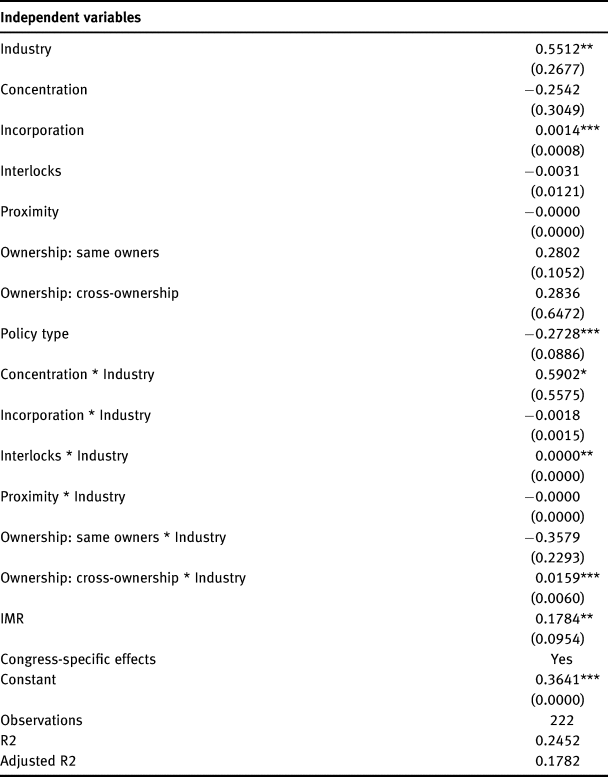
Table 4 reports the results of the regression analysis of agreement overlap. Note that I have decided to omit regulation, government contracts, and unionization from the equation. This is done for three reasons. First, their inclusion severely compromises the degrees of freedom. Second, few hearings concern business-labor relations or government contracts. Third, hearings on regulation tackle specific policies. It is not obvious how, or why, overall regulatory exposure should determine specific policy positions.
QAP regression analysis of agreement overlap.

Note: Reported coefficients are unstandardized. Standard errors within parentheses. IMR is the Inverse Mills Ratio: variable derived from the Heckman Selection Equation. Significance levels: *p < 0.1; **p < 0.05; ***p < 0.01.
Table 4 shows that industry is the most powerful predictor of policy positions. Its main effect accounts for a 0.55 increase in agreement overlap. When firms belong to separate industries, incorporation is the only variable that has a significant effect on agreement overlap. As for the interactions between industry and the various proxies of interorganizational relations, they do produce significant results. Although only significant at the 10 percent level, the interaction between industry and concentration confirms the hypothesis that industries with fewer players are more capable of coordinating. The interactions between industry and interlocks and industry and cross-ownership, which were weakly associated with activity overlap, are also significant and positive. In light of this, three points are worth making. First, the few observations and the dichotomous coding of policy positions ought to be taken into consideration when interpreting the results. Second, one should perhaps not completely dismiss domestic interlocks, at least when it comes to agreement overlap between similar firms. Last, the thesis that similar interests and interorganizational together play an important role also holds with respect to the policy positions adopted by firms.
Discussion and conclusions
In this paper, I have explored activity overlap. That is, the propensity of large American corporations to lobby on the same policy issues. The expectation was that the co-occurrence of similar interests and interorganizational relations reduces activity overlap. What came out of the subsequent analysis confirmed this hypothesis.
The expectation was derived from collective action theory and the literature on issue niches. Through collective action, firms with similar interests can entrust their lobbying to third-parties, such as trade associations, ad-hoc coalitions, or even other firms. This enables them to focus on their issue niches—narrow policy domains where allies and enemies rarely encounter each other—which causes activity overlap to drop. Collective action arises from coordination and monitoring, which are facilitated by interorganizational relations. The idea that the interaction between similarity and interorganizational relations produces this effect was corroborated by the analysis of activity overlap and further bolstered by the analysis of the policy positions adopted by firms.
Furthermore, the autonomous effects of similar interests and interorganizational relations on activity overlap were positive. This was expected. Similar interests in the absence of interfirm ties lead to the failure of collective action. Unable to act collectively, large firms will take individual action to defend the interests of the group. This will make them gravitate towards the same issues, which causes activity overlap to go up. That interfirm relations between dissimilar firms increase activity overlap is in line with previous investigations, which have demonstrated that social ties help to diffuse a political agenda across different sectors.
The fact that my hypotheses were confirmed lends support to the collective action theory. Despite its theoretical appeal, scholars have struggled to find evidence in support of it. Especially troubling is the weak relationship between industry concentration and firm-level lobbying expenditures. According to theory, firms with large market shares are willing to bear the costs of participation since they receive a bigger portion of the benefits of CPA. Here, I have argued that these studies only test one implication of the collective action theory. Rather than inducing firms to intensify their political engagement, the results indicate that higher concentration promotes joint delegation of lobbying efforts and a stronger focus on issue niches. This gives a new perspective on how collective action theory can be used to make sense of corporate political behavior. In summary, while collective action theory does not help us to understand why some firms lobby more than others, and while concentration is a poor predictor of lobbying expenditures, collective action theory tells us how firms lobby and concentration is a strong predictor of similarity of lobbying patterns.
Apart from the collective action theory, this investigation speaks to the literature on issue niches. Browne,Footnote 86 who introduced this concept, suggests that all organized interests carve out issue niches, and that it would be irrational not to do so. This study challenges both the descriptive and prescriptive component of this statement. Some firms are able to give priority to specific political demands, while others need to adopt a more comprehensive strategy to defend their interests.
Certainly, there are limitations to this study. First, one cannot readily extrapolate the results to small and medium-size firms or to non-American settings. The selection of large enterprises severely undercuts the generalizability of the results, as small and large firms have two different approaches to collective action. Whereas small firms almost exclusively rely on trade associations, firm action is a much more attractive option for those with economic muscles.Footnote 87 The generalizability is further limited by the focus on the United States, where collective action is less common than in other countries.Footnote 88 Consequently, what shapes activity overlap among smaller market actors, or among those headquartered in other parts of the world, are questions this paper cannot answer.
Second, collective action is the proposed mechanism through which the interaction between similar interests and interorganizational relations reduces activity overlap. However, collective action itself was not measured. One reason for this is the difficulty of obtaining membership data for associations and coalitions. Another reason is the existence of informal political collaborations between firms, which are even more hidden from view. In other words, collective action is elusive. Moreover, this piece of research is meant to speak directly to those studies that test the logical implications collective action theory—not collective action itself—by exploring the relationship between industry concentration and firm-level lobbying expenditures. Nevertheless, by only including the facilitators of collective action in the models—similarity and interorganizational relations—the full effect of collective action on activity overlap does not become visible. This is likely to generate mixed results, like the ones pertaining to the prediction that firms with dissimilar interests and interorganizational relations score higher on activity overlap. To more directly unravel the connection between collective action and activity overlap is a promising avenue for future research.