Introduction
This article explores the degree of competition in clearing banking in the UK from 1946 to 1971, a period in which there was a cartel in the industry and the Committee of London Clearing Bankers (CLCB) set certain prices collectively.Footnote 2 The prevailing interpretation in the literature holds that, although the structure of the industry and the nature of the regulatory framework resulted in an unusually stable banking sector, it also led to one in which competition was weak. Weak competition in turn impeded innovation. This interpretation is summarized succinctly by Capie and Billings as follows, although it should be noted that they do not wholly concur with it themselves:
It has long been contended that British commercial banking, for most of the twentieth century, was not competitive; it has sometimes been described as a ‘complex’ or ‘collusive’ oligopoly. This is said to account for the banks’ allegedly sluggish, conservative and inefficient behaviour—part of the capital market failure that was said to contribute to Britain’s relative economic decline.Footnote 3
Moreover, “it is generally believed that English banks failed to finance industry in as supportive a way as their European contemporaries, discriminated against small firms … and suffered from many other defects.”Footnote 4
This interpretation—with its implicit acceptance of the competition-fragility hypothesis—has long prevailed.Footnote 5 In the late 1980s, Ross asserted that “the cocoon in which the government wrapped the British banking structure not only stifled innovation and development of new services and products, but left it completely unable to respond to the competitive pressures of the following decade.”Footnote 6 Moreover, it has not altered substantially in the wake of the global financial crisis. Shortly after the crisis in 2010, Baker and Collins argued that banking suffered from an “industry-wide cognitive inertia” as a result of which there was “a failure to recognize competitive threats and opportunities.”Footnote 7 In 2016, Michie characterized the banking industry between 1945 and 1970 as marked by a “high degree of inertia and conservatism,” and observed that “it was as if the British banking system had been ‘frozen in time’ and that time was 1922.”Footnote 8 Scott and Newton argued, in relation to the 1930s, that the clearing banks used their market power to undermine competition. Specifically, they thwarted the development of “specialist medium-long-term industrial lending institutions.”Footnote 9 Although dominant, this interpretation is not completely uncontested. Bátiz-Lazo and Wardley, for example, rejected the idea that “the major British clearing banks were managed ineffectively by conservative and technically naïve executive officers.”Footnote 10
This study takes as its unit of analysis the London clearing banks. The London clearing banks, of whom there were eleven in 1946, were designated as “clearing banks” by virtue of their membership in the London Bankers’ Clearing House. The clearing banks’ checks and other payment instructions were exchanged each day at the Clearing House, which greatly simplified the settlement of balances between the eleven banks. They were “London” clearing banks in that one requirement of a “London” clearing bank was to have a principal office in London. The London designation did not mean, however, that they operated in London only. When the District Bank joined the Clearing House on January 1, 1936, the conditions for membership (and for being considered a London clearing bank) were thus:
-
(i) … the District Bank Limited shall have a principal office in London and shall have a Director resident in London who can attend meetings of the Committee at short notice, e.g. meetings called by telephone message, and who has authority to commit his bank in cases of emergency.
-
(ii) [that] the District Bank Limited shall agree to publish a Monthly Statement of Average Weekly Balances, in accordance with the practice of the present Clearing Banks.
-
(iii) … the District Bank shall pay the Bankers’ Clearing House Limited an entrance fee of One thousand guineas and take up £4,500 of the Stock of the Company.Footnote 11
The central claim of this article is that the evidence as to the degree of competition in clearing banking, and the propensity of the clearing banks to innovate, is more equivocal than the literature would suggest. This assertion needs to be understood in the context that the degree to which unfettered competition in banking should prevail was contested. On the one hand, the authorities feared the absence of competition and the prospect of a monopoly or duopoly developing in banking. On the other, the authorities greatly benefited from the policy of financial repression and the moderated competition which flowed from it. British banking during this period is an illustration of a more general problem—how to measure over the long term the extent of competition in, or the contestability of, a market in which there are relatively few competing firms. This issue has been thrown into sharp relief in recent years as a result of reduced competition (and increased concentration) in many industries in the United States since the late 1990s and early 2000s.Footnote 12
This article evaluates competition in clearing banking from four perspectives. First, the article measures competition quantitatively—the conventional approach—using the Herfindahl-Hirschman Index (HHI) and concentration ratios. It then evaluates an aspect of the contestability of the market by evaluating banking from the perspective of competition policy and law (the presence or otherwise of monopoly, mergers, and restrictive trade practices). Next, it explores the findings of the report on Bank Charges by the National Board for Prices and Incomes (NBPI) in May 1967. Finally, it assesses the clearing banks’ openness to change and their propensity to innovate. Taken together, these perspectives paint a more ambiguous picture of competition in banking than is portrayed in the existing literature. The article concludes by considering the wider implications of this conclusion.
The end point of this study—1971—is significant. In September 1971, the Bank of England implemented its radical new approach to competition in banking and to the control of credit—Competition and Credit Control. This liberalization of clearing banking occurred in the same year as the closing of the U.S. Federal Reserve “gold window,” marking the beginning of the end of the exchange rate system established under the Articles of Agreement of the IMF, whereby exchange rates were fixed but adjustable in relation to the U.S. dollar. Offer sees this a seminal moment, ushering in the “market turn” and with it the “transition away from social democracy.”Footnote 13
Evaluating Clearing Banking Competitiveness
Introduction
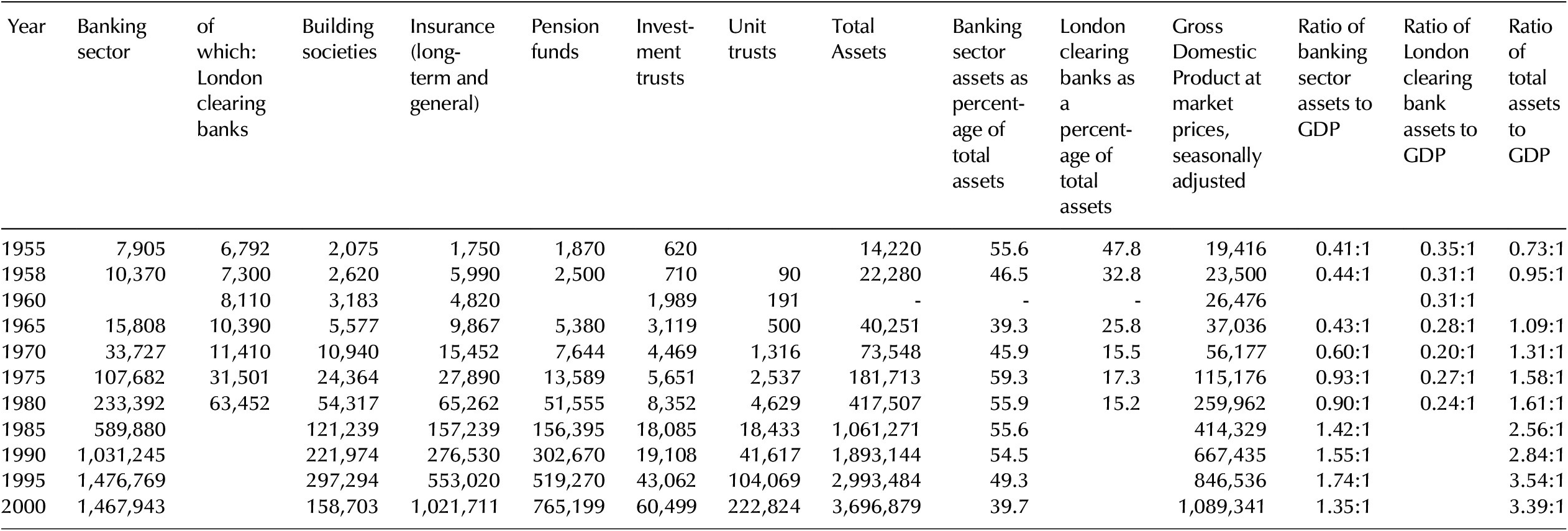
Competition in clearing banking in the quarter of a century or so after World War II needs to be considered in the context of the changing structure of banking and financial services. Watson has analyzed the assets of types of UK financial institutions from 1955 until 2000. A modified and expanded version of her data is set out in Table 1.Footnote 14 Although there was growth in banking and financial services measured by assets between 1955 and 1970, the rate of growth accelerated for most types of financial institutions from the 1970s and was exceptionally strong during that decade. Between 1955 and 1980, bank assets grew by a factor of 30, insurance by a factor of 32, and pension funds by a factor of 28. Although by 1980 banking remained the dominant industry within the sector, the assets of the London clearing banks were much less significant than in 1955. From 1955 until 1980, London clearing bank assets fell as a ratio of UK GDP from 0.35 to 0.24. What makes this particularly noteworthy is that this reduction was during a period when the assets of banking and financial institutions as a whole were growing strongly in relation to GDP. Banking sector assets increased from a ratio of 0.41 of GDP in 1955 to 0.90 in 1980, while the ratio of assets of all UK financial institutions to GDP increased from 0.73 in 1955 to 1.61 in 1980.
Assets of UK Financial Institutions, 1955–2000 (£ million current prices)

Note: For all years except 1958: Watson, “The Financial Services Sector since 1945,” Table 7.1, page 171. For 1958: Committee on the Working of the Monetary System, Report, to face page 360, Table 20, column headed ‘End 1958’. The data in the London clearing banks column for 1955, 1960 and 1965 is from: Sheppard, The Growth and Role of UK Financial Institutions 1880-1962, Table (A) 1.8; Annual Abstract of Statistics No. 112 1975, Table 390; and Bank of England Quarterly Bulletins Quarter 4 1976 and Quarter 4 1981. By 1985, the Bank of England Quarterly Bulletins did not show the assets of the London clearing banks separately. GDP figures are taken from Gross Domestic Product at market prices: Current price: Seasonally adjusted £m, accessed May 29, 2019, https://www.ons.gov.uk/economy/grossdomesticproductgdp/timeseries/ybha/pn2?referrer=search&searchTerm=ybha. An earlier version of this table appears in Arch, The Regulation of the London Clearing Banks, 1946–1971: Stability and Compliance, Table 3.
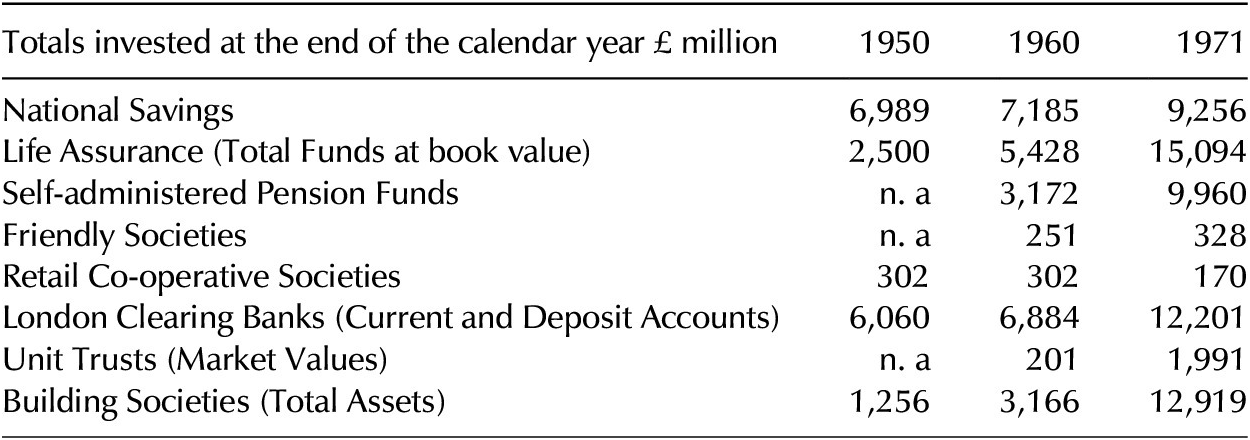
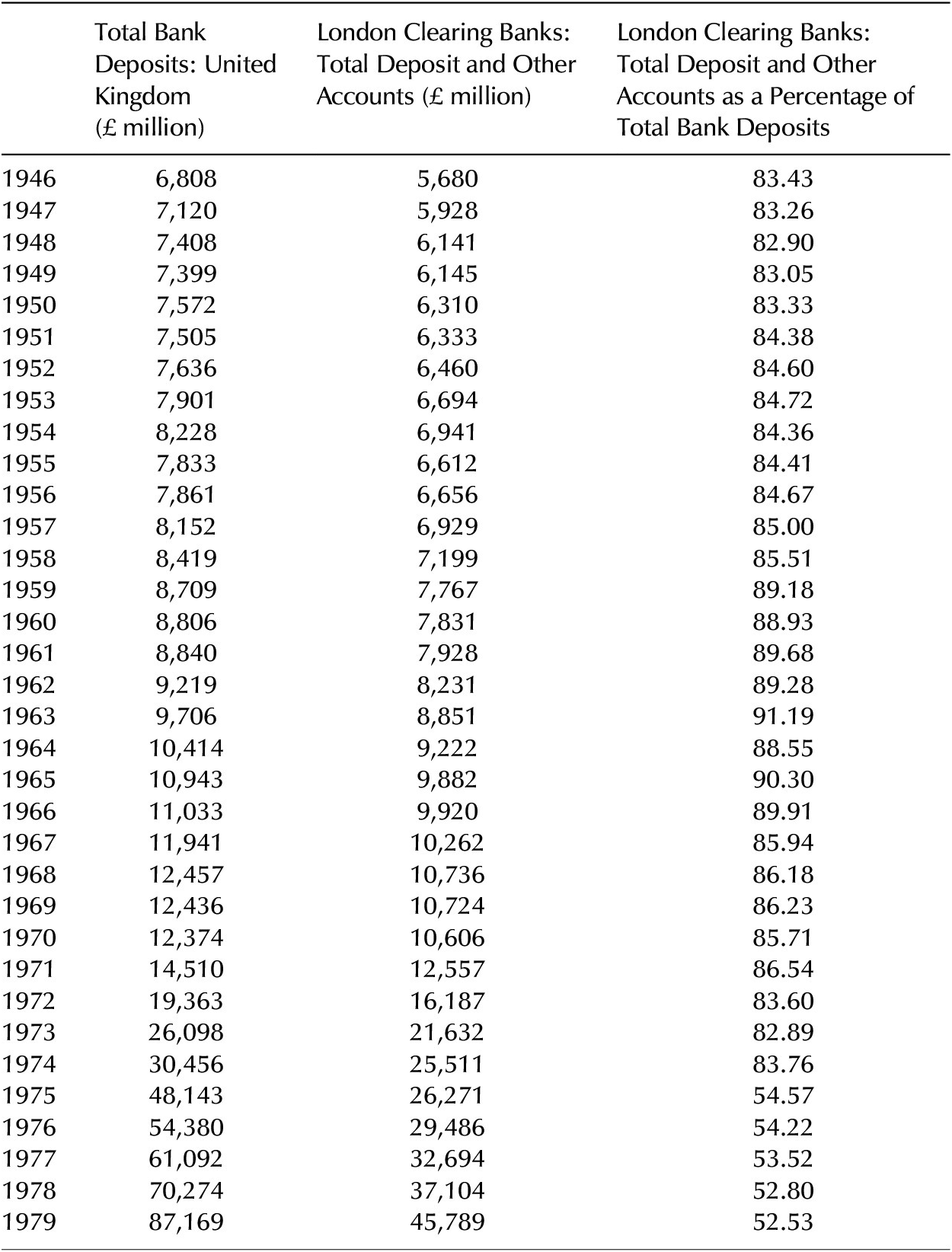
Table 2 illustrates the changing structure of a specific market, the market for savings products, by type of financial institution. During the period 1950 to 1971, savings held with the clearing banks grew less strongly than those held with building societies, pension funds, and life assurance companies. Amounts deposited with the London clearing banks accounted for a diminishing proportion of all UK bank deposits, but not until the mid-1970s, as shown in Table 3.
National Savings and Other Financial Institutions: Savings Balances

Note: Adapted from the report of the Committee to Review National Savings, Cmnd. 5273, April 1973, Table 6, page 12.
UK Bank Total Deposits and London Clearing Banks Deposit and Other Accounts, 1946-79

Note: (i) B. R. Mitchell, British Historical Statistics, Financial Institutions 4. Bank Deposits – United Kingdom, 1870-1982, page 663; (ii) Bank of England Statistical Abstract Number 1, 1970, Table 9 (1); (iii) Bank of England Statistical Abstract Number 2, 1975, Table 8 /2; (iv) Bank of England Statistical Abstract 1992, Part 1, Table 2.4. The discontinuity in the column ‘Total Bank Deposits: United Kingdom (£ million)’ from 1975 was as result of changes introduced in that year in the statistical information collected from banks and discount houses with a larger number of institutions being included in the statistics.Footnote 1
1 See “New Banking Statistics,” Bank of England Quarterly Bulletin, Quarter 2, 1975. Collins noted that the larger number of institutions included in the statistics from 1975 meant that the relative decline of the London clearing banks in relation to all banks is likely to be “overstated.” See Collins, Money and Banking in the UK, 411.
Measuring Competition Quantitatively
How does the market structure of a banking system (such as the number of banks in the market, their size, and the degree of concentration within it) affect its competitiveness? A high degree of concentration in an industry might suggest that there are high barriers to entry, which in turn thwarts competition.Footnote 15 On the other hand, if there is relatively easy entrance to and exit from it, incumbent firms are subject to the threat of new entrants. They will act as if those potential entrants had already entered the market. How concentrated was clearing banking? The empirical research uses several methods to measure concentration and competition.Footnote 16 Measures of competition (or concentration) tend to fall into one of two categories. First, there are “structural” measures such as the n-firm concentration ratio and the HHI. These measures tend to assume that concentration is an indicator of the absence of competition. There are also “nonstructural” measures which are concerned not only with the current set of participants in the market, but also with potential participants. These focus on the contestability of the market rather than its structure. Empirical research relies increasingly on nonstructural competition measures. Given that there is no single, universally accepted quantitative measure of competition, a limitation of measuring competition quantitatively is that different measures may result in different outcomes, and for this reason, Liu, Molyneux, and Wilson suggest that the research should consider using multiple measures.Footnote 17 De-Ramon and Straughan, for example, adopt this approach in their study of competition in the deposit-taking sector in the UK from 1989 to 2013, in which they deploy the HHI (a structural measure), and three nonstructural measures: the Panzar-Rosse H-statistic, the Boone indicator, and the Lerner Index.Footnote 18 In this case, all four measures yielded consistent results.
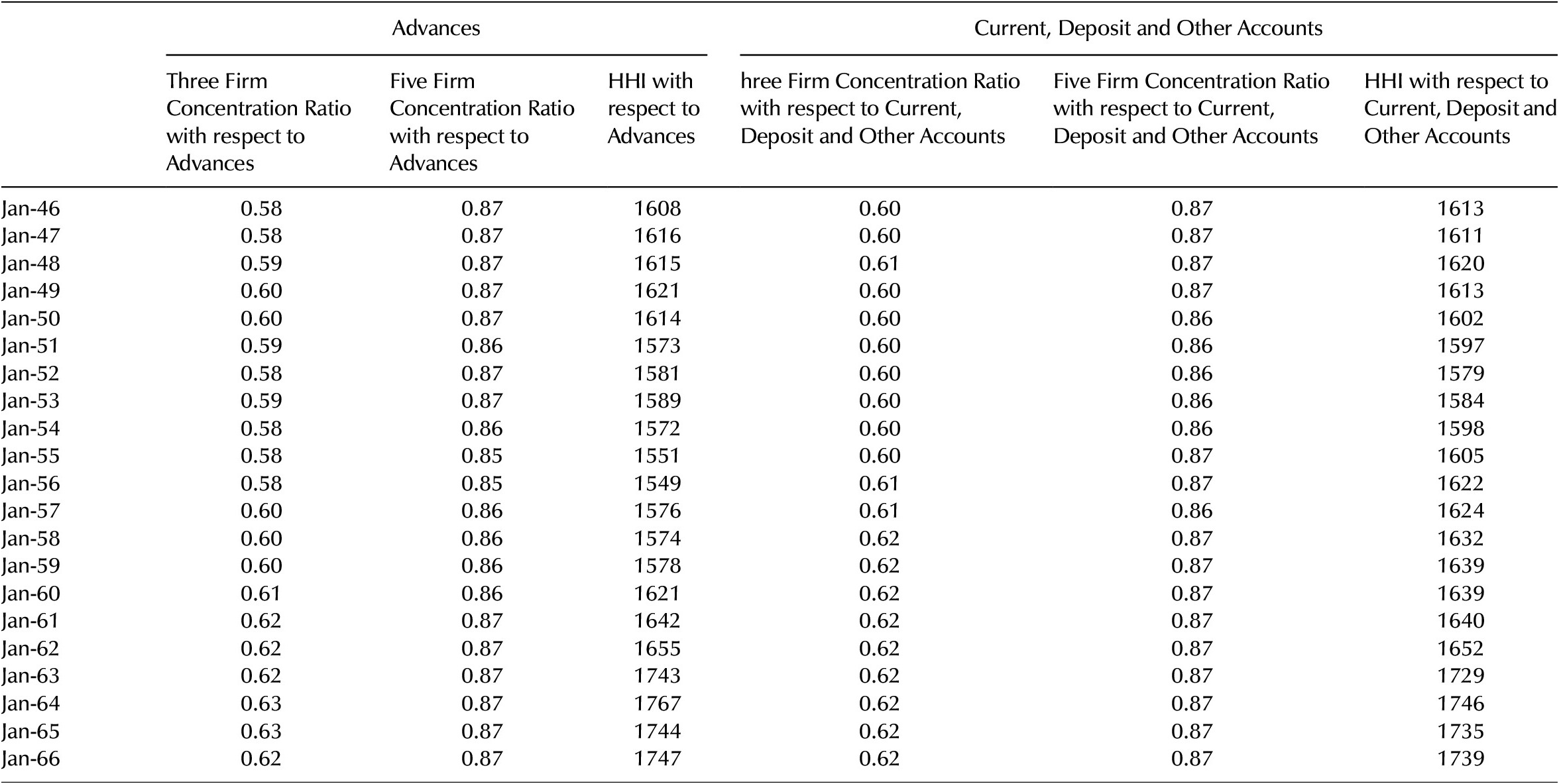
Table 4 below gives an indication of the degree of concentration in London clearing banking, which has been measured using concentration ratios (three-firm and then five-firm) and the HHI.Footnote 19 The results below for the period 1946–1966 show that, measured by the HHI, clearing banking was moderately concentrated.
London Clearing Banking: Concentration Ratios and the HHI with respect xsto (i) Advances and (ii) Deposits, 1946–66

Note: “Monthly Statement of Balances of London Clearing Banks,” London Metropolitan Archives (LMA) CLC/B/029/MS32193/004–7 and author’s calculations
Table 4 indicates high but stable levels of concentration in UK banking between 1946 and 1970. Following the merger of Westminster and National Provincial in 1968, concentration in clearing banking increased.Footnote 20 From 1970, concentration declined steeply. We can thus associate the earlier stable period with moderate to high concentration and associate the less stable period from the early 1970s with lower concentration. This would support the proposition that concentration in banking is associated with stability.
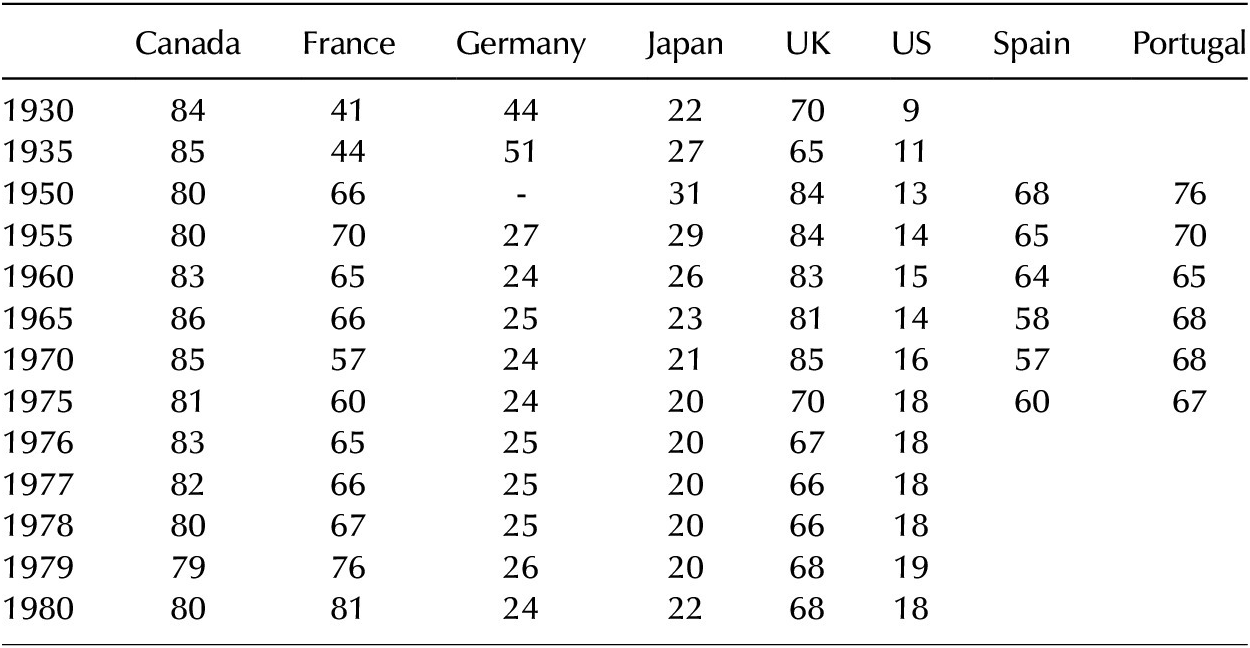
Table 5 enables concentration in the UK banking system to be considered in a wider context. The marginal increase in concentration in the UK from 1950 until 1970 contrasts with the falls in concentration in the other European countries in the table and with Japan. From 1970 to 1980, there were reductions in concentration in the UK and Canada only, albeit the reductions were more marked in the UK than in Canada. In 1967, the Bank Act in Canada introduced some liberalizing measures. These had some parallels with changes in British banking as a result of the new policy of Competition and Credit Control in 1971.
Five-firm Bank Concentration Ratios, 1930–80

Note: (i) Canada, France, Germany, Japan, UK and US: Baer and Mote, “The Effects of Nationwide Banking on Concentration: Evidence from Abroad,” pages 3-17. Baer and Mote cite as their source Herbert Baer and Elizabeth Pongracic, “The Development of Banking Structure Histories in Five Countries,” unpublished paper, Federal Reserve Bank of Chicago, 1984; (ii) Spain and Portugal: Luciano Amaral, “Measuring Competition in Portuguese Commercial Banking During the Golden Age (1960–1973),” Table 3, page 1201.
If clearing banking was moderately to highly concentrated up until the 1970s, what does this imply about the degree of competition in the market? The theory of contestable markets suggests that competition can prevail even in an oligopolistic market. The definition of a contestable market is that “it has no entry or exit barriers, no sunk costs, and all firms (new and incumbent) have access to the same level of technology.”Footnote 21 One approach to evaluating the contestability of banking in this period would be to test whether or not these three conditions were met. We can also evaluate the contestability of the market from a competition policy perspective, by evaluating the market for the presence of monopoly, mergers, and restrictive trade practices. These phenomena potentially impede entry into and exit out of the market. To what extent were they present in banking?
Monopoly, Mergers, and Restrictive Practices
Monopoly
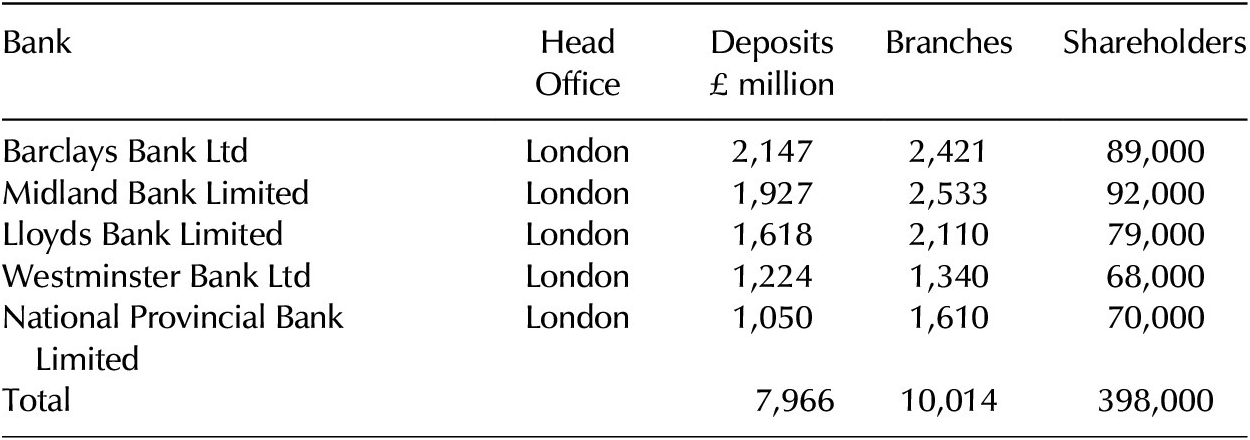
Competition policy is concerned with curbing the anticompetitive effects of monopoly and oligopoly, and reducing the adverse impacts of mergers and restrictive trade practices on competition. In 1948, the Labour government enacted the Monopolies and Restrictive Practices (Inquiry and Control) Act, and thereby established a ten-member Monopolies and Restrictive Practices Commission. This could be interpreted as the first formal implementation of competition policy in the UK.Footnote 22 Of central importance was the definition of a monopoly. Under the act, the threshold was that at least one-third of the supply of goods in an industry was carried out by any one person or body corporate. The Commission was an administrative body whose verdicts did not carry legal weight, it being for the Board of Trade to act (or otherwise) on those verdicts. Monopoly did not emerge or prevail in clearing banking in the period under review. The market structure was oligopolistic. Table 6 shows the relative size of each of the Big Five in terms of deposits, branches, and numbers of shareholders in 1964. Deposits with Barclays, the largest bank in terms of deposits, amounted to 27 percent of total deposits.
Distribution of Deposits among the Big Five, December 31, 1964

Note: Roger Orsingher, Banks of the World, page 48.
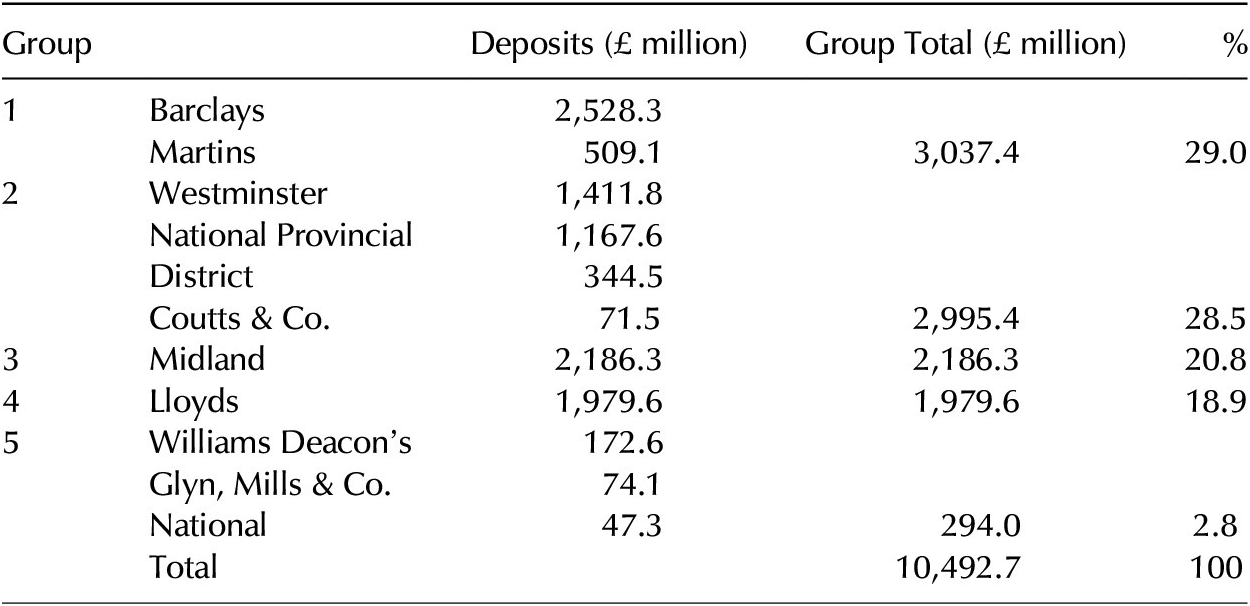
Had the proposed merger of Barclays, Lloyds and Martins in 1968 proceeded, the combined deposits of all three banks would have been well in excess of the monopoly threshold – see Table 7.
Had the proposed merger of Barclays, Lloyds, and Martins in 1968 proceeded, the combined deposits of all three banks would have been well in excess of the monopoly threshold—see Table 7.
Deposits by Group on July 17, 1968

Note: “Committee of London Clearing Banks: Grouping of Deposits on 17th July, 1968,” Bank of England Archive (BoE) G1/13 Governor’s File: Various Bank Mergers and Amalgamations.
Mergers
Mergers and monopolies are closely related, in that a merger of entities might lead to a monopoly or at least a duopoly in a market. In 1962, the takeover of District Bank by National Provincial Bank was the first takeover of one clearing bank by another since the report of the Treasury Committee on bank amalgamations in 1918. The Treasury Committee recommended that the joint stock banks be required by statute to obtain prior approval for future amalgamations. A bill to that effect was presented to the House of Commons in April 1919. Under threat of legislation, the Big Five undertook not to propose further amalgamations. Although the bill was withdrawn in December 1919, in 1924 the government and the governor formalized the principle that the Big Five should not amalgamate among themselves or with another bank without approval. The “gentlemen’s agreement” between the clearing banks not to amalgamate without government approval was thus established.Footnote 23 National Provincial accordingly sought and received consent from HM Treasury for the takeover of District.Footnote 24 The clearing banks thus self-regulated mergers—with their gentlemen’s agreement—as opposed to using competition policy to regulate mergers, at least until 1965.
The scope of competition policy was extended to mergers with the Monopolies and Mergers Act 1965. In that year, Jasper Hollom, then chief cashier at the Bank of England, expressed a distinctly tolerant attitude toward mergers in clearing banking: “I am attracted by the idea of a clearing bank coming to be the center of a group of concerns covering the widest range of financial interests. H.S.C. objects that such a development would lead to a reduced field of choice.… It seems to me more important, however, that it would lead to the creation of the powerful units that are increasingly necessary in international trading.”Footnote 25 By the time of the publication of the NBPI’s report on Bank Charges in 1967, the Bank of England’s position had shifted decisively, and it explicitly questioned the convention that the Big Five clearing banks should not amalgamate. This coincided with a change of governor, Leslie O’Brien having replaced the Earl of Cromer in 1966:
Further amalgamations among the banks, carried through to the appropriate point, could permit some rationalization of existing networks. The Bank of England and the Treasury have made it plain to us that they would not obstruct some further amalgamations if the banks were willing to contemplate such a development; and we think that a further reduction in the number of independent banking units would not necessarily affect very significantly the degree of competition.Footnote 26
On January 26, 1968, two of the Big Five clearing banks—the Westminster Bank and the National Provincial Bank—announced that they were to amalgamate, reducing the Big Five to the Big Four. This merger was a “tremendous shock” according to Wilson, chief general manager of Lloyds.Footnote 27 Within two weeks, on February 8, Barclays, Lloyds, and Martins announced that they proposed to merge. This announcement came as “a bombshell” according to The Economist, which nevertheless pronounced itself in favor of the merger: “A regrouping of British banking into three giants … would give Britain the kind of superbanks required by the growing demands of British and international business companies.”Footnote 28
On February 12, 1968, the Board of Trade referred the proposed merger to the Monopolies Commission. Ten members of the Commission carried out the investigation under its chair, Sir Ashton Roskill. It reported on July 15, 1968, stating, “By a majority of six to four, the Commission concluded that the mergers could be expected to operate against the public interest and that there were no safeguards which could be recommended as practicable and worthwhile.… The Commission accepted that there was a strong case for Martins Bank Ltd. joining with another bank.”Footnote 29 The four dissenters on the Commission believed that “a three-bank system”—the merged bank, plus Midland Bank and National Westminster Bank—“would be one in which all three banks would have an incentive to compete.”Footnote 30
The principal concern of the authorities with the proposed merger was that it would lead to a duopoly. With one very large bank (the merged Barclays, Lloyds, and Martins) and two other banks—National Westminster and Midland—each roughly half the size of the largest one, there was a strong possibility that in due course the National Westminster and Midland would merge. A duopoly, according to a Bank of England official, could lead to “instability, particularly if the largest bank grew faster than the others.”Footnote 31 This echoed the Treasury’s concern: “The Treasury representatives thought a drop in the number of banks to two would be very serious … a two-bank system might in certain circumstances behave like a monopoly.”Footnote 32
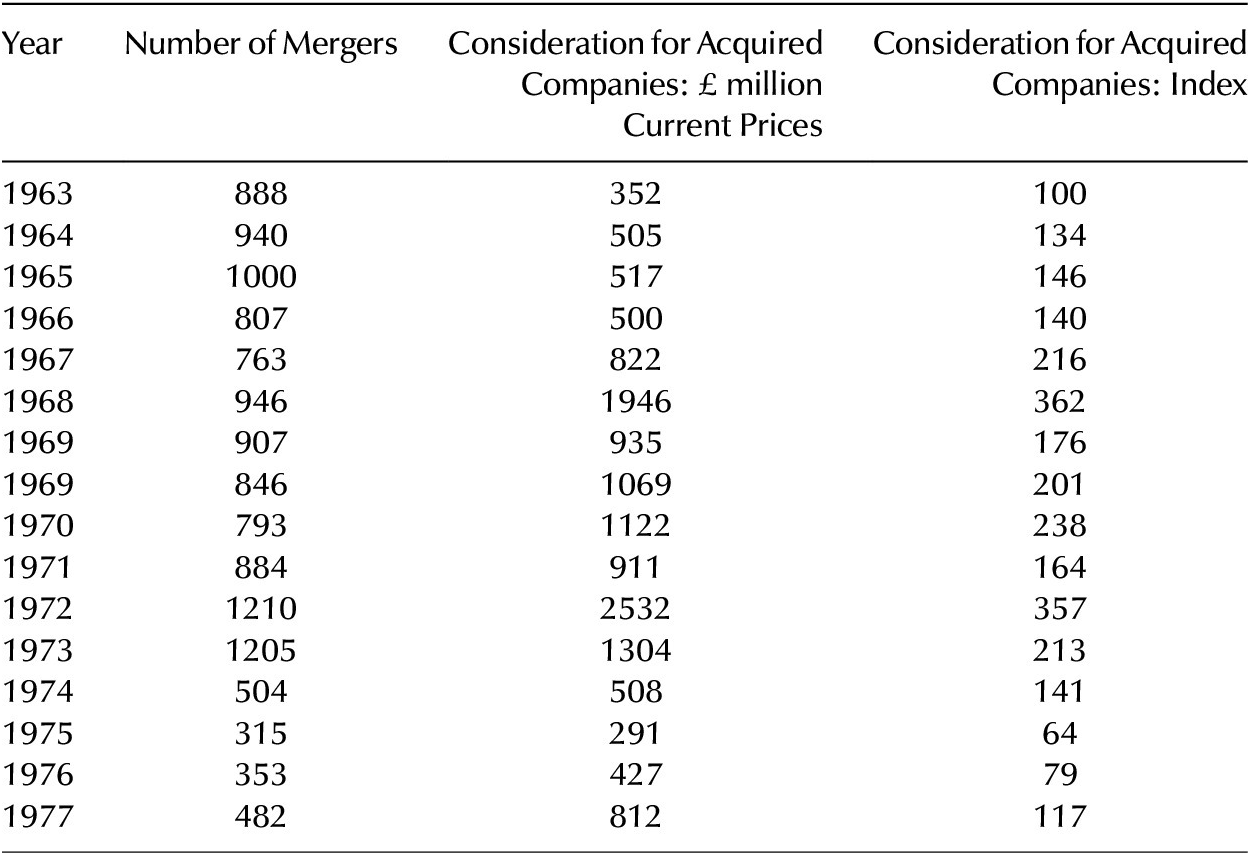
The Monopolies Commission investigation in 1968 was one of the very few instances of competition policy having a direct impact upon the structure of clearing banking in this period. It was unusual for the Commission to reject mergers in any sector, let alone banking. From 1965 to 1979, the activity of the Commission in relation to mergers across all sectors was modest.Footnote 33 It investigated thirty-one proposed mergers during that period, excluding both newspaper mergers and those which were abandoned during the investigation. In twenty cases it recommended that the merger be permitted; in eleven it recommended against the merger. Merger activity intensified in the 1960s, in terms of value, peaking in 1968 and 1972, as shown in Table 8.
Merger Activity, Industrial and Commercial Companies, 1963–77

Note: A Review of Monopolies and Mergers Policy: A Consultative Document, Appendix: Table 1, itself derived from Business Monitor M7. The data for 1969 is based upon company accounts prior to 1970, and on the financial press and other sources since 1968. The consideration in current prices is deflated by the FT Actuaries 500 Ordinary Share Index.
Notwithstanding the persistence of these concerns about amalgamations in banking on the part of the authorities, Garnett, Mollan, and Bentley point out that the population of British banks has been in decline since 1810 and that neither “strategic action at the firm level, [n]or regulation at the state level” have altered that fundamental trend.Footnote 34 In any case, attitudes toward mergers (across industry and commerce generally) were changing by the 1960s. Greater tolerance of merger activity in the 1960s and early 1970s reflected the authorities’ view that one reason why the UK economy was declining in relation to its competitors was because of the relatively small size of its operating units. Middlemas notes: “The first stage of the great wave of concentration … was based on the premise that, as competition externally became more difficult, economies of scale and increased monopolistic power would safeguard domestic market share.”Footnote 35 The Board of Trade was not hostile to mergers, it even welcomed them:
[The Board of Trade] watched the burgeoning process of concentration with enthusiasm. Mergers and takeovers … appeared to offer an alternative means to recover Britain’s lost competitive position in world trade … BOT policy favoured and facilitated mergers, yet at the same time worked to eliminate restrictive practices, a trend that culminated in Edward Heath’s abolition of resale price maintenance in 1963. Footnote 36
In 1966, the Labour government established the Industrial Reorganisation Corporation (IRC)—which reflected a presumption in favor of mergers in its workings—expressly to rectify the problem of relatively small operating units, by seeking out opportunities for “rationalization schemes.”Footnote 37 Any merger that took place under the aegis of an IRC scheme was exempt from referral to the Monopolies Commission.Footnote 38 The Financial Times characterized the IRC’s role as “help[ing] in the task of welding much of British industry into bigger and more efficient units.”Footnote 39 The establishment of the IRC fits with an ideational shift between the 1950s and the 1980s whereby the state came to see monopolies as “relatively harmless.”Footnote 40 In 1968, the chair of the NBPI commented on the growing tolerance for firms with significant market power thus:
Is market power in fact the result of efficiency, and if so, should it be penalised? I think our Reports that have dealt with this problem have tended not to condemn the expansion of market power if there is a reason to believe that this is the outcome of efficiency.Footnote 41
As it was articulated in 1978, UK legislation made a presumption that “mergers are generally not against the public interest and should therefore be allowed to go ahead unless clear net detriments can be identified.”Footnote 42
Restrictive Trade Practices
The Conservatives were victorious in the October 1951 general election, and Peter Thorneycroft was appointed to the position of president of the Board of Trade by the prime minister, Winston Churchill. Thorneycroft focused increasingly on eliminating restrictive practices as a prominent feature of competition policy. In 1956, the Restrictive Trade Practices Act established a new Restrictive Practices Court. Simultaneously, there was a diminution of the power of the Monopolies and Restrictive Practices Commission, with the reduction of its membership from twenty-five to ten. Crucially, the scope of the Restrictive Trade Practices Act 1956 was limited to the supply of goods only, so it did not address bank restrictive agreements. The Fair Trading Act 1973 amended the Restrictive Trade Practices Acts of 1956 and 1968 to cover services and defined a monopoly situation as one in which the supply of services, to the extent of at least one-quarter, was supplied by one and the same person.Footnote 43 Governments in the period 1946 to 1971 did not use competition law to address restrictive practices, as is illustrated in the three examples of restrictive practices which follow.
The quintessential expression of the cartel in clearing banking was that it set rates of interest payable (or receivable) on many bank products and services collectively. Typically, the chief executive officers of the clearing banks met and reviewed rates whenever the bank rate changed. Their collective agreement included an agreement not to pay interest on current accounts; the minimum period of deposit for a deposit account; the rate of interest payable on deposit accounts; the minimum rate of interest on loans to the discount market; and the discount rate on bills. For example, on March 11, 1952, the bank rate increased from 2.5 percent to 4 percent. The chief executive officers of the clearing banks met on that day and agreed to a rating structure to take effect from March 12, 1952. Interest rates payable on deposit accounts were set at 2 percent.Footnote 44 There was not a formal mechanism for enforcing uniform prices. Adherence to collectively-agreed prices was a norm and thus not binding. Transgressions (usually by other types of banks) would be reported to the Committee and the Chair would take-up the matter with the transgressing bank. The Bank of England ended collective pricing in 1971 with its new policy of Competition and Credit Control.
The operation of uniform opening hours by the London clearing banks was a restrictive practice, and, as with pricing, the CLCB was responsible for collectively agreeing to these. Uniform bank opening hours were a restrictive practice. In the mid-1960s, the opening hours of the London clearing banks were from 10:00 a.m. to 3:00 p.m. from Monday to Friday and from 9:30 a.m. to 11:30 a.m. on Saturdays. If anything, the practice became more restrictive at the end of the 1960s because in 1968 the clearing banks collectively decided that from July 1, 1969, they would close on Saturdays. This change was driven by the fact that, with the UK economy operating at close to full employment, it was not easy for the banks to recruit and retain staff. In parallel with a reduction in opening hours, the banks introduced cash dispensers and/or Automated Teller Machines (ATMs) in the late 1960s and early 1970s, with the ATM becoming “the chief alternative to the human teller during the 1980s.”Footnote 45
A third restrictive practice was that membership of the Bankers’ Clearing House was strictly controlled by its members. This was a major barrier to becoming a clearing bank. Joint-stock banks were able to become members of the Clearing House from 1854, when six joint-stock banks were admitted. The admission of District Bank to the Clearing House on January 1, 1936, brought the number of clearing banks to eleven. It was not until the early 1970s that the Clearing House admitted some new members, although banks who were not members of the Clearing House did have access to the check clearing system through agency arrangements with Clearing House members. It is not evident that other banks were clamoring to become members of the Bankers’ Clearing House. In a document submitted to the Monopolies Commission in 1968, “Report on the Bankers’ Clearing House,” on March 6, 1968, the Committee of London Clearing Bankers commented on whether any new applications for membership had been turned down in recent years. They stated in their response: “There is no record of any formal application for membership having been either made or refused in recent years, except for the admission of the District Bank in 1936. This may, to an extent, be accounted for by the fact that certain non-Clearing Banks, as shown on the attached list, have access to General clearing through their clearing agents.”Footnote 46
In 1973, following the dismantlement of the cartel, the CLCB invited a number of banks to discuss the possibility of joining the Bankers’ Clearing House. In 1974, the Co-operative Bank (which had become a banking company in 1971) joined, the first new member of the Clearing House since 1936. The Central Trustee Savings Bank joined the Clearing House in November 1975.
Reveley and Singleton advance the view that the principal role of the Committee of London Clearing Bankers’ was solely to advance the interest of its members: “It [the CLCB] was an organizational vehicle for supporting the rent-seeking activities of its clearing bank members.”Footnote 47 Although it is the case that the Committee of London Clearing Bankers played a central role in the enforcement of London clearing bank restrictive practices, to conceive of the Committee as a trade association is too narrow and understates the multifaceted role of the CLCB.
Governments’ reluctance to mobilize competition policy and competition law in banking is a reflection of the authorities’ ambivalence toward competition in banking until the mid- to late-1960s. Monopolies and mergers in services (including banking) only came within the remit of competition law with the passage of the Monopolies and Mergers Act 1965. It was not until 1968 that the Monopolies Commission directly used competition law upon the clearing banks, when it voted by a narrow margin to reject the proposed merger of Barclays, Lloyds, and Martins. The law did not cover restrictive practices in services until the Fair Trading Act 1973. Moderated competition in clearing banking was not a sufficiently serious problem for governments to bring competition policy and competition law to bear upon it. This was because the degree to which competition should prevail in banking was contested and because it may not have been in the immediate interests of the authorities to inject greater competition into banking. In any case, the management of sterling was the priority issue during this period.
The Report of the National Board for Prices and Incomes
Under the National Board for Prices and Incomes’ Terms of Reference, it was for the government to determine which questions relating to prices and pay should be referred to the Board. Inevitably, therefore, these referral decisions had a political dimension, and the clearing banks were sitting targets. Prior to the reference on bank charges, a very early NBPI report addressed the salaries of the staff of Midland Bank. The Board recommended that no further pay increases be made until early in 1967 at both Midland and the other clearing banks.Footnote 48 In June 1966, the government requested the NBPI to examine “the system and level of charging customers of the London clearing banks and of the Scottish banks.”Footnote 49 The government wanted this examination “in the light of the banks’ profit and dividend record,” implying that clearing banking was excessively profitable and therefore not sufficiently competitive.Footnote 50 The Board reported to parliament eleven months later in May 1967.Footnote 51
The NBPI report highlighted the need to improve competition in banking:Footnote 52 “We think that a widening of the area of competition between the banks is a prerequisite for promoting change, for the banks to regain the place which they have tended to lose in the capital market and for extending the degree of competitiveness in the entire financial system.”Footnote 53 To correct these problems, it recommended the abolition of collective pricing of current and deposit accounts, and of advances. It also recommended that financial reporting exemptions for banks be rescinded, as they inhibited competition: “To sharpen the competitive pressures on the banks—and therefore between the banks and other institutions—we recommend that … the Government should aim at ensuring complete disclosure of profits and reserves as soon as is practicable.”Footnote 54
Competition between the clearing banks and other institutions implied the existence of substitutes in consumption. By the 1960s, there were at least eight sources of substitutes in consumption for core clearing bank products:Footnote 55
-
1. Building Societies: The purchase of shares in a building society was an alternative to saving in a clearing bank deposit account.
-
2. Trustee Savings Banks (TSBs): In addition to competing for savings, TSBs offered a limited current account from 1965, as an alternative to a clearing bank current account. They also sold the Trustee Savings Banks Unit Trust from 1968.
-
3. The Post Office Savings Bank: It offered ordinary accounts and investment accounts and focused on customers with modest savings. Interest was offered on their ordinary accounts, in contrast with clearing bank current accounts.
-
4. Finance Houses: They offered medium-term instalment credit to individuals and industry and thus competed with clearing bank loans and advances.
-
5. Non-clearing Banks: These included Accepting Houses, British overseas banks, and overseas and foreign banks, most notably American banks and Japanese banks. As these banks operated primarily in the wholesale rather than the retail markets, they were competing less directly with the clearing banks as takers of retail deposits and as retail lenders. Battilossi has documented how important the new Euromarkets, led by the American banks, were to the transformation of the large clearing banks from “sleeping giants” into global banking groups.Footnote 56
-
6. Local Authorities: Firms could lend to a local authority as an alternative to placing a term deposit with a clearing bank.
-
7. Sterling Certificates of Deposit: In 1968 the Bank of England authorized a market for sterling certificates of deposit. Unlike ordinary deposits, these could be traded in a secondary market.
-
8. National Savings: There were a number of national savings products, which were potential substitutes for clearing bank savings products.
Returning to the question of profitability, Capie and Billings’ research indicates that over the period 1920–1970, returns on capital in banking took the form of a very shallow “U-shape.” Profitability in clearing banking did increase from the 1940s through to the 1960s, albeit modestly.Footnote 57 Ackrill and Hannah’s study of Barclays Bank specifically suggests that the rate of return on actual shareholders’ funds in real terms was extremely volatile for the period 1945 to 1971. It ranged from –2.9 percent in 1955 to 37.5 percent in 1958. In terms of decadal averages, they estimate that the annual average actual rate of return above bank rate (or Minimum Lending Rate) for Barclays was 4 percent from 1946 to 1970 and 1970 to 1979, but then fell to 1 percent in 1980–1989.Footnote 58 Throughout this period, the Bank of England implemented quantitative and qualitative credit controls. These controls had an impact upon clearing bank profitability by restricting lending in the form of advances, their most profitable service. Davies and Wynne Evans showed that for the period from 1970 to 1982 (when lending ceilings had largely disappeared) the average annual growth rate of pretax profits of the Big Four was 17 percent.Footnote 59
Table 1 illustrated the growth of banking and financial services measured by assets. Gross trading profits also grew, and significantly faster than in other broad sectors. Over the period 1947–1970, gross trading profits in the “Insurance, Banking and Finance” sector increased from £172 million in 1947 to £1,571 million in 1970, a compound annual growth rate (CAGR) of 10.09 percent. For “Distributive Trades,” the increase was from £345 million to £940 million (a CAGR of 4.45 percent), and for “Manufacturing,” from £1,017 million to £3,180 million (a CAGR of 5.08 percent). The gross trading profits of the “Insurance, Banking and Finance” sector as a percentage of the UK’s Gross National Product increased from 1.90 percent in 1948 to 6.69 percent by 1970.Footnote 60 On the other hand, although gross trading profits were healthy, a series of articles in the Bank of England Quarterly Bulletin drew attention to the fact that there was a downward trend in aggregate real profitability in the 1960s and early 1970s for the economy as a whole. A sharp decline in the mid-1970s was followed by a modest recovery from 1975.Footnote 61
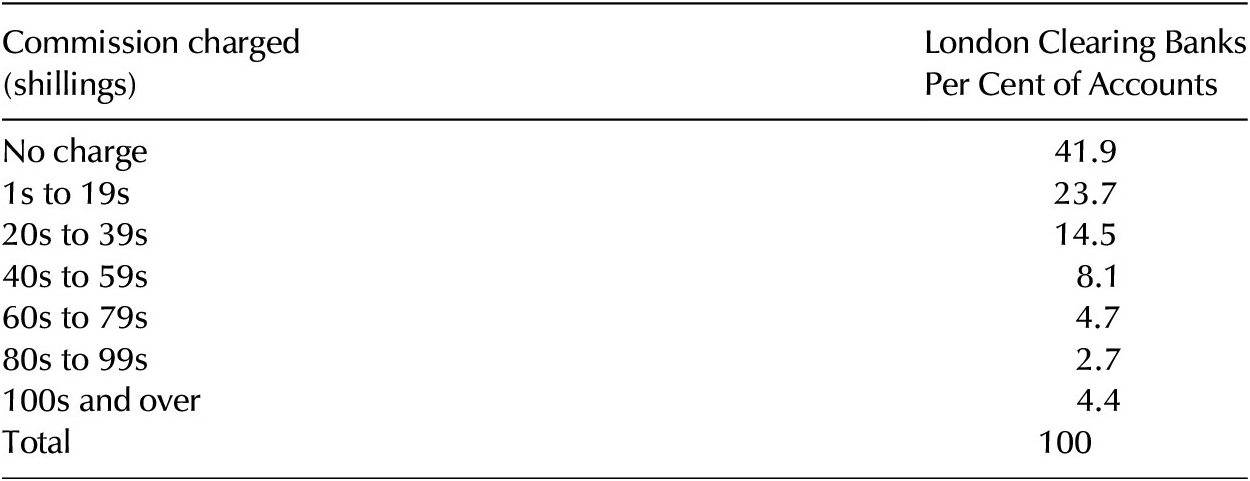
It is not necessarily straightforward to compare the profitability of banking with that of other sectors, however. This is in part because bank balance sheets are different from the balance sheets of many other companies because customer deposits are liabilities (from a bank’s perspective) and loans to customers are assets (from a bank’s perspective). These items would not feature on the balance sheets of companies in other sectors. In addition, there are several distinct measures of profitability, some based on return on sales and others based on return on investment. It is not evident which measure would be most appropriate when comparing banking with other sectors. In commenting on bank profitability, the NBPI was at pains to point out that bank profits necessarily contained an “endowment” element. Bank income rose with increases in the bank rate, but costs did not necessarily increase at the same rate. This was an inherent feature of the industry. The NBPI recognized that the generally higher levels of the bank rate during the 1960s contributed to increased profit margins.Footnote 62 The bank rate had been 2 percent from October 1939 until November 1951. Between then and 1959 it ranged from 2.5 percent to 7 percent, whereas between 1960 and 1969, it was in the range 4 percent to 8 percent. The Board concluded that the recent high levels of profit and dividend were not attributable to excessive charges: “It does not seem that the actual level of charges could be described as unreasonable.”Footnote 63 It reiterated the point on several occasions: “We cannot say that these ‘excessive’ profits have resulted from unnecessarily high charges, including lending rates, since, granted existing conventions, they merely reflect the level of Bank Rate.”Footnote 64 “As for commission charges,” the Board opined, “we have received no information to indicate that they are generally too high.”Footnote 65 The distribution of accounts with London clearing banks by commission charged over a six-month period in 1966 is shown in Table 9.Footnote 66
Distribution of Accounts by Commission Charged for Six Months ending August 31, 1966

Note: Adapted from National Board for Prices and Incomes, Report No. 34, Bank Charges, Appendix VIII, Table C, page 74.
The NBPI thus cast doubt on the idea that moderated competition necessarily led to high or excessive prices. Alternatively, if bank charges were reasonable, competition may not have been as weak as was generally assumed, particularly if high profits were at least in part attributable to the endowment effect.
Openness to Change and Innovation
The conclusions of the NBPI notwithstanding, it was generally assumed that high profits in clearing banking were evidence that they were insufficiently innovative. The Economist opined that “innovations do not pay—or anyway not immediately. That is suggested by the greater profitability of Lloyds on almost any fair basis of comparison; it is usually reckoned the staidest of the big four.”Footnote 67 Was there an absence of innovation in clearing banking between 1946 and the early 1970s? Innovation is often measured by counting the number of patents issued (it being assumed that this is a proxy for innovation) or by determining the scale of expenditure on research and development.Footnote 68 This article takes the approach of itemizing chronologically significant product, process, organizational, management, and marketing changes and innovation in a clearing banking in the period, drawing predominantly (but not exclusively) on evidence from Lloyds Bank, showing the results in Table 10. Its purpose is to give an impression of the types of changes and innovations in clearing banking from 1946 into the 1970s, and also to suggest that it is an exaggeration to characterize clearing banking as stagnant.Footnote 69 Furthermore, whereas competition may be the fundamental driver of innovation in many industries, this axiom may not hold in banking and financial services. What may motivate innovation in finance is not competition, but the drive to reduce constraints, including the constraint of regulation, according to Silber.Footnote 70 Moreover, in the wake of the global financial crisis, we can call into question the assumption that innovation in banking and finance is always and necessarily beneficial to consumers. In his study of the cost of financial intermediation, Philippon reached the startling conclusion that, in the United States, innovation does not appear to have reduced the cost of financial intermediation: “The unit cost of financial intermediation appears to be as high today as it was around 1900. [It] does not seem to have decreased significantly in recent years, despite advances in information technology and despite changes in the organization of the finance industry.”Footnote 71 The questions we should pose about innovation in clearing banking in the period under review is not only whether the banks innovated, but whether the benefits of any innovations were greater than their costs and risks.Footnote 72 The literature does not address this point and is more concerned with establishing the clearing banks’ lack of dynamism and failure to innovative.
Change and Innovation at Lloyds Bank, 1946–79

1 Meeting of the Board of Lloyds Bank Limited, October 19, 1962, Lloyds Banking Group Archive (LBGA) HO/D/Boa/Age/32.
2 Meeting of the Board of Lloyds Bank Limited, February 3, 1956, LBGA HO/D/Boa/Age/26.
3 Meeting of the Board of Lloyds Bank Limited, January 27, 1961, LBGA HO/D/Boa/Age/31.
4 Lloyds Bank Limited, Statement by the Chairman Accompanying the Report of Directors and Balance Sheet for the Year Ended December 31, 1950, 3, LBGA HO/S/Rep/9.
5 Lloyds Bank Limited Report and Accounts 1966, Statement by the Chairman, 20, LBGA HO/S/Rep/15–19.
6 Lloyds Bank Limited Report and Accounts 1962, Statement by the Chairman, 18, LBGA HO/S/Rep/11–13.
7 Lloyds Bank Limited Report and Accounts 1962, Statement by the Chairman, 18, LBGA HO/S/Rep/11–13.
8 Meeting of the Board of Lloyds Bank Limited, November 1, 1968, LBGA HO/D/Boa/Age/38.
9 Lloyds Bank Limited Report and Accounts 1976, Statement by the Chairman, 35, LBGA HO/S/Rep/21–24.
10 Lloyds Bank Limited Report and Accounts 1974, Statement by the Chairman, 26, LBGA HO/S/Rep/15–19.
11 Holmes and Green, Midland: 150 Years of Banking Business, 227.
12 Winton, Lloyds Bank, 1918–1969, 181.
13 Lloyds Bank Limited Report and Accounts 1966, Statement by the Chairman, 22, LBGA HO/S/Rep/15–19.
14 Lloyds Bank Limited Report and Accounts 1960, Statement by the Chairman, 15–16, LBGA HO/S/Rep/11–13.
15 Winton, Lloyds Bank, 1918–1969, 187.
16 Press Announcement, December 17, 1963, LMA CLC/B/029/MS32141/001.
17 Kynaston, City of London: The History, 496.
18 Lloyds Bank Limited Report and Accounts 1962, Statement by the Chairman, 19, LBGA HO/S/Rep/11–13.
19 Hanson, Service Banking: The Arrival of the All-Purpose Bank, 192.
20 Meeting of the Board of Lloyds Bank Limited, November 1, 1968, LBGA HO/D/Boa/Age/38.
21 Winton, Lloyds Bank, 1918–1969, 185.
22 Winton, Lloyds Bank, 1918–1969, 182.
23 Winton, Lloyds Bank, 1918–1969, 191.
24 Lloyds Bank Limited Report and Accounts 1966, Statement by the Chairman, 19, LBGA HO/S/Rep/15–19.
25 Winton, Lloyds Bank, 1918–1969, 183.
26 Lloyds Bank Limited Report and Accounts 1966, Statement by the Chairman, 22–3, LBGA HO/S/Rep/15–19.
27 Minutes of a Meeting of the Chief Executive Officers of the Clearing Banks, January 20, 1966, LMA CLC/B/029/MS32037/017.
28 Lloyds Bank Limited Report and Accounts 1965, Statement by the Chairman, 19, LBGA HO/S/Rep/14.
29 Lloyds Bank Limited Report and Accounts 1969, Statement by the Chairman, 27, LBGA HO/S/Rep/15–19.
30 Lloyds Bank Limited Report and Accounts 1969, Statement by the Chairman, 28, LBGA HO/S/Rep/15–19.
31 Lloyds Bank Limited Report and Accounts 1970, Statement from the Chairman, 38, LBGA HO/S/Rep/15–19.
32 Winton, Lloyds Bank, 1918–1969, 181.
33 Winton, Lloyds Bank, 1918–1969, 183.
34 Winton, Lloyds Bank, 1918–1969, 183-4.
35 “Intercontinental Banking Services,” September 22, 1967, LBGA HO/D/Boa/Age/36.
36 Lloyds Bank Limited Report and Accounts 1968, Statement by the Chairman, 20, LBGA HO/S/Rep/15–19.
37 Meeting of the Board of Lloyds Bank Limited, November 1, 1968, LBGA HO/D/Boa/Age/38.
38 Report to a Meeting of the Board of Lloyds Bank Limited on Computer Operations, September 29, 1970, LBGA HO/D/Boa/Age/39.
39 Lloyds Bank Limited Report and Accounts 1970, Statement by the Chairman, 34, LBGA HO/S/Rep/15–19.
40 Meeting of the Board of Lloyds Bank Limited, March 19, 1971, LBGA, HO/D/Boa/Age/41.
41 Holmes and Green, Midland: 150 Years of Banking Business, 240.
42 Meeting of the Board of Lloyds Bank Limited, April 21, 1978, LBGA HO/D/Boa/Age/48.
43 Lloyds Bank Limited Report and Accounts 1972, Statement by the Chairman, 31, LBGA HO/S/Rep/15-19.
44 Winton, Lloyds Bank, 1918–1969, 202.
45 Meeting of the Board of Lloyds Bank Limited, May 7, 1976, LBGA HO/D/Boa/Age/46. Entry into this market was significant given the potential profitability of credit cards. Barclays had been issuing the Barclaycard credit card since 1966-7. By 1986, it was “Britain’s most profitable credit card business.” See Ackrill and Hannah, Barclays: The Business of Banking 1690–1996, 251.
46 News Release, November 2, 1972, LBGA HO/D/Boa/Age/42.
47 Postcard: Customers using a Lloyds Bank Cashpoint at Upminster branch in 1981, Lloyds Bank, plc.
48 Bátiz-Lazo, “Emergence and Evolution of ATM Networks in the UK, 1967–2000,” 10-14. Bátiz-Lazo states that the initial order was for 500 machines at a cost of £3.5 million.
49 Lloyds Bank Limited Report and Accounts 1972, Statement by the Chairman, 31.
50 Bátiz-Lazo, “Emergence and Evolution of ATM Networks in the UK, 1967–2000,” 11,14.
51 Meeting of the Board of Lloyds Bank Limited, November 3, 1972, LBGA HO/D/Boa/Age/42.
52 Lloyds Bank Limited Report and Accounts 1973, Statement by the Chairman, 26, LBGA HO/S/Rep/15–19.
53 Winton, Lloyds Bank, 1918–1969, 202.
54 Lloyds Bank Limited Report and Accounts 1973, Statement by the Chairman, 26, LBGA HO/S/Rep/15–19.
55 Lloyds Bank Limited Report and Accounts 1977, Statement by the Chairman, 7–8, LBGA HO/S/Rep/21–24.
56 Lloyds Bank Limited Report and Accounts 1977, Statement by the Chairman, 7, LBGA HO/S/Rep/21–24.
57 Lloyds Bank Limited Report and Accounts 1978, Chief General Manager’s Report, 8, LBGA HO/S/Rep/21–24.
58 Lloyds Bank Limited Report and Accounts 1979, Review of Group Operations, 7, LBGA HO/S/Rep/21–24.
Conclusion
There are three implications of this study. First, a purely quantitative evaluation of competition has limitations. To begin with, there is the question of which quantitative measure(s) to use given that there is no single, universally agreed quantitative measure of competition. Different measures might yield different and even contradictory results as to the degree of concentration or competition. Furthermore, measures of concentration/competition are static in that they measure concentration/competition at a single point in time. The structure of an industry may be highly dynamic, and the intensity of competition may fluctuate continuously. One way of addressing this is to focus on trends over time. Finally, even though we discuss competition as if there were two possible states—competitive or not competitive—concentration and competition are a matter of degree. Perfect competition is an ideal type, so what needs to be evaluated is the extent to which a market is imperfect and the nature of its imperfections.
Second, there are definitional issues with which to grapple. Regardless of whether we measure competition quantitatively or qualitatively, the question of how we should define an “industry” for the purposes of measuring concentration or competition is not straightforward.Footnote 73 Do we measure competition between firms, taking the firm as our unit of analysis, based on industry classifications? Or do we measure competition by activity or function (the provision of loans, the provision of insurance, the provision of current accounts, and so on) regardless of the industry classification of the firm. An emphasis on the first approach may have resulted in the weakness of competition in clearing banking being overstated.
Furthermore, competition itself is a polysemous term. An economic interpretation of competition might view a sector as competitive if it were productively efficient. From a consumer sovereignty perspective, we would understand competition as providing the consumer with options and the consumer being able to choose effectively from those options.Footnote 74 A perspective from the business literature might see an industry as competitive when there are low barriers to entry; when there is rivalry between firms in the market; when there are substitute products and services; and when there are suppliers and buyers who are relatively powerful in relation to the firms in the industry.Footnote 75 A popular view of competition might equate it with the free market and an absence of regulation. In contradistinction, competition might be defined as the existence of a level playing field. Under this view, competition rests upon regulation. As Vogel puts it, free markets require more rules, not fewer.Footnote 76 Academic research into the degree of competition in a market needs to be explicit about which version of competition is being evaluated.
The third implication of this research is that competition needs to be evaluated in the context of the regulatory and institutional frameworks within which the industry operates. Ideally we will have policy goals of competition and regulation that are consistent and complementary, and consistent with the wider institutional framework. They may, however, be in tension. For example, the goal of competition policy may be to maximize the productive efficiency of the sector being regulated, whereas regulatory policy may have the social goals of ensuring stability in the banking sector and of ensuring high professional standards in banking. Competition policy may lean toward lower barriers to entry, whereas regulatory policy might wish them to be higher. The political goal of preventing monopoly may conflict with the competition objective of productive efficiency. In this earlier period, a policy tension existed between the objective of greater competition in banking on the one hand, and the need to manage the currency and the balance of payments on current account on the other. This manifested itself in the authorities’ distinct ambivalence toward greater competition in clearing banking. How should these tensions or conflicts be resolved?
Competition in clearing banking in the period from 1946 until the early 1970s was imperfect. On the other hand, there were mechanisms to prevent mergers between the Big Five, and these were effective until 1968; charges were not excessive, and consumers had available to them an increasing range of substitute products and services from which to choose. Finally, it was not the case that the clearing banks did not innovate. Insofar as it has been established that there was some degree of competition in clearing banking, this research lends support to the competition-stability hypothesis.Footnote 77
The concerns which arose in 1968 about the dangers of banking being dominated by two very large firms and the consequences this would have for competition, bring to mind a very contemporary business problem: In some industries, in some economies, market concentration has been increasing since the 1990s. How can competition (or contestability) be measured in concentrated sectors, with relatively few firms? What constraints should be placed on those few firms, and how are they best implemented and enforced through competition, regulation, and institutions?
Acknowledgements
The author wishes to thank Lloyds Banking Group plc for permission to use material from records for which they hold the copyright. The author also wishes to thank the archivists at the Bank of England Archive, Lloyds Banking Group Archive, and the London Metropolitan Archives for their assistance. This article contains public sector information licensed under the Open Government License v3.0. The information concerned relates to Crown copyright material created by civil servants, ministers, and government departments and agencies.