INTRODUCTION
Freezing of gait (FoG), defined as “a brief, episodic absence or marked reduction of forward progression of the feet despite the intention to walk” (Nutt et al., Reference Nutt, Bloem, Giladi, Hallett, Horak and Nieuwboer2011), is a unique and disturbing gait disorder usually observed in patients with Parkinson’s disease (PD), affecting approximately half of them in the advanced stages of the disease (Giladi et al., Reference Giladi, Treves, Simon, Shabtai, Orlov, Kandinov and Korczyn2001). It can be experienced when initiating gait or approaching destination, turning or obstacle avoiding, passing through a narrow spaces (e.g., a doorway), but also while walking in an open space, and in stressful, time-constrained situations (Okuma & Yanagisawa, Reference Okuma and Yanagisawa2008). FoG mainly occurs during “off” time, but it can also be observed during “on” time (Okuma & Yanagisawa, Reference Okuma and Yanagisawa2008). PD patients suffering from FOG (PD-FoG+) are more likely to experience falls, loss of independence, and decrease in quality of life compared with those without (PD-FoG−) (Nutt et al., Reference Nutt, Bloem, Giladi, Hallett, Horak and Nieuwboer2011).
The precise pathophysiology of FoG and the underlying neural network damage are still unknown. Besides described environmental stimuli, considerable evidence suggested that additional cognitive demands while walking might be an important trigger of FoG. Recent evidence suggested that FoG in PD correlated with generalized executive dysfunction, suggesting the role of fronto-striatal circuitry (Amboni, Cozzolin, Longo, Picillo, & Barone, 2008). The FoG severity negatively correlated with the executive test performance, with faster progression of executive dysfunction in PD-FoG+ patients during a 2-year follow-up study, while the cognitive status of the non-freezers did not change (Amboni et al., Reference Amboni, Barone, Picillo, Cozzolino, Longo, Erro and Lavarone2010). More recent data, instead of generalized, favored the specific pattern of executive deficits in PD-FoG+; i.e., set-shifting and conflict resolution being the “key disabilities in the cognitive profile” (Naismith, Shine, & Lewis, Reference Naismith, Shine and Lewis2010; Vandenbossche et al., Reference Vandenbossche, Deroost, Soetens, Spildooren, Vercruysse, Nieuwboer and Kerckhofs2011). Lewis and Barker (Reference Lewis and Barker2009) suggested that the mechanism underlying FoG could be due to a reduced ability to keep different tasks (motor, cognitive, and/or limbic) on-line and to shift from one response set to another.
Attentional set-shifting in both treated and particularly drug-naive PD patients were impaired in their ability to perform an extra-dimensional (ED), but not an intra-dimensional (ID) shift (Downes et al., Reference Downes, Roberts, Sahakian, Evenden, Morris and Robbins1989; Owen, Downes, Sahakian, Polkey, & Robbins, Reference Owen, Downes, Sahakian, Polkey and Robbins1990; Owen, Roberts, Polkey, Sahi, & Robbins, Reference Owen, Roberts, Polkey, Sahi and Robbins1991). In situations in which competitive stimuli were present, PD patients have impaired attentional set-shifting abilities, but preserved task-set switching abilities (Kehagia, Barker, & Robbins, Reference Kehagia, Barker and Robbins2010).
In the present study, we tested the cognitive-behavioral and motor characteristics of the PD-FoG+ and PD-FoG− patients. We hypothesized that the attentional set-shifting disabilities in PD-FoG+ were not solely due to ED shifting impairment, as it has been previously reported in PD, but might be due to dysfunction in visual discrimination and attentional set formation maintenance in the interplay with inadequate inhibitory control system. Therefore, in the present study particular emphasis was put on the certain components of executive control processes in FoG, assessed by the automated tests of Cambridge Automated Neuropsychological Test Battery (CANTAB) (i.e., Intra and Extra dimensional (IED) shifting and Stop Signal (SST) tasks). The IED is a test of rule acquisition and reversal. It features: visual discrimination and attentional set formation maintenance, shifting and flexibility of attention, while the SST is best described as a laboratory measure of inhibitory control.
MATERIALS AND METHODS
Patients
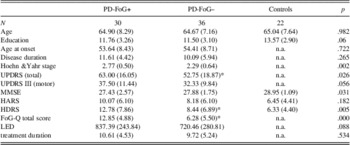
Thirty PD-FoG+ and 36 PD-FoG− right-handed outpatients were recruited from the Institute of Neurology, University of Belgrade, Serbia (Table 1). PD was diagnosed according to the UK PD Brain Bank criteria (Hughes, Daniel, Kilford, & Lees, Reference Hughes, Daniel, Kilford and Lees1992). All patients except (n=2) used levodopa, which was combined with dopamine receptor agonists (n=55), COMT-inhibitors (n=2), and amantadine (n=10), respectively. Inclusion criteria were: (1) age≥45 years; (2) Hoehn and Yahr (H&Y) stage score<4 (“off” time) (Hoehn & Yahr, Reference Hoehn and Yahr1967); (3) stable and optimized antiparkinsonian treatment during the 4 weeks before study entry; and (4) the Mini-Mental State Examination (MMSE) score≥25 (Folstein, Folstein, & McHugh, Reference Folstein, Folstein and McHugh1975). Patients were excluded if they had: (1) significant comorbidities limiting gait, such as cardiovascular or cerebrovascular disorders including strokes, history of traumatic brain injury, hydrocephalus, or intracranial mass, rheumatic or orthopedic disease, visual disturbances impairing walking abilities, or musculoskeletal disorders; (2) a major depression according to DSM-IV criteria; and (3) an anticholinergic treatment. Patients were clinically examined, tested in the morning during “on” period. At study entry, stage of the disease was scored using the H&Y staging system, patient disability using the Unified Parkinson’s Disease Rating Scale part III (motor part; UPDRS III) (Fahn & Elton, Reference Fahn and Elton1987), and global cognitive function using the Mini-Mental State Examination (MMSE). Patients were also administered the Hamilton Depression Rating Scale (HDRS) (Hamilton, Reference Hamilton1960) and the Hamilton Anxiety Rating Scale (HARS) (Hamilton, Reference Hamilton1959).
Demographic and clinical characteristics of the PD-FoG+ patients, PD-FoG− patients, and healthy controls

Note. PD-FoG+=Parkinson’s disease patients with freezing of gait; PD-FoG−=Parkinson’s disease patients without freezing of gait; UPDRS total=Unified Parkinson’s Disease Rating Scale; MMSE=Mini Mental Status Examination; HARS=Hamilton Anxiety Rating Scale; HDRS=Hamilton Dementia Rating Scale; FoG-Q=Freezing of gait scale; LED=levodopa equivalent dosage.
*significance at p<.05 between PD-FoG+ and PD-FoG−.
Approval was received from local ethical committee on human experimentation and written informed consent was obtained from all subjects participating in the study. Patients were classified as freezers (PD-FoG+) if the following conditions were satisfied: (1) score>1 on FoG Questionnaire (FoG-Q) item 3 (Giladi, Shabtai, Simon, Biran, Tal, & Korczyn, Reference Giladi, Shabtai, Simon, Biran, Tal and Korczyn2000); and at least two out of following criteria: (2) observation of FoG by two experienced neurologists (including the timed “up-and-go” test [TUG] with obstacles) (Podsiadlo & Richardson, Reference Podsiadlo and Richardson1991); (3) the participant’s verbal account on whether they had experienced FoG; and (4) the recognition in their experience of typical FoG when this was identified and described to them by a physician. None of the patients with a score≤1 had results on the remaining three criteria suggestive of FoG. Twenty-two age- and sex-matched, healthy controls (HC) of similar age, sex, and education, to patients were recruited from patients’ spouses and friends, free from parkinsonism, dementia, major depression, psychosis and history of cerebrovascular accidents. All control subjects underwent clinical and neuropsychological testing.
Neuropsychological Tests
An experienced neuropsychologist, who was unaware of the FoG status, administered neuropsychological and behavioral tests during 2 consecutive days due to an extensive battery planned for the present study. It included the Addenbrooke’s Cognitive Examination–Revised (ACE-R) (Mioshi, Dawson, Mitchell, Arnold, & Hodges, Reference Mioshi, Dawson, Mitchell, Arnold and Hodges2006), Frontal Assessment Battery (FAB) (Dubois, Slachevsky, Litvan, & Pillon, 2000), Executive Interview (EXIT) (Royall, Mahurin, & Gray, Reference Royall, Mahurin and Gray1992), and two executive tests from CANTAB battery (duration of 60–70 min): (1) the IED set shifting and (2) SST. For the later two tests, procedure began with a motor screening test (MOT) introducing subjects to the touch screen, while assessing difficulties in vision, movement or comprehension. Familiarization with the testing environment and with each individual test was accomplished through practice sessions. In the IED shifting task (for detailed description of the task see Jazbec et al., Reference Jazbec, Pantelis, Robbins, Weickert, Weinberger and Goldberg2007) four empty rectangular boxes appeared on a computer screen, and each trial started with two stimuli in separate opposing boxes (left–right or top–bottom). The stimuli were abstract, unfamiliar pink shapes or white line drawings. The subjects were instructed to select a stimulus and then induce a rule through computer feedback (“correct” displayed in green or “wrong” displayed in red). After selecting correctly for six consecutive trials, the rule changed. Subjects had to make six consecutive correct selections within 50 trials to successfully complete a stage, and the task ended when they fail a stage. The task had nine stages. Stages 1–5 were discrimination stages, which required from the subject to distinguish between one of two shapes through trial and error learning, while ignoring distracting shapes. Stages 6 and 7 introduce ID shifting and reversal demands, while the stages 8 and 9 required ED shifting and reversal, because the subject must attended to a previously ignored feature of the stimulus. This test has several outcome measures, assessing IED errors, and IED numbers of trials and IED stages completed.
Stop Signal Task
This test consists of two parts: In the first part, the participant is introduced to the press pad, and told to press the left hand button when they see a left-pointing arrow, and the right hand button when they see a right-pointing arrow. There is one block of 16 trials for the participant to practice this. In the second part, the participant is told to continue pressing the buttons on the press pad when they see the arrows, as before, but, if they hear an auditory signal (a beep), they should withhold their response and not press the button. SST has five outcome measures, each of which can have various options applied to it. The SST measures cover direction errors, proportion of successful stops, SST Reaction Time (RT) on GO trials, SSD (50%), and SST SRT.
Statistical Analyses
All datasets were examined for normality (Kolmogorov-Smirnov test). If the criterion was not met, the datasets were analyzed by the Kruskal-Wallis analysis of variance (ANOVA). One-way ANOVAs analyses were applied on all other data to compare PD-FoG+ and PD-FoG− and healthy controls, with post hoc Scheffe comparisons between groups. To differentiate the specific subset of IED task (discrimination task set, ID and ED paradigm), the nine stages were divided in Level 1 (discrimination learning 1–5th stage), Level 2 (ID 6th shift and 7th reversal stages), and Level 3 (ED 8th shift and 9th reversal stages). The χ2 test of homogeneity was applied to test the differences between PD-FoG+ and PD-FoG− groups in attrition rates on 3 different levels of the IED task (discrimination set learning part, ID and ED, respectively). Logistic regression analysis was performed to evaluate the relationship between the set of predictors (H&Y stage, IED stages, and ACE-R clock drawing score) and the FOG status as dependent variable. These analyses were performed using the STATISTICA version 7 software.
RESULTS
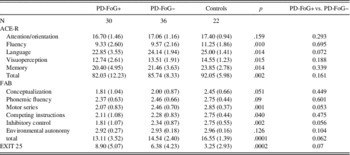
The demographic and clinical features of PD-FoG+ and PD-FoG− patients, and healthy controls are presented in Table 1: (1) Cognitive functioning of patients with Parkinson’s disease, with and without freezing of gait, and healthy controls. (2) The results on the ACE-R, FAB and Exit-25 are presented in Table 2. With the exception of ACE-R attention orientation subtest, significant differences were observed on all ACE-R scores (total, fluency, memory, language, and visuo-constructional scores) between the three groups. (3) However, in the post hoc analyses the only significant difference between PD-FoG+ (3.40±1.88) and PD-FoG− patients (4.24±1.29) was found on the ACE-R clock drawing task scores (F(1,60)=4.75; p=.033) (Cohen’s d=0.521). Although the significant differences between the three groups were also obtained in the FAB total and the Exit-25 results (Table 2), post hoc Scheffe comparisons did not achieve significance when PD-FoG+ and PD-FoG− groups were analyzed.
Cognitive performance in PD-FoG+ and PD-FoG− patients and healthy controls

Note. PD-FoG+=Parkinson’s disease patients with freezing of gait; PD-FoG−=Parkinson’s disease patients without freezing of gait; ACE-R=Addenbrooke’s Cognitive Examination–Revised; FAB=Frontal Assessment Battery (FAB); EXIT-25=Executive Interview.
CANTAB Tasks
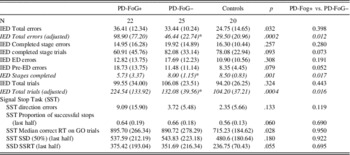
The performances on the SST and IED shifting tasks for the PD-FoG+, PD-FoG−, and control groups are presented in Table 3. Due to a testing on two consecutive days, outpatients living outside Belgrade were not included; therefore, 22 PD-FoG+ and 25 PD-FoG− patients were tested with the CANTAB SST and IED shifting tasks.
CANTAB measures in PD-FoG+, PD-FoG− and healthy control subjects

Note. CANTAB=Cambridge Automated Neuropsychological Battery PD-FoG+=Parkinson’s disease patients with freezing of gait; PD-FoG−=Parkinson’s disease patients without freezing of gait; IED=Intra/Extra dimensional set-shifting task from CANTAB; IED Total errors=IED Total errors (adjusted); IED Completed stage errors=IED completed stage trials; IED ED errors, IED Pre-ED errors, IED Stages completed, IED Total trials, IED Total trials (adjusted),
SST=Stop Signal Task from CANTAB; SST direction errors; SST Proportion of successful stops (last half); SST Median correct Reaction Time (RT) on GO trials; SST SSD (50%) (last half); SST=Stop signal delay (50%) (last half); SST SSRT (last half)= an estimate of the subject’s response time to the stop signal.
*Significance at p<.05 between PD-FoG+ and PD-FoG−.
Stop Signal Task (SST)
Regarding the outcomes on the SST (Table 3), the PD patients showed significantly more direction errors and prolonged SST reaction time in comparison to HC. By contrast, no significant differences were btained on the post hoc analyses between PD-FoG+ and PD-FoG− groups (Table 3).
IED Attention Set-Shifting Task
Significant differences were shown in the main IED efficiency measures between three groups (Table 3). Further post hoc analyses showed that PD-FoG+ and PD-FoG− patients had significantly different performances on three measures of the IED tasks, such as IED total errors adjusted (Kruskal-Wallis ANOVA test; H (1, n=47)=6.28; p=.012) (Cohen’s d=0.9488), IED stages completed (Kruskal Wallis test; H (1, n=47)=5.70; p=.017) (Cohen’s d=0.901), and IED total trials adjusted (Kruskal Wallis test; H (1, n=47)=5.760; p=.016), (Cohen’s d=0.936).
Attrition Rates on IED Task (% of Patients Failing Stage)
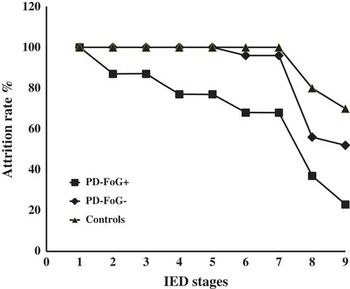
As stated in statistical section, the 9 stages of the IED task were divided in Level 1 (discrimination learning; 1–5th stage), Level 2 (ID 6th shift and 7th reversal stages) and Level 3 (ED 8th shift and 9th reversal stages). Analysis by χ2 for homogeneity of distribution revealed significant group differences at the discrimination learning level (Yate’s χ2=4.59; df=1; p=.03), but not at the level 2 (Yate’s χ2=0.41; df=1; p=.52) and the level 3 (Yate’s χ2=1.44; df=1; p=.23). Significantly more patients in PD-FoG+ group have difficulties in discrimination tasks than PD-FoG− patients. The attrition rates analyses showed deficient decline for the PD-FoG+ group in the course of the IED task, in comparison to PD-FoG− on the pre ID level of the task.
Thirty-two percent PD-FoG+ patients and 4% PD-FoG− patients did not succeed further after the 5th stage of the IED task (χ2 (df=1)=6.41; p=.011), whereas in healthy control group all subjects proceed further to ID shift level (6th stage). Thirty-two percent of patients from the PD-FoG+ and 40% from the PD-FoG− group finished the IED task on ID level (ID shift and reversal) (p=.759). In contrast, only 20% healthy controls stopped on ID level (6th and 7th stage). Reversal difficulties were not seen on the ID level between the both PD groups either with FoG or without (p>.05). Eventually, 52% of PD-FoG− patients successfully finished the 9th stage in contrast to only 23% of those from the PD-FoG+ group (Figure 1).
Attrition rate per stage (%) on IED task in PD-FoG+, PD-FoG− and healthy control subjects; PD-FoG+=Parkinson’s disease patients with freezing of gait; PD-FoG−=Parkinson’s disease patients without freezing of gait; IED=Intra/Extra dimensional set-shifting task from CANTAB.

Logistic Regression Analysis
Previously presented bivariate analyses have indicated a possible set of predictors of FOG status, namely IED Stages score and ACE-R clock drawing score, the variables that are relevant to the testing of one of our initial hypotheses. To evaluate the relationship between this set of predictors and the FOG status as dependent variable, taking into account the impact of motor impairment as potentially confounding variable, a sequential logistic regression procedure was applied. H&Y score (dichotomized 1 and 2 vs. 3 and 4) was put into the model first, and IED Stages score and ACE-R clock drawing score (dichotomized: 5 vs. all other values) as the second block of variables. A test of the model with these three predictors against a constant only model was statistically significant (χ2=13.42; p<.004 with df=3). Nagelkerke’s R2 was 0.33, and prediction success overall was 75%. This was a slight improvement on the 68% correct classification with the constant and H&Y covariate model. The Wald statistics were significant for H&Y score (dichotomous) and for the IED Stages score (4.65 and 4.55, respectively). Clock drawing score was not a significant predictor of the FOG, over and above these two predictors. Cross-odds ratio, OR for IED Stages score was 1.67, indicating that, even after controlling for the motor impairment, the higher the stage successfully completed the less likely that the FoG is present.
DISCUSSION
The main finding of this study is that FoG in PD is not merely associated with general executive dysfunction, but that it is associated with specific attentional set-shifting profile, i.e., an inability to ignore the irrelevant stimuli and to follow the rule, indicating discrimination and learning impairments. In the present study the attentional shifting performance on IED task was the most consistent predictors of FoG in PD, the significance mainly brought by the disproportionate failure at pre-ID stage in PD-FoG+ patients, on discrimination and set-learning level. The second of our initial hypotheses was not proved; by contrast, no differences emerged on any aspect on inhibitory control (SST) task.
Previous studies have demonstrated the association between FoG and a dysexecutive phenotype in PD (Amboni et al., Reference Amboni, Cozzolino, Longo, Picillo and Barone2008, Reference Amboni, Barone, Picillo, Cozzolino, Longo, Erro and Lavarone2010; Naismith et al., Reference Naismith, Shine and Lewis2010; Vandenbossche et al., Reference Vandenbossche, Deroost, Soetens, Spildooren, Vercruysse, Nieuwboer and Kerckhofs2011; for review see: Heremans et al., Reference Heremans, Nieuwboer, Spildooren, Vandenbossche, Deroost, Soetens and Vercruysse2013). Our results are in agreement with the findings of Naismith et al. (Reference Naismith, Shine and Lewis2010) who showed that difficulties in set-shifting were strongly associated with FoG, while other executive domains such as working memory, verbal fluency, and planning/organization abilities had weaker association. The correlation between impaired attentional set-shifting and FoG severity (Shine et al., Reference Shine, Moustafa, Matar, Frank and Lewis2013) supported this hypothesis that an inability to shift between competing attentional demands particularly under time constrains may form part of the pathophysiological mechanisms underlying FoG (Shine, Naismith, & Lewis, Reference Shine, Naismith and Lewis2013).
In situations in which competitive stimuli were present, PD patients have impaired attentional set-shifting abilities, but preserved task-set switching abilities (Kehagia et al., Reference Kehagia, Barker and Robbins2010). Considering attentional set-shifting, both treated and particularly drug-naive PD patients were impaired in their ability to perform an ED (involves a shift of responding that entails switching of attention between two perceptual dimensions), but not an ID shift (defined as a shift that occurs when new stimuli or exemplars are presented, but the subject has to continue to choose the same perceptual dimension or follow the same rule when responding to them) (Downes et al., Reference Downes, Roberts, Sahakian, Evenden, Morris and Robbins1989; Owen et al., Reference Owen, Downes, Sahakian, Polkey and Robbins1990, Reference Owen, Roberts, Polkey, Sahi and Robbins1991; Robbins, Reference Robbins2007).
In the present study, the PD-FoG+ patients did not express impairment on ID or ED shifting on IED task. The failure appeared at earliest stage on pre-ID (stimulus discrimination set learning part) level (1st to 5th stage). Approximately a third (32%) of PD-FoG+ patients did not pass to the ID level of the IED task in contrast to almost negligable 4% of patients in PD-FoG− group (p=.0113). Seventy percent of the control subjects and 52% of PD-FoG− patients finished the ED level, in contrast to only 23% of PD-FoG+ patients. Therefore, the PD-FoG+ group appeared inefficient in accomplishing the IED task on several measures, as it was shown in the present study (measures of efficacy on attentional shifting included completion of the IED stages, total errors and trials and attrition rate). Significantly more subjects in PD-FoG+ group failed at the pre-ID level already at the earliest stages of the task when distracting and/or non-relevant stimuli are introduced. Thus, implicated that performance difficulties on attentional set-shifting might not only be caused by failure in performing an attentional shift per se, but also by impairments in other cognitive functions required to establish and maintain an attentional set such as susceptibility to distraction. It means that the failure might be at the level of set maintenance, stabilization of representations and sensitivity to distraction, besides the perseverative behavior (i.e., being stuck on a previously established attention set; Elliott, McKenna, Robbins, & Sahakian, Reference Elliott, McKenna, Robbins and Sahakian1995, Jazbec et al., Reference Jazbec, Pantelis, Robbins, Weickert, Weinberger and Goldberg2007).
Functional magnetic resonance imaging (fMRI) has identified that the IED set-shifting task is associated with activity in the ventrolateral prefrontal cortex (VLPFC), while reversal learning with activity in orbitofrontal cortex (OFC)–ventral striatal circuitry (Hampshire & Owen, Reference Hampshire and Owen2006). Essentially, the orbitofrontal cortex (OFC) plays a crucial role in complex decision-making processes (Rolls, Reference Rolls2004), the evaluation of relative reward values (Padoa-Schioppa & Assad, Reference Padoa-Schioppa and Assad2006), and assigning affective values to choice alternatives (Kringelbach, Reference Kringelbach2005).
A particular role of the prefrontal cortex (PFC) in response selection becomes evident in fluctuating or ambiguous circumstances (Shine, Moustafa, Matar, Frank, & Lewis, Reference Shine, Moustafa, Matar, Frank and Lewis2013). Brain imaging studies suggested that structural damage and reduced functional connectivity in the frontal and parietal cortices may underlie exaggerated executive dysfunction in freezers compared to non-freezers (Kostić et al., Reference Kostić, Agosta, Pievani, Stefanova, Jecmenica-Lukic, Scarale and Filippi2012; Tessitore, Amboni, Esposito, et al., Reference Tessitore, Amboni, Esposito, Russo, Picillo, Marcuccio and Barone2012; Tessitore, Amboni, Cirillo, et al., Reference Tessitore, Amboni, Cirillo, Corbo, Picillo, Russo and Tedeschi2012).
In the present study, the classical tests like the ACE-R, FAB, Exit-25, and the verbal fluency were not sufficiently sensitive to show significant differences between PD-FoG+ and PD-FoG− patients. Recently, published reports favored the fluency, TMT B task and Clock drawing as the good predictors for FoG in PD (Amboni et al., Reference Amboni, Cozzolino, Longo, Picillo and Barone2008; Giladi et al., Reference Giladi, Treves, Simon, Shabtai, Orlov, Kandinov and Korczyn2001; Naismith et al., Reference Naismith, Shine and Lewis2010). The reduced performance on Clock drawing task in the group of PD-FoG+ in the present study, which requires both executive and visuospatial functions, could be consistent with the study that evaluated the influence of space perception on gait in patients with PD and found that visuospatial ability appeared to be more profoundly affected in those with FoG (Almeida & Lebold, Reference Almeida and Lebold2010; Nantel, McDonald, Tan, & Bronte-Stewart, Reference Nantel, McDonald, Tan and Bronte-Stewart2012).
It is necessary to mention that our study was including small number of participants, and the results need to be interpreted cautiously. Also the follow-up studies could help us to clarify the more specific cognitive deficits underpinning the freezing in PD. The new experimental paradigms testing in the context of attentional set-shifting and inhibitory control are needed.
CONCLUSIONS
Our neuropsychological findings support the hypothesis that rather specific, but not generalized, attentional set-shifting dysfunction might be associated with FoG in PD. In this particular study, on freezing in PD, the specific processing failure was showed in the context of IED performance that reflect difficulties in stabilizing a representation, at the pre ID stage, in contrast to expected problems on ED-stage, suggestive of compromising set shifting of classic prefrontal failures.
ACKNOWLEDGMENTS
This work was funded by the Ministry of Science, Republic of Serbia (project no. 175090). We thank our patients and their caregivers who contributed their time to participate in this study. The authors report no biomedical financial interests or potential conflicts of interest.