In early September 2007, a Syrian nuclear reactor site, Al Kibar, exploded in a hail of precision bombs, snuffing out what the Israeli government believed was a key facility in a nascent weapons program. Israel conducted the mission with extensive secrecy and denied involvement for months afterward. The strike was met with a surprisingly tempered diplomatic reaction. Syria, along with other governments, downplayed, ignored, and denied the character and even existence of the incident. Media investigations much later revealed that Israel had quietly informed the United States and concerned Arab neighbors that a covert strike would take place and requested a low-key response. Israel did so believing “the lower the signature of the attack the less likely Syria would be to retaliate.”Footnote 1 As anticipated, Syrian President Bashar al-Assad tacitly cooperated by denying the strike had occurred and the premise that the site was used for a weapons program. He fulfilled the prediction of Israeli strategists that “as long as Assad could deny the existence of the reactor, he would not feel pressured to retaliate.”Footnote 2
The Al Kibar strike is a window into a poorly understood dimension of world politics: what states do covertly and the geostrategic factors that influence this activity. The strike is an example of a covert act of military coercion in which a state uses secret, plausibly deniable action to address security threats on the ground. Although scholars often associate covert activity with James Bond movies and the Cold War, the strike in Syria is part of a modern “shadow war” in the Middle East and reflects renewed interest in covert tools.Footnote 3 Since the 2001 terrorists attacks on the United States, American leaders have increasingly turned to covert methods of military coercion including recently developed drone and cyber-enabled techniques.Footnote 4
Unfortunately, systematic analysis of specific covert incidents and the larger backstage that patterns of covert activity create is in painfully short supply in International Relations (IR). Even basic questions remain unaddressed. What happens in such “shadow wars” between rivals? Why do states resort to such tactics or reject them? Some aspects of the covert side of strategic rivalries are especially puzzling. For example, why would adversaries and other states tacitly cooperate in keeping the covert actions of another state secret? In the Al Kibar incident, why would Saudi and even Syrian leaders join in concealing Israel's covert action?
This article seeks answers by parting the curtain on covert military intervention. It introduces a novel theoretical framework highlighting secrecy's role in helping adversaries compete for influence while avoiding unintended conflict escalation. Covert activity is not simply helpful for surprising adversaries or engaging in Nixonian “dirty tricks.” Covertness is an essential tool for engaging in limited war. Tacitly cooperating to hide the most extreme forms of rivalry allows adversaries to operate within a kind of backstage and preserve the appearance of limited competition. Sequestering activity in the covert sphere reduces mobilization of external audiences, the reputational and domestic stakes involved in an incident, and hard-to-control escalation pressure. Such secrecy practices emerge, I argue, when adversaries share a fear that outside pressure could rob leaders of control and drive geopolitical competition to dangerous heights of hostility. This shared fear explains both the initial preference for covert methods and reactive concealment (what I call “tacit collusion”) by other states.
To develop this argument I draw on insights about secrecy from the sociology of Erving Goffman, who famously viewed social life as akin to theater in which participants tailor their images to fit contextually appropriate rules and roles. Impression management creates order out of chaos: specific encounters are given a coherent meaning by everyone playing their part. Secrecy has a central but often overlooked role. Secrecy operates like the backstage of a theater, allowing performers to hide discrepant incidents or, in Goffman's terms, engage in impression management and “face-work.” The aggregate effect of using the backstage well is an encounter with coherent and stable meaning for observing audiences. I combine Goffman's insights with those of limited war theorists to understand covert activity in interstate rivalries. Rivals may tacitly cooperate to steer dangerous encounters to the backstage as a way to safeguard the external impression of their encounter as a limited conflict. The illusion of a limited war helps avoid further conflict escalation. Just this logic appears to have motivated Israeli strategists in 2007 to conduct their military strike secretly and court the tacit collusion of other leaders.
I assess the covert side of modern war in several cases of great power intervention during the Korean War. Fought between 1950 and 1953, the conflict featured interventions by the United States, China, and the Soviet Union. The Soviet covert intervention gave rise to a dramatic and lengthy episode of “backstaging” and is the main feature of the empirical analysis. For the vast majority of the conflict, thousands of Soviet pilots covertly performed combat missions in the skies above Manchuria and North Korea. American leaders, well aware of Soviet participation from signals intercepts, concealed evidence of Moscow's involvement and waged a de facto air war with Russian pilots. In short, the Cold War rivalry started hot—but in secret. The secrecy regarding Soviet involvement is puzzling on several levels. Joseph Stalin elaborately concealed his pilots' role despite expecting their detection by his adversary. Why go to the trouble of hiding it? American leaders chose to conceal Moscow's role despite otherwise hoping to mobilize domestic and allied support for remobilization and containment. Stalin's domestic invulnerability also meant he faced no barriers to backing down had American leaders publicized his role and drawn a red line. Why not dispel the Soviet narrative of noninvolvement? I also analyze the embrace of publicity in the initial American intervention and its partial embrace by China by drawing on extant collections, new historiography, and original archival research.
The exercise yields important empirical and theoretical contributions. There are two primary contributions to the larger study of IR. First, the findings complicate our understanding of how leaders approach coercive diplomacy, specifically reputation, publicity, and limited uses of force. Coercive bargaining scholars have long analyzed these as essential mechanisms for leaders to create coercive leverage through risk generation and reduced decision freedom.Footnote 5 In contrast, the behavior in the intervention cases I analyze involves the refusal to publicize—even a kind of tacit collusion in concealing covert activity—as a way to minimize reputational stakes and preserve freedom of action. Analyzing the covert side of conflict therefore substantiates recent critiques that suggest leaders are at least as interested in minimizing risk and decision constraints as they are in maximizing them.Footnote 6 More broadly, I show how limited war, rather than being a means of displaying resolve and coercing one another, is a delicate, jointly produced framework for adversaries to compete without uncontrollable escalation. The article shows the promise in developing more refined theories of how leaders approach reputation, how they manage information and visibility of their actions, and the role of limited war in modern diplomacy.
The second contribution is a contrasting narrative about the origins of endemic secrecy and uncertainty in the international system. Rationalist models see the source of “private information” in deception's security benefits for states in a self-help world. Secrecy helps leaders misrepresent, hiding their weakness, posturing for strength, and, when war is imminent, engaging in tactical surprises.Footnote 7 This suggests secrecy is a relatively constant feature of the international system that emerges from competition among adversaries. In contrast, I show how part of secrecy's appeal during war is to deal with the challenge of limiting it. Because of a unique combination of highly destructive military technology, domestically vulnerable leaders, and conflicts that implicate alliance and similar interstate partnerships, the problem of limiting war is especially acute in the modern era. Secrecy as a tool of limited war may therefore be a somewhat unique modern phenomenon. This, in turn, suggests the appeal of secrecy during war may grow as technological and political trends exacerbate escalation costs and leaders' vulnerability. In general, then, the theory and findings suggest the root of private information is not simply self-help rivalry but a kind of “conspiracy of silence” among tacitly cooperative adversaries. In addition to these broader contributions, the article also adds to more specific literatures on Goffman, secrecy and private diplomacy, the Korean War, and conflict escalation.Footnote 8
Facing Off and Saving Face: A Theory of Secrecy in Interventions
States do many things covertly and for a range of purposes. This article focuses on covert forms of military intervention. External military interventions feature ongoing civil or interstate conflicts in which major outside powers provide combat assistance to one or more participant. Combat assistance can come in two basic forms: lethal military assistance or participation in combat activity.Footnote 9 Interventions may be undertaken overtly or covertly. Overt interventions involve an external power using its military assets with visible official markings and official public acknowledgment. Covert interventions feature an external power providing lethal aid or combat participation in ways that render the source invisible or, at worst, plausibly deniable. Secrecy requires that officials maintain a public position of limited or no involvement.Footnote 10 The covert form of intervention has, to date, been almost entirely overlooked. Prior scholarship on third-party intervention in civil wars has noted the importance of covert forms of external involvement but not systematically described or theorized it.Footnote 11
I specifically focus on covert forms of combat participation. Covert combat participation by at least one state has been demonstrated in most conflicts in the modern era including World War I, the Spanish Civil War during the interwar period, World War II, the Korean War, and numerous interstate and civil conflicts during the Cold War. More recently, major media outlets have alleged covert combat involvement by the Iranian Quds special force in American-occupied Iraq and Russian personnel in Eastern Ukraine.Footnote 12 An outside power that wishes to conceal its role can do so in one of four ways: by secretly shifting noncombat personnel to combat roles (for example, Soviet military advisors in Egypt quietly playing air defense roles during the 1970 War of Attrition),Footnote 13 altering military equipment to mimic the recipient's military equipment (for example, Italian naval ships disguised to resemble ships in the Nationalist fleet during the Spanish Civil War),Footnote 14 deploying military assets as putatively “private” actors (for example, U.S. Central Intelligence Agency (CIA) aerial missions in postwar Asia conducted by the Civil Air Transport company),Footnote 15 or by limiting combat operations to those that can be made anonymous (for example, torpedo strikes by nonsurfacing submarines, lethal drone strikes, or cyber attacks).
What factors do existing studies identify that might influence whether an external power intervenes covertly or overtly? One rationale for secrecy is to deceive adversaries and obtain tactical and strategic advantages. Realists have long argued insecure states have strong incentives to misrepresent capabilities and intentions to adversaries.Footnote 16 A recent analysis of the bargaining model of war and surprise attacks uses the Chinese entry into the Korean War to show the role secrecy can play in deceiving adversaries and generating important battlefield advantages.Footnote 17 A second rationale for preferring a covert intervention can be found in studies of conflict behavior and domestic politics. Realists and critics of the democratic peace thesis have shown secrecy can help vulnerable democratic leaders use force without antiwar domestic punishment.Footnote 18
Although intuitive and plausible, these explanations for secrecy have important limitations. For example, deceiving an adversary for battlefield advantage is most useful for states facing an acute power asymmetry, confident in their ability to conceal a surprise campaign, and prepared to shed deniability after springing a surprise trap. As I will show, Stalin's secret intervention in Korea was made despite anticipating exposure to his strategic adversary. In general, covert interventions are often by outside powers with substantial advantages in battlefield capabilities, suggesting more political origins for concealment. The domestic politics logic is also limited to external interventions by meaningfully accountable leaders facing antiwar domestic constituents. Such characteristics often do not apply to covertly intervening states. In the Korean War, for example, covert interventions were selected by two famously unaccountable leaders: China's Mao Tse-tung and the Soviet Union's Stalin. Stalin in particular was among the least domestically vulnerable leaders in modern politics and yet he carefully retained secrecy about his personnel's role in the war. Most importantly, neither tactical surprise nor domestic insulation provides a rationale for other states witnessing covert meddling to react with secrecy. The puzzle of why the United States tacitly colluded about Soviet covert intervention in Korea, for example, is left unsolved.
More promising is a third cluster of insights derived from bargaining models of secret diplomacy. These scholars find private forms of diplomacy may be rational for all sides if deals require domestically painful concessions. Making threats privately, for example, reduces the domestic audience costs for an opponent's capitulation and makes a bargain short of war more likely. For external interventions, this suggests both sides may eschew publicity in the hopes of easing their opponent's capitulation. One initial limitation of this work is its exclusive reliance on domestic accountability that may not be present on both sides of a conflict. Wars such as Korea that host multiple external interventions often feature at least one state with minimal domestic constraints. Without shared domestic vulnerability, the equilibrium of private diplomacy unravels.Footnote 19 A second limitation is that private diplomacy models have been developed in prewar settings where secrecy is employed to threaten the use of force rather than actually use it. In contrast, interventions take place during an ongoing war and secrecy allows outside powers to become directly involved in conflict. As I will show, secrecy is a means for rival external powers to confront one another in a sustainable framework of limited war; it is not a means to make threats, capitulate, and strike a bargain short of war.
Secrecy in Goffman's World: Using the Backstage to Avoid Threats to Face
Looking to Goffman's sociological analysis of everyday life for lessons about diplomacy and statecraft has a rich history in IR. Canonical work by Jervis and Schelling drew on Goffman and, more recently, scholars have adapted his ideas to understand Arab leaders' public posturing in the Middle East, strategic norms adoption in Europe, and stigmatization responses by pariahs of the international community.Footnote 20 I focus on the overlooked role of secrecy in Goffman's analytical repertoire and use it to derive novel insights about covert forms of state behavior.
A consistent theme throughout Goffman's analysis of everyday social life is that much of what we see as ordered social interaction is the result of an organic and collective process of impression management. From elevator etiquette to funeral rituals, society contains a variety of micro-structures, or what Goffman called “interaction orders” and “games” that link a kind of encounter with a set of roles and rules.Footnote 21 Social actors operate in a quasi-anarchic setting where the character of specific encounters—that is, the answer to the question of “What kind of situation is this?”—depends on how both individuals and the overall group behave. A dinner party is only a dinner party, in this line of reasoning, if the individuals and group as a whole follow the basic rules and roles of a dinner party (for example, how to dress, kinds of conversation topics, ways of eating politely, and so on). Deviations from these roles and rules by one or more participant can disrupt the stability of the encounter's meaning and trigger a shift to a different kind of social situation.
Secrecy plays a prominent role in Goffman's analysis of how abstract interaction orders are reproduced in any specific encounter. To do so he famously used the metaphor of a theater where “actors” carefully display role-consistent words and behavior on a kind of “front stage.”Footnote 22 A critical piece of the theater metaphor highlighted by Goffman but often overlooked is the “backstage” where inappropriate words and behavior can be sequestered. He defined a backstage broadly as “a place, relative to a given performance, where the impression fostered by the performance is knowingly contradicted as a matter of course.”Footnote 23 Such a space is helpful because, as Goffman puts it, “a basic problem for many performances, then, is that of information control” and good performances require the ability “to conceal action which is inconsistent with these standards.”Footnote 24
The backstage helps individuals avoid the negative consequences of breaking their role. Chief among them is loss of face. Face refers to the various personal and social benefits that an individual, once committed to a given role, accrues via successful performance.Footnote 25 Goffman referred to the various ways visible impressions are safeguarded as face-work. Threats to face arise when actors engage in visible role-inconsistent actions or words. For Goffman, safeguarding face may be done through preventive (avoiding face threats altogether) or restorative (recovery once face threats emerge) means.Footnote 26 The backstage is preventive: individuals can avoid face-threatening events in the first place rather than cope with the consequences by hiding discrepancies.
The backstage is helpful to the larger group as well. Goffman warns that “a false impression maintained by an individual in any one of his routines may be a threat to the whole relationship or role of which the routine is only one part.”Footnote 27 Situational coherence depends on “the utility of control over the back stage” and Goffman warns of “the dramaturgical trouble that arises when this control cannot be exerted.”Footnote 28 A breakdown in performances does not necessarily usher in chaos; instead, breakdowns often simply trigger a transition to a different kind of social encounter. Goffman argues a breakdown in secrecy may reshuffle the social situation such that “previous and expected interplay between the teams is suddenly forced aside and a new drama forcibly takes place.”Footnote 29
Goffman therefore believed impression management is tacitly cooperative.Footnote 30 Instead of a lonely and selfish exercise, social interaction involves a “general conspiracy to save face so that social situations can also be saved.”Footnote 31 This applies in both friendly environments (for example, a family dinner) and more competitive settings (for example, a poker game).Footnote 32 Though participants in competitive settings have conflicting goals, they pursue those goals within a basic framework of rules and roles that define a particular kind of “game.” So long as adversaries are committed to this framework, they may act to safeguard each other's face from threats.Footnote 33 This provides hints about the reason that adversaries in world politics might join in using secrecy and avoid exposing one another's covert actions. Such activity might arise if adversaries share an interest in hiding transgressions that threaten a specific kind of “game” or “interaction order,” specifically limited war.
Two general observations about moving Goffman's concepts to the IR context are worth noting. One involves the possibility of exploitation and misperception. Goffman noted the “vagueness and ambiguity of the ritual order” in everyday life can make encounters “prone to be exploited by individuals for their own egoistic ends.”Footnote 34 As we travel to the context of adversaries and conflict, it is important to account for the possibility of misunderstanding and exploitation. Adversaries may mistakenly believe the other side is acting to maintain a public impression of limited war by using secrecy. However, this may be a misinterpretation with potentially dangerous results. Second, Goffman's concept of “face” needs to be clarified vis-à-vis other concepts in IR, specifically reputation. His use of the term suggests a broad conceptualization that includes reputation and other negative emotional states such as humiliation and embarrassment.Footnote 35
Secrecy, Intervention, and Limited War
Goffman's ideas about secrecy's role in helping social actors manage their impressions and build situational meaning sheds new light on why states may engage in tacitly cooperative uses of secrecy in world politics. Intuition for the argument can be found in a passing discussion of the link between limited war and covert intervention in Schelling's Arms and Influence. Though better known for his ideas about the tactics of coercion, Schelling also wrestled with the challenge of how to wage war in a limited framework.Footnote 36 He focused on tacit communication that takes place during war when states stay behind or cross salient lines or thresholds (for example, categories of weapons; geographic features).Footnote 37 Schelling analyzes crossing these lines through two hypothetical scenarios. In one, external involvement by American and Soviet militaries lead to “infantryman in Soviet and American uniforms, organized in regular units and behaving in accordance with authority … shooting at each other.”Footnote 38 The critical feature is not deaths of soldiers but the visible transgression of a line previously limiting the conflict to a local or proxy event (for example, no direct combat encounters by uniformed personnel of the external powers). This magnifies the pressure on leaders to escalate the conflict further and further making general war difficult to resist. In a contrasting scenario, external involvement by at least one power is on a covert basis and is unpublicized by the other side. As a result, any direct combat encounters cross a line on the ground but do not visibly threaten the image of a carefully delimited war. Schelling describes this in the context of US decision making during the Vietnam War.
The question of whether or not to bomb North Vietnam's surface-to-air missile [SAM] sites was recognized to involve, in an attenuated way, the possibility of Russian casualties from American military action … The Vietnamese case illustrates that many thresholds can become ambiguous, especially if pains are taken to make them so. Any Russians at the SAM sites were not, presumably, “at war” or even officially “in” it; their presence was more supposed than verified; their participation in the shooting, if any, could be denied by the Soviet Union to reduce the embarrassment to both sides; and in other ways the drama of the “incident” could be played down.Footnote 39
Great power involvement in local disputes inevitably creates a danger of conflict escalation. Theorists of limited war have noted the particular dangers of unintended conflict escalation.Footnote 40 External involvement can take on a life of its own as leaders of major powers find themselves deepening their role to avoid political punishment for failure or weakness. Sallagar's study of World War II found widespread concern over unintended, hard-to-control conflict escalation dynamics.Footnote 41 Schelling too cautioned that escalation may result from a “process in which both sides get more and more deeply involved,” whereas Smoke's book-length study of limited war describes the risk of political and military events “setting off a chain reaction.”Footnote 42 Soviet leader Nikita Khrushchev confessed this fear in 1962 during the Cuban Missile Crisis, saying “a time may come when this knot is tied so tight that the person who tied it is no longer capable of untying it.”Footnote 43 Although some scholars highlight unintended escalation because of psychological or other factors, a political mechanism is most common.Footnote 44 The scrutiny and reactions of audiences outside the actual conflict play the central role. War can escalate if leaders on one or more sides face unacceptable political costs for restraint. One source driving deepening involvement can be domestic politics.Footnote 45 Yet domestic politics is only part of the story. Interventions are active support, of some kind, on behalf of a local partner or ally that can trigger questions of alliance reliability.Footnote 46 Leaders may feel trapped into escalating their involvement in a particular conflict to avoid damaging their reputation for support of partners and allies.
As noted, lines delimiting certain forms of applied violence help states avoid escalation (that is, kinds of weaponry; beyond national borders; beyond certain rivers or mountain ranges).Footnote 47 Although these lines allow adversaries to communicate messages to one another, behavior with respect to lines also influences outside audience reactions. The level of domestic mobilization and strength of reputational association in the eyes of allies is influenced by whether conflict lines are crossed. Combining the insights of Goffman with limited war theories: it is important for leaders to be seen abiding by thresholds to control external reactions and avoid unintended escalation. Secrecy's role as a tool for limited war stems from adversaries' shared interest in avoiding visible discrepancies to minimize external pressure for a larger war.
Drawing on Goffman, scholars can conceptualize limited war as a distinct kind of “interaction order” with its own rules and roles that adversaries must actively cultivate in any given encounter. The roles of limited war permit outside powers to partner with allies and pursue their geopolitical self-interests. Yet they also require constraints on means and ends. In terms of means, limited war requires at a minimum that intervening powers avoid actions that produce direct and public combat encounters. In terms of ends, limited war requires each side to avoid exploiting the other side's restraint to achieve decisive victory that substantially alters the local status quo. Generating and maintaining the perception of a given conflict as a “limited war” thus requires either abstaining from rule violations or backstaging them. Failure to do so leads to a shift to a different interaction order with its own rules and roles: regional or world war.Footnote 48
Backstaging transgressions reduces the pressure to escalate further through several distinct pathways. One is challenge minimization. A public intervention produces a clear political-strategic challenge in the eyes of domestic audiences and allies.Footnote 49 This makes it hard for responding states to abstain from counterintervening or otherwise visibly responding.Footnote 50 A covert intervention, however, makes the challenge to outside audiences appear less clear and thus reduces other states' need to preserve face by retaliating. A second mechanism is commitment dilution. Public interventions can symbolize a commitment to a local ally and lead outside audiences to assign larger reputational and other implications to the outcome. For the intervening state, resisting deeper involvement is more costly with larger stakes.Footnote 51 In contrast, secrecy dilutes the clarity of the commitment, making any disapproval for restraint from leaders of third-party states and domestic publics less harsh. Finally, both mechanisms are supported if rival great powers join in tacitly colluding. Rival powers are often informed of the broad outlines of others' covert activities via intelligence sources. British and German intelligence records now available regarding the Spanish Civil War in the interwar period, for example, show extensive monitoring of foreign involvement.Footnote 52 Overt interventions remove the ability for other states to downplay the challenge and commitment involved. Covert intervention, however, enables other states to look the other way. If states aware of covert activity share an interest in safeguarding the impression of a limited war, they can react by concealing and otherwise ignoring it.
Observable Implications and Key Conditions
The theory has a number of distinct observable implications. Several expectations are especially useful in discriminating among my own and existing theories of secrecy in war. A limited war logic expects covert activities to be relatively open secrets among adversaries, for example. However, the most common logic for secrecy during war—to surprise an adversary—requires that state to be deceived. Thus, evidence of open secrecy among adversaries and the expectation thereof strongly supports the theory. In addition to detection, a unique expectation of the limited war logic is tacit collusion. Covert activity that is detected by other states who share escalation fears should be concealed and not exploited for public relations gains. Only private diplomacy models provide a rationale for multiple states converging on secrecy but do so for different reasons (that is, to enable humiliating concessions prior to war). Finally, the theory suggests the kind of activity that should unfold on the “backstage.” Secrecy in interventions should be used as a space for adversaries to continue resisting one another by engaging in sustained covert combat. In contrast, the private diplomacy logic would expect the backstage used to conceal concessions or humiliating retreats.
The decision process provides another place to evaluate the theory's validity. Internal records of leaders' discussions on both sides of a conflict with covert involvement should express concern about unintended conflict escalation. More specifically, leaders should express some intuitive sense that escalation can emerge from political constraints rather than solely from one side's intentional act of aggression. Especially strong support would be internal records linking the visibility of either side's role with the degree of escalation risk based on the specific mechanisms of unintended escalation (that is, domestic politics; reputational considerations regarding allies). For domestically vulnerable leaders, the theory expects hawkish rather than dovish pressure to drive leaders' attempts to use the backstage in contrast with research on democratically vulnerable leaders avoiding punishment by dovish constituents. The specific mechanisms regarding challenges and commitments have observable manifestations as well. Leaders should see a link between the visibility of involvement, the perceived commitment to local allies, and perceived challenge to other great powers.
Although secrecy may help limit war, states sometimes embrace publicity and overt intervention. How does the theory address this variation and which circumstances give rise to either outcome? I focus next on actor and situational conditions.Footnote 53 The first set favoring the use of secrecy for limited war is any feature of a crisis that increases the risks and costliness of escalation. Systemic or regional variables such as the state of military technology—for example, the presence of nuclear weapons—make limited war more appealing and thus covert tools and tacit collusion more likely. Similarly, limited war is a more likely objective for adversaries when a local conflict attracts the attention of rival regional or global powers aligned on opposing sides. Sensitivity to external pressure for escalation—both because of domestic vulnerability and the presence of alliance relationships—should increase the likelihood of converging on limited war methods such as backstaging. Together these suggest that secrecy to maintain a framework for limited war is most common when systemic military technology threatens substantial damages for escalation; multiple major powers exist and are aligned on opposite sides; and external powers are either domestically vulnerable or embedded in an emerging or extant alliance network. Publicity is most likely when these conditions are reversed, for example, low technological sophistication, local conflicts with no or one-sided outside interest, and if intervening powers are domestically insulated and lack alliance considerations.
Finally, as Goffman notes, interaction orders such as limited war are vulnerable to misperception, exploitation, and abandonment. This relates to the question of when adversaries that initially backstage their activities may later go public. After all, publicity can be a powerful source of credibility and coercion in international crises. One important influence on the sustainability of backstaging over time is mutual pursuit of limited aims. I argue that secrecy helps limit war and that limited war is a framework that allows both sides to compete while avoiding the worst forms of conflict escalation. The theory suggests a sustainable limited war requires that neither side exploit the restraint of the other to achieve decisive and rapid victory. Complete victory by one side will involve the elimination of the other's local ally; thus the very basis of a limited competition will be undermined. States should therefore abandon secrecy and embrace publicity if one side's actions exploit prior restraints and appear to threaten decisive victory in the local conflict.
Research Design
I evaluate the theory in a series of nested cases within the Korean War.Footnote 54 The war was fought between 1950 and 1953 and included external interventions by the United States, China, and Soviet Union. Some unique features of the Korean War provide the basis for relatively confident judgments about causal inference. Specifically, the war features variation in form of intervention both across states and over time while holding larger systemic and personality variables constant. The conflict also features two different cases of covert activity detected by an adversary and an especially rich primary source record on the American side. Though less comprehensive, there is uncharacteristic transparency regarding Chinese and Soviet activities and decisions as well.Footnote 55
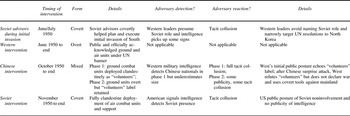
The Korean War took place amid plausible conditions for the use of secrecy to limit war including a local conflict pitting two opposed great powers (United States, Soviet Union) joined by one regional power (China), opposing sides equipped with lethal military technology (including atomic weapons), and both sides concerned about alliance relationships. Yet the conflict was a “least likely” context for the theory in several important respects.Footnote 56 The conflict took place in the earliest years of the Cold War. The pattern of limited war described in this article would be easiest to cultivate among superpowers with a long track record of encounters. Moreover, domestic politics on both sides of the American-Soviet pair make the conflict a least likely host for secrecy to limit war. On the one hand, the postwar Stalinist Soviet Union was devoid of domestic rivals or audience costs for making concessions. Stalin therefore possessed considerable flexibility whether or not his involvement was covert. On the other hand, American leaders held a domestic priority of mobilization and remilitarization. Exposing the Soviet air role could have provided American leaders a golden opportunity to galvanize domestic sentiment against the Communist threat.Footnote 57 Instead, American leaders tacitly colluded. Table 1 gives an overview of the nested cases, their character, and their timing. The subsequent analysis moves in rough chronological order beginning with the initial Soviet covert advisory role.
Cases in the Korean War

Case Studies: Escalation and Secrecy in the Korean War
The Soviet Role in the Initial Invasion
Although the June 1950 invasion of South Korea was at the North Korean leader Kim Il Sung's initiative, his patron in Moscow, Stalin, vetted the request and provided advisory support to the invasion.Footnote 58 In consultation with Mao, Stalin approved the invasion and authorized Soviet military advisors to quietly and secretly help direct it. To conceal their role, Soviet advisors were withheld from the front lines and instructed to pose as Pravda journalists.Footnote 59 Soviet diplomats “avoided direct Soviet implication” by relying on “numerous ambiguities” and giving “no publicity to participation [of] Soviet ‘volunteers.’”Footnote 60 Stalin's motive for concealment was to avoid conclusive evidence that would make a larger and direct confrontation with the United States and its Western allies hard to avoid.Footnote 61
Interestingly, Western leaders consciously echoed the misleading impression of Soviet noninvolvement. Behind closed doors, American leaders universally believed Moscow played a central role.Footnote 62 This belief was not based on faith: a declassified intelligence report as early as July 1950, for example, described eyewitness reports of a Soviet colonel in the North Korean capital of Pyongyang and suspicious looking “non-Asiatic” officers.Footnote 63 The benefits of exposing Moscow's role were tempting: as US Secretary of State Dean Acheson noted, “prompt and explicit exposure of Sov[iet] responsibility for [a] clear-cut case of aggression sh[ou]ld go far, appropriately played by Western propaganda, to destroy [the] effectiveness of peace offensive.”Footnote 64 Yet after consulting advisors and allies, Acheson and other Western leaders chose to downplay the Soviet role. Consistent with the commitment dilution mechanism, the West narrowly construed the invasion as North Korean. Invoking the language of face and commitment, the American ambassador in London counseled against the long-term consequences of publicizing a Soviet role.
If in any public announcement which we may make, the use of armed forces by the North Koreans is associated with the Soviet [Union], either directly or indirectly, we may possibly be ourselves so committing the Soviet[s] that they will find it difficult to save their face … In a situation of this sort which might develop into a general world conflagration … we believe it essential to refrain from committing a major power capable of precipitating a world war that it will not be embarrassed by what otherwise would be a moral if not a political retreat.Footnote 65
At this early phase in the war, US leaders were also concerned about the effect of visibility on their own flexibility as the conflict evolved. In light of the hawkish domestic climate of the early 1950s in the United States, President Harry S. Truman instructed his subordinates to avoid direct accusations of a Soviet role because of “the fear that the domestic mood might suddenly overheat.”Footnote 66 Consistent with the challenge-minimization mechanism, Western leaders saw tacitly colluding in minimizing the direct Soviet role in the invasion as a way to lower the perceived directness of the Communist challenge. Paul Nitze, State Department Policy Planning Staff director, advised Secretary Acheson that publicizing Moscow's direct role would place American leaders on the horns of a dilemma as the conflict evolved.
It is distinctly not to the interest of United States to make any move on its part which would tend to widen the conflict … Should the US officially denounce the Soviet government as responsible for the aggression, it would be very difficult to avoid the logical consequences of such a position, i.e., branding the Soviet Union as the aggressor through UN action. Other steps, such as breaking diplomatic relations, etc., would be almost inescapable once the direct accusation was made. Failure to take these steps which would logically flow from any official position would be a very serious indication of fear of the Soviet Union.Footnote 67
The United Nations Enters: Overt Intervention by the West
Yet even as Western leaders downplayed Moscow's direct role in the invasion, they felt an urgent need to visibly respond to the North Korean invasion itself. The need for an overt and robust response was reinforced by the rapid gains on the battlefield by North Korean forces in the first weeks. With their South Korean ally in jeopardy of complete destruction, Truman approved air, naval, and ground combat assistance using US General Douglas MacArthur's forces in Japan by 30 June 1950. Washington and its Western allies simultaneously shepherded resolutions condemning the invasion as an act of North Korean aggression through the United Nations Security Council.Footnote 68 The result was a highly publicized intervention under the mantle of the United Nations intended to restore the hopes of South Korea and counter North Korea's gains.
Regarding limiting the war and the threat of escalation, Western leaders certainly saw risks including from unintended escalation.Footnote 69 Acheson noted American decision making “was taken in the full realization of a risk of war with the Soviet Union.”Footnote 70 However, two considerations led them to favor an overt form, both supportive of a limited war rationale. One was the urgency created by North Korea's rapid advances. The possible elimination of South Korea constituted a threat to the very possibility of limited war before it even started. The operational benefits of a large intervention on behalf of South Korea were not seen as inconsistent with limited war. A second consideration was early signs of Soviet interest in playing a limited war game. Western leaders interpreted Stalin's arms-length treatment of the initial invasion—denying a role even behind closed doors—as a sign Moscow was “not prepared to risk the possibility of global war.”Footnote 71 Because “the weight of official opinion in Washington tilted to the belief that the Soviet Union did not seek a global conflict or even a wider war in Asia,” American leaders believed their narrowly tailored use of force to prevent South Korean collapse would retain the limits of the war.Footnote 72
Soviet Pilots Quietly Enter: Stalin's Covert Air Role
Western air, ground, and naval forces soon turned the tide of the war in favor of South Korea after a daring surprise landing behind enemy lines in September 1950. With momentum building for the West, General MacArthur's troops rolled over the original North/South border at the thirty-eighth parallel and into Pyongyang. As Western troops stormed north and threatened North Korea with defeat, China and the Soviet Union quietly rushed to aid their beleaguered ally.
The strength of Western air power and near-complete absence of such capabilities in his allies left Stalin with a serious dilemma. Providing air cover was essential to avoid North Korea's collapse and support the Chinese ground troops that would soon enter the fighting. Yet doing so would cross an essential line in the limited war interaction order, placing his military personnel and assets in direct combat with the West. Consistent with the theory, Stalin selected a covert form of intervention to preserve the outside appearance of a strictly demarcated proxy war.
The facts regarding the covert Soviet air role, concealed for decades, are now clear. From November 1950 until the end of the conflict in 1953, the Soviet Union covertly deployed between 40,000 and 70,000 service personnel in air combat, anti-aircraft, and support roles over Manchuria and northern North Korea. At their peak in 1951–52, around 26,000 Russian service personnel served in twelve divisions.Footnote 73 Soviet pilots flew as many as 90 percent of flights by mid-1952, according to one American estimate.Footnote 74 Moscow gave strict orders for all personnel to appear as North Korean or Chinese and avoid physical detention by the enemy.Footnote 75 Planes flown by Soviet pilots bore the markings of North Korea or China. Soviet pilots were even instructed to use memorized Chinese words. A Soviet veteran of the Korean War, still flummoxed by this impractical order, told American journalists in an interview after the Cold War that switching languages worked “until the first real fight in the air, when we forgot not only our Chinese commands but Russian words too—except for dirty language.”Footnote 76 Russian sources claim Soviet pilots shot down between 1,100 and 1,300 American aircraft.Footnote 77 Remarkable telegrams from Mao to Stalin complimenting Soviet pilots' performance in the first two weeks of November 1950 document just how early their combat presence was felt.Footnote 78 By early 1952 and through 1953, Soviet pilots were gradually phased out of combat operations in favor of newly trained Chinese pilots.
Documenting Stalin's motivation for covertness is inevitably more difficult than doing so on the American side because the documentary record is comparatively much thinner. Documentation about reasoning rather than factual matters is especially rare. However, the judgment of historians of the Korean War is unanimous that Stalin was extremely concerned about conflict escalation and that this consideration influenced many of his choices during the war. Stalin reluctantly authorized the initial invasion and, even after doing so, “continued to be extremely reluctant to risk direct confrontation with the United States.”Footnote 79 Zhang concludes that “fearing the conflict might escalate into a full-blown war between the Soviet Union and the United States, Moscow placed security restrictions on Soviet pilots in an effort to conceal their participation in the Korean conflict.”Footnote 80 The most recent studies of the Korean War reach the same conclusion drawing on primary materials from all three sides and Chinese and Soviet specialists. Hopf's analysis of Soviet decision making in the early Cold War, for example, describes a number of foreign policy decisions by Stalin in 1949 and 1950, including concealed pilots in Korea, driven by “fear of provoking the United States.”Footnote 81
What primary evidence is available supports the limited war thesis in two important respects. First, Stalin approved covert air support knowing it would be quickly detected by American intelligence. A remarkable cable to Stalin from his top defense advisor in Pyongyang warned that any pilots “will inevitably be discovered by the US troops right after the first air combat, because all the control and command over the combat in the air will be conducted by our pilots in the Russian language.”Footnote 82 This is powerful evidence against the hypothesis that Stalin chose secrecy to surprise the United States and suggests Stalin was relatively confident his primary adversary had reasons to keep the secret. There is also primary evidence of Stalin's fear of unintended escalation. A cable to Mao in early October 1950 states that, even though the Americans did not appear to want a global war, they might attack China or the Soviet Union because of “prestige” considerations.Footnote 83 A third source of evidence is apparent escalation aversion and limited war practices in Stalin's decisions in addition to concealing his pilots. For example, Soviet complaints about occasional American bombing incidents over the border into Soviet territory were expressed privately rather than publicly.Footnote 84 Stalin steadfastly refused to provide Soviet ground personnel that would be more susceptible to capture and widespread publicity even when North Korea's collapse appeared imminent.Footnote 85 Stalin also insisted Chinese ground forces that did enter Korea be called “volunteers” as a way to “reduce prospects for a US declaration of war against the PRC.”Footnote 86
On the American side, declassified records show the covert Soviet air role was known with certainty through radio intercepts and other intelligence sources. Declassified records show early reports of Soviet air assets in an Air Force daily report as early as mid-November 1950.Footnote 87 Daily CIA summaries in late December described swelling shipments of aircraft from Soviet bases into Chinese Manchuria but judged this “does not permit the conclusion that Soviet pilots are flying the planes.”Footnote 88 By the end of 1951, however, an analysis by the CIA reported “upwards of 15,000 Russians were physically involved in the Korean War” and that “Russian personnel pilot about 150 Jet interceptor and 25 long-range conventional fighter aircraft in almost daily and nightly combat missions.”Footnote 89 A language-based signals intercept analysis concluded that “of the total flights referred to by these nets during the period, 90 percent were made by pilots flying aircraft whose call numbers equated to ‘allied’ (Russian) units and were vectored and controlled by Russian speaking operators.”Footnote 90 A summer 1952 National Intelligence Estimate starkly concluded that “a de facto air war exists over North Korea between the UN and the USSR.”Footnote 91
In a prototypical case of tacit collusion, American leaders chose to conceal this evidence. Such a reaction was neither unintentional nor improvised. Declassified State Department policy planning records reveal that, from the start of the war, American leaders anticipated Soviet military personnel might covertly enter the war and planned to ignore them if Moscow kept their profile low. An August 1950 State Department memorandum on the possibility of external intervention argued “Soviet or Chinese communist forces might be organized elements of the regular Soviet or Chinese Communist armies fighting under their own banners, or they might masquerade as North Korean forces fighting as an integral part of the North Korean Army.”Footnote 92 In consultation with Sovietologist George Kennan, Acheson's advisors in the State Department recommended the United States ignore any low-level, covert combat that might result. On the one hand, Kennan himself argued that entry by the Soviet Union “using the uniforms or insignia of the Soviet Union” would require mobilization for a third world war.Footnote 93 On the other hand, if Stalin entered covertly, American leaders could choose whether to publicize any resulting clashes and declare war. A memo capturing this contrast concludes:
we should use the device of recognition of a state of war only as a final resort. We should not thus generalize hostilities and restrict our freedom of action unless the Soviet Union affronts us in such manner that no other course is possible, or unless we decide that a generalization of hostilities is in our National interest. We should leave ourselves free to take limited military action against Soviet forces without a declaration, if this seems advisable.Footnote 94
This policy of ignoring clashes with Soviet forces as long as they were covert was codified in the rules of engagement approved by the National Security Council and issued to General MacArthur. The general was instructed to immediately halt offensive operations and consult Washington should Soviet combat units overtly enter Korea. However, “if the participation of Soviet or Chinese Communist forces should not be announced by their governments, such forces should be treated as if they were North Korean and might be fired upon without restriction.”Footnote 95
Why not exploit Soviet deceit? One key reason for tacit collusion was the American domestic climate and Truman's vulnerability to hawkish sentiment. Rather than operating as an antiwar constraint, secrecy for the administration was useful to avoid empowering hawks who sought war with China and/or the Soviet Union. Tacit collusion helped maintain the impression to domestic audiences of a conflict demarcated by an absence of direct combat encounters with Soviet forces. Nitze stated in an interview years later that “the public would expect us to do something about it and the last thing we wanted was for the war to spread to more serious conflict with the Soviets.”Footnote 96 Eisenhower's attorney general and close advisor Herbert Brownell also told historian Halliday that “we had to keep that under the carpet. If that had ever gotten out, there would have been tremendous pressure to have a war with Russia.”Footnote 97
Misperception, Exploitation, and Limited Aims: Lessons from China's Ground Entry
After weeks of negotiations with Stalin, Mao ordered Chinese soldiers in the newly christened “Chinese People's Volunteers” to cross the Yalu River and into North Korea on 14 October 1950. All troop movements were carefully concealed via night marches, false North Korean uniforms, and instructions to pose as ethnically Korean volunteers.Footnote 98 These Chinese ground units initially fought a very limited counteroffensive to prevent North Korea's imminent collapse. Twenty days after the end of these limited operations, Mao's forces launched a massive counteroffensive on 25 November, reversing momentum and threatening South Korea anew. For reasons of space, I highlight the three most theoretically relevant elements of China's intervention: how misperception permits exploitation in limited war games; how actions violating the limited aims rule can trigger publicity; and how covert tools helped restore a limited war.
First, China's use of secrecy allowed it to mimic caution and exploit the West's inclination to limit the war. Consistent with Slantchev's analysis, Mao used secrecy not to carefully limit the war but to spring a surprise that he saw as the only route to battlefield success against a technologically superior enemy.Footnote 99 Yet understanding why this surprise was so effective requires understanding the link between covert intervention and limited war—and the misperception it produced. Declassified American records show how Western leaders reacted to the first signs of Chinese nationals on the battlefield by tacitly colluding.Footnote 100 Acheson saw China's behavior as mimicking the Soviets, noting that “just as we pretended Moscow was not committing aggression in N[orth] K[orea] so it may be necessary for us not to overplay the new factor of Chi[nese] intervention in N[orth] K[orea] until our combined political-military interests require that action.”Footnote 101 The British foreign secretary cabled Washington on 4 November, for example, arguing publicity of China's entry “might make it more, rather than less, difficult for the Chinese to climb down and avoid open commitment.”Footnote 102 This shows the danger of exploitation because of secrecy's multiple benefits and the difficulty in identifying an adversary's purpose.
The escalation to major Chinese-Western ground combat after the surprise counter-offensive led Western leaders to reject diplomatic tact and embrace public castigation of Chinese “volunteers” and aggression.Footnote 103 The use of publicity by China and the United States supports the theory's connection between secrecy and limited aims. On the one hand, China's large and visible entry was precipitated by General MacArthur's forces advancing through North Korea and threatening North Korea's survival. On the other hand, China's response of a large-scale intervention convinced the West that South Korea was now under threat of defeat. American leaders abandoned their diplomatic tact and embraced publicity. Each side therefore engaged in activities that threatened to decisively end the war on disastrous terms. This was followed by a partial rejection of backstaging. In contrast, the Soviet covert air role was always geographically limited to North Korea and grew into a sustainable form of backstage rivalry.Footnote 104
Finally, the Chinese role highlights how covert tools can be used to reestablish a framework of limited war even after a breakdown. The entry of Chinese nationals into ground combat visibly crossed one line limiting the war: national identity. Yet Western leaders sought to continue to manage pressure for a wider war even as they responded to China's actions. They did so by reinforcing a second line limiting the conflict: geography. Even as they resisted Chinese combat forces on the peninsula, the Truman administration refused to heed calls to open a second military front over the border into mainland China by rejecting air strikes, a naval blockade, and a declaration of war. Instead, Truman chose to target mainland China with expanded CIA covert operations to destabilize the regime in cooperation with Chinese Nationalists and other groups opposed to Communist rule.Footnote 105 Thus, even as a direct clash within Korea threatened the framework of limited war, covert tools allowed both sides to restore geographic limits and avoid escalation beyond the peninsula.
Discussion of Findings
My analysis of the variation among and within the three external interventions during the Korean War provides substantial support for a theory linking tacitly cooperative uses of secrecy to the process of waging limited war. Moscow's use of secrecy in the initial invasion allowed American leaders to narrowly construe their overt response to a highly threatened South Korean ally. The rich American documentary record shows clear evidence that they linked the visibility of Soviet involvement with the risks of unwanted conflict escalation. This set the tone for later interactions as well. Stalin's approval of a Soviet covert air role was made amid numerous indications of extreme caution regarding escalation to a general war. Moreover, declassified records on the American side show leaders anticipated a covert Soviet role, planned to ignore it, and executed this plan once Soviet pilots were detected. Both sides appeared to see the creation of a backstage as a way to safeguard the framework of Korea as a limited war from discrepancies on the battlefield and reduce the danger of external pressure and unintended escalation. The Chinese intervention shows the validity of covertness as a tool of surprise and the importance of limited war in generating the misperception that the West suffered. In addition, the Chinese role shows how exceeding limited aims can lead both sides to abandon the backstage, and how covert tools can help restore a framework of limited war thereafter.
Conclusion
Secrecy has been an important part of leaders' attempts to address the problem of limited war in light of the destructiveness of two world wars and the invention of atomic weaponry. In general, limiting war requires that adversaries see themselves, and be seen as, confining violence behind clear lines. Visibly crossing these lines often raises the stakes of an otherwise localized conflict and can mobilize pressure groups, making further escalation hard to avoid. Secrecy therefore allows leaders to generate the illusion of a more limited war. In the Korean War, a covert air war among Soviet and American pilots produced a striking dissonance between battlefield reality and the wider image of a well-regulated limited war. Although susceptible to misperception and exploitation, the cases in this study show secrecy can successfully enable adversaries to manage external escalation pressures. Israel's covert strike on the Syrian nuclear facility noted in the opening similarly suggests that states manipulate the visibility of their activity to deal with political pressures and avoid spirals of escalation.
The theory and hypotheses shed important light on why states sometimes reject secrecy and embrace the spotlight. Kennedy famously publicized secret Soviet missiles and started the Cuban Missile Crisis. In 2014, American leaders disclosed classified intelligence to help make a public case linking Russian covert activities to separatists that shot down a Malaysian jet in Eastern Ukraine.Footnote 106 The framework presented in this article suggests one key reason publicity was embraced in these cases: an adversary's covert activity was being used to substantially alter the strategic status quo rather than for more limited aims. Limited war's sustainability depends on both sides refraining from decisively altering the status quo. Leaders in Washington detecting nuclear missiles in Cuba and covert Russian activity in Ukraine have used publicity to criticize, rally other leaders to sanctions, and prevent a substantial shift in the strategic balance of power. As declassified records continue to be made available, future research may further explore the complex ways in which leaders invite and avoid publicity in adversary relationships.
Although the focus in this study is great power interventions, analogous secrecy patterns may emerge in a range of competitive relationships. States that are regional rather than global powers, for example, may join in keeping more aggressive acts on the backstage to prevent unintended regional conflict escalation, as may well be the case for Israel and its rivals in the Middle East. Outside security contexts, the theory describes patterns that may emerge in any mixed-motive situation that meets two common conditions: (1) competing actors have an information advantage vis-à-vis outside audiences that can be the basis of deception, and (2) one or more sides is vulnerable to losing control over additional levels of hostilities and such escalation is costly. Future research could, for example, explore analogous forms of secrecy, tacit collusion, and face saving in trade relationships that feature economic competition (rather than military). Leaders may have better information about discriminatory trade practices of other governments and tacitly collude in ignoring some violations that could trigger hard-to-control escalatory pressure. More broadly, Goffman's insights about secrecy and social interaction include a number of additional applications for scholars interested in secrecy and publicity dynamics in world politics.Footnote 107
The primary contribution of the theory and findings to wider studies in IR is to shed new light on the tools of coercive diplomacy and the origins of private information. The article also contributes to more specific areas of scholarly interest by showing how careful and opportunistic use of declassified materials can shed substantial light on the dynamics of covert activity. This holds promise for rigorous and theoretically motivated studies of similar topics in the future. Excavating Goffman's insights regarding secrecy contributes to continued interest in using Goffman to shed light on various aspects of world politics. When it comes to debates on regime types, the theory highlights secrecy's attraction as a tool to foster and maintain limited war. Democratic leaders tend to be most vulnerable to escalation pressures, which suggests that a limited war logic may be an important reason democracies often find covert tools so appealing. This, in turn, highlights an important normative dilemma: those regimes premised on transparency in domestic governance may be the governments most attracted to using secrecy for pursuing limited war. The fact that a modern democracy such as the United States is aggressively developing new covert tools (for example, drones and offensive cyber capabilities) is suggestive evidence of the continued attraction and normative tension in these activities. In general, theorizing secrecy's appeal to democratic leaders helps demonstrate the importance of loosening assumptions in IR theory about the transparency of democratic state behavior.Footnote 108
Future research may address a number of interesting extensions. For example, how might secrecy and tacit collusion work among friendly states? Recent leaks about American spying on its European allies, for example, prompted a very public crisis. Goffman's framework might suggest these states are in a different “interaction order” than adversaries in limited war. When an unauthorized leak made the US spying on Germany public, German Chancellor Angela Merkel had to visibly demonstrate anger to her domestic audiences in part because deception among allies is especially inappropriate.Footnote 109 Future research could explore these scenarios as well as how allies create their own backstages through explicit coordination on secret resolution of disagreements. Future research might also explore other policy tools that draw on ambiguity rather than outright concealment. The principle of judicial economy in international trade dispute settlement, for example, consciously fosters legal interpretive ambiguity.Footnote 110 American foreign policy doctrines embrace ambiguity regarding Taiwan (for example, “constructive ambiguity”) and the use of nuclear weapons (for example, “calculated ambiguity”). The theory suggests such ambiguity helps judges and leaders avoid foreclosing face-consistent ways for states to act in different ways in the future.