

INTRODUCTION
I feel I should offer apologies as I begin this piece; firstly it seems a little cheeky as a former law librarian to be offering advice to readers of Legal Information Management. Secondly, the content will pivot around my own experiences as I seek to share with you ways in which you might look to engage with those outside of your own institutions. I will of course be bringing in the experiences of others so bear with me, it is not all ‘me me me’.
My fourteen years as an academic law librarian were largely happy ones: I enjoyed my work, my involvement with BIALL and learnt a tremendous amount. I was very fortunate for much of this time to have a good deal of freedom in my role and this meant I could ‘have ideas and run with them’ in a way that burgeoning committees often make impossible today. I created a website called LawboreFootnote 1, building it around the needs of my students, with the full support of the library and law school.
This resource continued to develop, moving from a simple internet gateway to a site supporting many different functions – from careers to legal skills like mooting. My role changed as the years rolled on, and whilst I was still managing the library space and the collections, answering enquiries and teaching; I was also organising events, coordinating mooting activities and competitions, alongside all my Lawbore work. It was hectic but I loved it. My close contact with students meant I could help Lawbore grow by reacting to the types of questions I was asked, and the challenges students faced.
This work gained a good deal of recognition: I received various awards from City University, including the annual Saddlers Prize given to one member of University staff for their contribution to the institution. Externally I was shortlisted for various awards before an amazing two years where I received the Wildy BIALL Law Librarian of the Year 2012, the Routledge/ALT Teaching Law with Technology Prize 2013 and finally a HEA National Teaching Fellowship in the same year. These proved to be my undoing. My independence and close relationship with the school was viewed as dangerous, and it was clear my role would be diluted and responsibilities chipped away until it was urecognisable.
It was a tough decision to leave the profession I thought I would be in for life, but I've started again as a law academic and it has proved to be a wise move, as I'm enjoying it hugely.
So, why have I bored you with my life story? Well I wanted to set the scene for you, to let you know where I'm coming from before trying to convince you of my message. Here it is: the most beneficial bits of my career in librarianship mostly came as a result of reaching out to others who were not librarians, sometimes outside of my institution, occasionally not even in this country.
Rebecca Davies, Pro-Vice-Chancellor for Student and Staff Services at Aberysthwyth University, states:
A successful, collaboration-rich library and information service will:
• be part of the shift to open-access scholarly communication
• be entrepreneurial and mutate services, take risks, and learn from (regular) failures to confront disruptive technologies
• collaborate within and outside our professional and institutional boundaries, working as part of multi-service teams and with organizations and businesses outside our perceived sector wallsFootnote 2
The bold type is my emphasis, not Rebecca's, but I wanted to flag up the essence of her statement. Libraries need champions; we need to reach others in our organisations in order to strengthen the perception of our role. The services we offered were much more obvious when print dominated our collections; now it is necessary to make our value explicit. In academia, the way in which people teach and research has shifted, and this has a knock-on effect on how they use the library:
“Faculty used to rely almost exclusively on the library for the scholarly materials they needed for research and teaching, and librarians guided faculty to and otherwise facilitated the discovery of these materials. As scholars have grown better able to reach needed materials directly online, going to or using the library is not essential to carrying out research and so faculty are turning to other options”Footnote 3.
In Higher Education (HE) our language has altered as universities seek to restructure and cut costs. In this ‘edgeless’ era of HE, convergence and holistic shared services rule: the library bundled in with other, seemingly unrelated, parts of the university. Libraries streamline in order to improve efficiency; carving out teams who can carry out each other's roles interchangeably.
Making connections with those outside of the service is essential to our survival; otherwise we risk becoming sucked into the unidentified mass of ‘services’ within our organisations. A few years ago there was some buzz about the ‘echo chamber’ – the idea that as librarians we dedicate too much time telling other librarians about the great work we do. Ned Potter and Laura Woods defined this as ‘a situation in which information, ideas or beliefs are amplified or reinforced by transmission and repetition inside an ‘enclosed’ system’Footnote 4.
It's so important to get out there and be part of the networks and communities that your clients or users rely upon – for me this meant engaging with the academic law community. I'd like to say that this was some kind of well-thought out strategy on my part – it was not, but I wanted to join the dots. I didn't see how I could be a law librarian without having connections with both legal academia and the legal profession. This meant moving into different circles and networks than I was used to, edging out of my comfy librarian world. It was intimidating but I felt sure that I had a lot of knowledge to gain, and that my work also might be of interest to them.
I started in small ways: looking out for Calls for Papers at academic law conferences and attending events. I began tweeting and also attended some tweet-ups for lawyers (this was 2009!). Legal blogging was emerging and I got to know some of those who still dominate the field today. My papers were accepted and I spoke at both a BILETAFootnote 5 and UKCLEFootnote 6 conference, receiving the HEA ‘Best Paper’ award in the Legal Education stream at the latter event.
THINKING GLOBALLY
Obviously this wasn't at the expense of my own field: I continued to put forward papers and write articles within librarianship too. I was also keen to learn from our colleagues abroad and got funding to attend two AALL conferences, where I gave short papers and made some important new connections. I got lots of new ideas, inspiration and also reassurance that I was doing something new that others in our profession were interested in.
Always take the time to speak with the international delegates who come to the BIALL conference - you never know what might come of it. International highlights for me include doing a joint AALLFootnote 7 paper in Boston with Alison Shea, a wonderful visit to Norway to put on a workshop at the University of Oslo (thanks to Bard Sverre Tuseth) and a lecture tour across Australia in 2014, climaxing with a keynote in Adelaide for the ALLAFootnote 8 conference (thanks to Carole Hinchcliff). These kinds of opportunities can really change the way you think about your role, and also the way others view you. Having international ‘impact’ is certainly a way of demonstrating to your employer that they are lucky to have you, and that you are likely to be able to contribute widely to future strategy.
BACK TO LAWBORE…
My work with Lawbore has always been dependent on my reaching out to others to get involved. This includes a wide array of people: students, academics, e-learning teams, alumni, publishers and legal practitioners. Here is a snapshot of selected examples of this from recent years:
Collaboration with academics
- Learnmore: which houses all my legal skills content, was given a major refresh when I bribed encouraged an academic colleague to get involved. We worked on the mooting section together, making it the most comprehensive multimodal resource for this discipline available online.
- Talking Essays: a resource bank of examples of real student essays, complete with audio hotspots to give feedback at certain points within the work. Lecturers selected 2 pieces within their discipline and then recorded comprehensive feedback.
- Video series for would-be barristers: working with a colleague from our professional programmes (also a practising barrister) to create a series of 5 videos taking students from the moment they receive a brief, up to preparing for court. Using a mix of ‘talking heads’, interview, screencasts and animation to engage BPTC students.
Collaboration with students
- Learnmore: I approach students about collaborating with me on certain skills areas - for Mooting we have lots of video resources; some are compiled from real moots, others are extracts from a roundtable discussion. In other areas students have written pieces giving advice and tips.
- The blog: this part of Lawbore focuses on careers and the legal profession. Each year a number of students across different law courses take a role as a Lawbore journalist; reviewing events they attend, writing pieces based on their own experiences (of pro bono work, internships, mini pupillages and vacation schemes), or interviewing their peers.
It makes complete sense to work with students to create resources for your users. It helps to foster a feeling of community within the school; students helping each other via peer learning. It's true of course that generally speaking, students hold what their peers say in great regard, often feeling that those who have experienced things more recently are more trustworthy than their lecturers in this respect. Giving students the opportunity to write for fun and raise their profile is also important.
Maria Bell and Jane Secker at LSE have been taking the collaboration with students further still with their Student Ambassadors for Digital Literacy (SADL)Footnote 9 project. This partnership between the Learning, Technology and Innovation (Lti) team and the Library seeks to:
“Explore the role that student ambassadors can play in developing and integrating digital and information literacy into the curriculum”.
SADL is aimed at undergraduate students and those selected as ambassadors attend 4 workshops during the year to gain skills in ‘finding and evaluating information, improving their reading and research, managing and sharing information and managing their online identity’Footnote 10.
Once trained up these ambassadors then deliver the workshops themselves, developing future content and offering support to their peers. This seems an excellent way to engage students in digital literacy guerrilla-style: using their peers to get the message across.
Collaboration with alumni
Along similar lines to the student section above, alumni can hammer home a message to current students very successfully. The unspoken message: ‘I've started out where you are, and look where I am now’ is very powerful for engagement and motivation.
- The blog: I approach alumni to write pieces or do video interviews with me.
Aside from the online aspect, alumni are brilliant for speaking at events, or coming forward to offer opportunities for students. At City, we have various pro bono programmes with different sets of chambers which were initially started via a connection with our alumni. Adam Wagner, barrister at Crown Office Row and creator of the wonderful UK Human Rights Blog and rightsinfo.org offers two of our students the chance to write the roundups on the blog each year.
Collaboration with publishers
Learnmore: once the mechanism for the Talking Essays feature had been developed, it struck me that this could have other uses. I had been thinking for some time of ways in which we could bring alive law reports, and help students understand the purpose of each section. After speaking to the Incorporated Council of Law Reporting (ICLR), Paul Magrath, Head of Product and Online Content, agreed to work with me. We used Hunter v Canary Wharf [1997] AC 655 and he recorded explanatory sections to help the students navigateFootnote 11. Another member of the ICLR team, Daniel Hoadley, had previously written me a piece encouraging students to use their ‘raw law’, and not just rely on textbooks.Footnote 12
I was concerned students rarely used Halsbury's Laws and so asked LexisLibrary to write a lively piece for the blog. They penned ‘Halsbury's Laws of England: What is it for?Footnote 13
Collaboration with other university teams
There are so many options for working together with other teams within your institutions: in Higher Education (HE) this is most likely to be the careers team, academic study skills people, research department or those who focus on learning and development across the university. There are risks with this: a silo mentality still exists within certain quarters, and in a climate where fear of the dreaded ‘restructuring’ is ever-present, colleagues can be worried about who gets the credit and turf wars kick in.
After being inspired by Michael Doherty's Open Law MapFootnote 14, in my new role as an academic I joined forces with Sally Thorpe from our Academic Study Skills team to give our students something exciting to get their teeth into in the September 2015 induction period. Sending students out in teams to explore different parts of their local area, their task was to locate 4 specified buildings of legal significance, take a photo of themselves outside it whilst doing research on the move to answer questionsFootnote 15. When finished they have a few days to put together a blogpost on something inspired by their visits. On Day One they have an explanation of the task and some tips on writing at university level.
The following week Sally and I put on legal writing workshops, encouraging students to bring along their blogs and take part in peer review. They then get a chance to refine, before submitting online. With the help of alumni, myself and a colleague will review the submissions, choosing 15 to receive prizes and be published on Lawbore. The exercise has many aims:
- to get students working together within their tutorial groups, getting to know each other informally
- to help familiarise them with the local area
- to help us identify those who need extra support with their written skills (so that we can assist them prior to the first piece of written coursework)
- to set in motion the idea that law is all around us, not just found in textbooks
For Sally this is a great way of ensuring the students know what her team can help with straightaway. Getting practically involved in a task shows far more effectively what she can do than the generic 10 minute ‘Who we are’ lecture. For the law school, it hopefully means an engaged cohesive student cohort who are better informed about what's involved in writing and fired up about their three years at City.
Collaboration between Universities
Cross-institutional projects are becoming more common and librarians are often active here, particularly in relation to designing learning spaces outside of the library, Bradford University, University of Bolton, Teeside and the University of Cumbria are amongst these.
The first phase of the JISC-funded, University of Huddersfield-managed Library Impact Data Project (LIDP) concerned the investigation of the hypothesis that: ‘There is a statistical correlation across a number of universities between library activity data and student attainment’Footnote 16.
Initially carried out over a four-year period, the first phase of the project looked for correlation between library usage and degree results. Seven university libraries signed up to work with project initiators at Huddersfield and found that there was indeed such a correlation in relation to book loans and ebook usage.
Collaboration with the community
A brilliant example of collaboration between a library, an outside organisation and the community was the Sir Henry's project. Sir Henry's was a prominent bar and nightclub in Cork, renowned for its music scene, which closed in 2003 after 25 years of business. Three people collaborated to put on an exhibition celebrating the impact of the iconic Sir Henry's: Stevie G, a DJ and promoter, Eileen Hogan, an academic at University College Cork (UCC) and Martin O'Connor, librarian at UCCFootnote 17. The idea for the exhibition was sparked by a tweet and the campaign to encourage collaboration from the local community was, to a large part, also driven via social media.
The exhibition brought huge interest from the Cork community but also from the national press. The ‘community’ included those who owned the club, those who worked there, clubbers, bands who played there, those who drank there. The diversity of musicians featured at Sir Henry's (including dance and rock) meant that this was a very varied community. Pleas for material to exhibit and stories to include resulted in a wealth of set lists, ticket stubs, photographs, records and clothing. The exhibition ran from July to September 2014, within the library, bringing in lots of visitors who had never visited before.
WHAT DO THOSE WITHIN THE INFORMATION PROFESSION HAVE TO OFFER TO FUTURE COLLABORATORS?
As a new outsider, I got to thinking about others who have moved into other professions; what are the key skills that we took with us? Indeed what are the characteristics that make us so adaptable, perhaps this would give us further insights into why people should want to work with us.
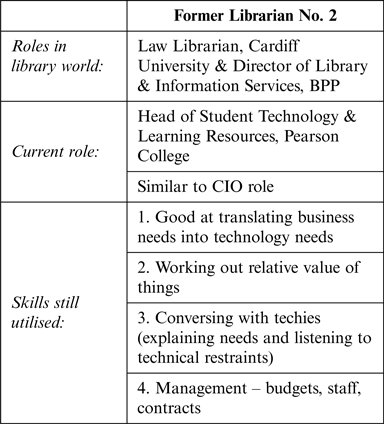
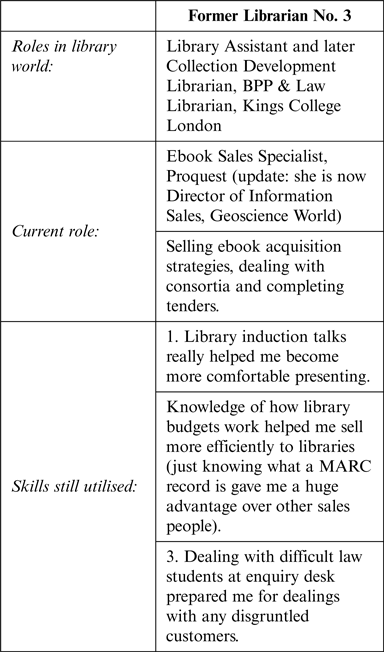
I spoke to six ex-law librarians who had moved into a range of different roles, asking them which skills proved most indispensable for their new career path. These are summarised within tables below:

BARRIERS TO COLLABORATION
We've already mentioned silo culture, but there are various ways in which chances of collaboration can be scuppered. These fall under the following descriptors: Existing attitudes, history, different cultures, communication and autonomyFootnote 18.
What is clear is that in addition to the expected traditional skill-set, librarians have a great deal to add to any collaboration or partnership. Expertise in needs analysis and networking, organisers and planners, managers of budgets, people and spaces. The tenacity of the information professional is the stuff of legend. An understanding of IT, or at least how to communicate with IT teams with the right language, to push a project forward came up frequently. Most strong however was the ‘librarian as hub’ point: knowledge of how to connect people and join the dots.
So go out there and connect! Engaging and potentially teaming up with those outside the profession, making your choices wide and varied (even sometimes unlikely), can result in huge benefits (to both sides!). Don't hold back!


