Historically, English pronunciations of the digraph <wh> differed from those of <w>, yielding minimal pairs such as which ~ witch and whine ~ wine. While this contrast has been lost in many varieties of English (e.g., in North America; Labov, Ash & Boberg, Reference Labov, Ash and Boberg2008:45), Scottish Englishes have traditionally been described as retaining it (Giegerich, Reference Giegerich1992:36; Jones, Reference Jones2002; Wells, Reference Wells1982:409). However, sociolinguistic research across Scotland suggests this is changing (Brato, Reference Brato and Lawson2014; Chirrey, Reference Chirrey, Docherty and Foulkes1999; Lawson & Stuart-Smith, Reference Lawson and Stuart-Smith1999; Macafee, Reference Macafee1983; Reiersen, Reference Reiersen2013; Robinson, Reference Robinson2005; Schützler, Reference Schützler2010; Stuart-Smith, Timmins, & Tweedie, Reference Stuart-Smith, Timmins and Tweedie2007). Based on an analysis of 1,400 tokens of <wh> produced by eighteen female speakers of Edinburgh English, I propose that, in Edinburgh at least, this is best conceptualized as variation within the sociolinguistic variable (HW).
(HW) denotes a sociolinguistic variable that encompasses all pronunciations of <wh>. Variants of (HW) are often described as labial-velar fricative and labial-velar approximant. In contrast, I use the terms “fricated” to refer to tokens characterized by a period of frication preceding a glide, and “fricationless” to refer to tokens that only consist of a glide. This distinction is useful because, as I show in this study, variants of (HW) differ with respect to type and duration of frication and quality of glide, voicing, and phonation. I find that middle-class speakers (and those who orient toward Standard Scottish English) produce higher rates of fricated tokens, while working class speakers (and those who orient toward Scots) favor fricationless tokens. As with other sociolinguistic variables, the phonetic context is also a meaningful predictor of variant choice and variant realization. Notably, I do not find evidence of a change in progress. Given the broader context this does not support an effect of contact with Southern British English(es) as suggested in prior work and points instead to variation based on social class and speech style.
Background
Setting the scene: Edinburgh, Leith, and linguistic diversity
Home to the Scottish parliament, several universities and a finance sector, Edinburgh is a cosmopolitan city associated with power and wealth. The most prominent spoken varieties are Gaelic, Scots, Scottish Standard English (SSE), Southern British English, Polish, and Urdu.Footnote 1 Gaelic, which has been repressed like other Celtic languages in the British Isles, has been the focus of revitalization efforts in recent years and is visible on official signage (Lawson, Reference Lawson2014). Scots differs from English on the levels of syntax, phonology, and lexis (Jones, Reference Jones2002; Lawson, Reference Lawson2014). SSE features some Scots lexis and syntax and differs from Standard Southern British English (SSBE) in terms of phonology (Giegerich, Reference Giegerich1992; Schützler Reference Schützler2015). Like other standard varieties, SSE is strongly associated with formal contexts and middle- and upper-class speakers rather than a particular place. Scots, on the other hand, is generally associated with working-class speakers, and varieties of Scots are spoken in urban and rural areas of Scotland. Many speakers shift between Scots and SSE depending on the social context (Stuart-Smith, Reference Stuart-Smith, Kortmann, Burridge, Mesthrie, Schneider and Upton2004). In Edinburgh, most people likely encounter Scots, SSE, and SSBE every day.
Most of the women interviewed for this study (n = 16) have grown up in Leith. Historically an independent port town, Leith retains a distinct identity from Edinburgh (Doucet, Reference Doucet2009; Marshall, Reference Marshall1986). In recent years, deindustrialization and gentrification have changed it dramatically. Today, the area around Leith Walk, a thoroughfare connecting Leith and Edinburgh city center, and Easter Road, home to Leith's football team, is one of the most densely populated in Scotland. It features small international supermarkets and tailors between pubs, bars, and restaurants. The other two participants lived in Morningside, a neighborhood of Edinburgh long perceived as middle class whose high street is dominated by upmarket boutiques and supermarkets, cafes, and pubs.
Historical perspective: an unstable contrast
Old English featured several <h>-initial clusters including <hw>, whose patterns of alliteration and rhyme suggest was pronounced as the voiceless labial-velar fricative [ʍ] (Minkova, Reference Minkova, Curzan and Emmons2004:16). This contrasted with <w>, produced as the labial-velar approximant [w]. This distinction was preserved in modern spelling as <wh> and <w>. While at first glance it appears that some varieties of English retained a phonemic contrast until recently, Minkova (Reference Minkova, Curzan and Emmons2004) suggested that this contrast has been unstable for a long time. Considering Old English texts, Minkova (Reference Minkova, Curzan and Emmons2004:17) argued that <h>-insertions in etymologically <h>-less words indicate variation or confusion on the part of authors, while <h>-less spellings of etymological <hw>-words suggest reduction (e.g., <wistle> instead of <hwistle> and <bilhwit> instead of <bilewit>). The contrast later reappeared in the speech of upper-class Southern English speakers but has since been lost in all Anglo-English varieties, including SSBE (Wells, Reference Wells1982)Footnote 2 and North American varieties (Bridwell, Reference Bridwell2019; Labov et al., Reference Labov, Ash and Boberg2008:49; Thomas, Reference Thomas and Thomas2019). Minkova (Reference Minkova, Curzan and Emmons2004) traced the fricated variant in Scottish English to an allophone of Old English /hw/, [xʍ], which developed to [hw̥].
Variation in type and duration of frication in fricated (HW) tokens found in several varieties of English today could indicate that the distinction between different allophones was never as clean as Minkova (Reference Minkova, Curzan and Emmons2004) described. Similarly, the apparent “reappearance” of the contrast in Early Modern English could be evidence for a “reconstruction” of the contrast based on spelling (Minkova, Reference Minkova, Curzan and Emmons2004) or variable retention (Milroy, Reference Milroy, Curzan and Emmons2004). In any case, the diachronic perspective highlights that any variability in choice and realization of variants found today is not necessarily new.
A contact-induced merger in progress?
Over the last forty years, variable use of fricated and fricationless variants of (HW) in Scotland has been found to be conditioned by age, gender, socioeconomic class, educational background, contact with SSBE, and linguistic factors such as phrasal position and phonetic context. (HW) has been described in Glasgow (e.g., Lawson & Stuart-Smith, Reference Lawson and Stuart-Smith1999; Macafee, Reference Macafee1983; Stuart-Smith et al., Reference Stuart-Smith, Timmins and Tweedie2007), Livingston (e.g., Robinson, Reference Robinson2005), Edinburgh (e.g., Chirrey, Reference Chirrey, Docherty and Foulkes1999; Fruehwald, Hall-Lew, Eiswirth, Boyd, & Elliot, Reference Fruehwald, Hall-Lew, Eiswirth, Boyd and Elliott2019; Reiersen, Reference Reiersen2013; Schützler, Reference Schützler2010), and Aberdeen (e.g., Brato, Reference Brato and Lawson2014).
Beginning with social factors, Schützler (Reference Schützler2010) interpreted differences by age and gender among twenty-seven middle-class speakers in Edinburgh as a change in progress and argued, based on effects of contact with SSBE and level of education, that the loss of fricated (HW) was a contact effect. In forty-four Aberdeen speakers, Brato (Reference Brato and Lawson2014) found that middle-class teenagers (in particular girls) and older speakers shifted from the traditional, local, Scots variant [f] of (HW) to the fricated supraregional Scottish English [ʍ], while younger working-class speakers shifted toward the fricationless variant [w]. Like Schützler (Reference Schützler2010), Brato (Reference Brato and Lawson2014) argued that contact with non-Scottish varieties played a role in this shift. Drawing on formal speech from 138 speakers in the ICE-Scotland corpus (e.g., parliamentary debates and television broadcasts), Li and Gut (Reference Li and Gut2022) showed that even in formal SSE none of the speakers fully retained the original (HW) phonemic contrast, while 12% exclusively produced fricationless variants. Similar to Schützler (Reference Schützler2010) and Brato (Reference Brato and Lawson2014), they noted differences by age and gender, with women and younger speakers more likely to produce fricationless tokens (Li & Gut, Reference Li and Gut2022). In Glasgow, Stuart-Smith et al. (Reference Stuart-Smith, Timmins and Tweedie2007) and Lawson and Stuart-Smith (Reference Lawson and Stuart-Smith1999) described effects of age and social class on (HW). Working-class speakers, in particular young working-class speakers, preferred fricationless variants, while middle-class speakers favored fricated ones. The putative role of contact with Anglo-English varieties is particularly interesting among these Glaswegian speakers, as it highlights the complex relationship between social class, local and nonlocal linguistic standards, and contact. Middle-class speakers retained the fricated variant despite contact with Southern British varieties (Stuart-Smith et al., Reference Stuart-Smith, Timmins and Tweedie2007). Young working-class speakers adopted the “nonlocal” fricationless variant not due to direct face-to-face contact with Southern British speakers or a positive orientation toward Southern British varieties or a non-Scottish identity, but rather, Stuart-Smith et al. (Reference Stuart-Smith, Timmins and Tweedie2007) argued, to distinguish themselves from middle-class Glaswegians. As to linguistic factors, while fricated realizations seem to be straightforwardly favored after pauses and in lexically stressed positions, the effects of lexical frequency and lexical category, phonetic context, and word-specific effects are difficult to disentangle because the incidence of lexical items is so heavily skewed toward what, when, why, where, which (Schützler, Reference Schützler2010). Fricated tokens have been reported least likely to occur in word-internal contexts (e.g., somewhere), and fricationless variants to be favored word-initially, after vowels, and (less strongly) after consonants (Brato, Reference Brato and Lawson2014).
A range of variants
Many discussions of (HW) treat it as a merger (which ~ witch) (e.g., Fruehwald et al., Reference Fruehwald, Hall-Lew, Eiswirth, Boyd and Elliott2019; Labov et al., Reference Labov, Ash and Boberg2008; Macafee, Reference Macafee1983; Reiersen, Reference Reiersen2013; Schützler, Reference Schützler2010) between the voiceless labial-velar fricative [ʍ] that is characterized by a period of frication and the fully voiced labial-velar approximant [w]. However, in their study of Glaswegian children's speech, Lawson and Stuart-Smith (Reference Lawson and Stuart-Smith1999:2542) described an additional intermediate variant perceived as voiceless but lacking the characteristic period of frication and a category of tokens which “[are] neither like [hw] nor like [w]” but a “breathy [w̤].” Such tokens are found in a 1997 corpus of adult speakers from Glasgow, too (e.g., Stuart-Smith et al., Reference Stuart-Smith, Timmins and Tweedie2007). Among children in Livingston, a town between Edinburgh and Glasgow, Robinson (Reference Robinson2005:186) also found a “continuum of phonetically intermediate forms,” the most “traditional” of which was a “voiceless lip-rounded consonant with audible friction at both velar and bilabial articulations,” while an intermediate variant included voiced fricated tokens. Working on Southern White American English in South Carolina, Bridwell (Reference Bridwell2019:104) also described “voiced [hw] tokens” featuring both frication before the glide and voicing throughout the entire segment.
Acoustic phonetic variation and (HW)
Most prior studies of (HW) relied on auditory coding of variants (e.g., Brato, Reference Brato and Lawson2014; Schützler, Reference Schützler2010; Stuart-Smith et al., Reference Stuart-Smith, Timmins and Tweedie2007) or minimal pair tests (e.g., Labov et al., Reference Labov, Ash and Boberg2008). However, acoustic phonetic analyses can reveal patterns that are not necessarily auditorily perceptible. Variants of (HW) consist of a glide, which can be characterized by formants, and an optional period of frication preceding the glide. Li and Gut (Reference Li and Gut2022) examined this frication by measuring harmonicity, or the ratio of harmonics to noise. They found that while [ʍ] and [w] generally differed in harmonicity, there was considerable overlap of harmonicity values and that [w] tokens in <wh>-words were different from those in other words (Li & Gut, Reference Li and Gut2022). Complementing these findings, I analyze the center of gravity of the periods of frication preceding the glide.
Center of gravity (CoG), or spectral mean, is a measure commonly used in phonetic research to describe fricatives (e.g., Gordon, Barthmaier, & Sands, Reference Gordon, Barthmaier and Sands2002; Jongman, Wayland, & Wong, Reference Jongman, Wayland and Wong2000; Zimman, Reference Zimman2017). It represents a weighted average of the frequency components of a spectrum and shows the locus of high energy in the spectrum. In the only other study of (HW) considering CoG, Bridwell (Reference Bridwell2019:120) reported two categories of frication, one very similar to [h] (as in [hw]) and one associated with “true labiovelars” [ʍ]. For the former, the aperiodic noise was spread across frequencies and thus associated with a high CoG. For the latter, the noise was clustered at much lower frequencies and thus associated with a lower CoG.
Formants represent local peaks of acoustic energy that are estimated from the spectral envelope. In phonetics, the first three formants are commonly used to distinguish voiced sounds. Lawson and Stuart-Smith (Reference Lawson and Stuart-Smith1999) described distinctive formant patterns for the voiced glides of their variants: [w] tokens were characterized by low F1 and low and weak F2 contours before rising toward the expected formant loci of the following vowel. [ʍ] was characterized by an abrupt start of both formants at the onset of voicing without this period of lower formants. Their “intermediate” breathy tokens appeared to fall somewhere in between those extremes, with shorter periods of low F1 than the voiced variant. Notably, in their Glasgow-based study, Lawson and Stuart-Smith (Reference Lawson and Stuart-Smith1999) also found some apparently socially conditioned variation, with middle-class children producing a slightly longer period of low F1 than working-class children.
Data and Methods
Participants
The speech of eighteen women born between 1938 and 1994 was analyzed for this study. All had spent most of their life in Edinburgh, sixteen of them in Leith, a traditionally working-class neighborhood in North Edinburgh, and the remaining two in Morningside, a traditionally middle-class neighborhood in South Edinburgh. The group from Leith includes working- and middle-class speakers, and both Morningside speakers are middle-class.
Recordings
The data is comprised of eighteen semistructured sociolinguistic interviews. I conducted fifteen of those interviews between December 2018 and February 2019 in Leith as part of a research project on sociophonetic variation. These one-on-one conversations focused on the participants’ experiences of growing up and/or living in Leith and other topics such as their work and hobbies. There was also a reading task (adapted from Schützler [Reference Schützler2015]). The remaining three interviews were collected in 2014 by Jonathan Berk as part of a master's thesis exploring differences between Leith and Morningside and similarly focused on speakers’ life in Morningside (Berk, Reference Berk2014). All interviews were recorded using a portable digital recorder and a lavalier microphone in quiet, public spaces and digitized at 44kHz. Neither of the interviewers is from Scotland (or the UK), although we were both residents at the time of the interviews.
Manual annotation
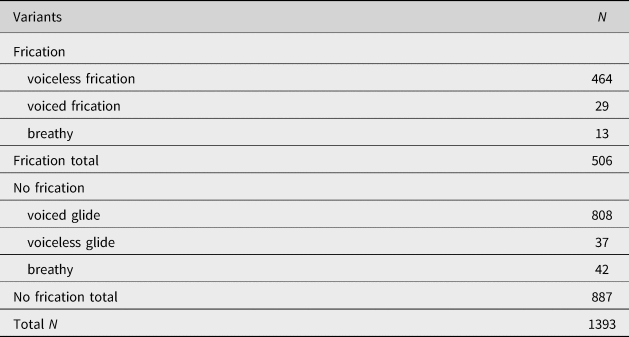
I orthographically transcribed all recordings, force-aligned them using the Montreal Forced Aligner (McAuliffe, Socolof, Mihuc, Wagner, & Sonderegger, Reference McAuliffe, Socolof, Mihuc, Wagner and Sonderegger2017) and annotated tokens in Praat (Boersma, Reference Boersma2001). Using auditory perceptual information, spectrogram, and waveform, I first coded each token as fricationless or fricated. During this process, I discovered a range of variants. In addition to the “fully voiced fricationless” (n = 808) and “fully voiceless fricated” (n = 464), like Bridwell (Reference Bridwell2019) I also identified “voiced fricated” (n = 29) tokens where both frication and glide are characterized by voicing (see Table 1). While most of these occur after voiced segments, it is not clear that this is merely a coarticulation effect as six of the tokens occurred after voiceless obstruents or pauses. Conversely, there are also thirty-seven “voiceless fricationless” tokens featuring a voiceless glide (similar to Lawson & Stuart-Smith, Reference Lawson and Stuart-Smith1999:2543), which appear distinct (both visually and auditorily) from “typical” fricationless tokens. Glides in fricated and fricationless tokens can be breathy (n = 42). In addition to these six variants, I also identified a small number (n = 7) of tokens that are more similar to [f], [v], and [h]. I annotated the duration of frication manually using changes in spectrogram and waveform from glide to the following vowel as cues (see Figure 2).
Counts of different (HW) variants (n = 1400); there were seven tokens annotated as [f] (n = 5), [v] (n = 1), and [h] (n = 1)

Acoustic phonetic measures
Formants were extracted from voiced parts of each <wh>-token (glides) and all “<w>-glides” (i.e., glides in words like water) using a semiautomated Praat script. Each <wh>-token was visually checked and the glide manually selected (for <w>-glides this process was fully automated). The script records the word and phonological environment of each token and segment duration. The first three to five formants (depending on trackability) were extracted in 5ms intervals, with the maximum formant frequency set to 5500Hz and the window length set to 25ms. F1 and F2 measures taken between 45% and 55% of the voiced duration of the glide were retained in subsequent analysis in R (R Core Team, 2017). This narrow window effectively reflects the midpoint of the voiced glides and was preferable to a longer duration to avoid distortion from formant transitions. Furthermore, formants could not be reliably extracted for all tokens beyond this point. Measures were transformed from Hertz to Bark (Traunmüller, Reference Traunmüller1990).
CoG of the fricated portion of each fricated token was measured using a Praat script adapted from DiCanio (Reference DiCanio2017). This script creates a set number of spectral slices across the middle 80% of the segment (to minimize context effects). CoG measures for each slice are averaged across the segment. To avoid overlap between windows, which would bias the averaged CoG measure toward the middle of the segment, the original script was adapted to automatically adjust the window length based on the duration of the segment. To ensure that each window contained enough data to make inferences, a minimum window length of 5ms was implemented.
Data “tidying” and dataset construction
Three datasets were used for statistical analysis: the full manually annotated dataset of 1,400 tokens of (HW), and two subsets of that dataset. The first subset contains only fricated tokens and is used to analyze variation in CoG. There were no obvious outliers resulting from measurement errors, so no further tokens were excluded from analysis. The second subset contains measurements of F1 and F2 at the midpoint of the voiced portions of both fricated and fricationless glides as well as labial-velar approximants in <w>-tokens (e.g., in water). Some tokens were completely voiceless, in others the voiced portion of the segment was too short to reliably extract formants, and, in some, Praat's formant tracking was inadequate. While formant trajectories would be interesting, not enough formant measurements could be extracted for most tokens to reliably explore these. Instead, I opted to only look at the measurement closest to the midpoint within 45% to 55% of the glide duration. This second subset contains 262 fricated tokens, 388 fricationless tokens, and 2,915 <w>-tokens.
Statistical analysis
Statistical analysis was conducted with the R package brms (Bürkner, Reference Bürkner2017), which estimates generalized (non-)linear multivariate multilevel/mixed effects models using the probabilistic programming language Stan in R (Carpenter, Gelman, Hoffman, Lee, Goodrich, Betancourt, Brubaker, Guo, Li, & Riddell, Reference Carpenter, Gelman, Hoffman, Lee, Goodrich, Betancourt, Brubaker, Guo, Li and Riddell2017). The key difference between popular frequentist regression models (as fitted with lme4 [Bates, Mächler, Bolker, & Walker, Reference Bates, Mächler, Bolker and Walker2015]) and their Bayesian equivalents is the underlying philosophical approach to statistics. Bayesian models combine prior information with observed data to estimate (posterior distributions of) model parameters.Footnote 3
In this paper, four models are fitted to four dependent variables: proportion of frication (a rate, beta distribution), CoG (a numeric outcome variable [Hertz], lognormal distribution), F1 (a numeric outcome variable [Bark], lognormal distribution), and F2 (a numeric outcome variable [Bark], lognormal distribution). In this analysis, I use “weakly informative” priors (see Gelman, Jakulin, Grazia Pittau, & Su, Reference Gelman, Jakulin, Grazia Pittau and Su2008) to constrain the parameter space to appropriate estimates, for coefficients, intercept(s), and standard deviations. For example, we know that formant values are likely to fall within a specific range (see supplementary materials for full model specifications). Because Bayesian approaches estimate distributions of parameters, where some parameter values are more probable than others, we avoid asking whether or not there is an effect of a factor (Null Hypothesis TestingFootnote 4) and instead ask what the most probable direction and magnitude of an effect is. In the context of this study, these questions are more relevant. Accordingly, I use the metrics “probability of direction” and “region of practical equivalence” to interpret results (see also Makowski, Ben-Shachar, Chen, & Lüdecke, Reference Makowski, Ben-Shachar, Chen and Lüdecke2019).Footnote 5 For completeness, I also include the median parameter estimate and lower and upper bounds of the 89% Highest Density Interval (HDI) that captures the most probable parameter values.
Interpretation: Probability of Direction
The Probability of Direction (PD) captures the certainty that an effect has the same direction as the median estimate of the posterior distribution (i.e., is positive or negative) (Makowski et al., Reference Makowski, Ben-Shachar, Chen and Lüdecke2019). The simplest method of computing PD is by counting all samples in the posterior distribution that share a sign with the median estimate and dividing by the number of total samples (i.e., the PD is equivalent to the percentage of positive/negative samples). It answers the question “What is the probability of the direction of the effect of independent variable A?” In the results below, I express PD as a positive/negative direction and the percentage of samples sharing that sign (e.g., -(100%) means that 100% of samples are negative). I also provide a description of this probability of direction along the following scale: “unclear” (<60.0%), “possibly positive/negative” (60.0-69.9%), “likely positive/negative” (70.0-89.9%), “very likely positive/negative” (90.0-100%).
Interpretation: Region of Practical Equivalence
The Region of Practical Equivalence (ROPE) describes an interval that is practically equivalent to zero, based on subject knowledge of what represents a meaningful difference. Effect size can be gauged by considering what percentage of a given posterior distribution falls within that interval. The intuition here is that while the coefficient might not be exactly zero, it may well be too small to be of any practical significance. ROPE directly answers the question “What is the probability that this effect is not of practical significance?” In the results below I express ROPE as the percentage of samples falling within ROPE. I also provide a description of the likely practical meaning of the effect along the following scale: “very unlikely meaningful” (>89.9% in ROPE), “unlikely meaningful” (50.0-89.9% in ROPE), “possibly meaningful” (20.0-49.9% in ROPE), “likely meaningful” (5.0-19.9%), “very likely meaningful” (<5.0%).
Variables and hypotheses
Social and linguistic independent variables are social class, year of birth, style, phonetic context, speech rate, and (for formants) type of glide. Speaker and word were included as random effects (intercepts and slopes where appropriate). Social class is defined as “working class” (WC) or “middle class” (MC). The fifteen participants recorded in 2019 chose a social class label for themselves during the interview, while the three participants recorded in 2014 were assigned a social class label based on their occupation. Style was defined as either “conversation” or “reading,” as speakers in the 2019 sample also completed a reading passage. The definition of phonetic context depends on the statistical model and outcome variable. For the model looking at presence and duration of frication, the relevant phonetic context is the preceding context (pause or nonpause, as also used by Brato [Reference Brato and Lawson2014] and Schützler [Reference Schützler2011]). For the CoG model, the relevant phonetic context is the preceding manner of articulation (fricative, plosive, approximant, nasal, vowel, and pause). For F1, what matters is the following vowel height (high, mid, low) and, for F2, following vowel anteriority (front, central, back). Speech rate was operationalized as number of syllabic consonants or vowels per second (measured within chunks not interrupted by pauses of more than 3s). The glide type is only relevant for the formant models and comprises fricated, fricationless, and <w>-glides (e.g., the initial glide in water). Categorical variables (social class, phonetic context, style, glide type) were deviance-coded,Footnote 6 and numeric variables scaled and centered.
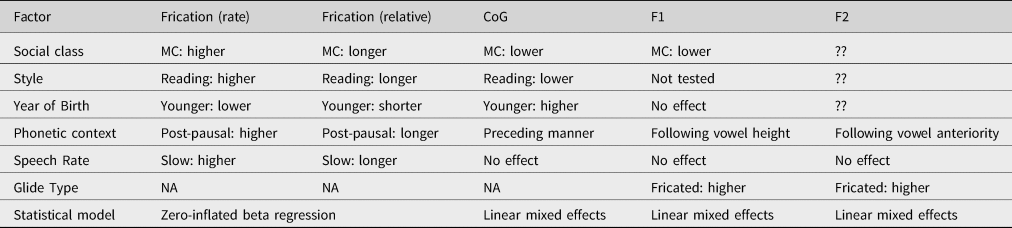
The hypotheses for this study are summarized in Table 2. I expect fricated tokens to be more likely among middle-class speakers and older speakers (see Brato, Reference Brato and Lawson2014; Robinson, Reference Robinson2005; Schützler, Reference Schützler2010; Stuart-Smith et al., Reference Stuart-Smith, Timmins and Tweedie2007), and potentially formal styles. Based on work that associates lower CoG with “true labiovelars” (Bridwell, Reference Bridwell2019:120; Robinson, Reference Robinson2005:186), I expect CoG to be lower in those formal contexts too. Otherwise, CoG is likely affected by the preceding manner of articulation (Bridwell, Reference Bridwell2019). Fricated tokens are expected to be more likely after pauses (Brato, Reference Brato and Lawson2014; Schützler, Reference Schützler2010), which might translate to longer periods of frication. Formants are expected to be influenced by phonetic context, social class, and glide type (Lawson & Stuart-Smith, Reference Lawson and Stuart-Smith1999).
Summary of all hypotheses explored in this paper

Probability and proportion of frication: Zero-inflated beta regression
The probability (“is a given token fricated?”) and relative duration of frication (“how long is the period of frication in fricated tokens?”) can be modeled using a zero-inflated beta regression. Beta regressions are commonly used for proportions as they can model outcomes bounded by the open interval (0,1) (Douma & Weedon, Reference Douma and Weedon2019; Ferrari & Cribari-Neto, Reference Ferrari and Cribari-Neto2004; Stewart, Reference Stewart2013). Zero-inflated models can handle datasets containing many zeroes (i.e., in our case, many fricationless tokens), and are particularly suitable when there is theoretical reason to believe that the process generating a 0 or non-0 outcome (i.e., a fricationless or fricated token) is distinct from the subsequent process generating a positive outcome (i.e., a token with a particular rate of frication). A posterior predictive check, which simulates data based on priors and observed data, confirms that a zero-inflated beta regression is appropriate for the data.
Center of gravity: Bayesian linear mixed effects (log-normal)
To quantitatively analyze variation in CoG, I use a Bayesian linear effects model. These models are specified similarly to frequentist mixed effects models, including fixed and random intercepts as well as random slopes. CoG (in Hertz) is commonly log-normally distributed (validated via a posterior predictive check).
F1 & F2: Bayesian linear mixed effects (log-normal)
F1 and F2 (in Bark) were modeled in two separate Bayesian linear mixed effects models.Footnote 7
Results
Overall, fricationless tokens are more common than fricated tokens, though the exact distribution is conditioned by linguistic context, style, and social class. Interestingly, there is no clear effect of speaker year of birth, as would be expected in a straightforward change in progress. Proportion and type of frication varies depending on linguistic and social context. The glide differs depending on whether or not the token is fricated. In the discussion of the statistical results, I focus on the direction and magnitude of effects rather than exact coefficients. Recall that PD describes the probability of a particular direction of the effect, positive (+) or negative (−), on the dependent variable and that ROPE describes the probability that the effect is not of practical significance. For coefficient tables, visualizations, and details about the models, see supplementary materials.
Fricationless tokens are more common
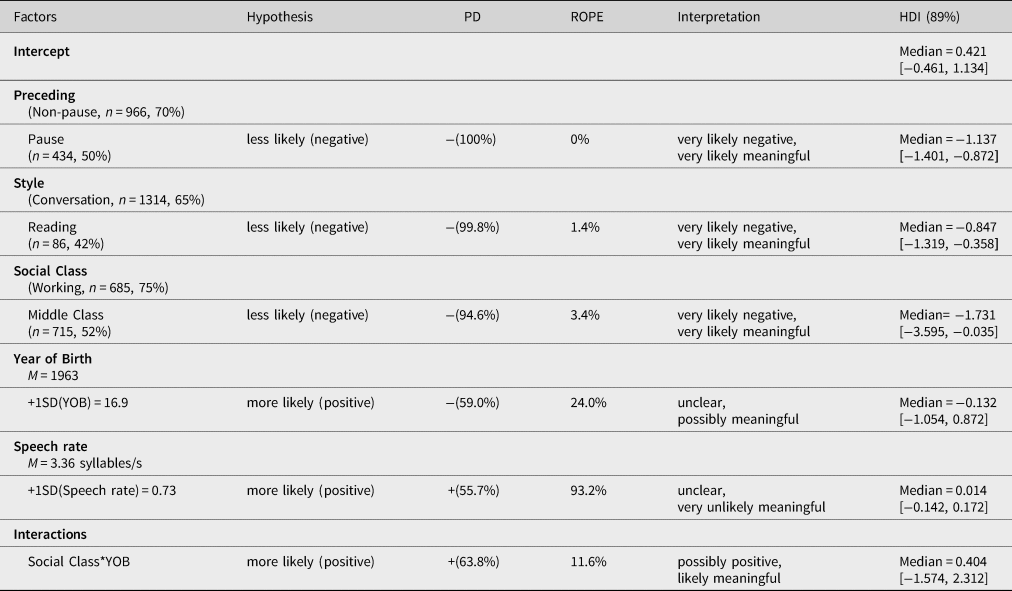
Fricationless tokens are less likely among middle-class speakers, in a reading style, and following a pause; year of birth is likely not a meaningful predictor (Table 3). The zero-inflated component of the model is a logistic regression estimating the probability that a token is fricationless.
Probability of a fricationless (HW) token: summary of the zero-inflated component of the zero-inflated beta regression (n = 1400, overall rate of fricationless tokens = 64%)

ROPE is defined as [-0.18, +0.18]. Numeric variables are scaled and centered, categorical variables are deviance-coded. Percentages in first column indicate rate of fricationless.
The proportion of frication varies
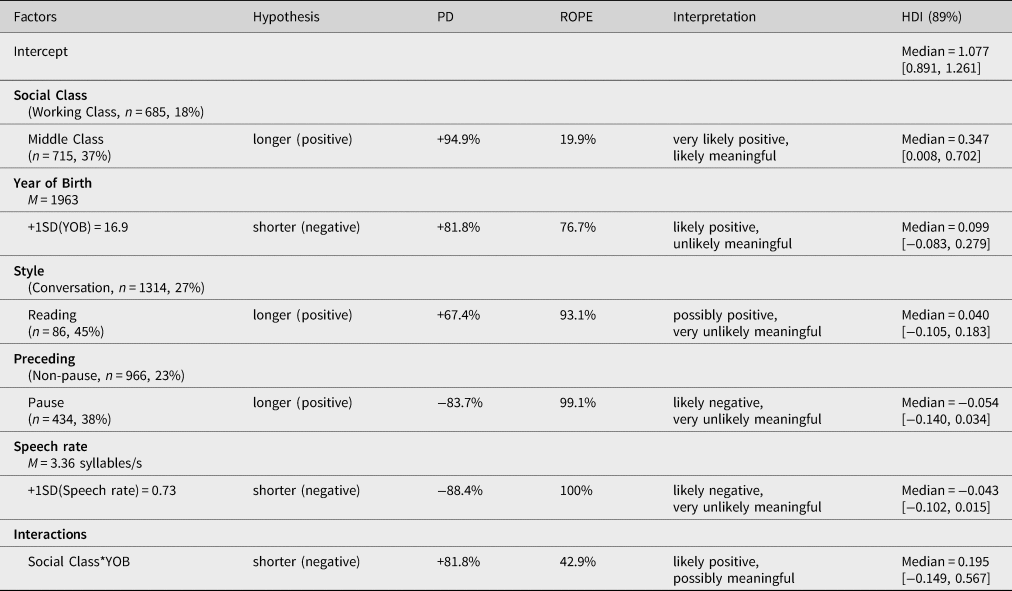
While the probability of direction indicates that the proportion of frication is conditioned by the same factors (and in the same way) as the presence or absence of frication, ROPE ([-0.18, +0.18]) suggests that the effects are not practically meaningful (see Table 4).
Proportion of frication in (HW) fricated tokens: summary of conditional component of the zero-inflated beta regression (n = 1400, mean overall proportion of frication = 28%)

ROPE is defined as [-0.18, +0.18]. Percentages in first column indicate mean proportion of frication.
The type of frication varies
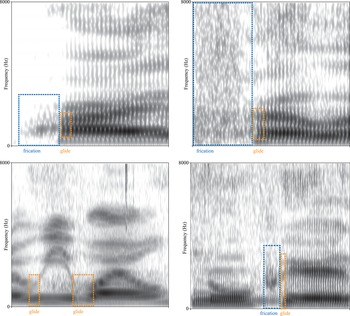
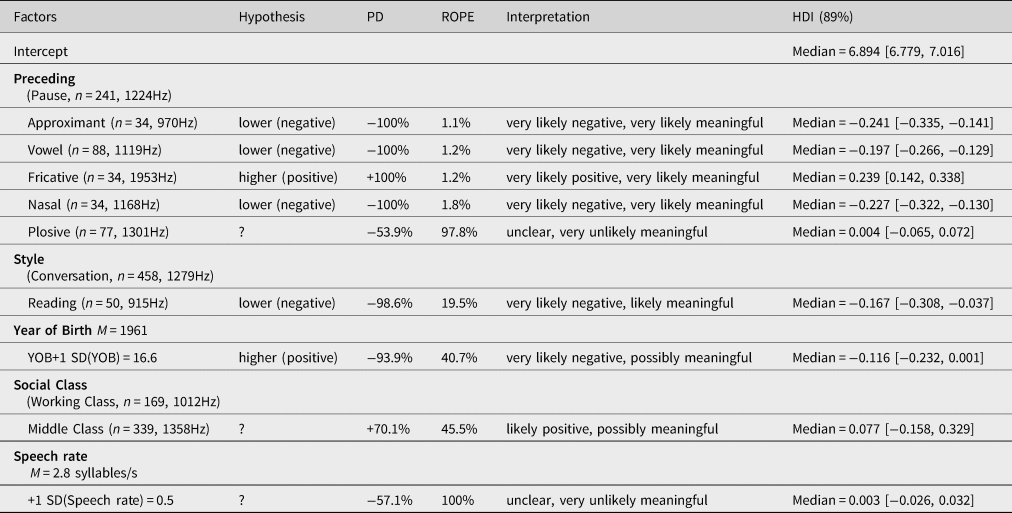
Frication noise is either diffused across the spectrum (as in Figure 1b) or clustered at low frequencies (Figure 1a). Most speakers produce both types of frication. For all fricated tokens, F1 and F2 start abruptly high at the onset of voicing and do not rise. The statistical analysis suggests that (1) context is a meaningful predictor (higher CoG after fricatives and lower CoG after vowels, approximants, and nasals); (2) style is a possible predictor with lower CoG in reading; and that (3) effects of year of birth (possibly positive) and social class (likely negative) are less likely to be meaningful (see Table 5).
Frication is either spread across frequencies or clustered low. For fricated tokens, F1 and F2 start abruptly at the onset of voicing and do not rise. For fricationless tokens, F1 starts low and rises, and F2 is weak. Figure 1a (top left). Younger working-class woman (Lily) reading “why.” Frication is clustered at low frequencies. Figure 1b (top right). Lily saying “while.” Here the aperiodic noise is spread across frequencies. Figure 1c (bottom left). Young working-class woman (Fiona) saying “a wee while.” Both glides are voiced and the (HW) realization is fricationless. Glides are characterized by a period of low F1 and low and weak F2. Figure 1d (bottom right). Lily saying “nowhere.” The period of frication is clearly visible and audible as is the voice bar throughout.

Summary of log-normal mixed effects linear regression model for CoG (n = 508, grand mean CoG = 1243 Hz)

Outcome variable: CoG of the period of frication in Hertz. ROPE is defined as an absolute difference of 100 Hz. Hz in first column indicates mean CoG.
F1 and F2 of glides vary
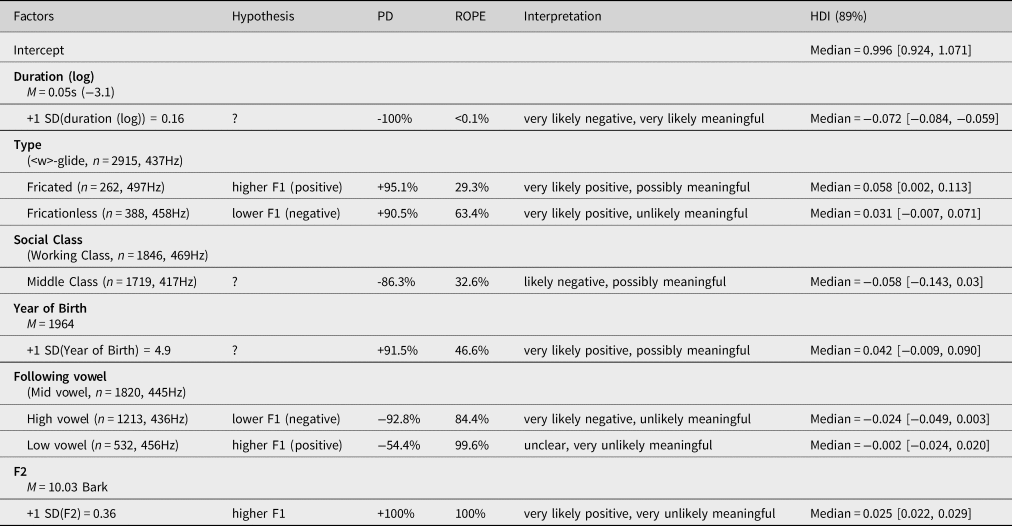
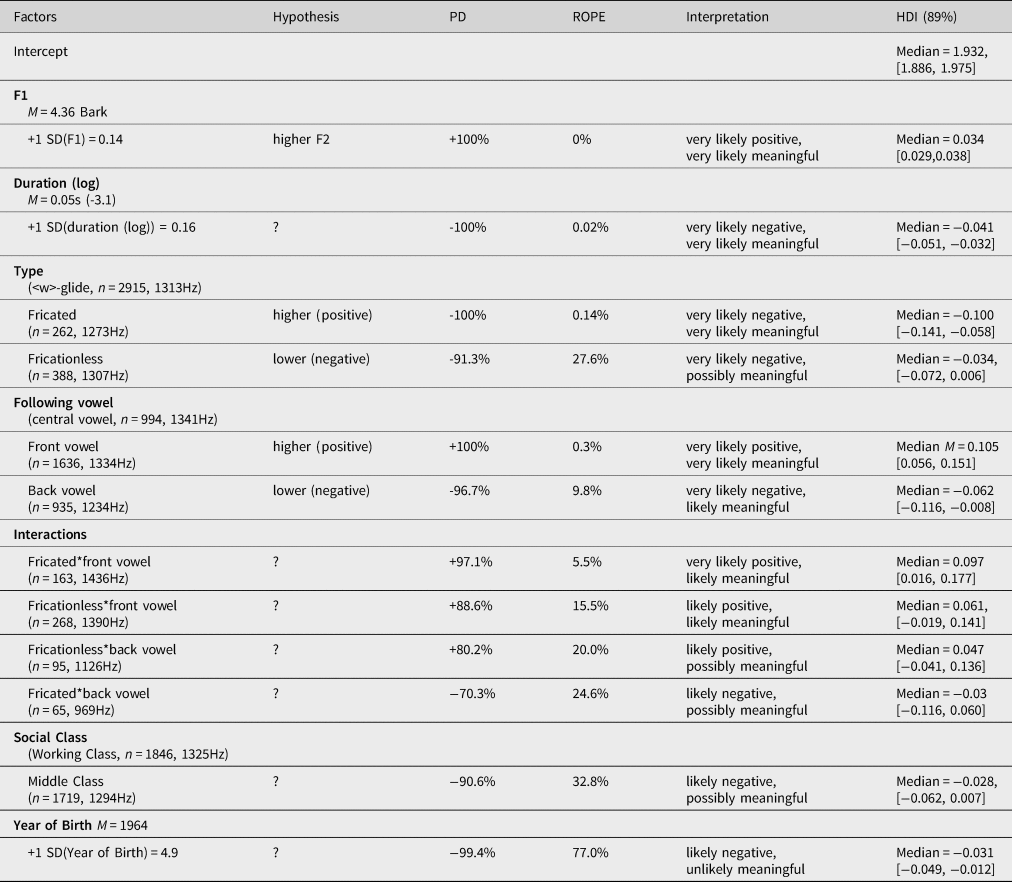
The qualitative analysis of spectrograms shows the formant patterns also reported by Lawson and Stuart-Smith (Reference Lawson and Stuart-Smith1999): fricationless tokens feature a period of low F1 and F2 before the appearance of higher formants and a movement toward the following vowel formants, while fricated tokens show an abrupt high start of F1 and F2. To confirm these observations quantitatively, F1 and F2 were measured at the midpoints of glides. In linear models, ROPE is often conventionally defined as [−0.1σ, +0.1σ] where σ denotes the standard deviation of the dependent variable. For F1, this is equivalent to an absolute difference of 0.11 Bark from the intercept. For F2, this is equivalent to an absolute difference of 0.16 Bark from the intercept. For F1, I find that (1) glides in fricated (<wh>) tokens have likely higher F1, (2) glides with a shorter duration have lower F1, (3) middle-class speakers have possibly lower F1, and that (4) most effects of linguistic contexts are very small (see Table 6). For F2, glides in fricated tokens have lower F2 (mediated by following vowel anteriority), glides with a shorter duration have lower F2, and middle-class speakers have possibly lower F2 (see Table 7).
Linear mixed effects regression for F1 (n = 3565, grand mean F1 = 443Hz)

ROPE is defined as a difference of 0.11 Bark. Hz in first column indicates mean F1.
Linear mixed effects regression for F2 (n = 3565 , grand mean F2 = 1310Hz)

ROPE is defined as a difference of 0.16 Bark. Hz in first column indicates mean F2.
Discussion
Beyond the binary distinction of which and witch there are a range of other variants, whose use appears conditioned by phonetic context, social class, and style.
(HW) as a sociolinguistic variable: the variants
There are six main variants that differ in terms of frication (fricated/fricationless), glide quality, voicing (voiced/voiceless frication, voiced/voiceless glide), and phonation (breathy/modal).
Variation in frication
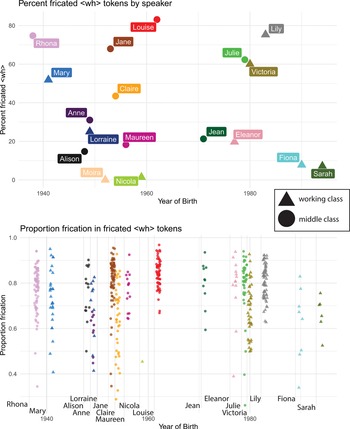
For tokens perceived as “fricated,” frication accounts for at least 26% to 96% of token duration (see Figure 2b). Meaningful predictors conditioning this proportion of frication are speaker's social class and preceding phonetic environment. Notably, year of birth is not a meaningful predictor here, suggesting that there is no ongoing gradual loss of frication.
Rate and relative duration of frication varies greatly by speaker, social class, and year of birth. Figure 2a (top) shows the percentage of fricated tokens produced by speaker, year of birth, and social class. Lily and Victoria stand out with their exceptionally high rates given their age and social class. Figure 2b (bottom) shows the relative duration of frication in every fricated token by speaker, year of birth, and social class. The duration of frication is highly variable. Each shape represents a fricated <wh>-token and the y-axis indicates which proportion of the total segment duration was annotated as frication. (Note that Moira does not produce any fricated tokens.)

Variation in CoG is conditioned by style, preceding phonetic environment, and speaker's social class. If the preceding segment is fricative, CoG is significantly higher than after a pause. Conversely, CoG is significantly lower following an approximant, nasal, or vowel sound. While these coarticulation effects are not particularly surprising, the effects of social class and preceding pause on the realization of fricated tokens is interesting.
Variation in glides
Fricated and fricationless variants differ not just in frication but also in glide quality. The most meaningful predictors of F1 are frication and token duration. Glides in fricated tokens have a higher F1 at the midpoint than those in fricationless tokens. This confirms the observation (also made by Lawson & Stuart-Smith [Reference Lawson and Stuart-Smith1999]) that glides in fricationless tokens are characterized by a period of low F1, while fricated tokens show a very abrupt start of raised F1 and F2. I also identify a small effect of social class, whereby middle-class speakers produce tokens with lower F1 than working-class speakers. This echoes Lawson and Stuart-Smith's (Reference Lawson and Stuart-Smith1999) finding that middle-class children produce a longer period of low F1 than working-class children, corresponding, presumably, to a lower midpoint.
Fricated tokens have lower F2. Effects of phonetic environment are also likely meaningful and follow expectations: tokens preceding front vowels show higher F2 while those preceding back vowels show lower F2. There is also an interaction effect of frication and phonetic context where fricated glides appear more strongly influenced by their phonetic context than fricationless tokens. This could be due to the, on average, shorter duration of fricated glides. Context effects could be more pronounced as their midpoint is closer to the next segment than in a fricationless glide. A limitation of this analysis is that midpoints are not an ideal proxy for the formant trajectories considered in the qualitative analysis. While I have been assuming that tokens characterized by a rising F1 (fricationless) have a lower midpoint than those where F1 starts abruptly and high and remains stable (fricated), there could be a lot of variation regarding the formant trajectories.
Variation in voicing
I also observe tokens that are either fully voiced (including frication) or fully voiceless. Notably, these do not exclusively occur in environments that would give rise to coarticulation effects. Bridwell (Reference Bridwell2019) accounts for voiced [hw] by positing that the underlying representation of the voiceless labial-velar fricative is /hw/, which undergoes voicing in appropriate environments and surfaces as [w]. Since no participant in my study produces only voiced fricated tokens after voiced segments, this explanation does not apply here. The devoiced [w] tokens are perceptually voiceless while lacking frication.
Variation in phonation type
A sizable subset of tokens are breathy. These variants are perceptually and acoustically hardest to pin down, as they vary in degree and duration of breathiness. While there are not enough of these tokens for a quantitative analysis, single spectrograms suggest that they are highly variable and either pattern more with “prototypical” fricated or fricationless tokens, depending on whether they show frication preceding the glide. Generally, they appear more frequently among younger speakers. Sarah (born 1993, working class) and Fiona (born 1990, working class) produced 10% (n = 8) and 5% (n = 5) of all their tokens as breathy, respectively. Notably, these two women have some of the lowest rates of frication (both under 10%). Similarly, Lily (born 1983, working class) produced 8% of breathy tokens (n = 7). However, unlike Sarah and Fiona, Lily shows a very high rate of frication (over 70%). It is therefore not clear whether the rate of frication is related to the rate of breathiness. Social class could be an explanatory factor here. The prevalence of breathy (HW) realizations among young working-class women mirrors Lawson and Stuart-Smith's (Reference Lawson and Stuart-Smith1999) observation that breathy fricated variants are more common among working-class children (who would have been born around the same time as Sarah and Fiona). However, the highest rate of breathy tokens is found in Jean's speech (17%, born 1971, middle class, low rate of frication) and the absence of any middle-class women born after 1980 in this sample means this hypothesis remains untested here.
No apparent time change in this sample?
Following the Apparent Time approach, speakers are expected to reflect the linguistic norms of their speech community when they acquired the variety (Sankoff, Reference Sankoff2006:115). If there was a change in progress, we would expect younger participants to produce higher rates of fricationless tokens than older participants. The probability of direction of the effect of year of birth in the zero-inflated component of the zero-inflated beta regression in Table 3 would then be positive (later year of birth ~ higher probability of fricationless token). Sixty percent of speakers predominantly use fricationless tokens (Figure 2a), which suggests that some change probably has taken place since older descriptions of Edinburgh English have noted that (only) “some younger speakers” use fricationless variants variably (Chirrey, Reference Chirrey, Docherty and Foulkes1999:36). However, there is little evidence of ongoing change.
Style and lexical variation
As hypothesized, tokens produced after a pause (about a third of the dataset) are much more likely to be fricated than those following a nonpausal segment. Unfortunately, other factors such as lexical frequency and lexical category are exceptionally hard to disentangle from phonetic context. Highly frequent words featuring (HW) tend to be closed class items (e.g., what, which, where, when, why), while open class items are much rarer (e.g., whisky, whistle, whale). Most instances (93%) of (HW) are furthermore word-initial (exceptions include elsewhere, anywhere, nowhere). Schützler (Reference Schützler2010:5) argues that the preference for fricated tokens after a pause is an articulatory effect. At a lower speech rate or after a pause there is “more time” to articulate the “slightly more effortful” fricated variant after a pause. However, since I do not find such a speech rate effect, I would argue that the postpausal context favors fricated tokens for the same reason that the reading style does: because fricated tokens are part of a more careful or formal speech style.
Style (conversation or reading) conditions whether tokens are fricated, relative duration, and CoG of frication. Tokens are more likely to be fricated in a reading style. This effect is one of the strongest predictors of frication. Tokens in a reading style are somewhat more likely to have a longer period of frication, but this effect is likely very small. Read tokens do, however, have a meaningfully lower CoG. They appear to be most similar to Robinson's “voiceless lip-rounded consonant with audible friction at both velar and bilabial articulations” (Reference Robinson2005:184), which she posits to be the “traditional form,” and to Bridwell's “true voiceless labiovelar glides” (Reference Bridwell2019:120). These can be contrasted with tokens in which frication is more diffuse across frequencies more similar to a glottal fricative. One interpretation of the effect of speech style on CoG is that tokens with lower CoG are produced by speakers when they pay more attention to their speech because they are more prestigious. This prestige may be the result of their association with SSE, as some of the speakers with the highest rates of fricated tokens clearly orient toward the standard and/or describe negative attitudes toward Scots. Conversely, speakers who use more Scots lexis favor fricationless tokens. The most common <wh>-noun featuring in this corpus is whisky. Family members of two informants, Louise and Jane, used to work in (now defunct) whisky companies in Leith. Of all the occurrences of the word whisky (n = 8), five are fricated. Jane produces two of three tokens with the fricated variant (a slightly higher rate than her average), Louise produces both tokens with frication (she also has the highest average rate of frication of all speakers at 83%), Julie produces one of two tokens with frication, and Mary produces one token without frication. Another locally salient (HW) word is whaling. Leith used to be an active whaling port, and the oldest informant, Rhona (born 1938), recalls whaling boats in the Leith docks, and Moira (born 1951) notes that her father used to work as a whaler. Rhona, a retired teacher (middle class) with one of the highest rates of frication, produces two tokens in this context with frication, while Moira, a retired laboratory technician (working class) with the second lowest rate of frication (7%), produces two without.
Social class, identity, and changing neighborhoods
Speaker social class is a predictor of both amount and type of frication. Middle-class speakers produce (HW) tokens that are both more likely to be fricated and, if fricated, more likely to be more fricated. Middle-class speakers furthermore tend to produce fricated tokens with a higher CoG than working-class speakers (though this effect is likely smaller). These findings echo Stuart-Smith et al. (Reference Stuart-Smith, Timmins and Tweedie2007), who also reported that Glasgow middle-class speakers favored fricated variants, while working-class speakers favored fricationless tokens.
An exception to this pattern are Lily (born 1983) and Victoria (born 1980), both in Leith and identifying themselves as “working class.” They produce higher rates of fricated tokens than all other working-class speakers (Victoria: 60%, Lily: 75%), and much higher rates than other working-class women their age. Notably, their educational and professional backgrounds suggest that both style-shift along the Scots-SSE continuum (Stuart-Smith, Reference Stuart-Smith, Kortmann, Burridge, Mesthrie, Schneider and Upton2004), and that they could perhaps be described as upper working class or “new middle class” (Dickson & Hall-Lew, Reference Dickson and Hall-Lew2017). Lily works in finance administration at a university, having previously worked in insurance but not having attended university herself. In her interview, she talks about shifting from “speak[ing] Leith,” a variety she describes as having “its own words and phrases,” to “an Edinburgh accent,” especially when interacting with colleagues from outside of Scotland. Victoria is a community officer in Leith who studied at Edinburgh University. Victoria notes that, in her perception, the way people speak in Leith has changed between generations (though she was not asked about [HW] specifically). She finds that “the older generation definitely have a different dialect from [her]self and [her] brothers” and that people her age in Leith speak very similarly to people elsewhere in Edinburgh (likely referring to SSE). These perceptions are potentially colored by her broader negative attitudes toward Scots: she explains that she believes that children should not be taught Scots in schools and that she does not want her grandmother to speak Scots to her children. This metalinguistic commentary reveals that Victoria is very concerned with “speaking properly.” Fricated (HW) appears to be part of this targeted style. Victoria's comments about language (however inflected by her attitudes) and both women's relationship to social class also speak to a real ongoing change in Leith. Crucially, the apparent time construct assumes that adult speakers remain relatively stable over their lifetime and that the speech community they were raised in is fundamentally the same today as it was then. While real time and panel studies that consider data collected at different points in time provide strong support for a model of intergenerational language change and intragenerational stability (e.g., Denis, Gardner, Brook, & Tagliamonte, Reference Denis, Gardner, Brook and Tagliamonte2019; Fruehwald, Reference Fruehwald2017), changes within speakers across the lifespan and broader external changes affecting the speech community are likely also factors. As shown above, speakers like Lily style-shift frequently and have (somewhat consciously) accommodated to a variety or standard other than the one they spoke growing up. Furthermore, over the course of the twentieth century, Leith has undergone drastic changes as the result of deindustrialization. After a period of economic decline (somewhat infamously portrayed in Irvine Welsh's (Reference Welsh1994) novel Trainspotting), Leith has become one of the most densely populated and diverse areas of Scotland, and, in recent years, has been rapidly gentrifying (Doucet, Reference Doucet2009). The speech community in which the oldest participant Rhona (born 1938) grew up is therefore very different from the one the youngest informant Sarah was born into in 1993.
Social class and local identity may also offer a better alternative account for variation than contact with Southern British English invoked in prior work. Looking only at middle-class speakers from Edinburgh, Schützler (Reference Schützler2010) argued that the adoption of fricationless [w] is an effect of higher education and contact with Southern British varieties of English (which in Edinburgh are closely intertwined). Most SSBE speakers, he argued, did not produce fricated variants at all, and the observed “merger” was thus an effect of language contact. Contrary to Schützler's argument, though, the informants in this sample with the most contact with SSBE and higher education tend to also be the speakers with the highest rates of frication (i.e., the least likely to “merge”). This is especially apparent in young upwardly mobile working-class women like Victoria and Lily, who appear to orient toward SSE, or, as Lily puts it, “Edinburgh English.” The idea that fricated variants are associated with SSE can also account for the stylistic effect, as speakers are generally more likely to use a “more standard” form while reading. The lowest rates of frication are found among working class women who have not had much contact with higher education, both older (Moira, Nicola, Lorraine) and younger (Fiona, Sarah). In the context of Glasgow, Stuart-Smith et al. (Reference Stuart-Smith, Timmins and Tweedie2007) argued that young working-class speakers used the fricationless variant, which may well have entered originally from Southern British varieties (though perhaps not face-to-face contactFootnote 8) to index distance from (or opposition to) the middle-class norm. Like in Glasgow (Stuart-Smith et al., Reference Stuart-Smith, Timmins and Tweedie2007), linguistic differences between social class groups observed in Edinburgh could be the result of changing neighborhoods and social networks, changes in Scots among working-class speakers and distinct linguistic norms for different social class groups.
Conclusion
(HW) as a complex sociolinguistic variable
In this study, I have described the so-called which ~ witch merger as a sociolinguistic variable with six internally heterogeneous variants. Realizations of (HW) differ most notably in presence or absence of frication, relative duration of frication, type of frication, glide quality, phonation, and voicing. Contrary to other studies on (HW) in Scotland (and Edinburgh), I do not find evidence for ongoing change or effects of contact with Southern British English. Rather, variant selection and realization are conditioned by social class, style, and phonetic environment. Fricated variants are particularly prevalent in the speech of middle-class and “new middle-class” or upwardly mobile working-class women, as well as in formal speech styles. A more specifically designed project using laboratory recordings could shed some light on effects of lexical frequency, phonetic environment, and semantic content. Another striking finding to explore further is that the variants identified here are very similar to those found in other varieties of English (in Scotland, but also in the United States).
Acknowledgments
This work was supported in part by the UKRI Centre for Doctoral Training in Natural Language Processing, funded by the UKRI (grant EP/S022481/1) and the University of Edinburgh, School of Informatics and School of Philosophy, Psychology & Language Sciences. I would like to thank Lauren Hall-Lew, Catherine Lai, Josef Fruehwald, Adam Lopez, two anonymous reviewers, the LVC editorial team, the audience at UKLVC 13, the University of Edinburgh LVC Research Group, and Lukas Eigentler for comments and advice. Most importantly, I would like to thank the research participants who generously shared their experiences and time with me.
Competing Interest
The author declares no competing interests.