INTRODUCTION
Archaster is the single genus in the Archasteridae (Sukarno & Jangoux, Reference Sukarno and Jangoux1977) with three species differentiated by small but distinct external characters (Jangoux, Reference Jangoux1972). Sukarno & Jangoux (Reference Sukarno and Jangoux1977) gave the distribution of the species. Archaster typicus Müller & Troschel, 1840 as extremely common throughout South-East Asian waters, Melanesia, west Polynesia and the north-east coast of Australia, often in very dense littoral populations. Archaster angulatus Müller & Troschel, 1842 has been reported from Mozambique, the west coast of Australia and South-East Asia. Archaster lorioli Sukarno & Jangoux, Reference Sukarno and Jangoux1977 has been collected from the islands of the central Indian Ocean (Mauritius, Seychelles and Maldive Islands). Clark (Reference Clark1946) described Archaster laevis (=angulatus) as the characteristic starfish species of Western Australia.
The ecology and biology of Archaster typicus in the Indo-Pacific has been widely studied. Despite its abundance and widespread distribution off the coast of Western Australia, Archaster angulatus has not been studied. We asked the question whether characteristics of two populations of Archaster angulatus differed with habitat characteristics. We also asked whether the biological and ecological characteristics of A. angulatus are similar to those of A. typicus.
MATERIALS AND METHODS
Study sites
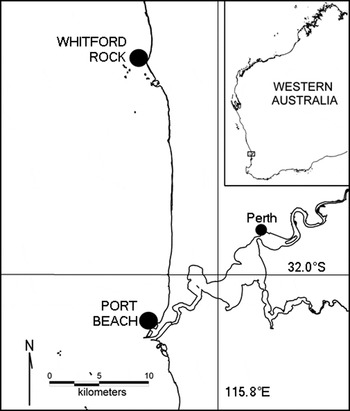
Archaster angulatus were studied on 11 January 2009 at 2 sites in south-western Australia separated by 23 km: Port Beach (32.03933 115.72965, depth 9 m, nearest land 1 km, water temperature 23oC) and Whitford Rock (31.79849 115.71889, depth 7–9 m, nearest land 1.2 km, water temperature 23oC) (Figure 1). Both are sheltered by offshore reefs or islands, ~10 km offshore for Port Beach and ~3 km for Whitford Rock. The Whitford Rock site was revisited again on 13 January to observe A. angulatus but no collections were made.
Location map of study sites.

Sediment analysis
The sediment characteristics at each of the two sites were analysed on samples from sediment cores collected previously from 5 stations at the sites from 7–18 March 2008. The samples were taken using 20 cm diameter stainless steel cores inserted into the sediment to 10 cm depth. After digging down alongside the core, a steel base was inserted beneath the core to prevent sediment loss when extracting the core. The sediment from the core was placed into a calico bag and brought to the surface. In the laboratory the sand was sieved through a sequence of 24 sieves with mesh size ranging from 0.063 to 8 mm. The sediment retained in each sieve was dried to constant weight at 80oC. The proportion of sediment in each particle size-class by weight was then calculated. The locations were compared by a two-sample Kolmogorov–Smirnov test (following Sokal & Rohlf, Reference Sokal and Rohlf1995) of the mean percentages of each of the particle size-classes using SYSTAT software.
Collection and measurements of specimens
At each site Archaster angulatus were collected by SCUBA divers (167 from Whitford Rock in 231 diver minutes and 259 from Port Beach in 212 diver minutes). Divers used a small rake to locate sea stars buried in the sediment. The sea stars were brought back to the vessel where each undamaged individual was measured (greatest R, from the centre of the disc to the arm tip, to the nearest mm) with callipers, blotted and weighed. All animals with missing or shortened arms and 10 undamaged animals from each site were retained for further measurements. The remainder were released alive at the collection site. Difference in the mean size for the two locations was determined by a t-test for unequal sample variances. Length–weight relationships were examined by analysis of covariance (ANCOVA, in SYSTAT software) (following Underwood, Reference Underwood1997) following exclusion of the 3 smallest in size (2 from Port Beach and 1 from Whitford Rock) due to a lack of overlap in size-range of individuals less than 65 mm in arm length from the two sites.
Sexual behaviour
At Whitford Rock nine pairs and one group of three Archaster angulatus were collected on 11 January 2009. The position (top, middle or bottom) was recorded and each animal was labelled and kept separately for subsequent determination of sex and reproductive condition. No paired or grouped animals were observed at Whitford Rock on 13 January 2009.
Colour
Each Archaster angulatus returned to the laboratory was photographed. The dominant colours on the aboral side were orange, brown and grey. Colleagues who had no knowledge of the collection location of the starfish scored each photograph for the percentage contribution of each colour. For example, a sea star that was predominantly orange but had parts that were brown and grey in equal proportions as well might be scored orange 60, brown 20 and grey 20. In addition they scored the percentage uniformity of colour for each individual. A sea star that was predominantly a mottled mix of colours would score closer to 0 and a sea star with uniform coloration would score closer to 100. For each individual, the average and standard error of observer's scores for each colour were determined to examine variation between observers. For the collection of sea stars from each site, the overall average and standard error of each colour was calculated. Significant differences of the means of the 4 variables between the two populations were determined by a t-test after assumptions of normality and equal variance were validated. Principal coordinate analysis (PCA) of the 3 colour averages for each individual was performed in PRIMER-E on non-transformed data (Plymouth Marine Laboratory, UK).
Histological examination of gonads
The individuals in the 9 pairs and 1 group of three were dissected, the interior was photographed and the colour of the gonads was recorded before fixing 3 arms from each individual in 10% formalin. Archaster angulatus has multiple separate gonad lobes in each arm. At least 10 gonad lobes were taken from each of the 21 sea stars. The gonad lobes were dehydrated in alcohol, cleared in xylene and mounted in paraffin blocks, sectioned at 5 microns, mounted on slides and stained with eosin and haematoxylin. The sex and stage of reproductive activity was determined from these sections under a compound microscope. The fullness of gonad lobes and the presence of different stage gametes were used to evaluate the reproductive state of the sea star (pre-spawning, ripe or post spawning).
Arm loss, gonad, pyloric caeca index and organic matter content
The retained samples of sea stars with all arms intact and those that had sustained arm loss were measured (R of the longest undamaged arm), weighed and dissected in the laboratory. The criterion for arm loss was a distinct plane separating the proximal part of the arm from the distal part that differed in width and/or colour. For individuals with a regenerating arm, the length of the damaged arm (‘stump’) was measured from the centre of the disc to where the damage had occurred, and the length of the regrown portion measured. The fraction of arm lost for each damaged arm was determined as (intact R – stump length)/intact R and a mean calculated for damaged sea stars at each site. Difference in the mean fraction lost for the two locations was determined by a t-test for equal sample variances.
The pyloric caeca and gonads (if present) were separately dissected from each arm. The caeca and gonads from any stumps or regrown portions were kept separate. The wet weights of the organs, entire body wall and body wall of any regenerating arm tips were recorded separately. The caeca, gonads and a sample from the body wall were dried to constant weight at 80oC, weighed and then ashed at 500oC for 2 hours and reweighed to calculate ash free dry weight. The pyloric caeca index was calculated as wet weight of caeca/wet body weight × 100. The proportion of organic matter of pyloric caeca was calculated as AFDW/dry weight × 100. The percentage of organic matter in the body wall was calculated by extrapolating the dry weight and AFDW of the subsample to the whole and then determined as AFDW/dry weight × 100. For pyloric caeca index, pyloric caeca organic content and body wall organic content differences between the two sites and intact or regenerating sea stars were analysed by two-way ANOVA (in SYSTAT software). Pyloric caeca index data were log transformed prior to analysis to achieve normality.
RESULTS
Description of sites and sediment and habit of sea stars
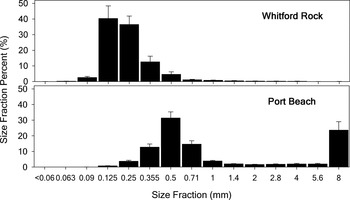
The Whitford Rock and Port Beach sites are very similar in depth and distance offshore. Both are sheltered from large swells by offshore reefs or islands. In the case of Port Beach these are further offshore and as such Port Beach is subject to greater and more variable waves. Both sites are extensive, predominately soft bottom habitats in a mosaic of other habitat types. The Whitford Rock habitat exists between patches of seagrass beds and high relief limestone reefs dominated by macroalgae. The Port Beach habitat also exists between extensive seagrass beds but lacks large limestone reef formations although low relief rocky limestone outcrops occur. The most obvious difference between the two habitats is the nature of the sediment. It can be characterized as fine sand at Whitford Rock and a mix of coarse sand, shell grit, shell pieces and limestone rubble at Port Beach, the difference most likely due to differences in hydrodynamics. The sediment at Whitford Rock was skewed to smaller particles, with 77% by weight being between 0.25 and 0.125 mm (Figure 2). Small particles at Port Beach were slightly larger with 59% by weight being between 0.71 and 0.355 mm. In addition, at Port Beach, 24% by weight of particles was rubble of greater than 8 mm. The two locations had significantly different size-distributions (P = 0.006). At both sites the vast majority of sea stars were buried just below the surface of the sediment. Sometimes the outline of the sea star beneath the sediment was visible from above. Occasionally sea stars were found moving along on top of the sediment. Some sea stars dislodged from the sediment had their stomachs extruded into the sediment but no prey or food was observed.
Sediment particle size-distribution at Port Beach and Whitford Rock.

Size
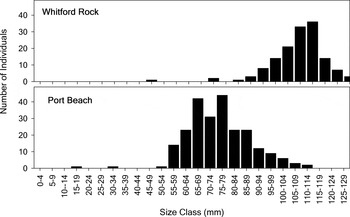
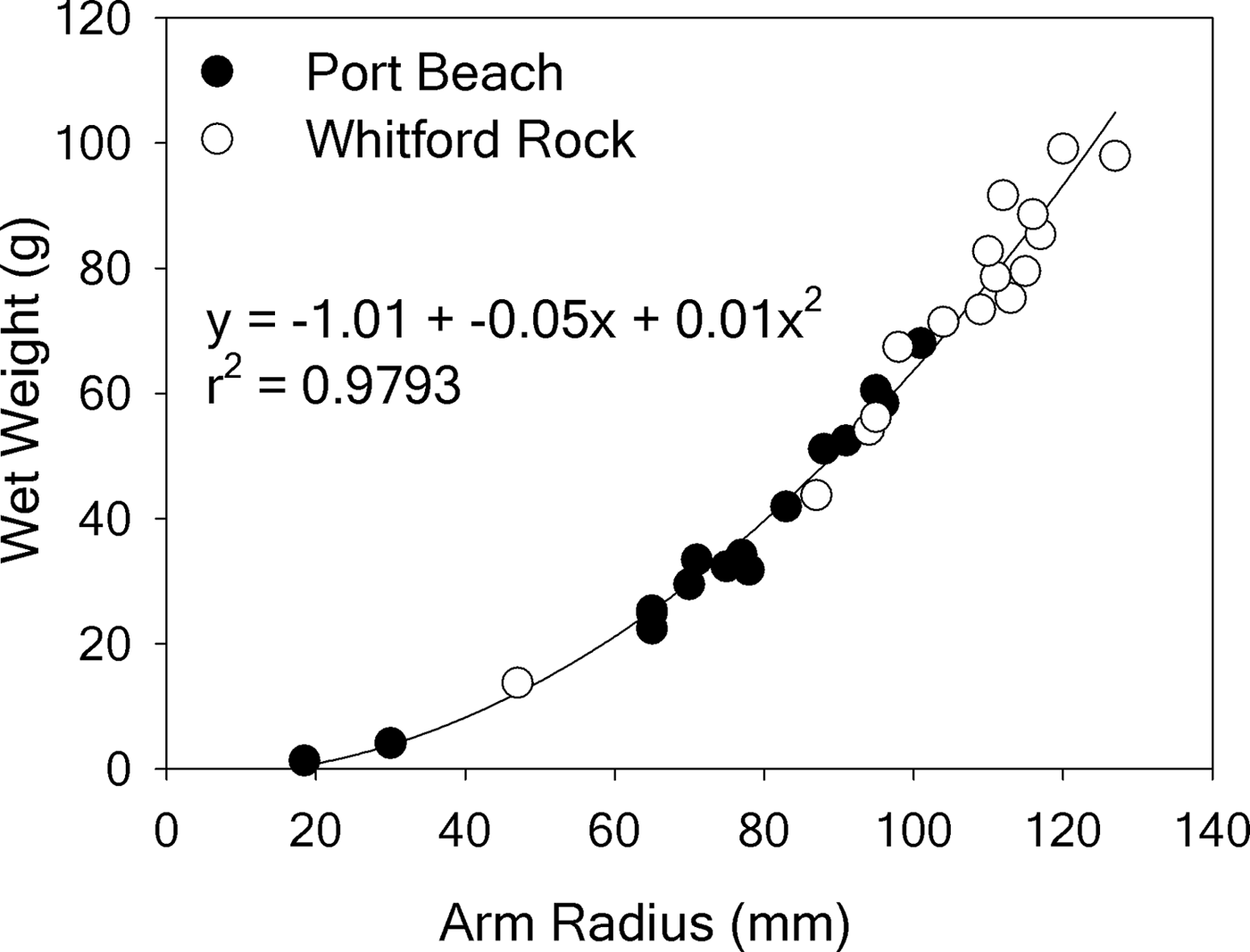
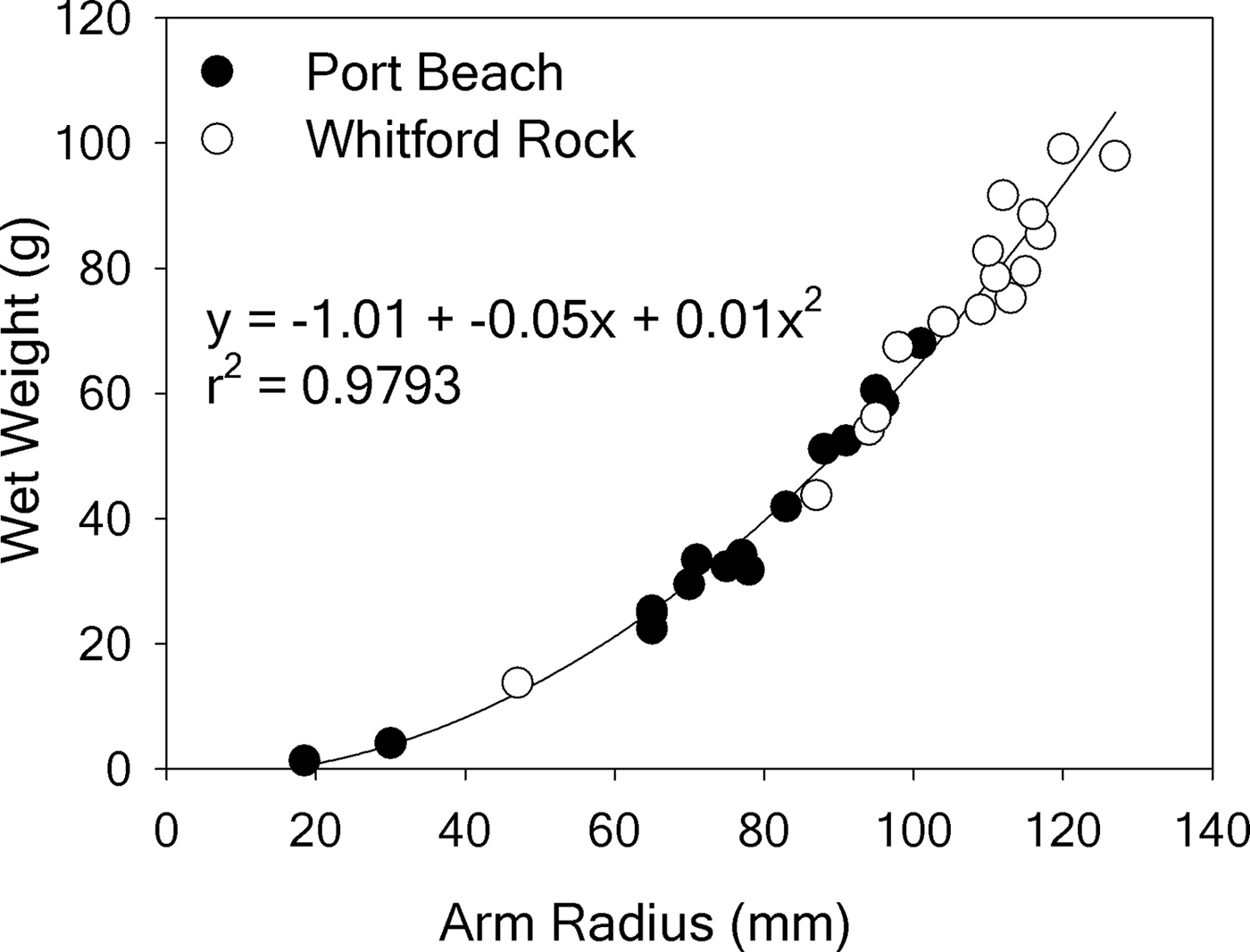
Figure 3 shows the size–frequency distribution for Archaster angulatus at the two sites. There was a significant difference in the mean radius length of 75.7 ± 0.8 mm at Port Beach and 106.2 ± 0.9 mm at Whitford Rock (t-test, P < 0.0001). Sizes ranged from 18–113 mm at Port Beach and 47–129 mm at Whitford Rock. The modal size was 75–79 mm (19% of sea stars) at Port Beach and 110–114 mm (25% of sea stars) at Whitford Rock. Figure 4 shows the size to weight relationships for Archaster angulatus. The relationship between size and weight is homogeneous for the two sites (P = 0.747), thus one curve can be fitted to all data (Figure 4). The mean body wet weight of sea stars with all arms intact at Port Beach was 35.72 ± 4.74 g and for Whitford Rock was 72.41 ± 5.50 g.
Size–frequency distribution of Archaster angulatus from Port Beach and Whitford Rock.

Relationship between size and weight for Archaster angulatus at Port Beach and Whitford Rock.
Sexual behaviour
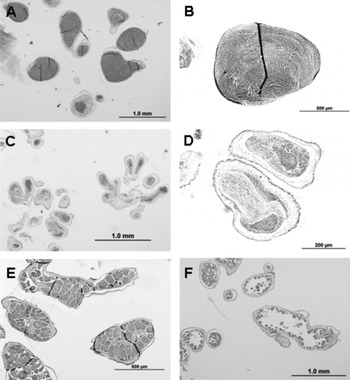
Nine pairs and one group of three individuals were found in the pseudocopulatory position. Histological sections revealed that all sea stars in the top position were males. All individuals on the bottom were female. The two lower individuals of the group of three were both females. Dissection of the pairs revealed that males (red coloured gonads) and females (apricot coloured gonads) had very small amounts of gonads. All individuals were partly or fully spawned (Figure 5). Some males with partly spawned testes had partly spent, fully spent and ripe gonad lobes present. Pseudocopulatory behaviour was only observed at Whitford Rock, not at Port Beach and only at Whitford Rock on 11 January, not on 13 January.
Histological sections of gonad of Archaster angulatus showing partly spawned male with some ripe testes lobes (A, B), fully spawned testes lobes (C, D), partly spawned female showing some mature oocytes in ovary lobes (E) and fully spawned ovary lobes (F).

Colour
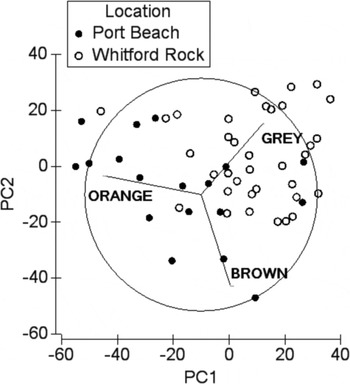
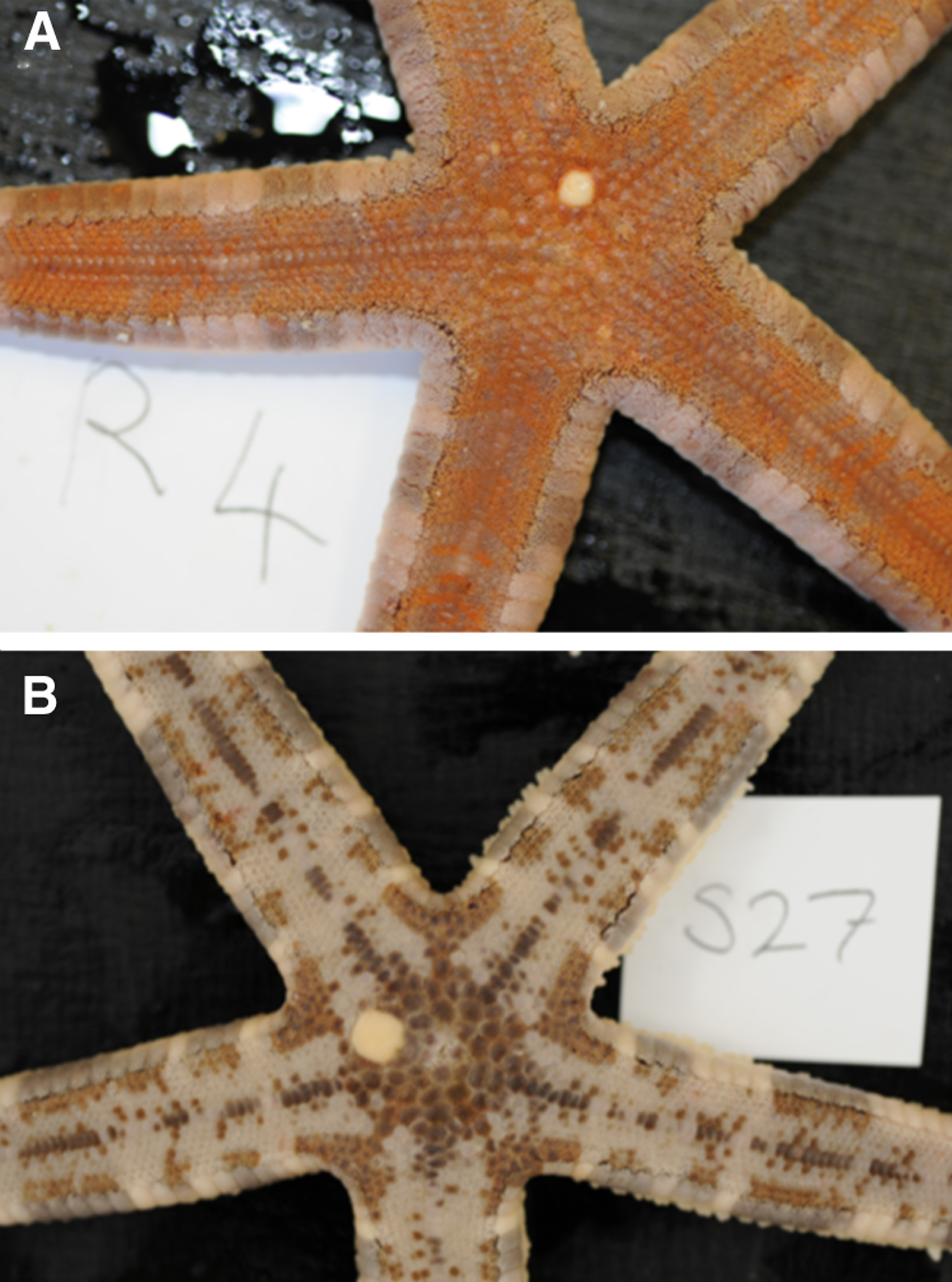
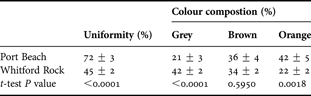
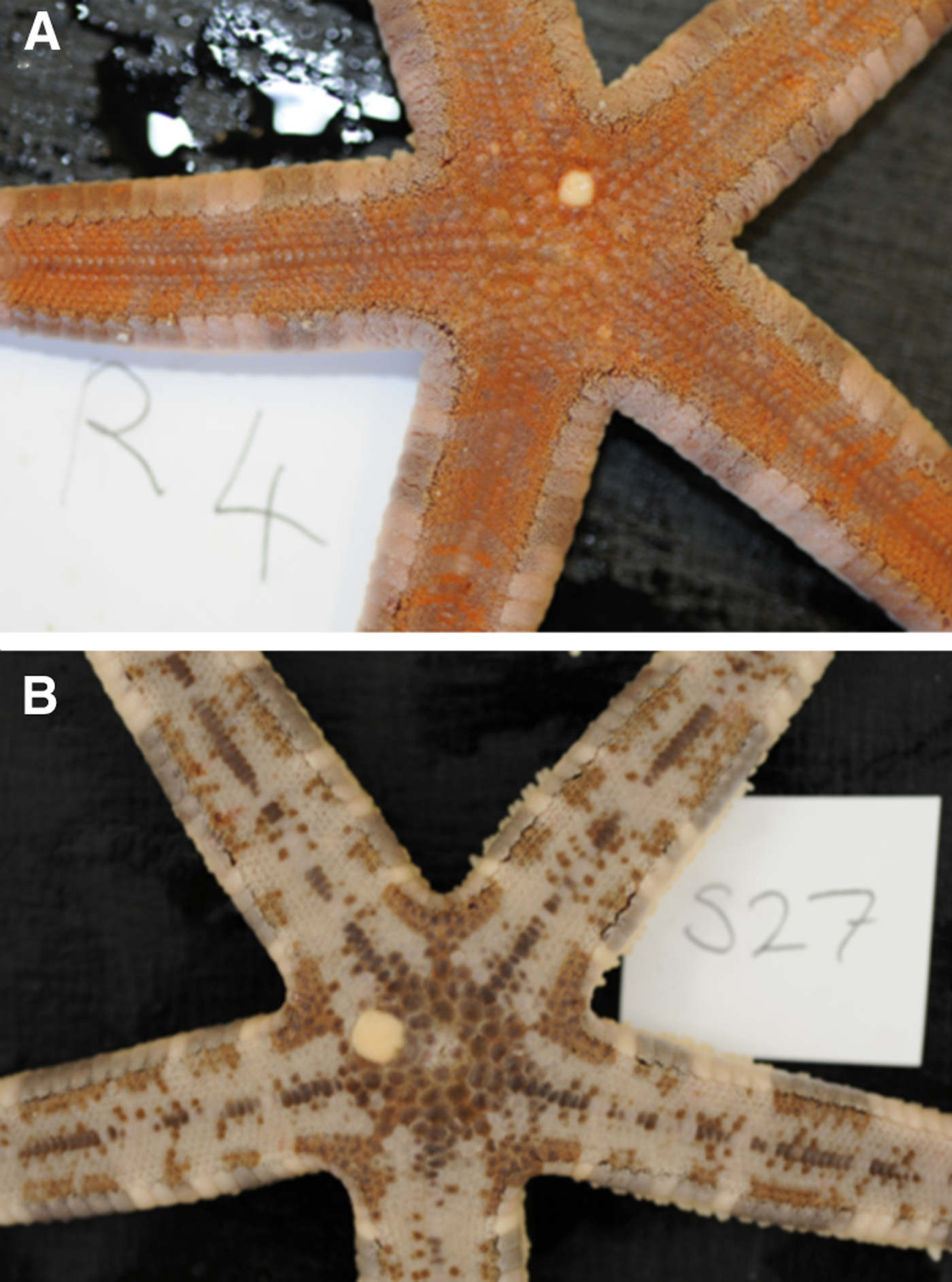
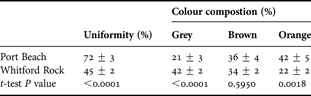
The uniformity rating of individual sea stars from several observers varied with the standard error ranging 1–42% of the mean; 49 of the sea stars (89%) had standard errors less than 20% of the mean. For colour proportions, 72% of observer measurements had standard errors less than 30% of the mean. Characteristics of the sea stars at the two locations are given in Table 1 Sea stars found at Port Beach were significantly more uniform in colour than those at Whitford Rock, being graded an average of 72 ± 3% uniformity compared to 45 ± 2% (P < 0.0001). In sea stars from Port Beach, the dominant colour was orange, which was 42 ± 5% of the body; this is in much larger portion than for Whitford Rock sea stars (P = 0.0018). In contrast, the dominant colour on individuals from Whitford Rock was grey (42 ± 2%). There was no difference in the portion of brown observed (P = 0.60). In PCA, 2 PC axes capture 99.6% of the variation and individuals from the two locations clearly separate based on the proportion of the 3 colours (Figure 6). Individuals from Whitford Rock are displayed along the vector for grey colour and those from Port Beach along the orange and brown vectors. Photographs of typical individuals from the two sites are shown in Figure 7.
Principal coordinate analysis plot of individual Archaster angulatus based on proportions of three colours.

Individuals typical of colour pattern of Archaster angulatus at Port Beach (A) and Whitford Rock (B).
Colour characteristics of Archaster angulatus at two locations (mean ± SE).
Arm loss
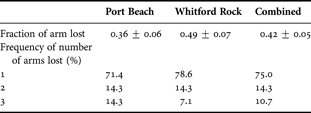
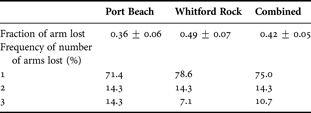
At Port Beach 5.4% of the sea stars (N = 259) had lost all or part of at least one arm. At Whitford Rock the frequency was 8.4% (N = 167). At Port Beach we found 1 four-arm specimen and 1 six-arm specimen, a frequency of 0.4% of each of these abnormalities.
There was no significant difference in the fraction (%) of arm lost between the two sites (P = 0.15); overall a mean of 42% of the arm was lost to damage (Table 2). Damaged sea stars had lost between 1 and 3 arms; the frequencies (%) of each are given in Table 2. Seventy-five per cent of damaged individuals had lost only one arm.
Mean arm loss frequency and fraction of each arm lost (± SE). Values are percentages.
Gonad, pyloric caeca and body wall indices
Among the majority of sea stars collected at both Port Beach and Whitford Rock the amount of gonad was too small to be removed and weighed except for one intact individual and one regenerating individual. Consequently these data are not presented.
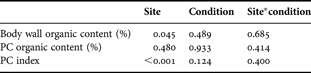
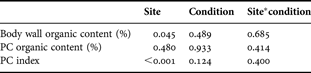
The pyloric caeca index of both intact and regenerating individuals at either site did not differ significantly but the pyloric caeca index of individuals at Port Beach was significantly less than those of individuals at Whitford Rock (Tables 3 & 4). The dry weight percentage of organic matter of both intact and regenerating individuals at either site did not differ significantly (Tables 3 & 4). The dry weight percentage of organic matter of the pyloric caeca of individuals at the two sites did not differ significantly but the dry weight percentage of organic matter of the body wall of individuals at Port Beach was significantly less than of individuals at Whitford Rock (Tables 3 & 4). However, the difference was less than 2%.
Organic content (% dry weight) of body wall and pyloric caeca (PC) measurements (mean ± SE).

P values for body wall and pyloric caeca (PC) analysis by two-way ANOVA (condition indicates if individuals were intact or with regenerating arms).
DISCUSSION
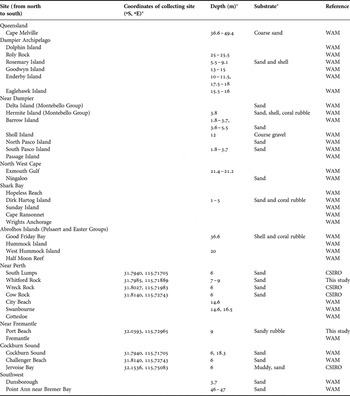
Archaster angulatus has been collected off the Western Australian coast between the Dampier Archipelago in the north to Bremer Bay in the south (Table 5). This is a vast distance crossing 14 degrees of latitude and stretching the distribution of A. angulatus from tropical to cool temperate waters and diurnal tidal ranges from less than 1 m in the south to 10 m in the north. While soft sediment habitats of different types occur commonly across this entire region, it underlines the tolerance of A. angulatus to a range of marine environments. Archaster typicus has been reported from 0–60 m depths (Rowe & Gates, Reference Rowe and Gates1995) but seems most abundant in shallow, often intertidal water (Ohshima & Ikeda, Reference Oshima and Ikeda1934; Domantay, Reference Domantay1936; Clemente & Anicete, Reference Clemente and Anicete1949; de Celis, Reference de Celis1980; Mukai et al., Reference Mukai, Moritaka, Kamisato and Fujimoto1986; Run et al., Reference Run, Chen, Chang and Chia1988). Archaster angulatus has been reported from 0 to 50 m depths (Rowe & Gates, Reference Rowe and Gates1995).
Depth and type of substrate of populations of Archaster angulatus along the West Australia coast. WAM indicates material is held in Western Australian Museum, CSIRO indicates material in CSIRO collections (Keesing & Irvine, unpublished).

*, if known.
In Western Australia Archaster angulatus has been found along a similar depth-range if all records all along the extent of its observed range are considered (Table 5). We found abundant A. angulatus at ~4–8 m depth along a section of the Western Australian coast where diurnal tidal ranges are small (~1 m). Intertidal areas are predominantly reef or surf beaches where A. angulatus would be unlikely to occur. Archaster typicus are reported to occur on mud (Bedford, Reference Bedford1900), sand–mud (Domantay, Reference Domantay1936; de Celis, Reference de Celis1980) and sand (Oshima & Ikeda, Reference Oshima and Ikeda1934; Clark, Reference Clark1946; Morton, Reference Morton1979; Mukai et al., Reference Mukai, Moritaka, Kamisato and Fujimoto1986; Run et al., Reference Run, Chen, Chang and Chia1988; Lane & Vandenspiegel, Reference Lane and Vandenspiegel2003). Only Mukai et al. (Reference Mukai, Moritaka, Kamisato and Fujimoto1986) have analysed particle size of the sediment. They found A. typicus on both fine sandy sediment and a sand–pebble mixture (mode φ = 1.06 to –0.81, 1.75 to 2.08 mm). The particle diameter distribution of the sediment of the populations of A. angulatus are less than this, as most particles were < 0.7 mm at Port Beach and < 0.355 mm at Whitford Rock. Archaster angulatus, like A. typicius, is found only on particulate substrate (Table 5).
Archaster angulatus from Port Beach and Whitford Rock were different from each other in both uniformity of colour and colour composition. It is possible this is the result of camouflage on the differing substrates at each site. Clark (Reference Clark1946) gave an anecdotal statement that colour of Archaster typicus is ‘said to be almost indistinguishable from that of the sand upon which the sea stars live’. de Celis (Reference de Celis1980) reported A. typicus has an irregular alternation of light and grey colour at Marinduque Island, Philippines. In contrast, Clark (Reference Clark1946) said A. angulatus is cream on the lower surface and more or less yellow-brown variegated with light fawn grey, bluish grey or dull light purple on the upper side.
Mukai et al. (Reference Mukai, Moritaka, Kamisato and Fujimoto1986) related the occurrence of Archaster typicus on particulate sediment to its deposit feeding behaviour. Morton (Reference Morton1979) said A. typicus is a detritovore. Neither provided support for these statements. Pinto (Reference Pinto1982) reported that A. typicus is carnivorous, 97% of its gut contents consisting of crustaceans and sponges. This contrasts to the statements by Schoppe (Reference Schoppe2000) and Lane & Vandenspiegel (Reference Lane and Vandenspiegel2003) that A typicus is an extraoral feeder. Our observations showed that A. angulatus is frequently buried just below the surface of the sediment, at least in daylight hours, indicating an important association with particulate habitat types. Our limited observations suggest that feeding behaviour of A. angulatus at least includes extra-oral feeding. The diet remains unknown. Further observations on food and feeding behaviour of A. angulatus are needed.
The difference in body size of individuals in two populations is striking. The maximum radius length at Whitford Rock was >120 mm while it was ~100 mm at Port Beach. Clark (Reference Clark1946) said the radius of A. angulatus could exceed 120 mm and Clemente & Ancicete (1949) gave a maximum radius length at 150 mm for A. typicus. One possible explanation for the difference in size of the two populations of A. angulatus is that they consist of cohorts of different ages. However, the small difference in maximum size at the two sites and unimodal size distribution clustered around the mean strongly suggest a differential growth rate at the two sites rather than the result of two separate recruitment events or a difference in longevity. Asteroids appear to have a growth pattern that is habitat dependent, with the asymptotic size set by the balance between food availability and factors affecting physiological costs (Feder & Christensen, Reference Feder, Christensen and Boolootian1966; Sebens, Reference Sebens1987).
The proportion of arm length lost did not differ significantly between populations with a mean of 42% lost; although four individuals had lost their arm at the disc edge. This suggests Archaster may be like luidiids and lose arms anywhere along the length of the arm, unlike other asteroids where it is almost always at the autotomy plane at the base of the arm (Emson & Wilkie, Reference Emson and Wilkie1980). Frequency of arm loss is thought to indicate sublethal predation pressure (Emson & Wilkie, Reference Emson and Wilkie1980; Lawrence, in press). Archaster typicus was reported to have a 3% frequency of arm loss at Taiwan (R. Chen, unpublished, in Lawrence, Reference Lawrence, Scalera-Liaci and Canicatti1992). This is similar to the frequency of arm loss found here for A. angulatus. This frequency of arm loss is small compared to frequencies of arm loss greater than 25% found for other species of sea stars (Lawrence, Reference Lawrence, Scalera-Liaci and Canicatti1992). This suggests either a lack of predators or effectiveness of camouflage.
The pyloric caeca store nutrient reserves and the pyloric caeca index is indicative of the nutritional condition of asteroids (Lawrence & Lane, Reference Lawrence, Lane, Jangoux and Lawrence1982). The index can vary seasonally and reciprocally with the gonad index. Run et al. (Reference Run, Chen, Chang and Chia1988) calculated the gonad index of Archaster typicus but did not report the pyloric caeca index. Although the percentage dry weight of organic matter of the pyloric caeca and body wall of individuals from both sites were similar, the pyloric caeca index of individuals at Whitford Rock was greater than that of individuals at Port Beach. This suggests the nutritional condition of individuals at Whitford Rock was better than that of individuals from Port Beach. This can be correlated with the larger size of individuals at Whitford Rock and suggests the quantity or quality of food was better at Whitford Rock. The larger pyloric caeca index of intact individuals than of regenerating individuals probably results from the absence of the body wall of lost arms of regenerating individuals. The lack of difference in percentage dry weight of organic matter of the pyloric caeca of intact and regenerating individuals at both sites indicates arm loss had no effect on the gross proximate composition of the pyloric caeca.
Pseudocopulation was first reported for Archaster typicus by Boschma (Reference Boschma1924) and Mortensen (Reference Mortensen1931) and for A. angulatus by Mortensen (Reference Mortensen1931). Boschma (Reference Boschma1924) and Clemente & Anicete (Reference Clemente and Anicete1949) reported only pairs of A. typicus consisting of a male superposed on a female. However, although Oshima & Ikeda (Reference Oshima and Ikeda1934) confirmed male on female in most pairs, they also reported male on male in some pairs and female on male in a few pairs. They found no pairs with female on female. Although Komatsu (Reference Komatsu1983) also found male on a female was most common, she found groups of three to five individuals, in which the one on the bottom was always female and the superposed individuals were males.
Pseudocopulation has been associated with the spawning season. Pseudocopulation was noted for A. typicus in February and May in Java (Boschma, Reference Boschma1924), July in Okinawa (Oshima & Ikeda, Reference Oshima and Ikeda1934), June to August in Okinawa (Mukai et al., Reference Mukai, Moritaka, Kamisato and Fujimoto1986), April to June in Hong Kong (Morton, Reference Morton1979), mid-June through to July at Ishigaki Island, Japan (Komatsu, Reference Komatsu1983) and late June and July at Taiwan (Run et al., Reference Run, Chen, Chang and Chia1988) and before April through to May in Mindoro, Philippines (Clemente & Anicete, Reference Clemente and Anicete1949). Run et al. (Reference Run, Chen, Chang and Chia1988) confirmed the presence of gonads and successful fertilization of eggs at the season when pseudocopulation occurred. Our histological examination of the gonads of Archaster angulatus in late austral summer (January) indicates that pseudocopulation occurred in individuals that were partly or fully spawned. The persistence of the behaviour when few gametes were present is remarkable and contrary to observations that it is closely correlated with spawning in Archaster typicus (Run et al., Reference Run, Chen, Chang and Chia1988) and Neosmilaster georgianus (Slattery & Bosch, Reference Slattery and Bosch1993).
In conclusion, these data indicate considerable differences in characteristics of individuals of two populations of Archaster angulatus that differ with characteristics of the habitat. Differences in colour and pattern between the two populations may be associated with predation. The specific characteristics of the habitats responsible for these differences in the populations require further study and would benefit from analysis of populations along a broader section of the Western Australian coast. Archaster angulosus has characteristics that are similar to those of Archaster typicus. However, occurrence of pseudocopulatory behaviour when gonads are not mature is different. Determination of the timing of reproduction, factors affecting the pseudocopulatory behaviour and the diet and mode of feeding of A. angulatus would be of most interest.
ACKNOWLEDGEMENTS
We are grateful to R. Crossing, R. Downie, F. Parker and J. Strzelecki for assistance in the field and J. Ritchie for assisting in laboratory work and collecting information about A. angulatus held in the Western Australian Museum. We also thank A.L. Lawrence, S.A. Watts and J. Strzelecki for helpful comments. This study was supported by the Western Australian Marine Sciences Institution and CSIRO's Wealth from Oceans National Research Flagship.