INTRODUCTION
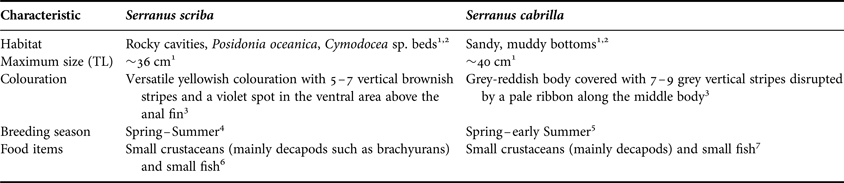
The painted comber, Serranus scriba (Linnaeus, 1758), and the comber, Serranus cabrilla (Linnaeus, 1758), are two of the most common and widespread littoral species in the Mediterranean Sea. While both species are reef associated, S. scriba shows higher preference for rocky substrates, mostly dwelling in rocky cavities, while S. cabrilla spends more time moving in the water column (Fasola et al., Reference Fasola, Canova, Foscie, Novelli and Bressan1997). In addition, S. scriba is often found in seagrass beds (Posidonia oceanica) while S. cabrilla is found both in seagrass beds (P. oceanica and Cymodocea nodosa) and in muddy and sandy bottoms (Tortonese, Reference Tortonese, Whitehead, Blaunchot, Hureau, Nielsen and Tortonese1986; Guidetti & Cattaneo-Vietti, Reference Guidetti and Cattaneo-Vietti2002; Giakoumi & Kokkoris, Reference Giakoumi and Kokkoris2013). The two species are simultaneously hermaphroditic (Fisher & Petersen, Reference Fisher and Petersen1987) and exhibit similar body size and shape with quite different colouration patterns (Table 1). Moreover minor differences have been reported in their feeding habits with the trophic level of S. scriba in the Mediterranean ranging from 3.70–3.87 and that of S. cabrilla from 3.30–4.37 (Stergiou & Karpouzi, Reference Stergiou and Karpouzi2002). Given that the two species usually occur in the littoral zone of the same broader areas, resource partitioning should be of major importance for the maintenance of their populations (Schoener, Reference Schoener1974; Sphigel & Fishelson, Reference Sphigel and Fishelson1989).
Summary of habitat and life history characteristics for Serranus scriba and Serranus cabrilla.

2 Bussotti & Guidetti (Reference Bussotti and Guidetti2009).
3 Guidetti & Cattaneo-Vietti (Reference Guidetti and Cattaneo-Vietti2002).
4 Tuset et al. (Reference Tuset, Gonzalez, Garcia-Diaz and Santana1996).
5 Sabates (Reference Sabates1990).
6 Arculeo et al. (Reference Arculeo, Froglia and Riggio1993).
7 Labropoulou & Eleftheriou (Reference Labropoulou and Eleftheriou1997).
Fasola et al. (Reference Fasola, Canova, Foscie, Novelli and Bressan1997) studied potential resource partitioning in a Mediterranean rocky slope fish assemblage and showed that S. cabrilla mostly occurs in deeper zones (maximum abundance: 36–42 m) than S. scriba (maximum abundance: 16–20 m). Vacchi et al. (Reference Vacchi, Bussotti, Guidetti and La Mesa1998) also worked at the fish-assemblage level and suggested a similar pattern, with S. scriba being mostly concentrated between 10–15 m and S. cabrilla between 25–30 m. The study of Guidetti & Cattaneo-Vietti (Reference Guidetti and Cattaneo-Vietti2002) was focused exclusively on the two species and assessed their distribution patterns in relation to the mineralogical features of their substrate; the authors provided evidence that S. scriba and S. cabrilla preferred granite and carbonate bottoms, respectively. Pais et al. (Reference Pais, Azzurro and Chessa2004) investigated the distribution patterns in a fish assemblage, including S. scriba and S. cabrilla in relation to the substrate type (granite vs schist) and depth. However, the authors did not detect any patterns in the distribution of the two species either with depth or rock type, while similar results are also reported by Tunesi et al. (Reference Tunesi, Molinari, Salvati and Mori2006).
According to the previously mentioned literature the bathymetric distribution of S. scriba and S. cabrilla and the factors determining it still remain unclear. In addition, none of these studies has assessed possible seasonal patterns in the bathymetric distribution of the two species. The main objective of the present study was to assess seasonality in the bathymetric distribution of S. scriba and S. cabrilla in a Mediterranean littoral area. The association of individuals to the bottom and the physical characteristics of their habitat including the nature of the substrate were also examined.
MATERIALS AND METHODS
Sampling
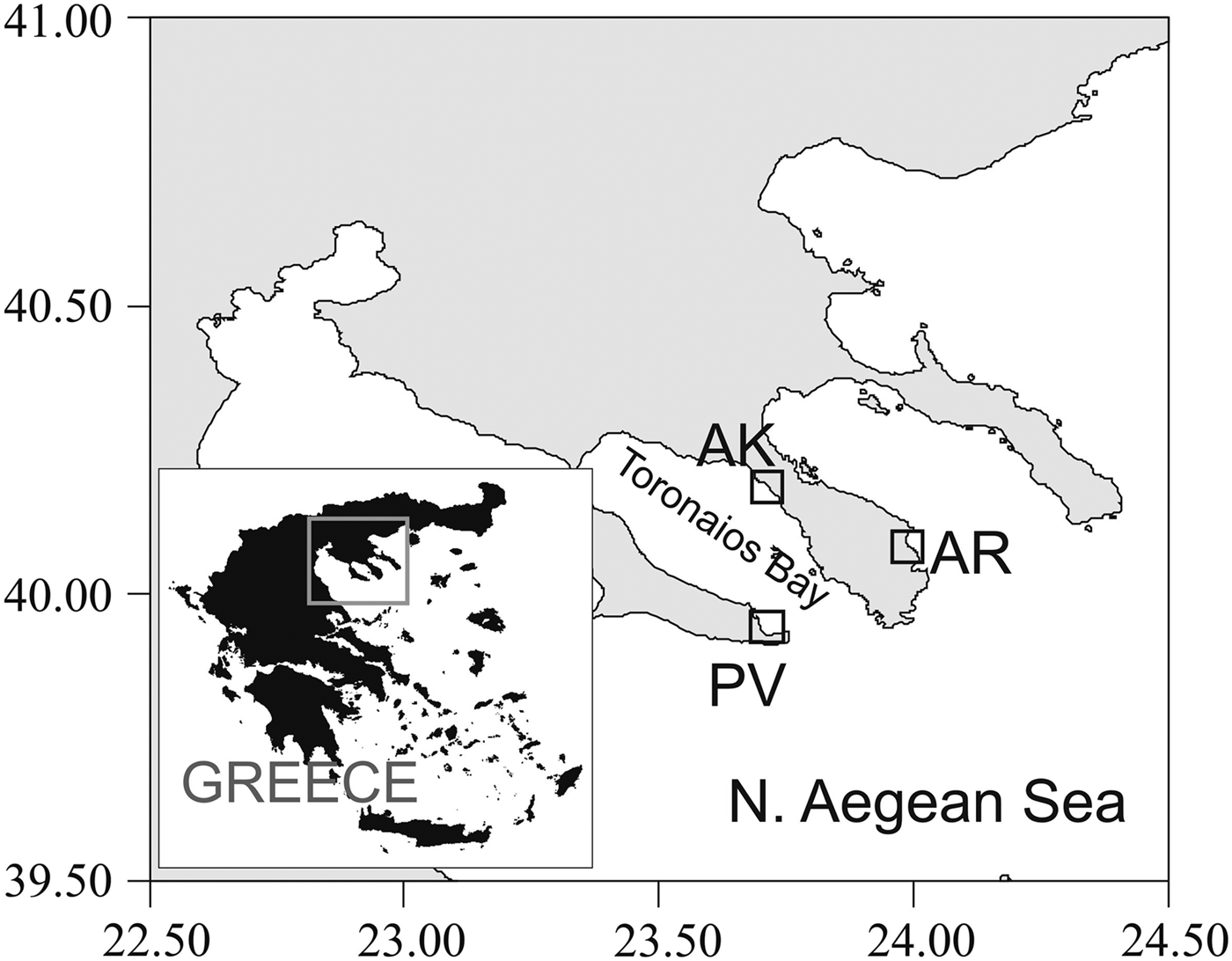
The spatial patterns of Serranus scriba and Serranus cabrilla were explored in two different surveys. The first survey assessed seasonality in bathymetric positioning of the two species while the second survey assessed their vertical positioning in relation to substrate type. The first survey took place at ‘Akti Kalogrias’ (AK) which is situated in Sithonia peninsula, Toronaios Bay, N. Greece (Figure 1). According to NATURA 2000 Network, AK is placed inside a broader marine protected area which is also a site of community importance with the code name GR1270007. Although the study site belongs to NATURA 2000 Network, limited scientific data have been published about its marine communities and currently it has no established management structure. The survey took place over a small rocky reef, characterized by steep slope and a large amount of cavities and sandy patches. AK is highly touristic, especially during summer, while activities such as sport fishing or amateur fishing take place throughout the year. However, neither S. scriba or S. cabrilla are targeted in this region commercially or recreationally.
Study area indicating the three sampling sites. AK, Akti Kalogrias; AR, Akti Armenistis; PV, Porto Valitsa.
Data collection in the first survey was based on a variation of the visual census method of Harmelin-Vivien et al. (Reference Harmelin-Vivien, Harmelin, Chauvet, Duval, Galzin, Lejeune, Barnabe, Blanc and Chevalier1985). Specifically, instead of using ropes or strings that could disturb or attract individuals (Fasola et al., Reference Fasola, Canova, Foscie, Novelli and Bressan1997) distance measurements were based on the number of fin-kicks with 1 kick corresponding to 1 m. Application of such non-destructive methods is critical, especially for protected areas, because the acquisition of quantitative data has minimum impact on the marine environment. For both species, individuals were recorded along 4 isobaths of 100 m each placed every 5 m, ranging between 5–20 m depth. Depth was monitored using an Oceanic Veo 180Nx personal dive computer. Transects were not fixed but taken at random in each sampling. Given that the mean width of the visual field along each transect was 2 m the area covered in each isobathic transect (our sampling unit) was 200 m2. Samplings were conducted once every 1–4 weeks between September 2010 and August 2011 making a total of 27 samplings.
The second survey took place immediately after analysing data from the first survey. Because the analysis showed that the two species exhibit seasonal consistency in their depth of occurrence (see Results section) all samplings were carried out during the same week in October 2011, at the preferred depth range of each species (S. scriba: 5–10 m; S. cabrilla: 15–20 m). Sampling was carried out at AK while two additional samplings were carried out at two neighbouring sites, ‘Akti Armenistis’ (AR) and ‘Porto Valitsa’ (PV) (Figure 1), in order to enhance the spatial resolution of our samples. Data collection followed a similar protocol to the one previously described for the first survey with the exception that stationary targets (small anchored buoys) were placed over the exact points at the bottom where individuals of S. scriba and S. cabrilla were initially spotted at 5–10 m and at 15–20 m transects respectively. The distance of each individual from the bottom, DIS [bottom dweller (BD), <25 and >25 cm] was also recorded. After completing the transects, the stationary targets were revisited in order to visually assess the dominant substrate type, ST (rocky patches vs sandy patches) at the 25 × 25 cm quadrat around each target.
Statistical analysis
Fish abundance, N (the number of fish per sampling unit), in the first survey was analysed pertinent to sampling depth and season. Given that N theoretically conforms to a Poisson distribution (integer-valued count data), it was primarily tested for over-dispersion through calculating the ratio of the residual deviance of the null model (i.e. only the intercept) to the residual degrees of freedom. The ratio was quite high (1853/802 = 2.3) suggesting that N data were over-dispersed, i.e. there was 2.3 more variation in the residuals than expected. Consequently, N data were modelled as a function of species (S. scriba or S. cabrilla), season (autumn, winter, spring, summer) and isobath (5, 10, 15, 20 m) using a generalized mixed effects model (GLMM) with an over-dispersed Poisson distribution and a logarithmic link function. All effects were treated as random variables, having isobath nested inside season, and season nested inside species. In order to account for over-dispersion a random effect was also included in the GLMM for the sampling unit. The variance components, i.e. the proportion of the random effect variance that is attributable to each random effect was estimated by dividing their variance to the total variance of random effects. We used the conditional modes (CM) of the random effects of the GLMM to describe the bathymetric trends for the two species. Data were analysed using R v.2.14.1 (R Development Core Team, 2012). GLMM analysis was performed using the package lme4 while graph plots were constructed using the package ggplot2.
The proportions of S. scriba and S. cabrilla in each DIS × ST category from the second survey were analysed using analysis of means (ANOM) while the interaction between DIS and ST was tested through contingency tables analysis. ANOM and contingency tables were performed using STATGRAPHICS v. 15.12.11.
RESULTS
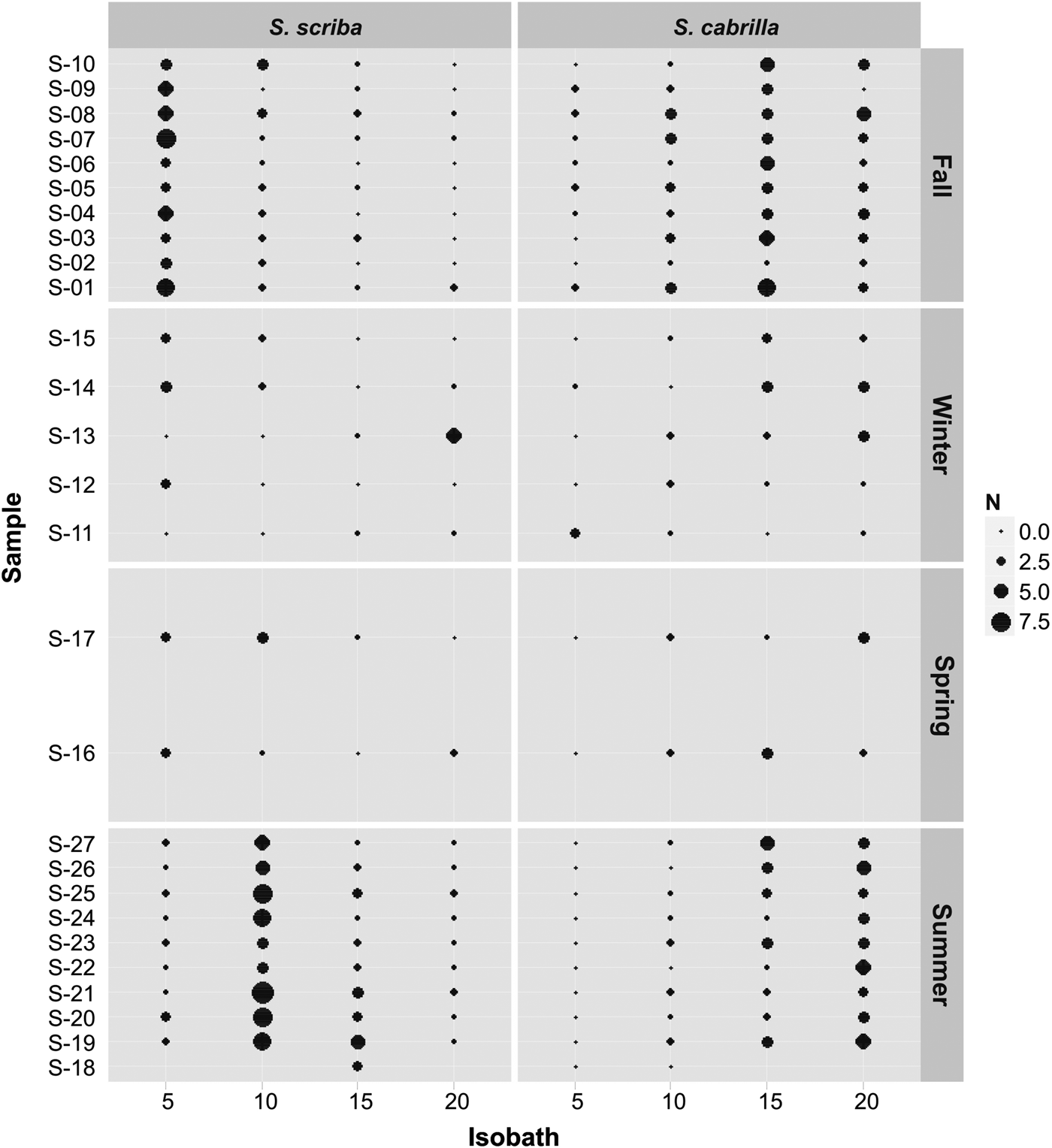
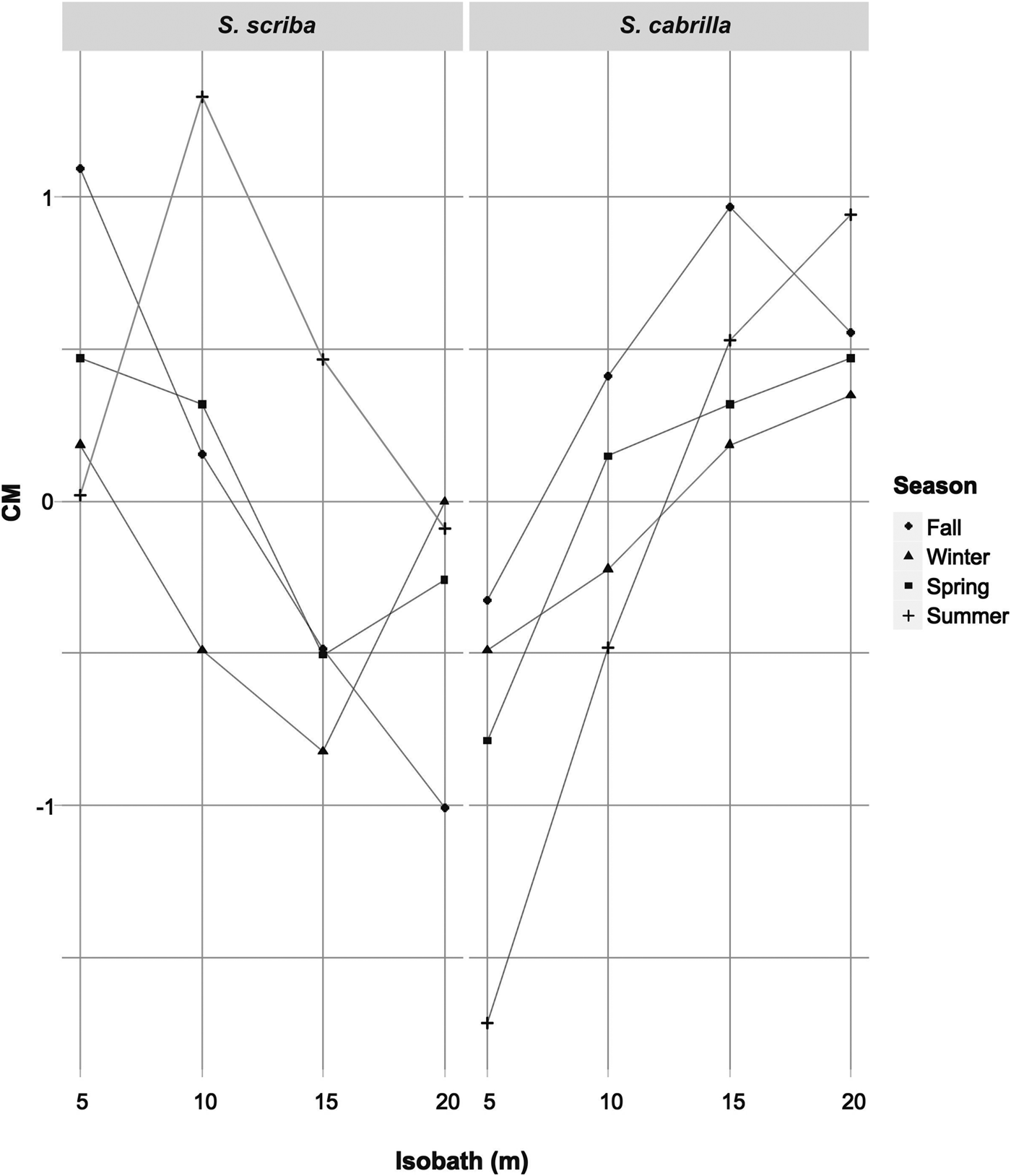
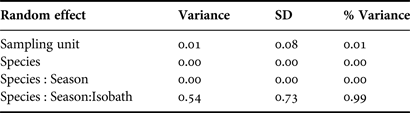
Figure 2 shows the abundance of the two studied species per sampling unit, isobath and season. Simple visual examination of the plot suggests that S. scriba and S. cabrilla exhibit opposing bathymetric distribution trends, the former mainly occurring at the 5 and 10 m isobaths whilst the latter at the 15 and 20 m isobaths. GLMM analysis showed that almost 100% of the total variance of the random effects (species, season, isobath, sampling unit) was attributed to the nested effect of isobath (Table 2). The conditional modes (CM) of the random effects of the GLMM are showed in Figure 3. For all seasons, CM values in S. cabrilla tended to increase with depth (except between the 15–20 m isobaths in autumn) while the opposite pattern was generally observed for CM values in S. scriba (Figure 3).The most important deviation from this general pattern was observed for S. scriba in summer, when the highest CM score was found at the 10 m isobath.
Fish densities (N: number of individuals/200 m2) per species, sampling unit, season and isobath.
Change of the conditional modes of the GLMM in each of the four isobaths per season for S. scriba and S. cabrilla.
Variance components of the random effects used in the GLMM.
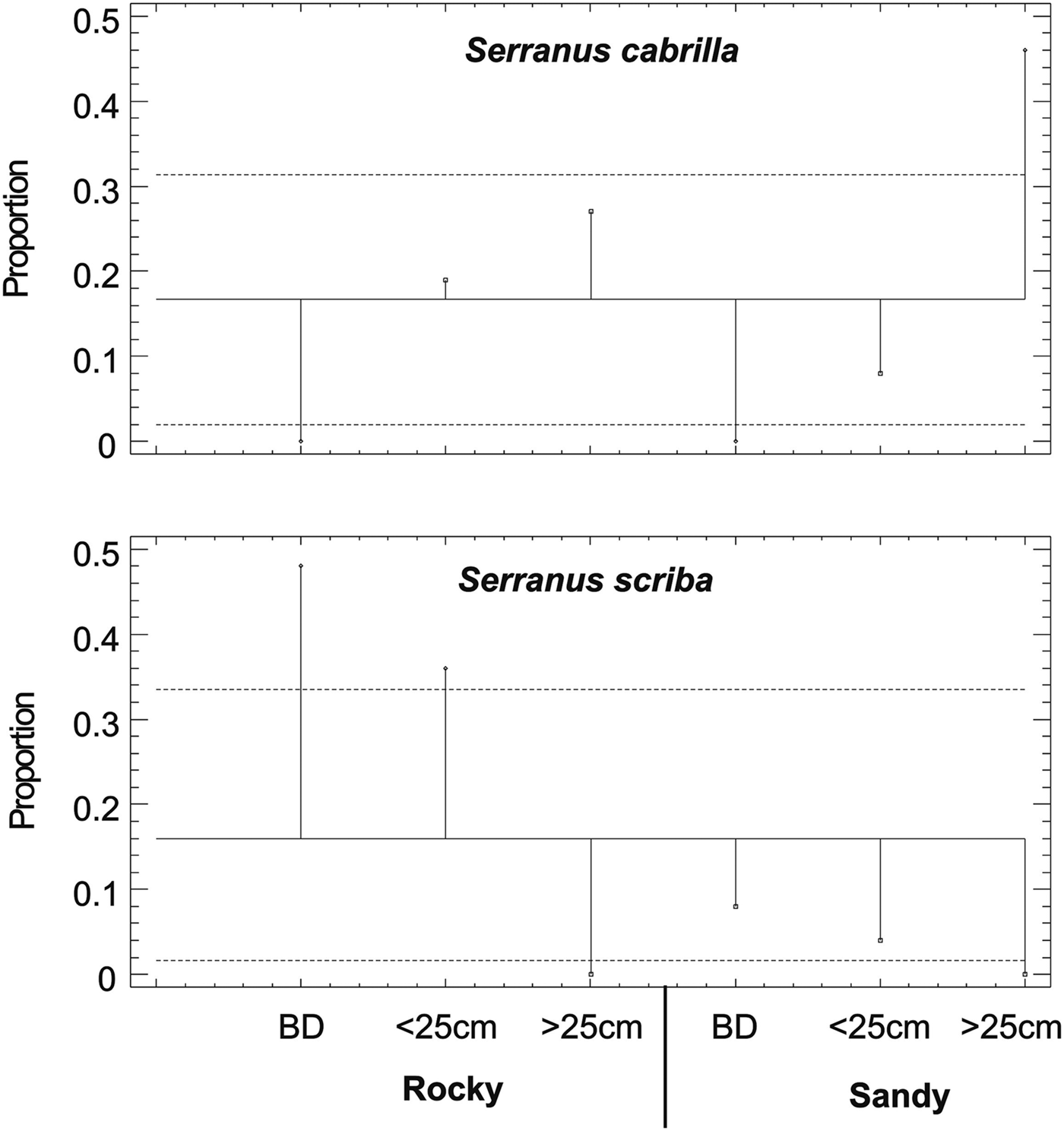
In addition, the two species displayed differences both in the pattern of association to the bottom and in their preferred substrate type. Specifically, almost 58% of S. scriba were bottom dwellers while no individuals were recorded above 25 cm from the sea bottom. On the contrary, ~73% of S. cabrilla occurred above 25 cm from the bottom while none of them was bottom dwelling. Concerning the preferred substrate type, most S. scriba were recorded over rocky bottoms (88%) while S. cabrilla were mostly recorded over sandy patches (54%). ANOM showed that the significantly higher proportion of S. scriba (48%) occurred >25 cm over sandy patches while the significantly higher proportion of S. cabrilla (46%) was dwelling over rocky bottoms (Figure 4). For both species contingency tables analysis showed that the pattern of association to the sea bottom was not related to the substrate type (S. scriba: χ2 = 2.077, d.f. = 2, P > 0.1; S. cabrilla: χ2 = 3.203, d.f. = 2, P > 0.1).
Analysis of means (ANOM) plot for comparing the proportions of Serranus cabrilla and Serranus scriba in each substrate type (rocky vs sandy patches) and vertical positioning (BD: bottom dwelling, <25 14;cm >25 cm) class. Vertical bars represent the difference between the proportions and the grand mean (horizontal solid line). Dotted horizontal lines in plots represent 95% confidence limits.
DISCUSSION
Our study showed that S. scriba and S. cabrilla exhibit complementary bathymetric distributions, the former mainly occurring at the 5 m isobath and the latter at the 20 m isobath, as already suggested in some studies (Fasola et al., Reference Fasola, Canova, Foscie, Novelli and Bressan1997; Vacchi et al., Reference Vacchi, Bussotti, Guidetti and La Mesa1998). However, our work is the first to assess bathymetric patterns on a seasonal basis showing that this complementary spatial pattern is maintained during the whole season. This suggests that in both S. scriba and S. cabrilla bathymetric pattern is a well-established ecoethological adaptation regulated by endogenous and/or environmental drivers. A slight deviation from this general pattern was shown for S. scriba during the summer when highest densities occurred slightly deeper, at 10 m isobath (Figure 2). This can be attributed to depth repositioning of S. scriba due to changes of the physical parameters such as water temperature, light level, etc. (Rowe, Reference Rowe1994). On the other hand the possibility of human disturbance from touristic activities should not be ignored (Tuya et al., Reference Tuya, Sanchez-Jerez and Haroun2006).
Differences in the bathymetric distribution between these two sympatric serranids could be linked to differences in their pattern of association to the seabed. Depth-related changes in reef gradient should be excluded as a possible cause since individuals of the two species occurred at locations of similar slope. On the other hand, S. sciba were almost always observed over rocky substrates and were mostly bottom dwellers whilst S. cabrilla were mostly observed over sandy substrates at distances more than 25 cm from the bottom. In that respect, populations of S. scriba would be more sensitive to hard substrate-related changes in the epibenthic biota.
Cerrano et al. (Reference Cerrano, Arillo, Bavestrello, Benatti, Calcinai, Cattaneo-Vietti, Cortesogno, Gaggero, Giovine and Puce1999) and Bavestrello et al. (Reference Bavestrello, Bianchi, Calcinai, Cattaneo-Vietti, Cerrano, Morri, Puse and Sara2000) showed for sandy and rocky bottoms respectively that increasing carbonate/quartz ratios are accompanied by steep declines in the population densities of both meiobenthic and macrobenthic organisms as a result of the top-down, bottom-up mechanism described by Menge (Reference Menge2000). Cattaneo-Vietti et al. (Reference Cattaneo-Vietti, Albertelli, Bavestrello, Bianchi, Cerrano, Chiantore, Gaggero, Morri and Schiaparelli2002) and Guidetti et al. (Reference Guidetti, Bianchi, Chiantore, Schiaparelli, Morri and Cattaneo-Vietti2004) provided evidence that variation in the structure of epibenthic communities and fish assemblages resulted from differences in the mineralogical composition of the substrate. In that respect the observed decrease of S. scriba with depth could be due to sediment-related decline in epibenthic preying fields. The increasing abundance of S. cabrilla with depth could thus be attributed to habitat partitioning given that the two species are sympatric; they display similar life histories and feeding habits (Arculeo et al., Reference Arculeo, Froglia and Riggio1993; Labropoulou & Eleftheriou, Reference Labropoulou and Eleftheriou1997) and should therefore partition their resources for maintenance of their populations.
The observed differences in the bathymetric distribution of the two species might further be related to differences in their colouration patterns. As already reported (Table 1), the colouration of S. cabrilla is disruptive along its sagittal plane, exhibiting a pale ribbon along the middle of its body. Such areas of contrasting colouration in disruptively coloured fish break up their outline, making them appear unfishlike and consequently more difficult to discern at lower light levels and at more homogeneous environments (Helfman et al., Reference Helfman, Collette, Facey and Bowen2009), which is the case with S. cabrilla. On the other hand, S. scriba lives at lower depths and on rocky bottoms of versatile colouration where water is more transparent and light is more abundant. Therefore conspicuous colouration and other visual cues such as the violet spot above the anal fin would be more important for interspecific visual communication, camouflage and so forth.
ACKNOWLEDGEMENTS
G. Orfanidis, M. Zoupas and A. Adamidis are thanked for helping IG during samplings.