Introduction
The association between psychopathology and traumatic stressful events (TSE) exposure during childhood and adolescence is evident in clinical psychiatric practice (Wiersma et al. Reference Wiersma2009). Significant childhood adversities, including TSE occurring during brain development, can derail normative neurodevelopmental trajectories and increase susceptibility to psychiatric (Teicher et al. Reference Teicher, Tomoda and Andersen2006; Shonkoff et al. Reference Shonkoff, Boyce and McEwen2009; Lee et al. Reference Lee2014) and other medical conditions (Derry et al. Reference Derry2015; Berens et al. Reference Berens, Jensen and Nelson2017). Extensive research documents the association with ‘classic’ stress-related disorders, such as post-traumatic stress disorder (PTSD) and depression [for reviews (Heim & Binder, Reference Heim and Binder2012; Messman-Moore & Bhuptani, Reference Messman-Moore and Bhuptani2017)], with fewer studies on TSE association with other domains of psychopathology (Gilman et al. Reference Gilman2015; Carliner et al. Reference Carliner2017; McGrath et al. Reference McGrath2017; Miller & Brock, Reference Miller and Brock2017).
Most research describing the association of early life traumatic events with psychopathology relies on the adult recollection of childhood adversity, which can be inaccurate (Hardt & Rutter, Reference Hardt and Rutter2004), especially in psychiatric patients often biased to recall adversities (Newbury et al. Reference Newbury2017). Therefore, there is a need for studies conducted in youths ascertained through non-psychiatric services, which integrates data collected from typical and atypical development at young ages (McLaughlin, Reference McLaughlin2016). An example of such an effort is the National Comorbidity Survey Replication Adolescent Supplement study, conducted in a representative US adolescent population aged 13–17 evaluated between 2001 and 2004 (McLaughlin et al. Reference McLaughlin2012). This study reported an association between childhood adversities (not limited to traumatic events, i.e. parents’ divorce) and lifetime anxiety, depression, behavioral and substance use disorders (Kessler et al. Reference Kessler2009).
The Philadelphia Neurodevelopmental Cohort (PNC) is a unique resource with genetic, clinical and neurocognitive data on a large (N = 9498) youth (age 8–21) community sample, representative of US urban population (Calkins et al. Reference Calkins2015). In addition to anxiety, mood, and externalizing disorders, the clinical phenotyping included psychosis spectrum symptoms and cognitive assessments, which were not previously obtained in large-scale community studies. Importantly, high exposure to TSE in the PNC provides an informative platform for dissecting TSE-developmental psychopathology relationships. In the current study, we evaluated the association of lifetime TSE load with psychopathology domains, gender-specific associations with exposure and psychopathology beyond PTSD and depression, and the association of TSE with cognitive performance.
Methods
Participants
The PNC is a collaboration between the Children's Hospital of Philadelphia and the Brain Behavior Laboratory at the University of Pennsylvania, as previously described (Calkins et al. Reference Calkins2014; Reference Calkins2015). Enrollment criteria included (1) age 8–21 years; (2) ambulatory in stable health; (3) proficient in English; (4) physically and cognitively capable of participating in an interview and performing the neurocognitive assessment; and (5) absence of a disorder that impaired motility or cognition (e.g., paresis or palsy, intellectual disability).
Recruitment procedure
Participants were recruited from a pool (N = 150 293) of children previously genotyped as part of a genomic study at the Children's Hospital of Philadelphia healthcare network, which extends to over 30 clinical community sites in the tri-state area of Pennsylvania, New Jersey, and Delaware, in the USA. Participants were not recruited from psychiatric clinics and the sample is not enriched for those seeking mental health services. Based on electronic medical records review or follow-up phone contact, potential participants from this pool were excluded if they were not proficient in English, had significant developmental delays or other conditions that would interfere with their ability to complete study procedures, or could not be contacted. From the remaining pool, 13 598 individuals were invited, 2699 declined, 1401 were excluded, and 9498 youths (age 8–21) were enrolled. The cohort is racially diverse (56% Caucasian, 33% African American and 11% other), with the diverse socioeconomic background (Moore et al. Reference Moore2016).
Clinical assessment
Psychopathology symptoms were evaluated in clinical interviews by trained and supervized assessors using a structured screening interview (GOASSESS) (Calkins et al. Reference Calkins2014), based on the Kiddie Schedule for Affective Disorders and Schizophrenia (K-SADS) (Kaufman et al. Reference Kaufman1997). Psychopathology factors were produced based on item-level data from GOASSESS as previously described (Shanmugan et al. Reference Shanmugan2016). For the current analyses, psychopathology domains were considered significant if sufficient items were endorsed with frequency and duration meeting DSM-IV disorder or episode criteria, accompanied by significant distress or impairment. Comparison of the diagnostic algorithms from this interview with the full criteria using data from the National Comorbidity Survey-Adolescent (Merikangas et al. Reference Merikangas2009) yielded fair (e.g. eating disorders) to excellent (e.g. ADHD) area under the receiver-operating characteristic curve values for the major classes of disorders (Calkins et al. Reference Calkins2015). Computerized algorithms used the endorsement of symptoms, their frequency and duration, and the presence of distress or impairment to approximate DSM-IV criteria of PTSD or depression. Level of function was evaluated by the Children's Global Assessment Scale (C-GAS) (Shaffer et al. Reference Shaffer1983). Age was regressed out of clinical scores.
Factor analysis
We used itemwise (i.e. symptom-level) psychopathology responses from the GOASSESS across all assessed psychopathology domains to run an exploratory factor analysis (EFA) extracting four factors (using 111 items), as previously described (Shanmugan et al. Reference Shanmugan2016). The items used to calculate the factor scores did not include the traumatic stress exposure GOASSESS items (independent variable in the current analysis). This EFA was then used to assign items to factors for a confirmatory factor analysis (CFA). The CFA was estimated using a Bayesian estimator in Mplus, version 7.1. As predicted by theory and supported by initial exploratory models, the four factors primarily represent anxious-misery (mood/anxiety) symptoms, psychosis spectrum symptoms, externalizing behavior symptoms (conduct and ADHD), and fear symptoms (phobias). Factor scores were generated from these four confirmatory correlated-traits factors.
Evaluation of TSE
The GOASSESS TSE screen assessed lifetime exposure to potential traumatic events including situations in which the participant (1) experienced a natural disaster or (2) experienced a bad accident; (3) thought that s/he or someone close to him/her could be killed or hurt badly; (4) witnessed someone getting killed, badly beaten, or die; (5) saw a dead body; or if s/he ever was a victim of one of the following assaults: (6) attacked or badly beaten, (7) threatened with a weapon, or (8) sexually forced (including but not limited to rape). For the visual presentation of data and univariate comparisons, TSE load was categorized into four groups: none, one TSE, two TSEs, and three or more TSEs, as in previous work (McCutcheon et al. Reference McCutcheon2009). In participants with at least 1 TSE (N = 4104), we compared two groups based on whether or not they had endorsed having a history of being a victim of assault (badly beaten, threatened with a weapon, or sexually forced). For 190 participants (2% of PNC), GOASSESS sections including TSE screening were missing and therefore they were excluded from analyses.
Neurocognitive assessment
The 1-hour Penn Computerized Neurocognitive Battery includes 14 tests assessing five neurobehavioral domains: executive (abstraction and mental flexibility, attention, working memory), episodic memory (words, faces, shapes), complex cognition (verbal reasoning, nonverbal reasoning, spatial processing), social cognition (emotion identification, emotion intensity differentiation, age differentiation), and sensorimotor speed (motor, sensorimotor) (Gur et al. Reference Gur2010; Moore et al. Reference Moore2015). The reading subtest of the Wide Range Achievement Test-4th Edition (WRAT4) (Wilkinson, Reference Wilkinson2006) was administered first to determine participants’ ability to complete the battery and to provide an estimate of IQ. In this study, we examined a measure of cognitive efficiency, which combines accuracy and speed of cognitive performance.
Statistical analysis
Univariate comparison among TSE exposure categories (load category, assaultive category) was conducted using Analysis of Variance (ANOVA), t Test, or Chi-Square as appropriate. For multivariate analyses, we considered the continuous variable of cumulative TSE count as the key independent variable of interest. Linear regression was conducted for continuous measures (psychopathology factors, functioning scale and cognitive scores) and binary logistic regression for dichotomous measures (lifetime suicidal ideation or cannabis use). We controlled for covariates including age, gender, socioeconomic status (Moore et al. Reference Moore2016), race, and a proxy-measure of parents’ separation status (based on a text search from the Timeline section of the GOASSESS). In order to control for lifetime PTSD and depression association with psychopathology factor scores, PTSD and depression were regressed out of both the independent variable (cumulative stress load) and the dependent variable (psychopathology factors).
For all regression models described above, domains of psychopathology were analyzed separately so as to obtain separate coefficients for quantitative and visual comparison. To test statistically whether the relationships of stress with psychopathology differ by psychopathology domain, we performed a mixed model repeated measures (MMRM) analysis treating domain as a within-subject variable. All relevant covariates were included, and the effects of interest were the stress × domain interactions. Significant interaction terms would suggest that the relationship of stress with psychopathology differs across domains. To examine gender by stress and gender by assaultive stress interactions, we conducted linear regression with gender, stress, and gender X stress as independent variables and psychopathology domain as the dependent variable. A two-tailed p value <0.05 was considered statistically significant in all subsequent analyses performed to elucidate significant interactions. Statistical analyses were performed using SPSS Statistics 24 (IBM, Armonk, New York, USA), except for the MMRM (‘nlme’ package in R (Pinheiro et al. Reference Pinheiro2017)).
Results
Exposure rates
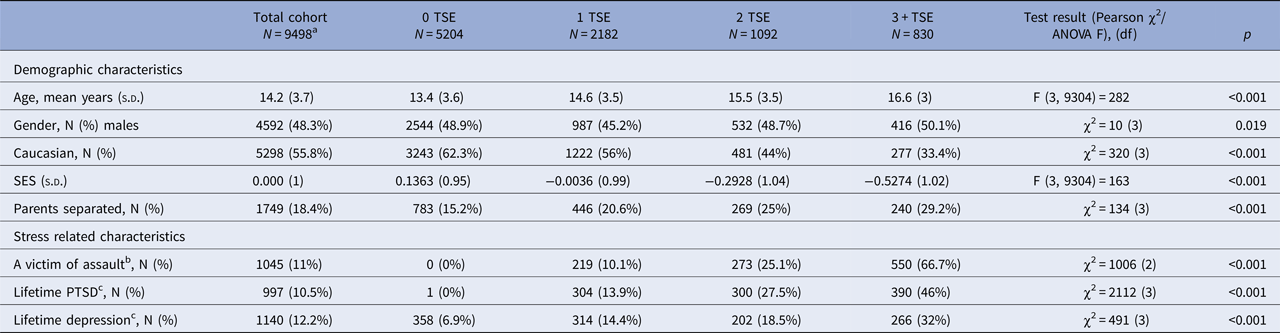
Of the 9498 PNC participants, 4104 (43.2%) endorsed at least one |TSE: 2182 (23%) endorsing a single |TSE, 1092 (11.5%) two TSEs, and 830 (8.7%) three or more TSEs. As can be seen in Table 1, higher TSE load was associated positively with age and parents’ separation, and inversely with socioeconomic status and Caucasian race (Table 1). PTSD rates (based on K-SADS) rose from 13% in the 1 TSE group to 27% and 46% in the 2 TSE and 3 + TSE groups, respectively. Regarding the nature of the assault, 1042 participants reported having been a victim of an assault. Specific TSE frequencies and rates are provided in the online supporting information (online Supplementary Table S1).
Demographic characteristics and exposure rates for traumatic stressful events in PNC participants

PNC, Philadelphia Neurodevelopmental Cohort; TSE, traumatic stressful events; s.d., standard deviation of the mean; PTSD, post traumatic stress disorder.
a For 190 participants (2% of PNC), clinical sections including TSE screening were missing and therefore they were excluded from analyses.
b Assaultive victimization included a history of being attacked or badly beaten, threatened with a weapon, or sexually forced, not limited to but including rape.
c Lifetime PTSD or depressive episode were determined based on the DSM-IV criteria, screened using Kiddie Schedule for Affective Disorders and Schizophrenia (K-SADS) based interview.
Association of exposure with psychopathology and functioning
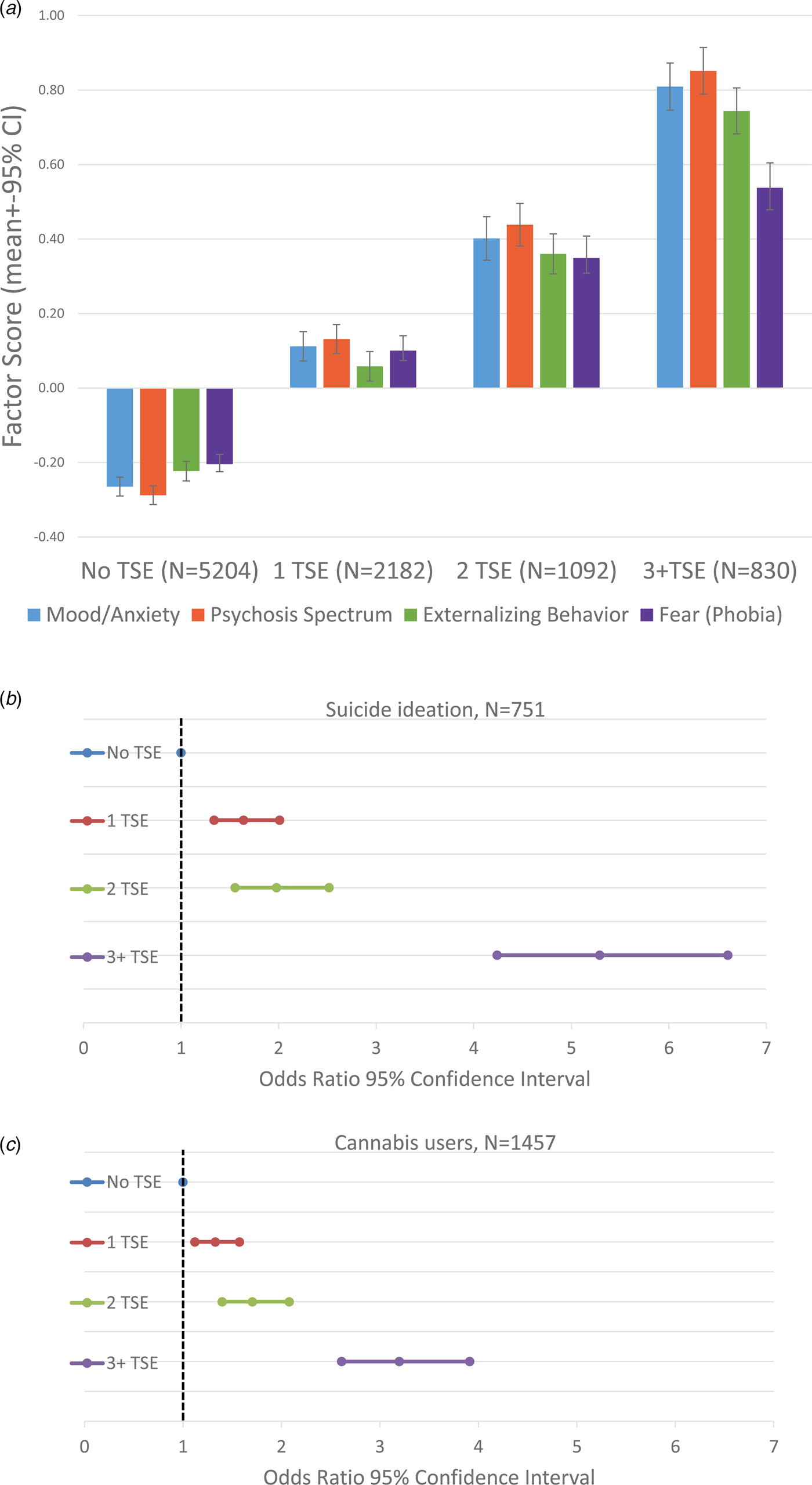
A history of TSE was associated with higher psychopathology factor scores in all the four domains, in a dose-response pattern (Fig. 1a). After controlling for covariates, linear regression revealed that TSE was significantly associated with psychosis-spectrum, mood/anxiety, externalizing and, to a lesser extent, fear (models detailed in Table 2). Associations remained significant for all psychopathology factors after regressing out lifetime PTSD and depression (model c in Table 2). For the mixed model, treating psychopathology domain as a within-subject variable, all stress × domain interactions were significant (p < 0.001), indicating that the stress–psychopathology relationship does indeed differ by domain. The nature of these interactions is apparent in Figure 1a. Higher TSE load was negatively associated with the level of function (linear regression controlling for covariates, Table 2). High TSE load was also associated with lifetime history of suicidal ideation and with cannabis use (Fig. 1b, c, odds ratio compared with non-exposed was 5.3 and 3.2, respectively, both p < 0.001).
Association of traumatic stress load with psychopathology in all PNC participants. (a) Association with psychopathology factor scores: mood/anxiety (Cohen's d = 0.4 for 1TSE, 0.7 for 2TSE, and 1.16 for 3 or more TSE, all values represent effect sizes as compared to no traumatic stress exposure- 0TSE); psychosis spectrum (Cohen's d = 0.39 for 1TSE, 0.69 for 2TSE, and 1.16 for 3 or more TSE); externalizing behavior (Cohen's d = 0.29 for 1TSE, 0.62 for 2TSE, and 1.03 for 3 or more TSE); fear (phobia) (Cohen's d = 0.32 for 1TSE, 0.57 for 2TSE, and 0.76 for 3 or more TSE). (b, c) Association of childhood traumatic stress load with a history of lifetime (b) suicidal ideation and (c) cannabis use. Bars represent mean ± 95% confidence interval in Figure a and odds ratio ± 95% confidence interval in Figs b, c. (TSE = traumatic stressful events).

Linear regression with cumulative TSE count as independent variable and psychopathology factor of global assessment of function score as dependent variable

a Model A controls for age, gender and SES.
b Model B controls for age, gender and race (white, black).
c Model C controls for age, gender, SES, lifetime PTSD, and lifetime depression.
Gender by traumatic stress exposure interaction in association with psychopathology
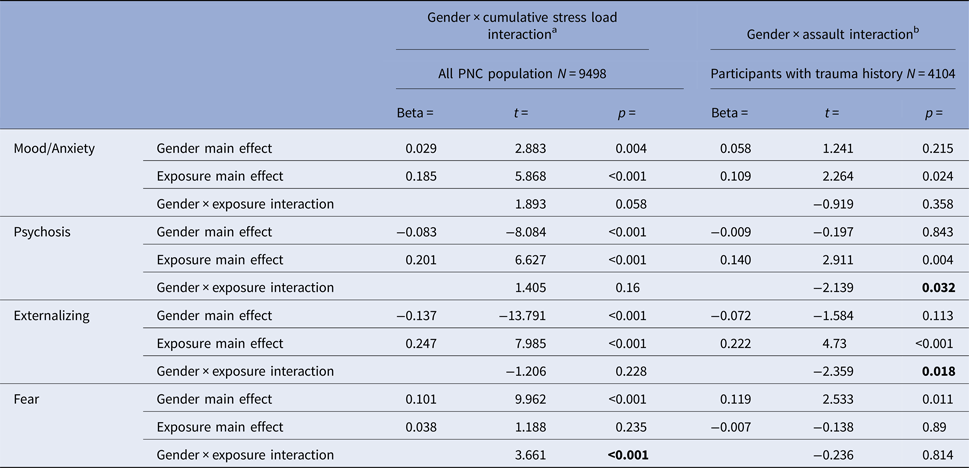
Both males and females showed increased psychopathology factor scores in association with increased TSE load (Table 3, see also Fig. S1, available online). There was a significant TSE load by gender interaction in association with fear (t = 3.661; p < 0.001), and a trend level interaction in association with mood/anxiety (t = 1.893; p = .058), controlling for lifetime PTSD and depression. In both cases, TSE load in females was associated with higher psychopathology factor scores compared with males (online Supplementary Fig. S1). No TSE load by gender interaction was found in association with psychosis or externalizing psychopathology factors.
Gender × stress interactions in association with psychopathology factor scores. Significant interactions are marked in bold

a Linear regression models controlling for age, socioeconomic status, lifetime PTSD, and depression.
b Linear regression controlling for age, socioeconomic status, lifetime PTSD and depression, and cumulative non-assaultive stress load.
Within the group of participants that have experienced at least one TSE, being a victim of assaultive TSE was associated with higher psychopathology and with poorer level of function in all four psychopathology factors compared with victims of non-assaultive TSEs, controlling for covariates including non-assaultive cumulative TSE count (online Supplementary Table S2 and Fig. S2, available online). After controlling for lifetime PTSD and depression, there was a significant gender by assault interaction (Table 3, see also Fig. S3, available online), manifested by increased susceptibility of males to assaultive stress in association with psychosis (t = 2.139; p = .032) and externalizing factors (t = 2.359; p = .018). No assault by gender interaction was found with mood/anxiety or fear factors (Table 3).
Association of TSE load with cognitive function
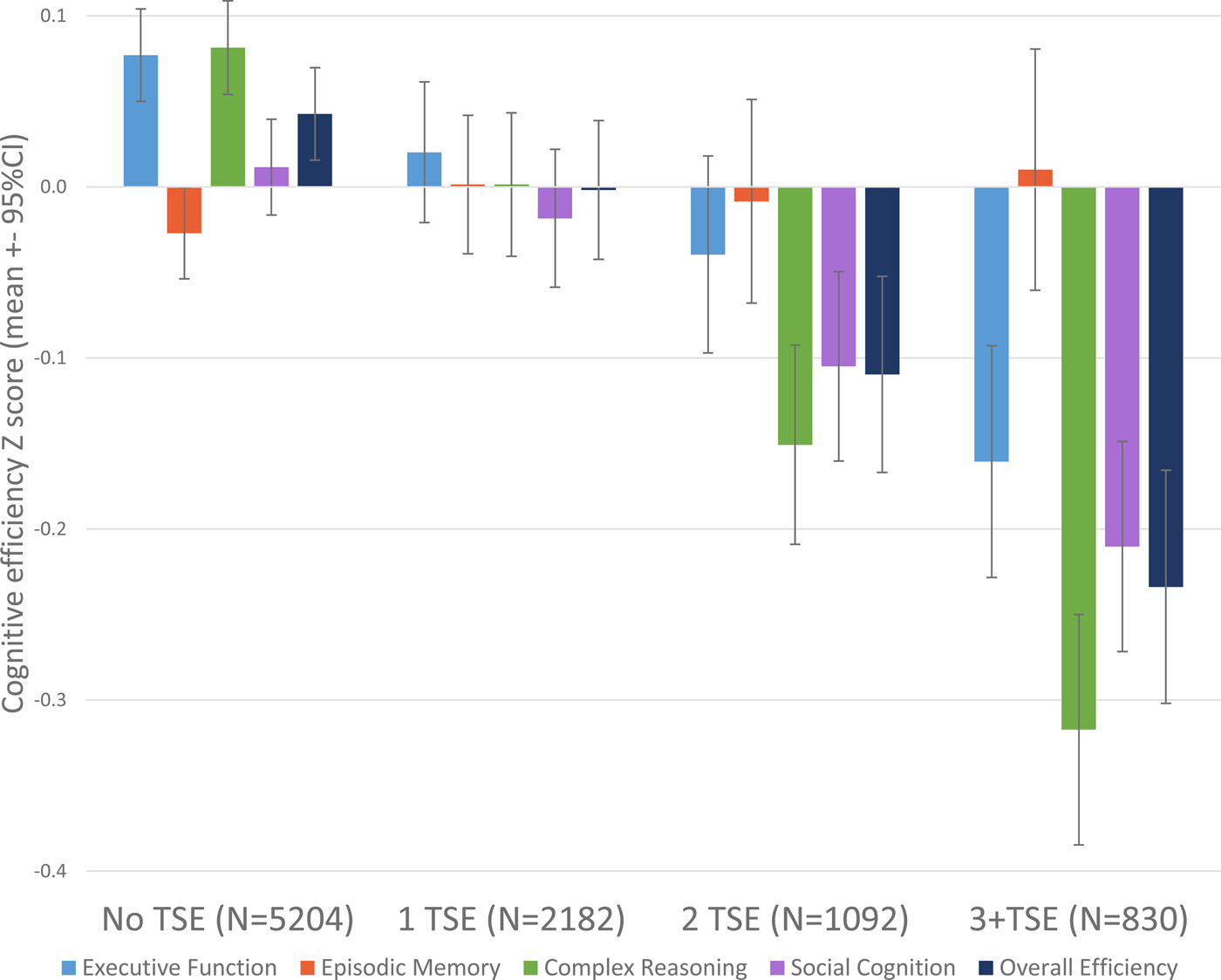
Higher TSE load was associated with poorer overall efficiency in cognitive function, controlling for covariates (Fig. 2, see also Table S3, available online). The strongest negative association was observed with executive function and complex reasoning, whereas for social cognition the negative association with TSE load did not survive controlling for covariates. Episodic memory was the only cognitive domain to show a weak, but the significant positive association with higher TSE load. No significant TSE load by cognitive efficiency interactions were found in association with any of the psychopathology factors (p values > 0.05 for all TSE load X overall cognitive efficiency linear regression analyses predicting psychopathology factors, supporting information in Table S4, available online).
Association of traumatic stress load with cognitive efficiency. Association of traumatic stress load with performance in executive function (Cohen's d = −0.06 for 1TSE, −0.12 for 2TSE, and −0.25 for 3 or more TSE, all values represent effect sizes as compared with no traumatic stress exposure); episodic memory (Cohen's d = 0.03 for 1TSE, 0.02 for 2TSE, and 0.04 for 3 or more TSE); complex reasoning (Cohen's d = −0.08 for 1TSE, −0.24 for 2TSE, and −0.4 for 3 or more TSE); social cognition (Cohen's d = −0.03 for 1TSE, −0.12 for 2TSE, and −0.22 for 3 or more TSE); and general cognitive efficiency (Cohen's d = −0.05 for 1TSE, −0.16 for 2TSE, and −0.28 for 3 or more TSE). Bars represent mean ± 95% confidence interval. (TSE = traumatic stressful events).

Discussion
We report that traumatic stress load in childhood and adolescence is robustly associated with psychopathology, reduced global function, and poorer cognition in a deeply phenotyped, generalizable, US youth community sample. This stress–psychopathology association cuts across diagnostic domains and remains statistically significant after controlling for lifetime PTSD and depression. Particularly, the association of TSE with psychosis factor was comparable in magnitude to that with mood/anxiety factor. Our results indicate that in community youths, stress exposure-psychopathology association is not limited to ‘traditional’ stress-related disorders. The association had a ‘dose-response’ pattern in several psychopathology domains, level of function and cognitive efficiency. These findings are consistent with literature describing cumulative traumatic stress as a greater risk factor for psychopathology (Suliman et al. Reference Suliman2009; Evans et al. Reference Evans, Li and Whipple2013; Karam et al. Reference Karam2014), in the presence of elevated allostatic load that confers susceptibility for illness (McEwen, Reference McEwen1998, Reference McEwen2017).
We chose to treat psychopathological phenotypes of the study participants using continuous factor scores that represent various domains of psychopathology (mood/anxiety, psychosis spectrum, externalizing behaviors, and fear). This approach, compared with dichotomous psychiatric disorders, allowed us to obtain a more precise understanding of each participant's psychopathological profile, especially as the study's sample was intentionally not enriched for youth with threshold psychiatric symptomatology. That is, most of the study participants did not reach psychiatric threshold symptoms, and analysis using non-continuous scales would have likely resulted in the loss of meaningful data (Markon et al. Reference Markon, Chmielewski and Miller2011). Nonetheless, even in the non-psychiatric population of this study, we found a dose-response association pattern with the accumulation of TSEs across all the psychopathological domains (small effect size for 1 TSE, medium effect size for 2 TSEs and large effect size for 3 + TSEs). Importantly, the large sample and the deep phenotyping of the participants, coupled with the substantial rate of traumatic stress exposure, enabled us to control for PTSD and depression and show that there is significant association for TSEs beyond these two disorders, for which there is robust literature describing their association with traumatic stress (Heim & Binder, Reference Heim and Binder2012; Messman-Moore & Bhuptani, Reference Messman-Moore and Bhuptani2017). This finding shows that in a community youth population, not ascertained to enrich for trauma exposure or significant psychopathology, traumatic stress exposure is associated with psychopathological domains including psychosis and externalizing symptomatology, not accounted for by PTSD or depression.
The strength of the cumulative stress load association with psychopathology, as estimated by the standardized beta coefficients of the regression analyses, varied according to the participant gender and whether they had endured an assaultive trauma. These findings align with the view that cumulative stress by itself can only partly explain the mental health risk attributed to stress exposure (McLaughlin & Sheridan, Reference McLaughlin and Sheridan2016). We found that females showed higher fear and mood/anxiety (trend level significance) symptoms associated with greater stress load, consistent with reports indicating an increased risk for PTSD and depression in females (MacMillan et al. Reference MacMillan2001; Bale & Epperson, Reference Bale and Epperson2015). Furthermore, in patients with a history of trauma exposure, assaultive TSE was associated with worst psychopathology scores, consistent with previous reports (Ribeiro et al. Reference Ribeiro2013; Liu et al. Reference Liu2017; Lowe et al. Reference Lowe2017). Examination of gender by assault interaction revealed that in males, an assault was associated with higher psychosis and externalizing symptoms. Taken together, our results suggest a gender-specific developmental trajectory associated with trauma exposure, as previously suggested in clinical settings (MacMillan et al. Reference MacMillan2001; Cort et al. Reference Cort2012) and studies with neuroimaging (Everaerd et al. Reference Everaerd2012; Reference Everaerd2016; Elton et al. Reference Elton2014), as well as inflammation (Derry et al. Reference Derry2015; Baldwin et al. Reference Baldwin2018) related phenotypes.
There is growing interest in understanding the association between early life adversities and poorer cognitive performance (Cowell et al. Reference Cowell2015). The neurocognitive phenotyping of PNC participants, coupled with substantial TSE exposure, enabled examination of the association between early life traumatic stress load and cognitive performance in a non-clinical population. We report a dose-response of TSEs associated with poorer cognitive efficiency across multiple cognitive domains. Specifically, there was a small effect size association of high traumatic stress exposure (3 + TSEs) with poorer executive function and social cognition and a larger effect size (small to moderate) association of high exposure with poorer abstract reasoning. Judging from these effect sizes, we suggest that in the current study (non-help-seeking sample), the participants require substantial exposure (3 + TSE) to show significantly lower cognitive performance in association with the exposure. This might indicate that cognitive efficiency is somewhat ‘spared’ compared with the larger effect sizes that we observed in the association of traumatic stress exposure with psychopathology factor scores. Importantly, one should be cautious interpreting directionality from stress to cognition when analyzing cross-sectional data, especially in light of recent evidence suggesting that cognitive deficit itself should be considered a risk factor for victimization (Danese et al. Reference Danese2017).
Examination of cognitive performance in specific domains showed that episodic memory was the only cognitive domain that was not negatively associated with traumatic stress exposure. While unexpected, this finding is in line with a recent meta-analysis examining cognitive correlates of childhood trauma with and without PTSD (Malarbi et al. Reference Malarbi2017). Specifically, the meta-analysis reported that trauma exposure without known PTSD status was not significantly associated with memory impairment but was associated with poorer cognitive performance in tests measuring complex reasoning and executive function. However, in separate analyses of adolescents with a diagnosis of PTSD, traumatic stress exposure was associated with poorer memory, as well as other cognitive domains (Malarbi et al. Reference Malarbi2017). Notably, a different meta-analysis of adult PTSD studies examining cognitive functioning reported that studies of help-seeking individuals showed greater memory deficits than studies of community samples (Scott et al. Reference Scott2015), which may partially explain why our non-help-seeking community population did not show associations between increased trauma exposure and poorer memory.
There is growing recognition that a history of childhood adversities, as in the case of people with high TSE load, has critical clinical implications (Teicher & Samson, Reference Teicher and Samson2013; Nemeroff, Reference Nemeroff2016). These include more severe clinical course (Barnhofer et al. Reference Barnhofer2014; Kelly & Mezuk, Reference Kelly and Mezuk2017) and less favorable response to treatment (Tyrka et al. Reference Tyrka2013; MacPherson et al. Reference MacPherson2014; Miller et al. Reference Miller2015). While most studies describing the unfavorable trajectory of early life adversity focused on patients ascertained for depression, here we describe detrimental associations between high TSE load and psychopathology and level of function in a non-psychiatrically ascertained population, with psychopathological associations extending beyond depression. Considering the high rate of stress exposure observed in our study (2 + TSE in almost 20% of the PNC) and a previous population-based study in community youth (Kessler et al. Reference Kessler2009), we propose that screening for adversity in clinical settings may help better determine risk, prognosis and treatment plan. Moreover, as we show robust association of TSE with psychopathology and cognition, and as there is evidence of association of trauma exposure with other phenotypes (e.g. imaging (Busso et al. Reference Busso2017), inflammation (Baumeister et al. Reference Baumeister2016)), screening and controlling for history of early TSE exposure may be warranted in research studies involving children and adolescents.
Our study has several limitations. First, the cross-sectional data of the PNC limit causal inferences from TSE to psychopathology and related outcomes. Most prominently, it is difficult to disentangle the possibility of early sensitization to consequent PTSD and depression following early life adversity associated with later trauma exposure (McLaughlin et al. Reference McLaughlin2017). We tried to address that limitation through conducting a regression model controlling for lifetime PTSD and depression and showing that the association between exposure and psychopathology remains significant. The cross-sectional nature of the study also constrains inferring directionality between stress exposure, psychopathology, and the associated poorer cognitive efficiency we observed, and warrants longitudinal investigation in prospective studies. Another limitation is that TSEs were endorsed from a list of eight events, not allowing evaluation of other forms of early life adversity. As a result, we do not have measures for childhood neglect or chronicity of abuse - factors that significantly affect development (McLaughlin & Sheridan, Reference McLaughlin and Sheridan2016). Furthermore, in this study ‘load’ refers to the endorsement across multiple categories and types of TSE, but we cannot account for ‘load’ wherein an individual may have experienced repeated or ongoing exposures within a category or type of stressor. That we nonetheless found robust clinical associations with load, as defined in this study, may highlight the broad role of traumatic stress during brain development in mental health, cognition, and function.
In conclusion, in a community ascertained, socio-demographically diverse, generalizable US youth population we found that traumatic stress exposure is strongly associated with a broad range of psychopathology domains, lower functional level and poorer cognitive efficiency. The psychopathology profile involved higher symptom burden that extended beyond the well-described stress-related disorders PTSD and depression. The results are relevant to child and adolescent mental health policy, as we show that administration of a short screen for TSE may reveal information that is robustly associated with mental illness in community youth and may identify at risk populations (Asselmann et al. Reference Asselmann2018). The high exposure rates we and others have observed further underscore the effort required from society to minimize childhood adversities (Shonkoff et al. Reference Shonkoff, Boyce and McEwen2009; Walker et al. Reference Walker2011). More research is needed to better understand the biological mechanisms underlying the developing brain's vulnerability to stress and elucidate causative pathways.
Supplementary material
The supplementary material for this article can be found at https://doi.org/10.1017/S0033291718000880.
Acknowledgements
Sources of funding and support: This work was supported by NIH grant MH-107235, MH-089983, MH-096891, MH-P50MH06891, the Dowshen Neuroscience fund, and the Lifespan Brain Institute of Children's Hospital of Philadelphia and Penn Medicine, University of Pennsylvania. The funding organization had no role in the design and conduct of the study; collection, management, analysis, and interpretation of the data; preparation, review, or approval of the manuscript; and decision to submit the manuscript for publication. This work was supported by NIH grant MH-107235; MH-089983; MH-096891; MH-P50MH06891; the Dowshen Neuroscience fund; and the Lifespan Brain Institute of Children's Hospital of Philadelphia and Penn Medicine, University of Pennsylvania. Kathleen Merikangas, PhD, and Marcy Burstein, PhD, Genetic Epidemiology Research Branch, Intramural Research Program, National Institute of Mental Health, assisted in the development of GOASSESS; they received no compensation from the funding sponsor. We thank participants and families; staff of the Brain Behavior Laboratory, University of Pennsylvania, Philadelphia, for their contribution to data generation; study assessors and recruiters for their invaluable contributions to data collection; and staff from the Center of Applied Genomics, Children's Hospital of Philadelphia, Philadelphia, Pennsylvania, for the genomics interphase with brain-behavior measures.
Declaration of interest
Barzilay serves on the scientific board and reports stock ownership in ‘Taliaz Health’, with no conflict of interest relevant to this work. All other authors declare no potential conflict of interest.