

What is the issue and what has been done?
Over 70% of women in their 20s and 30s have been ‘groped’ while on public transportation in Tokyo, Japan (Horii & Burgess, Reference Horii and Burgess2012). Japanese society has named both the act and the offenders of this distinct sex crime ‘chikan’, which translates as ‘lewd man’. The problem of groping in Tokyo is not unique. However, the filled-to-capacity conditions of Tokyo subways creates a hotbed for molestation cases that stand out amongst other developed cities. Victimization from chikan could heighten risk perception, induce a sense of shame and damage one's sense of self-control (Kirchhoff et al., Reference Kirchhoff, Joseph and Barkhuizen2007). Chikan is a problematic societal issue that poses excessive danger to both men and women in Japan. Yet, tactics against the issue still stress the responsibility of women in protecting themselves as opposed to deterring sexual harassment; government interventions often appear passive and ineffective.
Previous attempts to tackle groping include the adoption of women-only railway carriages and CCTV cameras. Adopted first in 2005, women-only carriages in Tokyo have since been unpopular, as women find them more of a hassle than a form of protection (Horii & Burgess, Reference Horii and Burgess2012), especially during rush hour. Additionally, this measure assumes that women can only be made safe through confinement, therefore paradoxically shifting the attention from condemning gropers to blaming victims for inadequately protecting themselves. This results in increased vulnerability for those who forget or choose not to use the specified carriages (Iida, Reference Iida2005).
Surveillance cameras are one of the most common crime prevention tactics. However, their wide use has promoted desensitization towards CCTV cameras. Instead of deterrence, CCTV cameras today are operated more for evidence collection after the occurrence of crimes. Chikan incidents occur mostly during rush hour when carriages are crowded, and most CCTV cameras are installed on the ceiling, which is insufficient for collecting evidence and deterring offenders due to their lack of visibility.
Multiple limitations are observed regarding existing anti-groping measures. This proposal suggests an alternative countermeasure by displaying images of watchful eyes inside carriages and stations in order to explore a possible behavioural intervention in deterring groping. The underlying logic reflects how humans rely on fast, simple, non-conscious ‘rules of thumb’ to make decisions; therefore, even the slightest change to the environment could alter behaviour (Kahneman, Reference Kahneman2011). By summarizing the existing findings and results, a tentative design of the image will be presented at the end of the paper. However, it is critical to emphasize that this proposal does not intend to reject any existing measures, despite their observed limitations. Rather, it proposes an idea supporting a broader and holistic strategy for reducing sexual harassment.
Looking into the eyes: exploring the psychology of surveillance
The feeling of being watched can change human behaviour, even if the watcher is artificial. A growing body of evidence has demonstrated that mere images of watchful eyes can induce more pro-social behaviours (Ernest-Jones et al., Reference Ernest-Jones, Nettle and Bateson2011; Bateson et al., Reference Bateson, Callow, Holmes, Redmond Roche and Nettle2013). This phenomenon is known as the ‘watching eyes’ effect. In the last decade, researchers have observed that in the presence of watchful eyes, individuals are more likely to give money to others (Keller & Pfattheicher, Reference Keller and Pfattheicher2011), donate to charities (Powell et al., Reference Powell, Roberts and Nettle2012) and recycle properly (Francey & Bergmüller, Reference Francey and Bergmüller2012). Studies in the past have primarily focused on small acts of generosity or relatively minor infringements of social norms. A potential field for investigation is: could a pair of eyes deter more serious antisocial behaviour?
Human eyes and gaze detection
The area around the eyes plays a pivotal function of conveying social cognition, including threat, intimidation and attention (Baron-Cohen, Reference Baron-Cohen1995; Macrae et al., Reference Macrae, Hood, Milne, Rowe and Mason2002). In nature, it is an animalistic instinct to become aware of danger and to initiate a fight-or-flight response when predated (Langton et al., Reference Langton, Watt and Bruce2000). Although acts of natural predation are rare in humans, the same neuropsychological architecture still lingers, known as the ‘eye-direction detector’ (Baron-Cohen, Reference Baron-Cohen1995). Out of all primate species, humans possess the largest ratio of exposed sclera size (Kobayashi & Kohshima, Reference Kobayashi and Kohshima1997), which is hypothesized to have emerged for greater efficacy in non-verbal communication. Furthermore, the research of Whalen et al. (Reference Whalen, Kagan, Cook, Davis, Kim and Polis2004) has shown that only the upper half of an alarmed face is required to stimulate the amygdala to sense fear and threat. Neuroscientists have also discovered that the unpleasant atmosphere felt when stared at stems not from being monitored, but rather from the belief of being watched by conspecifics (Wykowska et al., Reference Wykowska, Schubö and Hommel2009). Therefore, as humans possess fast, automatic psychological mechanisms to respond to all eye-like stimuli (Izuma, Reference Izuma2012), images that merely resemble human eyes are sufficient to trigger the watching eyes effect (Mareschal et al., Reference Mareschal, Clifford and Calder2013).
The psychology of surveillance
Artificial surveillance exploits this human sensitivity to gaze in order to shape behaviour without the presence of real surveillance. The earliest implication of the watching eyes effect is the arguably renowned ‘Hawthorne effect’ (Bramel & Friend, Reference Bramel and Friend1981; Chiesa & Hobbs, Reference Chiesa and Hobbs2008). The effect is generally understood as a phenomenon in which productivity amongst workers increases when they are supervised intensively by peers rather than through improvement of physical conditions (Campbell et al., Reference Campbell, Maxey and Watson1995). One of its underlying principles is norm psychology.
Not only are people highly responsive to injunctive and descriptive norms, but people who conform to locally specific norms also tend to sanction those who are deviant (Cialdini et al., Reference Cialdini, Reno and Kallgren1990; Chudek & Henrich, Reference Chudek and Henrich2011). In addition, while it is suggested that the act of being watched makes people more pro-social, a more accurate implication is that surveillance induces people to act more normatively. The study of dictator games demonstrated that participants tend to give amounts of money that are closer to the midpoint of possible donations when watched (Nettle et al., Reference Nettle, Nott and Bateson2013). This gesture resembles acting within the perceived norm rather than simply behaving more generously when being observed (Bateson et al., Reference Bateson, Callow, Holmes, Redmond Roche and Nettle2013).
Another crucial aspect is the threat perception mechanism. A recent experimental study by Panagopoulos and van der Linden (Reference Panagopoulos and van der Linden2017) demonstrated the existence of a high level of negative emotions, such as anger, disgust and shame, when individuals are exposed to images of watchful eyes. Artificial surveillance also influences our perception of opportunities. Most crimes are opportunistic (Clarke, Reference Clarke2012), especially sex-related crimes. However, opportunity is subjective. It is the perception of set circumstances that makes a behaviour more opportune (Smith et al., Reference Smith, Clarke, Pease and Tilley2002). Images of eyes can therefore induce awareness of others’ presence, increase potential anxiety (Tsuji & Shimada, Reference Tsuji and Shimada2015) and heighten social awareness and self-evaluation (Baltazar et al., Reference Baltazar, Hazem, Vilarem and Beaucousin2014; Pfattheicher & Keller, Reference Pfattheicher and Keller2015), which are important factors for deterring antisocial behaviour.
Fitting the Japanese context: informal control in subways
Every student in policy-making is taught that context is key. The question here remains: how does the watching eyes effect fit into the Japanese context? In Japan, informal social control itself is a crime prevention tactic (Komiya, Reference Komiya1999). As Leonardsen (Reference Leonardsen2003, p. 1) observed, the Japanese ‘are extremely conscious that they are constantly under the scrutiny of an ever-watchful public eye.’ ‘Kūki wo yomu’ is considered a standard navigating principle, which means ‘to read the air’. In Japan, even the tiniest change in the environment, people's words and body language can influence behaviour drastically. This practice cultivated Japan's heavily valued conformity, making Japan distinct in that its culture has already internalized the psychology of surveillance. Criminologically, this characteristic has contributed to Japan's low crime rate (Komiya, Reference Komiya1999) and is essential to understanding why strategies exploiting informal social control could have a stronger impact in Japan than elsewhere.
Whereas Ernest-Jones et al. (Reference Ernest-Jones, Nettle and Bateson2011) believed that images of eyes are only effective when there are few or no real observers, Bateson et al. (Reference Bateson, Callow, Holmes, Redmond Roche and Nettle2013) suggested that such images were more effective when the environment is crowded. Regardless, this effect pairs with the subway environment in Tokyo. Although the Tokyo subway is famous for its crowdedness and the white-gloved staff who cram passengers on board the trains, the packed carriage environment makes it impossible for any real eye-to-eye observation. In this context, self-awareness and the psychology of surveillance can serve as powerful deterrents.
How to utilize the eyes: designs, successes and lessons learned
From a limited amount of previous literature, a handful of practical suggestions for implementing the images of watchful eyes will be provided.
The eyes
Recent studies suggest that the watching eyes effect is most effective when the images are prominently large-eyed, alert and tightly cropped (Bateson et al., Reference Bateson, Nettle and Roberts2006; Lewis, Reference Lewis2016). It is postulated that the inclusion of these features is vital, as the ‘directed gaze’ captures attention faster than the ‘averted gaze’ (Conty et al., Reference Conty, George and Hietanen2012). In addition, most of the studies pinpointed the crucial nature of displaying images of real human eyes instead of computer graphics or cartoons (Figure 1) in order to stimulate a more natural human gaze, thus triggering more effective psychological functions.
(a) A poster of a pair of male eyes used in a bicycle theft study by Nettle et al. (Reference Nettle, Nott and Bateson2012). (b) A stylized eye-like graphic displayed as the desktop background in a study on generosity by Haley and Fessler (Reference Haley and Fessler2005).

Lewis (Reference Lewis2010) found that the colour yellow was often the first colour human eyes can perceive, highlighting its potential to be seen from a great distance and at high speeds. It has therefore been widely used in signage, on school buses and on emergency vehicles. When designing the eyes, the colour yellow is preferred in order to leverage its potential power to capture attention.
Another element that has been discussed only minimally is the importance of eyebrows. While the commonly understood function of eyebrows is to divert perspiration, scientists have found that eyebrows are crucial in displaying sexual dimorphism, as well as in the aesthetics of faces (Sadr et al., Reference Sadr, Jarudi and Sinha2003). They are critical in expressing countless emotions and social signals, including anger and threat. Therefore, it is suggested that in order to maximize the emotion of fear, an image of staring eyes that includes the eyebrow region should be employed.
Configuration
An early experiment conducted by McNees et al. (Reference McNees, Egli, Marshall, Schnelle and Risley1976) on anti-theft tactics proposed that displaying a related verbal message could reduce theft, as such messages imply the authorities’ awareness. From a behavioural science perspective, by indicating the severity of the situation, this may inadvertently normalize the situation and justify individuals’ inappropriate behaviours. This is what Robert Cialdini identified as the ‘big mistake’ that policy-makers commit (Halpern, Reference Halpern2015). Therefore, in the context of groping in Japan, if a verbal message were to be included with the images of eyes, rather than stating, ‘70% of Japanese women were groped, we are watching you,’ the message could state, ‘95% of Japanese males and females find chikan distasteful and abnormal. You are being monitored!’ This warning could then reinforce a shaming effect and deter offenders from acting against social norms.
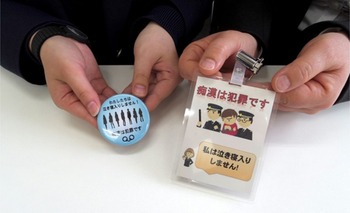
The location of the images of eyes is also vital and should be an adjunct to existing surveillance technologies, such as CCTV cameras. CCTV cameras are installed in most subways in Japan. However, their limitations lie in their visual range and gradual desensitization. The images of eyes could therefore be displayed adjacent to CCTV cameras in order to fully engage the psychology of surveillance. As a method of defence, many Japanese girls have started to pin badges around the shoulder areas of their backpacks or handbags stating, ‘Chikan is a crime!’ (Figure 2). While the logic behind this is distinct from the watching eyes effect, its effectiveness may increase if an image of staring eyes were to be included.
Badges designed for a Japanese anti-molestation campaign (Shukan Josei PRIME, 2016).

Aside from displaying them next to CCTV cameras, the images of eyes should also be displayed in as ‘timely’ a fashion as possible, as Halpern (Reference Halpern2015) has termed it. This does not imply a temporal meaning, but rather refers to displaying the images as the passengers enter the station, near the entrance, in elevators, on platform walls and inside carriages. The reasoning for this is that the earlier the images are perceived, the sooner the psychology of surveillance can be engaged and accumulated.
Other benefits and possible limitations
This intervention has several additional benefits with regards to policy-making. The benefits can be summarized in the acronym ‘FACE’: flexible, attractive, cheap and easy.
Flexible
This intervention is extremely flexible in implementation. While CCTV cameras are often restricted due to financial reasons, technological restraints, blind spots or privacy issues, images of eyes can be displayed in any location with adjustable size configurations.
Attractive
The UK Behavioural Insights Team (2014) published the ‘EAST’ framework, emphasizing attractiveness as a key element of an effective behavioural policy. As they explain, the mere image of eyes can be eye-catching, as humans are naturally sensitive to others’ gazes. The possible digitalization of images by adding animations, such as blinking, could further portray realistic human eyes and attract more attention in order to fully achieve the desired effect.
Cheap
Budget is critical in policy-making. Compared to creating more women-only carriages, expanding train capacity or installing more CCTV cameras, displaying images of eyes is inexpensive and hence economically attractive.
Easy
This measure is simple to implement and could spark fewer social debates or counteractive forces. In addition, since the embarrassment of reporting remains an issue for most victims and witnesses, wearing badges with images of eyes could be stress-free and practical. This approach could further engage with a broader social engineering process of empowering citizens to stand up against chikan.
Possible limitations
Like many other situational and location-based interventions, crime displacement remains the biggest challenge (Gabor, Reference Gabor1990). A watchful eyes experiment led by Nettle et al. (Reference Nettle, Nott and Bateson2012) on bicycle theft demonstrated a reduction in bicycle theft that coincided with a rise in other types of theft on campus. Although displacement is observed in some cases, diffusion of benefits could also be found (Guerette & Bowers, Reference Guerette and Bowers2009; Nettle et al., Reference Nettle, Nott and Bateson2012). In other words, the increase in the perception of surveillance can deter potential crimes in nearby places. Hence, the benefits of surveillance can diffuse.
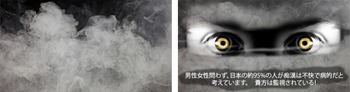
In addition, Sparks and Barclay (Reference Sparks and Barclay2013) found that the length of exposure to eye-like images could reduce participants’ willingness to give money. It is possible that if potential offenders are exposed to the same image for a prolonged period, they may become desensitized to the watching eyes effect. However, a possible modification that could be further explored is the digitalization of images, as stated in the previous section. Images could be displayed on the constantly changing electronic panels inside stations and carriages. The digitalization of eye-based images could even include animations or realistic eye movements, such as blinking, to increase the resemblance to a real human gaze and maximize the effect. This in turn could be executed by programming a piercing gaze to blink, with the above descriptions as to how to maximize the effectiveness of the watching eyes effect (Figure 3).
A tentative proposal of a design to deter groping via electronic implementation of the watching eyes effect. This proposed design suggests a smoke-based foreground to maximize attention, while yellow-hued eyes are used in order to mimic a predatory gaze. Caption: ‘男性女性問わず、日本の約 95% の人が痴漢は不快で病的だと考えています。貴方は監視されている!’ translating to ‘95% of Japanese males and females alike find chikan to be distasteful and abnormal. You are being monitored!’ © Chu Ka Ki 2018.

As emphasized in this proposal, it is unrealistic to rely on a pair of eyes to stop sexual harassment. Unlike other opportunistic crimes, groping is triggered by more complex psychological and cultural factors. In Saito's recent book (Reference Saito2017), The Reasons Why Men Become Chikan, the Japanese professional reveals the deeply rooted issues of male domination and female subjugation underlying the issue of groping, instead of describing it as being a simple sexual impulse. The critical caveat of this proposal is that it does not touch on this multifaceted cultural and social root of groping in Japan. The proposed intervention thus has limited effectiveness in addressing crucial issues such as the reluctance to report, gender inequality and issues surrounding urban settings. Policy-makers must be aware of this caveat and react accordingly in order to design holistic policies that target these roots through education, public awareness and female empowerment in the modifications of station designs.
Conclusion
The rationale for the watching eyes effect is that people tailor their behaviours when they believe they are being observed. This proposal exploits such biological sensitivity to gazes and proposes displaying images of watchful eyes (Figure 3) in order to reduce groping in Tokyo subways. It explores the possible application of surveillance psychology within the Japanese context, as informal social control has an influence over individuals’ behaviours. Such behaviourisms include reminding passengers on trains of others’ existence and of surveillance in order to augment their self-awareness and self-control, hence deterring chikan.
This paper also offers a number of insights regarding the practical implementation of the measure in terms of its design, content and location, with reference to previous literature and the researcher's own observations. Although the measure could be effective at reducing groping due to its potential advantages of flexibility, attractiveness, cost–effectiveness and practicality, this proposal is not without its limitations. In fact, studies in this area are still limited, rendering the potential effectiveness of this approach inconclusive. Policy-makers should also be aware of problems such as displacement and desensitization. In addition, this proposal does not touch on other sociocultural roots of groping in Japan, such as the fear of reporting and sexual objectification, which are all fundamental to the core of tackling sexual victimization. Essentially, it is the objective of this proposal to reveal these limitations, to expand the scope of current discussion and to argue for more experimental studies on related subjects. This proposed measure is noteworthy as it could be a simple and effective intervention for reducing sexual harassment. It demonstrates a potential role for future studies of which biopsychological factors might play a part in the regulation of social behaviours.