


Persistent antisocial behaviour – a core feature of conduct disorder – substantially increases the likelihood of problems in adulthood such as violence, criminality, unstable relationships and mental health problems (Reference Hill and MaughanHill & Maughan, 2001). Forty per cent of children aged 7–8 years with conduct disorder become recidivist teenagers and over 90% of juvenile delinquents had conduct disorder as children (Reference ScottScott, 1998). It is also a major predictor of lifetime resource use. Individuals with persistent antisocial behaviour at age 10 years cost society ten times as much as controls by the time they were 28 years old (Reference Scott, Knapp and HendersonScott et al, 2001a ; Reference Knapp, McCrone and FombonneKnapp et al, 2002b ). Although younger children with severe antisocial behaviour are likely to require support from a wide range of agencies (Reference Knapp, Scott and DaviesKnapp et al, 1999; Reference Vostanis, Meltzer and GoodmanVostanis et al, 2003) little is known about the immediate, short-term costs in childhood. Lack of this information may be one reason why the mean annual spend in England and Wales on child and adolescent mental health is so low–about £10 per child per year (Audit Commission, 1999). The objectives of our study were to estimate the costs of supporting children with severe antisocial behaviour, to identify socio-demographic and clinical factors associated with those costs, and to gain further insight into who bears them.
METHOD
Participants
The study sample was derived from a multicentre controlled trial of parenting groups for childhood antisocial behaviour (Reference Scott, Spender and DoolanScott et al, 2001b ). This study investigated the last 80 cases recruited in the original trial, which had a total sample of 141. The children were referred to four child and adolescent mental health services (CAMHS) in London (Brixton, Belgrave, Camberwell and St George's Hospital) or to the CAMHS in Chichester, in the south of England. Children eligible for inclusion in the study were aged 3–8 years, with severe antisocial behaviour as the presenting problem. On average, they were in the worst 1% of the population with the most disruptive behaviour, as measured by semi-structured interview. Children were excluded if there were clinically apparent developmental delays, hyperkinetic syndrome or any other condition requiring separate treatment.
Measures
Costs
Service use data were collected using the Client Service Receipt Inventory (CSRI; Reference Beecham, Knapp, Thornicroft, Brewin and WingBeecham & Knapp, 1992) specifically adapted for childhood (Reference Knapp, Scott and DaviesKnapp et al, 1999). Data were collected at the point of entry into the trial, and covered the previous 12 months. These data were obtained for each participating child from the child's main carer, including family demographic and socio-demographic characteristics, employment status of parents, severity of disorder and service utilisation. For costing, a broad societal perspective, including health services, education, social care and informal care (mainly family) was adopted. The overall cost of care was estimated by multiplying the units of health and social services used by their unit costs.
Resource use data for each child were collected concerning contact with the National Health Service (NHS), educational and social care services directly as a result of the child's behaviour. Through detailed questioning of the parent, care was taken to ensure that the extra services were indeed attributable to antisocial behaviour. Usage for other reasons such as unrelated illnesses was excluded. Additional data on services used by the child's family directly or indirectly because of the child's behaviour were also collected, as discussed below. Interviewers collected information on the pattern and intensity of services used, including hospital inpatient admissions, out-patient attendance, accident and emergency attendance, general practitioner visits, health visitors, child guidance clinic contact, child development clinic contacts, social worker and health visitor contacts, voluntary agency counselling and advice, nursery school attendance, educational psychologist services, special needs assistance and classroom assistance.
All costs were calculated at nationally applicable 2000–2001 prices (Reference Netten, Rees and HarrisonNetten et al, 2001). Costs were then inflated to 2002–2003 prices using appropriate health, personal social services and building cost information indices (Reference Netten and CurtisNetten & Curtis, 2003). These figures are generally held to approximate well to the long-run marginal social opportunity cost values, which are the usual method of costing as recommended for use in economic evaluations (for further details see Reference Drummond, O'Brien and StoddartDrummond et al, 1997). No discounting of costs was necessary since the period of analysis was 1 year. An estimate of lost productivity was derived from the data collected on days taken off work by the main carer because of the child's difficult behaviour, using the human capital approach; this method focuses on the potential lost productivity resulting from sickness (Reference Pritchard and SculpherPritchard & Sculpher, 2000). Wages were assumed as a proxy measure for lost production. The cost of household tasks is the summation of three categories of activities: extra time taken to prepare meals, extra time spent shopping and extra time spent household cleaning because of the child's behaviour. The cost is based on a conservative unit cost per hour of employing a child carer at £5.57 for parents who were unemployed. For mothers who were in paid employment their costs were estimated using their average hourly pay. The cost of additional home repairs was based on the average weekly household expenditure on alterations to dwellings for home improvements (Office for National Statistics, 2003).
Child psychopathology and family characteristics
Measures were taken at the point of entry into the study on demographic and socio-demographic characteristics and the severity of the child's behaviour, assessed using the Parent Account of Child Symptoms interview (PACS; Reference Taylor, Schachar and ThorleyTaylor et al, 1986). The PACS is a semi-structured interview used to assess the severity and frequency of antisocial behaviours, such as fighting, destruction and disobedience.
Statistical methods
From the measures, a set of possible predictors was selected on the basis of previous research and discussions with the clinical expert on the team. We used multivariate statistical methods, taking the total cost of care as the dependent variable. The explanatory variables were age, gender of the child, gender of the main carer, ethnicity of the main carer, marital status of the main carer, education of the main carer, severity of symptoms in each of three domains (antisocial behaviour, hyperactivity and emotional problems), the subjective difficulty the main carer experienced with the child, and whether there was special educational needs provision made for the child.
Because cost data are typically skewed in their distribution, we planned to use both parametric and non-parametric methods of analysis. Initially, bivariate analysis was used to investigate associations between each of the child and family measures and the total costs of care, using simple linear regression. Associations between costs and continuous variables were conducted, but when we present the descriptive results below we separate two groups distinguished by each variable's median value. Both ordinary least squares and generalised linear modelling were then used to examine the associations between baseline characteristics, total costs and component costs such as NHS costs, education service costs, voluntary sector costs and indirect costs. Multiple regression using ordinary least squares can be misleading when the error term is non-normally distributed and has a non-constant variance. If the dependent variable is non-normally distributed, there is a good chance that the residuals will be too, which will invalidate tests of significance associated with fitting a model with ordinary least squares and so produce imprecise estimates of costs (Reference Dunn, Mirandola and AmaddeoDunn et al, 2003). An alternative is to use generalised linear modelling to address these concerns about the distribution of the data, as employed previously in the mental health field (Reference Knapp, Chisholm and LeeseKnapp et al, 2002a ). In this study, the Park test on the raw scale residuals was used to select one of the relevant family distributions (Gaussian, Poisson, gamma or inverse Gaussian) for the generalised linear model. If the values were consistently near 0, Gaussian was chosen; for values near 1, the Poisson was used; for values nearer to 2, gamma was used; for values nearer to 3, inverse Gaussian was used. For values far below 0 or much bigger than 3 (say 5 and above), it would be necessary to select another link function (Reference Manning and MullahyManning & Mullahy, 2001). Once the appropriate family distribution had been selected, generalised linear modelling was repeated with this choice of family using a robust option.
When multiple regression using standard ordinary least squares was conducted, all explanatory variables that had a bivariate association with costs were initially included in the model. Variables that did not have bivariate associations with costs were then included one at a time and were kept if they added significantly to the model. The decision to retain or discard a variable was based on significance at the 10% level. Analyses were conducted using the continuous variables.
RESULTS
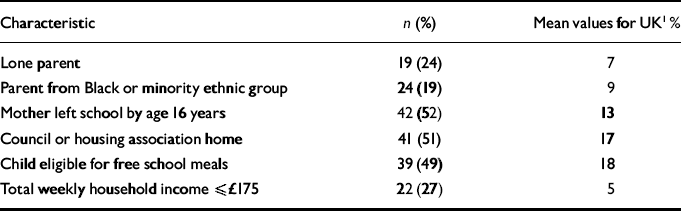
The personal characteristics of the children and their families are shown in Tables 1 and 2. Three-quarters of the children were boys, with an average age of 5 years. Their antisocial behaviour was on the 98th percentile and their hyperactivity on the 90th percentile, so that taken together they were in the worst 1% for disruptive behaviour. The families in the sample were notably disadvantaged on certain indicators of low socio-economic status (Table 2), with high rates of poverty and state-subsidised housing and low levels of parental education when compared with averages for the UK. This pattern of disadvantage is typical of the families of children displaying persistent antisocial behaviour in Britain and other Western countries (Reference Ford, Goodman and MeltzerFord et al, 2003). Nineteen per cent of children had a parent from a Black or minority ethnic group. In addition to the other characteristics mentioned in Table 4, all of the children lived with their mother as main carer, and most of the mothers had a live-in partner.
Characteristics of the 80 children in our sample

| Characteristic | |
|---|---|
| Age, years: mean (s.d.) | 5.06 (1.61) |
| No. of boys, n (%) | 60 (75) |
| Mother as main carer, n (%) | 80 (100) |
| PACS interview score: mean (s.d.) | |
| Antisocial behaviour | 1.53 (0.43) |
| Emotional problems | 0.69 (0.51) |
| Hyperactivity | 1.11 (0.63) |
| Mother had difficulty coping with child in first year, n (%) | 31 (39) |
| Special educational needs provision, n (%) | 19 (24) |
Characteristics of the 80 families in our sample
| Characteristic | n (%) | Mean values for UK1 % |
|---|---|---|
| Lone parent | 19 (24) | 7 |
| Parent from Black or minority ethnic group | 24 (19) | 9 |
| Mother left school by age 16 years | 42 (52) | 13 |
| Council or housing association home | 41 (51) | 17 |
| Child eligible for free school meals | 39 (49) | 18 |
| Total weekly household income ≤£175 | 22 (27) | 5 |
Service use and impact on family
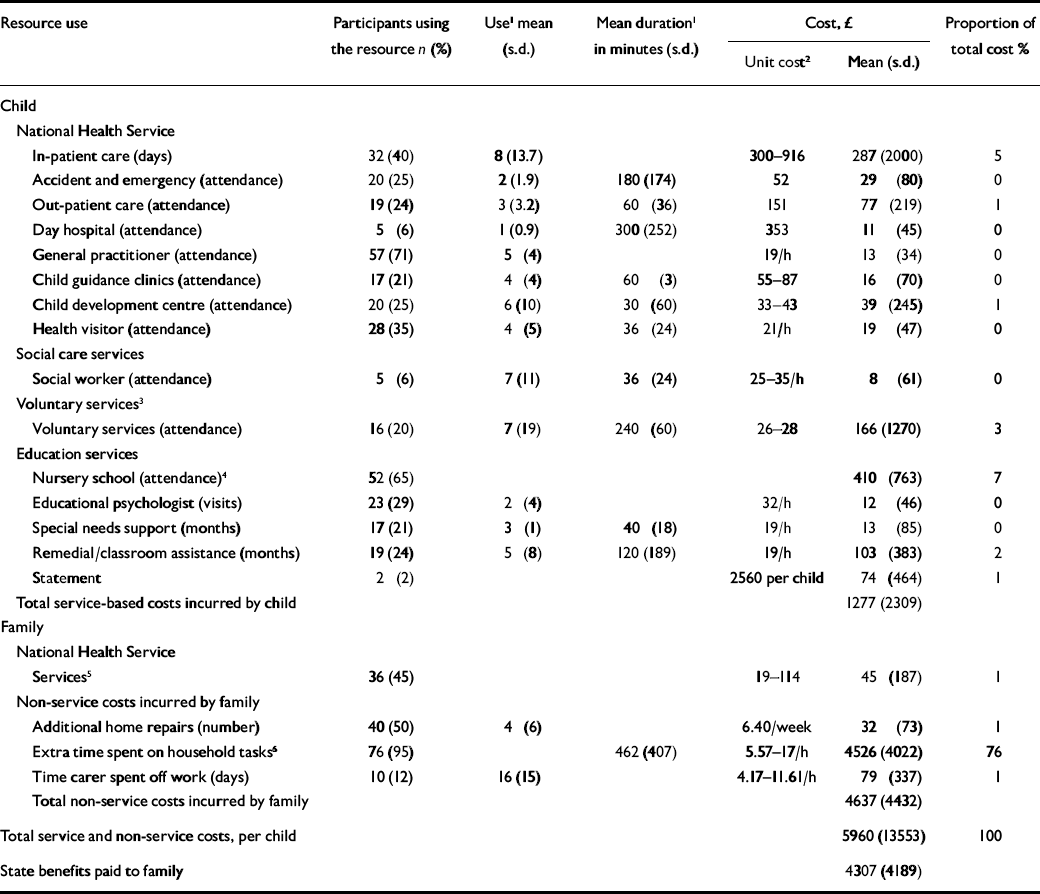
Service use patterns are shown in Table 3.
Service use and costs and non-service impact of antisocial behaviour by children over the previous 12 months
| Resource use | Participants using the resource n (%) | Use1 mean (s.d.) | Mean duration1 in minutes (s.d.) | Cost, £ | Proportion of total cost % | |
|---|---|---|---|---|---|---|
| Unit cost2 | Mean (s.d.) | |||||
| Child | ||||||
| National Health Service | ||||||
| In-patient care (days) | 32 (40) | 8 (13.7) | 300-916 | 287 (2000) | 5 | |
| Accident and emergency (attendance) | 20 (25) | 2 (1.9) | 180 (174) | 52 | 29 (80) | 0 |
| Out-patient care (attendance) | 19 (24) | 3 (3.2) | 60 (36) | 151 | 77 (219) | 1 |
| Day hospital (attendance) | 5 (6) | 1 (0.9) | 300 (252) | 353 | 11 (45) | 0 |
| General practitioner (attendance) | 57 (71) | 5 (4) | 19/h | 13 (34) | 0 | |
| Child guidance clinics (attendance) | 17 (21) | 4 (4) | 60 (3) | 55-87 | 16 (70) | 0 |
| Child development centre (attendance) | 20 (25) | 6 (10) | 30 (60) | 33-43 | 39 (245) | 1 |
| Health visitor (attendance) | 28 (35) | 4 (5) | 36 (24) | 21/h | 19 (47) | 0 |
| Social care services | ||||||
| Social worker (attendance) | 5 (6) | 7 (11) | 36 (24) | 25-35/h | 8 (61) | 0 |
| Voluntary services3 | ||||||
| Voluntary services (attendance) | 16 (20) | 7 (19) | 240 (60) | 26-28 | 166 (1270) | 3 |
| Education services | ||||||
| Nursery school (attendance)4 | 52 (65) | 410 (763) | 7 | |||
| Educational psychologist (visits) | 23 (29) | 2 (4) | 32/h | 12 (46) | 0 | |
| Special needs support (months) | 17 (21) | 3 (1) | 40 (18) | 19/h | 13 (85) | 0 |
| Remedial/classroom assistance (months) | 19 (24) | 5 (8) | 120 (189) | 19/h | 103 (383) | 2 |
| Statement | 2 (2) | 2560 per child | 74 (464) | 1 | ||
| Total service-based costs incurred by child | 1277 (2309) | |||||
| Family | ||||||
| National Health Service | ||||||
| Services5 | 36 (45) | 19-114 | 45 (187) | 1 | ||
| Non-service costs incurred by family | ||||||
| Additional home repairs (number) | 40 (50) | 4 (6) | 6.40/week | 32 (73) | 1 | |
| Extra time spent on household tasks6 | 76 (95) | 462 (407) | 5.57-17/h | 4526 (4022) | 76 | |
| Time carer spent off work (days) | 10 (12) | 16 (15) | 4.17-11.61/h | 79 (337) | 1 | |
| Total non-service costs incurred by family | 4637 (4432) | |||||
| Total service and non-service costs, per child | 5960 (13553) | 100 | ||||
| State benefits paid to family | 4307 (4189) | |||||
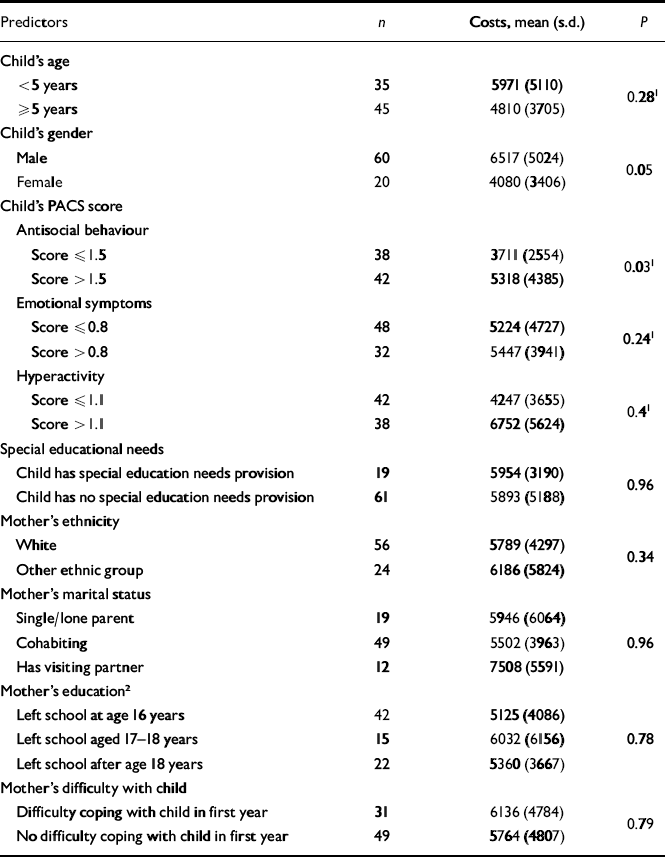
Bivariate analysis of total costs for the child and family over 12 months
| Predictors | n | Costs, mean (s.d.) | P |
|---|---|---|---|
| Child's age | |||
| < 5 years | 35 | 5971 (5110) | |
| 0.281 | |||
| ≥ 5 years | 45 | 4810 (3705) | |
| Child's gender | |||
| Male | 60 | 6517 (5024) | |
| 0.05 | |||
| Female | 20 | 4080 (3406) | |
| Child's PACS score | |||
| Antisocial behaviour | |||
| Score ≤ 1.5 | 38 | 3711 (2554) | |
| 0.031 | |||
| Score > 1.5 | 42 | 5318 (4385) | |
| Emotional symptoms | |||
| Score ≤ 0.8 | 48 | 5224 (4727) | |
| 0.241 | |||
| Score > 0.8 | 32 | 5447 (3941) | |
| Hyperactivity | |||
| Score ≤ 1.1 | 42 | 4247 (3655) | |
| 0.41 | |||
| Score > 1.1 | 38 | 6752 (5624) | |
| Special educational needs | |||
| Child has special education needs provision | 19 | 5954 (3190) | |
| 0.96 | |||
| Child has no special education needs provision | 61 | 5893 (5188) | |
| Mother's ethnicity | |||
| White | 56 | 5789 (4297) | |
| 0.34 | |||
| Other ethnic group | 24 | 6186 (5824) | |
| Mother's marital status | |||
| Single/lone parent | 19 | 5946 (6064) | |
| Cohabiting | 49 | 5502 (3963) | 0.96 |
| Has visiting partner | 12 | 7508 (5591) | |
| Mother's education2 | |||
| Left school at age 16 years | 42 | 5125 (4086) | |
| Left school aged 17-18 years | 15 | 6032 (6156) | 0.78 |
| Left school after age 18 years | 22 | 5360 (3667) | |
| Mother's difficulty with child | |||
| Difficulty coping with child in first year | 31 | 6136 (4784) | |
| 0.79 | |||
| No difficulty coping with child in first year | 49 | 5764 (4807) |
Health
During the previous 12 months the majority of the children (71%) were taken to their general practitioner for reasons connected to their behaviour (Table 3). To our surprise, 40% of the children had had a hospital admission, with a mean duration of 8 days. Children were admitted because their reckless or disobedient behaviour directly or indirectly led to accidents such as concussions, scalds, burns, being hit by a car or hitting their head severely. A further quarter of children were taken to accident and emergency services, attending on average twice each over the 12 months prior to interview. Attendance was predominantly for accidents: for example, bruising their eyes, falling off a bicycle, falling on a radiator and cutting their neck, eating money, sand in their eyes, and their hands being shut in doors.
Education
Two-thirds of parents made extra use of nursery services because of their child's behaviour, and already at the relatively young age of this sample a third had been seen by an educational psychologist and were receiving special educational provision.
Other agencies
A fifth of the children had been in touch with social services, but only 6% of parents reported being in touch with a voluntary sector agency because of their child's behaviour.
Impact on the family
Families were carrying a substantial burden. They estimated that they spent a large amount of extra time on daily household tasks because of the child's behaviour: almost 8 h per week. Additionally, there were extra house repairs due to the child's destructiveness, and some parents had to take days off work because of their child's behaviour, chiefly when the child was sent home from school.
Cost of care
Annualised costs indicate the intensity of service use weighted by their unit costs. Table 3 provides a summary of the costs of services and other resource impacts over the previous 12 months. The results show that the mean cost of NHS, voluntary services and education services used directly by the child was £1277, which is 21% of the total costs (median £509, range 0–17 446). Additionally, service use by other family members because of the child's behaviour cost £45 – mainly owing to contact with primary care and community health services, such as seeing the general practitioner or a counsellor, or receiving therapy for anxiety and depression. However, the mean non-service costs of the child's behaviour to the family were high, at £4637 (median £3217; range 0–19 533), because of the burden of extra time spent on household tasks, the need for repairs, and time off work looking after the child.
The overall mean total cost per child was £5960 per annum (median £4957, range 48–19 940). Many children used few or no services; consequently many children had zero or very small costs. However, a smaller number of children made heavy use of relatively expensive services such as in-patient care. The family impact costs represent the highest element, contributing over three-quarters of the total. Indeed, for the majority of the families it was estimated that the time spent on additional household tasks had an opportunity cost of £4526 over the past year. This is equivalent to paying a local authority home care worker £87 per week to provide extra support around the home. The overall balance of costs is shown in Fig. 1.
Service and non-service annual costs for child and family (local authority social services costs not represented as statistically 0%). NHS, National Health Service.

Cost associations
The only variables associated with total costs in the bivariate analyses were being male and increased severity of antisocial behaviour (Table 4).
The final ordinary least squares regression model is shown in Table 5. When all variables that had a significant bivariate relationship with costs were included, the only variable that was significantly associated with costs was increased severity of antisocial behaviour (P=0.05). Being male was of borderline significance (P=0.09). However, these variables did not explain much of the total cost variance (only 7%). Because of potential distributional problems with the ordinary least squares regression we re-estimated the equation by fitting the generalised linear model (Table 5). Only variables that were significant (P<0.1) in the bivariate testing were included. In the generalised linear model, both increased severity of antisocial behaviour score (P=0.01) and being male (P=0.02) were significant (Table 6). Thus, the relationships between costs and the predictors identified included in the final ordinary least squares and generalised linear models were broadly similar, although being male failed to reach significance using ordinary least squares. Further analyses were conducted with various cost components and demographic and clinical variables. Results using the generalised linear model are shown in Table 6. There were associations between non-service based costs and hyperactivity, antisocial behaviour score and being male.
Ordinary least squares (OLS) and generalised linear modelling (GLM) regression analyses for total cost

| Variables | OLS1 | Log gamma GLM2 | ||||
|---|---|---|---|---|---|---|
| β | (95% CI) | P | β | (95% CI) | P | |
| Constant | 660 | (-2980 to 430 1) | 0.72 | 7.4 | (6.7 to 8.1) | <0.001 |
| Gender: male (=1) | 1880 | (-317 to 4079) | 0.09 | 0.4 | (0.1 to 0.8) | 0.02 |
| Child PACS antisocial behaviour score | 2192 | (-25 to 4409) | 0.05 | 0.5 | (0.1 to 0.9) | 0.01 |
| Child PACS hyperactivity score | 1533 | (-812 to 3879) | 0.20 | 0.1 | (-0.8 to 0.3) | 0.23 |
Ordinary least squares (OLS) and generalised linear modelling (GLM) regression analyses for non-service costs incurred by families

| Variables | OLS | Log gamma GLM | ||||
|---|---|---|---|---|---|---|
| β | (95% CI) | P | β | (95% CI) | P | |
| Constant | 2537 | (830 to 4244) | 0.04 | 7.1 | (6.5 to 7.9) | <0.001 |
| Gender: male (=1) | 875 | (-3568 to 2764) | 0.35 | 0.4 | (0.1 to 0.8) | 0.02 |
| Child PACS antisocial behaviour score | 1694 | (-165 to 3552) | 0.07 | 0.5 | (0.2 to 0.9) | 0.01 |
| Child PACS hyperactivity score | 1404 | (126 to 2672) | 0.02 | 0.3 | (0.0 to 0.5) | 0.04 |
DISCUSSION
The objective of this study was to estimate the cost of supporting children with severe antisocial behaviour, to identify the factors associated with these costs and to gain further insight into who bears them. We found that children aged 3–8 years who were referred with antisocial behaviour received help from a wide range of agencies in the previous year, and cost nearly £6000 per annum overall. Health services cost the most, not just because of the child's prior referral to mental health services (the current episode was excluded, but would have added £641 on average), but because of general hospital admissions as a result of accidents, which represented the greatest expense to the NHS. Use of additional educational services and of social services also led to significant costs. Educational costs are likely to have increased as the children grew older – half the study population was still only at nursery. The high costs accruing to the NHS, other public sector agencies and to the family were consistent with the findings from our previous pilot study on the costs of antisocial behaviour in a sample of 10 children (Reference Knapp, Scott and DaviesKnapp et al, 1999), which also found that costs to the family were a major element. In addition, families received benefits averaging £4307, although these were not necessarily related to the child's behavioural problems and have not been analysed in this study.
Prediction equations of the annual cost accounted for only 7% of the total variation observed in our study, but none the less showed that having more severe behaviour, and being a boy, led to greater expense. The increased cost for boys was mainly due to their having more accidents that required hospital admission. These predictors agree with our long-term follow-up study of cost, in which nearly 30% of eventual cost by age 28 years was predicted by variables present at age 10 years, with more severe behaviour being by far the most important predictor (Reference Scott, Knapp and HendersonScott et al, 2001a ). These findings allow for some optimism, since antisocial behaviour is eminently treatable. If treatment is successful, then the service burden and costs should go down by comparable amounts. If, on the other hand, a large proportion of the cost had been predicted by fixed characteristics such as ethnicity, parental socio-economic status or indeed being male, then the prospects for reducing service burden and costs through successful treatment would have to be far more guarded.
The burden falling on the family is one of the striking findings of this study. Component cost analyses suggested positive associations between non-service-based costs carried by families and the child's hyperactivity. Parents accessed more advice and counselling services the greater the emotional difficulties of the child. Children with poorly controlled, aggressive behaviour require constant supervision (Reference Webster-Stratton and SpitzerWebster-Stratton & Spitzer, 1996) which renders the tasks of daily living more difficult, and means that parents take a great deal longer to carry them out – 8 h per week in this study. Families of children with disruptive behaviour usually do not receive the support they require from relatives (Reference Cunningham, Bremner and BoyleCunningham et al, 1995), which could have adverse consequences for their own health and quality of life. When all else fails, parents may give up their children to the care of the local authority because they find their antisocial behaviour overwhelming – and this was found to be the case for a significant number of children in our previous follow-up study (Reference Scott, Knapp and HendersonScott et al, 2001a ).
Implementation of effective interventions
Given the high burden and cost of antisocial behaviour in the short term, and the even higher costs in the long term, the case for using effective interventions seems overwhelming. There have been several hundred controlled trials proving the effectiveness of interventions (Reference Kazdin, Hill and MaughanKazdin, 2001), with parenting programmes having the greatest impact (Reference Scott, Rutter and TaylorScott, 2002); yet in England at present only a quarter of children with mental health problems receive specialist treatment (Reference Ford, Goodman and MeltzerFord et al, 2003). With the increasing pressure on child and adolescent mental health services to focus their limited resources on life-threatening disorders such as depression, psychosis, self-harm, anorexia and major drug misuse, some services are refusing to see cases of conduct disorder on the grounds that they are a ‘social problem’. This stance is understandable, given the very small amounts spent on child and adolescent mental health (about £10 per head per year; Audit Commission, 1999), but the thinking is fallacious. First, the problem is by no means caused only by faulty socialisation – indeed, recent studies show a high genetic contribution. Thus, for example, Scourfield et al (Reference Scourfield, Van den Bree and Neilson2004) found that the heritability of pervasive antisocial behaviour was 100%, with no environmental contribution at all. Second, other agencies are often less well placed to assess and treat antisocial behaviour effectively. It requires a careful assessment of established contributory factors, many of which require mental health expertise, such as child hyperactivity and maternal depression (Reference Rutter, Giller and HagellRutter et al, 1998), and then the treatments that are effective mostly require mental health expertise, such as parent training and medication for hyperactivity. Although considerable efforts are being made to train non-mental-health staff to deliver some of these interventions, the evidence suggests that treatments provided without high levels of skill and fidelity to the manual are much less effective (Reference Henggeler, Schoenwald and LiaoHenggeler et al, 2002).
In addition to treatment programmes for established cases of severe antisocial behaviour of the kind studied here, there is a strong case for prevention and early intervention strategies. This is because ‘lifetime persistent’ antisocial behaviour first becomes evident very early, typically when the child is 2–3 years old (Reference Broidy, Nagin and TremblayBroidy et al, 2003), and because if left untreated until adolescence, it is then very hard to correct. In the present study the younger children did not incur costs significantly less than those incurred by the older ones, so on financial grounds the sooner effective intervention is started, the greater the cost saving. By late adolescence the total cost of untreated antisocial behaviour is far higher, as it includes criminality and lost earning potential (Reference Greenwood, Model and RydellGreenwood et al, 1996; Reference Walsh, Loeber and FarringtonWalsh, 2001; Reference AosAos, 2002). High-quality early prevention can be notably cost-effective (Reference Schweinhart, Weikart and CraneSchweinhart & Weikart, 1998). In the USA the cost of crimes committed by a juvenile delinquent (under 10 years old) was estimated at $80 000 to $350 000 (£56 000–232 000), whereas rescuing a high-risk youth from this life path was estimated to save $1.7–2.3 million (Reference CohenCohen, 1998). In England, government initiatives such as SureStart are beginning to tackle this issue, although preliminary results are not encouraging (Reference Melhuish, Belsky and LeylandMelhuish et al, 2004), possibly because of the failure to adopt evidence-based interventions widely.
Methodological issues
Our study sample was reasonably large, and drawn from a range of clinics across London and in south-east England. The families showed characteristics typical of those who present children with antisocial behaviour across the UK. We used a careful, semi-structured interviewing approach (Reference Knapp, Scott and DaviesKnapp et al, 1999) which required the investigator to continue questioning the informant until the former was sure a reliable answer had been obtained, otherwise no cost was applied for the service in question. Although the economic section of the interview was not formally tested for interrater reliability, the immediately following section on psychopathology was found to have intraclass correlations of 0.71–0.82 (Reference Scott, Spender and DoolanScott et al, 2001b ). It remains possible that some parents did not remember some of the services they used, which might have led to underestimation of the costs. Also, we did not determine whether the parent was not seeking work because of the child's behaviour. Anecdotally, this happens with some frequency, in which case it results in parents failing to be economically productive and contribute taxes, and leads them to claim benefits. However, this could be a result of a lack of employable skills (52% of mothers in the sample left school before the age of 16 years).
Costs were only applied for services used by particular individuals, and were not apportioned for universal service provision. For example, schools have to spend time training teachers and playground supervisors how to deal with the increasing levels of children's antisocial behaviour and implement anti-bullying programmes; shops and institutions have to install closed-circuit television cameras and employ security staff to deter theft and destruction to property; car drivers have to pay higher insurance premiums to cover vandalism and thefts from vehicles, and so on. If these expenses were included, estimates of the annual cost of antisocial behaviour would be higher.
More generally, the study has attached costs to the services that were used and not to those that were needed. Differences between these could arise because of the limited availability of established services, and according to whether or not any service exists for the problem in question. For established services, such as (say) educational psychology, there may not be sufficient provision to meet the need, so that some children who should have received the service do not do so, and no cost is applied. This applies in large degree to mental health services, where, as noted above, only about a quarter of cases receive specialist help in England at present (Reference Ford, Goodman and MeltzerFord et al, 2003). More generally, a service has to exist to be counted as a cost, and for many aspects of antisocial behaviour there is no specific service. Thus, for example, in future someone might set up a service for siblings of antisocial children, because their lives were being made a misery by constant attacks; as it became used, this would add to the cost calculated for antisocial behaviour. For other consequences of antisocial behaviour there may never be a service, but none the less there may be an economic impact. For example, having several disruptive pupils in a class may take up much of the teacher's time and energy, thus impairing the quality of education and learning that the remainder receive; these children may then get poorer examination grades and less well-paid jobs. Again, these costs of antisocial behaviour remain uncounted.
Clinical Implications and Limitations
CLINICAL IMPLICATIONS
-
▪ Clinical and demographic characteristics that predict costs for children with severe antisocial behaviour are severity of antisocial behaviour and hyperactivity (both of which are treatable), and being male.
-
▪ The costs and wider burden of persistent antisocial behaviour are high, and should encourage the implementation of evidence-based treatments.
-
▪ Families carry a heavy economic burden.
LIMITATIONS
-
▪ The study was of referred children, who represent about a quarter of all cases of conduct disorder; costs for the remaining three-quarters may be different.
-
▪ The proportion of cost variation that could be explained by child characteristics was low; either there were other factors not measured in the study, or service responses to children's behavioural and other needs are inherently inconsistent.
-
▪ More information is needed on the link between costs of early intervention services for children with severe antisocial behaviour and the cost savings to agencies and society of a decrease in crime, violence and possible drug misuse.
Acknowledgements
We thank the Mental Health Foundation for funding this study, and Derek King for statistical advice. Additionally we thank Juliet Henderson for under-taking the groundwork on the current data-set.




eLetters
No eLetters have been published for this article.