I
In September 1591, Queen Elizabeth I visited the earl of Hertford at his estate at Elvetham. The lavish entertainments provided for the queen during her four-day stay included water pageants, fireworks, feasts, and a ‘banquet’. A printed account of the entertainment makes it clear that this banquet was no ordinary meal. Served after supper, ‘all in glass and silver’, and with an accompanying firework display, it involved a thousand sweet dishes. These included sculptural sugarwork representing the queen's arms, castles, and forts, human figures and mythical and exotic animals as well as preserved fruits and other confections.Footnote 1 The banquet at Elvetham is one of the best-documented examples of a dining practice which had first appeared at the court of Henry VIII in the 1520s and was quickly adopted by the nobility and gentry. The ‘banquet’, as exemplified in the account of the entertainment at Elvetham, took place after the main meal or feast, in a distinct space, and consisted of sweet foods and sculptural sugarwork.
Although in recent years scholars have increasingly recognized the sweet banquet as a meal type, it has received relatively little attention.Footnote 2 This is due, in part, to a seeming lack of primary sources relating to this dining practice. The accounts of the royal kitchens for the relevant period, which might have been expected to provide a rich seam of information, were destroyed in a fire in 1698. Moreover, written descriptions of the sweet banquet tend to be brief and fragmentary, and are often overlooked due to the modern understanding of the term ‘banquet’ to refer to any great feast. Additionally, there are very few visual depictions of the English sweet banquet.
Despite the challenges involved, the value of studying ephemeral cultural practices has been demonstrated in recent years by scholars working in disciplines as varied as anthropology, English literature, and history. This work has drawn particular attention to the symbolic importance of food and dining practices in sixteenth- and seventeenth-century England.Footnote 3 This is a rich period of enquiry due to high levels of political and cultural upheaval and emergent capitalist economies. Related to these developments was an enhanced dialogue about food, manners, and status, played out in contemporary conduct literature, and an increasingly recognized willingness to spend significant amounts of money and time in dining. Scholars such as Michel Jeanneret, Sergio Bertelli, Ken Albala, and David Goldstein have emphasized the importance of food and dining practices as status markers and their role in conveying ideas of kingship and forming and maintaining social relationships.Footnote 4 Anthropological approaches have been important in this regard. Felicity Heal, for example, has utilized Marcel Mauss's theories of gift exchange to provide new insights regarding the meanings of food gifts and hospitality in this period.Footnote 5 Works with a strong grounding in political and social context have used published sources including recipe books, conduct literature, and plays to explore the ways in which foods were perceived to affect body and mind, their symbolic associations, and use in the marking of key life events.Footnote 6 Relatedly, scholars focused on material culture have explored the ways in which objects associated with preparing and serving food played roles in articulating identities, expressing social status and virtue, and even facilitating subversive agency.Footnote 7 In this way, dining practices and the objects associated with them are revealed to have been capable of communicating in highly sophisticated ways.
This article contributes to these discussions in examining the social and cultural significance of a specific dining practice. As is discussed below, a high-status person in early modern England would have expected to be entertained with a sweet banquet at any important social occasion involving their peers. The following examination of the literary, visual, and material cultures associated with the banquet provides an explanation for its ubiquity. It establishes that the banquet was a highly effective means by which to express and even maintain class status at a time of anxiety regarding social mobility. Banqueting also provided opportunities to demonstrate evidence of a refined education and knowledge of a pan-European culture of revived antiquity.
II
It is likely that the English sweet banquet was originally based on continental models which conflated two features of medieval feasts, the ‘void’ and the ‘entremet’ in the development of increasingly elaborate finales. Throughout fourteenth- and fifteenth-century Europe, ceremonial feasts at court were followed by a ‘void’. This involved the consumption of wine, spices, and wafers and occurred in the main dining hall, after the tables had been cleared, or ‘voided’.Footnote 8 From the fourteenth century, the courses of ceremonial feasts at the Valois-Burgundian courts were interspersed with entremets, including sculptures, and sometimes tableaux involving live performers.Footnote 9 As early as 1369, the final course of Dutch marriage feasts was referred to as the ‘banket’ and consisted of wine and a mixture of sweet and savoury dishes which, like the void, were served buffet-style on tables from which guests helped themselves.Footnote 10 At the mid-fifteenth-century French courts, entremets began to be presented towards the end of the meal, and could accompany the wine and spices of the void in a grand finale.Footnote 11
In Italy, by this period the intersection of the void and entremets had been elaborated into a separate meal, the collation. This featured spectacular edible sculptures, confectionery, and fruit alongside the wine and spice of the void.Footnote 12 Accounts of ducal weddings of the 1460s and 1470s describe sweet collationi (collations), which could precede feasts or be presented late in the evening, after the main meal, dancing, and masquing. The wedding of Lorenzo Medici and Clarice Orsini in 1469 featured various collations. One, of fruit, confections, and wine, took place in a garden loggia, and the following evening, after dancing, another collation of wine and gilded confections was served.Footnote 13
The void had been a feature of royal and ecclesiastical feasts in England from at least the thirteenth century.Footnote 14 The first substantial evidence for its elaboration in the style of the European courts is found in literary sources and court records relating to the reign of Henry VIII. Here, this fashionable, separate sweet meal was known as a ‘banket’ or ‘banquet’.Footnote 15 Sources indicate that it took place in specially designated spaces, was distinct from and generally occurred after ‘supper’, the main evening meal, and involved a specific category of sweet foods known as banqueting foods. These included spices, fresh and preserved fruits, a variety of confectionery, sculptural sugarwork, and ‘marchpanes’, decorative objects made from a substance similar to marzipan, which was itself also referred to as marchpane.Footnote 16
Given that the term ‘banquet’ is used today to refer to any lavish feast, there is potential for confusion in relation to this terminology, and arriving at a precise definition of the term as it was used in the early modern period is challenging, not least due to the dispersed and often fragmentary nature of the sources in which it appears. Whilst the term banquet was clearly widely understood, its specific meanings in sixteenth-century England can only be reconstructed through the close reading of primary sources. In the majority of cases, its use is accompanied by references to sweet foods and/or spatial withdrawal. It is not clear that the term was always used to refer to what is classified here as the separate sweet banquet, and particularly in sources relating to the 1520s, there is ambiguity between the terms ‘banquet’, ‘void’, and ‘supper’. However, in attempting to reconstruct and contextualize this highly ephemeral dining practice, this article has drawn on examples where at least two of the triad outlined above (sweet foods, spatial withdrawal, and the term ‘banquet’) are present. Given the nature of the evidence, it has often been necessary to extrapolate and interpret what appears in textual sources. Nevertheless, they do suggest an increasing understanding, from the 1520s, of the banquet as a separate dining practice.
One of the earliest descriptions of a sweet banquet in England appears in a 1518 letter by Sebastian Giustinian, Venetian ambassador to the English court. This took place during celebrations relating to the signing of the Treaty of London. On 3 October, Universal Peace was declared at St Paul's cathedral, after which the king, ambassadors, and nobles attended a supper hosted by Cardinal Wolsey. A masque and dancing followed supper, and then the twelve male and twelve female maskers, including the king and his sister Mary, lords, and ladies ‘seated themselves apart from the tables, and were served with countless dishes of confections and other delicacies’.Footnote 17 Here, we have evidence that a separate course or meal, served after entertainments, was associated primarily with confectionery. This account is of further interest as it indicates that this course was both temporally and spatially distinct from other eating practices, being consumed away from the supper tables, if in the same architectural space. Also of significance is the fact that only the twenty-four masquers are described as being served with the confectionery. The use of specific, separate spaces and exclusivity in terms of participants would later become common, and conceivably defining, features of the sweet banquet. A 1700 account of a summer house in a garden, for example, describes the structure as ‘pretty, and therefore little, built rather for a Banquet than a feast’, underscoring the exclusive and distinct nature of the banquet.Footnote 18
Later descriptions of banquets held during the reign of Henry VIII clearly distinguish them from other meal types and associate them with specific foodstuffs. In a remembrance for the meeting between Henry VIII and the Emperor Charles V at Gravelines in May 1520, for example, it is noted that a supper should be held on the Sunday night, ‘and after supper a mummery, with a banquet’.Footnote 19 Orders for the reception of Anne of Cleves into England in 1539 call for ‘wine, fruits and spices’ to be prepared in the ‘manner of a banquet’.Footnote 20 These examples of the specificity of the term's use suggest that, like other terms such as ‘dinner’ and ‘supper’, it had a clear and recognizable meaning, being associated with sweet foods and spatial and temporal distinction from other meals.Footnote 21
An analysis of the frequency and use of the term in both contemporary printed sources and modern editions of sixteenth- and seventeenth-century state papers is revealing with regard to the chronology of the banquet's adoption at court. Relevant state papers from the reign of Henry VIII onwards are now available online and can therefore be subjected to keyword searches for the term ‘banquet’. In the documents relating to the reign of Henry VIII, the term ‘banquet’ occurs 111 times. Of these, twenty-one instances are almost certainly separate sweet banquets, in that they are associated with sweet banqueting foods and/or movement to another space after supper and masquing. Seventy instances are ambiguous: they might refer to sweet banquets, but without sufficient accompanying information it is impossible to be sure. Two references to the term banquet clearly refer to something other than the sweet banquet as defined here, and there are eighteen references to banqueting houses.Footnote 22 The Elizabethan state papers contain twenty-four ambiguous or certain references to banquets, five to banqueting houses, and one to banqueting foods.Footnote 23 In the equivalent volumes relating to the reigns of James I and Charles I, there are thirteen ambiguous or definite references to banquets, and thirty-seven to banqueting houses.Footnote 24 In the papers relating to the reigns of Charles II and James II, the term banquet appears in contemporary usage twenty-three and two times respectively, and again the majority of these references are to the banqueting house as a space rather than to the banquet as a dining practice.Footnote 25 This suggests that at court the banquet reached a peak of popularity under Henry VIII, and declined significantly in the early seventeenth century.
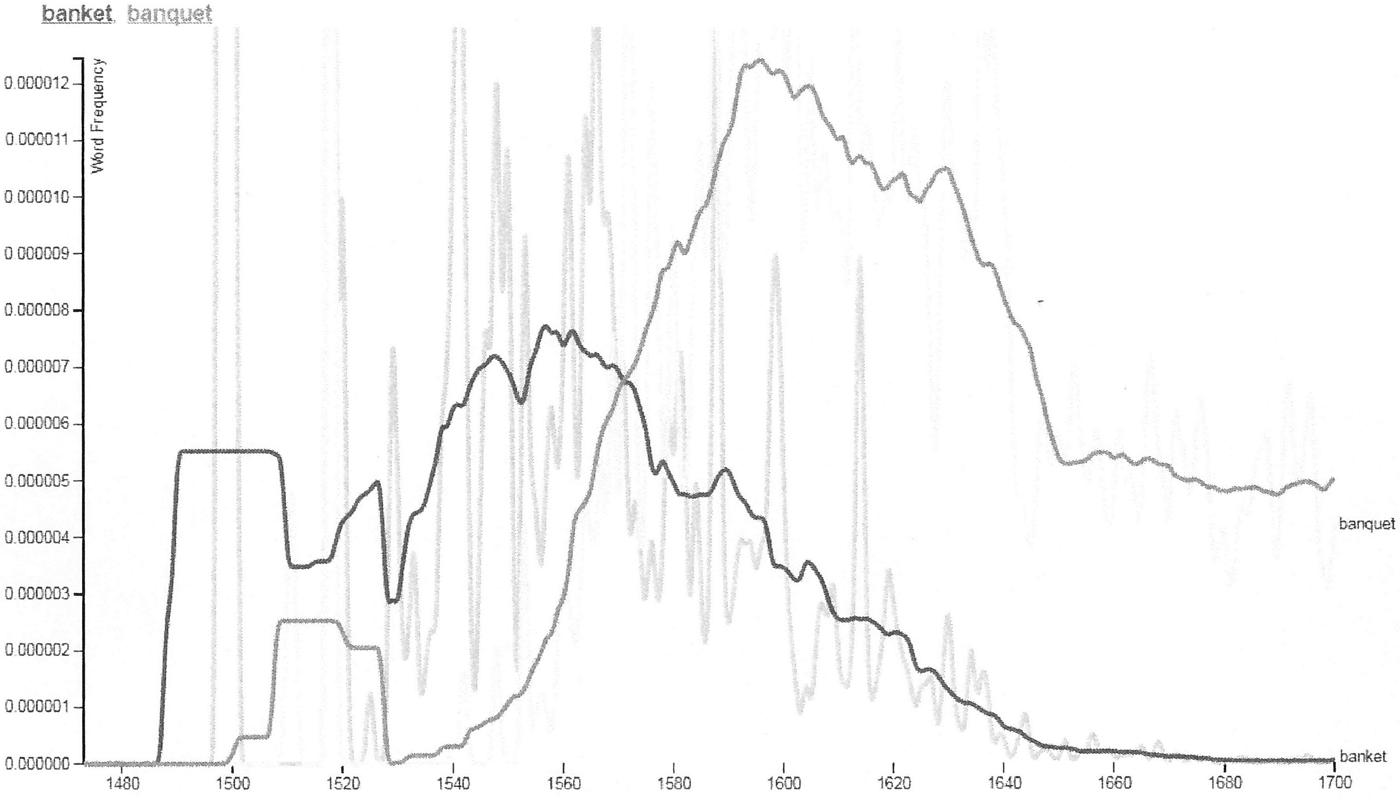
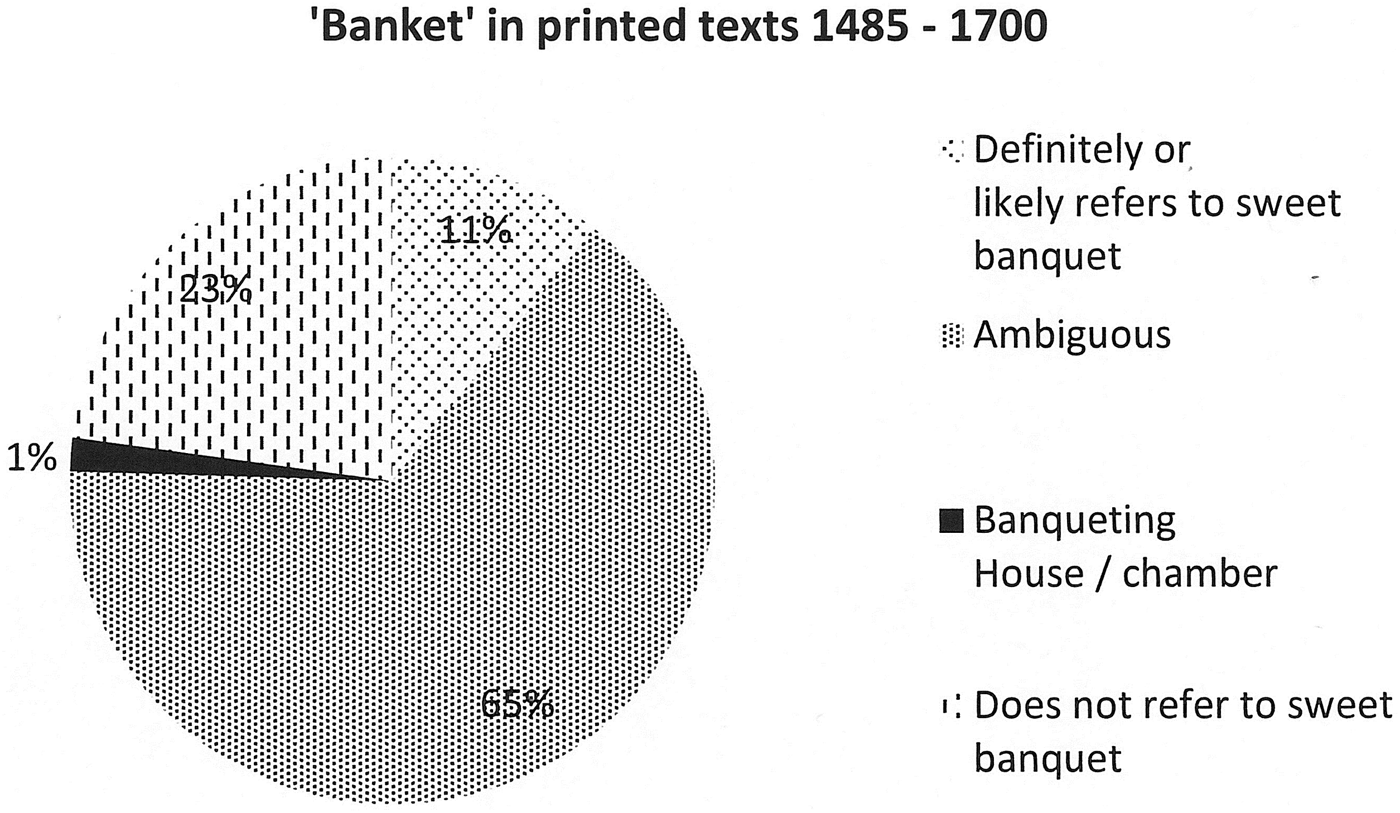
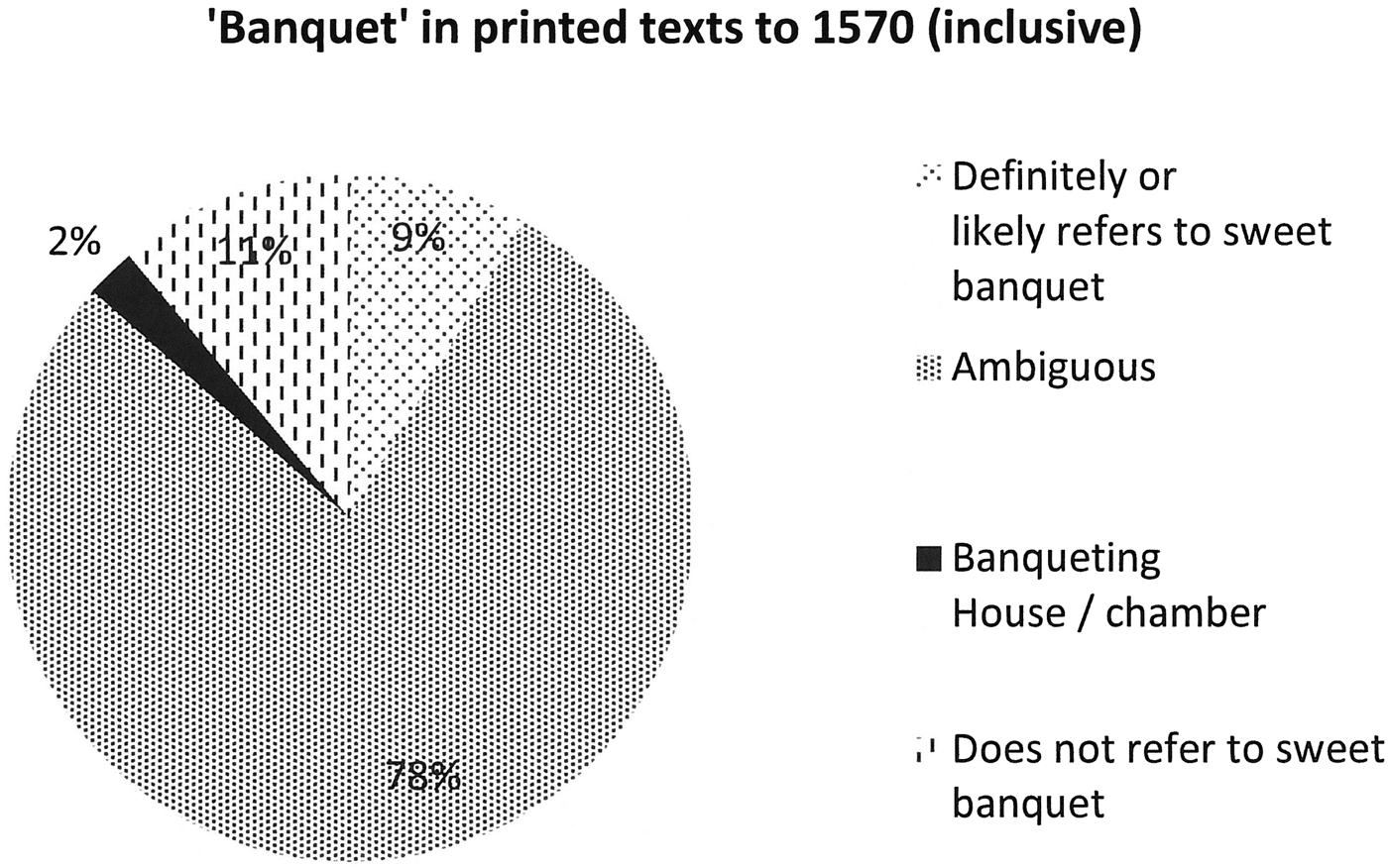
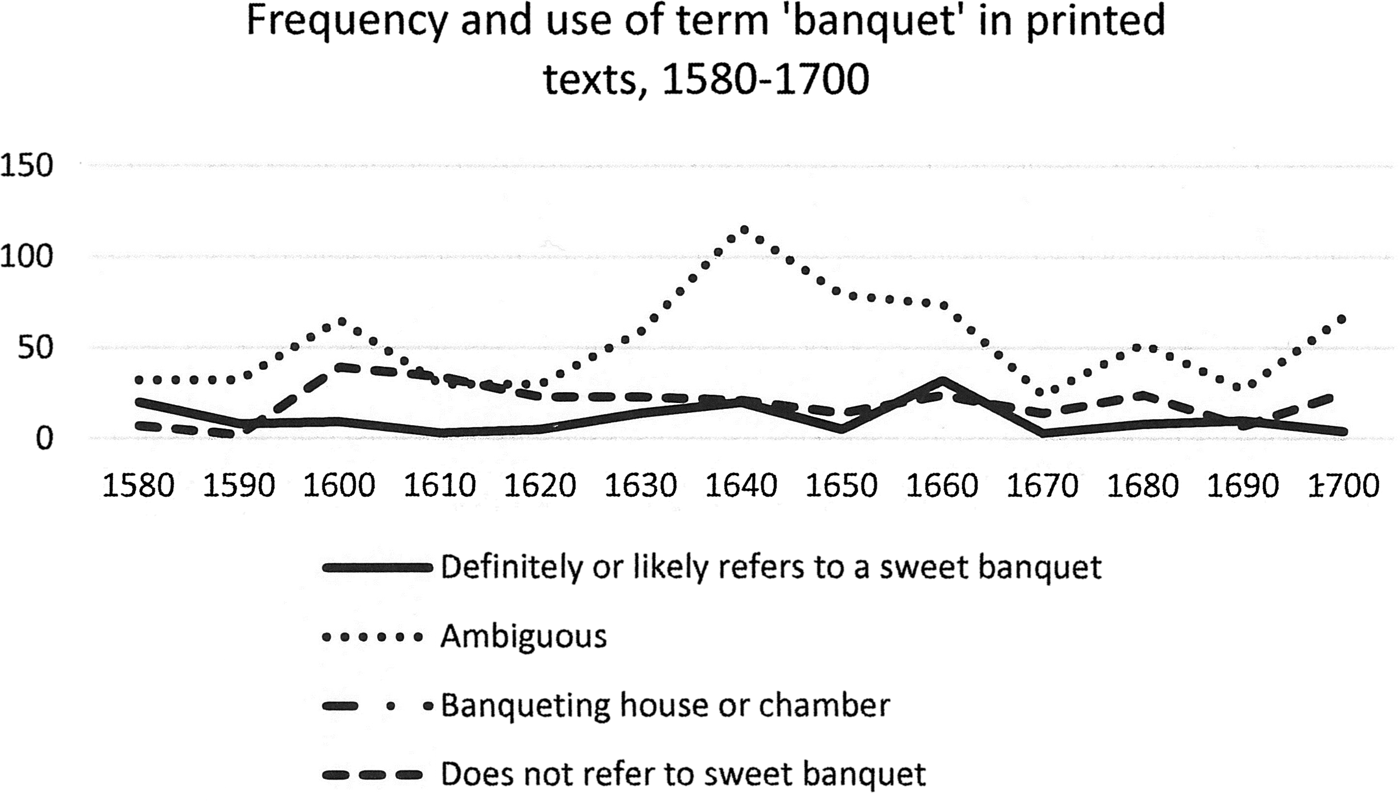
Online ‘text mining’ applications also allow for the analysis of the frequency with which the terms ‘banket’ and ‘banquet’ appear in printed sources from the late fifteenth century onwards (Figure 1). This data makes it clear that the term ‘banquet’ gains momentum from 1540 and takes over from ‘banket’ in 1570. Although neither the data nor written sources suggest a clear explanation for this shift, it may be related to the early use of the term ‘banket’ in the Dutch context and the later elaboration of this course at the French/Burgundian and Italian courts. The highest incidence of printed occurrences of banket/banquet falls between 1530 and 1650. That the term was at its peak in printed texts slightly later than was the case in papers associated with the royal courts suggests that the banquet was originally adopted at court and subsequently disseminated beyond it. Due to the large quantity of data for the term ‘banquet’ produced via the text-mining method for the later part of the period, a sample was analysed using the works published in the first year of each decade for the period from 1580 to 1700. This allowed the data to be analysed over time, which indicated that there was little significant change across the sample. Analysis using the EEBO-TCP keywords in context tool made it possible to apply the criteria of sweet foods and spatial withdrawal to the terms ‘banquet’ and ‘banket’.Footnote 26 This indicated that the majority of references are ambiguous, as is the case in the state papers, with a smaller number of definite references to the practice of banqueting as defined here, a comparable number of instances which do not refer to the sweet banquet and a very small number of references to banqueting houses or chambers (Figures 2, 3 and 4). The large number of ambiguous uses may indicate that the term was widely understood and therefore required little by way of explanation.
Frequency of the use of the term ‘banquet’ in printed sources to 1700. earlyprint.wustl.edu, accessed 24 Apr. 2017.

Usage of ‘banket’ in printed sources using data from https://earlyprint.wustl.edu/toolwebgrok.html?corpus=plaintext&searchPattern=banket&startYear=1473&endYear=1700&authors=&titles=&page=1, accessed 12 Dec. 2017.

Usage of ‘banquet’ in printed sources to 1570 using data from https://earlyprint.wustl.edu/toolwebgrok.html?corpus=plaintext&searchPattern=banquet&startYear=1473&endYear=1700&authors=&titles=&page=1, accessed 12 Dec. 2017.

Frequency of ‘banquet’ in printed texts using data from https://earlyprint.wustl.edu/toolwebgrok.html?corpus=plaintext&searchPattern=banquet&startYear=1473&endYear=1700&authors=&titles=&page=1, accessed 12 Dec. 2017.

The data was also analysed based on broad categories of types of text. Of the 3,189 uses of the term ‘banket’ in print between 1485 and 1700, it was most often found in works on ancient history (147 occurrences), books of manners (249 occurrences), compendia (194 occurrences), works on contemporary and recent history (220 occurrences), and accounts of travel or distant lands (192 occurrences). The high incidence to be found in books of manners and contemporary chronicles is to be expected for a term denoting a current dining practice. Its association with accounts of travel may be the result of a widespread awareness of the origins of sugar and spices in the east and related ideas about the ‘exotic’ nature of the banquet as a whole.Footnote 27 The association with works on ancient history and compendia is significant in light of the below discussion of the sweet banquet as a revival of the ancient symposium.
The most common categories of text in which the term ‘banquet’ was found in the 1,674 instances analysed for context were contemporary histories (102 instances), accounts of travel and distant lands (99 instances), and plays (98 instances); works on ancient history, classical mythology and literature, compendia, and books of manners also continued to use the term relatively frequently (33, 62, 56, and 45 instances respectively), reflecting the wider range of types of text published during the later period during which ‘banquet’ became dominant.
Across the whole period, the majority of those instances which did not refer specifically to the sweet banquet were found in theological texts: 632 out of a total of 728 in the analysis of the term ‘banket’ and 238 out of a total of 297 in the sample analysed for ‘banquet’. Here, the term was frequently used to refer to Holy Communion (often described as a holy banquet), the experience of faith or as a metaphor for heaven. Thus, one 1664 text describes God as ‘a bower of spices unto thee, and his fruit is sweet to thy tast, he hath brought thee into his banketting house … he causeth thee to drink of his spiced wine which is the liquor of life’.Footnote 28 Such usages are likely to have drawn on the banquet's perceived health-giving properties, the term's associations with costliness, rarity, and royalty as well as the wine and wafers served at voids and banquets; the same items as those consumed during communion.Footnote 29 Incidences of the term categorized in the statistical analysis as not referring specifically to the sweet banquet could therefore still draw on readers’ awareness of this meal type.
In addition to textual sources, architectural remains and surviving material culture provide important evidence for the awareness and, importantly, the practice of banqueting in early modern England. In relation to the elite, this is demonstrated by the proliferation of banqueting houses in the gardens and on the roofs of the country houses of the nobility and gentry, and by information found in household accounts. Small, ornamental buildings, banqueting houses were first built in the grounds of wealthy homes as early as the 1520s, but the majority of over sixty surviving examples date from the late sixteenth or early seventeenth centuries.Footnote 30
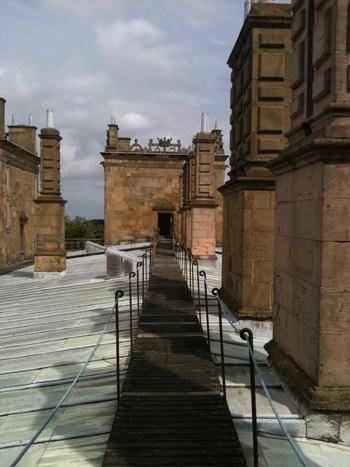
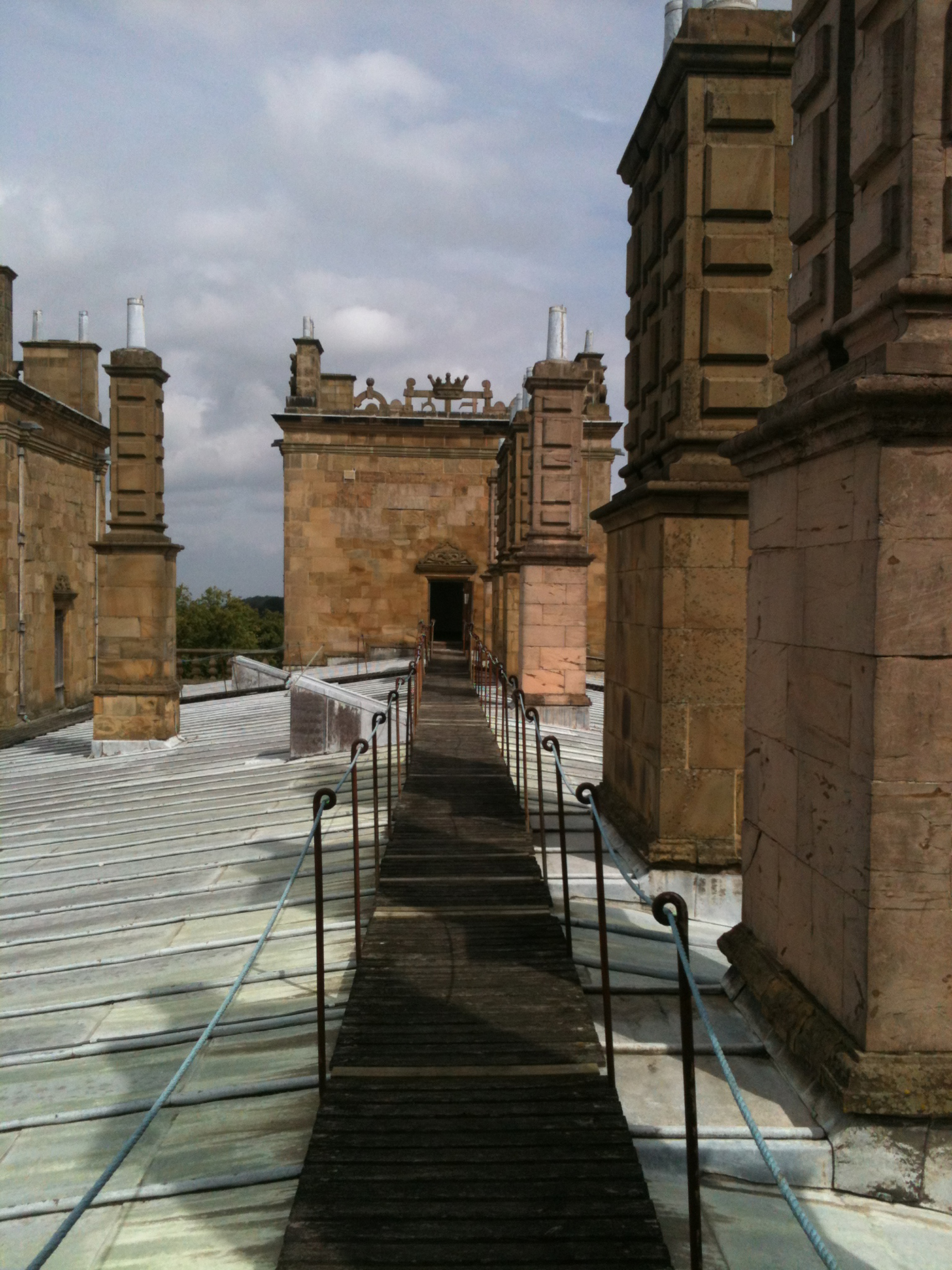
One such example, described in building records as a ‘banqueting house’, can be found on the roof of Hardwick Hall in Derbyshire (Figure 5).Footnote 31 Household accounts provide evidence for the consumption of banqueting foods at Hardwick Hall in the 1590s and 1600s. The accounts for February to March 1606 include a payment of 6s 4d to ‘Mrs Spurling’ for sweetmeats, and comfits were bought in spring 1598, September 1600, February 1603, and January 1605.Footnote 32 A payment was made by ‘My Lady’ in October 1604 of 12d for gilding marchpanes.Footnote 33 As noted previously, marchpanes provided centrepieces for banquets, and gilding them added significantly to their expense.
Hardwick Hall, Derbyshire, 1590–7, walk leading to banqueting house. Photograph by the author, reproduced by kind permission of the National Trust.
Material relating to the manor house at Ashby de la Zouch in Leicestershire, the principal house of the earls of Huntingdon, provides further evidence for banquets beyond the court. There are several early modern garden buildings here, some of which are likely to have been banqueting houses.Footnote 34 The household accounts include detailed lists of ‘banqueting stuff’ purchased. For example, on 11 September 1634, a payment of £20 13s 7d was made to a confectioner for ‘banqueting sweetmeats served in at my lady Elizabeth's wedding and other times not entered before’.Footnote 35 In 1673, a bill for confectionery included cherries, currant cakes, raspberry cakes, apricot paste, quince cakes, dried raspberries, ‘puffs’, muscadines (grapes), orange blossom, long muscadines, 1 lb of marchpane ‘royal’, jumbals, oranges, lemons, comfits, and plums. The total came to £5 17s 6d.Footnote 36 In conjunction with the garden buildings/banqueting houses, this strongly suggests that banquets took place at Ashby.
Evidence from gentry households indicates that the sweet banquet and the foods associated with it were considered to be particularly appropriate for high-ranking guests. Amongst the generally modest entries for spices in the sixteenth-century steward's accounts from Haddon Hall is a payment on 11 August 1549 of 6s 4d for ‘dyuers kynds of spycs agenst Mr Cavendysshes coming to Haddon ffor the use of my mast[e]r’.Footnote 37 The wording in this brief entry suggests that the spices were an element of hospitality, and that this was exclusive: they were to be used specifically by the master.
Household accounts from Wollaton Hall also demonstrate that banqueting foods were largely consumed in the presence of important guests. A household book for 1587–8 is particularly useful in this respect. It lists items purchased, received, used, and remaining by week, including banqueting foods such as marmalade, comfits, rosewater, and ‘biskets’. These items were only eaten when important guests were present. The largest amounts of banqueting foods were consumed at Thurland House on 22 June 1588, when Francis Willoughby dined with the archbishop of York, Sir Thomas Manners, Mr Edward Stanhope, and ‘dyvers other gents w[i]th their retyne[rs]…w[i]th many comers and goers’.Footnote 38 Other occasions of significant sugar consumption coincide with the visits of Thomas Manners, on 22 June 1587, and the duke of Rutland on 22 July 1587, when 2 lb of sugar was used, along with other spices, marmalade, sucket, ‘bisket bread’, and comfits.Footnote 39 When no guests were present, sugar, spices, and other banqueting foods were rarely consumed.
The sweet banquet, then, was a social occasion, specifically suited to the entertainment of high-ranking guests, and is likely to have played a role in early modern patronage networks. A dining practice which had originated in the royal household, it was undoubtedly fashionable, its expense useful in demonstrating wealth. Although the price of sugar fluctuated during the period in question, it should be noted that, as an imported commodity which was difficult to cultivate, it was always relatively expensive.Footnote 40 However, as its continued popularity over several decades suggests, the banquet had further significance. It provided participants with opportunities to perform their elevated social status, to display elite forms of knowledge and refined manners, and to engage with a pan-European culture of nobility.
III
The analysis of the architecture, foods, texts, and objects associated with banqueting reveals that they were highly concerned with signalling the separateness of those who had access to them from the rest of society. The locations of banqueting houses in the gardens or on the roofs of country houses are symptomatic of this desire for separation. Access to them was contingent on surmounting spatial barriers, from walls and moats to the labyrinthine routes which led to rooftop chambers. Richard Carew's projected banqueting house at Anthony in Cornwall, for example, was to be located on an island in a pond.Footnote 41 At Lacock Abbey in Wiltshire, remodelled in the 1540s, the ascent to the banqueting rooms required the negotiation of a complex route from the main reception rooms through smaller, private staircases, passing through an attic space above a long gallery. It would be impossible to reach the banqueting space without a guide, or prior awareness of the route.
These barriers emphasized the move away from the public spaces of the house, and also the privileged nature of access to the sweet banquet. The country house was organized hierarchically, and access to certain spaces was regulated by both gender and social status.Footnote 42 With the creation of rarefied banqueting spaces, to which high-status guests could only gain access by invitation from their hosts, another layer of distinction was added: the banqueting house facilitated the measuring of status through social relationships.
The foods associated with the banquet, and the ways in which they were served and consumed also underlined the separateness of its participants and its difference from ordinary meals, fostering what Patricia Fumerton has termed ‘an aesthetics of culinary detachment’.Footnote 43 The tableware used at banquets was highly specialized. Gilded, elaborately decorated wooden trenchers were specifically associated with the sweet banquet.Footnote 44 These tend to survive in sets of twelve, and are decorated with moralizing stories, witty songs, and rhymes and depictions of fruit and flowers. Instantly visually distinct from the plain wooden trenchers used at other meals, they are an obvious example of this trend. In England, forks were originally used exclusively for eating sweetmeats. A number of ‘sucket forks’ and forks for use with green ginger appear in inventories from the fourteenth century onwards.Footnote 45 An early surviving fork in the Ashmolean Museum dating from 1599 has an agate handle and silver mounts which are engraved with complex foliate decoration.Footnote 46 The precious materials and attention to detail here are testament to the luxurious nature of the banquet.
Similarly, banqueting foods were often served in delicate, expensive sweetmeat glasses, or on spice plates made from precious metals.Footnote 47 It is also likely that foods were served at the banquet in boxes. Contemporary inventories list numerous sugar and spice boxes.Footnote 48 That some boxes were used for serving rather than storing banqueting foods is suggested by their elaborate decoration and valuable materials. An English mother of pearl casket dating from c. 1600 and now in the collection of the V&A Museum may have been used to serve banqueting sweetmeats.Footnote 49 Mother of pearl, which came from the West Pacific, would have been a particularly appropriate material in which to serve exotic sugar and spices. That the casket could be presented closed again emphasizes the value of the sweetmeats inside, and mirrors the enclosed, private nature of the sweet banquet as a whole. The marked association between precious materials and banqueting foods is exemplified in a seventeenth-century recipe for marchpane from a manuscript associated with Lacock Abbey. This stipulates that only silver vessels should come into contact with the marchpane's ingredients.Footnote 50
The specialized material culture associated with the banquet, from gilded trenchers, spice plates, and comfit boxes to sweetmeat glasses and forks, speaks of a proliferation of different types of tableware and an elaboration of table manners.Footnote 51 By the late sixteenth century, refined manners had become an important way for courtiers, nobles, and the gentry to demonstrate their high status. This was achieved through codes of conduct which emphasized self-restraint and physical separation from others.Footnote 52 These are set out in the books of manners which began to be published in England in the sixteenth century, and which indicate an increased interest in the concept of ‘civility’ at around the same time that the sweet banquet was adopted by the aristocracy.Footnote 53 Relatedly, scholars have identified the emergence in this period of forms of tableware which could be ‘performed’. Flora Dennis, for example, has examined several surviving sets of sixteenth-century knives, thought to be French, which bear sections of words and music for polyphonic benedictions and graces. She suggests that these may have been performed at table, by groups of diners or professional musicians.Footnote 54 There is also evidence that Italian istoriato maiolica was used to prompt learned conversation about the classical scenes it bore after meals.Footnote 55 Dennis argues that the ‘performative’ nature of dining objects was designed to induce ‘either elegance or error’.Footnote 56
The complex material culture associated with the banquet would also have provided opportunities for the performance of good manners. Banqueting trenchers in particular provide an excellent example of performative objects as defined by Dennis. Their witty verses could have been read aloud, as a form of after-dinner entertainment. A contemporary reference to the dangers of the ‘lascivious songs’ which accompanied banquets suggests that the rhymes, which often deal with themes of love and marriage, could be sung, requiring literacy and possibly the ability to read music.Footnote 57 Discussion of trenchers’ images and verses would, in many cases, have required elite, sophisticated knowledge as they often refer to classical literature and contemporary elite culture.
This is exemplified in an early seventeenth-century set, the ‘Twelve Wonders of the World’. The verses on them were written by John Davies for Thomas Sackville, 1st earl of Dorset, and were intended specifically to be used on trenchers at new years’ celebrations around 1600.Footnote 58 They were published in 1608, and musical settings for them were printed in 1611, suggesting that they were intended to be sung.Footnote 59 The characters depicted on the trenchers and described in the verses are a courtier, a divine, a soldier, a lawyer, a physician, a merchant, a country gentleman, a bachelor, a married man, a wife, a widow, and a maid. The verses themselves bear numerous allusions to elite culture. That of the country gentleman, for example, describes noble pastimes such as hawking and hunting and reflects on principles of good government:
The soldier's and the widow's verses refer to classical mythology:
In reading or singing aloud, and discussing the verses, banquet participants would have had opportunities to demonstrate their in-depth knowledge of contemporary aristocratic culture, theories of government, and ancient mythology. Their performance also required literacy, and, if the verses were to be sung, the ability to read music. Like the knives analysed by Dennis, they not only provided opportunities for the demonstration of knowledge, refinement, and therefore social status, but could also test these qualities, and potentially expose imposters.
The trenchers’ references to classical culture are particularly significant when considered in light of the fact that the banquet itself was intended as a creative emulation of the ancient symposium/convivium. As is explored below, this contributed to the Renaissance project of articulating elite, humanist identities through dining practices.
IV
The association between the banquet and the symposium is made clear in the preface to Thomas Elyot's Banket of sapience, first published in 1539. Elyot describes how, in the spring,
in whome is any sparke of gentylle courage, requireth to solace and bankett with mutual resort, communicatyng together their fantasyes and sundry devyses, which was not abhored of the moste wyse and noble philosophers, as may appiere to them that have wytsaufed to read the workes of Plato, Xenophon and Plutarche, whyche they named symposia, callyd bankettes in Englyshe.Footnote 61
An examination of the social practices and intellectual and visual culture associated with the sweet banquet in light of Elyot's words suggests that it should be understood as a means by which early moderns engaged with the symposium or convivium. Banquet settings in particular were designed and decorated to create an appropriate atmosphere. This was intended to evoke both the ancient world and contemporary European models and to provoke the types of discussion described by Elyot. He outlines the sources of knowledge about the symposium in sixteenth-century England with his list of ancient authors: Plato, Xenophon, and Plutarch, all of whom produced symposium literature.Footnote 62 Plato and Xenophon's symposia are imagined symposiac dialogues, whilst Plutarch's Symposium of the seven wise men is a collection of philosophical sayings like Elyot's Banket.
These ancient works define symposia in opposition to public, civic meals (deipnon), as exclusive events focused on ‘drinking together’. The typical group size was fourteen to thirty, and participants reclined on couches. The symposium centred around politics and pleasure and, in early modern Europe, was understood to have been an elite, intellectually focused event.Footnote 63 The exclusivity of the banquet, which typically involved only twelve participants, and its location in specialized banqueting houses which emphasized its separateness from other, more public forms of feasting, can be seen as mirroring the symposium.Footnote 64 Symposium literature, and particularly the sources cited by Elyot, characterize the symposium as a site for intellectual as well as bodily nourishment, so much so that they have been understood in later scholarship as being defined by erudite conversation.Footnote 65 Further investigation of the rich visual and material culture associated with early modern banqueting indicates that erudition was also central to this interpretation of the symposium.
Elyot underscores the link between the contemporary banquet and the learned conversation of the convivium tradition with his instruction to the reader to ‘beholde sentences sundry and dyvers, whyche I doo applye unto bankettynge dyshes, made and seasoned by Sapyence her selfe, and served forthe to the table by theym whyche dyd wryte or pronounce them’.Footnote 66 There is also evidence that the metaphorical association of banqueting foods with witty and erudite sayings could be expressed in more explicit ways. Early modern recipe books instruct their readers to make letters from sugar paste, raising the possibility that these may have been used at banquets to spell words or to suggest conversational themes.Footnote 67 John Murrel even instructs that these should take the form of ‘faire capital Romane letters’, again underscoring the classical connotations of the banquet.Footnote 68 A recipe in the anonymous Closet for ladies and gentlewomen describes how to make ‘a walnut, that when you crack it, you shall find Biskets and Carrawayes in it, or a pretty posey written’.Footnote 69
The connection between literature and the banquet is also reflected in a set of oblong trenchers in the collection of the Ashmolean Museum.Footnote 70 The trencher box here is particularly noteworthy as it is designed to emulate the binding of a book. In this way, the rhymes on the trenchers are likened to the contents of a book, and this is perhaps a witty reference to works such as Elyot's Banket of sapience and the sayings they contained. The association between the banquet and humanist learning is typified by a published account of a masque and banquet presented to the royal children in 1635. The masque included a pageant of the seasons, followed by a dialogue on education between the allegorical figures of Minerva and Time. It culminated with the presentation of a banquet of books filled with sweetmeats. The names of the confections here were clearly selected as a play on those of the classical authors whose works they filled, for example ‘Cato in bisket cakes, and sugar plates in Plato. Erasmus full of preserv'd raspices…damesons in Damascenus and preserv'd lemons here in Levinus Lemnius.’Footnote 71 The sweets themselves are therefore conflated with the words of the ancient writers.
The association with the ancient world is further underscored through the architecture and interior decoration of surviving banqueting houses, which is indicative of efforts to create classicizing settings. The ‘ambulatory’ in the grounds of Horton Court in Gloucestershire, for example, takes the form of a Florentine loggia and was built by the diplomat and courtier William Knight between 1517 and 1521. That such spaces were used for banquets is suggested by Florio's 1598 definition of the loggia as ‘a faire hall, a dining chamber, a terrace or walking place, a banquetting house’ and an early seventeenth-century painting of the myth of Phaëton, which features figures dining in a loggia very similar to that at Horton Court.Footnote 72 The loggia form, as Paula Henderson has noted, is reminiscent of the ancient Greek stoa, traditionally the setting for philosophical discussions, making it a particularly appropriate setting for the banquet/symposium with its focus on erudition.Footnote 73
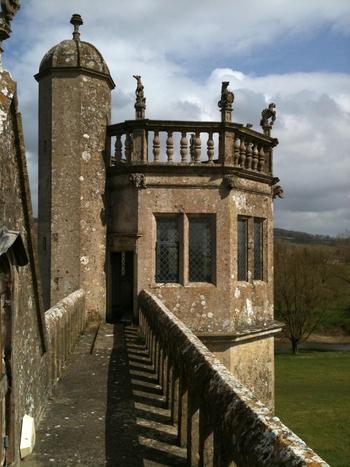
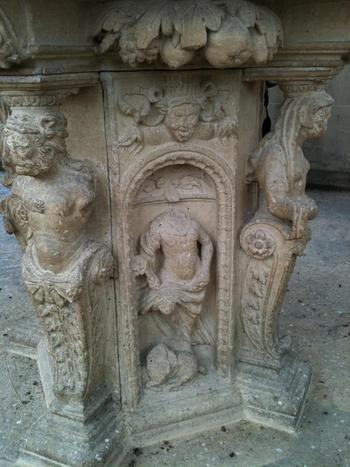
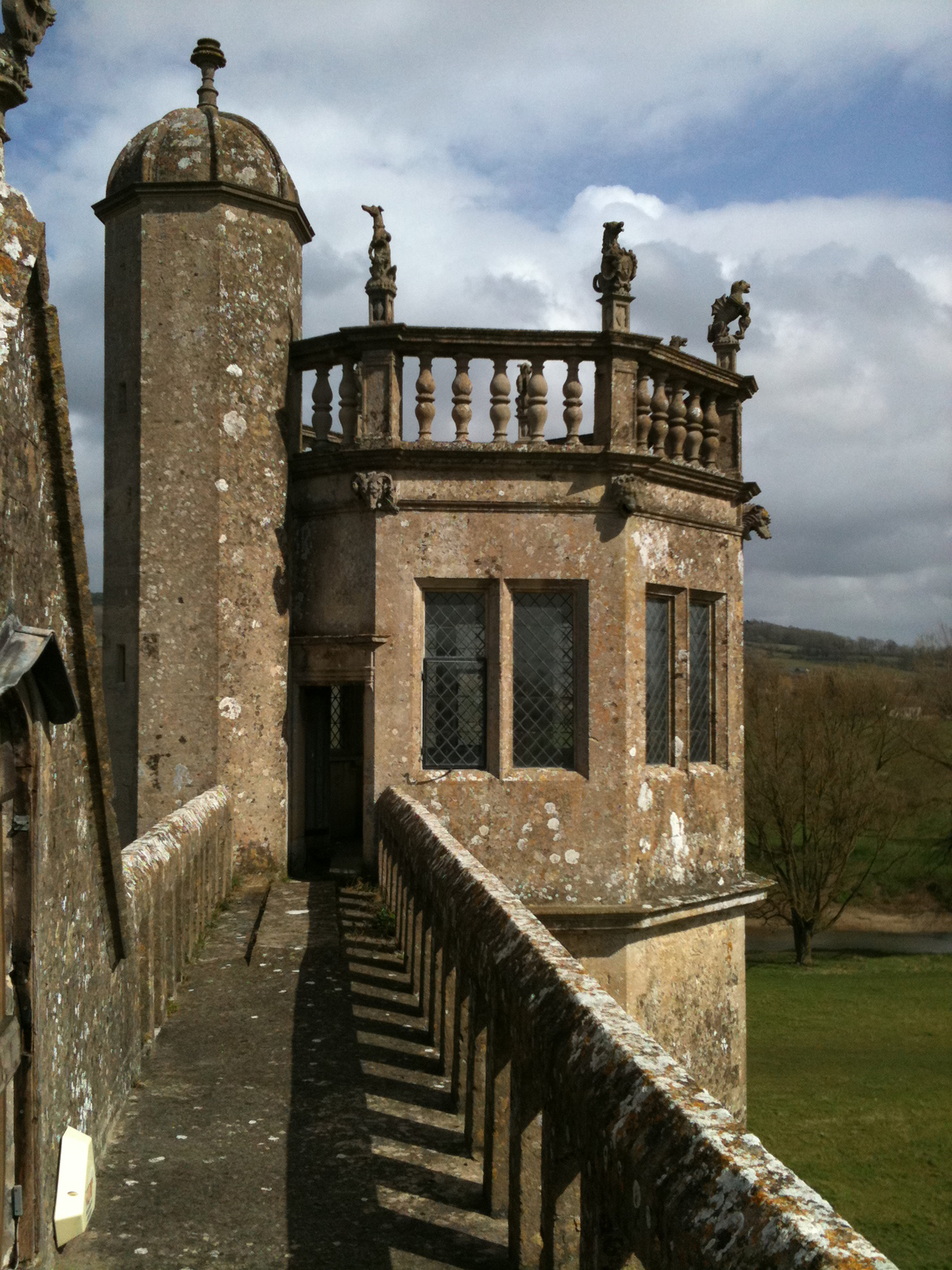
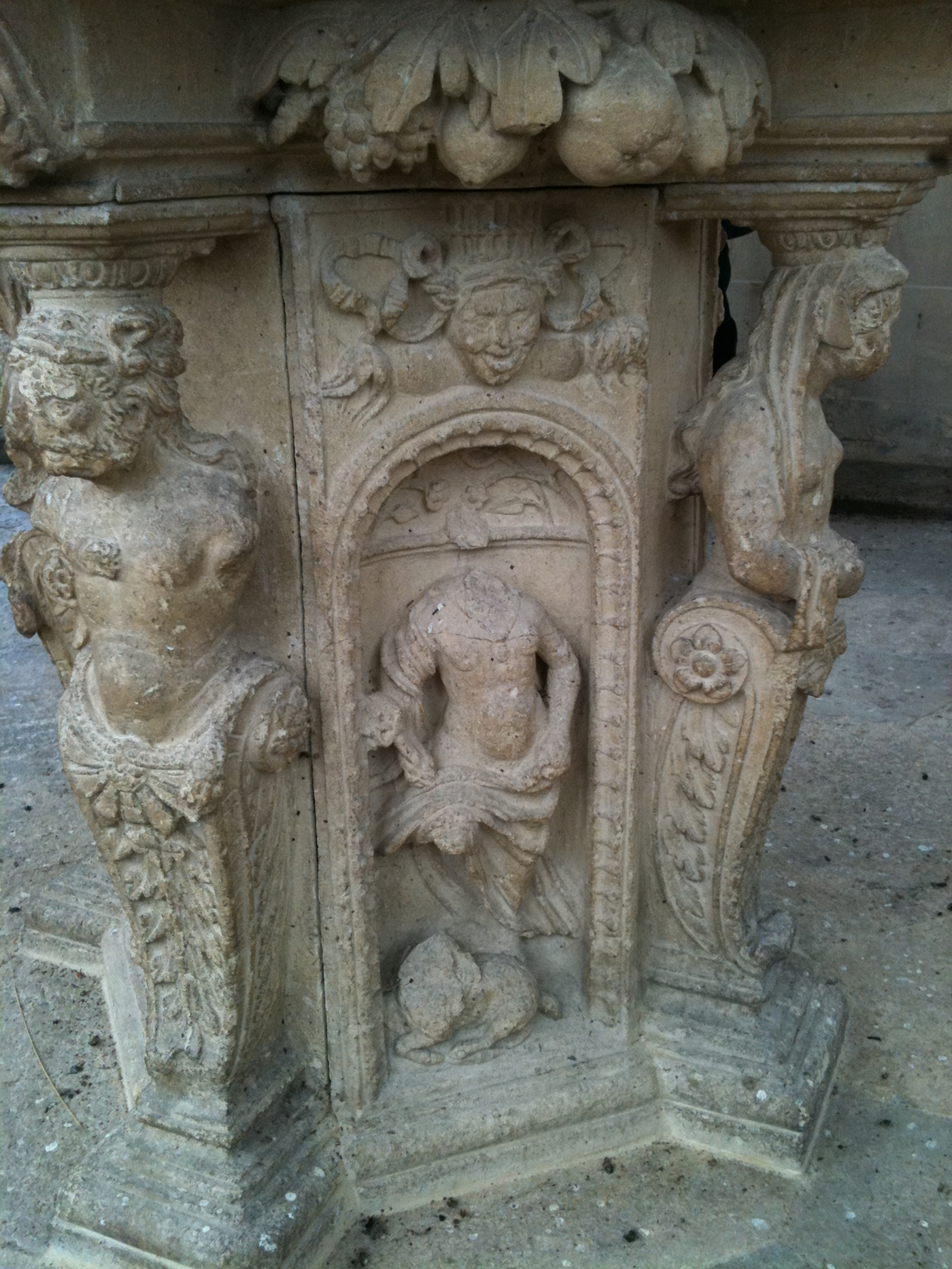
The banqueting chamber at Lacock Abbey, built by William Sharington in the 1540s, also employs classicizing ornament (Figure 6). It takes the form of a Renaissance style ocagonal tower which was reached via a balustraded walk across the leads and topped with a further balustrade.Footnote 74 The original marble table, which survives inside the banqueting house, is decorated with the figures of Dionysos, Ceres, and the ancient gourmand Apicius (Figure 7). Sharington was at the intellectual centre of a classicizing ‘academy’ which revolved around Edward Seymour, 1st duke of Somerset in the late 1540s when the tower was being built. As such, the use of classical ornament at Lacock displayed not only his awareness of continental trends, but also his links to prominent courtiers.Footnote 75
Rooftop walk to banqueting house, Lacock Abbey, Wiltshire, remodelled 1540s. Photograph by the author, reproduced by kind permission of the National Trust.
Carving on marble table inside banqueting chamber at Lacock Abbey, c. 1540s. Photograph by the author, reproduced by kind permission of the National Trust.
Later banqueting houses also referred to classical and Renaissance models. An example at Gorhambury, built by Francis Bacon around 1610, was described in the early modern period as being ‘Roman’ in style.Footnote 76 William Cecil's banqueting house at Theobalds featured pillars and classicizing portrait busts which Cecil had imported from Venice.Footnote 77 Above this was a round banqueting room ‘excellently well Painted all the seeing over with naked men & women’, which suggests that the painted decoration was also based on classical or contemporary renaissance models.Footnote 78 A monumental, barrel-vaulted Roman staircase at Cecil's Burghley House led to the banqueting spaces on the roof, and was the only example of its kind in England at the time.Footnote 79 The use of highly ornamented Roman architectural forms emphasized the move from the public spaces below to the private roofscape, and also the privileged nature of this ascent. It is also likely to have set the scene and raised anticipation for the rarefied banquet/symposium on the roof. Similarly, the doorway to the late sixteenth- or early seventeenth-century banqueting house at Melford Hall in Suffolk is framed by a classicizing portico, which also seems to have emphasized the shift from the everyday world to that of the symposium.
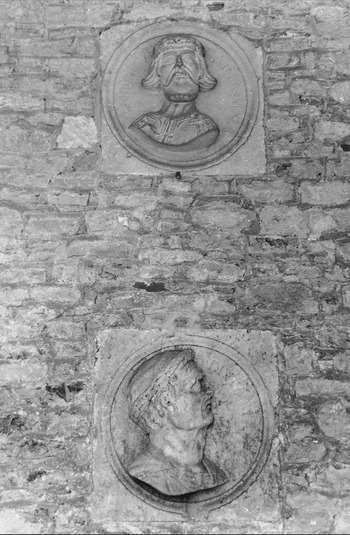
Further analysis of the markedly classicizing interior decoration of a number of surviving banqueting houses suggests that it was designed to prompt the erudite conversation associated with the symposium. Within the loggia at Horton Court, for example, are four stucco roundels which show Hannibal of Carthage, Augustus, Nero and Atilla the Hun (Figure 8). Nicholas Cooper has argued that Augustus represents the type of the virtuous ruler, with Nero cast against him as evil ruler, while Hannibal and Atilla the Hun similarly contrast ‘good and bad outsiders’.Footnote 80 The roundels are carved in contrasting styles: Nero and Augustus are highly reminiscent of classical coins and medals, with naturalistic detailing in the faces and classicizing drapery. Hannibal and Atilla are rendered differently, with Hannibal forward facing, and both treated in a more stylized, gothic manner.
Stucco roundels depicting Hannibal of Carthage (top) and Julius Caesar in ambulatory at Horton Court, Gloucestershire, c. 1517–21. Conway Library, The Courtauld Institute of Art, London.

This is a sophisticated decorative programme, which demonstrates the well-travelled patron's knowledge of fashionable Italian models. William Knight had plenty of opprtunity to gain first-hand knowledge of these, having spent part of his early career in Italy. He was in Ferarra studying law in 1501 and travelled to Rome in 1506. His subsequent diplomatic activities saw him travel to the Low Countries, France, and Switzerland, and in 1526–7 he again travelled to Rome, tasked with obtaining a dispensation allowing Henry VIII to remarry.Footnote 81 The roundels here also provide evidence of an awareness of contrasting styles, with the gothic style employed for the representations of the non-Roman figures.
A more elaborate scheme decorated Nicholas Bacon's banqueting house at Gorhambury, built prior to Francis Bacon's ‘Roman’ example on the same estate. Depicted on the walls were the liberal arts, accompanied by ‘heads of Cicero, Aristotle and other illustrious ancients and moderns who had excelled in each’ with ‘verses expressive of the benefits derived from the study of them’.Footnote 82 The ‘heads’ here may have been roundels or busts, and their description is similar to the the imported busts of Roman emperors in Cecil's banqueting house at Theobalds. The countess of Arundel's ‘Pranketing roome’ at Tart Hall provides another example of the use of portrait sculptures of ancient figures in banqueting spaces. In 1641, it contained four ‘curious marble head statues’.Footnote 83 The pranketing room was a hybrid space which served as both a collectors’ cabinet and banqueting chamber, and the statues can be assumed to be classicizing busts.Footnote 84
Surviving prints designed to be pasted onto trenchers also demonstrate an interest in contemporary interpretations of ancient literature. A set in the British Museum is derived from Marcus Gheeraerts the Elder's illustrations for Aesop's fables.Footnote 85 In sixteenth-century England, as elsewhere in Europe, the Fables were widely used in the teaching of Latin, and were recommended by Thomas Elyot and other educational theorists.Footnote 86 Their appearance on banqueting trenchers is likely to have given banqueting participants opportunities to demonstrate their access to a fashionable, humanist education.
V
Based on the preceding evidence, it is clear that the depiction of classical figures and references to ancient literature was a trend in the decoration of banqueting houses belonging to high-status English people in the period between c. 1520 and 1640. In establishing the motivations behind this impulse, it is necessary to consider it in light of the appropriation of the convivium tradition elsewhere in Europe and the ways in which humanists in this period approached ancient historical and literary examples. As Lisa Jardine and Anthony Grafton have demonstrated, in early modern England, noblemen mined classical texts for information on military strategy, career advancement, and political theory which could be applied to contemporary situations. Ancient historical examples were thus considered capable of triggering political action.Footnote 87
The use of visual depictions of classical figures and scenes from ancient myth and history to provide models for behaviour and to prompt dinner table discussion was common in Renaissance Europe. Jerome de Busleyden's feasts in early sixteenth-century Antwerp took place in a space decorated with scenes from classical mythology and the Bible. Claudia Goldstein has suggested that these were intended to prompt discussion in the mode of the convivium.Footnote 88 Similary, Erasmus's ‘Godly Feast’ in his Colloquies describes a dialogue which takes place over a meal in a garden pavilion decorated with biblical and classical scenes. These included the Last Supper, Dives and Lazarus, and Alexander the Great. The images were intended to ‘warn us to be temperate at feasts and defer us from drunkenness and sensuality’.Footnote 89 On the upper floor were images of the life of Jesus as well as portraits of the popes and the Caesars ‘to help us remember history’.Footnote 90 A 1607 carnival feast hosted in Siena by the Accademia de’ Fimonati took place in a room decorated with classical figures and featured tables adorned with scenes from the Fables, all of which were intended to provoke learned discussion.Footnote 91
In light of this, it is likely that the images of classical figures in English banqueting houses were intended to serve the same purpose. In providing examples of good and bad government and aids to memory, they could be actively read like texts, the histories they evoked providing material for learned discussion in the convivium tradition. This is particularly appropriate at the homes of Knight, Nicholas Bacon, Cecil, and the countess of Arundel, all prominent courtiers. The display of this form of decoration also made statements about status in that the busts inhabited the space of the banqueting house alongside the banquet's living participants, inviting comparisons between them and the ancient statesmen depicted.
The banquet's emphasis on literacy, erudition, and knowledge of the ancient world is connected to changing attitudes to education in early modern England and elsewhere. The centralization of the state under the early Tudors, along with the development of modern diplomacy in the early sixteenth century, had seen increased demand for educated statesmen. Nobles hoping to serve in government positions now required not just martial might, but literary, linguistic, and legal skills.Footnote 92 The same period saw the publication of educational treatises throughout Europe. Works by Juan Louis Vives, Erasmus, and, in England, Thomas Elyot's The governour provided instruction on the education of noblemen. They advocated a humanist, liberal arts curriculum, and Elyot in particular recommended the study of ancient history with its examples of good and bad government.Footnote 93 The visual culture associated with the banquet provided opportunities to demonstrate precisely this form of education. The discussion of busts of ancient rulers, epigrams dealing with court culture and government, classicizing architectural settings, and the conception of the banquet as a modern symposium confirmed attendees’ status as governors, participating in a pan-European courtly culture of revived antiquity.
The opportunities afforded by the banquet in demonstrating this status as members of a ruling class were particularly valuable as the period in which this dining practice emerged was characterized by a sense of class instability, and widespread anxiety regarding a perceived increase in social mobility. This originated at the court of Henry VIII, where the centralization of government resulted in increased opportunities for educated men who were not of noble birth: men like Cardinal Wolsey and Thomas Cromwell. In addition, the period after the dissolution of the monasteries saw large amounts of land exchange hands, providing opportunities for new families to acquire this essential status marker; William Sharington was one such beneficiary with the purchase of Lacock Abbey. Like her father, Elizabeth I appointed non-nobles as councillors; both Nicholas Bacon and William Cecil were examples of this phenomenon. James I's inflation of the honours system in the early seventeenth century maintained a sense of large numbers of people coming up in the world.Footnote 94
This impression was not confined to court society, and there was a perception, underpinned by fact, that the numbers of the gentry were rapidly increasing between 1540 and 1640.Footnote 95 England was particularly vulnerable to class instability because of the presence of the gentry, a group categorized not by blood or title but by the characteristic of ‘gentleness’ or ‘nobility’. Because of the ambiguity surrounding class distinctions outlined above and the emphasis on distinctiveness in definitions of nobility, elites became increasingly concerned with signalling their difference from the rest of society. This was achieved by physically and conceptually separating themselves from it and through the demonstration of noble virtues.Footnote 96 The qualities which constituted nobility or ‘gentleness’ were much discussed in contemporary conduct literature, and have also been subject to a good deal of modern scholarly enquiry. Thomas Elyot's manual for the training of elite youths, The governour, includes a chapter outlining ‘what very nobilitie is’. Elyot explains that nobility originates with inherent virtue demonstrated through magnanimity, justice, liberality, temperance, and martial skill. This results in positions of authority, the practice of good government, and the accumulation of wealth. Both virtue and wealth are augmented in subsequent generations through a combination of breeding, good upbringing, and education. This led to a distinctive way of life, characterized by education, magnificence, hospitality, and the contemplation, discussion, and practice of government.Footnote 97
Whilst modern scholarship has revealed that the category of the ‘gentry’ was an ambiguous and often unstable one, Elyot's definition does give an accurate sense of a status group characterized by a number of intersecting features. These included land ownership, wealth, participation in government, and a particular way of life.Footnote 98 Henry French has recently argued that while the emphasis on features such as lineage in the way in which the gentry defined themselves might have made their power appear permanent and inevitable, the very instability of the category of gentry meant that this power was constantly threatened and in need of reinforcement.Footnote 99 In this light, it is highly significant that the sweet banquet provided opportunities to put many of the defining features of gentry status into practice.
It is particularly telling that the banquet became popular in the homes of wealthy English people during a period (1520 to 1640) which was marked by both a new emphasis on education and a perceived increase in class mobility. Of the key figures associated with the banquet in this article, William Sharington, Thomas Elyot, William Knight, Nicholas Bacon, and William Cecil, it should be noted that none came from particularly illustrious backgrounds. Bacon, in particular, the son of a yeoman farmer who rose to be Elizabeth's lord keeper and, in effect, chancellor of the realm, was just the sort of newly ennobled but highly educated courtier perceived as threatening the social hierarchy. This suggests that the practice of banqueting was particularly valuable to those whose elite status was relatively recent, and therefore perceived as insecure.
The banquet was effective in signalling elite separateness because it gave its participants opportunities to perform their status and belonging to an exclusive group. The acts of moving to the banqueting space and engaging with the foods, objects, and interior décor they found there signalled not only wealth, but access to particular, elite forms of education, the practice of good government, an awareness of a pan-European culture of revived antiquity and refined manners. All of this fostered the illusion of longstanding nobility. As Dennis has pointed out, in an environment in which class lines appeared to be blurred, and it was increasingly easy to purchase the material signs of social status, it became more and more difficult, and therefore imperative, to perform them.Footnote 100