Methionine and lysine have been recognised as limiting amino acids for milk production in dairy goats (NRC, 2007), but the optimal dose for dairy goats is unknown. Exploring the optimal dose for lactating Saanen goats using ruminally protected methionine (RPM), Flores et al. (Reference Flores, Mendoza, Pinos-Rodríguez, Plata, Vega and Bárcena2009) provided doses of 0, 2·5 and 5·0 g/d and found a quadratic response indicating that milk production and milk protein were increased with a daily supplemented dose of 2·5 g of RPM. However, the experiment lasted only 30 d and used only twelve goats.
Thus, the possibility of improving milk production in dairy goats by increasing the duodenal flow of methionine should be evaluated. Therefore, the objective of this study was to evaluate the effect of graded levels of rumen-protected methionine (RPM) on milk yield and milk composition in dairy goats during 110 d of the lactation period.
Materials and methods
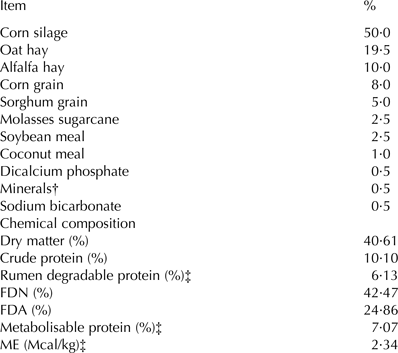
The experiment was conducted at the experimental station Centro de Enseñanza Práctica e Investigación en Producción y Salud Animal of the UNAM (19°N, 99°W, 2760 m above sea level) with a mean temperature of 19 °C. Twenty-five primiparous dairy goats (crosses of Toggenburg, French Alpine and Saanen; 45·44 ± 1·02 kg BW) were fed a basal diet (10·10% CP, 6·13 DP and 2·34 Mcal/kg ME) of corn silage, oat hay, alfalfa hay and concentrate for 110 d (Table 1). The goats were individually fed in pens at 9:00 am and 2:00 pm, ensuring 100 g of orts per kg of the amount fed daily. During the rest of the day, goats had access to a yard with water ad libitum. After kidding, treatments were randomly assigned to goats, which consisted four different oral doses of ruminally protected methionine (Mepron 85 Degussa México Co.) at 0, 1, 2 or 3 g/d. To dose with methionine, first a mixture of 250 g of molasses and 1250 g of corn flour was prepared and stored in the refrigerator at 3 °C. A total of 20 g of this mixture was mixed with the daily dose for each animal to prepare a bolus and then dosed individually to ensure its consumption.
Experimental diet and chemical composition

† Vitasal cabras: Ca 115 g, P 80 g, Mg 20 g, Na 150 g, Cl 230, K 5 g, S 40 g, Mn 2000 mg, Fe 5500 mg, Zn 6000 mg, Se 30 mg, Co 50 mg, I 100 mg, Cu 1000 mg, vitamin A 500 000 IU, vitamin D 150 000 IU and vitamin E 1000 IU
‡ Estimated according to the NRC (2007)
Dry matter intake was measured on three consecutive days every week and body weight was assessed every 14 d. Goats were weighed after morning milking and were not fasted. Milk production was recorded 2 d per week at 8:00 and 15:00 h with automatic equipment (Sistemas de ordeño Flaco, México). Morning and afternoon samples of milk were collected every 2 weeks; samples were mixed, homogenised in a water bath for 1 min (40 °C) until the temperature reached 29 °C and then 20 ml were analysed with a Lactoscan Ultrasonic milk analyser to determine fat, protein, non-fat solids and lactose (Konyali et al. Reference Konyali, Sitki and Yurdabak2010).
Samples of feed and orts were composited every 14 d. Dry matter and total nitrogen in the diets were analysed according to the AOAC (1999) (Table 1). Neutral detergent fibre (NDF) and acid detergent fibre (ADF) analyses were carried out according to Van Soest et al. (Reference Van Soest, Robertson and Lewis1991). Goats were weighed after morning milking but feed was not restricted.
Data were analysed as a completely randomised design testing linear and quadric effects for methionine levels (Steel et al. Reference Steel, Torrie and Dickey1997). Data were analysed with the JMP7 software (Sall et al. Reference Sall, Lehman, Stephens and Creighton2012).
Results
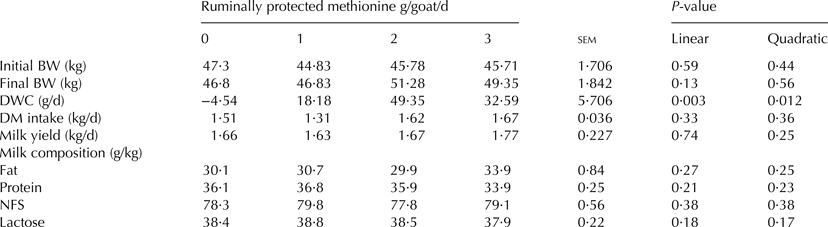
No treatment effects were detected on body weight, DM intake or milk production and composition (Table 2). However, goats without methionine showed weight loss, whereas those receiving the amino acid showed a positive energy balance and live weight changes were improved as dose of RPM was increased (linear P < 0·01).
Effect of ruminally protected methionine on milk production and composition of dairy goats
BW, body weight; DWC, daily weight change; DM, dry matter; NFS, non-fat solids; sem, standard error of the mean
Discussion
In other experiment Flores et al. (Reference Flores, Mendoza, Pinos-Rodríguez, Plata, Vega and Bárcena2009) showed positive effects of ruminally protected methionine on milk yield in lactation goats, and there are some farm evaluations that indicate that milk production can be improved in dairy goats with 5 g/d of ruminally protected methionine (Poljičak-Milas & Marenjak, Reference Poljičak-Milas and Marenjak2007). As observed in this experiment, Al-Qaisi & Titi (Reference Al-Qaisi and Titi2014) did not find differences in milk production and composition or in dry matter intake using doses of 2·5 and 5 g/d of protected methionine, while Madsen et al. (Reference Madsen, Nielsen and Nielsen2005) found a positive response only when methionine (duodenal flow 6 g/d) was combined with ruminally protected lysine (duodenal flow 15 g/d) with a Lys: Met ratio of 2·55 : 1.
The importance of the lysine: methionine ratio has also been pointed out by Lara et al. (Reference Lara, Mendoza, Landois, Bárcena, Sánchez, Rojo, Ayala and Vega2006) in dairy cows. The basal diet in this experiment had a theoretical duodenal flow of metabolisable lysine of 5·57 and 1·83 g/d of methionine; considering a ruminal degradation of 15% of the RPM (Lara et al. Reference Lara, Mendoza, Bárcena and Landois2003), the amino acid increased the duodenal flow up to 4·5 g/d, which reduced the lysine: methionine ratio from 3·03 in the control group to 1·31 at the highest dose. Thus, the lack of response in milk production (Table 2) could be explained by the low dose of methionine and by the reduced Lys: Met ratio. In dairy cows, a ratio between 2·8 : 1 and 3·0 : 1 is recommended (Lara et al. Reference Lara, Mendoza, Landois, Bárcena, Sánchez, Rojo, Ayala and Vega2006); however, this needs to be studied in dairy goats.
Although the RPM did not affect the milk composition, protein and fat ratio are indicative of low acetic fermentation with presumably are associated to starch from corn silage and concentrate; similar results were observed by Salama et al. (Reference Salama, Caja, Albanell, Such, Casals and Plaixats J2003) who reported similar values in a diet which included a mixture of whole-plant maize, barley grain and a concentrate, in Flores et al. (Reference Flores, Mendoza, Pinos-Rodríguez, Plata, Vega and Bárcena2009) reported more protein and less fat in a diet with less concentrate and corn silage than the used in this experiment.
The fact that goats in the control group without the RPM showed lost weight and those receiving methionine had a positive balance deserves attention and further research (Table 2). The negative balance in the control group suggests that metabolisable methionine could be limited. Methionine plays a central role in lipoprotein synthesis in the liver as the key intermediate in methyl group transfer (Lobley et al. 1996). Another possible effect of methionine may be through the metabolism of carnitine. L-carnitine is synthesised from methionine, and is a normal constituent of animal tissues and plasma, required for the transport long-chain fatty acids to the site of oxidation (Harpaz, Reference Harpaz2005). There is no direct evidence in mammals of methionine supplementation and L-carnitine, but studies with birds indicate that in response to Methionine deficiency there is an impairment of one of the hepatic carnitine palmitoyltransferase systems (CPT-I) (Kikusato et al. Reference Kikusato, Sudo and Toyomizu2015) and feeding a Met deficient diet resulted in lower hepatic carnitine content than control diets (Zhan et al. Reference Zhan, Li, Xu and Zhao2006). Studies with weaned rats indicated that the expression of genes for CTP-I in the liver can be affected by other nutrients such as carbohydrates (Thumelin et al. Reference Thumelin, Esser, Charvy, Kolodziej, Zammit, McGarry, Girard and Pegorier1994).
Methionine in the body could be improving the energy balance in lactation by two mechanisms, first as essential amino acid and integral part of proteins methionine preserving the lean mass and second because of their functions related to carnitine or methyl group transfer improving fat utilisation at cellular level (Pissios et al. Reference Pissios, Hong, Kennedy, Prasad, Liu and Maratos-Flier2013).
Conclusion
The results of this study show that the use of different doses of ruminally protected methionine up to 3 g per day did not improve milk production in primiparous lactating dairy goats, but, goats receiving the amino acid showed positive live weight changes during the experiment, which is important in lactating goats and may improve overall productive performance. Higher doses of RPM need to be evaluated in future studies.
The authors thank Degussa México S.A. for supplying the ruminally protected methionine for this experiment. This study was carried out by the first author as a partial requirement for a Master Sciences degree in the Production and Health of Animals at the Universidad Nacional Autónoma de México, México.