Introduction
Global climate change has led many countries to look for different options in their energy matrix, mainly alternatives to reduce the use of fossil fuels, which are pointed out as partially responsible for the greenhouse effect (Baede et al., Reference Baede, Ahlonsou, Ding, Schimel, Maccarthy, Canziani and Leary2001; Zickfeld et al., Reference Zickfeld, Arora and Gillett2012; Friedlingstein et al., Reference Friedlingstein, Andrew, Rogelj, Peters, Canadell, Knutti, Luderer, Raupach, Schaeffer, van Vuuren and Le Quere2014). Among the raw materials for biodiesel production, the National Program for Production and Use of Biodiesel (NPPUB) in Brazil (Brasil, 2004, 2005) included jatropha (Jatropha curcas L.) (Euphorbiaceae) as a promising species (Ferreira & Cristo, Reference Ferreira and Cristo2006). The expectations were that, once jatropha was grown commercially, it would have high oil productivity, combined with low production costs and resistance to water stress (Ferreira & Cristo, Reference Ferreira and Cristo2006).
However, commercial cultivation of jatropha in Brazil lacks basic agronomic information to verify its economic viability. In this context, studies related to plant health, such as the occurrence of pests and the development of management strategies for this species, are fundamental to the successful expansion of this crop. In central Brazil, an insect pest species Cophes notaticeps (Marshall) (Coleoptera: Curculionidae), commonly known as jatropha stem-borer, was identified (Oliveira et al., Reference Oliveira, Frizzas and Dianese2011). This species was first recorded in jatropha plants by Bondar in the state of Bahia (Costa Lima, Reference Costa Lima1922, Reference Costa Lima1956; Silva et al., Reference Silva, Gonçalves, Galvão, Gonçalves, Gomes, Silva and Simoni1968). This insect, whose larva develops inside the plant tissue, mainly at the base of the stem, offers few alternatives to curative control (Oliveira et al., Reference Oliveira, Frizzas and Dianese2011). Preventive control measures, based on adult behavior may be feasible to avoid plant infestation. Therefore, developing knowledge about the bio-ecological aspects of this pest is essential, especially its population dynamics.
Control measures for Curculionidae pests, mainly on annual crops, has been restricted to cultural measures such as crop rotation, removal of infested plant organs, destruction of crop residues and alternative host plants, since chemical control is inefficient (Callan, Reference Callan1942; Monte, Reference Monte1940, Reference Monte1945; Jansson, Reference Jansson1992). However, these practices cannot be applied to jatropha, because it is a perennial plant and C. notaticeps mainly attacks the trunk (Oliveira et al., Reference Oliveira, Frizzas and Dianese2011).
The genus Cophes Champion occurs throughout the Americas, from Canada to Argentina (Alonso-Zarazaga & Lyal, Reference Alonso-Zarazaga and Lyal1999). This genus is composed of 242 species, with 202 occurring in South America, and currently includes the species that once belonged to the genera Graphonotus Chevrolat, Coelosternus Schoenherr and Sternocoelus Kuschel (Wibmer & O'Brien Reference Wibmer and O'Brien1986; Alonso-Zarazaga & Lyal, Reference Alonso-Zarazaga and Lyal1999). Although it has already been reported as a jatropha (Peixoto, Reference Peixoto1973; Siqueira Franco & Gabriel, Reference Siqueira Franco and Gabriel2008) and cassava pest in Brazil (Monte, Reference Monte1940, Reference Monte1945), there is no information about the biology and ecology of C. notaticeps. Data concerning bio-ecological aspects of this genus are restricted to C. granicollis (Pierce) (=Coelostenus granicollis), an insect pest of cassava (Manihot sculenta Crantz). For this species the larval stage, which develops inside cassava stems, lasts about 2 months and the insect completes its cycle in about 3 months (up to four generations can occur per year), with adult population peaking in December and January (Monte, Reference Monte1940, Reference Monte1945; Oliveira & Paula-Moraes, Reference Oliveira, Paula-Moraes, Fialho and Vieira2011). Monitoring the populations of these coleoborers in Brazil has been accomplished with traps that use cassava roots “in natura” as an attractant (Carvalho et al., Reference Carvalho, Rodriguez, Alves, Oliveira and Diniz2009).
The use of baited traps, which release volatile lures, such as alcohol or plant material in fermentation, has been widely used for monitoring populations of insects from the Curculionidae family (Coleoptera) (Vacas et al., Reference Vacas, Primo and Navarro-Llopis2013; Miller et al., Reference Miller, Dodds, Hoebeke, Poland and Willhite2015; Flechtmann & Atkinson, Reference Flechtmann and Atkinson2016). The capture efficiency, however, may depend on the trap type, bait and adult behavior of each species studied.
Our hypothesis is that C. notaticeps may have an adult population peak in a given time of the year, which would be detected through insect monitoring by baited traps. This would direct the adult control measures in that period, reducing the infestation of jatropha plants.
The aim of this study was to determine the population fluctuation of C. notaticeps in a jatropha plantation in the Cerrado of the Federal District, through the use of a new trap, and different types of attractive lures and trap colors.
Materials and methods
Trial area
The study was conducted in an area of about 1.3 ha, with 5-year old jatropha plants, located at Embrapa Cerrados in Planaltina/DF (15°35′42.7″S; 4744′14.8″W; 1039 m). The experimental area consisted of 15 rows, 12 m in length, with 48 plants per row, totaling 720 plants. This site was chosen because C. notaticeps activity had previously been reported in the area.
New trap
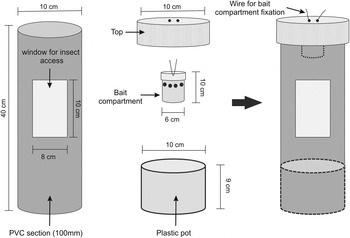
Based on C. notaticeps habit of damaging the region around the base of the stem (Oliveira et al., Reference Oliveira, Frizzas and Dianese2011), the traps were installed close to the plants, at the ground level, rather than suspended, as most of the Curculionidae traps. The traps, called CPAC16, were made of a 100 mm in diameter PVC pipe, cut into sections of 40 cm in length with a window of 10 × 8 cm in the center, to enable insect access. A cap was placed at the top of each section. A bait compartment, consisting of a plastic pot (10 cm tall and 6 cm in diameter) with holes on the sides to help the lures smell dissipate, was fixed on the inside of the cap. A plastic pot (9 cm tall and 10 cm in diameter), containing water and detergent, was placed at the bottom of the trap, directly under the bait, to collect the insects attracted to the trap (fig. 1). The traps were painted with spray paint in red (code 8761 – wavelength range for highest % reflectance: 630–740 nm), yellow (code 8591 – wavelength range for highest % reflectance: 580–590 nm), blue (code 8621 – wavelength range for highest % reflectance: 450–480 nm) and green (code 8731 – wavelength range for highest % reflectance: 510–550 nm) (Colorgin®, Sherwin-Williams do Brasil, Taboão da Serra/SP, Brazil). We selected the primary colors (red, yellow and blue) and green, which resembled the color of the vegetation. Since many Curculionidae are attracted by compounds such as alcohols and esters obtained from the fermentation of plant material, molasses from sugarcane, ethanol (92.8° GL) and pineapple (macerated) were used as attractive lures for C. notaticeps adults. Each bait compartment received about 100 ml of lure solution. Baits were replaced weekly.
Trap model CPAC 16 used to collect Cophes notaticeps in the jatropha trial area in the Federal District, Brazil, between May 2013 and April 2014.

Sampling
Traps were sampled weekly for a period of 12 months between May 2013 and April 2014. The field plot design was a randomized block in a 4 × 3 factorial. The first factor being the four colors (red, yellow, blue and green) and the second factor the three types of bait (molasses, alcohol and pineapple). There were five repetitions totaling 60 traps. The traps were installed near the base of the jatropha plants. The distance between traps in the same row was approximately 8 m and 12 m between rows. They were placed in steel screened cages to prevent the baits from being taken by wild animals, especially small primates (Oliveira & Mendonça, Reference Oliveira and Mendonça2011). After sampling, the insects were transported to the laboratory of Entomology at Embrapa Cerrados, where they were screened using a stereoscopic microscope, separating the Coleoptera and C. notaticeps specimens of other insects.
The identification of C. notaticeps was based on comparisons with specimens previously identified by Dr Sergio Vanin (Department of Zoology, Institute of Biosciences, University of São Paulo, São Paulo, SP) [Diagnostic characters of the species and keys for taxonomic identification can be found at Fiedler (Reference Fiedler1942, Reference Fiedler1943)]. Specimens vouchers of the insects collected, were mounted on entomological pins, labeled and deposited in the Entomological Museum of Embrapa Cerrados (CPAC).
To characterize the presence of the jatropha stem-borer and the development of the epidemics in the experimental area, a survey was done, before the start and at the end of the sampling period, to calculate the percentage of plants showing signs of the infestation, mainly the presence of holes near the base of the plant and resin exudation or accumulation of sawdust (Oliveira et al., Reference Oliveira, Frizzas and Dianese2011).
Data analysis
As the data related to C. notaticeps adults collected during the experiment represent a quantitative variable with a cumulative frequency distribution, the weekly numbers of insects obtained for each trap, were added during the collection period. Box-Cox transformation was applied to the data set (Box & Cox, Reference Box and Cox1964) and normality was verified by the Shapiro–Wilk test; Kolmogorov–Smirnov; Cramer-von Mises and Anderson-Darling. Data were subjected to an ANOVA using the general linear model PROC GLM (SAS Institute, 2001). The objective of this analysis was to determine whether there are statistically significant differences in the number of C. notaticeps adults collected in the sample period in relation to colors and types of bait used in traps, and verify the existence of interaction between these two factors. The averages for each factor (color and bait) were compared by Tukey's test at the 0.05 level of probability (SAS Institute, 2001). To measure the degree of association between the dependent variable (quantitative) ‘number of C. notaticeps collected per month’ and the monthly values of the independent variables (climate data: average monthly temperature, average monthly relative humidity and monthly cumulative rainfall) a correlation analysis (Spearman) was calculated using the Statistica program version 13 (Dell, 2015). This non-parametric analysis, which is used for quantitative discrete variables (i.e., number of adult insects collected per trap) does not require data normality or linearity.
Results
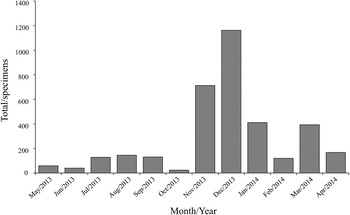
Of all the Coleoptera captured, 3494 specimens were C. notaticeps adults (30.1%). Among the Coleoptera, except for C. notaticeps, the most abundant species belonged to the Nitidulidae and Histeridae families. The population peak of the jatropha stem-borer occurred in December, when 1162 specimens, representing 33.3% of the total, were captured. The month with the lowest numbers was October, when only 24 specimens (0.7%) were captured. Therefore, C. notaticeps adults were present at the trial area during the entire sampling period (fig. 2). The CPAC16 trap captured, on average, about 1.2 C. notaticeps adults per trap, ranging from 0.4 to 19.4 adults per trap. There was no significant interaction between the four trap colors used and the three attractive lures (F = 0.86; P = 0.53).
Total monthly number of Cophes notaticeps adults captured with trap model CPAC16, using different baits [sugarcane molasses, ethanol (98.7o GL) and pineapple (macerated)] and colors (red, yellow, blue and green) in a jatropha trial area in the Federal District, Brazil, between May 2013 and April 2014.

It was observed that data presented normality (Shapiro–Wilk W = 0.98, P = 0.36; Kolmogorov–Smirnov D = 0.07, P > 0.15; Cramer-von Mises W-Sq = 0.04, P > 0.25 and Anderson-Darling A-Sq = 0.29, P > 0.25) and there was no interaction between the factors ‘colors’ and ‘lures’ used in the experiment (F = 0.82; P = 0.56).
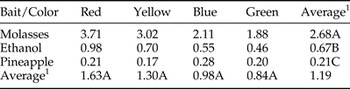
Although there was no statistically significant differences among the four colors used to paint the traps (F = 1.53, P = 0.21), the ones painted in red captured the highest absolute number of specimens (n = 1200), representing 34.3% of the total, followed by the yellow color (n = 953 or 27.3%), blue (n = 720 or 20.6%) and green (n = 621 or 17.8%) (Table 1).
Mean number/trap/week of Cophes notaticeps adults captured with different types of baits [sugarcane molasses, ethanol (98,7o GL) and pineapple (macerated)] and colors (red, yellow, blue or green) using the trap model CPAC16 in a jatropha trial area in the Federal District, Brazil, between May 2013 and April 2014.

1 Means followed by the same letter in the column (bait) or in the line (color) do not differ by Tukey's test at P < 0.05.
There were statistically significant differences among the attractive baits (F = 28.46, P < 0.0001) (Table 1). Traps baited with sugarcane molasses captured significantly more adult C. notaticeps (n = 2627 or 75.2%) than those which used ethyl alcohol or pineapple. Traps baited with ethyl alcohol (n = 657 or 18.8%) captured significantly higher numbers than those using pineapple (n = 210 or 6.0%).
There was no correlation (Spearman) between the meteorological data (rainfall R 2 = 0.50, P = 0.10; temperature R 2 = 0.24, P = 0.45; and relative humidity R 2 = 0.30, P = 0.34) and the monthly average of C. notaticeps captured during monitoring.
The survey done at the beginning of the trial (May 2013) identified 66.4% plants with signs of attack by C. notaticeps. After 1 year (April 2014) signs were detected in all plants of the experimental area (100%).
Discussion
For most insects, population fluctuation is directly influenced by abiotic factors. Among these factors, the distribution of rainfall appears to be one that has the greatest importance, for directly influencing changes in temperature, relative humidity, plant growth, and also promoting an increase in the population of natural enemies (Oliveira & Frizzas, Reference Oliveira and Frizzas2008; Silva et al., Reference Silva, Frizzas and Oliveira2011). In the central region of Brazil the distribution of rainfall follows a pattern where, approximately, 87% (1212 mm) of it occurs between October and March, and 13% (185 mm) between April and September (Silva et al., Reference Silva, Assad, Evangelista, Sano, Almeida and Ribeiro2008). Most insect species in this biome concentrate their adult populations in the first half of the rainy season (Oliveira & Frizzas, Reference Oliveira and Frizzas2008; Silva et al., Reference Silva, Frizzas and Oliveira2011).
Our results demonstrated that C. notaticeps adults also have a higher abundance during the rainy season, when 80.8% were trapped. Of the total number of specimens collected during the trial, 53.7% were captured in the months of November and December. However, unlike many other Coleoptera whose adult populations are observed only in the rainy season (Oliveira et al., Reference Oliveira, Morón and Frizzas2007, Reference Oliveira, Morón and Frizzas2008), C. notaticeps representatives were captured during the entire sampling period, indicating that, for this species, development appears to be continuous during the year. However, in the rainy season, the jatropha plants resume vegetative growth and this physiological state of the plant seems to be more suitable for C. notaticeps, leading to a population increase. Population studies with Curculionidae in Brazil, have pointed out the presence of adults throughout the year, peaking in the rainy season (Monte, Reference Monte1940; Tironi et al., Reference Tironi, von Treuenfels and Parra2005), as observed for the species C. granicollis (Monte, Reference Monte1940), Cyrtomon luridus Boheman (Tironi et al., Reference Tironi, von Treuenfels and Parra2005), Neochetina eichhorniae Warner, N. bruchi Hustache (Sousa et al., Reference Sousa, Marques, Rosado-Neto and Santana2011) and Rhynchophorus palmarum L. (Takada et al., Reference Takada, Batista Filho, Hojo and Carvalho2011). The absence of abrupt climatic changes, such as severe winters with freezing temperatures, and the cryptic life habit of most Curculionidae seem to allow adults to develop throughout the year in Brazil. On the contrary, in other countries abiotic factors such as temperature and rainfall distribution can lead species of Curculionidae to concentrate the adult population only during favorable periods of the year as it occurs, for example, with Sternechus subsignatus Boheman in Argentina (Socías et al., Reference Socías, Liljesthröm, Casmuz, Murúa and Gastaminza2014) and Curculio elephas Gyllenhal in France (Menu, Reference Menu1993).
In this study no correlation was found between climate variables and the population dynamics of C. notaticeps. In fact, many studies have failed to demonstrate this direct relationship, especially with rainfall data. However, rain has been identified as the ‘trigger’ for the restart of development of many insect groups after periods of inactivity (i.e. diapause) and, also, for their population growth, especially in regions where there is a clear alternation between dry and rainy seasons (Wolda, Reference Wolda1988; Oliveira & Frizzas, Reference Oliveira and Frizzas2008; Silva et al., Reference Silva, Frizzas and Oliveira2011).
Representatives of Curculionidae, except those of the Entiminae subfamily, usually have adults and larvae with restricted hosts (monophagous or oligophagous). Adults usually cause very little damage to host plants and larvae have cryptic habits, feeding inside roots, stems or reproductive organs (Casari & Ide, Reference Casari, Ide, Rafael, Melo, Carvalho, Casari and Constantino2012). That seems to be the case for C. notaticeps. Unlike other insect species, whose juveniles and adults are free living and are subject to direct influence of abiotic factors and natural enemies, the larvae of C. notaticeps, protected inside the stem of the plants, seem to be able to develop throughout the year, allowing the emergence of adults even during the dry season, when environmental conditions are less favorable.
Baited traps of all kinds have been widely used for monitoring species of Curculionidae, especially those of economic interest, such as R. palmarum in palms (Aldryhim & Ayedh, Reference Aldryhim and Ayedh2015; Correia et al., Reference Correia, Lima, Cordeiro, Silva Maciel, Martins and Dionísio2015; Löhr et al., Reference Löhr, Vásquez-Ordóñez and Lopez-Lavalle2015), Hypothenemus hampei Ferrari in coffee (Pereira et al., Reference Pereira, Vilela, Tinoco, Lima, Fantine, Morais and França2012; Aristizábal et al., Reference Aristizábal, Jiménez, Bustillo, Trujillo and Arthurs2015; Fernandes et al., Reference Fernandes, Picanço, Fernandes, Dângelo, Souza and Guedes2015) and species of Scolitinae and Platypodinae in forest trees (Carvalho & Trevisan, Reference Carvalho and Trevisan2015; Steininger et al., Reference Steininger, Hulcr, Šigut and Lucky2015; Iidzuka et al., Reference Iidzuka, Goto, Yamasaki and Osawa2016). Although there are no other studies using traps for monitoring populations of C. notaticeps currently available for comparison, the CPAC16 trap seems to be suitable for this purpose because it allowed the capture of adults in all sampling dates, trapping up to 20 adults per trap in just 1 week during the population peak. Therefore, the trap CPAC16 model can be a viable alternative for monitoring this species in commercial plantations of jatropha.
Among the factors that can influence capturing a specific insect species, the color of the trap used can play an important role (Hoback et al., Reference Hoback, Svatos, Spomer and Higley1999). In studies with Rhabdoscelus obscurus (Boisduval) (Coleoptera: Curculionidae), it was observed that the brown color was the most efficient, and all other tested colors (black, red, gray, blue, yellow, white and green) showed no significant differences among themselves in the number of captured adults (Reddy et al., Reference Reddy, Balakrishnan, Remolona, Kikuchi and Bamba2011). We did not observe statistically significant differences in the number of captured adults, so any of these colors can be used for monitoring C. notaticeps.
In addition to the visual stimulus (color), the olfactory cues are one of the most important factors for locating the host plant. The adults have antennal sensilla that function as olfactory receptors. These receptors are capable of recognizing host plant volatiles allowing the insects to reach their target (Leskey et al., Reference Leskey, Prokopy, Wright, Phelan and Haynes2001; Prokopy et al., Reference Prokopy, Phelan, Wright, Minalga, Barger and Leskey2001). Several compounds, such as alcohols and esters from the fermentation of plant tissues, have proved attractive to many species of Curculionidae (Vacas et al., Reference Vacas, Primo and Navarro-Llopis2013; Miller et al., Reference Miller, Dodds, Hoebeke, Poland and Willhite2015; Flechtmann & Atkinson, Reference Flechtmann and Atkinson2016) such as Cosmopolites sordidus (Germar) (Budenberg et al., Reference Budenberg, Ndiege, Karago and Hansson1993), Ceutorhynchus assimilis Payk. (Smart & Blight, Reference Smart and Blight1997), Curculio caryae (Horn) (Collins et al., Reference Collins, Mulder, Grantham, Reid, Smith and Eikenbary1997), Sitona lineatus L. (Landon et al., Reference Landon, Ferary, Pierre, Auger, Biemont, Levieux and Pouzat1997), Rhynchophorus ferrugineus (Olivier) (Gunawardena et al., Reference Gunawardena, Kern, Janssen, Meegoda, Schafer, Vostrowsky and Bestmann1998), and Metamasius hemipterus L. (Perez et al., Reference Perez, Hallett, Gries, Gries, Oehlschlager and Borden1995).
Molasses has a variable chemical composition (Veana et al., Reference Veana, Martínez-Hernández, Aguilar, Rodríguez-Herrera and Michelena2014), and studies of its volatile components have revealed the presence of 35 compounds, among which are aliphatic and aromatic esters, aldehydes, alcohols and various derivatives of furan. The acidic fraction contains at least 11 compounds in which five are simple aliphatic acids (Yokota & Fagerson, Reference Yokota and Fagerson1971). Although it is not certain that volatile compounds are involved, it was observed during the trial, that the fermentation of sugarcane molasses proved to be an efficient lure, capturing higher numbers of C. notaticeps adults than ethanol, which is widely used for monitoring Scolytinae and Platypodinae (Aristizábal et al., Reference Aristizábal, Jiménez, Bustillo, Trujillo and Arthurs2015; Fernandes et al., Reference Fernandes, Picanço, Fernandes, Dângelo, Souza and Guedes2015), and pineapple, an efficient bait for capturing R. palmarum (Duarte et al., Reference Duarte, Lima, Navarro and Sant'Ana2003). These results support the use of sugarcane molasses for monitoring C. notaticeps.
The initial survey of plants with signs of jatropha stem-borer infestation showed a very high incidence rate of 66.4%. There was a sharp increase in the period of a year, with incidence reaching 100% of the plants, in a 6-year old jatropha plantation. These results indicate that, although the Cerrado presents potential for planting jatropha, the cultivation of this crop on a large scale may be impractical due to the occurrence of high populations of C. notaticeps, an insect pest with no efficient control recommendations, to this date (Oliveira et al., Reference Oliveira, Frizzas and Dianese2011).
Our results suggest that the flow of C. notaticeps adults arriving or moving from attacked plants to healthy ones in the experimental area was continuous, which would hinder management strategies targeting the adult stage. However, since the greatest population incidence of adults occurs between November and January, it is suggested that any management measures focusing on adult control should be adopted during this period, especially in the month of December in order to reduce the pest population density in the cultivated areas.
Acknowledgements
The authors wish to thank Sergio Antônio Vanin (Department of Zoology, Institute of Biosciences, University of São Paulo, São Paulo, SP) for the specific identification of the Curculionidae C. notaticeps, João de Deus G. dos Santos Júnior (Embrapa Cerrados) for permitting us to carry out the studies in the J. curcas trial area, Rodrigo Alves Xavier, João Alves da Silva, Maian José dos Santos and Isabela Cristinne Spindola for their aid in the field activities, Juacy Vitória Malaquias for his help with the statistical analysis. This study was financed by the project BRJatropha/FINEP (Brazil).