INTRODUCTION
Studies of endangered species, such as franciscana dolphins (Pontoporia blainvillei), is essential for designing strategies for its conservation. This dolphin is endemic to the south-western Atlantic coastal waters, extending from Itaúnas (18°25′S) in Brazil to Golfo San Matías (42°10′S) in Argentina (Crespo et al., Reference Crespo, Harris and González1998; Siciliano et al., Reference Siciliano, Di Beneditto and Ramos2002). Its extensive by-catch is well documented in coastal fisheries, especially in gillnets, throughout its range (Pérez Macri & Crespo, Reference Pérez Macri, Crespo, Perrin, Brownell, Kaiya and Jiankang1989; Corcuera, Reference Corcuera1994; Secchi et al., Reference Secchi, Zerbini, Bassoi, Dalla Rosa, Moller and Rocha-Campos1997, Reference Secchi, Ott, Danilewicz, Gales, Hindell and Kirkwood2003a b; Pinedo & Polacheck, Reference Pinedo and Polacheck1999; Di Beneditto & Ramos, Reference Di Beneditto and Ramos2001; Bertozzi & Zerbini, Reference Bertozzi and Zerbini2002; Kinas, Reference Kinas2002; Ott et al., Reference Ott, Secchi, Moreno, Danilewicz, Crespo, Bordino, Ramos, Di Beneditto, Bertozzi, Bastida, Zanelatto, Perez and Kinas2002; Rosas et al., Reference Rosas, Monteiro-Filho and Oliveira2002; Cappozzo et al., Reference Cappozzo, Negri, Pérez, Albareda, Monzón and Corcuera2007). Four management areas have been recognized in the entire distribution range of franciscana (Secchi et al., Reference Secchi, Danilewicz and Ott2003b), with a suggested genetically isolated population in Argentina (Mendez et al., Reference Mendez, Rosenbaum, Subramaniam, Yackulic and Bordino2010).
Recently, the Río Negro Estuary (RNE), north-east Patagonia, has been identified as an important conservation area for franciscana dolphins in their southernmost distribution limit (Failla et al., Reference Failla, Iñiguez, Tossenberger and de Haro2004). This paper presents the first description of various aspects of the biology of the franciscana dolphin in the RNE, Patagonia.
MATERIALS AND METHODS
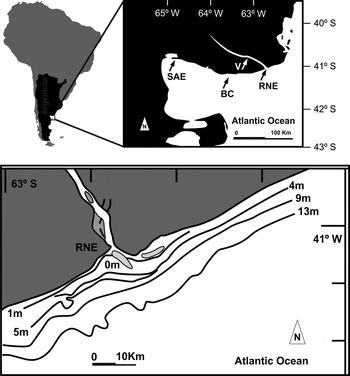
Between January 2002 and December 2011, sightings were made from the coast and by boat, as well as during coastal surveys to search for animals stranded on the beaches or gillnets in the RNE and surrounding areas (41°3′S 63°50′W) (Figure 1). The Río Negro River is the longest river in Patagonia. It contains turbid (visibility <1 m) and warm waters (mean temperature 19°C), islands, sandbars, channels and saltmarshes. Generally, the coast drops off steeply with depths of up to 2 m at a distance of only 5 m from the coastline. The mean tidal annual amplitude is about 2.2 m. Its water flow is regulated 500 km up river due to the presence of a dam, which varies its water flow between 500 and 2000 m3/seg.
Map of the study area indicating the Río Negro Estuary (RNE), Patagonia, Argentina.

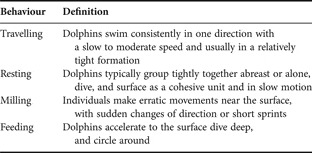
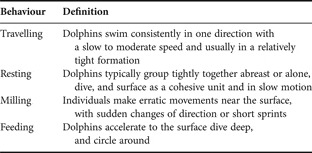
During the period January–February and August–December 2002 land based observations were made, using binoculars 10 × 50, from an elevation of 50 m and during optimum sea conditions (<2 Beaufort). Additionally, vessel surveys were made during January–February 2002–2003–2005 and March–July 2007–2008–2009. Data were recorded using a scanning 3′ point sampling and focal animal/group mode (Altmann, Reference Altmann1974; Mann, Reference Mann1999). Data were recorded on group size and group dispersion, the latest defined as the distance between individuals within a group, measured as ‘dolphin length' (1 DL = 1.5 m) (adapted from Bejder et al., Reference Bejder, Dawson and Harraway1999). A dolphin group was defined as all individuals within a 10 DL radius of each other, interacting or engaged in similar general behaviour (Iñíguez & Tossenberger, Reference Iñíguez and Tossenberger2007). General behaviour was studied, adapted from Bordino et al. (Reference Bordino, Thompson and Iñiguez1999) and Iñíguez & Tossenberger (Reference Iñíguez and Tossenberger2007) (Table 1). The category ‘calf' was assigned to individuals which were half the length of an adult and mostly swimming in close association with an adult. The number of sightings per unit effort (SPUE) was defined as the number of dolphin groups per hour.
Definitions of behaviours shown by franciscana dolphins in the Río Negro Estuary (2002 to 2011) (adapted from Bordino et al. (Reference Bordino, Thompson and Iñiguez1999) and Iñíguez & Tossenberger (Reference Iñíguez and Tossenberger2007)).
The distance from the coast was estimated using 10 × 50 binoculars and various reference points (buoys) at known distances. Three categories were used in the analysis: (1) ≤100 m (sandy substrate, depth ≤1 m); (2) 100 to 200 m (ledge of rocks, depth ≤3 m); and (3) 200 to 300 m (sandy-rocky substrate, depth ≥5 m). Due to the characteristics of the species (small size, cryptic coloration and rare aerial displays), individuals sighted at distances greater than 300 m were excluded. The state of the tide was classified as rising or falling and analysed separately.
Due to their relevance, non-systematic observations were also included in the present work.
RESULTS
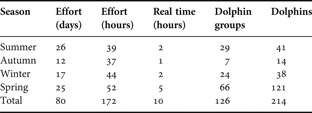
Between 2002 and 2011, a total of 413 sightings (within 80 days of effort) were recorded from the coast (total effort = 106 hours, minimum = 1 hour, maximum = 7.5 hours) and by boat (total effort = 66 hours, minimum = 1 hour, maximum = 6.5 hours) (Table 2). The SPUE calculated was 2.16 groups/hour.
Land and boat based observation effort, effort (total time in days and hours), real effort (contact time with dolphins), number of groups and individuals of franciscana dolphins per season in the Río Negro Estuary (2002 to 2011).

Group size and dispersion
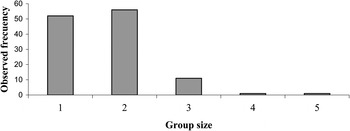
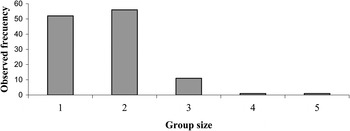
Group size varied from 1–5 dolphins (X = 1.69; standard deviation (SD) = 0.74; N = 121) (Figure 2). The maximum number of groups recorded simultaneously in the same area was 4 (N = 12). In terms of individuals, the maximun numbers at the same time was 7 individuals (N = 13). Group size did not find significant variation as a function of behaviour (Kruskal–Wallis test (KW): P = 0.07; N = 81) or distance from the coast (KW: P = 0.07; N = 117). However, significant differences were detected in group size depending on the tide. In particular, bigger groups were recorded during rising tide (KW: P = 0.0005; N = 117).
Group size of franciscana dolphins in the Río Negro Estuary (2002 to 2011) (N = 121).
Group dispersion varied from 0–10 DL (X = 1.4; SD = 0.75; N = 51), 0 DL being the most frequent value (54.9%; N = 28), followed by 1 DL (15.69%; N = 8) and 5 DL (15.68%; N = 8). Group dispersion did not vary significantly with behaviour (KW: P = 1.00; N = 51), with tide (KW: P = 0.36; N = 51), or with the distance from shore (KW: P = 0.42; N = 51).
Presence of calves
A total of 10 calves were recorded in January 2002, January and March 2004, March and November 2007, November 2009, February 2010, December 2010 and 2011.
Behaviour and habitat use
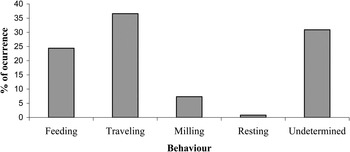
Behavioural data on travelling, feeding, resting and milling (N = 123: Table 2) were quantified. Travelling was the most frequent behaviour recorded (36.58%; N = 45) (Figure 3).
Percentage of behavioural observations of franciscana dolphins in the Río Negro Estuary (2002 to 2011) (N = 123).

The most frequent distance from the coast was the category 1 (46.25%; N = 191), followed by 2 (34.38%; N = 142) and 3 (19.37%; N = 80).
At least 5 groups of dolphins, including a group with calf, were in Bahía Creek (41°05′S 63°66′W) aproximately 100 km south-west of the study area; and in San Antonio Este harbour (40°49′S 64°45′W) 200 km west from the RNE. Both locations are characterized by clear marine waters (visibility ≥2 m). We also found 3 groups of franciscana dolphins up to 30 km upstream of the RNE in Viedma city (40°48′S 62°58′W).
Predator
During our study, four killer whales (3 females or subadults and an adult male, as defined by Bigg, 1982) were observed for an hour in December 2003 in the study area. Two days prior to the appearance of the killer whales, franciscana were recorded in the area. However, for the next two days, they were not observed.
Stranded animals
Fifty-two coastal surveys were conducted in search of stranded dolphins (effort = 330 km).
A total of 13 stranded franciscana dolphins (including 5 calves) were reported. 10 of them were dead, of which 3 were collected from gillnets. 3 calves were found alive and were rescued by tourists and researchers (January 2004 and 2010, December 2011).
Additionally, 4 other by-caught animals were reported by artisanal and sports fishermen; 2 dead individuals were recorded in gillnets and 2 live animals were subsequently rescued by the fishermen.
DISCUSSION
Data reported herein indicate that franciscana dolphin use the RNE throughout the whole year. The permanent presence in the area may be explained by the abundance of two species of fish which are included in the franciscana dolphins’ diet: whitemouth croaker (Micropogonias furnieri) and the stripped weakfish (Cynoscion guatupuca) (Danilewicz et al., Reference Danilewicz, Rosas, Bastida, Marigo, Muelbert, Rodríguez, Lailson, Ruoppolo, Ramos, Bassoi, Ott, Caon, Monteiro da Rocha, Catao-Dias and Secchi2002; Rodríguez et al., 2002). Both fish species are found at the RNE and local fishermen catch them throughout the year (Curtolo & Di Giacomo, Reference Curtolo and Di Giacomo2002). The distribution and the accessibility of food may have been a determining factor for the establishment of franciscana dolphins in the area.
This area seems to meet the environmental requirements for this species (Pinedo et al., Reference Pinedo, Praderi, Brownell, Perrin, Brownell, Kaiya and Jiankang1989; Bordino et al., Reference Bordino, Thompson and Iñiguez1999, Reference Bordino, Siciliano, Bastida and Cremer2002; Danilewicz et al., Reference Danilewicz, Secchi, Ott, Moreno, Bassoi and Borges-Martins2009). These requirements include turbid waters, depths up to 35 m, favourable conditions for feeding and protection against natural predators. Our results verify that franciscana dolphins use both fresh water and seawater in the north-east of Patagonia and are capable of living both in clear marine waters (visibility ≥2 m) and turbid fresh water (visibility <1 m). Data presented here indicates that the RNE is the southernmost breeding and feeding site reported to date.
The recorded group size coincides with previous studies carried out in southern Brazil and Bahía San Blas, Argentina (Pinedo et al., Reference Pinedo, Praderi, Brownell, Perrin, Brownell, Kaiya and Jiankang1989; Bordino et al., Reference Bordino, Thompson and Iñiguez1999; Secchi et al., Reference Secchi, Ott, Crespo, Kinas, Pedraza and Bordino2001). However, larger groups have also been recorded in Argentina and Brazil (Crespo et al., Reference Crespo, Harris and González1998; Bordino et al., Reference Bordino, Thompson and Iñiguez1999; Di Beneditto et al., Reference Di Beneditto, Ramos and Lima2001; Secchi et al., Reference Secchi, Ott, Crespo, Kinas, Pedraza and Bordino2001; Cremer & Simões-Lopes, Reference Cremer and Simões-Lopes2005).
The results presented here suggest a breeding season for franciscana dolphins off the RNE from November to March which coincides with that reported for Argentine waters (Bordino et al., Reference Bordino, Thompson and Iñiguez1999; Rodríguez et al., Reference Rodríguez, Rivero and Bastida2002).
During this study we observed four general behaviours (travelling, feeding, resting and milling), similar to those reported for franciscana dolphins in Bahía Anegada, Argentina (Bordino et al., Reference Bordino, Thompson and Iñiguez1999). However, in our study the proportions of behaviours were different to those observed by Bordino et al. (Reference Bordino, Thompson and Iñiguez1999) for shallow waters. They found that milling was the most frequently observed behaviour (>40%), followed by feeding (>30%), which was similar in ranking to our study, but not in terms of percentage. Since franciscana dolphins are difficult to observe in the wild, 30.9% of the observations could not be classified into a specific behaviour.
The predation of franciscana dolphins by killer whale (Orcinus orca) was reported in Brazil (Ott & Danilewicz, Reference Ott and Danilewicz1998; Santos & Netto, Reference Santos and Netto2005). The avoidance responses by franciscana to the presence of killer whales in the mouth of the Rio Negro may suggest killer whales are a predator in this area. Killer whales were frequently encountered in the north of Golfo San Matias, including the mouth of the Rio Negro during June and August (Iñíguez, Reference Iñíguez2001). Avoidance behaviour towards killer whales has been observed in other small cetacean species such as Lagenorhynchus obscurus (Würsig & Würsig, Reference Würsig and Würsig1980; Constantine et al., Reference Constantine, Visser, Buurman, Buurman and McFadden1998; Visser, Reference Visser1999), Sousa chinensis (Saayman & Tayler, Reference Saayman, Tayler, Winn and Olla1979), Phocoenoides dalli (Jefferson, Reference Jefferson1987), Tursiops truncatus (Constantine 1995 in Constantine et al., Reference Constantine, Visser, Buurman, Buurman and McFadden1998; Visser, Reference Visser1999) and Delphinus delphis (Visser, Reference Visser1999).
Our results of distance from the coast and group dispersion could be useful for future design and calibration of aerial surveys in the area.
Regarding the distance from the coast, it should be noted that all groups were sighted in waters that are used by local artisanal and sports fishermen. It is also necessary to highlight that both artisanal and local sports fishermen use gillnets to fish in the RNE. Our results on stranded animals, even though preliminary, may indicate that gillnets could be a threat in the study area and further studies are necessary in this regard and for this threat to be considered in future management measures. For Argentina P. blainvillei use small areas (Bordino et al., Reference Bordino, Well and Stamper2008) and there is a suggested genetically isolated population in Argentinean management areas (Mendez et al., Reference Mendez, Rosenbaum, Subramaniam, Yackulic and Bordino2010). Being the southernmost population described, along with the possible lack of contact with northern populations, a local decrease in the population would have a significant impact due to the low probability of recovery.
Scientific contributions from this study were used for the formulation of a proposal to create a Río Negro Estuary Protected Area, which would represent a management tool for the conservation of franciscana dolphins in their southernmost distribution limit. We urgently recommend the establishment of the proposed natural reserve by the Governments of Río Negro and Buenos Aires provinces.
As a result of the high numbers of franciscanas observed in the RNE, it is a very suitable location for long-term research focusing on both ecological and behavioural aspects of this species.
ACKNOWLEDGEMENTS
Field research was partially supported by the Whale and Dolphin Conservation Society and the Cetacean Society International, CEAMSE (Argentina) and was logistically supported by Prefectura Naval Argentina Carmen de Patagones. M. Hevia, N. Hodgins and M. Melcón made helpful suggestions to the original manuscript. Comments from two anonymous referees greatly improved this work. This study was carried out with permission of the Dirección de Fauna de la Provincia de Río Negro, Argentina (Exp. No. 132264-DF-2010).