Introduction
In recent decades, considerable progress has been made in the understanding of obstructive sleep apnoea (OSA). A significant number of patients diagnosed with OSA are unsuitable for, or poorly compliant with, continuous positive airway pressure (CPAP) or mandibular advancement splints. Current clinical guidelines recommend that such patients should be evaluated for surgical intervention.1
General anaesthesia for obstructive sleep apnoea surgery
Upper airway reconstructive surgery for OSA poses unique management problems for the surgeon and the anaesthetist. In some fields of surgery, the use of regional or local anaesthesia can avoid the need for sedatives and respiratory depressant medications; however, this is not feasible for most OSA surgical procedures.
Sixty to 90 per cent of patients with OSA are obese.Reference Chung and Imarengiaye2 There is a greater than normal incidence of co-morbidity such as hypertension, cardiovascular disease, dysrhythmia, pulmonary hypertension and polycythaemia due to sympathetic overactivity, all of which may make the patient haemodynamically unstable.Reference Riley, Powell, Guilleminault, Pelayo, Troell and Li3, Reference Shahar, Whitney, Redline, Lee, Newman and Javier Nieto4 The use of premedication can have a synergistic effect on pharyngeal muscle relaxation and cause respiratory depression, leading to hypoxaemia, hypercapnia, hypopnoea and increased risk of cardiovascular complications.Reference den Herder, Schmeck, Appelboom and de Vries5 Routine use of benzodiazepine premedication is therefore avoided.
Respiratory obstruction in the post-operative period can be multi-factorial. Upper airway surgical procedures are associated with significant post-operative pain, and opioids are commonly used for strong analgesia, potentially causing respiratory depression and sedation. Arousal responses may be compromised and OSA can be aggravated. Post-operative oedema and bleeding can precipitate airway obstruction and make the use of CPAP difficult.Reference Loadsman and Hillman6 This is of particular importance following tongue surgery for retrolingual segment collapse (e.g. geniotubercle advancement, hyoid suspension and submucosal glossectomy), as uncontrolled hypertension in this situation can be associated with the risk of haematoma and life-threatening airway obstruction.Reference Riley, Powell, Guilleminault, Pelayo, Troell and Li3, Reference Robinson and Friedman7 Consequently, precise control of blood pressure in an intensive care unit setting is imperative during the post-operative period.
In order to circumvent the potential problems highlighted above, the anaesthetist relies on a combination of drugs to effect good haemodynamic control. Drugs with an opioid-sparing analgesic effect are desirable, as they avoid respiratory depression and sedation and thus minimise the risk of airway obstruction.
Role of dexmedetomidine in general anaesthesia for obstructive sleep apnoea surgery
Dexmedetomidine (Precedex™; Hospira, Lake Forest, Illinois, USA) is a selective α adrenoceptor agonist with an affinity for α-2 adrenoceptors over α-1 adrenoceptors as demonstrated in vitro.8 Dexmedetomidine is pharmacologically related to clonidine, over which it has an eight times higher affinity for α-2 adrenoceptors. In 2001, the Therapeutics and Goods Administration organisation of Australia gave approval for the use of dexmedetomidine in intensive care units for post-operative care.
Dexmedetomidine has shown the potential to enable avoidance of the use of several other agents, due to its favourable pharmacological profile. Dose-related sedative, anxiolytic, anaesthetic and analgesic sparing effects have been demonstrated. Dexmedetomidine blunts the sympathetic responses to surgery, resulting in intra-operative haemodynamic stability. Its sedative effect is due to its action on the locus ceruleus, and has been termed ‘arousable sedation’ as patients are easily roused.Reference Arain, Ruehlow, Uhrich and Ebert9 It acts on the dorsal horn cells of the spinal cord, and this analgesic action is devoid of respiratory depression.
Dexmedetomidine has a distribution half-life of 9 minutes and an elimination half-life of 2 hours. It is administered as an intravenous infusion. Linear kinetics are observed in the dose range 0.2–0.7 µg/kg/hour. When dexmedetomidine is used in this dose range, few adverse effects have been observed; those reported include hypo- and hypertension, bradycardia and sinus pauses. These are easily reversed by withholding the infusion, and pressor agents are rarely required.
Materials and methods
Aims
This study aimed to determine the impact of peri-operative use of dexmedetomidine in patients undergoing airway reconstruction surgery for OSA, as regards: (1) use of ‘rescue’ medication; (2) blood pressure stability; and (3) analgesic requirements.
Study design
A retrospective, clinical record audit was undertaken for consecutive patients receiving general anaesthesia for multilevel upper airway reconstruction surgery. All the patients included in the study were from the private practice of one surgeon (SR) and underwent treatment between 2001 and 2006.
We obtained the approval of the Flinders Medical Centre human ethics committee to conduct the research.
The patients were divided into study and control groups depending on the use of dexmedetomidine in the peri-operative period, or lack thereof, respectively. The two groups were demographically homogeneous and underwent similar reconstructive surgical procedures performed by the same surgeon (see below). The decision of whether to use dexmedetomidine or alternative anti-hypertensive medication was determined by the personal preference of the anaesthetist involved in each case; thus, patient allocation into the two groups was non-randomised. Limited soft tissue surgery (such as uvulopalatopharyngoplasty with radiofrequency ablation to the palate and/or tongue) does not warrant stringent blood pressure control, and dexmedetomidine was not used when these procedures were undertaken in isolation.
Data collection
The following data were collected: patient demographic details; type of surgery performed; history of hypertension; mean arterial blood pressure in the recovery room; use of dexmedetomidine; total dose of morphine and fentanyl used peri-operatively (in the operating theatre and recovery); peri-operative use of rescue medication; and complications (if any).
Rescue medication was defined as anti-hypertensive drugs specifically used to control high blood pressure peri-operatively. Drugs in this category included glyceryl trinitrate (GTN; a venodilator, used as a transdermal patch) and hydralazine (a vasodilator, administered intravenously). Clonidine and α-1 blockers (atenolol and metoprolol) were also used for blood pressure control. However, their use was pre-emptive (at the beginning of the operation) in some cases, and hence they were excluded from our definition of rescue medication. We defined successful blood pressure control as a mean arterial blood pressure of 100 mmHg or less in recovery (i.e. 1–2 hours after completion of the operation). The total dose of opioids (i.e. morphine and fentanyl) used peri-operatively was taken as an indicator of the efficiency of pain control.
Dexmedetomidine was given as an infusion, with continuous monitoring of the heart rate, intra-arterial blood pressure, O2 saturation and electrocardiogram. The loading dose was 1 µg/kg given over 10–20 minutes, followed by a maintenance infusion of 0.1–0.2 µg/kg/hour. Transient ‘loading dose hypertension’ was often noted due to dexmedetomidine's peripheral vasoconstrictor effect. Following this, its central effects predominated, resulting in titratable, controlled hypotension and bradycardia.
All patients were extubated at the end of the procedure. After staying in the theatre recovery area for 1–2 hours, the patients were transferred to the intensive care unit for ongoing overnight care. The dexmedetomidine infusion was typically terminated after 4–12 hours in the intensive care unit, with ongoing close monitoring of cardiovascular and respiratory parameters.
In both patient groups, no significant cardiovascular complications were identified, and none of the patients required intervention due to airway compromise.
Sample size and statistical analyses
We based our sample size calculation on the likely need for rescue medication in the two groups. Assuming that 30 per cent of the control group would require rescue medication, compared with 15 per cent of the study group, a two group chi-square test with a 0.050 two-sided significance level would have 80 per cent power to detect a difference of this size when the sample size in each group was 121.
Statistical analyses included: Student's t-test for comparing age in the two groups; chi-square tests for comparing gender, history of hypertension and procedures undertaken; log binomial generalised linear models for comparing rates of rescue medication use, stable blood pressure and analgesic use; and Mann–Whitney U test for comparing total opioid use and the number of procedures undertaken. The generalised linear models were adjusted for clustering, since a patient could appear more than once in the database. Statistical analyses were undertaken using Stata 9 statistical software.
Results
Demographic and clinical data
Data were extracted from 268 patient case notes: 143 in the control group and 125 in the study group. The mean age of study group patients was 48.1 years (standard error of the mean (SEM) 0.78), compared with 47.4 years (SEM 0.87) in the control group; this difference was not statistically significant (p = 0.573). The study group comprised 82.9 per cent males and 17.1 per females, the control group 85.5 per cent males and 14.5 per cent females (p = 0.561, compared male percentages). Of the study group patients, 18.7 per cent had a past history of hypertension, compared with 15.2 per cent of the control group (p = 0.441). Patient's demographic data are depicted in Table I.
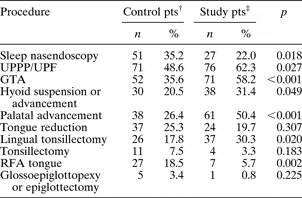
Procedures undertaken in control (n = 145) and study (n = 123) groups. UPPP = uvulopalatopharyngoplasty; UPF = uvulopalatal flap; GTA = geniotubercle advancement; RFA = radiofrequency ablation

Patients' demographic data

Pts = patients; yrs = years; Hx HT = history of hypertension
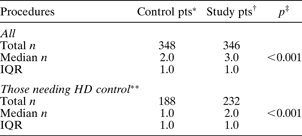
Table II and Figure 1 show the distribution of the procedures undertaken in each group. These are multiple response data, i.e. each patient could have undergone more than one procedure during one hospital admission. Whilst all patients underwent a varying number and combination of procedures during each admission, the patients in the study group underwent significantly more procedures than those in the control group (p < 0.001). Certain procedures (such as geniotubercle advancement, tongue volume reduction and palatal advancement) required stringent monitoring of haemodynamic parameters. Patients in the study group underwent twice as many of these procedures compared with the control group (p < 0.001), as shown in Table III. Uvulopalatopharyngoplasty was more commonly performed in the study group than in the control group (p = 0.02).
Procedures undertaken*

* Multiple response data; see text for explanation. †n = 145; ‡n = 123; UPPP = uvulopalatopharyngoplasty; UPF = uvulopalatal flap; GTA = geniotubercle advancement; RFA = radiofrequency ablation
Procedures undertaken: difference between two groups

*n = 145; †n = 123; ‡Mann–Whitney U test; **Those requiring strict control of haemodynamic parameters (excluding sleep nasendoscopy, uvulopalatopharyngoplasty, radiofrequency ablation and tonsillectomy). Pts = patients; IQR = interquartile range
Rescue medication
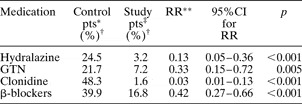
Rescue medication was defined as any interventions including hydralazine and GTN. Hydralazine was used in 24.5 per cent of the control group interventions, compared with 3.2 per cent of study group interventions (p < 0.001). Glyceryl trinitrate was used in 21.7 per cent of control group interventions, compared with 7.2 per cent of study group interventions (p = 0.005). Whilst β-blockers and clonidine reflect similar and statistically significant trends, they were not included in our definition of rescue medication, for the reasons outlined above. The results of the clustered log binomial generalised linear models for the intra-operative use of rescue medication and other anti-hypertensive medication are shown in Table IV.
Intra-operative use of ‘rescue’ medication and other anti-hypertensive medication

*n = 143; ‡n = 125; †Percentage of patients requiring medication; **Relative risk obtained from clustered log binomial generalised linear model. Pts = patients; CI = confidence interval; GTN = glyceryl trinitrate
Blood pressure stability
Stable blood pressure was observed in 72.0 per cent of the control group, compared with 93.3 per cent of the study group. Based on a clustered log binomial generalised linear model, this equated to a relative risk of 1.30 (95 per cent confidence interval 1.14–1.47; p < 0.001), which was highly statistically significant.
Analgesic requirements
Of the total patients, 24.2 per cent did not receive morphine and 18.3 per cent did not receive fentanyl. It was not possible to transform this variable into a normal distribution.
The data shown in Table V indicate that the study group was significantly more likely to require morphine, compared with controls. However, the study group was found to have smaller requirement of morphine. This was reflected in the median dose of morphine in Study group (8 mg) and in the Control group (10 mg). However, this difference was not statistically significant (Mann–Whitney U test; p = 0.799). The median dose of fentanyl used in both groups was 100 µg.
Intra and Post-operative use of analgesics

*n = 143; ‡n = 125; †Percentage of patients requiring analgesic. **Relative risk obtained from clustered log binomial generalised linear model. Pts = patients; CI = confidence interval
Discussion
Comparison with other studies
Several studies have assessed measures to obtain controlled intra-operative hypotension during endoscopic sinus surgery to provide a dry surgical field and reduce blood loss.Reference Blackwell, Ross, Kapur and Calcaterra10–Reference Boezaart, van der Merwe and Coetzee12 However, the key management issues faced in OSA surgery differ from those of routine otolaryngological surgery, being: a difficult airway, risk of post-operative airway obstruction (due to oedema, haematoma, or opioid or sedative sensitivity), underlying haemodynamic instability and cardiovascular events.Reference Esclamado, Glenn, McCulloch and Cummings13
In 1990, Fairbanks et al. reported 16 deaths and seven near-deaths in the early post-operative period following uvulopalatopharyngoplasty, mostly due to respiratory obstruction.Reference Fairbanks14 A more recent, large series (n = 3130) of patients undergoing uvulopalatopharyngoplasty revealed a low (0.2 per cent) 30-day mortality, but a five-fold increase in the risk of serious post-operative complications when additional, concurrent tongue base surgery was performed.Reference Kezirian, Weaver, Yueh, Khuri, Daley and Henderson15
Riley et al. studied patients undergoing OSA surgery and found that 69 per cent were normotensive pre-operatively but, despite this, 63 per cent required anti-hypertensive medication intra- and post-operatively.Reference Riley, Powell, Guilleminault, Pelayo, Troell and Li3 Li et al. evaluated post-operative airway findings following maxillo-mandibular advancement for OSA, and found mild to moderate laryngeal oedema in all 70 patients in the study. Additionally, 20 per cent of patients had ecchymosis in the pyriform sinus and 6 per cent had hypopharyngeal haematoma with partial airway obstruction.Reference Li, Riley, Powell, Zonato, Troell and Guilleminault16 Whilst none of Li and colleagues' patients experienced airway difficulty, their results reinforced the need for close monitoring of airway and haemodynamic function post-operatively.
Macalusa et al. recommended minimal use of opioid analgesics in order to reduce post-operative complications.Reference Macalusa, Reams and Gibson17 However, the reality of current clinical practice is that the upper airway procedures are often associated with significant post-operative pain, and therefore opioid analgesia in a monitored setting is necessary.
The safety and efficacy of dexmedetomidine has been well established by a number of studies. Dexmedetomidine-treated patients required significantly less post-operative morphine to achieve equivalent analgesia, in a study by Arain et al. Reference Arain, Ruehlow, Uhrich and Ebert9 In Venn and colleagues' study, 119 patients were randomly selected to receive either dexmedetomidine or placebo, with rescue medication, post-operative sedation and analgesia.Reference Venn, Bradshaw, Spencer, Brealey, Caudwell and Naughton18 The dexmedetomidine group required 80 per cent less sedative (midazolam) and 50 per cent less morphine, compared with the control group. Because of dexmedetomidine's half-life, its analgesic effects extend into the post-operative period for a few hours after cessation of the infusion.Reference Arain and Ebert19 Aho et al. demonstrated dexmedetomidine's sparing effect in maintenance of anaesthesia, in a double-blind, randomised, placebo-controlled trial.Reference Aho, Erkola, Kallio, Scheinin and Korttila20
The favourable effect of dexmedetomidine on haemodynamic stability has been demonstrated in a number of studies. Peri-operative dexmedetomidine infusion has been shown to attenuate the rise in blood pressure during emergence from general anaesthesia.Reference Talke, Chen, Thomas, Aggarwall, Gottlieb and Thorborg21 In patients with pulmonary hypertension undergoing cardiac valve replacement surgery, use of dexmedetomidine was associated with reduced fentanyl requirement, reduced mean arterial blood pressure, and reduced systemic and pulmonary vascular resistance, compared with a placebo group.Reference Carollo, Nossaman and Ramadhyani22 In a meta-analysis of the safety profile of dexmedetomidine, a trend towards improved cardiac outcomes in non-cardiac surgery was seen (assessing all-cause mortality, non-fatal myocardial infarction and myocardial ischaemia).Reference Biccard, Goga and de Beurs23
Clinical application of our study
Our results show that the use of dexmedetomidine is associated with a vast improvement in peri-operative haemodynamic stability during upper airway reconstruction surgery. These results are consistent with those for other types of surgery in which dexmedetomidine was used. In our patients, use of dexmedetomidine allowed a smooth recovery in the immediate post-operative period. We believe that the stringent control of haemodynamic parameters (including mean arterial blood pressure) achieved with the use of pharmaceutical agents reduces the risk of post-operative oedema. The use of dexmedetomidine was associated with a statistically significant rescue medication sparing effect, thus avoiding the need for polypharmacy. No adverse cardiovascular effects were noted in patients receiving dexmedetomidine. All our patients undergoing reconstructive surgery for OSA were successfully extubated post-operatively, and none required intervention for airway compromise.
• Upper airway reconstructive surgery for obstructive sleep apnoea (OSA) poses unique management problems for both surgeon and anaesthetist
• This paper evaluated the peri-operative usefulness of dexmedetomidine in OSA surgery
• In these high risk patients, use of this drug was associated with improved haemodynamic stability and reduced morbidity
The opioid-sparing action of dexmedetomidine could not be demonstrated in our study, despite being well established in the literature. This may be a type two error, as analysis of the drug's opioid-sparing effect was a secondary aim of the study, and the study was not specifically powered to investigate this parameter. It is noteworthy that the number of procedures undertaken in the study group was significantly greater than in the control group (see Table III). Amongst the various surgical procedures for airway reconstruction, uvulopalatopharyngoplasty is considered by far to be the most painful procedure. The patients in the study group also underwent significantly more palate surgery than their counterparts in the control group. This may have contributed to the study group's variant results regarding dexmedetomidine's opioid-sparing effect, compared with expected outcomes.
Conclusion
Our study demonstrated that dexmedetomidine is a valuable anaesthetic agent in the peri-operative management of OSA patients undergoing upper airway reconstruction surgery. The use of dexmedetomidine in this setting was associated with improved haemodynamic stability, in the form of favourable post-operative mean arterial blood pressure. Further research is needed to ascertain the role of dexmedetomidine in anaesthesia for other otolaryngological procedures, and to establish its opioid-sparing effect.