Perhaps no other academic endeavour presents a greater challenge for educators to remediate successfully than written language skills. Students are expected to write in a variety of styles, such as narrative, informative or persuasive, while simultaneously demonstrating their linguistic prowess through mastery of spelling, syntax, grammar, capitalisation, punctuation and organisation of ideas (Feifer, Reference Feifer and Davis2013). In essence, the complexity of written language is twofold, as children must not only organise and transcribe the mental representations in a motoric manner, but they must also possess the mental capacity and cognitive flexibility to formulate their own thoughts. Deficits in the organisational structures of language can be due to a wide range of cognitive processes, including poor attention skills, limited vocabulary development, poor working memory skills, or faulty executive functioning skills (Feifer & Defina, Reference Feifer and De Fina2002).
Therefore, written expression can be frustrating and difficult, not only for many primary school-aged students, but for many teachers as well. First, students may experience difficulties describing information and writing sentences, paragraphs and essays. Compositions may also be inadequately organised and may include excessive spelling and grammatical errors (Gerstein & Baker, Reference Gersten and Baker2001). Second, many teachers often become frustrated when seeking specific intervention approaches to assist struggling writers.
Without question, no other academic pursuit places a greater demand on executive functions than written expression. Furthermore, written language is a difficult endeavour as the demands of transcription require self-regulatory skills from a motor, cognitive and attention perspective. For instance, writing requires planning, monitoring, sentence generation, and evaluation and revision skills orchestrated in a manner that allows the writer to switch attention seamlessly between these functions (Feifer & Defina, Reference Feifer and De Fina2002).
In recent years, a growing interest has been accrued to the role executive functions play in children's ability to understand written and spoken language, in their ability to solve arithmetic problems, as well as in their ability to continuously monitor and regulate their behaviour (Hooper, Swartz, Wakwly, deKruif, & Montgomery, Reference Hooper, Swartz, Wakwly, deKruif and Montgomery2002). The importance of executive functions for academic success is well established for typically achieving students as well as for those with learning disabilities. Research findings support the view that executive functions deficits are real and important for students with learning disabilities (Borkowski, Estrada, Milstead, & Hale, Reference Borkowski, Estrada, Milstead and Hale1989). These difficulties are, first, reflected in the integration problems of cognitive processes involved in problem solving (e.g., perception, memory, attention and language); and, second, shown in the individual skills involved in reading and writing. Because writing can be cognitively overwhelming, physically exhausting and time consuming for students with learning disabilities, they often develop negative attitudes towards writing. As a result, many students with learning disabilities put forth minimal effort when writing and avoid writing when possible (Garcia-Sanchez & Fidalgo-Redondo, Reference Garcia-Sanchez and Fidalgo-Redondo2006).
Moreover, tests that assess the ability to solve verbal and non-verbal problems that require planning, self-regulation, induction and combinatorial thinking show an increasing spread for detecting cognitive factors associated with learning disabilities and generally low academic performance (Altemeier, Jones, Abbott, & Berninger, Reference Altemeier, Jones, Abbott and Berninger2006; Biederman et al., Reference Biederman, Monuteaux, Doyle, Seidman, Wilens, Ferrero, Morgan and Faraone2004; Giaouri, Alevriadou, & Tsakiridou, Reference Giaouri, Alevriadou and Tsakiridou2008, Reference Giaouri, Alevriadou and Tsakiridou2009; Graham & Harris, Reference Graham and Harris2000; Graham & Perin, Reference Graham and Perin2007).
Background
The frontal lobes represent nearly one third of the neocortex and house a variety of cognitive constructs known collectively as executive functions. According to McCloskey, Perkins, and Van Divner (Reference McCloskey, Perkins and Van Divner2008), executive functions are a complex set of directive processes housed primarily in the frontal lobes that cue other brain regions to carry out specific duties and tasks. ‘Executive function’ is actually an umbrella term that incorporates a variety of interrelated processes responsible for purposeful, goal-directed behaviour (Gioia, Isquith, & Guy, Reference Gioia, Isquith, Guy, Simeonsson and Rosenthal2001). Processes associated with executive function are numerous, but the principal elements include anticipation, goal selection, planning, initiation of activity, self-regulation, mental flexibility, deployment of attention, and utilisation of feedback (Anderson, Reference Anderson2002). Executive processes develop throughout childhood and adolescence at a rapid pace during school age, along with the child's ability to maintain attention focused for an increasingly longer time (Klenberg, Korkman, & Lahti-Nuuttila, Reference Klenberg, Korkman and Lahti-Nuuttila2001).
Furthermore, executive functions also play an important role in a child's cognitive functioning, behaviour, emotional control and social interaction (Anderson, Reference Anderson2002). Their role in school learning is widely recognised by modern literature (Sternberg, Reference Sternberg1998). Executive functions are necessary for successful learning and are related to two major categories of functions and capabilities. In the first category there are functions that are related to the capability of planning and handling activities efficiently, either directly or not. The second category is about how easily a person puts into action an already formed or externally indicated action plan, ignoring alternative courses of action (which may seem easier); for example, intervening stimuli, desires and so on that are not related to the ongoing task (Denckla, Reference Denckla, Lyon and Krasnegor1996; Lyon & Krasnegor, Reference Lyon and Krasnegor1996).
Most researchers also acknowledge the relationship between executive functions, attention, and working memory. It is important to note that while executive function deficits are typically thought of in association with attention deficit hyperactivity disorder (ADHD; Mahone et al., Reference Mahone, Cirino, Cutting, Cerrone, Hagelthorn, Hiemenz and Denckla2002), executive dysfunction can also be seen independently of ADHD symptomology (e.g., Mangeot, Armstrong, Colvin, Yeates, & Taylor, Reference Mangeot, Armstrong, Colvin, Yeates and Taylor2002).
It is generally considered that executive functions help a person build ways to handle knowledge in order to facilitate and promote performance, to learn strategies that are effective for specific performance targets, as well as to evaluate the effectiveness of action and correct action when it is necessary. In other words, executive functions facilitate the manifestation of self-regulated learning (Singer & Bashir, Reference Singer and Bashir1999). Research interest has focused on exploring how the skills and abilities associated with executive functions are applied within a learning context and how these skills interact and develop (Hooper et al., Reference Hooper, Swartz, Wakwly, deKruif and Montgomery2002).
In addition, teaching writing is necessary in an educational context. According to the well-known theoretical models of writing development (Berninger, Mizokawa, & Bragg, Reference Berninger, Mizokawa and Bragg1991; Hayes, Reference Hayes, Levy and Ransdell1996), writing is a complex problem-solving process (Hooper et al., Reference Hooper, Swartz, Wakwly, deKruif and Montgomery2002), as it requires more complex cognitive functions. It is obvious that written expression is not limited to spelling, grammar and syntax, but also encompasses conceptual content and how meanings connect with each other (Hammill & Bartel, Reference Hammill and Bartel1995).
Research on the production and processing of written language (Dimakos & Helmi, Reference Dimakos and Helmi2006) has suggested that students with learning disabilities often show weaknesses in writing or written expression despite their age or mental potential. Specifically, they exhibit difficulties in producing written language, such as composing sentences, paragraphs or texts that are less extensive, less readable and include many spelling, grammatical and punctuation errors as well (Gregg, Reference Gregg1986). They also have difficulties in the development of a subject, the sense sequence, the cohesion and the coherence of a text (Graves, Montague, & Wong, Reference Graves, Montague and Wong1990; Vallecorsa & Garris, Reference Vallecorsa and Garris1990). The difficulties in writing occur in all phases of the written language process; for example, in planning, drafting, recording, revising and editing of a text (Troia, Reference Τroia, MacArthur, Graham and Fitzgerald2006).
Furthermore, students with learning disabilities do not spend time to organise or plan a written text (MacArthur, Schwartz, & Graham, Reference MacArthur, Schwartz and Graham1991). Instead, they usually begin writing a topic without planning and they do not set goals for organising information and recording their thoughts to a particular writing framework (Graham & Harris, Reference Graham, Harris and Meltzer1993). In addition, they do not choose the right words to create sentences, paragraphs or texts, and then struggle to express their ideas on a topic following syntax, grammar and spelling rules (Berninger & Swanson, Reference Berninger and Swanson1994; Quinlan, Reference Quinlan2004). Their texts often include poor verbal fluency, disjointed content with poor transitions between sentences, and irrelevant information, as they are unable to hold their memory-related information for a given topic. They also have difficulties in keeping in mind and recalling some extra types of information such as morphology, phonology, semantics and syntax. Moreover, they do not develop critical thinking (Troia, Reference Τroia, MacArthur, Graham and Fitzgerald2006) and they do not fit the text's style in order to meet the reader's requirements (Berninger & Swanson, Reference Berninger and Swanson1994).
Hence, they have limited metacognitive skills with regard to the selection and the implementation of strategies related to text production, as well as to the writing process control (Graham, Reference Graham1992). The assessment of textual and spelling correctness is a significantly challenging process for students with learning disabilities, as they have difficulty in identifying or checking wrong combinations between the subject that they had intended to write about and the final result (Troia, Reference Τroia, MacArthur, Graham and Fitzgerald2006).
Someone easily finds out that the repertoire of strategies used by students with learning disabilities is limited (Wong, Reference Wong and Wong1991) and also structured by surface processing strategies that are usually simple and not appropriate either to their age or to their cognitive experience (Botsas & Padeliadu, Reference Botsas and Padeliadou2003; Wong, Reference Wong1994). A direct consequence is that students’ acquired strategies fail to support their cognitive effort. On account of the metacognitive knowledge deficit, they have also not been able to use known strategies in a flexible way in order to use them effectively.
Furthermore, students with learning disabilities have difficulties in monitoring and regulating their performance, as well as their ability to control and regulate appropriately or correctively their performance on cognitive tasks, such as written language. These students often face significant problems in evaluating the effectiveness of their learning functions. Since their initial target is only to complete a cognitive task, without further deep processing, when they complete it, they just stop the effort and do not reflect on it. For this reason, they cannot acquire new knowledge or improve their metacognitive skills.
Although the existing research on learning disabilities has not clearly defined a central profile, some cognitive characteristics related to perception, attention, memory and executive functions are found to a greater or lesser extent in a number of students (Levine et al., Reference Levine, Hooper, Montgomery, Reed, Sandler, Swartz, Watson, Lyon, Gray, Kavanagh and Krasnegor1993; Theodoridou, Alevriadou, Semoglou, & Anastasiadou, Reference Theodoridou, Alevriadou, Semoglou and Anastasiadou2014). Understanding the manner in which these characteristics develop and interact with each other is very important as it directly affects the design of individualised educational intervention programs for the prevention (in the first years of primary school) or treatment of learning difficulties (secondary classes), taking into account the students’ cognitive specificities.
The purpose of this study was to investigate the relationship between executive functions and the written language process in a sample of 50 Greek-speaking, 5th-grade students with writing disabilities.
Method
Participants
The present study involved a group of 50 Greek-speaking, 5th-grade students with no reported history of speech/language, attention, neurological or hearing difficulties. The sex ratio in the group was approximately 1:1 (male: female). The children were referred by their teachers for evaluation to the Public Centre for Diagnosis and Support for Children with Special Educational Needs and Disability (Hellenic Ministry of Education and Religious Affairs) in Kozani, Greece, during the school year 2012–13. The children were diagnosed with having writing disabilities, meeting the inclusionary criteria for writing disabilities as described in the Diagnostic and Statistical Manual of Mental Disorder (DSM-IV, American Psychiatric Association, 1994). None of the children had reading disabilities and/or attention deficit/hyperactivity disorder. Their ages ranged from 10 to 11.6 years, with a mean age of 10.8 years. All children were recruited from the same schools of average socioeconomic range (based on the location of the schools and the teachers’ reports on the children's home financial situation).
Measures
Test of Detection and Investigation of Executive Functions for Elementary School Students (Simos et al., Reference Simos, Mouzaki and Sideridis2007)
The subscales of this test ensure comprehensive coverage of the full range of executive functions associated with academic performance, including verbal and non-verbal tests, some of which were administered visually and some in an auditory manner. The subscales are:
• Subscale of Tower: The task consists of three beads that vary in colour and a board featuring three vertical pegs. Participants are shown a picture displaying the end position of the tower to be built. The participant's task is to move the beads across the three pegs to build the target tower in a specified number of moves. The task assesses spatial planning, rule learning, and inhibition of impulsive responding.
• Subscale of Extended Application of Complex Strategic Replies: This test assesses the ability to implement a complex strategy of selecting answers to predetermined vocal stimuli. The person tested listens to a sequence of words that are presented at a pace of a word per second for about 3 minutes. The person tested has in front of them an answering sheet showing four kinds of fruit (a grape, an apple, a banana, a watermelon). They have to detect the pronunciation of particular words (‘banana’, ‘watermelon’, ‘grape’), inhibiting the impulsive inclination to indicate the same picture when they hear ‘apple’ (they have to indicate the banana) and ‘banana’ (they have to indicate the apple), but answering in a ‘natural’ way when hearing ‘grape’ (they have to indicate the grape).
• Subscale of Inductive Thought: Non-verbal logical sequences (story and geometric shapes), verbal logical sequences, non-verbal analogies (geometric shapes and pictures), verbal analogies. The test scores are calculated by the final grades (0.1 to 1) per subscale using the tables with the norms by grade and sex percentiles (from 5 to 99, mean 50). The sum of the final scores of the subscales provides the total score of executive functions.
Test of Writing Difficulties (Porpodas, Diakogiorgis, Dimakos, & Karantzi, Reference Porpodas, Diakogiorgi, Dimakos and Karantzi2007)
This is a test that explores the difficulties in production and processing of written language for elementary school students. The test consists of two parts:
• First part: Subscale of Writing Production: Students have to write a text within 30 minutes, looking at a series of four images that show successive phases or episodes of a story. Students are asked to understand, synthesise, organise and write the story that the images show. The text is evaluated for spelling accuracy and textual organisation, which refers to the consistency and coherence of the text.
• Second part: Subscales of Writing Processing:
Replacement of a Jumbled Sentence (12 sentences must be put in the right order based on syntactic and conceptual criteria and they must be copied). We evaluate the conceptual and orthographic correctness of the final sentence.
Replacement of a Jumbled Text (three jumbled texts whose sentences are syntactically correct but not in the right order). The text is evaluated for the existence of a sequence between the sentences and the correct position of each sentence.
The raw test scores are converted into standard scores (from 2 to 16, mean = 10), which allow for the safe interpretation of raw scores, comparing the performance of a child in various scales, the categorisation of performance (at a low of 2–7, mean low performance of 8–9, average score of 10, mean peak performance from 11 to 12, and high performance from 13 to 16) as well as the psycho-educational interpretation of performance.
Both tests are highly reliable (Cronbach's α = 0.89 for the Test of Detection and Investigation of Executive Functions for Elementary School Students, and Cronbach's α = 0.87 for the Test of Writing Difficulties). They have been standardised in the Greek population by the Greek Ministry of Education.
Procedure
The participants underwent 2 days of evaluation at the Public Centre. Total administration time varied from participant to participant, but required between 1 and 1.30 hours and two sessions for each participant. The sessions took place in a quiet room.
Results
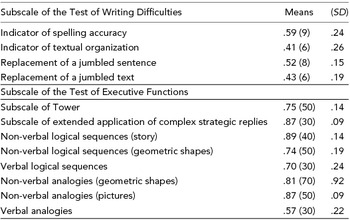
For the analysis of the results, the statistical program SPSS (V19) for Windows was used. Parametric statistical t test for independent samples according to sex was used in order to test the difference between the means of two independent samples. There were no statistically significant effects of sex on the students’ performance on both tests. Table 1 shows the means and standard deviations of the students’ performance on all subscales. The raw scores of the Test of Writing Difficulties are converted into decimal numbers for the analysis, but standard scores (from 2 to 16, mean = 10) are given in brackets, which allow for a better interpretation of the students’ performance. Additionally, the raw scores of the Test of Detection and Investigation of Executive Functions are converted into decimal numbers for the analysis, but percentiles (from 5 to 99, mean 50) are given in brackets, which allow for a better interpretation of the students’ performance.
Means and Standard Deviations of the Students’ Performance on All Subscales in Both Tests

Additionally, the Pearson correlation coefficient was used to show the degree of correlation between the students’ performance on all subscales in both tests. The data showed statistically significant positive Pearson correlations between the following subscales of the Test of Writing Difficulties and the total score of executive functions. These correlations are presented in Table 2.
Pearson Correlations Between the Students’ Performance on Subscales in Both Tests

Note: Correlations are significant at the *p < .05, **p < .01 level.
Moreover, logistic regression analysis was applied in order to examine the relative contribution of independent variables (subscale of the Test of Executive Functions) to the students’ performance on the subscales of the Test of Writing Difficulties. The analysis showed that: (a) verbal logical sequences were able to predict the orthographic accuracy (t = 3,437, p < .001), and (b) non-verbal analogies-pictures were able to predict the replacement of a jumbled sentence (t = 3,344, p < .002).
Discussion
The students’ performance on the Test of Writing Difficulties was found to be low when considering their ability to organise text and replace jumbled text, and low average with regards to spelling correctness and the replacement of a jumbled sentence. It is widely known that children with learning disabilities have difficulties in the organisation of a text (MacArthur, Schwartz, & Graham, Reference MacArthur, Schwartz and Graham1991) both in terms of form and content. Specifically, it seems that they have difficulties in using appropriate language, as well as in evaluating and detecting relevant or irrelevant information in a text. Additionally, low performance on the replacement of a jumbled sentence means difficulty in understanding the relations between the terms of a sentence, with an emphasis on their syntactic role based on features of morphology and syntax.
In the Test of Executive Functions the students showed the lowest performance on the scale of extended application of complex strategic replies to predetermined verbal stimuli and mainly on the scales of verbal inductive thinking (i.e., verbal sequences, analogies and completion of story sequence). First, these scales seem to better evaluate the children's reasoning ability in relation to their basic language skills (i.e., vocabulary, ability to read words); and second, they are less prone to attention problems and impulsivity. Comorbidity with attention problems and executive functions (especially functions related to the ability of control and inhibition) is very often observed in the population of children with learning disabilities (Simos et al., Reference Simos, Mouzaki and Sideridis2007). These findings confirm previous research evidence on this group of children for reduced ability to inhibit a spontaneous response, whether they focus their attention or not (Klenberg et al., Reference Klenberg, Korkman and Lahti-Nuuttila2001). Additionally, children with learning disabilities have a particular difficulty: (a) in shaping mental plans, (b) in assessing alternative plans, (c) in focusing attention and retaining relevant information appropriate for a particular task (i.e., reading, choosing appropriate words and making sense of a text), and finally (d) in the continuous monitoring and regulation of their behaviour (Hooper et al., Reference Hooper, Swartz, Wakwly, deKruif and Montgomery2002).
There were no significant sex differences in our study. Most research to date indicates that boys and girls develop executive processes at a similar rate during childhood (Welsh, Pennington, & Groisser, Reference Welsh, Pennington and Groisser1991). These findings are also consistent with those of Lompscher, Artelt, Schellhas, and Blib (Reference Lompscher, Artelt, Schellhas and Blib1995) in a sample of elementary school children with regard to sex differences. However, further investigation is required in order to draw reliable conclusions about the role of the gender.
Research data are in agreement with the findings of previous research (Cain, Oakhill, & Lemmon, Reference Cain, Oakhill and Lemmon2004; Graesser, Singer, & Trabasso, Reference Graesser, Singer and Trabasso1994; Hooper et al., Reference Hooper, Swartz, Wakwly, deKruif and Montgomery2002), as they revealed that executive skills are related to the production and processing of written language. Specifically, the total score of executive functions was significantly associated, first, with the production of written language at the level of spelling accuracy; and, second, with the processing of written language at the level of replacement of a jumbled sentence and text. In addition, the scales of the Test of Executive Functions (verbal logical sequences and non-verbal analogies/pictures) had predictive value for the spelling correctness and replacement of a jumbled sentence, as previously emerged from the logistic regression analysis. These data are important, as they could contribute to the detection of students who are at risk of developing difficulties in writing, taking into account further neuropsychological factors, such as memory, attention, motor skills, visual-spatial perception, and sequential processing (Levine et al., Reference Levine, Hooper, Montgomery, Reed, Sandler, Swartz, Watson, Lyon, Gray, Kavanagh and Krasnegor1993). Therefore, a significant correlation and predictability arises between the students’ executive functions, in the words of texts and sentences regarding the selective processing of their data based on spelling, syntax and conceptual criteria, and the final reproduction of sentences and texts. More specifically, it was revealed that inductive thinking, which evaluates reasoning ability, primarily requires the ability to focus attention on specific features of complex stimuli and to adopt an effective strategy of detection at a perceptual and cognitive level (conceptual representations and characteristics) in order to select the main characteristic of an analogy or a sequence. Such specific executive functions are important for every stage of the written language process.
Generally, adequate use of strategies during the production and processing of written language is considered to contribute significantly to the recognition of errors, the selection of semantic, syntactic and morphological components in sentences and texts, and to the control, by reviewing and replacing the structure and content of sentences and texts (Fiducia & O’Leary, Reference Fiducia and O’Leary1990; Hunt & Marshall, Reference Hunt and Marshall2005). Previous research (Giaouri et al., Reference Giaouri, Alevriadou and Tsakiridou2008, Reference Giaouri, Alevriadou and Tsakiridou2009) has shown no correlation between executive functions and textual organisation at the level of a text's consistency and coherence. More complex executive functions related to the recall of relevant knowledge and an appropriate thinking plan towards an integrated development of a theme with temporal and conceptual sequence seem to be required. It is well known that students with learning disabilities in writing concentrate all their efforts mainly on the proper performance of words and on corrections of mechanistic elements, and not on the enrichment of a text (i.e., the development of ideas and organisation) or on changes to the content (Baker, Gersten, & Graham, Reference Baker, Gersten and Graham2003).
Therefore, it is necessary to teach the major steps of the written language process, such as planning, drafting, recording and revising, with emphasis on familiarising students with different styles of texts (i.e., narrative, informative, persuasive; Gersten & Baker, Reference Gersten and Baker2001). Furthermore, the parallel teaching of metacognitive strategies not only enhances the standardisation of behaviours and familiarises students with their abilities and disabilities, but it also contributes to behaviours of self-regulation during writing and encourages the development of learning motivation. According to research data, students with learning disabilities do not show strong motivation and usually adopt passive learning patterns. The attitude towards learning that characterises these students is called learned helplessness (Sideridis, Morgan, Botsas, Padeliadou, & Fuchs, Reference Sideridis, Morgan, Botsas, Padeliadou and Fuchs2006). Repeated school failure, which they experience, makes them firmly believe that they do not have any skills, so any attempt to learn is futile and unsuccessful. The consequence of this attitude is a constant attempt to avoid any engagement in cognitive tasks, such as writing, so as not to face a new failure. But this attitude deprives them of learning opportunities and new knowledge, confirming and consolidating the beliefs of low motivation, frustration and negative emotions. Since learning is a difficult process for them, they often experience low levels of school effectiveness. Most often, these low efficacy beliefs and low behavioural self-control are accompanied by expectations of low school performance, withdrawal from school projects, as well as unwillingness to try more and process deeper.
However, teaching self-regulation strategies in particular, such as goal setting, self-monitoring and self-confidence, appears to have a great positive influence on the students’ performance while writing a text (Harris & Graham, Reference Harris and Graham1996; Harris, Graham, & Mason, Reference Harris, Graham and Mason2003; Troia, Reference Troia2002). More specifically, teaching spelling performance metacognitive control strategies and using enhancers, such as a dictionary or a computer, make it possible for students to significantly improve their spelling performance. It is equally important to familiarise students with metacognitive skills, such as correction through peer teaching. Therefore, students are required to find and note their errors and then work with their classmates to correct their texts. This method helps them to reduce mechanistic errors and improve the appearance of their text (Crimi & Tompkins, Reference Crimi, Tompkins, Tompkins and Blanchfield2005). At the same time, the use of assistive techniques, graphic organisers and mnemonic techniques, such as semantic mapping techniques, planning sheets (where there are predesigned keywords) and visual-spatial organisers (charts, diagrams or tables), illustrate the relationship between central and supporting ideas of a text and help students to detect or create analogies and conclusions, and combine their ideas, based on the required structure of a text. Particularly when graphs are given to students with learning difficulties to guide them to write paragraphs, with spaces for recording data such as the topic of a paragraph, the basic ideas, the hierarchy of ideas and the linking words, then the improvement of the content and the structure of the paragraphs is assured (Schumaker & Deshler, Reference Schumaker and Deshler2003).
In summary, the usefulness of these tests refers to the detection of cognitive factors associated with learning problems in the production and processing of written language. Thus, there is the possibility for reliable and sufficient data concerning the detection of learning difficulties and the detailed assessment for possible deficits in specific executive functions that contribute to the appearance of these difficulties. Finally, the neuropsychological evaluation of written language disorders provides school systems with a more viable option to assess and remediate children's learning disorders. Neuropsychological evaluations emphasise the functional integrity of specific core constructs included in the writing process, including language, motor, attention and executive functioning domains. It is important to note that the goal of a school-based neuropsychological evaluation should not only be to explain a child's unique learning style, but also to serve as a bridge for effective intervention techniques.
Several limitations of this study may have affected the overall results and interpretations. First, this study was limited by its small sample size. A larger, more diverse sample would have been beneficial for our results in order to ensure a representative distribution of the population and to be considered representative of groups of children to whom our results will be generalised or transferred. Ideally, the number of participants would have been more evenly distributed across years in school, age and nationality. Second, the lack of a control group may suggest alternative explanations to improved expository compositions. Although the brevity of the study attempted to control extraneous variables, without a true control group practice effects could not be parcelled out. Another possible improvement to the study could have been to interview the participants. Personal interviews could have elicited greater information regarding the participants’ learning motivation and attitudes towards writing. Our methodology could have also included surveying or interviewing individuals involved with the participants; for example, teachers, family and co-workers could have been part of the study. Future research should attempt to replicate these results across different writing compositions (e.g., persuasive, narrative, opinion), exploring simultaneously additional executive functioning capacities that are critical for successful writing. However, this study is a significant attempt to provide a stepping stone for further research in the area of executive functions and their relationship with writing in special populations.