To Thomas Nagel (Reference Nagel1974), a thing is conscious if there is something that it is like to be that thing. We know there is something it is like to be a person. We can imagine that there is something it is like to be a cat, as we see cats navigating their surroundings and making various decisions. However, we cannot say, with any confidence, that there is something that it is like to be a banjo. While consciousness is not under examination this paper, it does get us quickly to the point: we can say that there is something that it is like to be a person who composes, performs or listens to music, as these are conscious acts, but something that does not have consciousness, such as a banjo, does not compose, perform or listen to music. A person might use a banjo as a tool, to perform, compose or even to listen. However, because there is nothing it is like to be a banjo, we do not see the banjo as an agent. I do not want to conflate agency with consciousness. In fact, I need them to remain separate. However, we can be sympathetic to this possible conflation, in that an inanimate object might be seen as the opposite of a conscious being and also the opposite of an agent. If they can share an opposite, it appears like we could be playing a Wittgensteinian language game, and consciousness and agency are merely the result of different languages describing the same thing. However, in this formulation, we are ignoring when the conscious combines with the inanimate. I will argue that when human and instrument interact, the instrument has agency and contributes to the music.
In this paper, I will explore how the banjo, and other instruments in a bluegrass performance, such as the guitar and fiddle, do offer a form of agency when they are combined with a musician. This agency will be seen as primarily social, instilled in the instrument–performer combinations by a form of reciprocation to past instrument–performer combinations. Bluegrass provides a particularly useful repertoire to explore these issues, as bluegrass has a relatively stable collection of instruments, and generally each instrument will take a turn performing the tune. This allows the examination of how each instrument–performer combination will approach a particular tune.
The difficulty in defining bluegrass is explored by Joti Rockwell (Reference Rockwell2012), while good overviews can be found by Robert Cantwell (Reference Cantwell2003) and Neil V. Rosenberg (Reference Rosenberg2005). In this article, my definition leans towards the repertoire that is performed in bluegrass jam sessions around the world, but especially in the USA, which is where I encounter the music, playing guitar, mandolin and banjo. The repertoire in these jam sessions does vary from region to region (and even within a single city); it is generally centred on tradition, but also contains a flexibility. The traditional aspect comes from a tendency to focus on old-time fiddle tunes, and songs recorded by the likes of Bill Monroe, Jimmy Martin, Flatt and Scruggs, and the Stanley Brothers. While the flexibility is demonstrated by the speed that tunes, such as John Reischman's ‘Salt Spring’ (Reference Reischman2001), can become part of a large shared repertoire and can be performed together by people previously strangers, or the addition of tunes from more experimental artists like Bela Fleck, or the inclusion of cross-genre tunes such as ‘I've Just Seen a Face’ by the Beatles (1965) in jams. It is this social definition that I am using, while understanding that the jam session repertoire is in dialogue with professional touring and recording musicians (see Gardner Reference Gardner2020, pp. 124–5).
There is a rich history of exploring the interactions of humans and musical instruments. This concept is central to David Sudnow's Ways of the Hand (Reference Sudnow1978), where he explores how his body adapted to the piano as he learned to play jazz. Through a phenomenological lens, Sudnow notes how the gestures of his hands change and conform to the gestures common in the jazz piano improvisation community. However, while Sudnow does see himself and others adapting to the piano, there is no sense of what the piano actively contributes. The piano is somewhat inert, and Sudnow moulds to it, ‘as time got into the fingers, hands, arms, shoulders, everywhere … my note choices, as good notes for such chords, coming under consistently thoroughgoing reformulation as a handful choosing’ (Reference Sudnow1978, p. 141). Handful, here, could be seen as mindful, but for the hands. Sudnow sees his hands as making decisions through practice, through a bodily knowledge, but the decision making is not shared with the piano, it only conforms to the piano. After the long process of moulding his hands to the piano, Sudnow then sees his hands making decisions on the piano, but not with the piano. Still, this bodily knowledge, developed from time with an inanimate object, necessarily acknowledges the inanimate object.
In David Huron and Jonathan Berec's (Reference Huron and Berec2009) account of idiomatic musical organisation in trumpet compositions, they move closer to exploring the participation of the musical instruments. Huron and Berec consider how compositions for the trumpet that are composed by a trumpet player better fit the affordances of the instrument, that is the compositions are more idiomatic. The trumpet becomes more active here, in that they consider that affordance is when ‘an object provides latent action possibilities and that the perception of an object may entail the apprehension of certain functions’ (Reference Huron and Berec2009, pp. 103–4). Here the trumpet is providing possibilities, and the perceiving of the trumpet can bring to mind how it might be used. There is a generative aspect to the trumpet, although the generative aspect is firmly within the human; the trumpet is perceived, and it is this human-created perception that is generative. However, that is still a situation where the human is thinking/doing something that they would not without having perceived the trumpet.
More recently, Jonathan De Souza's Music at Hand (Reference De Souza2017) offers an in-depth study of human–instrument interactions with particular attention paid to technics, which could be described as a mode of knowledge linked to the interaction between humans and technology (with technology being broadly defined). De Souza explores issues such as Beethoven's use of violin and piano as a prosthetics, helping him to compose after losing his hearing. He argues that the physicality of interacting with instruments was generative to Beethoven as a composer. This goes further than Huron and Berec, where the perception of the trumpet can be generative, as De Souza is viewing a musician who already has a strong perception of the piano or violin but continues to need them in his creative acts. In further issues, such as exploring the use of the prepared guitar, De Souza shows how sabotaging an instrument will limit certain aspects while also opening up new affordances for exploration. To sum up his thesis, he explains: ‘technics opens up possibilities for musical action and cognition. As I use instruments to make music, they also make me a musician’ (Reference De Souza2017, p. 167).
Gavin Steingo (Reference Steingo2017) offers an account of object independence and interdependence when examining the creation and distribution of music in Soweto, South Africa, where the infrastructure leads to frequent accidents and disconnections from systems. Steingo points out that the more an object relies on relationships, the less able it is to function outside of its intended context, whereas an object that is less related to its context brings an independence of use. Drawing from Fred Moten (Reference Moten2003), Steingo sees that it is the resistance of objects that makes them relatively stable, autonomous and more flexible. The resistance allows the object to remain as that object, even when used in combination with other things. This resistance is something we will encounter in bluegrass instruments, which I am focusing on, and is something that I view as important to the genre.
Many of the above studies either draw on or are indebted to the phenomenology of Martin Heidegger, in particular, his tool analysis (Reference Heidegger, Macquarrie and Robinson1962, pp. 95–102). In his tool analysis, he notes that when a skilled person uses a tool, the tool disappears from their phenomenological view. That is, the tool is ready-to-hand (zuhanden). The user only notices the tool if it breaks, or if they do not know how to use it, that is, when the tool is present-at-hand (vorhanden). Using the standard example of a hammer, when it is functioning correctly, it is ready-to-hand and the user does not notice it. However, if the hammer breaks, the object of the hammer becomes very apparent in the user's hand. The hammer becomes present-at-hand.
In recent decades, Heidegger's tool analysis has become of central interest to Object-oriented Philosophy, stemming from Graham Harman's observation that in neither case (ready-to-hand or present-at-hand) do we ever fully come into contact with the tool (Reference Harman2002). When the tool is present-at-hand, we see it as resisting. The tool is foreign to us, and the distance is apparent. However, even when the tool is ready-to-hand, we also do not have access to the complete object of the tool, only to what is available to our senses, that is, the tool is still resisting, or in Harman's language, the object withdraws. We are only using the hammer to perform a function, but the hammer is capable of much more than that function. Harman explores this concept with cotton and fire as two objects:
When fire burns cotton, it makes contact only with the flammability of this material. Presumably fire does not interact at all with the cotton's odor or color, which are relevant only to creatures equipped with the organs of sense. Though it is true that the fire can change or destroy these properties that lie outside its grasp, it does so indirectly: through the detour of some additional feature of the cotton that color, odor, and fire are all able to touch. The being of the cotton withdraws from the flames, even if it is consumed and destroyed. Cotton-being is concealed not only from phenomenologists and textile workers, but from all entities that come into contact with it. (Harman Reference Harman2011, 44)
When Harman considers something an object, as he does cotton and fire, it is his own definition of an object. To Harman, an object is anything that cannot be reduced solely to knowledge. The reduction of something to knowledge is made either by undermining, where an object is broken down into smaller parts (cotton could be thought of as a collection of elements), overmining, where an object is reduced upwards to its relationships (cotton might be thought of as a collection of social relationships involving growers, pickers, buyers and so on), or duo-mining, which is the combination of both under- and overmining. That an object cannot be reduced to knowledge is the concept that I will move forward with when considering bluegrass instruments and musicians.
Bluegrass fiddle tunes
Bluegrass fiddle tunes are well suited to exploring the agency of instruments and the resistance of instruments as objects, as the form of a bluegrass fiddle tune brings to the spotlight what each instrument contributes. To start, I will use the analytical tools already available for viewing form, and then explore what we gain and where they fall short in our study. The analysis of form inherited from classical music sees a traditional bluegrass fiddle tune as most commonly based around a repeated small-binary formal unit. Each soloist will take a turn playing through the tune. While it might be tempting to think of this as either a standard jazz form or theme and variation, there are significant differences. In jazz, there is typically a head, followed by soloists taking turns improvising over the harmonic progression. In a bluegrass fiddle tune, a break (in bluegrass a solo is often referred to as a break) is often based on melody, rather than the harmony, which means there is no statement referred to as the head – it is breaks all the way down. In theme and variation, there is often an attempt to give each variation its own unique character, whereas in bluegrass, while there is variation, the character remains relatively steady throughout.
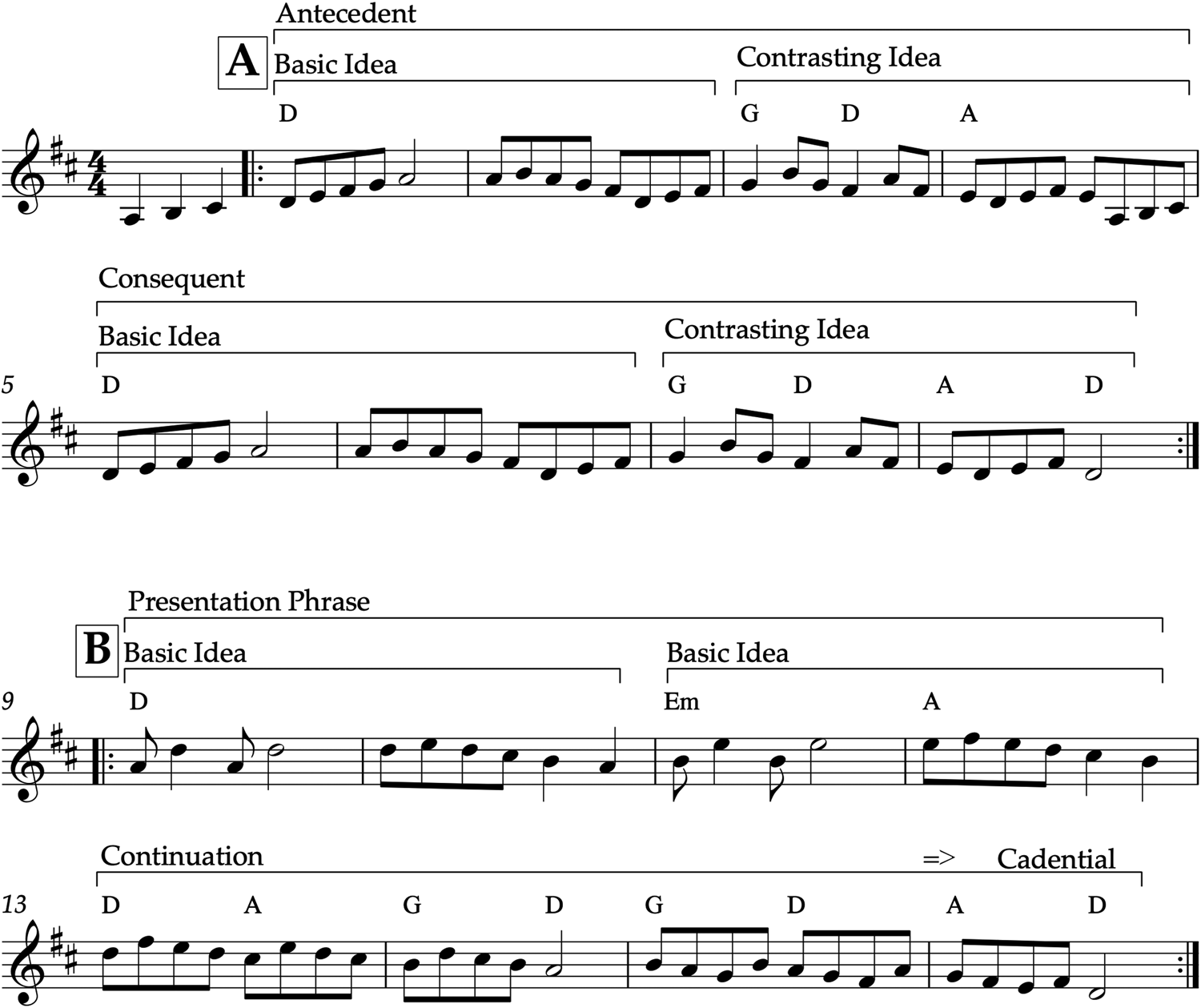
A classic approach to analysing form is shown in Example 1, with a look at ‘Whiskey Before Breakfast’. This highlights the formal similarities with other genres, but also goes some way to showing what is missing in examining bluegrass from this perspective. Inside the small-binary form, which is also common to both jazz and theme and variation, there are form types that fit traditional music-theory paradigms. The A section is analogous to a period, with the main difference from a classical period being that there is no real half cadence, but more of an arrival on the dominant. Nonetheless, the function is the same: a phrase with an open ending is followed by a phrase with a stronger ending. The period is by far the most common structure in bluegrass A sections. The B section of ‘Whiskey Before Breakfast’ closely matches a sentence, complete with sequence, fragmentation and increased harmonic rhythm in the continuation.
‘Whiskey Before Breakfast’.Footnote 1

The overwhelming majority of bluegrass fiddle tunes do fit form types that any reader of Caplin's Classical Form (Reference Caplin1998) would find familiar. However, to look at bluegrass form, other social connections need to be considered, as the tune is passed around a group of musicians, each adding their own interpretation. In a musical style where multiple performers repeat variations of a melody, looking at the form in a traditional music-theory perspective, despite mapping onto the tunes very well, misses much of the point, especially as it is a language that was never intended for bluegrass. We need to be able to consider the musicians and their instruments.
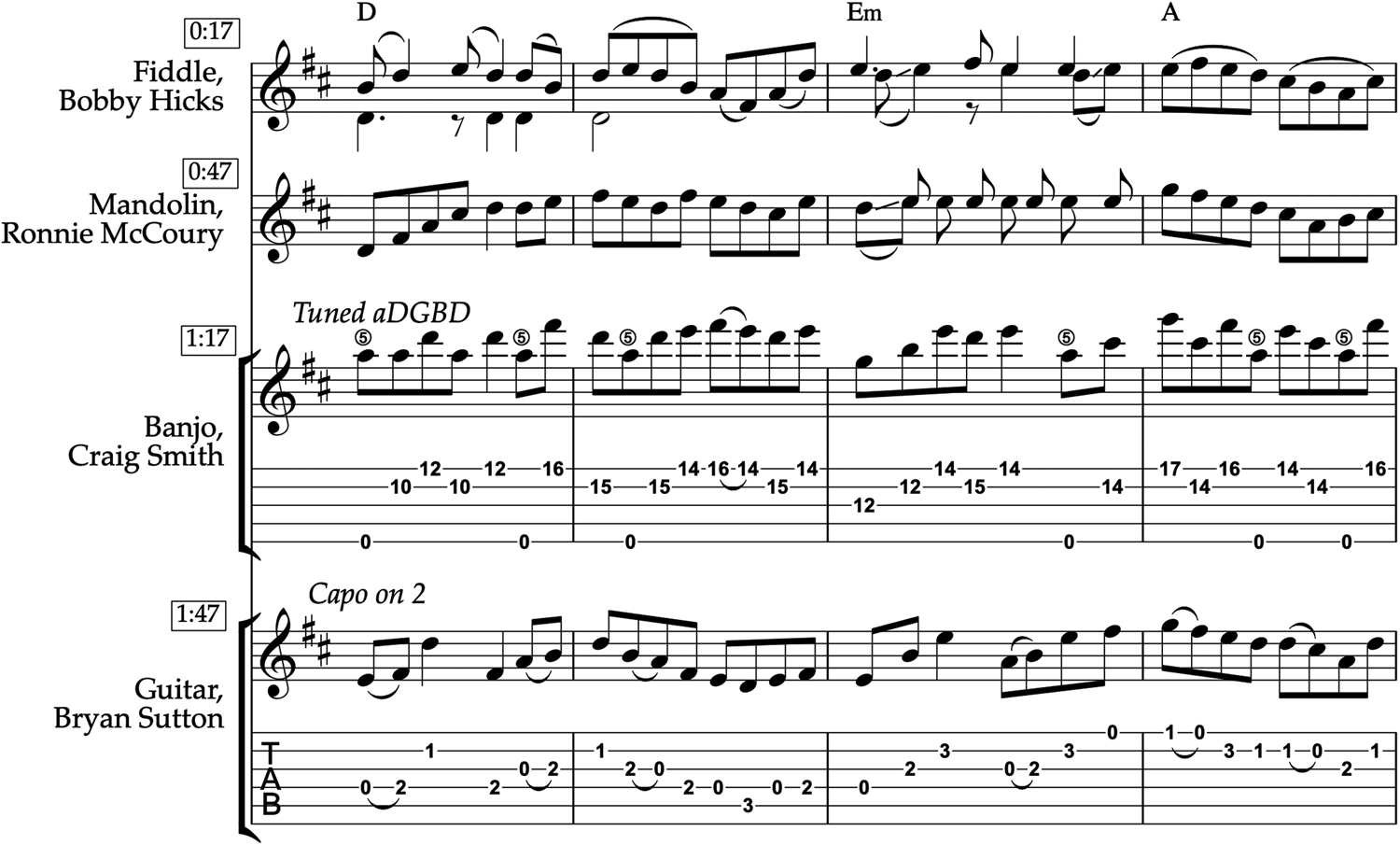
To illustrate the instrumental differences, in Example 2, the first four measures of four instrumentalists’ statements of the B Section are compiled. These are taken from a performance of ‘Whiskey Before Breakfast’, from the Bobby Hicks album Fiddle Patch (Reference Hicks1998). Hicks is key fiddle player in bluegrass history, having played with Bill Monroe in the 1950s, and later with Ricky Skaggs, and his album Fiddle Patch features both traditional and contemporary tunes, many of which, including ‘Whiskey Before Breakfast’, are often encountered in jam sessions. Each player approaches this passage in a way that makes use of affordances of their instrument. To this end, there are alterations made to the tuning of the guitar and banjo that allow the player to use the instrument in an idiomatic bluegrass style in the key of D: the banjo has the high fifth string, which mainly acts like a drone, raised to an A, which is more useful than the standard open G; and the guitar has a capo on the second fret to allow the melody to be accessed from an open C major shape.
‘Whiskey Before Breakfast’, B Section from Bobby Hicks's Fiddle Patch.

On the fiddle, Bobby Hicks makes use of the available open string pedal tones to support the melody. While the mandolin is tuned identically to the fiddle and with a very similar scale length, this same approach would not work, as a mandolin is played with a plectrum, rather than a bow, and has double-strung courses. These aspects partly lead to the mandolin having a sharp attack and quick decay. If the first measure of fiddle extract were played on the mandolin, it would naturally begin with a down–up picking pattern, and to maintain the D drone, it would need to be re-struck often. If the D drone was hit with each new melody note, it would create an awkward situation for the player to hit the D drone on an upstroke. The other option is to hit the D only on the downstrokes, but this would overemphasise the strong beats and is counter to the tune's feel, so the passage is necessarily different. In the third measure, Ronnie McCoury repeatedly hits alternative versions of the E on the mandolin, both open and stopped, as opposed to Hicks on the fiddle, who emphasises a longer held unison. Otherwise, the similarity of the instruments leads to relatively similar breaks.
Craig Smith and Bryan Sutton make use of the common chord shapes of the banjo and guitar, respectively. However, even though either passage can fit within the range of either instrument, the differences in tuning, along with the three-finger picking method common to bluegrass banjo playing (as opposed to guitar flatpicking), leads to the passage being played differently. The three-finger banjo style creates a strong performance preference for using a new finger or thumb in the picking hand for each note, as well as a new string for each note, which are both outlined in Joti Rockwell's banjo study (Reference Rockwell2009). Measure 4 provides a good comparison: the guitar plays a predominantly linear pattern like the fiddle and mandolin, whereas the banjo supplements the line with chord tones to ensure that no two consecutive notes are played on the same string. Most of the passage can be played on the guitar using a combination of open strings and fretted notes from chord shapes, such as C and Dm. On the banjo, this approach would require the doubling up of notes on the same string. It better suits the instrument to move the melody further up the neck and allow the high open A string to contribute to the melody and spread it over multiple strings, aiding right-hand technique.
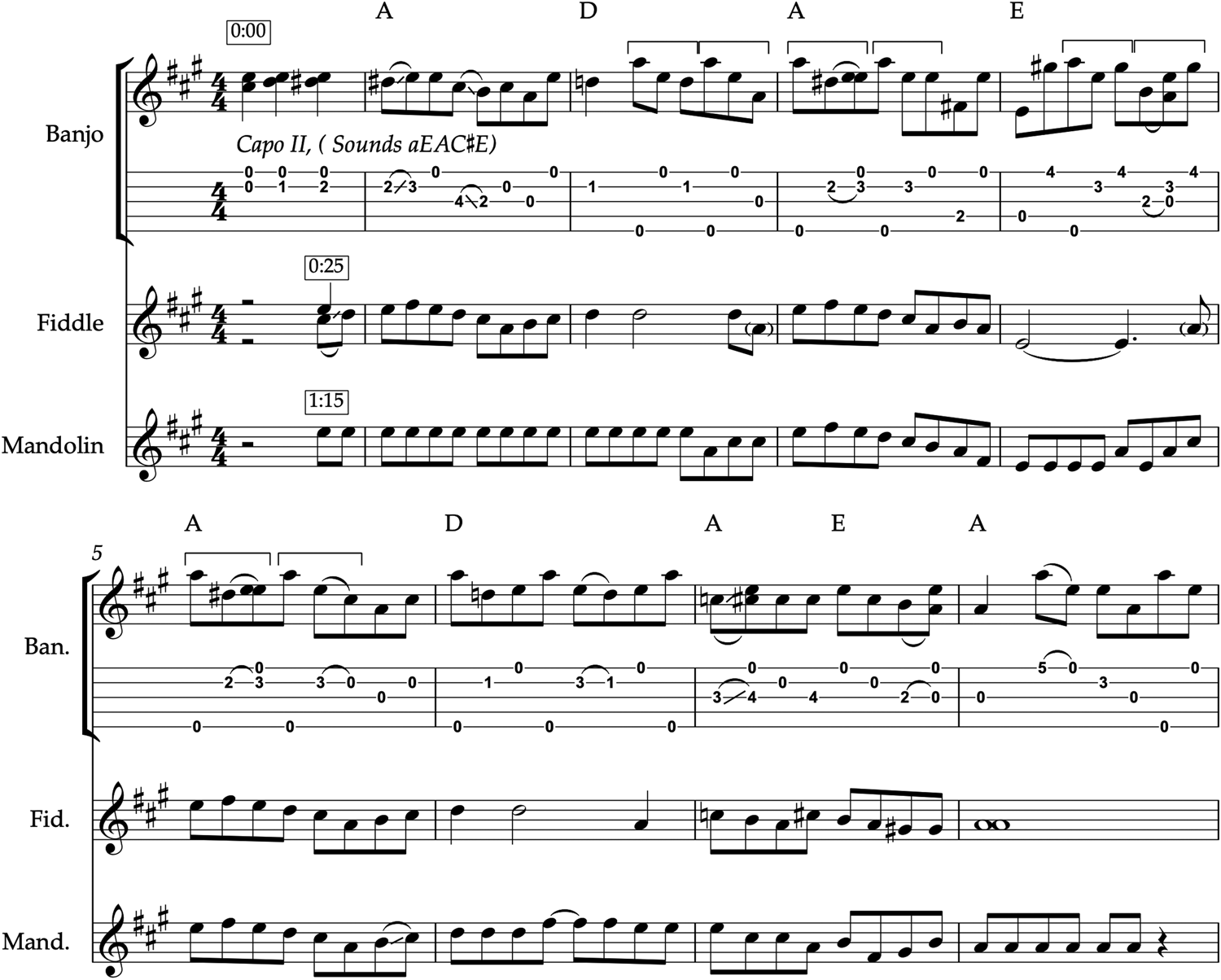
Bill Monroe's ‘Shenandoah Breakdown’ (Reference Monroe2005) provides another clear example of the differences between approaches in instruments.Footnote 2 The banjo is the main driving force of this song, with three breaks, but the fiddle and the mandolin also take a break each. The similarity between fiddle and mandolin, in contrast to the banjo, leads to two different approaches. Example 3 shows the first time through the A section of each player's first break. The A section is again a period type structure, finishing measure 4 in the example on the dominant before a stronger finish on the tonic at measure 8. The banjo's version of the tune features a high number of arpeggiations and three-note groupings (shown in the example with square brackets). Both of these features stem from the three-finger playing method and the performance preference that it creates for a different string for each note. It is noticeable in this section that the only time the banjo plays two adjacent notes on the same string, there is a slide, hammer on or pull off mediating the two notes. These articulations mean that only the first note needs to be struck by the right hand. Therefore, other than the three-beat kickoff, two adjacent notes on the same string are never struck by the right hand.
‘Shenandoah Breakdown’, A Section from Bill Monroe's Nine Pound Hammer.

Compared with the banjo, the fiddle and mandolin versions of the tune are very similar to each other, which makes sense owing to the similarities between the two instruments. The arpeggios are dropped here in favour of more linear melodies, which better suit the bow and plectrum. The violin, as it did in ‘Whiskey Before Breakfast’, makes use of the long-held notes that a bow allows (which become more frequent in the B section, not shown here); there are also slurs connecting notes (not notated in the example), which emphasise that the bow is not leaving the string. The plectrum-played mandolin replaces these long notes with repeated eighths. Part of the repetitive nature of the opening of Bill Monroe's mandolin break is probably a result of this example being taken from a live performance. When playing melodies, the banjo and the violin are capable of a greater volume than the mandolin. Robert Cantwell supposes that Monroe's ‘inimitable technique was born in an effort to simply be heard’ (Reference Cantwell2003, p. 49) in this loud setting. The mandolin's quick decay leads to it often using repeated note patterns to be heard in live situations. The repeated E at the start of the mandolin's break appears to be more of a player choice. This decision could arise from many things: fighting for volume, forgetting the melody briefly or the choreography movements of bluegrass, in which there is generally one microphone, and the person taking a break steps closer to the microphone to come through louder. A player caught further from the microphone at the beginning of their solo will sometimes play something simplified until they have moved into position.Footnote 3 Any of these issues could lead to Monroe playing the open E string repeatedly, even as the harmony moves to D.
It need not be different instruments that have variations, and the same fiddle tune can be approached in different ways by the same instrument. The banjo provides a good case study, as there are three predominant bluegrass styles, with the most common being ‘Scruggs style’, named after Earl Scruggs, who initially came to prominence in Bill Monroe's Blue Grass Boys and later in Flatt & Scruggs and the Foggy Mountain Boys. Scruggs style uses three fingers (thumb, index and middle) and generally involves playing the melody notes on lower strings, while other strings intersperse the melody with chord tones, utilising different patterns of string ordering (referred to as banjo rolls). Some of the more common rolls and performance preferences of Scruggs-style playing are outlined in Rockwell (Reference Rockwell2009). ‘Melodic style’ and ‘single-string style’ are the other two frequent styles.Footnote 4 Melodic style banjo retains many similarities with Scruggs style, such as the preference for not using the same string for consecutive melodic notes and not using the same finger to pick consecutive notes. However, melodic-style banjo playing aims for a closer representation of a fiddle tune. This is generally achieved by spreading the melody across the multiple strings, with fretted and open strings played next to each other to find linear passages.
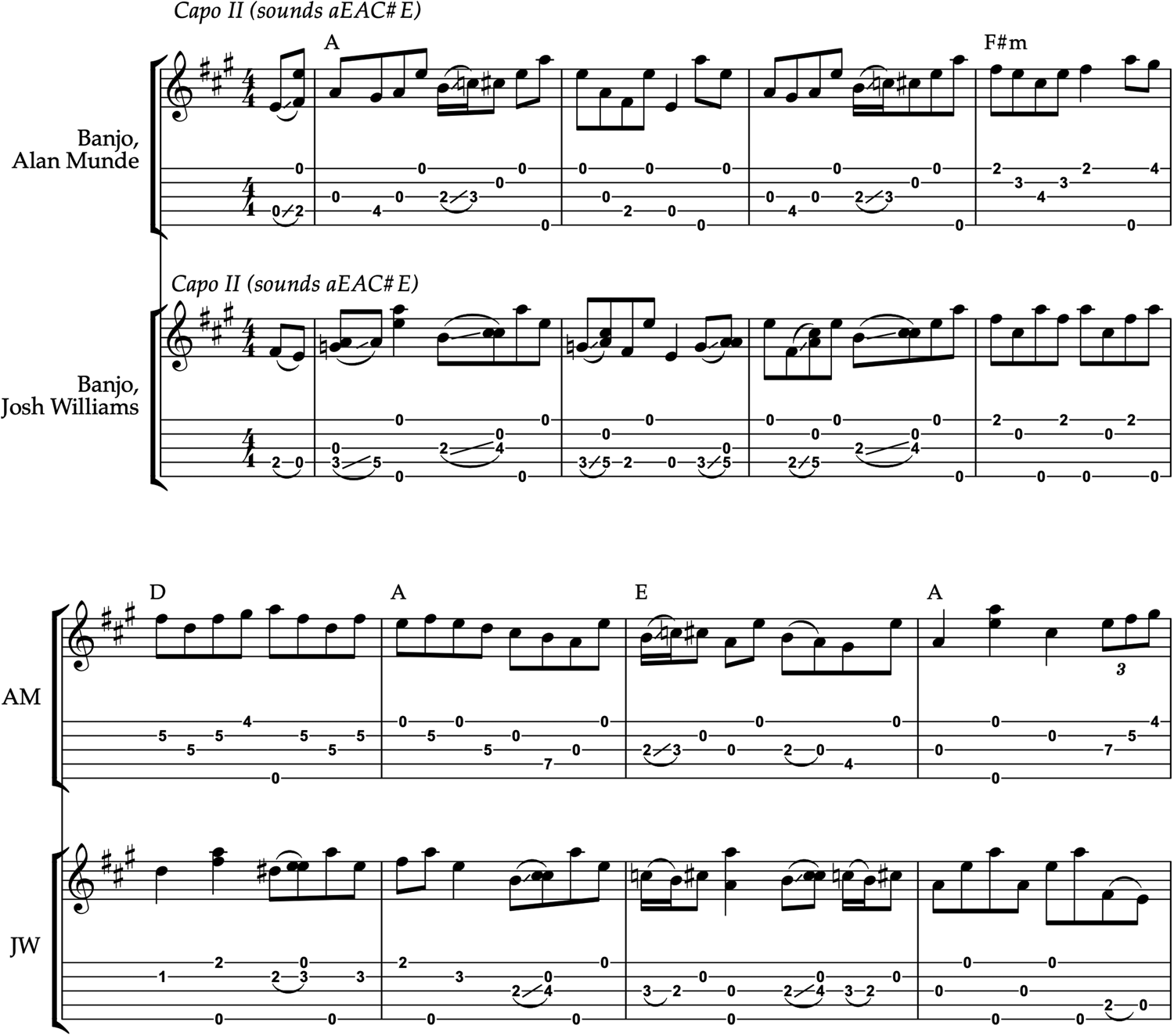
Example 4 provides an example of the fiddle tune ‘Cherokee Shuffle’ played by Alan Munde in melodic style (Country Gazette, 1987) and Josh Williams in Scruggs style (Williams Reference Williams2009). Both players use a capo on second fret to play the tune in in the traditional key of A major, although their approaches to playing tune are noticeably different. Measures 5–6 of the example provide the most marked differences: the melodic style, employed by Munde, emphasises the linear aspect of the melody, whereas Williams's Scruggs-style rendition has a simplified melody to allow more use of chord tones. However, there are still similarities required by the instrument, with neither performer playing two picked, consecutive eighth notes on the same string or with the same picking finger. In the melodic style, one can see the lengths needed to avoid string and picking finger repetition. This is demonstrated clearly in measure 6 of the example, where the traditional notation shows a predominantly stepwise melody, while the tablature below shows the string crossing required to play the linear passage with each note on a new string. Each player's mode of access, while restrained by the relationship between banjo and human body, is different and allows access to different aspects of the tune, such as linear passages or a combination of melody and harmony. At this point, it will help to consider the role of inanimate objects as agents in greater depth, before returning to bluegrass performances again.
‘Cherokee Shuffle’, Melodic and Scruggs style, from Country Gazette's Strictly Instrumental and Josh Williams's Down Home.

Josh Williams is most noted as a guitarist, having both a solo career and playing as a side musician for other artists, such as Rhonda Vincent. Yet despite being a guitarist, in the above example, he plays idiomatic banjo (in fact he plays every instrument on the track) and he has also played mandolin professionally, notably for Tony Rice. Multi-instrumentalism is not uncommon in bluegrass. There is crossover between many instruments, such as the mandolin, guitar and banjo being all fretted string instruments, and the fiddle and mandolin being tuned the same and of approximately the same size. This allows musicians to easily adapt to other bluegrass instruments, but it also leads to the question: why does an artist choose to play multiple instruments, rather than a single instrument? There is definitely an answer that views this economically, as creating more opportunities for a player – as amateurs they can switch to under-represented instruments in a jam session or as professionals be hired in more roles. However, what I want to explore below is the idea that the instrument is also bringing something to the tune, in collaboration with the player.
Inanimate objects as agents
The idea that external-material considerations shape a creation is referred to by Jean-Paul Sartre as technical intentionality. Building on ideas from Lewis Mumford, Sartre examines how steam engines led to large factories (Reference Sartre and Sheridan-Smith2004, p. 154). A simple idea that includes a steam engine, such as having the engine turn a circular saw to cut wood, does not include any preference for a large factory. However, the steam engine has additional requirements: labourers to run it, engineers for its upkeep, coal stored on-site, among a host of other things. Therefore, the steam engine, owing to these requirements, necessitates a large factory. Levi Bryant sees in Sartre's observation that: ‘[h]ere we have an example of the machine itself issuing certain imperatives on its designer that run away from the intentions of the designer’ (Reference Bryant2014, p. 19).
Similar to the steam engine, the fiddle, mandolin, banjo and guitar in the passages above exhibit technical intentionality, issuing imperatives on the player to realise a melody in one way rather than another. At this point, we might not be able to say that the instruments are actively contributing to the composition, but they are passively steering the player towards some choices and away from others. By playing the same tune over multiple instruments, and with players attuned to their instruments, there is a resultant variation in the melody. Not all variation can be attributed to the instrument, as different players will make different decisions on the same instrument, but each player is influenced by their instrument's technical intentionality.
In bluegrass, a perfect replica of an ideal melody (if such a thing even exists) is not the aim, but instead, it is the instrumentalists’ version of the piece that takes priority. Within each statement of the tune, the instrument resists. As a result, the tune must be altered to fit the instrument better. Through this process of resistance, the tune is contaminated by the instrument and the musician, working to overcome the resistance in potentially unique ways. I use contaminated in the sense of Anna Lowenhaupt Tsing, who argues for the generative power of contamination and its ability to create variations (Reference Tsing2015, pp. 27–9). Not only does the contamination of the tune by the musician and instrument provide variation within bluegrass melodies, it also provides sound. It is only through the contamination of the melody with an instrument that the melody becomes audible.Footnote 5 In bluegrass, rather than attempting to downplay this act of contamination, it is made a feature of the form. In bluegrass jam sessions, the importance of instrumental variation is commonly observed, with the leader of a jam (the person who decides who takes each break) often ordering players to avoid repetition of the same instrument, if more than one of a particular instrument is present.Footnote 6
Externalism, that is, the concept that what we think is not entirely determined by our internal processes, is helpful here. So far, the instrument's role in shaping its variation of the melody in a fiddle tune could be described as what Andy Clark and David Chalmers (Reference Clark and Chalmers1998) have labelled passive externalism, in reference to Hilary Putnam's externalism outlined in ‘Meaning and reference’ (Reference Putnam1973) and ‘The meaning of “meaning”’ (Reference Putnam2011). Passive externalism is a precursor to their model of active externalism. The key difference is that passive externalism is only causal, in that the external object has no part in our cognition other than providing limitations and possibilities for our internal processes. Whereas, in active externalism, the cognition is seen to exist in the relationship between human and the external world. Active externalism is central to Clark and Chalmers's concept of the extended mind. I will return to these ideas of externalism soon, after first examining a specific instance of a cognitive extension in bluegrass performance, in which a musician thinks with the guitar.
Bluegrass songs
In bluegrass, there can be a difference between taking a break in a performance of a fiddle tune and a performance of a song. When I first started to play bluegrass, an older musician at a jam session told me that ‘when you take a break in a fiddle tune, you play the tune, but when you take a break in a song, you don't play the tune’. That is, in a song, it is closer to the idea of playing to the harmony rather than the melody.Footnote 7
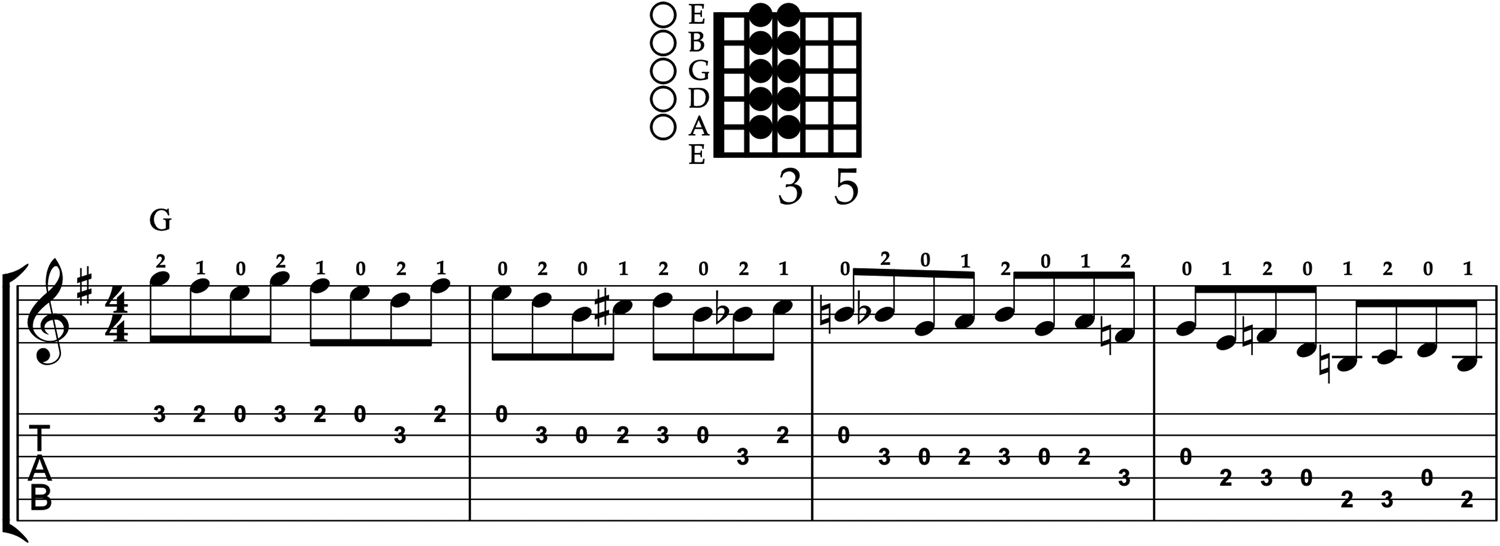
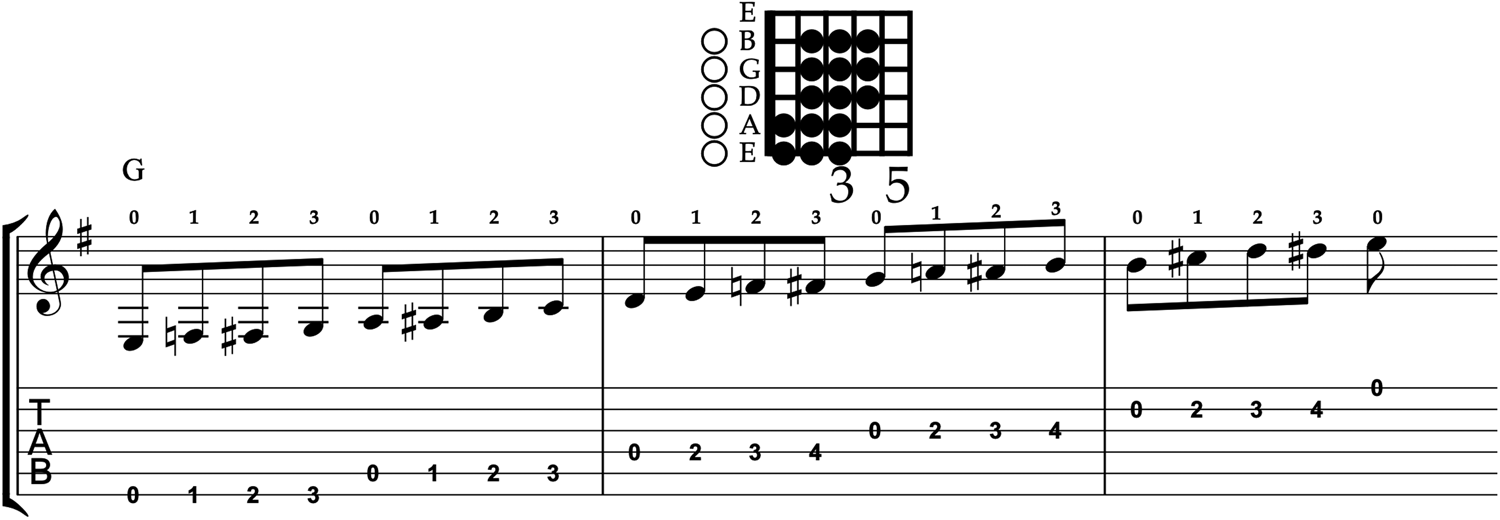
Multi-instrumentalist Norman Blake's guitar break in the song ‘Nashville Blues’ (n.d.) demonstrates the instrument's role in a song when the tune is less of a consideration. Blake's solo is, while idiomatic to Blake's own technique, a good representation of a bluegrass musician playing to the chords, rather than the melody, and clearly emphasises the instrumental patterns belonging to the instrument. In the two passages that I will concentrate on, Blake takes a fretboard pattern and moves it across multiple strings of the guitar, providing an interesting collection of chromatic alterations. It is the tuning of the guitar, its arrangement of strings and the chromatic fretboard that, along with Blake, shape the performance.
In the first passage, shown in Example 5, 10 pitch classes are used, only missing A♭ and E♭. On the surface, that the chromatic scale degrees ♭ $\hat{2}$ and ♭
 $\hat{6}$ are missing is consistent with the bluegrass style. However, by sticking to a strict fretboard pattern of open strings and frets 2 and 3, registral differences determine when one scale degree is used over another. In the higher register, Bake uses only a ♮
 $\hat{7}$ and ♯
 $\hat{4}$, while in the lower register, he only uses the ♭
 $\hat{7}$ and ♮
 $\hat{4}$. The placement of the two sevenths fits harmonic expectations, with the major seventh of G occurring in the first measure of the passage, and then shifting to the dominant seventh in the third and fourth measure, acting as V7/IV and preceding a move to C. However, the ♯
 $\hat{4}$ in the second measure, sitting between the
 $\hat{3}$ and
 $\hat{5}$, is a less frequent use of chromaticism and creates a Lydian sound, rather than the bluesy sound that the ♯
 $\hat{4}$/♭
 $\hat{5}$ would usually evoke in bluegrass, in which case the ♯
 $\hat{4}$ would often lie between
 $\hat{4}$ and
 $\hat{5}$, or in relation to ♭
 $\hat{3}$. Utilisation of similar passages to Example 5 can be heard in other performances of ‘Nashville Blues’ by Blake, where the analogous 4 measures make use of the fretboard pattern but present the notes in a different order. Importantly, the passages always maintain an overall descent that steers towards the secondary dominant of C at the end of the phrase. Using this fretboard pattern, the guitar does not allow an ascending run over this progression in a bluegrass style. It must be descending.
Norman Blake, ‘Nashville Blues’, first extract at 1:43.

The second passage, Example 6, shows Blake focusing on open strings and chromatically adjacent frets with fingers 1, 2 and 3 used sequentially. Again, over a G chord, here he uses every pitch class except for A♭. The fretboard pattern is shifted up a fret after two strings to continue to fit the harmony. By shifting the pattern up, Blake can retain the same fingering but hits more notes that are stylistically bluegrass, such as chromatically moving from  $\hat{6}$ up to
 $\hat{8}$ and from
 $\hat{2}$ up to
 $\hat{3}$, both of which can now appear at two different octaves. However, this pattern also results in the doubling of
 $\hat{3}$, leading into the b string at the start of the third measure of the extract, which breaks up the constant ascent, and also the use of D♯, or ♯
 $\hat{5}$, preceding E, which is less stylistically familiar.
Norman Blake, ‘Nashville Blues’, second extract at 1:48.Footnote 8

The fretboard patterns that Blake uses are easily accessible on the guitar fretboard, with the fingering remaining consistent over the parallel strings and fitting easily within the reach of his hand. There are no stretches that go beyond one fret per finger, and his fingers remain on adjacent frets. Through the patterns, Blake is realising the potential for the guitar to navigate the song. I have specifically chosen Blake's performance of ‘Nashville Blues’, because it makes strong use of instrumental patterns in performance. However, fretboard patterns such as these are not infrequently used by more modern bluegrass guitarists, and I have observed similar patterns in the improvised playing of both David Greer and Molly Tuttle, and I am sure they are used by numerous other players.
In these passages by Blake, it is harder to say that the instrument is only passively shaping an existing melody, as the solo is created by exploiting patterns on the guitar. We now enter a territory closer to what Clark and Chalmers consider as active externalism, where the cognition is found in the relationship between Blake and the guitar.
Active externalism and instruments
The classic example of active externalism that Clark and Chalmers use is that of a person with Alzheimer's who writes everything down in a notebook, which they refer to when necessary, creating memory that is distributed between notebook and mind. Another example is that of a blind person with a cane, where the cane is central to their cognition of the world. This concept is considered in the writing of both Maurice Merleau-Ponty (Reference Merleau-Ponty1962, p. 150) and Gregory Bateson (Reference Bateson2000, p. 318). An example that will be familiar to most musicians is when you cannot recall a melody or harmonic progression but can then instantly recall it as you play it on your instrument. In this case, the cognition of the melody is found in the relationship between the person and their instrument. As Jonathan De Souza has noted in his examination of harmonica performance, ‘the instrument might not be an autonomous agent – but, in a sense, neither am I. My own embodied agency is distributed; my actions respond to the instrument's call’ (De Souza Reference De Souza2017, pp. 80–1). When the cognition (for Clark and Chalmers) or agency (for De Souza) is distributed between human and non-human objects, it might be best not to consider the two parts, musician and instrument, separately. This distributed cognition does not negate the human, but instead, it becomes beneficial to look at ‘Norman Blake the Guitarist’ rather than Norman Blake or the guitar independently.Footnote 9
Having objects combine to form new objects is a central feature of Graham Harman's philosophy (Reference Harman2005 and Reference Harman2011). Harman's objects are made up of objects and can be combined to form new objects. A table might be a tabletop and four table legs, all of which are also objects in their own right. Furthermore, the tabletop is made up of objects such as wood, varnish and glue, while the table itself might be part of the object of the dining room. Even though objects can be combined to become new objects, the objects never truly come into contact with each other. This is because all objects are seen as containing an inexhaustible surplus. We can never know everything about an object.
Furthermore, to Harman, there is no ontological hierarchy of objects. The table is not more or less of an object than the tabletop or table legs. Nor is a human more or less of an object than a guitar. This is to say that all objects are equally objects and that humans do not precede any other objects ontologically. It is an ontology that decentres humans. This is not to deny many of the things that humans have, such as consciousness, or to claim any sort of panpsychism. It is an ontological statement that all objects, including humans, are equal, ontologically speaking. Humans are not granted a unique ontological status of their own.
The object of Norman Blake the Guitarist contains both Norman Blake and a guitar. Nevertheless, like fire and cotton, Norman Blake and the guitar never completely come into contact with each other owing to the fact that they can never exhaust each other's surplus. There are things that the guitar is capable of that Norman Blake cannot access; without stretching our imagination, we know that another musician can find new things to do on a guitar that Blake has never done, or, taking it further, Norman Blake cannot directly access the guitar's flammability. Likewise, there are a lot of aspects of Norman Blake that the guitar cannot access, such as his thoughts about dinner. De Souza's exploration of a sabotaged guitar requires a similar distance between guitarist and guitar: when using a prepared guitar or alternative tunings, new areas of the instrument's surplus can be opened up, while potentially limiting access to previously open areas. De Souza notes that ‘the guitar is not simply “instrumental” (that is, directed to some purpose); it is also aesthetic. The instrument never fully disappears in its practical functioning’ (Reference De Souza2017, p. 106).
In similar ways, the combination and relationships between things are also essential to Levi Bryant's Onto-cartography (Reference Bryant2014), in which he considers everything to be a machine. In some ways, a machine is similar to Harman's object, in that it contains an inexhaustible surplus, but a machine is something that does something to other machines; interconnection is necessary to a machine. Therefore, like objects, machines can be coupled to form larger machines, and, in the same way, the new machine is created because it has new powers, for which Bryant uses the Deleuzian term ‘emergence’. Importantly to Bryant, the natural state of coupled machines is failure, where ‘the parts of a machine never quite harmonize’ (Reference Bryant2014, p. 79). Like Harman's object, this failure is due to the machine's surplus that keeps them separate. However, this failure is essential to the understanding of instrument–player couplings in bluegrass: it is the failure in Blake's coupling with the guitar that creates distance between them, and it is the bridging of this distance, or circumventing this failure, where meaning and identity occur. The idea is also similar to Latour's conception of groups, where the resistance is framed socially: groups do not continue naturally and take effort to maintain, and this effort will produce information (Reference Latour2005, p. 32). The takeaway here is that the combination of Blake and the guitar creates something that they are incapable of separately, something that cannot fully be explained by looking at either Blake or the guitar individually, and new information is created as they battle failure to remain one object. Blake's break in ‘Nashville Blues’ can be seen as a new surplus, as information created, or the result of emergent properties of machines coupling.
Bluegrass instruments in the community
The dialogue with instruments is not limited to being solely between the instrument and its player, but each coupling of instrument and player (instrumentalist) is interacting within a larger social structure (the larger social structure explored by Kisliuk Reference Kisliuk1988 and Gardner Reference Gardner2020, pp. 117–20). The inter-instrumentalist dialogue, which helps to form a genre, has both generative and restrictive aspects on the music.Footnote 10
Crosspicking is a common bluegrass technique for both guitar and mandolin that provides an insight into how musician–instrument couplings can influence other musician–instrument couplings. A standard crosspicking pattern is shown in Example 7. At first glance, crosspicking does not seem suited to a plectrum-played guitar or mandolin as the use of three-string groupings goes against idiomatic picking patterns. When crosspicking, either a player will use strict alternate picking (down–up–down, up–down–up), which causes every other three-note group to be picked in the opposite direction or use directional picking (down–down–up, down–down–up), which retains the symmetry between three-note groups but breaks the preferred alternate picking pattern and places a downstroke on a weak beat. However, crosspicking needs to be viewed in relation to the bluegrass ensemble, where the three-fingered technique of the banjo often leads to three-note grouping, syncopated across strong beats. The interplay between instrumentalists within a community naturally leads to lines from some instruments appearing on others; the banjo does not contaminate just banjo practice, but also guitar and mandolin practice, and vice-versa. Sometimes when the banjo resists, the guitar player notices.
Crosspicking on the Guitar.

Within bluegrass, the relationships between instruments and players are particularly important, with Goldsmith observing that:
Even the specific instruments played by the founding pickers had immense influence. Monroe's Gibson F-5 mandolin, the big Martin D-28 guitar played by [Lester] Flatt, and the Gibson Mastertone banjo wielded by Scruggs became the instruments of choice. Throughout the history of bluegrass, especially beginning in the 1960s and early 1970s, collecting and preserving desirable vintage instruments became part and parcel of the bluegrass experience. Mandolins like Monroe's and big-bellied, pre-World War II Martin ‘dreadnought’ guitars came to bring fabulous prices. The network of instrument collectors and fans also served as another means for information about bluegrass to spread beyond its relatively limited early audiences. (Goldsmith Reference Goldsmith2004, p. 5)
Finding out what instruments people play, buying and trading instruments, and seeing those instruments as having a relationship with early players in the genre all provide connections between players within bluegrass. Rosenberg (Reference Rosenberg2005, p. 153) observes that ‘bluegrass musicians didn't play just any mandolin, they played (or sought to play) the pre-war Gibson model F-5 as used by Monroe, just as banjo-pickers preferred the old Gibson Mastertone models, with the flat-head tone ring, as used by Scruggs and Reno’. Within these connections, the sound and heritage of the instruments can be held up as being as important as the players themselves, with Sandy Rothman (Reference Rothman and Goldsmith2004, p. 311) reminiscing about the sound of ‘two fine old Gibson instruments ringing together (his 1923 mandolin, my 1930s banjo)’ when playing duets with Bill Monroe. David Grisman and Tony Rice released the album Tone Poems (Reference Grisman and Rice1994) intending to highlight the tone of vintage instruments, where the liner notes draw attention to the value and rarity of the instruments they are playing (Grisman and Rice Reference Grisman and Rice1994).
In certain circumstances, a musician and instrument coupling becomes so strong that other musicians might avoid it, rather than copy it. This might be the case with Bill Monroe's earliest competitors in Bluegrass. Bill Monroe is most closely associated with the Gibson F-5 mandolin. Early in his career, Monroe was considered to have a unique mandolin style. James Rooney considers that through his playing, Monroe ‘was creating a style on the instrument that also distinguished the Monroe Brothers from their competitors’ (Rooney Reference Rooney and Goldsmith2004, p. 41) and Ralph Rinzler has noted that ‘the style of mandolin picking associated with blue grass music is radically different from any approach to the instrument which existed prior to Monroe's appearance’ (Rinzler Reference Rinzler and Goldsmith2004, p. 138), while Richard Smith views the F-5 Mandolin as having a direct influence on Monroe's style (Smith Reference Smith2001, p. 78). With Monroe's style being considered a unique and distinguishing feature and being linked to the F-5, it would make sense that other groups might initially want to avoid it. While the F-5 is now the standard bluegrass mandolin, two of the other early major bluegrass acts contemporary to Monroe, both led by former members of Bill Monroe's band, Jimmy Martin and Flatt and Scruggs, had mandolin players who instead used a Gibson F-4 or F-2 model. Marty Godbey recalls that Martin's mandolin player, Paul Williams, saw the F-4 as being important to their own sound: ‘“That F-4 really helped set the tone of the trio we had” Paul said. “It was more of a bassy woodsy, sound. Old F-4s got a different tone than the F-5s did”’ (Godbey Reference Godbey2011, p. 53).
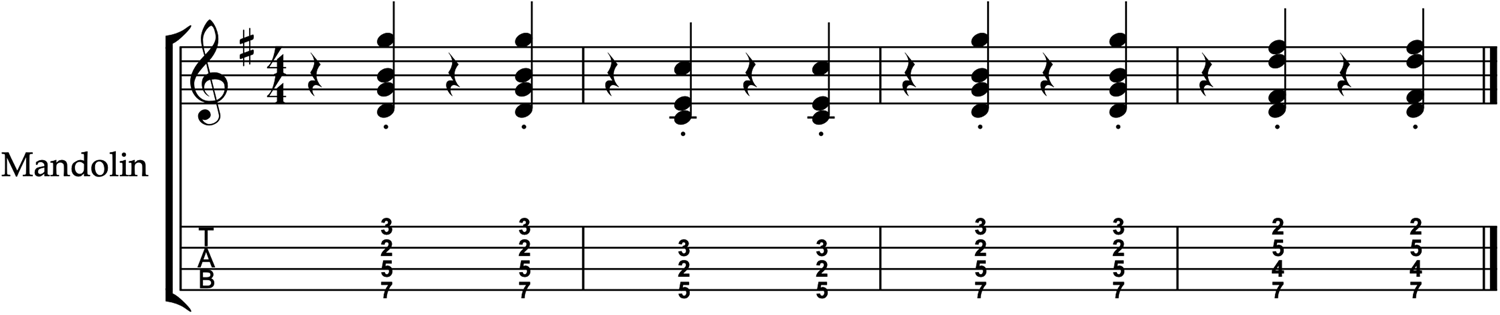
The difference in mandolin model is larger than it might initially seem. The F-5 mandolin favoured by Bill Monroe has F-holes in the carved top, similar to a violin. The F-holes on a mandolin lead to a sharp, percussive attack and very little sustain. However, the F-4 and F-2 models used by Paul Williams and Curly Seckler, who played with Flatt and Scruggs, have an oval hole in the carved top, closer in style to an acoustic guitar than a violin. Mandolins with an oval hole are less percussive and tend to have greater sustain, and ‘a round hole Gibson F-4, had a more mellow tone than that of the F-5s played by most bluegrass mandolinists’ (Rosenberg Reference Rosenberg and Goldsmith2004, p. 60). The F-5 is capable of what bluegrass players refer to as ‘chopping’, shown in Example 8. This is the practice of playing short, percussive chords on beats 2 and 4 of the bar using downstrokes, producing an effect similar to that of a snare drum in a rock band. The oval-hole mandolin models do not produce the same chopping sound when played in the same way and tend to be strummed in a style closer to that of a guitar. The use of an F-4 mandolin may have led to Jimmy Martin's inclusion of a snare drum, to compensate for the absence of the F-5's chop. While Martin's mandolinist Williams was highly talented, in Flatt and Scruggs, the mandolin ‘took a less important solo role until, in 1962, it was dropped entirely in favor of a second guitar’ (Smith Reference Smith and Goldsmith2004, p. 86). These all hint at the possibility of wanting to avoid the strong coupling of Bill Monroe and the F-5 model mandolin.
Mandolin ‘chop’ chords.

Following this initial wave of early bluegrass bands, where competitors may have felt the need to create distance, factors other than sound provide distance from Monroe, and the F-5 model becomes the most prominent, with Craig Harris noting that Monroe's Mandolin is considered the ‘Holy Grail’ (Reference Harris2018, p. 17), and Gardner drawing attention to how owning instruments based on noted players provides a link to the past, while also displaying a musician's study of the genre (Reference Gardner2020, p. 46). Monroe's particular instrument was signed by Lloyd Loar, the Gibson Acoustical Engineer who designed the F-5 mandolin, on 9 July 1923. There are 245 accounted for Gibson F-5 mandolins signed by Loar, dated between 1 June 1922 and 31 December 1924 (Beimborn Reference Beimbornn.d.). These Loar-signed F-5 mandolins are particularly sought after by bluegrass mandolin players, and playing a mandolin produced under the watch of the same builder can be seen as creating an even stronger bond to Monroe through the instrument. Notable Bluegrass mandolin players that use Loar-signed mandolins include Alan Bibey, David Grisman, Mike Marshall, John Reichsman, Herschel Sizemore, Ricky Skaggs and Chris Thile. It is important to note that the oldest of these players, Sizemore, is close to 24 years younger than Monroe. These are players who followed Monroe, rather than competed with him in the early years of bluegrass.
Resistance and gifts
The resistance of the instrument can partially explain why multiple instruments are used. If the instrument did not resist, we could make do with just one instrument, used in many ways in any style. Or, conversely, any single instrument could work in any genre, as the player could sculpt the non-resisting instrument to their own needs, without having to consider range, timbre, instrumental affordances, visual representation, and so on. However, this is not the case, as we have multiple instruments, each providing a different resistance. Genres and forms have, in part, grown out of the resistance of specific types of instruments, as the same types of instruments turn up repeatedly in different genres, such as the guitar in rock music, the drum machine in early hip hop and the banjo in bluegrass. Placing a strong emphasis on resistance might lead to some thinking that instruments only resist, but instruments still need to retain an aspect of openness so that they can be used creatively by a performer. This openness also means that the guitar used in bluegrass very closely resembles the guitar used in flamenco. Despite the Spanish guitar and dreadnaught model generally being constructed of different woods and utilising different bracing patterns and string materials, all match the sonic ideals of bluegrass and flamenco, and with neither guitar being idiomatic for use in the other genre, a player from either style can play something on the other's instrument with little trouble.
Instrument–-human couplings, such as Norman Blake the Guitarist, happen when resisting instruments couple with resisting humans. The human is independently cognitive, while the guitar is not. However, within the coupling, cognition can be distributed between both parties, with the human able to recall things, create things and hear things that they could not without the instrument. In the struggle to remain a single object, rather than two, fighting against the failure inherent to machines, individual musical styles, among other things, are created. Within this larger structure, the instrument–human coupling might couple with a bluegrass fiddle tune. The tune resists the instrument–human coupling, which in turn is also resisting the tune. Each becomes contaminated by the other, and a bluegrass instrument–human coupling plays a break. The inclusion of the instrument when considering the creative acts of music can provide an insight into genre creation when viewed in relation to the concept of gifts.
In his study, Marcel Mauss (Reference Mauss2011) examines how gifts remain associated with their givers. In opposition to gifts, Tsing observes that, not only are workers alienated from commodities, but commodities are alienated from workers. That is, the commodity shows no sign of the person who built it. When we look at our smartphones, we do not see the many individuals involved in making them: the commodity is alienated from the worker as much as the workers are alienated from the commodity (Tsing Reference Tsing2015, pp. 121–2). The key aspects of a gift, as opposed to a commodity, is that it is not alienated from its giver, and Tsing sees this as connected to a worker not being alienated from their commodity. The bluegrass break has this hallmark of a gift, in that it cannot be alienated from the instrument on which it was performed. Each break has the instrument's characteristics stamped on it: not only is Norman Blake attached to the break in ‘Nashville Blues’, but so is the guitar, suggesting that it is a gift from Norman Blake the Guitarist. It is this type of association that allows us to refer to a passage as pianistic, for instance, even if not played on a piano, or why crosspicking on the guitar can be connected to the three-finger banjo technique.
Within the bluegrass culture, fiddle tunes, songs and instrumental techniques could be viewed as a form of social currency. Kisliuk (Reference Kisliuk1988, p. 150) notes the importance of musicians selecting songs that other musicians can contribute to, but that are also not overplayed. Cantwell explores bluegrass jams as an aural tradition, where recordings and other performers’ material do not act as a score, that is as a plan, but as a resource that performers can draw on in their own playing (Reference Cantwell2003, p. 150). Further to this, Cantwell (Reference Cantwell2003, p. 150) notes how if a player's contributions reach too far, or are not easily repeatable (and therefore not contributing to the shared resource), the player ‘may be admired … [but] it is evident at the same time that he wishes to declare his independence of the tradition, which most back-porch musicians will readily grant him’. This reciprocation of the gift is equally important in Maus's study. If a musician breaks too far from the social traditions, it denies the others in a jam session the ability to reciprocate.
This reciprocation can also be viewed in relation to instruments, where the reciprocation of a gift from an instrument creates a replication of the relationship between musician and instrument. Malone and Laird (Reference Malone and Laird2018, p. 388) consider that ‘The bluegrass “sound” did not become a “style” until other musical organizations began copying the instrumental and vocal traits first featured in Bill Monroe's performances’. This copying is an act of reciprocation, and it is important to note that the reciprocal gifts almost always included the same instrumentation. The bluegrass band has remained strongly connected to the mandolin, banjo, fiddle, guitar, bass and vocals. There are some variations – notably Flatt and Scruggs would include a dobro player, which has become an accepted bluegrass instrument, but other variations, while they do occur, are minimal.
This reciprocation of the gift, or the reproduction of certain relationships characteristic to an instrument, is important to bluegrass style formation. One might still argue that, even in a particularly idiomatic solo, such as in ‘Nashville Blues’, Blake is the only creator attached to the solo, and that the guitar is not part of the cognition. One might make the case that Blake found all of those guitar patterns, and any contribution from the guitar is strictly a passive form of externalism. However, what happens when someone else reproduces those patterns when influenced by Blake, that is, when another player reciprocates? Once it is reproduced, or as Malone sees it, becomes a style, the person is not reproducing Norman Blake's playing, but Norman Blake's relationship to the guitar. The reciprocator is reproducing what Norman Blake did on a guitar, not merely what Norman Blake did; they are seeking out the coupling of Norman Blake the Guitarist. Chelsea Burns (Reference Burns2019) notes similar situations in the note choices in Tom Brumley's pedal steel guitar solo in ‘Together Again’, by Buck Owens and the Buckaroos, where the instrument's limitations and affordances are heightened by the instrument being broken, which leads to unresolved notes and performance choices, which are then reproduced by the pedal steel guitar community on instruments that are not broken.
The three banjo playing methods most often employed by bluegrass musicians also shine a light on the musician–instrument coupling, gifts and reciprocation. Each style of banjo playing is associated strongly with a single player. Scruggs style, as mentioned above, is associated with Earl Scruggs, but the melodic style of playing is often referred to as Keith style, after Bill Keith,Footnote 11 who, like Scruggs, found prominence as a banjo player in Bill Monroe's Blue Grass Boys, while single-string style is associated most strongly with Don Reno and is sometimes referred to as Reno style. Connecting their names to the styles acknowledges the gift aspect, with each player inalienable from the style. What these styles, with their musician–instrument couplings allow is a step towards the opening exploration of what it might be like to be a banjo. While we still might not know what it might be like to be a banjo, these couplings allow banjo players to ask, what is it like to be Earl Scruggs the Banjoist? Can they reproduce how Earl Scruggs the Banjoist might play a tune, even if Earl Scruggs has never played the tune? To play Scruggs style (or Keith style or Reno style) is to ask how Earl Scruggs and his banjo, together, would navigate a passage. It is to say that there is something it is like to be Earl Scruggs the Banjoist. It is also an attempt at reciprocating the gifts given by the coupling of Earl Scruggs and a banjo.
It is this coupling and its reciprocation that come to the forefront in bluegrass fiddle tunes. The relationships between musicians and instruments are reproduced throughout different tunes, with jam leaders attempting to avoid two of the same instruments playing a break consecutively. The fiddle tune's form grows out of musicians’ relationship to instruments, cycling through them, with the instruments having a role in creating the form.
Bluegrass is unlikely to be the only musical form where instruments are cognitive agents in performance, and this can be seen by the repeated use of certain instruments in certain genres, such as the electric guitar and drum kit in rock music, the laptop in electronic dance music (which could then be broken down further, by the prevalence of certain software in different styles) or the saxophone and trumpet in jazz. It can also lead to further questions, such as how does a composition for string quartet differ from that composed for another chamber ensemble? All of these factors suggest an underlying relationship between performers and their instruments that goes beyond mere familiarity with an instrument.
For bluegrass, instruments have become a shaping feature of the community, or, arguably, they participate in the community. It is the shared study of instruments used by musicians that are important to the genre, and the procurement of similar instruments, which helps to create a bond to those past players. The buying, selling, and trading of instruments that regularly happens allows people to meet. The sound that the instruments make and the musical decision they participate in help in shaping the repertoire and performances. These features also make bluegrass a lively source for studying the agency of objects among a community that is willing to let them talk.