To a man with a hammer, everything looks like a nail.
Mark Twain1. INTRODUCTION
Wackernagel (Reference Wackernagel1892) proposed that certain prosodically light elements (clitics in particular) tend to occur in the second position of declarative clauses in Indo-European languages. Mainland Scandinavian is generally not considered to have clitics of the right type to occupy the Wackernagel position; Hellan & Platzack (Reference Hellan, Platzack and Riemsdijk1999:126), for instance, identify the canonical clitic position in Scandinavian as PosCL, which amounts to the third, not second position in main clauses: ‘only enclisis to the right of the finite verb . . . is possible; Scandinavian clitics thus cannot precede the finite verb in main clauses’.Footnote 1 In this paper, I will discuss whether certain particle-like, resumptive elements often found between the topic and the finite verb in spoken Norwegian still might qualify as elements occupying the Wackernagel position. The elements under scrutiny are phonetically light, although not fully-fledged clitics, and they make take the shape of particles or light (weak) pronouns. One objective of this paper is hence to investigate whether even Mainland Scandinavian may be subject to this specific proportion and construal of ‘Wackernagel's law’, given a certain analysis of the relevant constructions. Additionally, the investigation serves to illustrate the generalization known from other Indo-European languages that not only clitics, but even weak pronouns and other types of particles may occupy the Wackernagel position. A rather innovative aspect of the analysis is the assumption advocated below that particles serving as topic-markers may occupy the Wackernagel position at least in Mainland Scandinavian; which opens up the possibility that this position may be used for the same purpose even in other languages employing the Wackernagel position.
The typical Norwegian main clause declarative is a subject-initial sentence with the finite verb in second position, as in (1a). In a corpus of spoken and written data, approximately two thirds of all main clause declaratives fit this description (see Eide & Sollid Reference Eide and Sollid2010, Reference Eide, Sollid and Siemund2011:335f.; Sollid & Eide Reference Sollid and Eide2010). The rest are verb second topicalization structures, typically with a fronted adverbial as in (1b), verb-initial structures as in (1c), and other main clause structures that can be analyzed as non-V2 declarative constructions, as in (1d, e). The constructions in (1d, e) are often analyzed as ‘left dislocation’ and employ resumptive elements (så or a weak pronoun) between the initial constituent and the finite verb.
(1)


This paper focuses on the constructions in (1d) and (1e). These constructions are more frequent in spoken language than in written prose. Eide & Sollid (Reference Eide, Sollid and Siemund2011) studied eight interviews with respondents from two dialect areas, Tromsø (Northern Norway) and Oslo (South-Eastern Norway) and found no significant differences between the dialects with regard to the phenomena being investigated. Eide & Sollid (Reference Eide and Sollid2010) and Sollid & Eide (Reference Sollid and Eide2010) compare spoken and written corpus data with respect to clause-initial elements and the number of verb second constructions. Even though the written texts consist of portrait interviews taken from Magasinet, the weekly supplement to the tabloid newspaper Dagbladet, clearly mimicking informal, oral-like discourse, there are significant differences between the written and spoken data in the number of constructions of the type in (1d, e). An investigation of more formal prose, such as law texts or textbooks, may have yielded even greater differences between the written and spoken data.
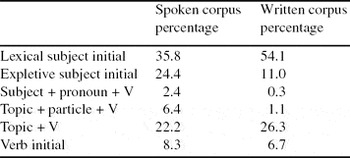
Table 1 shows that så-constructions and similar topic + particle constructions, as in (1d), make up 6.4% of main clause declaratives in the spoken corpus but only 1.1% in the written corpus. Although the number of subject-initial clauses is similar for the spoken and written corpus, 62.6% and 65.4%, respectively, interesting differences emerge when we break down these numbers.Footnote 2 In the spoken corpus, the Subject + pronoun constructions like the one in (1e) amount to 2.4% of all declaratives, while in the written data they occur in only 0.3% of declaratives. We also find differences in the frequency of clause-initial expletives. Whereas 24.4% of all declaratives were expletive-initial structures in the spoken data, the frequency dropped to 11% in the written data. This is interesting, but it will not concern us much here.
Spoken versus written corpus.

To sum up, topicalization of a non-subject is a little more frequent in spoken than written data (28.6% versus 27.4%), but in spoken discourse there is a much greater tendency to insert a particle between the topic and the finite verb.Footnote 3 We find the same tendency, although with lower frequency, for the pronoun occurring between the initial subject and the finite verb. This is clearly a spoken phenomenon almost completely absent from written discourse. Even though subject-initial clauses make up roughly two thirds of both spoken and written declarative main clauses, there is a much greater tendency to use expletive subjects clause-initially in spoken discourse. In written discourse, usually a full lexical subject is employed as the clause-initial element.Footnote 4
This paper is structured as follows. Section 2 presents the data for the two constructions at the center of our attention: the så-construction in Section 2.1 and the topic + pronoun construction in Section 2.2. In Section 3, I discuss the relevance of Wackernagel's observations for recent and more updated theories on sentence structure, clitics, and weak pronouns. Section 4 outlines some relevant recent theories on ‘the left periphery’ of the clause and discusses some theories on different types of clausal topics investigated in recent literature. In Sections 4.1, 4.2, and 4.3, I discuss the topics most relevant in analyzing the så-construction and the Copy Left Dislocation construction in Norwegian. Section 4.4 discusses some related phenomena and Section 5 sums up and concludes the paper.
2. THE SÅ-CONSTRUCTION AND THE TOPIC + PRONOUN CONSTRUCTION
2.1 The så-construction
The så-construction has received attention in the works of Østbø (1996), Ottesjö & Lindström (Reference Ottesjö and Lindström2006), Sollid & Eide (Reference Sollid and Eide2007a, Reference Sollid and Eideb), and Nordström (Reference Nordström2010). Ekerot (Reference Ekerot1988) is a Ph.D. dissertation devoted to the så-construction in Swedish, with a slightly broader scope; it mentions some older studies of the function word så, such as Elmquist (Reference Elmquist1945). In older descriptions, the use of så is often considered a stylistic problem, a feature of spoken language contaminating written texts. Although this is no longer the official view of linguists, teachers in Norwegian schools still find it time consuming but necessary to weed out most occurrences of så in student essays.
The function word så has many applications in contemporary Mainland Scandinavian: it is a temporal connective, a complementizer, a temporal adverbial, a degree adverbial, and in many Norwegian dialects also a relative complementizer corresponding to som in Standard Norwegian. There is also the så-construction in (2a–d), dubbed ‘adjunctive så’ in the Swedish literature, ‘resumptive så’ (Elmquist Reference Elmquist1945) and ‘pleonastic så’ (Åkermalm Reference Åkermalm1972).Footnote 5
(2)
One pertinent question is whether the fronted topic phrase (e.g. egentlig, nå, i byen, alle) is clause-internal or clause-external. If så is analyzed as a particle between a clause-internal topic and the finite verb, the relevant main clauses are non-V2 main clause declaratives. To avoid this unwanted state of affairs, linguists have analyzed the construction as a left dislocation structure. ‘Left dislocation’ is a construction where a topic is dislocated, i.e. placed outside the sentence proper, and repeated by some proform (pronoun, proadverb) clause-internally. On these analyses, så is considered a proadverb occupying the first clause-internal position, yielding a V2 declarative. Ekerot (Reference Ekerot1988:38) notes several reasons for not accepting the left dislocation analysis. His most convincing argument is that så in this construction is obviously non-referential, unlike the adverbial då (Swedish)/da (Norwegian) ‘then’, proadverbs that regularly occur in left dislocation. Thus, although så is often considered a proadverb, it has different referential properties. Secondly, as noted in Hyltenstam & Larson (Reference Hyltenstam and Larson1974:6), it is possible to have a left dislocation structure with da/då and så immediately following it, as in the Swedish example in (3a), from Ekerot (Reference Ekerot1988:38). The opposite sequence, however, is not possible: (3b) versus (3c) are Norwegian examples from Østbø (1996:7). Thorell (Reference Thorell1973:Sections 895–900) notes that there is no pause between the topic phrase and så, which is seemingly possible with other left dislocations. On a related note, Faarlund (Reference Faarlund1980:124) observes that since så is phonetically much lighter than other pro-words, it cannot be the initial word of a new clause, unlike da ‘then’; compare (3d) and (3e).
(3)
The presence of så in this construction is related to the grammatical expression of sentence modality. As noted by Ekerot (Reference Ekerot1988:22, quoting Teleman Reference Teleman1974; see example (4c)), and Faarlund, Lie & Vannebo (Reference Faarlund, Lie and Vannebo1997:817), interrogatives do not allow så in this function, even if it follows an adverbial.Footnote 6, Footnote 7 The examples in (4a, b) are taken from Østbø (1996:4), adapted from Faarlund et al. (Reference Faarlund, Lie and Vannebo1997).
(4)
Finally, the presence of så prevents an otherwise possible narrow construal of its topic; see Østbø (1996:5; quoting Ekerot Reference Ekerot1988).
(5)
The facts noted thus far point to så being a clause-internal particle, obligatorily phonetically light, unable to start a new clause, referentially deficient, related to sentence modality, forcing a wide scope of the topic, and causing non-V2 word order in declarative main clauses.
2.2 The topic + pronoun construction
This construction is sometimes discussed jointly with the så-construction, especially in descriptive works. Both are typically considered left dislocation. As mentioned earlier, however, there are seemingly crucial differences between the så-construction and left dislocation. Unlike så in the så-construction, the proforms in left dislocations are referential and may, but need not, receive stress. Since these proforms are both referential and phonetically more independent, they seemingly contrast with the så-construction; cf (6a) versus (6b, c).
(6)
According to Faarlund (Reference Faarlund1980:121), the constructions in (6b, c) should be separated from ‘proper’ left dislocation. In left dislocation (LD) proper, as in (7a–c), the dislocated topic has no prosodic autonomy, Faarlund says, and there is no pause between the topic and the proform immediately following it, unlike in (6b, c). The pronoun preceding mamma in this example (and in many later examples) is a proprial demonstrative occurring before names and kinship terms in many Norwegian dialects.Footnote 8
(7)
Vangsnes (Reference Vangsnes, Barbiers, Lekakou, van der Ham and Koeneman2008:18) claims that left dislocation in Norwegian ‘seems always to be accompanied [by] an intonation break’. The proposal in Grohmann (Reference Grohmann2000) may reconcile the two views on the intonation break in left dislocation constructions. Grohmann notes that in German there are two left dislocation structures with distinct properties: they may have identical word order, but differ with respect to the intonation break (#) following the left dislocated topic (Grohmann (Reference Grohmann2000:140) attributes this observation to Altmann Reference Altmann1981).Footnote 9
(8)
The structure in (8a) is a Copy Left Dislocation (CLD), like the examples in (7) above; (8b) is a Hanging Topic Left Dislocation (HTLD), corresponding to (6b, c) above. In German, these two constructions have differing case properties. In Norwegian, the difference between hanging topics (HT) and CLD may be harder to detect since we only have relicts of case distinctions in pronouns, and even these may be absent in spoken language. We will address the differences between hanging topics and CLDs in more detail in Sections 4 and 4.1 below; for now, we will simply follow Faarlund (Reference Faarlund1980) and Grohmann (Reference Grohmann2000) and use intonation breaks as a diagnostic: CLD has no intonation break and in HTLD the leftmost topic is followed by an intonation break.
The Copy Left Dislocation structure is thus quite similar to the så-construction: neither has an intonation break after the fronted phrase (hu mamma, kjøkkenet, hjemme in (7)), and both employ a phonologically light pronoun, or particle, i.e. a ‘copy’ after the topic, hu/det/der in (7a–c). Like the så-construction, CLD is related to sentence modality: it cannot embed under verbs other than bridge verbs (verbs of saying and believing taking complement clauses with main clause word order). Thus, none of the CLD constructions in (9b–d) can embed under (9a). The same is true for the så-construction in (9e) and any V2 clause with a fronted topic, even without the particle following; consider (9e) without så.
(9)
There is one important difference between (9b, c) and (9d, e); hu mamma and kjøkkenet are subjects, not fronted topics, and it should be possible to embed these structures, if the ‘copy’ pronoun is not related to sentence modality or topichood. If we remove the pronouns, the ‘copy’, in Grohmann's (Reference Grohmann2000) terms, the structures are fine as embedded clauses.Footnote 10
(10)
Faarlund (Reference Faarlund1980:122) notes that CLD structures do not allow an existential construal of the subject as a left dislocated topic. If this subject-topic is an indefinite noun phrase, the existential reading is impossible, whether the ‘copy’ pronoun is an agreeing masculine pronoun or a non-agreeing neuter. A generic subject, however, is quite OK in the same construction.
(11)
This unavailability of an existential reading of the subject may suggest that the left dislocated topic position adds an obligatory wide scope to the subject in CLD constructions, unlike the ordinary topic position. Compare this to (11a) without any of the pronouns, where the existential reading of the indefinite subject is perfectly possible. This restriction holds only for subjects; it is not true for topicalized objects or topicalized post-verbal associates of expletives in the same construction (Faarlund Reference Faarlund1980:122):
(12)
2.3 A brief summary of the så-construction and the CLD construction
From our investigation of the similarities between these two constructions we can conclude the following:
(i) There is an unstressed, weak pronoun or an unstressed particle-like element immediately following the fronted topic and immediately preceding the finite verb in the declarative main clause (the particle occurs in the second position).
(ii) The particle is seemingly related to sentence modality, probably the illocutionary force of assertion, since it is absent from this position in other clause types.
(iii) The particle imposes certain scope effects on the topicalized phrase.
(iv) The particle/pronoun seems structurally related to verb raising to the V2 position and semantically and structurally related to the Vorfeld (prefield) of the clause since it is not licensed in embedded clauses.
3. THE RELEVANCE OF WACKERNAGEL'S OBSERVATIONS
Based on several early Indo-European languages, Wackernagel (Reference Wackernagel1892) proposed that Proto-Indo-European had a specific position for clitics, the second position. This observation has been so significant that it has been referred to as a law. Watkins (Reference Watkins and Lunt1964:1036) says: ‘One of the few generally accepted syntactic statements about Indo-European is Wackernagel's Law, that enclitics originally occupied the second position of the sentence’ (quotation from Agbayani & Golston Reference Agbayani and Golston2010:1). More recent authors have objected to this. Ferraresi (Reference Ferraresi2005:126) says that
some light elements like pronouns, auxiliaries or particles tend to take the second position in main clauses: This generalization was first noted by Wackernagel in his seminal 1892 article; it has been known as Wackernagel's Law ever since. However, the syntactic position these elements take should rather be termed The Wackernagel Position, since his observation is not a law in the strict linguistic sense.Footnote 11
Although Wackernagel's ‘law’ may not be a linguistic law, the position it refers to is still dubbed the Wackernagel position, even outside of Indo-European languages (Agbayani & Golston Reference Agbayani and Golston2010:1). The significance of Wackernagel's observations is confirmed by Cardinaletti & Starke (Reference Cardinaletti, Starke, Thrainsson, Epstein and Peter1996:24), who note that ‘all the clitics we know of appear in one of two positions: adjacent to the verb, as the French le . . . or in what has been characterized as “the second position of the clause”, as the Slovak ho’. Note also, in the Ferraresi (Reference Ferraresi2005) passage quote above, that not only clitics but a range of other prosodically light elements, such as pronouns and particles, appear in the second position in main clauses. This will be relevant to our analysis.
Cardinaletti & Starke (Reference Cardinaletti, Starke, Thrainsson, Epstein and Peter1996, Reference Cardinaletti, Starke and Riemsdijk1999) offer what has become a rather influential analysis of pronouns cross-linguistically although their examples come mainly from European (Romance, Slavic and Germanic) languages. Firstly, the authors distinguish between strong pronouns and deficient ones. Strong pronouns appear in ordinary noun phrase positions, carry stress, and can be coordinated. Deficient pronouns cannot be coordinated or carry stress; also, they must appear in positions where ordinary noun phrases do not appear. Cardinaletti & Starke (Reference Cardinaletti, Starke, Thrainsson, Epstein and Peter1996:32) note that ‘[a] characteristic of deficient pronouns is their rigid placement: they cannot appear “outside” of their clause, e.g. topicalized or dislocated’. They also argue that there are two types of deficient pronouns (Cardinaletti & Starke Reference Cardinaletti, Starke, Thrainsson, Epstein and Peter1996:26):
Next to strong pronouns and clitic pronouns, there is another type of pronoun, in between clitic and strong, but reducible to neither. Following the terminology used to refer to clitic-like Germanic pronouns . . . we call this third class of pronouns ‘weak’ personal pronouns.
(13)
Discussing pronouns, Hellan & Platzack (Reference Hellan, Platzack and Riemsdijk1999:123) observe that ‘there is no recognized paradigm of clitic forms in the Scandinavian languages, and they are not represented in the standard written language’, whereas weak pronouns are morphologically identical to strong pronouns, clitics are not, although ‘most clitic forms can be seen as reduced versions of weak pronouns, such as Norwegian ‘n corresponding to han (sg.m subjective case)’. However, there are recognizable clitics different from the corresponding weak pronoun, e.g. Norwegian ‘a, corresponding to the strong and weak pronoun form hu(n) ‘she’ or henne ‘her’. Since the clitic ‘a is morphologically quite different from hu(n), it can be used to test if a structure requires or allows a clitic or a weak pronoun.
In CLD, the pronouns are weak pronouns, not clitics, as in (7a) above, repeated here as (7a’). The pronoun is the weak pronoun hu, not the clitic ‘a. The relevant pronouns are not strong since they cannot carry stress: adding stress to the pronoun gives rise to a different structure with a contrastive meaning absent from CLD (see Section 3.1).
(7)
Although the relevant pronouns are not clitics, they share with clitics a range of properties related to the status as ‘deficient pronouns’, one such property being prosodic lightness. Cross-linguistically, prosodic lightness tends to co-occur with a cluster of semantic, syntactic and pragmatic properties, thoroughly discussed in Cardinaletti & Starke (Reference Cardinaletti, Starke and Riemsdijk1999). Many of those properties hold not only for fully-fledged clitics, but also for weak pronouns. In Norwegian, for instance, weak pronouns are banned from certain positions where strong or stressed pronouns, with a distribution similar to full lexical DPs, may occur. This is easily illustrated by the main clause declarative with two adverbials in (14), where a weak pronoun (signaled by lower-case letters, de) is banned from the position between the two adverbials, a position available to full lexical DPs and strong pronouns (signaled by capitals, DE).
(14)
The syntactic distribution of weak pronouns is accompanied not only by prosodic traits (i.e. lightness), but also by semantic properties. Weak pronouns are subject to semantic restrictions. Being deficient pronouns, like clitics, they depend on a prominent discourse antecedent for interpretation; Cardinaletti & Starke (Reference Cardinaletti, Starke and Riemsdijk1999:158, 165):
Being referentially deficient, . . . deficient pronouns . . . cannot be interpreted without a (non-deficient) antecedent. . . . Deficient pronouns need a prominent discourse antecedent.
A strong pronoun, on the other hand, can be used contrastively or deictically: DE ‘they’ can be used while pointing to a group of people, unlike the weak pronoun de ‘they’. Cardinaletti & Starke (Reference Cardinaletti, Starke and Riemsdijk1999) call this use ostension and state that (op.cit 165)
The presence of a prominent discourse antecedent for a given pronoun is mostly incompatible with the use of contrastive stress and ostension on that pronoun, since the latter are devices to circumvent the absence of a prominent discourse antecedent.
The dependence of weak pronouns on a prominent discourse referent is confirmed by Sigurðsson (Reference Sigurðsson2011:276), who concludes that weak (subject) pronouns in Germanic are like null subjects (pro) in Italian: they are interpreted in relation to the closest topic of a particular kind (A-Topics, see more on this notion in Section 4). Hence, weak pronouns are dependent elements; they occur in particular positions, require a prominent topic antecedent for interpretation, and are prosodically deficient.
Benincà & Poletto (Reference Benincà, Poletto and Rizzi2004:56) warn against using prosody or intonation as reliable indicators of where an XP occurs in a clausal structure, but Frascarelli & Hinterhölzl (Reference Frascarelli, Hinterhölzl, Winkler and Schwabe2007) and Bianchi & Frascarelli (Reference Bianchi and Frascarelli2010) use intonation to (help) distinguish the topics residing in different parts of the left periphery of a clause; see Bianchi & Frascarelli (Reference Bianchi and Frascarelli2010:54):
Several prosodic studies . . . have distinguished different types of topics, although few attempts have been made to connect intonational properties to syntactic structures. In this respect, Frascarelli and Hinterhölzl (Reference Frascarelli, Hinterhölzl, Winkler and Schwabe2007) first showed that there is a systematic correlation between the formal properties of topics and their function in the discourse, which is encoded in a strict hierarchy in the C-domain (contra a free recursion analysis of Top[ic] Projections, cf. Rizzi Reference Rizzi and Liliane1997). They thus provide intonational and syntactic evidence that different types of TopP projections must be posited in the left periphery of the sentence.
There is a long tradition of using stress patterns and prosodic information in generative syntax to argue for analyses of underlying syntactic structure. Since Travis (Reference Travis1984), clause-initial weak pronouns have been used to argue for a specific syntactic clausal structure in Germanic subject-initial sentences, which is believed to differ from clauses where the initial phrase is a non-subject topic. Several studies suggest that children make extensive use of stress patterns to identify clausal structure, e.g. in separating functional elements and their positions from lexical elements and their associated positions. Powers (Reference Powers, Corver and Van Riemsdijk2001:118–120), quoting Morgan, Shi & Allopenna (Reference Morgan, Shi, Allopenna, Morgan and Demuth1996) argues that constellations of overlapping (including prosodic) cues available in the input may assist the child to distinguish closed-class (functional) items from open-class (lexical) items in the second half of their first year of life:
Function words are ‘minimal’ in a number of ways. First, there is a negative correlation between frequency and length, as the most frequent elements (function words) are typically the shortest words. Secondly, since function words constitute a closed class, they are easily recoverable. . .and predictable from surrounding context. Third, functional elements ‘carry light informational loads’ compared to lexical elements. These properties. . .show that this sensitivity to a set of perceptual cues . . . allows the child to differentiate closed-class elements from open-class elements. . . . Functional items have additional properties: They are often reduced.
Prosodic information was the basis for Wackernagel's original phonetic proposal about the properties of the second position. If children use prosody and the possibility for contrastive stress in constructing the clausal structure of their native language, and if the Wackernagel position is associated with weak, unstressed pronouns and particles, the particle så, and weak pronouns (such as the ones occurring between the fronted topic phrase and the finite verb of CLDs) are just the right type of elements to occur in the second position of the main clause. Recall also that the constructions we are discussing here are typically spoken phenomena (see Section 1 above and the discussion of Table 1), making the potential importance of prosody and stress patterns more likely.
4. TYPES OF TOPICS
Originally Wackernagel position referred to one position, the second word of the clause. But ‘recent discussion by syntacticians has simply assumed (often even citing Wackernagel Reference Wackernagel1892!) that the relevant second position is “after the first constituent”’ (Anderson Reference Anderson1993:72). Over time, Wackernagel position came to refer to positions lower in the clause, or a range of positions; e.g. Dimitrova-Vulchanova & Hellan (Reference Dimitrova-Vulchanova, Hellan and Riemsdijk1999:469) discuss Bulgarian ‘pronominal clitics which occur in positions associated with the area commonly called the “Wackernagel position”’ [emphasis added – KME].
This relaxation of the Wackernagel position is accompanied by a theoretical trend in syntactic theory to divide each domain of the clause (CP, IP and VP) into a range of positions and projections, each associated with specific syntactic and semantic properties. Rizzi (Reference Rizzi and Liliane1997) is the ground-breaking work on ‘Split-CP’ theory, advocating that what used to be seen as one projection, CP, allowing at most one constituent to the left of the finite verb in V2 languages is divided into several projections. This split is motivated by the fact that many languages allow for more than one constituent to be fronted to the initial domain of the clause. The fronted constituents show specific discourse-relevant properties in a strict relative hierarchical ordering:
(15) Force > (Topic) > (Focus) > (Topic) > Finiteness
Rizzi (Reference Rizzi and Liliane1997:325) concludes that ‘[t]he complementizer system minimally consists of a specification of force, accessible to higher selection, and a specification of finiteness, selecting a finite (or non-finite) IP’. ForceP and Fin(iteness)P are thus obligatorily present in main clauses and embedded clauses; TopP and Foc(us)P are present only on demand. ForceP is related to the illocutionary force of the clause and the topic projections are associated with (fronted) topics, the focus projection allows for special focalized elements; all scoping over the finiteness projection which in turn selects a finite or non-finite IP.
Since Rizzi (Reference Rizzi and Liliane1997), there has been consensus on more than one projection in what used to be the unique complementizer projection CP. However, the discussion on what projections exist, their relative placement, number, and specific discourse function continues. Benincà & Poletto (Reference Benincà, Poletto and Rizzi2004) discuss the types of topics that occupy the projections of the CP domain. They reject Rizzi's assumption that there is a domain below Focus accessible to topics (see (15) above); this domain, they say, is simply an extension of the Focus domain. Thus, topics always occur higher than Focus. Next, and more relevant to the constructions presently under discussion, the authors distinguish between different topics, separating Hanging Topics HT(LD) from Left Dislocation (C)LD, which ‘differ for a number of syntactic properties’. Hanging Topics travel alone: ‘only a single HT position per clause is available’ (op. cit. 64). When a Hanging Topic (in HTLD) and a Left Dislocation (in CLD) co-occur, the order is fixed, and it is always HTLD–CLD. Grohmann (Reference Grohmann2000:145) also notes for Germanic that it is possible to have a HTLD followed by a CLD, whereas the opposite is not possible: ‘the two may co-occur, but only if the hanging topic precedes the CLD’. According to Grohmann (Reference Grohmann2000:145), Hanging Topics, i.e. HTLDs, cannot be embedded even under bridge verbs (verbs of saying and believing that take complement clauses with main-clause word orders, such as the English verbs say and believe, for example). This, he says, is in contrast to CLDs which may be embedded under bridge verbs. Benincà & Poletto (Reference Benincà, Poletto and Rizzi2004:66) also address the possibility of a specific position for scene-setting adverb(ial)s in a split CP:
Scene Setting adverbials also occupy a very high position, probably located immediately lower than HT(LD) but still higher than (C)LD . . . In a split CP perspective we can hypothesize that embedded V2 never has a position for Scene Setting, which is only available in root contexts.
Scene-setting adverbials are also confined to root contexts, ‘the root restriction’, which has been claimed to hold for left dislocation and topicalization as well. Bianchi & Frascarelli (Reference Bianchi and Frascarelli2010) address this in a recent paper, entitled ‘Is topic a root phenomenon?’. The answer is ‘yes, partially’. On closer inspection, various topics behave differently relative to the root restriction. It turns out to be a misconception and a ‘prejudice that topic is a unique category, and thus susceptible of a single analysis’ (op. cit. 54). Bianchi & Frascarelli identify three relevant types of topic (in addition to Hanging Topics; HTLD, which they mention only in passing):
- (16)
a. Aboutness-shift topics (A-Topics)
b. Contrastive topics (C-Topics)
c. Given topics (G-Topics)
This list of topic types is reminiscent of Speyer's (Reference Speyer2007, Reference Speyer, Benz and Kühnlein2008, Reference Speyer2009, Reference Speyer, Tanskanen, Helasvuo, Johansson and Raitaniemi2010) partitioning of topics. Speyer investigates large corpora of German to find out what type of discourse material is likely to fill the Vorfeld (the prefield), the preverbal phrase position in V2 declaratives. Counter to his expectations to find mostly discourse-old information in this position, Speyer found that the preferred prefield-fillers in German are most likely to be hearer-new information:
Referential phrases of the following three types are eligible for the Vorfeld: Scene-setting elements, contrastive elements and topics. . .these types seem to be ranked: Scene-setting elements are the most likely to appear in the Vorfeld, followed by contrastive elements and finally by topics. (Speyer Reference Speyer, Benz and Kühnlein2008:267)Footnote 12
Note that Speyer defines topic as a piece of discourse-old information that represents the entity the utterance is about; this term seems to be similar in meaning to G(iven)-Topics, and scene-setting elements may seemingly subsume Benincà & Poletto's scene-setting adverbials and Bianchi & Frascarelli's (Reference Bianchi and Frascarelli2010) A-Topics.
Bianchi & Frascarelli (Reference Bianchi and Frascarelli2010:59) quote Frascarelli & Hinterhölzl (Reference Frascarelli, Hinterhölzl, Winkler and Schwabe2007) in saying that the three topics they study, A-Topics, C-Topics and G-Topics, occur in a natural hierarchical order in natural language:
The analysis of naturalistic data shows that different types of topics are realized in a specific order in the C-domain. Accordingly, a topic hierarchy is provided in Frascarelli and Hinterhölzl (Reference Frascarelli, Hinterhölzl, Winkler and Schwabe2007) . . .:
[(17)] [ShiftP A-Topic [ContrP C-Topic [FocP [FamP G-Topic [FinP [IP
As we can see, the A-Topic is realized in the highest TopP projection of the left periphery, while G-Topics are located in the lowest TopP position (lower than focused elements); as a consequence, in multiple topic constructions G-Topics are always preceded by either A- or C-Topics.
According to Bianchi & Frascarelli (Reference Bianchi and Frascarelli2010), not all languages have all types of topic positions; for instance, G-Topics, understood as occupying a designated position in the left periphery of the clause, are said to be absent in English (op. cit. 64). Also, some topics may be recursive (G-Topics) whereas others are unique per clause (C-Topics and A-Topics). C-Topics induce alternatives in the discourse, creating oppositional pairs (e.g. as an answer to Why did you study French and English? French I studied because I liked it). G-Topics are a ‘given constituent’, a topic that ‘corefers with a salient antecedent’ (op. cit. 58). A-Topics are inherently associated with a shift in the conversation ‘to newly propose or reintroduce a topic in the discourse’ (op. cit. 54). According to Bianchi & Frascarelli, only A-Topics are subject to the root restriction. A related fact is that there can be at most one A-Topic per clause. The authors also emphasize that ‘the A-Topic is not merely an aboutness topic, but an aboutness shift’ (op. cit. 78).
4.1 Norwegian HTLD, CLD and the så-construction
In Section 2.2 above, a possible intonation break between the leftmost topic and the rest of the clause was used to separate Hanging Topics; HTLD (intonation break after the leftmost topic) from Copy Left Dislocation CLD (no intonation break after the leftmost topic). In Norwegian, it is also possible to use a response particle such as ja ‘yes’ as a reliable indicator of a Hanging Topic (thanks to one of the anonymous reviewers for pointing this out). Unlike CLDs, an HTLD accepts a response particle immediately following it. Since there is no morphological difference between the phrases that may function as the topic in HTLDs and CLDs, and since they are both capable of stress, we can only see this difference clearly in instances where the HTLD is followed by an CLD. Note that the response particle follows the HTLD and cannot be repeated after the CLD-Topic. Recall that there is no intonation break before the ‘copy’ (the second pronoun) in the CLD.
(18)
In the CLD, the ‘copy’ can repeat either a full lexical DP (hu Marit) or a strong pronoun (HU). If the CLD contains a pronoun–pronoun pair, the sequence is always strong-pronoun– weak-pronoun. In some dialects in eastern Norway, a difference between hu(n) and henne(r) is maintained as a strong and weak version of the same pronoun (unrelated to case distinctions). There is thus no case distinction between the two pronouns in (19), but the forms clearly reveal the stress pattern of the CLD construction. The strong pronoun is first in the sequence and the light one follows, as noted by Faarlund (Reference Faarlund1980). Leaving out either pronoun still yields a grammatical structure although the construction is no longer a CLD. Each pronoun is thus non-obligatory, but if both are present, the strong one must come first.
(19)
Footnote 12 As seen in (18a) and (19a), a strong pronoun may be followed by a weak pronoun copy. The data in (18) also show that a full DP phrase may serve as the HTLD, followed by a strong-pronoun–weak-pronoun sequence, or a strong pronoun may be the HTLD followed by a full DP–weak-pronoun sequence. The example in (19b) suggests that a weak pronoun cannot have a strong pronoun as its copy. It also seems reasonable to suggest that a weak pronoun cannot be the copy of another weak pronoun, according to the generalization in Cardinaletti & Starke (Reference Cardinaletti, Starke and Riemsdijk1999:158) that ‘being referentially deficient, deficient pronouns cannot be interpreted without a (non-deficient) antecedent’. If this is correct, weak pronouns cannot serve as the topic part of a CLD or as an HTLD (see (19b)). Zwart (Reference Zwart1991:90) noted a similar generalization for the corresponding CLD constructions in Dutch, in (20): ‘[s]ubject initial sentences with flat intonation cannot host a d-word (i.e. a copy); topics must be stressed’ (the data quoted are from Weerman Reference Weerman1989:58).
(20)
The assumption that topics must be stressed is also crucial to the analysis of Travis (Reference Travis1984), who observed that es ‘it’ as a fronted object is ungrammatical in German, as is shown in (21a). She concluded that weak pronouns cannot appear as topics. Since weak subject pronouns may appear in the first position of subject-initial clauses, the weak pronoun subject in clauses like (21b) does not occupy the topic position (the data are quoted from Branigan Reference Branigan1996:53).
(21)
Thus, weak pronouns are typically not topics, but may repeat topics and refer to topics; topics are stressed, and need to be stressed, to license a CLD-copy (according to Zwart Reference Zwart1991).
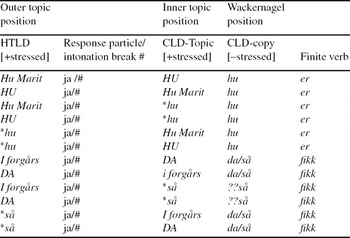
Let us consider these generalizations along with the relevant generalizations for the så-constructions as presented in Table 2. The table should be read as follows. Instead of the prescribed single position to the left of the finite verb in main clause declaratives, the table allows for a maximum of four positions to the left of the finite verb. The leftmost position of the table is the place for the Hanging Topic, HTLD, which may, but crucially, need not, be separated from the rest of the clause by a response particle, e.g. ja ‘yes’, which I have placed in the slot immediately to the right of the HTLD. An intonation break (#) is also possible here, instead of, or in addition to, the response particle. The position to the right of the response particle slot is the space designated for the CLD-Topic, optionally followed by a copy, i.e. a weak pronoun or the particle så, which occupies the position to the immediate left of the finite verb. This is thus the Wackernagel position, hosting prosodically light and obligatorily unstressed elements. Note that the proadverb da ‘then’, which sometimes co-occurs with så in the så-construction, can be stressed or unstressed, just like pronouns, and it may occupy the Wackernagel position (in its unstressed version) or the CLD-Topic position (in its stressed version). We signal stress distinctions in the table by lower case letters for the unstressed version and capitals for the stressed version of the proadverb; we follow the same rule for stressed and unstressed pronouns. The particle så, however, can never carry stress (see Section 2.1 above), and is thus banned from the CLD-Topic position, but occurs in the Wackernagel position.
Topic positions, relative placement, and stress.

HTLD = Hanging Topic Left Dislocation; CLD = Copy Left Dislocation.
The table only sums up what we already know: weak pronouns, just like så, cannot carry stress, so we never find them as an HTLD or as a CLD Topic, since both require stress. The generalizations expressed in this table also subsume the grammatical sequence da-så and the ungrammatical sequence *så-da in the så-construction in (3b, c) (repeated as (22a, b) below) and the fact that we never find two occurrences of så (see (22c)). Whereas the proadverb da, like pronouns, has a strong (stressed) and a weak (unstressed) version, allowing for double occurrences in CLDs (22d), så has no unstressed version and can never act as a topic, neither a HTLD-Topic nor a CLD-Topic; it can never be anything but a CLD ‘copy’. Recall that så cannot easily be the ‘copy’ of a Hanging Topic either, according to Faarlund's (Reference Faarlund1980:124) example in (22e).Footnote 14
(22)
Østbø (1996) analyzes the så-construction in a split-CP framework. She proposes the structure in (23) to account for Hanging Topics followed by a så-construction, Left dislocation with så. This is the analysis for examples like (22a).
(23)
Østbø thus analyzes the Hanging Topic as part of the CP (since all projections of ForceP are also part of CP), as adjoined on top of the ForceP projection. There is some evidence, however, that HTLD is outside the CP in Norwegian, unlike CLDs, which seemingly belong to the C-domain. Sigurðsson (Reference Sigurðsson2011) discusses how null arguments, such as Germanic zero topics, are derived and licensed. He shows that the successful licensing of such arguments takes place in accordance with the C/Edge-Linking Generalization (op. cit. 299):
C/Edge-Linking Generalization
Any definite argument, overt or silent, positively matches at least one CLn in its local C-domain, CLn ∈ {ΛA, ΛP, Top, . . .}.
{ΛA, ΛP, Top} includes Top(ic) features and speech participant features (‘speaker’, ‘hearer’) see op.cit. 269; silent arguments, like other arguments, must be locally matched (inside the closest CP) against these features to be licensed. Note that there is a difference between the HTLD in (24a) and the CLD in (24b) as the HTLD obviously does not interfere with the C-Linking of the null argument (most likely denoting ‘speaker’) in (24a), but the CLD prevents a successful licensing in (24b). The same is true for the så-construction in (24c).
(24)
We will analyze the Hanging Topic, not as part of the CP, but as a sentence fragment outside of the clausal structure proper, whereas CLDs are evidently part of the CP-domain in Norwegian.
4.2 CLD and the så-construction as A-Topic constructions
Nordström (Reference Nordström2010) notes that the så-construction blocks the topicalization of any other constituent in the clause, which leads her to analyze the construction as a Topic Phrase. We note here that the CLD construction is parallel: it blocks the promotion of any other constituent to the topic position.
(25)
Unlike Italian, for instance, which allows recursive topics, Mainland Scandinavian languages seemingly allow only one CP-internal topic-projection to the left of the finite verb. The data in (25) thus support an analysis of CLDs and så-constructions as Topic Phrases; A-Topics seem to be most relevant to our discussion. If we analyze CLD Topics and the topic in så-constructions as A-Topics, and the ‘copy’ in CLDs and the particle så as markers of A-Topics, we are one step closer to an explanation as to why these constructions are subject to the root restriction, just like Bianchi & Frascarelli (Reference Bianchi and Frascarelli2010) propose for A-Topics. Whatever explains the root restriction of A-Topics can account for the root restriction of CLD and the så-construction. There is evidence to suggest that this may be a plausible analysis.
Recall that, according to Bianchi & Frascarelli (Reference Bianchi and Frascarelli2010:54), ‘the specificity of . . . A-Topic is to newly propose or reintroduce a topic in the discourse’. Nordström (Reference Nordström2010) makes similar observations about the så-construction. Following Sollid & Eide (Reference Sollid and Eide2007a:21), Nordström (Reference Nordström2010:54f.) analyzes the particle så as a ‘new-topic’ marker, specifically as a relational predicate associated with topic-features and introducing a new topic. It signals a ‘new point of departure’ (Nordström Reference Nordström2010:59). A randomly chosen Norwegian text from a blog about computer games used in schools may serve to illustrate this point.
(26)
‘Hello Knut and thanks for commenting. To answer your latter question first, I have stated many times that I am not a pedagogue, so what I write must also be evaluated in that light. Do I teach? Well, I often teach for pedagogues, but as for pupils, I would have to say ‘no’. On the other hand, I spend a lot of times in schools and I talk to pedagogues a lot, so I build on their experience in what I write and what I mean. When it comes to the question of games, I do not mean that one should play just to play . . .’
This short sequence illustrates the typical use of the så-construction. The construction is used three times in this sequence (the two other occurrences of så in other constructions, where så can be paraphrased as ‘therefore’). Each time, the discourse function is to introduce a topic or to shift the topic from what one is talking about to some new matter. The first så introduces the first topic, ‘to answer to the latter comment’ from Knut. The second instance shifts the topic from ‘teaching pupils’ to ‘on the other hand’; and the third topic shift is from experience and writing situations to ‘the question of games’. Each time, to use Nordström's (Reference Nordström2010:37) words, the effect is to create ‘a new point of departure’.
Faarlund et al. (Reference Faarlund, Lie and Vannebo1997:907f.) describe the CLD structure similarly. They claim that CLD has a special communicative discourse function: a referent mentioned earlier in a discourse can be refocused and commented on with this structure. Typically, this construction is used when the discourse referent is no longer the focus of the conversation because of the continued conversation (or because of other aspects of the situation). If we are talking about Kari and her brother Ola, and we go on to talk about Kari only, we can continue the discourse with a CLD bringing Ola in once more or reintroducing the discourse topic Ola, see (27) (Faarlund et al.'s data and acceptability judgments, my translation).
(27)
The use of a CLD is rather unnatural in this context, according to Faarlund et al. (Reference Faarlund, Lie and Vannebo1997:907f.), since if we are already talking about Kari, the pronoun seems redundant.Footnote 15 The så-construction and the CLD construction thus share a discourse feature similar to A-Topics, to ‘newly propose or reintroduce a topic in the discourse’ (Bianchi & Frascarelli Reference Bianchi and Frascarelli2010:54).
4.3 Placement of A-Topics: Inside or outside the CP?
Østbø (1996) analyzes the så-construction as a ForceP (where så instantiates the head of the ForceP), a ForceP that seemingly has topic features, reflected in the label ForceP/TopP.
(28)
Østbø's (Reference Østbø2006) analysis (with a few auxiliary assumptions about the specification of ForceP/TopP as ASSERTION) accounts for the fact that så-constructions are subject to the root restriction, are linked to declaratives (hence to assertion), are not embedded (under non-bridge verbs), and that så looks like a syntactic head. We might simply take Østbø's analysis of så-constructions and apply it to CLDs with the refinement that Østbø's hybrid label ForceP/TopP is replaced with a ForceP/A-TopP label. Recall that Bianchi & Frascarelli (Reference Bianchi and Frascarelli2010:59) posit A-Topics as the highest in the hierarchy of topics in the clausal structure, as in (17) above, and Rizzi (Reference Rizzi and Liliane1997), whose split-CP they adopt, assumes that the highest head of the CP system is Force; the highest projection is ForceP. Bianchi & Frascarelli (Reference Bianchi and Frascarelli2010:75f.), however, are reluctant to identify the expression of assertion with the Force head:
Notice that the assertion operator cannot be identified with the Force head proposed by Rizzi (Reference Rizzi and Liliane1997 and subsequent work), which is assumed to occur also in embedded clauses that lack illocutive force.
They go on to quote Haegeman (2009), who distinguishes the Force head proper from a sub(ordination) head. Haegeman (Reference Haegeman2010:631), discussing her previous accounts, notes that
two heads were distinguished: ‘Sub’ and ‘Force’. . . . Subordinating conjunctions are merged in ‘Sub’; ‘Sub’ subordinates the clause, ‘makes it available for (categorial) selection independently of its force’ (cf. Rizzi Reference Rizzi and Liliane1997:note 6). ‘Force’ was a separate head hosting the feature for ‘illocutionary force’ and which types the clause in terms of assertion, question, imperative, etc.
Thus, Force may not be the relevant head, and Force may not be the highest head of the CP. Bianchi & Frascarelli (Reference Bianchi and Frascarelli2010:77f.) suggest adopting Krifka's (Reference Krifka2001:25–26) analysis that the selection of an A-Topic constitutes a speech act on its own, conjoined to the speech act expressed by the following sentence:
Topic selection is a speech act in itself, an initiating speech act that requires a subsequent speech act like an assertion, question, command, or curse about the entity that was selected. (Krifka Reference Krifka2001:25)
This hypothesis requires a modification of Frascarelli & Hinterhölzl's (Reference Frascarelli, Hinterhölzl, Winkler and Schwabe2007) topic hierarchy, as Bianchi & Frascarelli (Reference Bianchi and Frascarelli2010:78) note: ‘[a]s independent speech acts, A-Topics cannot belong in the left periphery of the clause’. Instead, the authors propose an analysis that is ‘an implementation speech act conjunction, equivalent to the consecutive performance of the two speech acts (see Krifka Reference Krifka2001:44)’, Bianchi & Frascarelli (Reference Bianchi and Frascarelli2010:78). This analysis also accounts for the root restriction: ‘the A-Topic is merged in the structure as an independent speech act, and it can only be conjoined to a root(-like) clause implementing another speech act’ (op. cit. 78). According to this proposal, A-Topics are not part of the C-domain of the clause.
Recall from (24), however, that there is evidence suggesting that CLDs and så-constructions, unlike Hanging Topics, are in fact part of the C-domain in Norwegian. Bianchi & Frascarelli admit the possibility (for G-Topics) that not all languages employ the same set of designated topic positions. The theory ought to allow for a modification so A-Topics may be attached to the following clause in different ways in different languages. The authors are also not very categorical about their Krifka-inspired analysis and mention possibly retaining their earlier analysis of the ‘A-Topic as part of the C-domain of the clause’ (op. cit. 79).
The data in (24) suggest that CLDs and så-constructions are part of the C-domain in Norwegian. These constructions are associated with root clauses, specifically declaratives. However, så-constructions (although not CLDs) may occur even in imperatives (see Note 7):
(29)
To accommodate data like (29), and assuming that the bracketed part of (29) may by itself constitute an imperative, our analysis should reflect that at least så may take a fully-fledged ForceP as its complement. Thus, I tentatively propose an analysis that is a hybrid of Østbø's (1996) and Bianchi's & Frascarelli's (Reference Bianchi and Frascarelli2010). There is a CP-internal projection specifically designated for topic-shift accommodating A-Topics and taking ForceP, necessarily specified as non-interrogative, as its complement. The particle så and the relevant weak pronouns are base-generated as heads of this projection, and their specifier may be filled with material raised from the specifier of ForceP.
(30)
It might seem odd to assume that weak pronouns are heads since they may fill argument positions and hence must be assumed to be phrases.Footnote 16 However, the distinction between heads and phrases is nullified in some contexts. Since Chomsky (Reference Chomsky and Webelhuth1995), this question is no longer crucial in generative theory; in fact, Chomsky uses clitics specifically as an example of elements that may be both phrase-like and head-like (op. cit. 402f.).
[A]n item can be both an X° and an XP. . . . Under the DP hypothesis, clitics are Ds. Assume further that a clitic raises from its theta position and attaches to an inflectional head. In this theta-position, the clitic is an XP; attachment to a head requires that it be an X°. . . . Clitics appear to share XP and X° properties.
Although weak pronouns are not clitics, they share with clitics the relevant properties, i.e. the appearance in argument positions and the possibility of attaching to a head. Just like clitics, weak pronouns in Mainland Scandinavian may even cluster and attach to a head as such a cluster, see (31).
(31)
4.4 Related issues
Although there are many similarities between så-constructions and CLDs, there are also differences. One such difference is the ability to occur in imperatives. Whereas så-constructions are possible in imperatives, CLDs are not.
(32)
This cannot be related to the argument–adverbial difference since even adverbial CLDs are impossible in imperatives (see (32c)). Secondly, unlike ordinary topicalization structures, så-constructions are clause-bound, whereas CLDs are not necessarily so, compare (33a–f).
(33)
The ordinary topicalization structure allows for the matrix and the embedded reading of the adverbial; the så-construction disallows the embedded reading. The matrix reading is also the natural reading of (33e), but the embedded reading comes easier if the proadverb is stressed, as in (33f). In that case, we have an HTLD (the copy of CLDs cannot be stressed). The differences between så-constructions and CLDs illustrated in (32) and (33) may call for separate analyses of CLDs and så-constructions. If the topics in så-constructions are not A-Topics, another possible analysis of them would be as scene-setting adverbials, as discussed in the beginning of Section 4. Speyer (Reference Speyer, Benz and Kühnlein2008:281f.) notes about scene-setting adverbials that ‘[i]t is conceivable that only specifications of the matrix situation show this strong tendency to appear in the vorfeld’ and that one might want to include in this group of elements ‘all adverbials of a “with respect to X’ sense”’. Since the analysis in (30) is designed to accommodate examples like (32), with a så-construction and an imperative, singling out så-constructions as separate would allow us to employ a simpler structure for CLDs, where the structure in (30) is reduced to a ForceP with a hybrid ForceP-A-Topic label.
(34)
A third difference between så-constructions and CLDs is that even though weak pronouns, weak proadverbs and så are all phonetically light, weak pronouns and proadverbs may be the first element of a declarative, but the så in så-constructions can never be the initial element of a declarative.
(35)
Although så-constructions and CLDs share many properties, weak pronouns and proadverbs may refer to a discourse topic in a way that så may not. A possible account for this difference may take as a point of departure that weak pronouns and proadverbs, unlike så, may have an additional function as G(iven)-Topics when they are the initial element of the clause. Recall that G-Topics are characterized as a ‘given constituent’; such a topic ‘corefers with a salient antecedent’ (Bianchi & Frascarelli Reference Bianchi and Frascarelli2010:58).
Some data suggest that the subject (pronoun) may always be accessible as a type of topic, as long as it has a certain referentiality; see the data from Boeckx & Grohmann (Reference Boeckx, Grohmann and Abraham2005) attributed to Marit Julien (p. c.):
(36)
The subject is accessible as the antecedent of a right dislocation even if it is not fronted (36c). The direct object, on the other hand, is only accessible as a right dislocation antecedent if it is a fronted topic; compare (36b) to (36d). However, note that even the subject is not accessible as a right dislocation antecedent if it is an existential subject, unlike a generic subject (compare to (36c)).
(37)
This is reminiscent of the data in (11) above, where it was shown that an existential subject cannot occur in a CLD either, unlike a generic subject.
(38)
One might assume that the reason for the ungrammaticality of (37a) and (38a) is that there is no appropriate pronoun to refer to an existential subject. However, it is perfectly possible to refer to an existential object or a postverbal existential associate of an expletive by means of the neuter pronoun det ‘it’, even if the DPs in question denote human entities:
(39)
There seem to be pronouns available to refer to indefinite DPs denoting existential human referents. Instead the patterns in (35)–(38) seem to be related to the possibility of topichood. We find similar restrictions cross-linguistically in other Left Dislocation constructions: the Clitic Left Dislocation structure discussed in Ferraresi (Reference Ferraresi2005:132f.) only allows definite or specific indefinite noun phrases as dislocated constituents. In Italian, existential indefinites cannot be left dislocated; constructions corresponding to (39) would also be unacceptable in Italian.
Although there are several intriguing questions remaining and many interesting differences between så-constructions and CLDs, there are also many similarities. Occam's razor suggests that we should propose a single analysis for these constructions if possible, even though they differ in some respects.
5. SUMMARY
In this paper, I examined declaratives that can be construed as non-V2, specifically two constructions that have traditionally been analyzed as left dislocation phenomena: the (adjcuntive) så-construction and the Copy Left Dislocation (CLD) construction, where the ‘copy’ is a weak pronoun. I used Sigurðsson's (Reference Sigurðsson2011) theory to argue that CLDs are part of the CP-domain, unlike Hanging Topics; HTLD, which resemble CLDs in many respects. I also applied a modified version of Østbø's (1996) analysis of så-constructions to illustrate the structure of så-constructions and CLDs. These two constructions share an affinity to root clauses, have particular scope effects, and employ a prosodically light particle between the topicalized phrase and the finite verb in V2 (så and a weak pronoun, respectively). I attributed these properties to the status of the relevant particles as markers of A-Topics. A-Topics signal a topic-shift in the conversation and are confined to clauses with illocutionary force (Bianchi & Frascarelli Reference Bianchi and Frascarelli2010). The aforementioned particles are much more frequent in spoken than in written contexts, and I suggested that this is because they depend on prosody. They are obligatorily phonetically light and occur in the part of the clause traditionally described as ‘the Wackernagel position’.
Wackernagel (Reference Wackernagel1892) proposed that certain prosodically light elements (clitics in particular) tend to occur in the second position in (Proto-)Indo-European languages. Although the resumptive elements of the så-construction and especially of CLDs are perhaps not fully fledged clitics, they share with clitics the affinity to the second position of declaratives. Thus, I argued that ‘Wackernagel's law’ is relevant to analyze these constructions, even though Mainland Scandinavian is usually not considered to employ clitics relevant for the Wackernagel position. On this construal of Wackernagel's law and on this analysis of the relevant constructions, the investigation thus illustrates the generalization known from other Indo-European languages that not only clitics but even weak pronouns and other types of particles may occupy the Wackernagel position. A rather innovative aspect of the analysis is the claim that particles serving as topic-markers may occupy the Wackernagel position at least in Mainland Scandinavian; which opens up the possibility that this position may be used for the same purpose even in other languages employing the Wackernagel position.
ACKNOWLEDGEMENTS
I want to thank the three anonymous reviewers, whose excellent comments, astute empirical observations and theoretical suggestions made me rethink and rewrite what was essentially an incoherent collection of ideas, examples and notes into something resembling a scientific paper. I also want to thank the editors, Camilla Wide and Pål Kristian Eriksen, for their patience, encouragement and support.